Search This Blog

Thursday, September 3, 2020

Every Day, Something New to Learn


 My son and I were talking on the phone one recent morning and saying how little alcohol either of us consumes, now that we are so – ahem! – let us say, mature. I tell him one beer does it for me. We went on to talk about wine, and I said red is supposed to be good for you, but he said he prefers white, since it doesn’t all the -- . We both paused, searching for the word he wanted.

“Tannins,” I said confidently. 


“No, it’s – congeners,” he said, pleased to retrieve a word that his mother had never heard or seen before in her life. 


In the context of wine, congeners are produced during fermentation, that is, “born with” the alcohol produced. In a more general definition, any pair of things belonging to a set by reason of resemblance or action can be called congeners. So I learned something new but will leave you on your own to search out whether or not tannins or congeners or both or neither cause headaches (white wine is lower in tannins) and whether or not white wine as good for you as red is supposed to be, because I’m not taking sides on any of this! 


Later the same morning, when a pair of my favorite local customer friends showed up at my bookstore, Walt told me he was pretty sure that Suzette Haden Elgin, whose verbal self-defense books I’d mentioned in a recent blog post, had also written science fiction. Really? I had no idea but looked her up online and found out that the linguist and science fiction author were indeed one and the same person. Astonishing! 


I’m giving you the Wikipedia site address but with at least one caution: What does it mean to credit SHE with having written the “dead skunk song”? Loudon Wainwright’s dead skunk song? Some other dead skunk song? Explain yourselves, Wikipedia!


I was sorry to learn that Elgin died in 2015, because that means it’s too late to write and thank her for all her wonderful work. Not being a sci-fi reader, I have only read the books on language but am now keen to read her novel of feminist speculative fiction, Native Tongue, for which the author invented a new language she called Láadan, well prepared for the task by having written two doctoral dissertations, one on the English language and the other on the Navajo language. When philosopher Henri Bergson did his graduate work in Paris, there was a two-dissertation requirement, one to be written in French, the other in either Greek or Latin. I wonder if she wrote her second dissertation in Navajo.... 


Native Tongue, I see now, is the first in a trilogy. Well, I’ll start with that and see how it goes. Elgin also founded the Science Fiction Poetry Association, it turns out, and was dedicated, through her Ozark Center for Language Studies, to reducing violence. And if you follow this link, you can see her photograph -- and doesn’t she look like a lovely person? I am very pleased to have learned so much more about her. Thank you, Walt!


P.S. For today’s postscript, I’m going to shed all modesty and share a compliment I received last week. The young man and woman were serious browsers, quietly discovering and showing each other various books, but finally he said to me directly, “Your bookstore is amazing!” A welcome compliment! When I asked where they were from, and they said “Brooklyn,” and I asked “New York?” and they said “Yes,” he added, “This place?” And he gave thumbs up as he said, “New York quality!” Then I’m sure I blushed! I know I laughed with joy. And yes, they bought books, too, a true sign of appreciation!


My curated book collection, David’s beautiful original art: New York quality in Northport, Michigan! Who doesn’t love to be appreciated?


Learning and appreciation: pass it on!


Tuesday, September 1, 2020

What Will Our Legacy Be?


The Saalfield Publishing Company of Akron, Ohio, which operated from 1900 to 1976, had its first big bestseller in 1902 with Billy Whiskers: An Autobiography of a Goat. (And I do have some raggedy Billy Whiskers books in stock.) Owner Arthur J. Saalfield was English-born, however, so it is perhaps not surprising that he published a dozen selected children’s titles as his “John Newbery Series,” paying homage to an earlier English publisher, John Newbery from Berkshire County, England, though I only learned about Saalfield’s Newbery series” from the back panel of the dust jacket to Granny’s Wonderful Chair, by Frances Browne, which Saalfield listed in his “Every Child’s Library” series. 


The Newbery Medal in children’s literature, another homage to the 18th-century English publisher, was inaugurated in 1922, and the winner that year – the first-ever Newbery Medal book – was Hendrik Willem van Loon’s The Story of Mankind, a book with wonderful illustrations but so popular with adults that a small paperback edition was issued for the grownups. In my opinion, however, it is the author’s illustrations as much as his lively story-telling that makes history come alive. The first van Loon book I ever found was at a yard sale in 1993, Van Loon’s Geography. I was charmed and intrigued but really fell in love over Van Loon’s Lives. One of my favorite illustrations from that book was of a man – I believe it was Descartes – walking against the wind, coattails streaming out behind him.

First-ever Newbery Medal winner

So there was the publisher John Newbery, and there came to be the Newbery Medal awards, and Saalfield had his John Newbery series. Here in Leelanau County we are proud and happy to have our very own Newbery winner, Lynne Rae Perkins, whose award-winning book was Criss Cross in 2006. Lynne Rae has written books for young people of all ages, from little kid picture books to young adult novels, and it’s hard for me to pick a favorite, since I love them all. Nuts to You, for instance, a tale of adventure and friendship. Love it! Then in 2019 there was the lovely picture book, Wintercake. If you’re thinking ahead to snow and holidays, you might want to pick up a copy of this book now. 

Newbery Medalist Lynne Rae Perkins at Dog Ears Books

John Newbery, Arthur Saalfield, and Hendrik Willem Van Loon – their names live on, but I will never meet any of them, so how amazing and wonderful it feels, to know someone in the Newbery pantheon! Then I wonder -- what about the rest of us? What will we have contributed when it comes our time to leave the earth?


Tuesday, August 25, 2020

Tragedy, Determination, Victory, Hope

Lake Michigan

Water: source of life on planet earth, vital and essential to all living things
Children: the future of our species and whatever kind of society our species constructs

Quite frankly, I wasn’t sure I could stand to read Mona Hanna-Attisha’s book about the Flint water crisis, What the Eyes Don’t See. There are so many things wrong these days that it can be hard to sleep through the night and, when night is over, hard to face another morning. But I had to look into the first few pages, at least, and I always enjoy reading first-person accounts of childhoods, particularly when someone grew up in Michigan, and so I launched into reading the author’s prologue.

Then came the painful segue:

This is the story of the most important and emblematic environmental and public health disaster of this young century. More bluntly, it is the story of a government poisoning its own citizens, and then lying about it. It is a story about what happens when the very people responsible for keeping us safe care more about money and power than they care about us, or our children.

The crisis manifested itself in water – and in the bodies of the most vulnerable among us, children who drank that water and ate meals cooked with that water, and babies who guzzled bottles of formula mixed with that water. The government tried hard to convince parents the water was fine – safe – when it wasn’t. But this is also a story about the deeper crises we’re facing right now in our country: a breakdown in democracy; the disintegration of critical infrastructure due to inequality and austerity; environmental injustice that disproportionally affects the poor and black; the abandonment of civic responsibility and our deep obligations as human beings to care and provide for one another. Along with all that – which is a lot already – it’s about a bizarre disavowal of honesty, transparency, good government, and respect for scientific truth.

Stomach-turning. But none of it was news. The Flint water crisis, under the administration of Republican governor Rick Snyder, made national headlines while the “controversy” was going on (see here for a report on what the governor knew and a complete timeline of the crisis), and I mention the political affiliation of the governor because the story of the crisis does seem, unfortunately, typical of a party that used to be called “Grand.” The party’s history is one thing, its present reality something very different, not only in recent Michigan history but currently at the national level, “the very people responsible for keeping us safe care more about money and power than they care about us, or our children” destroying public education, cheaply selling off public lands and resources, rolling back environmental protections, giving the biggest tax breaks to the wealthiest Americans, threatening Social Security, doing everything possible to cripple the postal service (established by the U.S. Constitution they claim to worship) and to subvert the electoral process with de facto disenfranchisement. This is not the Republican Party of my parents. Of course, my opinion may not be yours. I realize that.


To be fair, I acknowledge that there was plenty of blame to go around and that one of Dr. Mona’s eventually winning team, much to her astonishment, water engineer from Marc Edwards from Virginia, told her he was a “conservative Republican." Edwards had become so disillusioned in his battle over contaminated water in Washington, D.C., however, that he was dubious about any speedy action -- or any action at all -- taking place in Flint, Michigan.

Anyway, as I say, I wasn’t sure I could handle reading the book about Flint right now. I mean, yet another environmental and human rights and government corruption nightmare! But surely I could manage the final couple pages of the prologue, I told myself, and here is where the subtitle of the book, A Story of Crisis, Resistance, and Hope in an American City, came into play:

Resilience isn’t something you are born with. It isn’t a trait that you have or don’t have. It’s learned. That means that for every child raised in a toxic environment or an unraveling community – both of which take a terrible toll on childhood development and can have lasting effects – there is hope….

Just as a child can learn to be resilient, so can a family, a neighborhood, a community, a city. And so can a country. A country can endure trauma and neglect and become a place where people are cared for, where democracy and equality and opportunity are once again encouraged and advanced….

The title, What the Eyes Don’t See, of Dr. Mona Hanna-Attisha’s book is so, so important! What the eye doesn’t see and the mind doesn’t know, doesn’t exist, wrote D. H. Lawrence in Lady Chatterly’s Lover. Numerous studies of perception have shown (e.g., “The Trouble with Eyewitness Identification of Testimony in Criminal Cases”), over and over, it’s all too easy for human beings – all of us – to see what we expect to see, much more difficult to notice something that conflicts with our expectations. This important lesson was impressed on Dr. Hanna-Attisha during her pediatric residency by Dr. Ashok Sarnaik.

…When discussing a case and trying to figure out a diagnosis, he watched us run through our limited supply of options, and he always criticized us for not reading enough and therefore not knowing enough, for not seeing the whole picture.

“How can your eyes see something,” he’d say, “that your mind doesn’t know?”

Lake Huron

Quick background for those who didn’t follow the Snyder link to find the timeline: The quick-and-dirty general story of Flint’s lead-contaminated water began in April of 2014, when the municipal water supply was switched from the Detroit, which used treated Lake Huron water, to the Flint River, “a toxic industrial dumping site for decades….” Although tap water from the new source looked and smelled and tasted bad, and the city recommended boiling the water before drinking or cooking with it, eventually an all-clear was sounded, and the State of Michigan declared it in compliance with safe water guidelines. General Motors, however, six months after the switch in water supply, was granted a waiver and allowed to return to the Lake Huron supply. Why? Flint River water was “too corrosive.” It corroded engine parts. Offices switched to bottle water. Family homes in Flint, however, despite rashes, hair loss, weight loss, and other more disturbing problems, were told their water was fine.

Fortunately for Flint residents, pediatrician, educator, and hospital researcher Mona Hanna-Attisha had a close friend from high school, Elin Betanzo, who had worked in E.P.A. during the D.C. water crisis, who shook her head at Mona’s question about Flint’s water supply being safe. “No,” she said. “It’s not.” 

She did not go looking for a problem or for a cause: the problem and cause came to her as a challenge she had to meet -- because she was a doctor, because her patients were children, because her family tradition was to stand up for others who were threatened. Her parents taught her well.

Dr. Mona, as her young patients call her, and Jenny LaChance, her research coordinator, had no funding for their initial study, and in the beginning, the two of them were the whole team. All they had was their education training, a devotion to children’s health, and obsessive determination to get their hands on the necessary data. 

I will not synopsize page by page, day by day, the story Mona Hanna-Attisha tells so capably and movingly in her book, weaving her immigrant family’s experience with an often heartbreaking but ultimately triumphant mission to secure safe water for the youngest residents of Flint, Michigan. And as I have said, the blame for the crisis cannot be laid solely at the feet of one political party. There were elected officials to whom re-election was more important than admitting the problem; officials who had no real power and saw nothing to be gained in rocking the boat; agency people afraid of being labeled trouble-makers and being forced out of their careers; and Flint’s problems had begun long before 2014.

But the author is clear about where she thinks blame lies:

If I had to locate an exact cause of the crisis, above all others, it would be the ideology of extreme austerity and “all government is bad government.” The state of Michigan didn’t need less government; it needed more and better government, responsible and effective government.

As I read about the shameful role of the MDEQ in this sad chapter of Michigan’s history, I couldn’t help thinking back to a former Republican governor John Engler, who eviscerated the Department of Natural Resources, breaking it up into smaller units to create the understaffed and politically vulnerable Department of Environmental Quality, the MDEQ that would have done nothing to protect Flint residents had not a few brave and determined individuals blown the whistle and backed up their whistle-blowing with hard-won facts and analysis until the danger finally became public knowledge. Many government officials and employees and agencies ignored the crisis as long as they could, even denied it when they knew better, but for anyone who thinks the answer is no government and the privatization of everything, please think about how much worse the crisis in Flint could have been without any accountability to an electorate. Governor Snyder had appointed a series of Emergency Managers to run the city of Flint, over and against its elected mayor, to save money, but the governor and his staff were still, ultimately, held responsible. Imagine a corporation in charge of providing water, cutting costs wherever possible to provide the best return to stockholders, with no one responsible for preventing harm to thousands of children living in poverty. Who would care?  

One of the several crises facing our nation today in 2020 is that of the coronavirus, COVID-19. And let’s be honest here: we are all tired of wearing masks, weary of keeping a six-foot distance between ourselves and our dear friends, and some of us (though there are a few exceptions, I realize!) very frustrated at not being free to hug anyone outside our close, limited bubble. But one of my favorite overheard remarks this summer came as a group of visitors to Northport were standing outside my bookstore window and looking at the sign thanking Governor Whitmer for keeping us safe, and one of the men said, “I’m a registered Republican, and I think she’s doing a terrific job!” 

Dr. Mona Hanna-Attisha is such a successful advocate for children because she has been able to build, from the initial nightmare facts, a program for going forward to build health and resilience in her patients and their community. The United States is in a bad place right now, and I have hope we can pull out of it and move forward together, but we desperately need thoughtful, informed, inspiring leaders with positive programs to bring us together and rebuilt our nation. Name-calling and scapegoating and whining, lying and denying and passing the buck -- that's not the answer. We've had that counter-productive program of destruction for four years. Enough is enough. 

And the book I didn't know if I could stand to read? I raced through it in two days, unable to put it down.

---

This, by the way, is my two thousand and tenth post on Books in Northport. The 2,000-mile marker slipped right by me, in the midst of everything else going on. Thank you, though, for staying with me all these years, those of you who have – and for joining me more recently, those of you new to Books in Northport. All readers welcome!


Saturday, August 22, 2020

Lessons Without Words

"Backstage" at Junior Rodeo, Willcox, Arizona

In the preface to his book, Life Lessons From a Ranch Horse, Mark Rashid writes that his old horse, Buck, made him realize “that I wasn’t going to be able to get better in my work unless I first improved other things in my life.” In one of his books about dogs, Jonathan Katz recounted a dog trainer’s telling him (I have to paraphrase, since I don’t have that book in front of me) that if he wanted a better dog, he was going to have to become a better person. Finally, I recall reading that at a certain point in his career as a “dog whisperer,” Cesar Millan realized he needed to become a “people whisperer,” also, to achieve lasting results, since when he was done working with problem dogs, their future was in their owners’ hands.

Some people who would never hit a dog will whip or spur a horse. (Does that seem strange to you? It does to me.) There are riding instructors – I know because I had one once -- invariably kind to horses but cruel to other human beings. We humans can see through each other’s inconsistencies, but I’m pretty sure the horses and dogs see through us much faster. 

Calm. Confident. Consistent. Kind.

Not only do we get better results with animals if we approach them calmly, confidently, and consistently, but partnerships that develop between human and dog or human and horse strengthen those desirable traits in us. You’ve heard of a vicious circle. Well, this is a virtuous circle – and who wouldn’t prefer to ride that happy merry-go-round? 

Competing at Junior Rodeo, Willcox, Arizona
And the practice of kindness is very compatible with working on the other three behavioral traits. Now that it’s come to my mind and I reflect further, I realize that a certain quite horrid type of person might manage to be calm, confident, consistent, and cruel, which cannot be our aim, either in working toward partnerships with our animal companions or simply in becoming better human beings! So while I’ve had ‘3Cs’ in mind for 35 years or so, I see now that the addition of that ‘K’ as absolutely essential. 

If we approach them with kindness from the start, our speechless friends usually forgive us our lapses in calmness, confidence, and consistency. Isn’t that wonderful?

So how about leading with kindness -- with our fellow human beings? What do you think? 

It is not always easy! Being kind can be a struggle. Flashes of anger visit almost all of us from time to time. 

Here's a thought: Maybe looking at other humans as if they were horses or dogs would make it easier for us to remain calm and treat them better. Does that sound totally wacky?

Sarah likes my idea. Good girl!

Wednesday, August 19, 2020

I Want to Share Some of My Favorites With You

Summer Woodland, Michigan
Okay, you know I’m a devoted re-reader of my favorite books. I’ve said it often enough, and you've heard it before, so blah-blah-blah, yadda-yadda. What, however, does personal re-reading mean to me as a bookseller?

Come on in and browse!
Well, my old favorites are one reason I began my bookselling career in used books, and it’s also a reason why, when I am putting together an order for new books – things customers have asked me to get for them, as well as new titles I believe will appeal to my clientele – I often check to see which authors and titles I’ve loved are still in print so I can share them with my Northport public, locals and visitors.

For example, I’m always re-ordering Betty Smith’s A Tree Grows in Brooklyn because – well, it is a beautiful story, told with elegant simplicity, wonderfully accessible, and it also offers a window into an early time in our nation’s history, with horse-drawn peddler wagons, singing waiters, tenement buildings without elevators, and much, much more, all seen through the wide eyes of a young girl. It is a coming-of-age story, not a children’s book, and one I would list as an American classic. Have you read it yet? – A young woman came in as I was writing a draft of this post and asked if I had the book! It should arrive today! She’ll come back! This is the kind of thing that makes me so glad I am a bookseller!

Monarch time
Mark Rashid is a very different kind of author, and his nonfiction books are worlds away from fictional Brooklyn. Since I’ve written extensively about him already, I only want to say today that I am expecting delivery of a couple more of his books soon – and that you don’t have to have a horse (though how I wish I did!) or be training a horse, and maybe you don’t even have to be horse-crazy, to get a lot out of Rashid’s anecdotes and lessons about working with horses. When I read about Rashid working with horses, I am flooded with a feeling that the world is beautiful, not only because it has horses in it (see the poem by Alice Walker – and I need to re-order that book, too!) but also because there are good, decent people in it like Mark Rashid.

Now for another switcheroo: from fiction to horse training to interpersonal communication. Does the name Suzette Haden Elgin mean anything to you? I have handled and recommended and sold many copies of her original book, The Gentle Art of Self-Defense, which I absolutely love because it teaches us (1) how to recognize sneaky, indirect verbal attacks and (2) how to deflect the attack without going on a counter-attack. Brilliant! I don’t have that first title in stock and couldn’t order it new, but thank heaven The Last Word on the Gentle Art of Verbal Self-Defense was not the last word, because here are books I was able to stock, and I think the one on …Communicating with Kids will be one all parents will want to reference. 

Defend yourself gently without counter-attacking

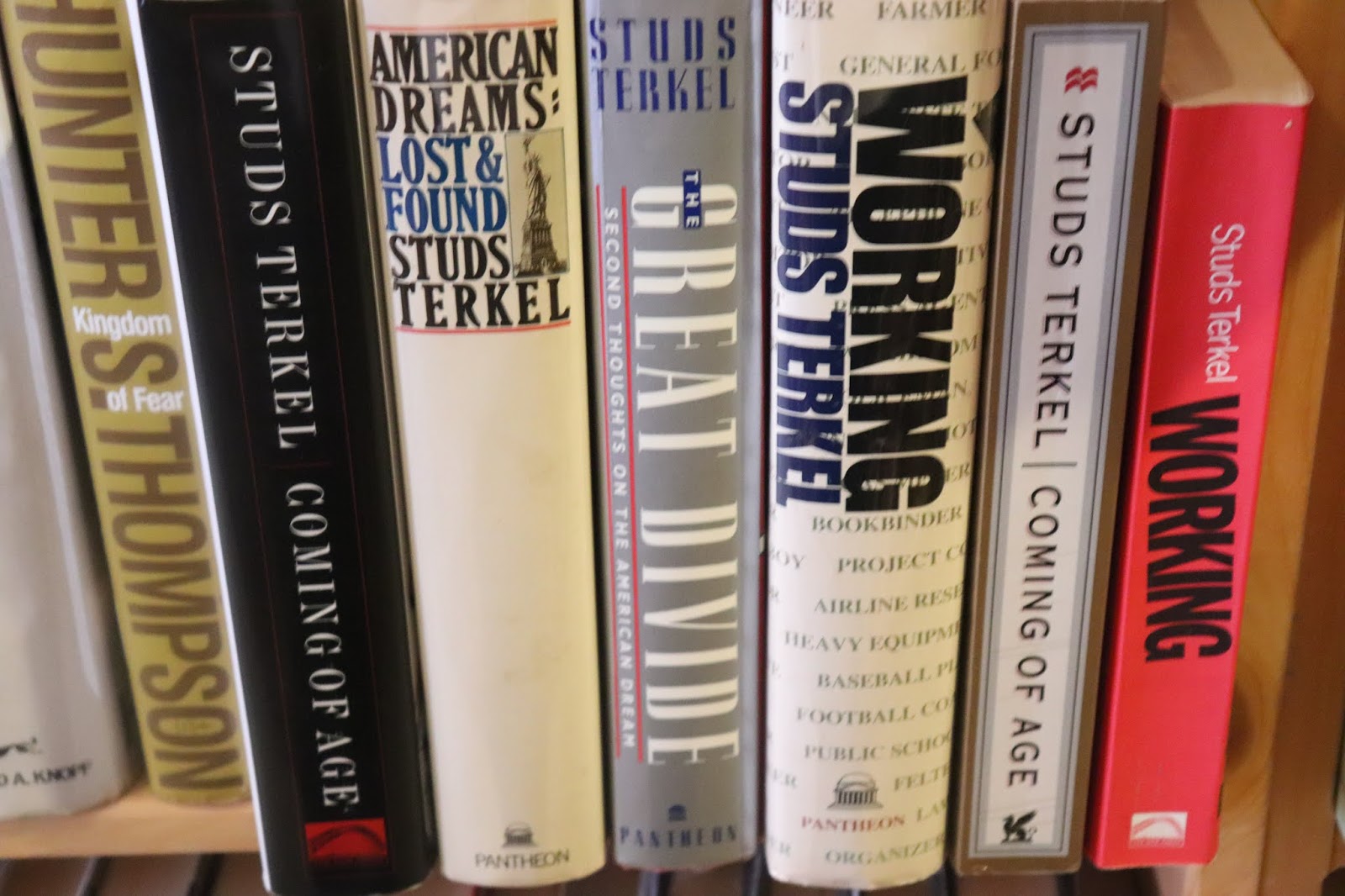
But a full and complete discussion of books I’ve read more than once and highly recommend would be a book in itself. Do you live in or live elsewhere but love Michigan? If so, and you have yet to read Bruce Catton’s history of Michigan and his memoir, Waiting for the Morning Train, put those on your list today! What about anything by Studs Terkel? All his books of interview with Americans, on a variety of subjects, are worth your time. 

Michigan's own Bruce Catton

Chicago's own Studs Terkel

Mildred D. Taylor’s novels are too good to be restricted to YA readers. Historians and lovers of good essays should not miss books by Tony Judt. If I were to begin listing books from the past decade alone, we would be here all day, though, and I know you have other things to do. Whatever you read, do make time for reading, because especially in this glorious summer of our discontent, getting lost in a good book (outdoors if possible) is good medicine for us all. As for me, I'm happy to realize that my bookshop is a Treasure Island, and if you are a booklover and know how to browse, you will never have to leave empty-handed. Only this morning, a repeat customer from Wisconsin told me, "The best part of the trip is coming to this bookstore." 

Just before this morning opening "bell"

But now -- oh, my goodness, the UPS delivery came! Another box of treasures have arrived!

And we are off to the races!


Saturday, August 15, 2020

Hardly Modern But Grateful To Be in Touch


Good morning! 


Confession: The Artist thinks I’m “modern” because I have a Facebook account for the bookstore and maintain this blog. You know better! I tell him that blogs are old-fashioned now and that if I were truly up-to-date I would be appealing to busy, nonstop scrollers and their short attention spans by tweeting, but what would I have to say to the twittering flock? As it is, I spend a certain amount of time online but basically continue to live life in the slow lane and have no desire to be pushed onto uncongenial platforms. As Popeye always said, I yam what I yam.


One might wonder why a book-reading, letter-writing dinosaur would bother publishing an online blog at all. Part of the answer is efficiency. It simply makes more sense to put my impressions of books read and trips taken and life observed on the web than to compose multiple individual e-mails and still leave out too many friends and regular customers. Because "Books in Northport" has been going since fall of 2007, I have some customers I’ve never met at all, people who order from me (instead of the behemoth) books I’ve written about on this very site.


Then there is that whole business of espressin’ myself. I have been a writer since that first story, in first grade, about a robin family in their nest and am myself largely via the written word.


Finally, habit. After almost 13 years, it would feel strange not to keep up my blog. It has become a natural part of my life.


Here, though, is something I realized only the other day. As far as how “natural” it can be called to throw these virtual messages-in-bottles out into the public ether, with no knowing where they may wash up, the truth for me right now that in the summer of 2020, with friendships constrained by 6-foot distance, bookstore encounters masked, hugs exchanged only within households, much of “normal” life is no longer [normal], but while personal visits and bookstore interactions are very different, exchanges not done face-to-face are unchanged, and I don't know about you, but I find some comfort in that. 


When my son and I converse by phone, our conversations are not constrained by concerns about distance. There are miles between us, but our voices are in the same space. Coronavirus hasn't changed that the way we talk to each other.


When I find a handwritten letter waiting in my post office box, reading it now is as pleasurable as it was one year or 10 years ago. I still have letters and postcards from 10 years ago, too! Like books, they can be revisited and enjoyed again and again, even after the writers have passed on. 


My daily texts with my sisters, sporadic e-mails with family and friends are as unconstrained as ever, too. I don't eschew all aspects of the technological world, by any means.


So while my blogging subject matter in 2020 has reflected and will continue to reflect this year’s unprecedented concerns (and the virus is far from the only one), the forum itself remains the same, and my relationship with those of you who comment continues to be what it has always been, and I'm grateful for that. For me, it's a little island of normality in the constantly changing, often stormy sea of our life today.


Like most of you – and I don’t exclude possible saints, since we know that they too had their dark nights of the soul – I have my down times and occasionally share them here. On the other, brighter hand, when life feels like something to celebrate, I share that, too. "Books in Northport" has no destination: we’re all "traveling between the eternities,” and I find comfort not only in sharing the journey but also, in the year of coronavirus, in having an unconstrained avenue we can travel together. Hope you do, too. 


As always, thanks for reading.

Wednesday, August 12, 2020

Beautiful Morning, Best Dog, Wonderful Life


The other day I told the Artist I was going to do an online search for “best dog” to see if it turned up Sarah. Kidding, of course. Every dog deserves to be thought the best dog in some human’s life, right? But Sarah outdid herself on this morning.


I was sitting outdoors with my first cup of coffee, talking by phone with my son, Sarah companionably nearby. A monarch drifted past. It was a lovely, peaceful summer morning. Suddenly Sarah stood up, gazing alertly at something in the distance. She started trotting off, then broke into a lope. 


The animal I saw emerging from the weeds was too big and slow to be a rabbit. Oh, please, let it not be a skunk! No, duller in color….


I yelled, “Stop! Stop! Leave it!” She stopped. “Leave it! Come! Come!” A bit reluctantly but without any fuss, she came back to me -- as the porcupine waddled down toward the little, hidden-away, no-name stream. Porcupine! I had successfully called her off a porcupine! No need for an emergency trip to the vet and anaesthetic and a horrid quill-pulling session. Well, I’ve called her off deer more than once, and she’s always come back. What a good dog! No, a great dog! The best!


Later, on our way to one of the quiet back roads where Sarah and I go for morning walks before beginning our bookstore day, we passed a neighbor’s farm and saw him and a helper hurrying a new crop of Holstein feeder cattle out of the barn. Love to see those big, young ones in the open air! Stopped and watched a while, taking a couple photos to share with a ranching friend out in Arizona, and then continued a couple miles more to park by the side of the road and have a good dog walk. I walked, anyway. Sarah trotted, stopping frequently to sniff. I would love to know what she knows about who’s been there before us!


Time before my bank errand in Northport for a stop at Adelade’s roadside stand for a couple of Lori’s homemade scones and then another stop across from the playground by the marina to photograph the gorgeous summer morning, sun blindingly bright on the water.


Best of all, at the post office, a wonderful surprise waited! A letter from Copper Canyon Press and two copies of Jim Harrison’s Collected Ghazals, the first in “The Heart’s Work” series that is bringing all Jim’s poetry back into print. I am happy, happy, happy and can’t wait for the Artist to arrive (I’ve already turned his gallery lights on) so I can share with him all the glories of this glorious Wednesday morning. Not all days begin so auspiciously, but this is one for the memory book.


Tuesday, August 11, 2020

Change, the Only Constant


The night pasture was a small piece of land. Much of it had been cleared once, then taken out of cultivation. As the years went by, we used that pasture less and less. At first the wildflowers were better than ever. Then the protected land began to change. I watched it, puzzled. I had not realized how the land, if left alone, begins moving back toward some inevitable destiny of its own.  

Goldenrod crept into the open land, beginning to cover the hillside with bright yellow plumes that moved in waves with the wind. A year or two later, black raspberry vines began to replace the goldenrod. Hazel brush moved out from the edge of the trees to compete with the berries.  

Most of the wildflowers were gone from the hillside by the time the scraggly sumac trees began to grow there. In a few more years, the poplars, with their restless singing leaves, had started. Soon the young oak trees began to spread out from the woods….  

-      Ben Logan, The Land Remembers


I think we in northern Michigan are now in the season Tom Springer, in The Star in the Sycamore, calls “between the raspberries and the goldenrod,” but I’ll have to re-order that book to find out, as the first copy I had in the store sold before I could do much more than look at the table of contents. On that first glance, however, I very much appreciated Springer’s observation that four seasons hardly seem adequate to describe a year in nature. I have always been skeptical about calendar divisions, sensing much more intersection and gradation and seesawing between the seasons than twelve months divided into four can possibly suggest.


Ben Logan’s memoir is divided into four seasons, but he is aware of finer distinctions, writing, for example, of fall that it 


…does not seem like a true season. It never settles down into a steady sameness of days the way summer and winter do. Fall is a time of change, an end of the growing season, a preparation for the season of cold and snow that is coming. 


It’s a rare Michigan August that fails to bring mornings that feel like September, mornings with the scent of leaf mold and fungus on cool, humid air and the first maple or sumac leaves turning red – ahead of schedule, we can’t help thinking, but nature isn’t going by our calendar.


The Land Remembers is set in Logan’s boyhood Wisconsin, on a ridgetop farm called “Seldom Seen.” The work he remembered was hard and never-ending, winter blizzards serious, crops always uncertain, but his memoir is a joyful one. His father, an immigrant from southern Norway, was still farming with horses when Ben and his brothers were boys, and their mother, who had been a schoolteacher before marrying, clearly enjoyed continuing to teach her own brood. The Logans on their family farm grew corn and oats, kept and milked cows, made hay all summer long, and in the winter they ate from the bounty of their land – chickens and eggs, milk and cream, garden produce (root cellared in sand, as well as canned), fruit preserves and jams, and berries and nuts gathered from the wild places around them. 


Explanations of the workings of different farm machinery and equipment in that time period, as well as his father’s careful choosing of seeds to save for the next spring’s sowing, made this memoir, at least in my mind, a kind of parallel to Ben K. Green’s Wild Cow Tales. That is, both books are reminiscences, the memories rural, and the way of doing things then largely been left behind today. More’s the pity, one cannot help thinking. While much of the work was physical and very hard, its rewards – for those who loved the work, that is, as did the Logans -- were satisfaction in visible results, family solidarity, and closeness to the earth. 


I don’t remember the name of the earth science teacher I had my freshman year of high school, but I always remember something he said on the first day of that class: “Change is the only constant.” Another memory from that subject, that year, is that when the teacher asked how many students lived in houses heated with coal, mine was the only hand raised. My parents considered themselves very modern when they had a stoker installed. Before that, I remember shoveling coal into a monster basement furnace at home (and standing in front of the open door envisioning, in the flames, Shadrach, Meshach, and Abednego). I also remember visiting grandparents in rural Ohio who still relied on an outhouse and a hand pump rather than modern plumbing … and I remember 4-cent first-class postage stamps … the amazing miracle of the advent of lightweight transistor radios and our family house before it was invaded by television and when we still had a party telephone line, and I have fond memories of doing dishes by hand (as I have always done and still do), singing rounds with my mother and sisters as we cleaned up after dinner each night. 


My parents are gone now, the family home sold, and my grandparents have been gone even longer. Do any siblings still sing together while doing chores? Is there an American home in the Midwest heated by a coal furnace? How many of us regularly exchange written letters with friends and relatives elsewhere? American life has changed from the mid-20th century to now.


I wonder if the reading of memoirs and biography, like the reading of history, is something we develop an appreciation for as we grow older, when we have accumulated a rich trove of our own memories and are looking backward to try to make sense of our lives and understand our society. Certainly, life is always changing for all of us. The world is changing, constantly, every day and from year to year. 


Recently in the mornings I’ve been looking for cardinal flower, thinking it should be about time to find it in bloom. A friend who grew up in Leelanau County told me that roadside ditches used to be red with cardinal flower in late summer, back before roadsides were regularly sprayed and mowed. Now it is a treasure in certain wet, off-road pockets, but I haven’t found it this year in the very place it was last year and the year before.


The corner of M-22 and Jelinek Road is being taken over by the dreadful autumn olive. One year, long ago, that corner was planted in wheat. I think it was in wheat only that one season, and yet I’ve never forgotten it as a wheat field. My own meadow was once a hayfield, one year a cornfield. Will it be woods someday in the future -- again, that is, as it doubtless was before ever there was a farm here?


Change! Where will next summer’s morels and blackberries and ash seedlings and cardinal flowers appear? Will we still be wearing masks in public places to stop the spread of coronavirus? The only thing we can count on is that there will be changes as we move from ephemeral present into unforeseeable future.