Search This Blog

Showing posts with label kindness. Show all posts

Wednesday, April 30, 2025

My Own Personal "'Hamlet' Back-&-Forth"


 “What kind of boat is she?”


An embarrassing question; for it was suddenly apparent that this small craft could not be classified. She was neither sailor nor steamer; she was not a trader, still less a yacht. A roof, the width of the beam, had been raised over a black, flat-bottomed hull; small square-paned windows had been cut in, and a short mast raised above. Space had been left in the bow for anchor and ropes; in the stern a tiny deck gave just enough room for the sweep of the tiller.


“She’s a—well—she’s a painter’s boat.” 


The San Luca, by Cilette Ofaire, book’s title taken from the name of the boat in the travel narrative, was on a bookshelf I was looking through at home. I wondered why it hadn’t been on the shelf with the houseboat books, where I would have found it months ago when moving those books from living room to office. Although the “painter’s boat” was not exactly a houseboat, they did live aboard for years, the husband and wife, both of them painters. (It should really have been called a “painters’ boat,” with the apostrophe indicated plural artists.) In any case, the subject matter moved me to set aside a novel I’d planned to read at bedtime in favor of traveling aboard the ‘San Luca.’ 


They begin in Germany, with the plan of giving up cheap apartment hunting and the dreariness of even cheaper hotel rooms in the years following World War I, to take to Europe’s canals, living and working in their waterborne vessel. 


Charles had found her in a partly drained canal in the dreary marshes bordering the Elbe between Hamburg and the sea. She made us think of a peddler’s booth abandoned after a fair, or a broken-down circus wagon left by the roadside. On her prow she had carried the carved wooden head of a dragon, set off by daubs of green and yellow, and along the sides of the hull had been painted wings which ended in a sort of tail vanishing into the rudder. We could not help smiling at her absurd, helpless air.


Charles and Cilette did not have Harlan and Anna Hubbard’s drifting voyage down the Ohio and Mississippi rivers. Sometimes they had an opportunity to moor in some lovely pastoral backwater, but just as often they were towed from one city to another in a long “train” of barges, a tugboat the motive engine of the train, past factories and cranes and sad little remnants of pathetic, bare-limbed trees. And in fact, being towed by some other vessel seemed their primary way of moving, from Germany to Czechoslovakia to Holland and beyond, in a world of customs officials, police, required permissions, and rules.


Intermission in Northport


I left my reading at the end of Part I to begin another day, first outdoors with dog and then indoors at bookshop. Part I of the story had ended sadly, with the suspicious disappearance of their little dog in Amsterdam, suspicious because neighbors on hand had complained about the boat being moored on “their” canal, and one had falsely claimed to the police that the quiet, sleeping dog “barked all night.” 


After a couple of early customers, the shop settled down to a dead quiet until, one by one, friends trickled in. Even before being introduced to one another (those not already acquainted), lively conversation ensued. Books were purchased and ordered, recommendations made, questions asked, until the talk ranged far and wide from Waukazoo Street, ceasing only a few minutes after closing time. It was a good day in Northport. And the next day, Saturday, would be Independent Bookstore Day! 


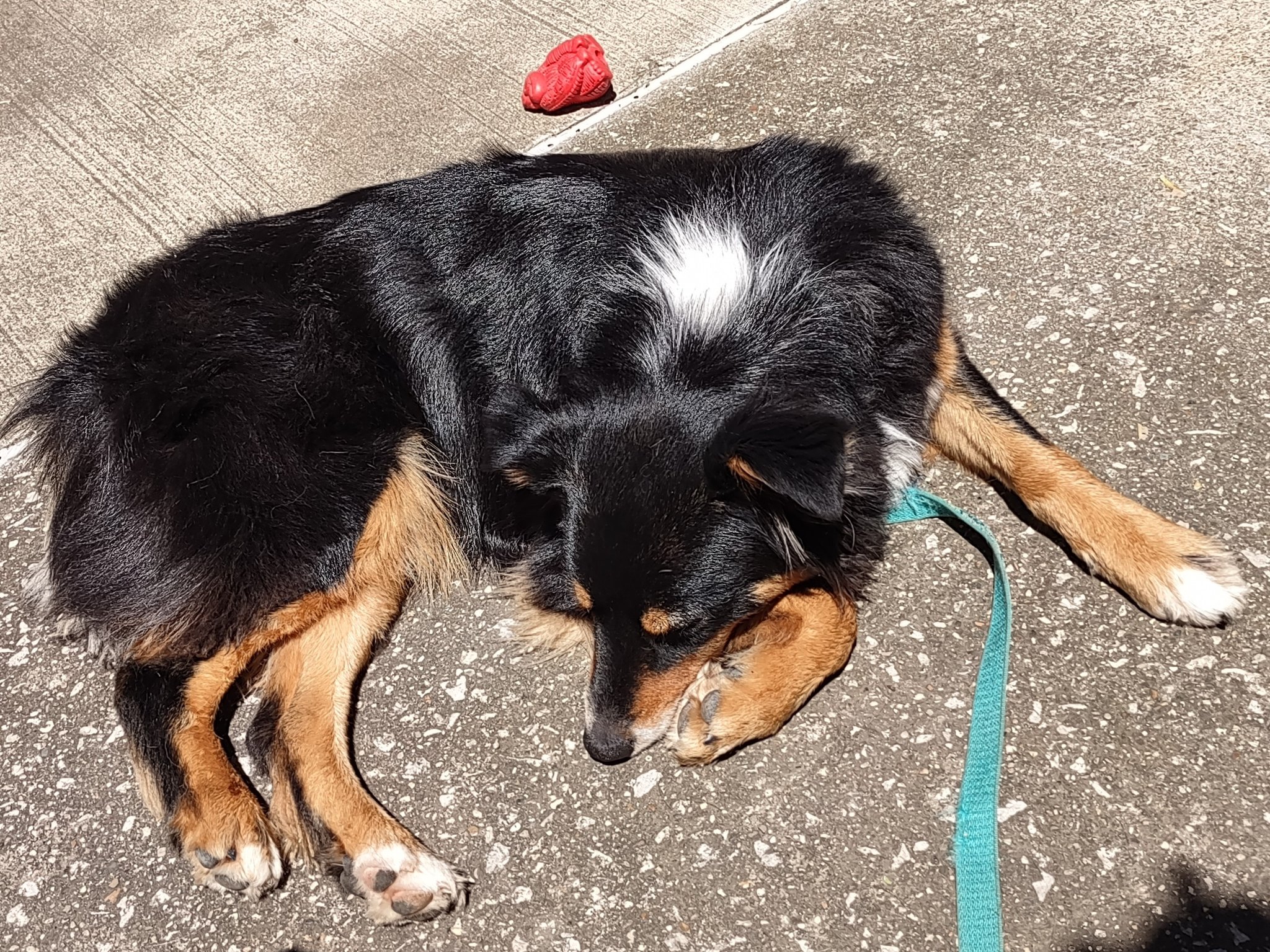
But first, back home to Sunny. In the rain. A short walk under an umbrella, dinner preparations, and then an hour of relaxation, the momma with her book, Sunny with her bone. 


Back to the Boat


What a surprise awaited me at the beginning of Part II. Charles and Cilette sell their boat! Right in the middle of the book! The new owner, a friend of theirs, gives it a new name, and C&C purchase another boat and christen it ‘San Luca’ to continue their voyaging, now through Belgium and on to France. 


Early in the story, we were told that Charles “knew how to create an atmosphere of intimacy out of the barest of materials” and thus transformed the droll, abandoned, dragon-headed boat into a waterborne home and studio to two wandering artists. Charles’s ingenuity is exercised once again on the new boat, a “lamentable figure” when first they see her, “streaked with rust” and further disfigured with “ugly red paint.” As soon as they found her,


…Charles began to draw up plans: taking her to pieces, putting her together again, modifying her to fit all our needs and our wishes. 


“The entry here,” he said aloud, “will become the living-room.” He shut his eyes and Cilette knew that he was building the wall over in his dream.


The Artist's houseboat in Leland, Michigan!

Oh, what memories such passages evoke for me! The Artist whose life I shared was a boat dreamer, also, and could not see an old hull anywhere on land or a smart vessel in harbor without making elaborate mental changes, sometimes even committing plans and sketches to paper, and so whenever we would read aloud to each from books such as this one, he could not bear to rush through descriptions of renovations and would often say, if I were the one with the book in hand, “Wait. Read that last part again. I didn’t quite picture it.” 


Daydream material

Sketching a remodel....


Then Back in the Bookstore


On Saturday, April 26, the sun came out in Northport for Independent Bookstore Day!!! More importantly, probably, from a traditional Northport point of view, it was the day of the annual Scott Brow Fishing Derby for families of young children up at the millpond. Some people came for both books and fish, though, and that worked fine.


Discussing movies and TV series with a customer-friend from Cedar, I needed to check on the date of the 19th-century establishment of the town that became the ghost town where the Artist and I spent several contented winters. Imagine my horror, in looking up my own blog post from 2015, to discover that I had mistyped the date for the first Dos Cabezas post office! It was, of course, 1879, not 1979! All this time, and of all the people who had read that post (a popular one because of its subject matter), no one had corrected me! It’s kind of a hassle to make a correction to a post that far back in time, but I persisted until victory was mine.


Two dogs visited the bookshop on Saturday, Charlie and, later, another little dog about the same size but held in the owner’s arms. Friend Lucia also stopped by (though she had bought books only the day before) to wish me a Happy Indie Bookstore Day! 


Always good to see Lucia!


My bedtime book on Saturday was, once again, Ellen Airgood’s South of Superior, my go-to comfort book, the one that soothes my soul in troubled times and strengthens my resolve.


An excerpt from one of my favorite books


…It was hard to say who the “real” people were. She didn’t have anything against most of the new people, not the retirees or the summer people or tourists or even the snowmobilers, not on a case-by-case basis, except that they tended to expect too much, to assume too much. But they paid their taxes and kept their lawns mowed and volunteered at the school and spent money in the local stores and had as much right to be here as Gladys did, she realized that. And McAllaster had always been a tourist town, a resort town; her own parents had made a living off that fact. 


But things were changing fast now. Too fast. Half a dozen new summer places got built on the beach every year, and no one was content with a regular house, everyone had to have a mansion. At this rate she wouldn’t be able to afford the taxes on the house she’d lived in for more than fifty years….


-      Ellen Airgood, South of Superior


On the road!


Last time I went anywhere farther from home than Benzie or Grand Traverse County? Last fall I ventured all the way to Cadillac, and in late spring of 2024 I made it up to the U.P. once. 


My spring road trip 2025 took me to Reed City, the halfway point a friend from Kalamazoo and I had chosen for this season’s rendez-vous. 


Always good to see Laurie!


We did no sight-seeing, and so I have no album of photographs to share, but I did stop to hover a few moments at a little farm village called Chase, where I mailed a postcard to a friend in the U.P. and used my phone to capture a couple of old buildings, the first because it must have been very important at one time in local history, the second because it made me think of how often I have meditated on hiding out in some out-of-the-way place where no one would ever find me. Why such an idea? Don’t you have occasional fantasies of leaving everything behind?


Faded glory

No one would look for me here.


Now, in closing, another excerpt


A somewhat strange book came into my hands. The title is King Noanett, the subtitle A Story of Old Virginia and the Masssachusetts Bay, the author’s name on the title page given as F. J. Stimson, but in parentheses below that J.S. of Dale. The main character is a young man of Devon, who meets a lass and falls in love – an old story, so far. This particular story, however, is set in the time of great conflict in England, and as the young man’s grandfather is a Parliamentarian and the young woman’s grandfather a royalist, the lovers are star-crossed. And here I must reveal that the young man’s unusual name is Bamfyde Moore Carew.


Let me here skip ahead in the story. Carew is convicted of giving aid to the royalists and sentenced to “transportation” (i.e., deportation to the colonies) and several years’ servitude (I forget how many), but eventually he and an Irishman who had shared the same transport vessel escape their masters and join an army. Horrors of slaughter and dissipation drive them from that life, also, and they carry away with them a girl whom neither of them wishes to marry (because the Irishman, like the Devon man, is in love with another) but whom they cannot leave to the life of the camp. 


Enough of background. Of this convoluted story, I only want to leave you today with a speech the Irishman makes to his friend:


“Beauty is given man, the good kind of beauty to enjoy, the bad kind to tempt him and teach him strength. In this way even pleasure hath its place—and a Puritan is but a suicide that thrusts him, like a blubbering child, away from the fires that are to try him! Let monks renounce—a man is here to live, and touch and try the lives of others; to feel his life and use it to the full, and then to give it away—to the first cause, maybe? Men to be brave and true, maids to be brave and gentle—and both their highest duty to be kind.” 


“Their highest duty to be kind.” Isn’t that a noble thought for the day? 


Quietly spectacular hellebore

Tuesday, October 3, 2023

Look in the Mirror. Do You Read the Future There?

Marina sunrise, Monday, October 1, 2023

What kind of world do you see around you today, and what future world do you envision? Is it one you want?


Years ago here in Northport, when our community was even deeper in the doldrums than the rest of the country, a series of “visioning” meetings was held for local residents, and at one meeting, we were asked to draw a picture of our “vision” for the future. I use scare quotes there because I interpreted the word as meaning something positive – something like a best-case scenario that we might be able to work toward and bring about. (Yeah, yeah, prepositions at the end of the sentence. Move along, move along!) One local woman, however, took “vision” to mean a prediction, and hers (obviously based on the times we were in) was ominous: her drawing showed a street of empty storefronts with big CLOSED signs on all the windows. Very unhappy "vision," I thought. 


View from inside my bookstore to Saturday morning preparations for street fair --


Leelanau UnCaged 2023! Northport was full of life!


My bookstore, like all the village, was full of life, full of people this past Saturday for our annual street fair, Leelanau UnCaged. Music, food, arts and crafts, face painting and art fun for the kids! It is a happy day in Northport, and my guest poets, Fleda Brown and Michael Delp, read to an attentive audience – though I fell down on the job, neglecting to pick up my camera, too overwhelmed by their powerful words. If you weren’t here, I’m sorry you missed them.


But coming back to my sheep (meaning and origin of that French phrase here): Asking the question about the future today, I’m not trying to elicit only positive visions but not exactly asking for predictions, either. I’m asking what you expect, personally, in our country and in the world in the coming years. Is yours an optimistic or a fearful vision? Do you welcome the future you see? Or maybe you don’t look very far ahead, but even if you’re focused more on today than tomorrow, please keep reading, anyway, because today is where we all are now.


This post will not be a book review. (For a fuller idea of the contents of the book, please see the publisher’s description I have included in the comment section below.) Everything Naomi Klein has written in Doppelganger: A Trip Into the Mirror World is worth reading, and most of it is very, very important, but I want to address a single narrow issue, more or less, one that has been hurting my heart. And I’m not just pointing a finger, either, because the temptation and danger are there for me as much as for anyone else. 


Klein notes that as the political divide has widened across the U.S., thinking has become binary on the left as well as on the right, with the left, simply to counter lies and conspiracy theories on the right, often defending the status quo rather than offering nuanced critique.


It's as if when something becomes an issue in the Mirror World, it automatically ceases to matter everywhere else. This has happened on so many issues that I sometimes feel we are tethered to each other as reverse marionettes…. 


When fear-mongers on the right encourage panic, the left knee-jerk is to dismiss all worry, and vice versa. The problem doesn’t stop there, either. 


There are also uncomfortable ways we have begun to imitate each other.


I added emphasis to the sentence above and set it apart by itself (though it does not take up three lines on my laptop screen) because that sentence brings into focus my today's concern. 


Potentially murky waters --


There were groups of people during the height of COVID concern who refused to wear masks, and when some went so far as to say it was for the good of the country and the human species if the weak and old were to die, mask wearers were indignant and horrified at such heartlessness. And yet, when unvaccinated people began to die, how many mask wearers made jokes about people dying of stupidity? “How,” Klein asks, “did we cede so much territory? Become so heartless [ourselves]?"


Klein uses this insight to introduce Steve Bannon’s strategy, that of picking up and using the left has dropped,


…identifying issues that are the natural territory of his opponents but that they have left neglected or betrayed…


-- but my concern here and now, in this post, is with what we are all becoming. The radio/television network that its followers call “conservative” has long hosted name-calling screamers who ridicule their opposition. (I choose to read their news online occasionally to know what they’re saying without having to hear the mocking voices.) I find it equally disturbing, however, when my fellow liberals stoop to name-calling and bad jokes, though I understand the temptation. “We have to laugh so we don’t cry,” one friend told me. But ridiculing our political opponents and those the opposition holds up as leaders and pundits will not open a single mind or heart, and, beyond that, it certainly does not make us kinder, happier people. A hate-filled future for our country? Is this what we want?


*****


Okay, let me switch gears. How do we escape from what Klein calls “the mirror world”? When I had almost reached the final chapter of her book, I picked up a paperback from 1962, The Image: A Guide to Pseudoevents in America, by Daniel J. Boorstin. Historian Boorstin’s thesis was that America had replaced originals with images, and now, like Narcissus in the Greek myth...


We have fallen in love with our own image, with images of our making, which turn out to be images of ourselves. 


When cursed-by-the-gods Narcissus saw his reflection in the water, he fell in love with his image and “died of languor” on the spot, his own image a narcotic that not only put him to sleep but ended his life. And so Boorstin can’t help but wonder,


How can we flee from this image of ourselves? How can we immunize ourselves to its bewitching conceitful power? 


This becomes ever more difficult. The world of our making becomes ever more mirrorlike.


(Are dogs wiser than humans?)


Again with the mirrors! In the mirror world both Klein and Boorstin describe, the kneejerk reach for false villains is matched by an equally desperate reach for false heroes. And here is a problem I have with e-mails that plead on a daily basis for my donations in these “dangerous” times: It isn’t that I don’t see our times as dangerous, because I do, but I see our fear and fixation on opponents as dangerous narcotics, too, not as signposts to peace among neighbors. Because what we are being asked to fear is our neighbors! Each other!


I don’t know how much common ground there might be between Boorstin (who died in 2004) and Klein, since the former traveled from Communist Party membership to mid-20th century conservatism, while the latter makes no bones about being an anticapitalist eco-leftist. Boorstin saw the beginnings of today’s mirror world when advertising invaded American politics, and Klein sees how the mirror world has divided Americans until, gazing at doppelgangers of one another over the abyss, we no longer share a view of reality. But somehow I don’t see them greeting each other as hard-and-fast comrades, because while they see similar dangers, they reach very different conclusions on what we need to do to get beyond the impasse.


Boorstin’s map for escaping the mirror world is stronger individualism:


Though we may suffer from mass illusions, there is no formula for mass disenchantment. By the law of pseudoevents, all efforts at mass disenchantment themselves only embroider our illusions.


“Each of us must disenchant himself,” he counsels. 


Klein, on the other hand, sees too much individualism as part of what lures us into the mirror world – the idea that each of us, on our own, is responsible only for ourselves. The first wave of COVID, like the shock of 9/11, initial brought Americans together in common cause. Quickly, however, we retreated not only to our respective “sides” (and in the case of COVID, for those fortunate enough to be able to do so, to the safety of our private homes) but also from connectedness. And now, too many who should be making common cause on important issues have become sidetracked into splinter groups with tiny, often entrepreneurial, self-admiring agendas. Fearing and ridiculing a dangerous, monolithic opposition, we subject one another to scrutiny, too, and who on earth can measure up on all possible counts? Even if we don’t begin from individual isolation, it’s where we may end up if we can’t give each other a little slack!


So Klein’s recipe for exchanging mirrors and images for reality is not more individualism, but solidarity and connections.


We have kin everywhere. Some of them look like us, lots of them look nothing like us and yet are still connected to us. Some aren’t even human.


Our doppelgangers can teach us, she urges, that we are “not as separate from each other as we might think.” And while working on ourselves is a start, changing the larger world requires collaboration and coalition, even in the face of discomfort.


I cannot urge too strongly the reading of Doppelganger. Naomi Klein writes as a friend, trusting readers with her own errors and weaknesses and difficulties in her journey through the mirror world. As I said, this is not a book review, and I have left vast numbers of the author’s ideas for you to discover on your own, because I have been wanting for a long time to address what I see as outright meanness in utterances and writings of those with whom I otherwise agree, and it makes me sad, and one of the things I most love about Naomi Klein is that she refuses to stoop to unkindness. 


Besides, it’s a fascinating journey! Doubles, twins, identity thieves, avatars, doppelgangers, a house of mirrors – it’s an irresistible story, isn’t it? 


But now I need to get back to Iain McGilchrist, because a common underground thread I see connecting all of us in this splintered, divided, many-mirrored world is what McGilchrist identifies as a cultural over-reliance on the left brain, that narrowly logical, super-rational “emissary,” with its intolerance for ambiguity and an inability to make room for facts and ideas that conflict with its orderly catalog of guarded knowledge. 


Another strength of Klein’s view and her book: she sees the irresistible temptation to judge characters globally on the basis of single issues. Is so-and-so this? Or that? We are all, she says, both this and that, neither devils nor angels. 


And every new day is an opportunity for us to make better choices.

Friday, May 5, 2023

An Adventure I Didn’t Need

Adios, las Dos!


The car was packed, dog exercised, and the fact that the U.S. road atlas had gotten buried beneath all that great packing didn’t upset me much because my planned route would be a familiar one, a trip the Artist and I had taken more than once, one Sunny Juliet had done last spring, and our first planned overnight stop in Santa Rosa, New Mexico, a town the Artist and I stayed in many times. (Sunny and I had been there last year on the very same date, May 1.) There was a little glitch when my credit card was declined in Santa Rosa – for absolutely no reason -- but after I paid cash for a room and made a call to straighten out the problem, the card was “re-set” so it would work again. 


Santa Rosa sunset


I used the card in the morning (at the pump) to fill up with gas, and we were on our way again.


Route 54 is the same as I-40 between Santa Rosa and Tucumcari, but at Tucumcari I got off the “superslab” (there’s a long David Grath story associated with that term, a story for another time) for my smaller road. Somehow, though, not taking the Business 54 direction, I found myself on old Route 66, following along beside the superslab. Well, okay. While not my intention, I remembered being on I-40 and looking over with longing to the old Mother Road. Now, here I was! Serendipity.


Click to enlarge for full effect.

Shoes on fenceposts


Tuesday's flower of the day


Old Route 66. Two-lane road. Right down in the landscape, not on a conveyor belt keeping me at arm’s length. So I was happy. Free to stop, to pull off the road, and photograph interesting sights, such as what I called my “sign of the day,” three different kinds wildflower, and a fence with every post topped by a shoe. Don’t ask me what was with the shoes, but I chose the Indian blanket as my “flower of the day,” so perfectly New Mexico, even as I remembered from the previous day all the beautiful blooming prickly poppies, or “fried eggs,” as the cowboys call them, along the road on the Alamogordo side of the San Augustin Pass.


San Jon probably doesn't have many tourists.

Arriving at little San Jon, New Mexico, I took what at first I thought might be a new two-lane north, only to realize quickly, from familiar scenes, that the Artist and I had traveled that road before. We’d been on I-40 and gotten off in search of a gas station, then taken 469 north to Logan. Maybe I’d even photographed this intriguing abandoned ranch house before, but don't you think it was worth stopping for again? 


Again, click to enlarge for full effect.


Logan, New Mexico, presented another irresistible photo opportunity -- and this isn't the last you'll hear of Logan, either. 


Wouldn't you have stopped for this shot?


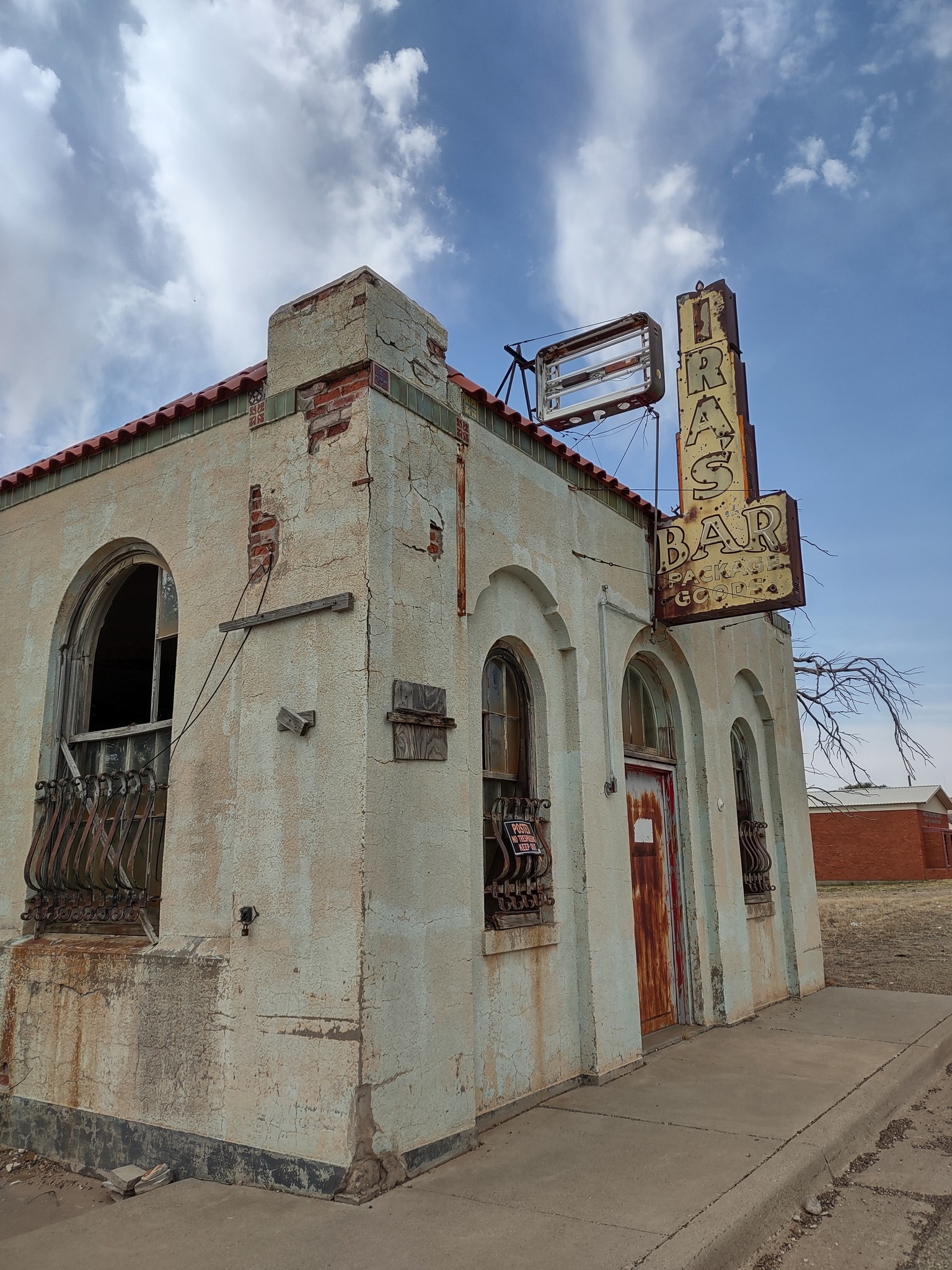
Then, Nara Vista, the last named town before the Texas state line, emptied out by changes long ago, but with some lovely old buildings, albeit abandoned and ruined. Besides the attraction of the ruins, I remembered vividly the drive east in 2020, the plague year, when the Artist and I stopped in an empty parking lot in Nara Vista to walk our Sarah. When I presented the Artist with a plastic cup of “fruit cocktail,” the ubiquitous 1950s accompaniment to cottage cheese, he was delighted to have something other than jerky and granola bars and congratulated my “brilliance.” So Nara Vista, sad though the place would be to the eyes of almost anyone else passing through, holds a happy memory for me, invisible to the rest of the world. I’d been lazily snapping away with my phone camera but got out the real camera for a couple of long shots.


(Formerly) Ira's, #1

Ira's, #2

Ira's, #3


Most of Nara Vista looks like this.


Detail

Across the road


Next, Texas panhandle, Oklahoma panhandle – and I barreled through those two states nonstop, aiming for Liberal, Kansas, another place the Artist and I had stayed many a night, enjoying dinner at the Cattleman’s Café. Gas prices were pleasingly low in Kansas, and I was ready to gas up again.


Photo taken for a Kansan friend transplanted to Arizonan.

That’s when terror struck! My billfold was not in my purse! I’d used it in Santa Rosa but not since. Now what?


Did I drop it at the gas station in Santa Rosa? Found their phone number on the receipt and called. No, no one had turned in any lost items that day. At the rest area on the staked plains? No luck on that possibility, either, when I called the New Mexico State Police. No, no personal items turned in at all so far that day, other than a gun. (Really! Someone lost a gun? Not me!) What to do?  This unexpected challenge was not at all the kind of adventure I’d been looking for on this trip.


Pajarito rest area in eastern New Mexico


The problem was that I’d developed the habit of sliding the billfold into my left front jeans pocket occasionally, rather than putting it in my purse. Easier to grab that way. But the jeans pockets weren’t all that deep, and it could have fallen out – almost anywhere!!! I’d been in and out of the car, photographing (as you've seen) all manner of random, rural sights. 


The most important items in the lost billfold from a practical point of view were my credit card and my driver’s license, but there was also a scrap of paper with the Artist’s last written words on it. Illegible those words had been to me at first, but I’d finally deciphered them and did not want to lose that precious note. 


And yet, I had to be practical -- thus my Tuesday thanks list:


➡️ Thanks to the UPS driver I flagged down there in Liberal, who helped me find the police station. Note: Washington Street in Liberal has two discontinuous stretches, and there is a 325 on both pieces of the street. 


➡️ Thanks to the dispatch officer at the police station, who told me I should cancel my credit card and explain the situation of the lost driver’s license, should I get stopped on the road for any reason, and then file a report from my home back in Michigan upon arrival. 


➡️ Big thanks to the pleasant, very helpful young woman at the visitors center, who did not have any Kansas state maps but printed one out for me from her computer. I knew I wanted an east-west road to a certain town but didn’t remember either the number of the road or the name of the town. U.S. 160 to Winfield. Good!


Two hours were “lost” there in Liberal, but back on the road again I felt pretty calm. With cash from an ATM in Willcox, AZ, on my way out of town, I was confident I could make it to Illinois, where I’d write my sister a check and get more cash for the remainder of the trip. I also had dried mango slices, Kind bars, beef jerky, and rice cakes for that night's dinner, along with foil packets of chicken for Sunny Juliet, plus the last of the rice and green beans from our cooler to mix with her chicken. 


So we spent the night in Winfield, Kansas, in the same friendly motel we had stayed in the year before. No time this trip for the dog park, though. We arrived too late in the evening (after sunset) and left too early in the morning. But my dog girl is a seasoned traveler now. Last year, less than five months old, she wanted to play in the evening when we arrived at a motel, when all the momma wanted to do was crash. This year she seemed to understand and settled right down. 


Sunny settles down.

Day 3 got us to my sister’s in Springfield, Illinois, after a 600-mile drive (maybe my longest driving day ever), and I slept all night, not waking once. Exhausted.


Oh, but on the way through Missouri (determined not to spend a night in that state), I had stopped again for gas in Wheatland, across the road from a little motel where the Artist and I had stayed once with Sarah. Maybe we stayed there once with Peasy, too? Wheatland is the home of the Lucas Oil Speedway (the Artist swore by Lucas products), as well as the Lucas Bull Ranch, and the Sinclair station sells much more than gas. They have seed & feed, baby chicks, nursery plants, groceries (including fresh produce), and of course anything you might need for a car or a truck. There’s a café attached, where the Artist once bought us a fried chicken dinner.


Why, other than general reminiscing, do I mention all this? Because since my New Mexico loss, I was traveling only with cash, remember. And when I went inside to prepay, I told the woman behind the counter that I wasn’t sure how much the tank would take -- I knew it would take twenty, but would it take twenty-five? -- and she said, “Why don’t you just go out and fill up and then come in and pay?” “I can do that?” “Sure.” Stranger in a strange place, and I was not made to prepay! When I went back inside to hand her a $100 bill for my $23+change purchase, I mentioned having lost my billfold back in New Mexico and not realizing it until Kansas, and she commiserated, saying how much trouble it could be to lose credit cards. I shrugged then and told her, “My husband died a year ago, and other problems that come along now --.” She interrupted to say, “I know what you mean. I lost my husband this past October, and everything else is ‘small stuff.’” “You go on, but nothing is the same, is it?” “Certainly is not.” Loss of a credit card made for kind of an “adventure” I would not have chosen, forcing me to rise to an occasion imposed on me and to improvise, but that was peanuts compared to losing the love of my life. A stranger and I had that in common.


How many strangers heard the story of my lost billfold? And yet, I didn’t share it with friends or family before arriving in Springfield. Why worry them needlessly? Once in Springfield, I wrote my sister a check, which she deposited in her bank the next day, handing me cash I knew would be sufficient for the rest of my trip back to northern Michigan. We went to the dog park. Sunny was the only dog there, but we exercised her pretty thoroughly with tennis balls, a Frisbee, and agility stations provided. After that it was on to the doggie wash to rid her of months of desert dust! 


Sister Deborah helping with Sunny Juliet's bath. Easier with two!


-- And now, another unexpected development --


I was relaxing with maps and snacks, not fretting, when a call came on my cell phone. Traverse City. Not a number I recognized. Didn’t pick up. A few minutes later another call from the same number, so I answered. It was my credit union. They’d had a call from the sheriff’s office in Logan, New Mexico! My billfold had been found and turned in! I should call and tell them where to send it. Hallelujah! 


What can I say? Is there a moral to this story? Not panicking, I guess. You just do what needs to be done, what you can do, and hope for the best. Do I wish I’d stayed on expressway and not taken the road less traveled? No way! Credit cards can be replaced. A driver’s license can be replaced. My memories, though, and the familiar scenes that evoke them are irreplaceable. And how many pleasant, friendly, sympathetic, helpful people I met along the way!


Occasionally the Artist called on a phrase to describe this or that person whom he failed to find congenial: “He knows the price of everything and the value of nothing." Maybe that’s the moral of my story, the difference between price and value, between the replaceable and the irreplaceable.  


Random Illinois squirrel, just to break up the wordy stuff.

Officer Slate from Logan told me, when I asked, that whoever found and brought my billfold to the sheriff's office hadn't left their name, so I have no way to write and thank them. "There are still honest people in the world," he commented. Since I couldn't thank the finder, I offered profuse thanks to the woman at my credit union and the policeman in Logan, the people on the phone who made my day.


Another moral? It isn't only bad things that happen unexpectedly. Good things happen, too. An even better happening was a three-sisters get-together, but we all agreed the pictures taken would not be made public. We were not looking our best but were happy to be together.


So expect good things to happen, I say. Because they do. And HUGE thanks to the anonymous stranger who found my billfold and took it to the sheriff's office in Logan, New Mexico -- and to people everywhere who do kind things for strangers every day! You make the world of other people a welcoming place for us all to live.


This girl is sometimes naughty, but always pretty, especially after a bath.