Search This Blog

Showing posts with label wildlife. Show all posts

Tuesday, September 15, 2026

"Locals' Summer" Comes 'Round Again


No, summer isn’t over!

‘Locals’ summer’ is what Up North residents, especially the non-retired, like to call September, these idyllic days when air and water are still warm enough to lure us to the beaches, and when the beaches themselves are much more sparsely populated than in July and August. For those with children back in school, even with college-age students gone off to begin classes, as well as for teachers and professors at all levels of instruction, September is the beginning of fall, but for those of us no longer returning to classrooms, this month of the first turning leaves is summer’s last hurrah.

Cathedral of trees

So it was that Tree Guy and Naughty Barker and I packed up the car and headed for the Mackinac Bridge the day after the annual Labor Day bridge walk. Tuesday found us stopping once more at Lehto’s for our dinner pasties, wrapping up the day with a long forest walk and a spell of quiet riverbank sitting before bedtime. 

Sunlight on the river

Tree Guy had important errands to accomplish in Marquette on Wednesday, which were taken care of with surprising and delightful ease, leaving time for a visit to Snowbound Books. Hurrah! Years ago—and for many years—Snowbound was an annual visit for me, and I hate to think how long it’s been since I was last there, so long that needed a brief tour to orient myself. Current inventory is about 70% new books and 30% used, which I judge is about the opposite of my own shop’s offerings.

How far to Dog Ears Books???

Bonnie at Snowbound Books

I’d have loved to linger twice as long … and to have time to stop in at Dead River Coffee, as well … but even with a shaded parking space, we didn’t want to leave Naughty Barker in the car too long, and we were as eager as the River Rat to get back to our “bijou riverside residence” for the rest of the gloriously summery September day.

Everywhere, goldenrod!

Only small pockets of fall color in the trees

Thursday we did little projects around the cabin, took more long forest walks, and made a short jaunt over to the famous Kitch-iti-kipi spring, not far from Manistique but challenging to locate (for us, at least), which I had somehow never seen before in all my U.P. travels. The spring is within the boundary of a state park, but though the parking lot and grounds were swarming with late-season tourists, a respectful hush fell over visitors as they neared, on foot, the destination spring. The hush surprised and pleased me. “Medicine Water” and “Mirror of Heaven,” Ojibwa names for the spring, express very well the sacred feeling of this North American freshwater cenote. 

Spring water's route to Indian Lake

The 10,000 gallons of water per minute that burble silently up from bedrock flow gently out via Indian Lake, six long, wide miles, the Indian River then flowing into the Manistique before entering Lake Michigan. The river has a peaceful look. We paused at the Bishop Baraga site (his first mission was at this location) and wondered about the path that had brought him to the spot.

Bishop Baraga's first mission: Indian Lake

A lot of cabin time is taken up with simple pleasures: watching water flow, walking in the forest, throwing tennis balls for Naughty Barker’s entertainment, reading, and observing wildlife. NB directed my attention to Mr. Toad. I was pleased that she did not harass him. Later she was surprised and puzzled by a garter snake. A bulge in the snake’s curves seemed to indicate a satisfying meal, and I hoped the meal had not been Mr. Toad. Surely the bulge would have been larger had she swallowed anything that big?


As for my reading, it was all over the map. A Dave Barry book from the privy had me in stitches, and after that I dove into Agatha Christie, first the book I’d gotten halfway through on our last visit to the cabin, A Holiday for Murder, and then a second Christie in my mini-binge, The Moving Finger, which may be (in my opinion, you understand) her best. Finally, then, my mind had had enough relaxation that I could get into Anatole France, The Gods Are A-Thirst, our reading circle’s selection for September. This one was—I should say is, as I have over half the book to read yet—anything but “escape reading,” as the politics of the French Revolution are both background and foreground to the story.

I learned to my great delight, in André Maurois's introduction to The Gods Are A-Thirst, that the author's father, François Noel Thibault was a bookseller, specializing in—guess what!—the French Revolution. 

In 1862, shortly after leaving the Collège Stanislas, his son had set to work in the family bookshop cataloguing the Comte de la Bédoyère's collection. Thus Anatole France had come to be on intimate terms with Robespierre, Marat and their clan down to its humblest members. 

It pleases me to think of the young Anatole France, not yet using the name under which he would become famous, busy in his father's shop on the Quai Malplaquais, 
hard at work over the correspondence and papers of revolutionaries of almost a century before. His novel's title, Les dieux ont soif, comes from a periodical article that got its editor beheaded in 1794 (pleas for moderation and freedom of the press not popular with the Tribunal) and supposedly comes from Aztec culture and justification for human sacrifice, the gods being “thirsty” for blood, a taste Anatole France did not share, I am happy too say, either in retrospect (in his views on the Revolution) or in his own time (his sympathies were with Dreyfus). 

Tree Guy is not a meandering kind of traveler—more “Point A to Point B”—but he was persuaded to take a 2-mile detour off our road back to the Bridge so I could visit another old favorite bookstore. The bookseller, my friend Mary, was off on a book adventure, but her daughter Holly took care of me. Again, it had been years since I had been inside this shop I used to visit on an annual basis, so it felt good to be able to make purchases there again.


That American flag hanging over the Mackinac Bridge — “Is that something new?” I asked as we drove over above the Straits (always a thrilling part of any trip from one peninsula to the other, as far as I am concerned). Was it because of 9/11? We had noticed other flags along the way at half-mast, and, when writing a check for my books at First Edition Too, I’d had to ask Holly the date. Twenty-five years. All of us remember that day, just as those of us my age remember the day President Kennedy was shot. Adam Kinzinger wrote something very moving about the 25th anniversary of 9/11. 


September continues, and we came back home.

September 12: A warm, open door day in Northport

Back in my shop on Saturday, I wasn’t sure if it felt as if I’d been for a long time or hardly any time at all, but on Sunday Tree Guy and I played tourist right here in Leelanau County, exploring roads north of the village of Northport and finding ourselves eventually at the Grand Traverse Lighthouse in Leelanau State Park, a place I hadn’t visited for many years, back when the first 1990s renovation was done and the public invited to celebrate. More work has been done since then, and there are further exhibits planned. It was good to be there, and a lot of what I felt had to do with local people connected both with the light itself and the preservation of its history. 

Grand Traverse Lighthouse

Library furnished to lighthouse keeper & family--
one of my favorite exhibits, of course!

View from the light tower

Back at home and back at work after a rest and a long walk (in that order), Tree Guy got busy with black walnut brush, and I undertook the very necessary annual wild grapevine tear-out. Oh, yes! We are home again! And the good news is that it rained while we were gone, so nothing died in my gardens, not even the annuals in planters.

Bacopa's third blooming

Black petunia

Blue & black salvia with citronella

We are now halfway through September, with Leelanau UnCaged coming up 
just a week from this coming Saturday, the last Saturday in September, this year 9/26. Fall color is also yet to come. Summer ends, eventually, but reasons for being in Northport do not. 

Anticipating our big street festival!

Sunday, January 5, 2025

As We Begin a New Year


Domestic vs. Wild 


Let’s lead with Sunny Juliet, looking back to see how far behind her momma is. We start out untethered when we leave the house, but I have taken to employing the leash on return to ensure that we arrive home together. Sunny doesn’t try to evade the leash. Neither captive nor wild canine, she generally accepts what I propose--though if her opinion differs from mine she will let me know. Oh, yes, Sunny still has opinions!


When she was an opinionated little puppy...

On the evening of Christmas Day—not Christmas Eve but late Wednesday, on our final sortie of the holiday at home—Sunny and I were startled to hear from across the fields a terrifying scream. Not a hooting owl or a yipping coyote but something neither of us had heard before, and I had to do some online searching later, back in the house, to identify the sound as coming from a fox. Talk about the hair standing up on the back of your neck! A screaming fox is a truly alarming wild sound!


When we’d started out the first time that day for our morning walk, the bells of St. Wenceslaus greeted us, so our Christmas Day 2024 was bookmarked by two very different voices in our country neighborhood, morning church bells and evening fox scream.


Bookstores and Libraries Are Not in Competition!


Once again the other day, someone in my bookstore referred to our township librarian as my “competition,” and once again I made my usual correction: The correct term is colleague. Booksellers and librarians are colleagues, not competitors. Other booksellers with bricks-and-mortar stores are also colleagues, not competition. (The online behemoth is something else.) There is no necessity for buying every single book you want to read, and I use the library myself. On the other hand—and I should probably explain this, too, when I make the point about librarians being my colleagues—a house without family books is incomplete as a home, and all children deserve to have a few books of their very own, books that belong to them. I’m not going to repeat today everything I’ve written before about bookstores and libraries, though, so here’s a link if you want more than this one paragraph.


Leelanau Township Library on Nagonaba St.


Past Light on Present Days


Living wholly in the past is incompatible with sanity, but living wholly in the present is no great shakes, either. Give up memories? Give up history? No, thank you. I spent a good part of 2024 in 18th- and 19th-century North America, through both fiction and nonfiction, motivated in part by a wish to retreat from the 21st century, but also, as there is no escaping one’s own time, again and again in my reading finding events and thoughts from our nation’s past shedding light on our present. 


It was James Boyd’s novel, Drums, set in the early 1770s, that got me started. My main takeaway from this book was that ours is a country that was born splintered and divided. Not every American wanted to break away from England. All on the North American continent did not see eye to eye with each other. Then I read Hodding Carter’s The Lower Mississippi, a volume from the “Rivers of America” series, and that strengthened my insight about our divided origins. What we usually learn in school about the region of our country covered in Carter’s book begins only with the Louisiana Purchase and visits the area only once again, briefly, for the Battle of New Orleans but otherwise? The Lower Mississippi, by contrast, concentrates on a complete history along the river between St. Louis and New Orleans, with a cast of characters including Spanish, English, French, European-American, African-American, and Native American, with economic and military and political plans and objectives creating dissension at every turn. A country born divided….


Neither Daniel Mason’s North Woods and Ariel Lawhon’s The Frozen River is set exclusively in the 18th century, but both continue a theme, for me, of the ways in which politics and war impinge on individuals and families and leave marks that endure sometimes past specific memories. While Mason’s time scope is broad, he limits his spatial canvas to a few acres of woods in western Massachusetts. Lawhon also places her two main speaking characters, both Black women, in a small community, a Canadian village peopled exclusively by refugees from American slavery. As different as they are, both novels incorporate voices and stories from far away and long ago, Mason more chronologically, for the most part, Lawhon in a brilliant, dizzying splendor of tales told and read within other stories shared, stories from the Underground Railway, the War of 1812, and complex relationships between indigenous peoples and those escaping slavery. Neither of these novels offers simple reading, but the challenges they present are well worth the effort.


Also during 2024 I read a couple of accounts by Englishmen who spent in the early United States and Canada. One of them, disappointed in his hopes for clerical preferment in his native land, hoped for more success in the U.S. but, again disappointed, moved to Canada and might have made a permanent home, except that his wife did not find Canadian life sufficiently civilized. Disappointed in their hopes, they returned to England after only a few months in the New World. The other man had no intention of transferring his allegiance to America, but he made a thorough, three-year tour of the country, including the Southern slave states and the Western frontier. If one were going to read only one of the two accounts, I recommend that of James Stuart, Three Years in North America, over the bare three-month account of the more self-seeking Rev. Isaac Fidler.


Margaret Van Horn Dwight’s A Journey to Ohio in 1810 told in diary form of her travels from New Haven, Connecticut, to Warren, Ohio, and was as entertaining as it was eye-opening. We like to think that settlers of that time were sober, God-fearing folk, but Margaret tells over and over of Sabbath drunkenness and “so much swearing … I have never heard before during my whole life,” such that when she encounters a Pennsylvania Dutchman not given to profanity she is amazed. As Margaret was traveling with a deacon and his wife, she had a few observations to make on religion and the clergy, but hers is a very personal account, written for her best friend; however, while not pretending to be anything else, it is a vivid picture of travel at the time. 


And then I come to a 2007 ARC, The Genius of America: How the Constitution Saved Our Country and Why It Can Again, by Eric Lane and Michael Oreskes. I am only halfway through this little paperback (which is already on my current new book order list), but the authors’ claims are that (1) the writing of the Constitution should be regarded as a second American Revolution and that (2) the Constitution’s ideas are our national political conscience—“conflict within consensus, compromise, representation, checks and balances, [and] tolerance of debate.” The authors wrote their book, they say, because they see Americans “losing touch” with these basic Constitutional values, “most particularly a commitment to compromise and a tolerance for competing ideas.” 


Michigan’s Representative Dan Kildee, who has served the 8thdistrict in the state Congress for twelve years, said in a recent radio interview that he thinks citizens often mistake disagreement for dysfunction, that disagreement is valuable and only becomes dysfunction when legislators place a higher priority on ideology than on collaborating and compromising to solve problems. This accords with Oreskes and Lane’s thesis. Unfortunately, what we see in Congress these days has been exactly that: an exaltation of ideology and a refusal to compromise.


The Framers of the Constitution debated the question of state power and federal power: Which should have priority? In what areas? They wrangled over how states would be represented in the national legislature—equally or according to population—and whether to have one legislative house or two. And when all the compromises had been accomplished and the Framers were reasonably content with what they had put together, they submitted their document to the American public, some of whom still hoped that their new government would have a king at its head. After all, monarchy was the form with which they were familiar. 


“No other nation,” the authors note, “had ever submitted its Constitution to its people.” Neither the Declaration of Independence nor the various state constitutions had been submitted for popular ratification. Patrick Henry (“Give me liberty or give me death”) was appalled (“inflamed,” the authors write) by the phrase “We the people,” which he saw as pledging allegiance to a centralized power at the expense of the states. And “in the fall of 1787 the People were divided.” There was strong feeling among many that the Constitution needed the addition of a Bill of Rights—and yet the Constitution had to be ratified by the states before it could be amended, and it took until 1791 before the amended Constitution, including the Bill of Rights, was finally ratified. 


Had it not been for compromises all along the way, the Constitution of the United States would never have come into being at all.  


What would a Constitutional Convention look like today? Here are a few thoughts (not mine). 


Looking Back and Looking Ahead


Many, many people found their way to Northport and to Dog Ears Books for the first time in 2024. What was most gratifying to me personally was how many people, both newcomers and repeat visitors, expressed appreciation and gratitude for my bookshop’s existence and the quality of its offerings. That’s a good feeling, knowing that what you are doing with your life matters to other people, and I had that good feeling frequently in the past year. Thank you so much, friends! It means more to me than I can express in words! 


Now, on the way to the 32nd anniversary of Dog Ears Books in July 2025, I’m here for another winter, with a short week and short hours while the nights are long and the village streets—let’s say, “uncrowded.” 


The shop will be closed on Thursday, January 9, for our national day of mourning and the state funeral of President Jimmy Carter. 


After that, barring holidays, the winter schedule will be Wednesdays, Thursdays, Fridays, Saturdays, 11 a.m. to 3 p.m. (weather and roads permitting, of course). And new book orders only once a month during the winter. That’s the plan.


Again, thank you for your custom, your appreciation, and for, as Mr. Rogers used to say, being my neighbor--in this hard, cold, wonderful, beautiful, miraculous world of light and life!


A patch of blue appeared!


Wednesday, August 24, 2022

My Wilderness


Gardens in front of house


Two cultivated apple trees


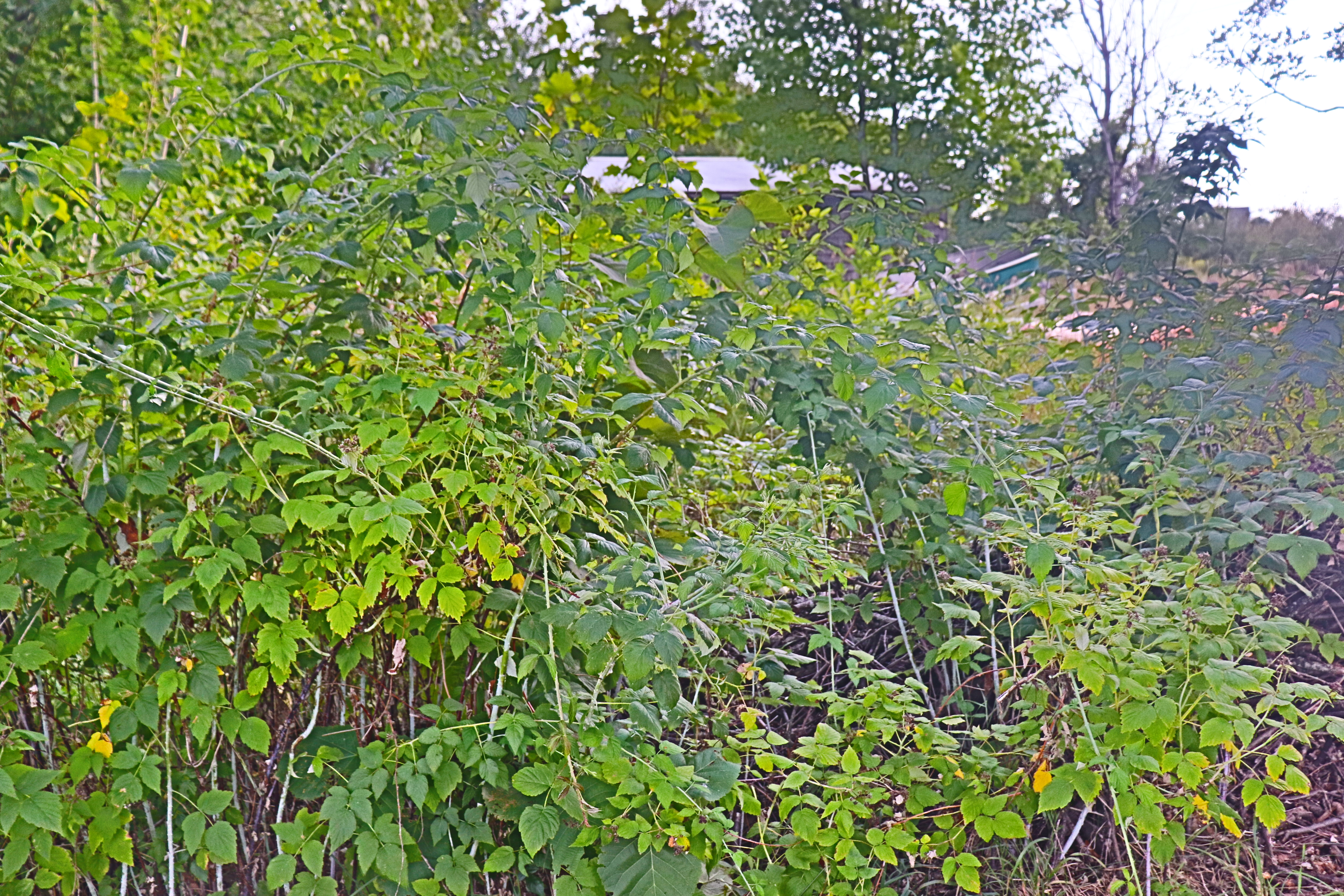
Yes, I mow the areas immediately around my old farmhouse, and yes, I prune my two apple trees and this year thinned the too-bounteous crop, but lest anyone conclude that I have a "lawn" and "landscaping," here is the truth of my rural life: there is plenty of wildness all around me, in very close proximity. The yard area that I keep mowed is predominantly but not at all exclusively grass, any more than the meadow can any more be called (what it once was) a hayfield. All areas, mowed and unmowed, are thick with wildness. Here is a partial list of plants in my immediate environment, not in any seasonal order, but as many as I could put together from observation and memory:


In my yard, besides grass, there are: common plantain, dandelion, escaped oregano (drat!), heal-all, clovers, autumn olive (UGH!!!), mouse-ear chickweed, prostrate pigweed, hawkweed (both yellow and orange), pokeweed (one isolated colony), wild grape (too much!), poison ivy (could do without that!), lots of purple violets (love ‘em!), smaller pussytoes (very cute!), broad-leafed helleborine (a weedy orchid), prostrate pigweed, cleared, hoary alyssum, wood sorrel, purslane, purple dead nettle, and probably much more. If I were really ambitious, I would try to identify all the varieties of grasses. Maybe someday.


In my meadow grow: various native grasses (I seeded those years ago), common milkweed (tons!), coneflowers (purple and little grey-headed), asters (all sizes and colors of asters: I seeded the asters and coneflowers), red clover, sweet white clover, soapwort (a.k.a. bouncing bet) alfalfa (from former hayfield days), Queen Anne’s lace, wild roses, blackberries, goldenrod, bladder campion, evening lichnis, daisies, daisy fleabane, wild lettuce, goatsbeard, black-eyed Susans, spotted knapweed (ugh!), autumn olive (ugh! I'm doing as much as possible to eradicate, but it is everywhere in the county and well beyond), cow vetch, bull thistle (goldfinches love the seeds), chicory, curly dock, ragweed, St. Johnswort, red osiers, wild grape, Virginia creeper, white baneberry, evening primrose, and sapling trees -- silver maple, green ash, black walnut, catalpa, black willow, mulberry, box elder, and aspen (a.k.a. popple). Often in the morning my puppy and I notice places where deer have bedded overnight. Recently I have discovered two healthy hawthorns, and there may be more. If not now, there will be in future, I'm sure.


At edges and in crannies are found: spiderwort, black raspberries, red raspberries, gooseberries, wild ginger, escaped dayliles and poppies, black walnut seedlings (too many!), staghorn sumac, alfalfa (from that old hayfield), evening primrose, autumn olive (again!), poison ivy (again!), more violets (both purple and yellow), naturalized daffodils, jewelweed (both pale and orange), evening primrose, buttercups, lamb's quarters, broad-leafed dock, common burdock, common mallow, wild mint, Virginia creeper, wild grape, and more sapling trees (see meadow list above).


There is a single tulip poplar in the shelter of the old henhouse, and a companion redbud nestled close to the tulip tree for years but has since disappeared. Another redbud, however, has now appeared in the former popple grove, near one of the black raspberry patches. Everywhere, all is in constant flux, changes apparent year by year, so that my surroundings look very different from the way they looked 22 years ago, when we first began living here fulltime, and that look in turn (going back further in time) was very different from the way things were when we still lived in Leland but David had his studio and I my garden at the farm. A tall catalpa stands where no tree stood in our early days here, while the dead but standing popple (what Westerners call aspen) that housed a bluebird family for two summers is now only a memory. Just this evening I noticed once again a wild apple tree on the aft side of the barn, an uncultivated tree that fruits as it will, undisturbed by intervention from me. Here, as Grand Marais, Michigan says of itself, there is "Nature in Abundance," no antiseptic monoculture.


P.S. There are more photographs, some of them closeups, over on my photo blog now. 


Wednesday, December 15, 2021

We Really “Go to Town!”

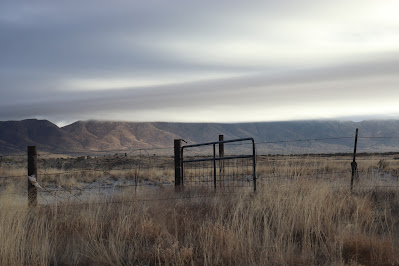
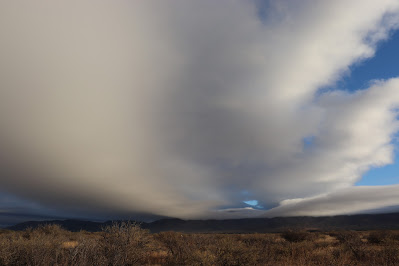
A rare cloudy day in southeast Arizona


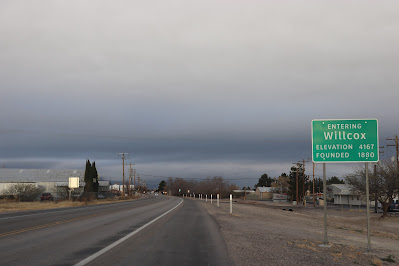
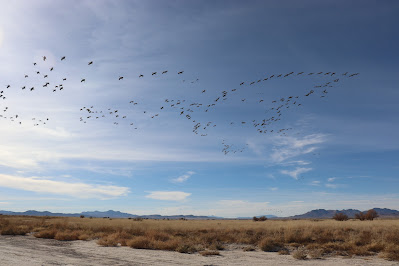
And it’s a rare day that we don’t go to town -- “town” for us, Willcox, only fourteen official miles from our winter ghost town digs in Dos Cabezas, though I think of it as fifteen miles, since we don’t do a lot on the outskirts. Well, other than stop at “the ponds,”  as we call them (Twin Lakes is the official name), to look for sandhill cranes or take the unpaved back road in to look for horses or stop at the animal shelter, where I hope to be volunteering when my background check is completed. 


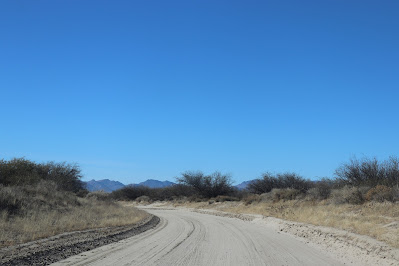
Sometimes we even take a much longer detour, just for the pleasure of the wilder scenery closer to the mountains. 


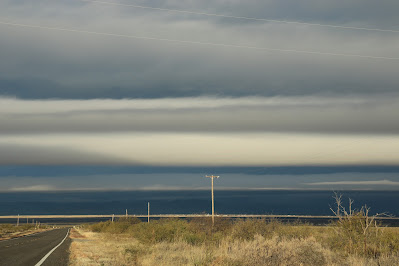
But either way, the 14-15 miles to town are never boring. Every day, every hour of the day, the scene is different, light and clouds making magic in the sky. It occurs to me that perhaps the clouds are so captivating here in the West not only because the sky is wide and uninterrupted by either forests or skyscrapers but also because the clouds look so soft, in contrast to the dry desert full of prickly plants and the sharp rocks of the mountains. 


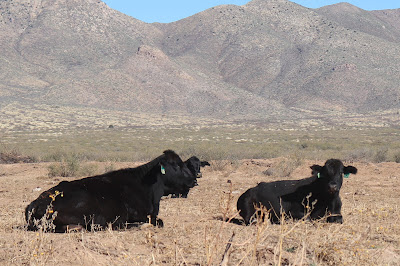
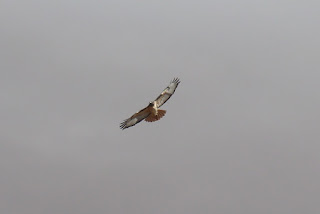
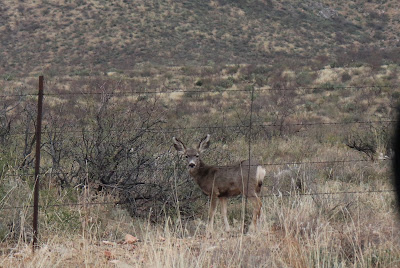
Hawks are a daily sight on the way to town, as are cattle. We don’t see horses every time (although I look for them every single time), and it’s exciting to sight a deer or coyote or javelina. The little deer below stood stock-still in the middle of the highway after its companion bounded across, and we stopped, also, gazing into its eyes before it wisely moved off the road. 


Another day, after a good night’s rain, we saw a young javelina drinking rainwater from the indentations of the rumble strip on the edge of the highway. 


The outskirts of Willcox are not, I’m happy to tell you, miles of malls and fast food joints. In fact, I usually refer to the area outside the city limits on the Dos Cabezas side affectionately as “man’s world.” There are well drilling businesses, body shops, sand and gravel and fertilizer dealers, stock watering tanks for sale, etc. To me, all this says that Willcox is a real place, where people work real jobs. One has a very different impression coming into town from one of the expressway exits (though only one of those has a couple of fast food outlets), and I feel sorry for and a bit impatient with people who think they have “seen Willcox” because they’ve stopped for gas just off the expressway. My particular favorite stop before we cross the railroad tracks from the Dos Cabezas side is the feed store. The eastmost expressway exit would bring you into town past the Willcox Livestock Auction, though, and that’s wonderful, also.


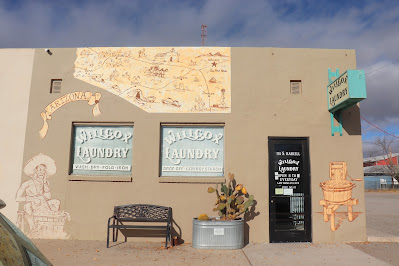
There are two feed stores and two grocery stores, two drugstores (one in the larger grocery store) and two barber shops, and a couple of thrift shops. There are maybe three banks, plus a credit union, although the bank I use (because it’s also in Traverse City,  Michigan) no longer has an open lobby but only an ATM. (For service from live human beings, it’s necessary to drive north to Safford in Graham County.) There are a couple of bars, but we haven’t been in either of them. Several wine-tasting rooms, but again, we have not imbibed. We have been to the Rex Allen Museum, and I recommend it highly! Naturally, there are motels, restaurants, and gas stations, as well as RV parks, but since we are not simply passing through but living here, more important to us are the laundromat, the library, and the post office.


"Cowboy starch" a regional specialty


There are a couple of large, well-stocked hardware stores and a little local hospital with ambulance or, if necessary, helicopter service to Tucson.


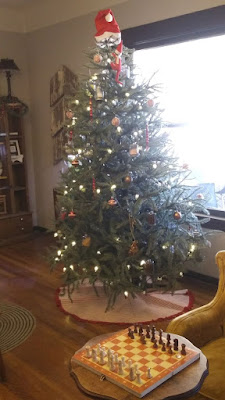
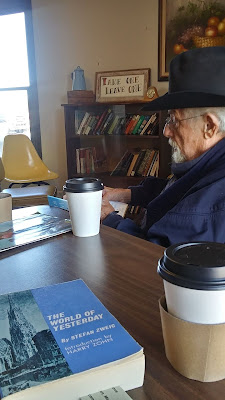
Last year there was an important addition to the town (and to our town visits) in the form of a new coffee house. On sunny, warm days we enjoy sitting out on the wide front porch, and when the wind turns cools it’s cozy inside. People meet to play chess, and there are shelves of books (to which we have contributed), where “Take one, leave one” is the policy. There is a little fish tank and, at present, a Christmas tree. Some very elaborate coffee drinks are available, though I get no fancier than a latte (just the flavor of coffee, thanks, no syrup added) or a double espresso, and there are cupcakes, “apple bites," and what I can’t help calling (in my mind, if nowhere else) pain au chocolat. –which reminds me that there is also a new bakery in town, and I need to try that soon!


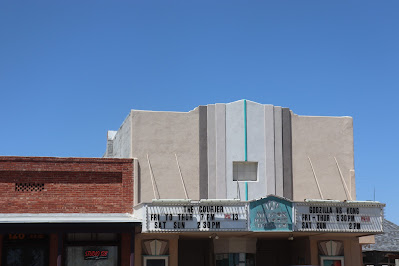
Willcox has a movie theatre, and we’ve seen some great shows there in past years. Right now I’m watching the marquee on a daily basis, eager for an evening show that would let us out into the magic of holiday lights strung on the trees of Railroad Park.


In short, the town of Willcox is a lot like Ralph’s Pretty Good Grocery in the fictional Lake Woebegone: if they don’t have what you want, you probably didn’t need it in the first place. Because believe me, I've left out quite a bit.


Books Read Since Last Listed


164. King, Thomas. A Matter of Malice: A DreadfulWater Mystery (fiction)

165. Thody, Philip & Howard Read. Introducing Sartre (nonfiction)

166. Samuels, Solomon K. A Life in Three Acts: My Journey From Wartime Burma to America (nonfiction)

167. Zweig, Stefan. The World of Yesterday (nonfiction)

168. Taylor, Rosemary. Ghost Town Bonanza (fiction)


To write an autobiography, it helps to have had an interesting life. Whatever the events of your life, however, telling your story in an interesting, readable manner is essential, and while bogus autobiographies and memoirs appear from time to time, the best are the stories honestly told by writers modest about their successes and not afraid to reveal their weaknesses. 


Is it more than coincidence that a good friend’s husband, Solomon K. Samuels, and a famous 20th-century author, Stefan Zweig, both saw their lives as divided into three parts? Samuels calls his book A Life in Three Acts, and Zweig’s working title for the story of his life, published posthumously, was Three Lives. In both cases, I thought it would take me a long time to get through these life stories, but in both cases, again, I sped through the chapters, thoroughly engrossed. There are personal achievements, as well as the horrors of war, in both books. The resolutions are very different. But both books are well worth reading, and I recommend them highly.


Peasy Tales (Briefly)


The dog without a tail, the dog with issues, our little Peasy, continues to enjoy life in Cochise County, Arizona, with his seasonally retired human folks and his neighborhood pack friends.