Search This Blog

Showing posts with label medicine. Show all posts

Sunday, October 11, 2020

Autumn Vacation Hours


[Late note: This should have been titled "Hours of Autumn Vacation," as the title I gave it sounds like bookstore hours, and that's not what it is. It istime stolen away from bookstore and housework and yard tasks to immerse myself in balmy autumn hours.]


It’s Sunday, and the sun is shining bright, and all over northern Michigan colors are popping. The Artist and I will be working outdoors this afternoon, preparing for a family visit and clearing the deck for visiting on Monday, rain or shine. Actually, the forecast for Monday is rain, with sunshine and clear skies to return on Tuesday. Whatever future days may bring, however, today’s post is a showcase for sunny days and the stunning colors of fall.


Friday, while Bruce manned the bookstore sales counter for me, I took the opportunity to take care of a couple errands down in Suttons Bay and then – oh, sybaritic escape! – took what remained of my New Bohemian CafĂ© chai latte and my dog and the novel I was reading down to the beach just north of the marina and sat there reading and looking up from time to time to note a sailboat out on the water or gulls huddled on the sand. Once in a while a gull would take wing and scream or laugh; other than that, the day was quiet and peaceful. 


I drove south and west in the county to see what I could see. Every prospect pleased. Back around the old homestead, asters in their stunning colors put a song in my heart. I was home, but I felt, just then, for a while, as carefree as if I were on vacation.


Not that my ordinary commute to Northport or time in the bookstore is a hardship. Here is some color from Leelanau Township and Dog Ears Books.


This morning, though, I vowed to pay full homage with my camera to the wonders of green ash leaves in autumn. While we have lost many mature ash trees in Leelanau County (perhaps the majority), enough remain to give some idea of the range of their subtle fall colors.


[Second late note: I haven't given you any idea at all of the range of colors of ash leaves. These all look yellow to brown. Where are the reds and purples?]


Going out to photograph ash leaves, I came upon an oddity that might have puzzled a newbie botanizer looking to identify a wild vine. Here is what I saw, and what do you say about it? 


If you realized that the wild grapevine had twined around the scarlet-leafed Virginia creeper, you are correct.


But pictures above show only the beginning of the northern Michigan fall color palette. Everywhere, overall, there is so much! 


Our eyes drink and drink, and still there is more! Lovely, lovely October in Michigan! What good medicine you are for our weary souls!


On Saturday afternoon a friend who dropped by the bookstore remarked on the soft, mild air we had enjoyed on Friday evening. “It reminded me,” he said, “of when I jumped ship in Caligari, Sardinia.” Oh, yes! Oh, yes! Wonderful, the associative leaps memory can make – and the delightful surprise of such a remark to the ear of a listening friend! 


Thank you, October! We needed you!


Tuesday, August 25, 2020

Tragedy, Determination, Victory, Hope

Lake Michigan

Water: source of life on planet earth, vital and essential to all living things
Children: the future of our species and whatever kind of society our species constructs

Quite frankly, I wasn’t sure I could stand to read Mona Hanna-Attisha’s book about the Flint water crisis, What the Eyes Don’t See. There are so many things wrong these days that it can be hard to sleep through the night and, when night is over, hard to face another morning. But I had to look into the first few pages, at least, and I always enjoy reading first-person accounts of childhoods, particularly when someone grew up in Michigan, and so I launched into reading the author’s prologue.

Then came the painful segue:

This is the story of the most important and emblematic environmental and public health disaster of this young century. More bluntly, it is the story of a government poisoning its own citizens, and then lying about it. It is a story about what happens when the very people responsible for keeping us safe care more about money and power than they care about us, or our children.

The crisis manifested itself in water – and in the bodies of the most vulnerable among us, children who drank that water and ate meals cooked with that water, and babies who guzzled bottles of formula mixed with that water. The government tried hard to convince parents the water was fine – safe – when it wasn’t. But this is also a story about the deeper crises we’re facing right now in our country: a breakdown in democracy; the disintegration of critical infrastructure due to inequality and austerity; environmental injustice that disproportionally affects the poor and black; the abandonment of civic responsibility and our deep obligations as human beings to care and provide for one another. Along with all that – which is a lot already – it’s about a bizarre disavowal of honesty, transparency, good government, and respect for scientific truth.

Stomach-turning. But none of it was news. The Flint water crisis, under the administration of Republican governor Rick Snyder, made national headlines while the “controversy” was going on (see here for a report on what the governor knew and a complete timeline of the crisis), and I mention the political affiliation of the governor because the story of the crisis does seem, unfortunately, typical of a party that used to be called “Grand.” The party’s history is one thing, its present reality something very different, not only in recent Michigan history but currently at the national level, “the very people responsible for keeping us safe care more about money and power than they care about us, or our children” destroying public education, cheaply selling off public lands and resources, rolling back environmental protections, giving the biggest tax breaks to the wealthiest Americans, threatening Social Security, doing everything possible to cripple the postal service (established by the U.S. Constitution they claim to worship) and to subvert the electoral process with de facto disenfranchisement. This is not the Republican Party of my parents. Of course, my opinion may not be yours. I realize that.


To be fair, I acknowledge that there was plenty of blame to go around and that one of Dr. Mona’s eventually winning team, much to her astonishment, water engineer from Marc Edwards from Virginia, told her he was a “conservative Republican." Edwards had become so disillusioned in his battle over contaminated water in Washington, D.C., however, that he was dubious about any speedy action -- or any action at all -- taking place in Flint, Michigan.

Anyway, as I say, I wasn’t sure I could handle reading the book about Flint right now. I mean, yet another environmental and human rights and government corruption nightmare! But surely I could manage the final couple pages of the prologue, I told myself, and here is where the subtitle of the book, A Story of Crisis, Resistance, and Hope in an American City, came into play:

Resilience isn’t something you are born with. It isn’t a trait that you have or don’t have. It’s learned. That means that for every child raised in a toxic environment or an unraveling community – both of which take a terrible toll on childhood development and can have lasting effects – there is hope….

Just as a child can learn to be resilient, so can a family, a neighborhood, a community, a city. And so can a country. A country can endure trauma and neglect and become a place where people are cared for, where democracy and equality and opportunity are once again encouraged and advanced….

The title, What the Eyes Don’t See, of Dr. Mona Hanna-Attisha’s book is so, so important! What the eye doesn’t see and the mind doesn’t know, doesn’t exist, wrote D. H. Lawrence in Lady Chatterly’s Lover. Numerous studies of perception have shown (e.g., “The Trouble with Eyewitness Identification of Testimony in Criminal Cases”), over and over, it’s all too easy for human beings – all of us – to see what we expect to see, much more difficult to notice something that conflicts with our expectations. This important lesson was impressed on Dr. Hanna-Attisha during her pediatric residency by Dr. Ashok Sarnaik.

…When discussing a case and trying to figure out a diagnosis, he watched us run through our limited supply of options, and he always criticized us for not reading enough and therefore not knowing enough, for not seeing the whole picture.

“How can your eyes see something,” he’d say, “that your mind doesn’t know?”

Lake Huron

Quick background for those who didn’t follow the Snyder link to find the timeline: The quick-and-dirty general story of Flint’s lead-contaminated water began in April of 2014, when the municipal water supply was switched from the Detroit, which used treated Lake Huron water, to the Flint River, “a toxic industrial dumping site for decades….” Although tap water from the new source looked and smelled and tasted bad, and the city recommended boiling the water before drinking or cooking with it, eventually an all-clear was sounded, and the State of Michigan declared it in compliance with safe water guidelines. General Motors, however, six months after the switch in water supply, was granted a waiver and allowed to return to the Lake Huron supply. Why? Flint River water was “too corrosive.” It corroded engine parts. Offices switched to bottle water. Family homes in Flint, however, despite rashes, hair loss, weight loss, and other more disturbing problems, were told their water was fine.

Fortunately for Flint residents, pediatrician, educator, and hospital researcher Mona Hanna-Attisha had a close friend from high school, Elin Betanzo, who had worked in E.P.A. during the D.C. water crisis, who shook her head at Mona’s question about Flint’s water supply being safe. “No,” she said. “It’s not.” 

She did not go looking for a problem or for a cause: the problem and cause came to her as a challenge she had to meet -- because she was a doctor, because her patients were children, because her family tradition was to stand up for others who were threatened. Her parents taught her well.

Dr. Mona, as her young patients call her, and Jenny LaChance, her research coordinator, had no funding for their initial study, and in the beginning, the two of them were the whole team. All they had was their education training, a devotion to children’s health, and obsessive determination to get their hands on the necessary data. 

I will not synopsize page by page, day by day, the story Mona Hanna-Attisha tells so capably and movingly in her book, weaving her immigrant family’s experience with an often heartbreaking but ultimately triumphant mission to secure safe water for the youngest residents of Flint, Michigan. And as I have said, the blame for the crisis cannot be laid solely at the feet of one political party. There were elected officials to whom re-election was more important than admitting the problem; officials who had no real power and saw nothing to be gained in rocking the boat; agency people afraid of being labeled trouble-makers and being forced out of their careers; and Flint’s problems had begun long before 2014.

But the author is clear about where she thinks blame lies:

If I had to locate an exact cause of the crisis, above all others, it would be the ideology of extreme austerity and “all government is bad government.” The state of Michigan didn’t need less government; it needed more and better government, responsible and effective government.

As I read about the shameful role of the MDEQ in this sad chapter of Michigan’s history, I couldn’t help thinking back to a former Republican governor John Engler, who eviscerated the Department of Natural Resources, breaking it up into smaller units to create the understaffed and politically vulnerable Department of Environmental Quality, the MDEQ that would have done nothing to protect Flint residents had not a few brave and determined individuals blown the whistle and backed up their whistle-blowing with hard-won facts and analysis until the danger finally became public knowledge. Many government officials and employees and agencies ignored the crisis as long as they could, even denied it when they knew better, but for anyone who thinks the answer is no government and the privatization of everything, please think about how much worse the crisis in Flint could have been without any accountability to an electorate. Governor Snyder had appointed a series of Emergency Managers to run the city of Flint, over and against its elected mayor, to save money, but the governor and his staff were still, ultimately, held responsible. Imagine a corporation in charge of providing water, cutting costs wherever possible to provide the best return to stockholders, with no one responsible for preventing harm to thousands of children living in poverty. Who would care?  

One of the several crises facing our nation today in 2020 is that of the coronavirus, COVID-19. And let’s be honest here: we are all tired of wearing masks, weary of keeping a six-foot distance between ourselves and our dear friends, and some of us (though there are a few exceptions, I realize!) very frustrated at not being free to hug anyone outside our close, limited bubble. But one of my favorite overheard remarks this summer came as a group of visitors to Northport were standing outside my bookstore window and looking at the sign thanking Governor Whitmer for keeping us safe, and one of the men said, “I’m a registered Republican, and I think she’s doing a terrific job!” 

Dr. Mona Hanna-Attisha is such a successful advocate for children because she has been able to build, from the initial nightmare facts, a program for going forward to build health and resilience in her patients and their community. The United States is in a bad place right now, and I have hope we can pull out of it and move forward together, but we desperately need thoughtful, informed, inspiring leaders with positive programs to bring us together and rebuilt our nation. Name-calling and scapegoating and whining, lying and denying and passing the buck -- that's not the answer. We've had that counter-productive program of destruction for four years. Enough is enough. 

And the book I didn't know if I could stand to read? I raced through it in two days, unable to put it down.

---

This, by the way, is my two thousand and tenth post on Books in Northport. The 2,000-mile marker slipped right by me, in the midst of everything else going on. Thank you, though, for staying with me all these years, those of you who have – and for joining me more recently, those of you new to Books in Northport. All readers welcome!


Wednesday, February 17, 2016

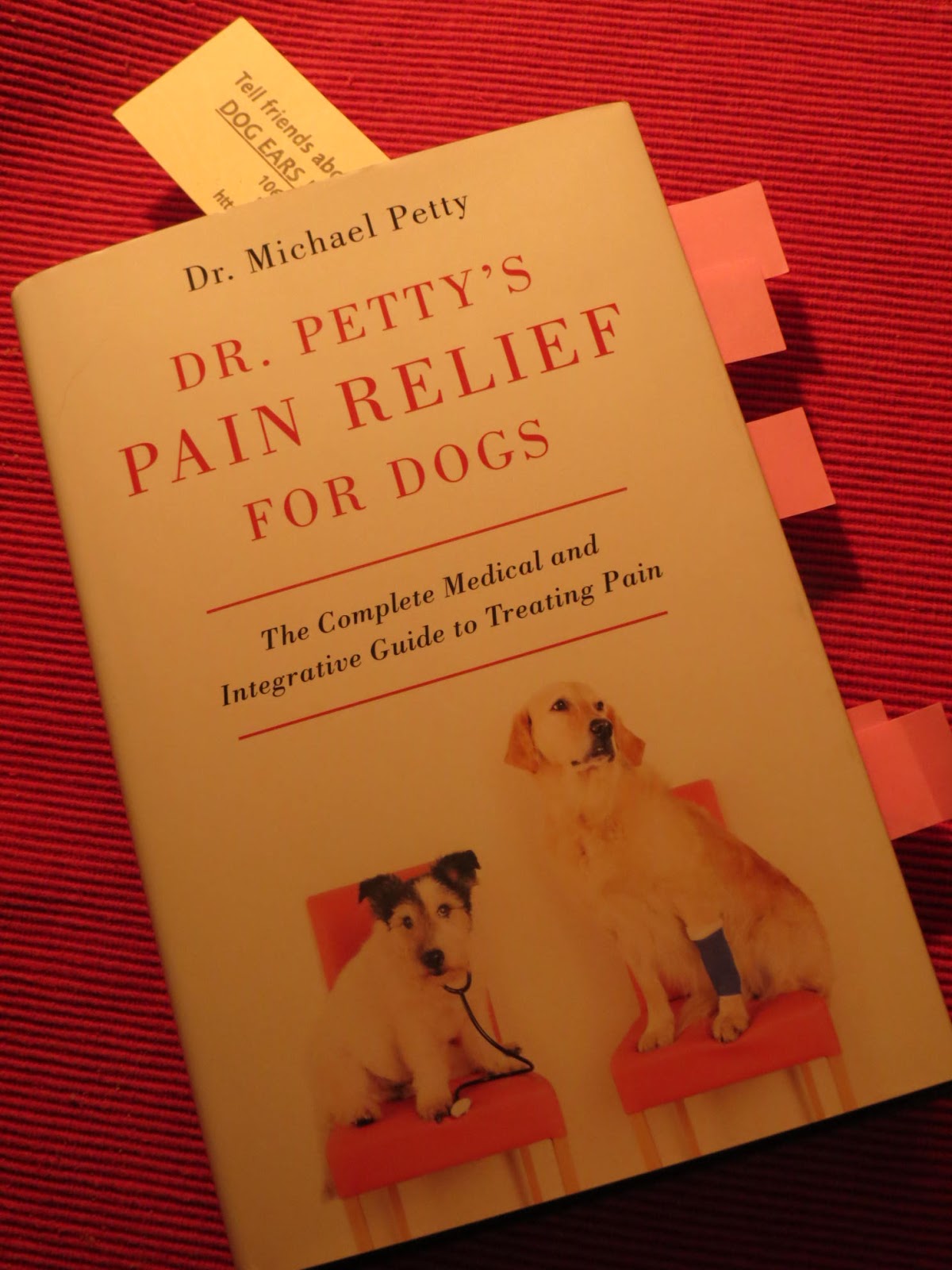
Book Review: DR. PETTY'S PAIN RELIEF FOR DOGS


Dr. Petty’s Pain Relief for Dogs: The Complete Medical and Integrative Guide to Treating Pain
by Michael Petty, D.V.M.
NY: Norton, 2016
Hardcover, $24.95

Dr. Petty’s Pain Relief for Dogs is NOT a do-it-yourself book. The author states very clearly – and more than once – that no book, even his own, is a substitute for having a dog examined and treated by a qualified veterinarian. What he offers is an informative survey of various causes of pain in dogs, treatment options professionally available, and special care owners can provide. Primarily, the author is concerned that dog owners realize: (1) that dogs do feel pain (he thinks they may feel it more than we do, and he explains why); (2) that there are usually ways that pain can be relieved; and (3), that pain treatment does not have to lead to bankruptcy.

Just as the paternalistic model of medicine has been rejected, Dr. Petty rejects paternalistic veterinary care. He believes owners can and should be informed – about causes of pain, possible treatment, and expected outcomes – in order to be partners with veterinarians in decision-making for their companion animals.

Each reader of this book will be struck by different facts not previously encountered elsewhere. One that hit me between the eyes was the reference to a 1997 Lancet article on a study of infant response to pain subsequent to neonatal circumcision. It was long believed that any pain during circumcision was minimal and brief – over, done with, not registered as memory. A 1995 study showed something very different. One group of neonates was circumcised with local anesthetic, a second group without anesthetic. At their four-month and six-month vaccinations, it was found that babies circumcised without anesthetic had an increase in pain response compared to the group circumcised with the local anesthetic cream. The name for this effect is hyperalgesia: untreated pain can be responsible for physiological changes that intensify subsequent pain. Naturally, Dr. Petty’s concern is what this finding means for treating pain in dogs, but the finding itself is fascinating and would seem to have important broad consequences.

The chapter order in the book is logical, and illustrations are helpful in clarifying text. For example, in the chapter on acute pain, illustrations show how to make an emergency muzzle (to avoid being bitten by an injured dog trying to protect itself) and how to pick up an injured dog. In the following chapter on chronic pain, we are shown (from the side) the typical stance of a pain-free dog, followed by a contrasting image of a dog suffering from hip dysplasia. The first dog stands with front feet directly under shoulders, the second with front feet farther back to ease pressure on weak hips. The difference is obvious once it is pointed out.

I particularly appreciated Dr. Petty’s discussion of acupuncture, both the general explanation of how it works (briefly, by enhancing natural pain-inhibitory signaling, but Chapter 9 gives a longer, more detailed explanation) and the author’s clear statement, “I can’t think of a single type of pain that won’t respond, at least in part, to acupuncture.” Possibly skeptical readers should know that the type of acupuncture the author advocates and practices is based on modern Western medicine-based research and has nothing “mystical” about it.

In sections on various other therapies, including botanical remedies, the author gives his own best assessment, based always on serious research rather than product claims or anecdotes from convinced customers. There is even a chapter frankly titled “Pain Relief Therapies Best Avoided,” in which the doctor pulls no punches.

Whether he is providing pharmaceutical or physiological explanations, recommending stretching exercises, or advising on the choice of dog bed or socks, Dr. Petty’s voice as it comes through his writing is authoritative caring, and conversational. As a reader and dog owner, you trust him. And then he makes you laugh. Cookie stretches! Those are great! (You have to read the book to find out.) He also includes helpful appendices, endnotes, and – hallelujah! – an index.

There was one analogy in Chapter 6 that I had some trouble getting my brain around at first. The author compares the pain pathway -- from nerve endings to the spinal cord and eventually to the brain – to a commuter returning home at the end of the day. My problem with the analogy was that it is, presumably, desirable that the commuter reach home, whereas relieving pain requires not allowing pain signals to reach the brain but instead blocking them from that natural destination. Re-reading made the point clear, but it would have been clearer from the beginning if the person in transit in the analogy had been someone the reader wanted to prevent from reaching his destination – say a terrorist or other criminal.

Also in the same section there is passing reference to “agonist action on receptors.” Readers with background in medicine, philosophy, or classics will not pause in perplexity over “agonist,” but other readers may, and a parenthetical definition would be helpful at that point.

But overall, and all in all, Dr. Petty’s Pain Relief for Dogs is highly readable and informative. I learned a lot and recommend the book highly. I know that as our Sarah ages, I'll be using some of the knowledge I gained from the good doctor.

Now here’s the surprise I’ve been saving all along: Dog Ears Books will probably have the honor of hosting Dr. Petty this summer in Northport! Maybe (depending on his book tour schedule) on Dog Parade day! I’ll put a notice on the blog as soon as we fix on a date, but contact me any time to order the book now (to read and bring with you to his event for signing) or to reserve a signed copy for purchase on the day of the event.

P.S. 5/25: Dr. Petty will be at Dog Ears Books on the day of the dog parade, Saturday, August 13, from 1 to 2:30 p.m. He will give a short presentation and take questions from the audience before signing books for customers. We're excited!!!

So start now making notes of what you want to ask he doctor. This will be a very special opportunity – and a memorable one, I’m sure -- for Dog Ears Books customers.


Thursday, June 11, 2015

Book Review: BEING MORTAL


Being Mortal:
Medicine and What Matters in the End
by Atul Gawande
NY: Henry Holt/Metropolitan, 2014
Hardcover, $24

I learned about a lot of things in medical school, but mortality wasn’t one of them. ... Our textbooks had almost nothing on aging or frailty or dying. How the process unfolds, how people experience the end of their lives, and how it affects those around them seemed beside the point. The way we saw it, and the way our professors saw it, the purpose of medical schooling was to teach how to save lives, not how to tend to their demise.
So begins Gawande’s latest book, important and well worth reading, as his writing always is, and particularly relevant to individuals in what the French call the “third age” of life (think of the riddle of the sphinx) and those who are or soon will be caring more and more for that generation as time brings about the inevitable.

Every doctor, every nurse, sooner or later must confront death, but Gawande notes that until recently few in modern medicine were given tools to deal with the situation. Instead, American medical training has focuses on testing, recording, gathering facts, prescribing drugs, and offering patients an increasing number of choices among an array of procedures with hoped-for but unclear outcomes. Death was the elephant in the living room, the one everyone knew was there but no one wanted to mention.

Medical costs in the final year of life are astronomical, as everyone knows but equally unfortunate (perhaps worse), Gawande believes, is the harm inflicted when people are “denied ... the basic comforts they most need.” And “basic comforts,” it turns out, are more than food and shelter and safety.

The most frequent complaint Gawande hears from nursing home patients is, “It just isn’t home.” However homelike in appearance (appearances often geared to appeal to residents’ adult children rather than residents themselves), in most facilities designed for care of the frail elderly, residents lack the privacy and autonomy most of us take for granted all our lives.

Gawande traces the history of the “assisted living” movement from its origin in the vision of a West Virginia coal miner’s daughter. When Keren Brown Wilson’s mother, Jessie, needed help with the basic tasks of living, there was nowhere for her to go but a nursing home. The daughter, a college student at the time, never got over her mother’s frequent plea, “Take me home,” and because of those pleas, Keren Wilson developed an interest in issues related to aging and eventually earned a doctorate in gerontology. What her mother had in mind for “home” was not a place designed for her health and safety (placement considerations important to most children of the elderly) but a place where she could be herself again, not a patient, but Jessie the person. Dr. Wilson wrote a paper to outline what such a place might look like.
The key word in her mind was home. Home is the one place where your own priorities hold sway. At home, you decide how you spend your time, how you share your space, and how you manage your possessions. Away from home, you don’t.
For a variety of reasons, Wilson’s original idea became diluted beyond recognition as “assisted living” facilities popped up all over the country, but Gawande visits and describes a few places where privacy and autonomy, key to Wilson’s original vision (rather than regimentation) are the rule.

Paramount at every stage of aging, whether or not it involves terminal illness, is “how to make life worth living when we’re weak and frail and can’t fend for ourselves....” What makes life worth living will vary from one individual to another, and the point of the “hard conversations” with family members and medical staff is to determine, in each case, what makes life worth living to this particular individual. For one man, being able to eat chocolate ice cream and watch sports on television was enough. “My dad,” Gawande tells us, in one of the passages focusing on his own experience with his frail, aging surgeon father, “didn’t think that would be good enough for him at all.”

Not surprisingly, there is a lot in Being Mortal about hospice and palliative care. The idea of offering “concurrent care” actually came from an insurance company. Instead of having to choose between hospice and other treatments, policyholders with less than a one-year life expectancy could continue their regular treatment and receive hospice care. Since they did not have to give up anything, enrollment in hospice jumped from 26 to 70 percent. More surprising were some of the other results:
They visited the emergency room half as often as the control patients did. Their use of hospitals and ICUs dropped by more than two-thirds. Overall costs fell by almost a quarter.
Gawande cites a 2010 study from Massachusetts General in which patients with stage IV lung cancer were randomly assigned to two different groups.
Half received usual oncology care. The other half received usual oncology care plus parallel visits with a palliative care specialist ... The result: those who saw a palliative care specialist stopped chemotherapy sooner, entered hospice far earlier, experienced less suffering at the end of their lives—and they lived 25 percent longer.
In other words, not only was it cheaper to add hospice care to other treatments, but terminally ill patients lived longer, had fewer emergency incidents, and their quality of life was higher. Gawande attributes much of the difference to the open conversations that hospice encourages and the focus of its staff on the person and his or her individual values and goals rather than on hope for recovery.

Conversations about end-of-life choices, he admits, are not easy. They take time and may “unleash difficult emotions” for all involved. In the end, however, they can make all the difference. The battle analogy he uses to make his point comes from the 19th century and pulls no punches:
Death is the enemy. But death has superior forces. Eventually, it wins. And in a war that you cannot win, you don’t want a general who fights to the point of total annihilation. You don’t want Custer. You want Robert E. Lee, someone who knows how to fight for territory that can be won and how to surrender when it can’t, someone who understands that the damage is greatest of all if all you do is battle to the bitter end.
The author of Being Mortal shares with readers not only his medical experience and the fruits of his research into how society deals with aging and dying, but also his own personal story, that of a loving son distressed to see his father losing ground.

My only wish – I will not call it a complaint – is that an index would have been helpful. I highly recommend this book.


Monday, March 24, 2014

The Apples Have Always Been Rolling


Someone dropped off bales of hay for the deer

I am being led to a conclusion can only be provisional at this stage, but what I’m thinking is that the world of publishing and bookselling, at least as far as the English language is concerned, has always been in a state of upheaval. One historian wrote the following in 1889, reflecting on the English book world of the 1500s:
In prosecuting an inquiry into the general state of bookselling just three hundred years ago, a frequent and not altogether explicable circumstance is that in relation to the different imprints which appear in some cases in the same year on one work. There was practically no such thing as copyright; and the moment a manuscript left the author's hand, and found its way into the printing-office, all claim on the part of the author ceased. If one bookseller had sufficient confidence to publish a poem or a play, and it proved successful, the chances were a thousand to one that rival tradesmen would offer rival copies. – William Roberts, The Earlier History of English Bookselling, 1889
Now, you know those warnings on DVD movies about piracy not being a victimless crime? It isn’t a new crime, either. Nor was it the only concern in the book world of the sixteenth century. As might readily be imagined – and, in fact, as we all learned in our history lessons back in high school – the introduction of the printing press brought challenges to political and religious authority. If ordinary people became literate and could read the Bible for themselves, what was to stop them from interpreting it for themselves? From thinking for themselves on all matter of questions?

For example, parallel to revolutions in politics and theology came a revolution in medicine, the idea that every literate Englishman might be “his own doctor.”
Just as the publication of the Bible in the vernacular eventually made ministers redundant, by selling printed matter that enabled every man to become his own doctor, which the title of one publication proposed, London bookmen undermined the legal monopoly of the traditional medical establishment and assured the success of its challengers. – Elizabeth Lane Furdell, Publishing and Medicine in Early Modern England (University of Rochester Press, 2002)
The bare notion of medical books being published in English rather than Latin was deemed dangerous by many in the Royal College of Physicians of London, those Furdell refers to as the “philosopher-kings of medicine” of the time, although Sir Thomas Elyot, author of Castle of Helth [sic], published in 1543, defended the practice by bidding his critics
“...remember that the Greeks wrote in Greeke, that Romaines in Latin, Avicinna and the other in Arabick, which were their owne proper and maternall tongues.” – quoted in Furnall, ibid.
Sixteenth-century medical books for the general public included botanicals, herbals, astrological treatises, recipe books “with lists of ingredients and directions for usage,” the line between cooking and preparation of remedies blurred in literature as well as in practice.

In early modern England, the “author” of a book (especially a foreign author whose work might be translated and published without his permission, let alone any remuneration) had little standing unless he were also a printer, and a printer might begin in a small way and work up to maintaining his own bookshop -- vertical integration at the very birth of the business of publishing and bookselling! Publishers of medical books often sold the remedies, also, in their combination bookshop/drugstores. Self-publishing and one-stop shopping!

Rivalry among printer/publisher/booksellers was fierce, too. Any “stationer” could record the name of a work (this had to be done in person) in the books kept at the Company Hall of the London Company of Stationers (“a union of printers, booksellers, bookbinders, and a few paper merchants”), which was chartered in 1557 to self-police the book trade. Along with recording the work, the union “stationer” paid a fee to register it, thus effectively blocking anyone else from publishing it, and not surprisingly cutthroat practices developed, such that “an ambitious printer ... registering a sweeping series title for anticipated books” could block rivals out of an entire topic or category.

Who owns a name? Today’s copyright and patent wars are nothing new; they have roots at least as far back as the sixteenth century.

Picture a struggling bookseller of the 1500s -- burdened with a large capital investment in printing presses, threatened by jealous physicians and clerics, harassed by government censors, set about by unscrupulous rivals – did he manage to get any sleep at all? Or did she, in those cases (and there were several) where a wife inherited her husband’s printing business and continued it herself, sometimes marrying a young apprentice printer to share the work?

The Charles Dickens biography I read recently shed a little light on nineteenth century practices, both in England and in America. Dickens had his first success, Pickwick Papers, with the publishers Chapman and Hall in London. Robert Seymour, a caricature artist, had suggested a series of sporting plates to Mr. Chapman, and Mr. Hall invited Dickens to contribute “letter-press,” or text to accompany the illustrations. The serial publication of the work was a flop (the publishers nearly abandoned it after a few numbers), but Dickens had a huge success from the subsequent book. Dickens received £2,500 and a share in the copyright, while the publishers’ profits were over £20,000. Thirty-two manuscript pages of Pickwick sold for $775 in 1895, according to Leacock, and for $35,000 in 1928. What would those pages bring today? Of course, Dickens did not see these later amounts, but he was even in his day a rich man, made rich by his writing, though others did the printing, publishing, and selling of his work.

To return to the knotty business of piracy-- the United States in the nineteenth century, at that time a young country, had no respect whatsoever for copyrights issued overseas, and Charles Dickens was terribly affronted by the publication of his works in America, earning him no royalties. In fact, while his first American tour began with loud, effusive mutual admiration and gratitude, Dickens and the Americans seeming completely in love with one another, the longer the tour went on, the more Dickens found the issue of nonpayment of royalties rankled. According to Leacock, along with slavery and tobacco-spitting it formed a triumvirate of offenses committed by the former colony.

(When did American publishers first begin paying royalties to foreign authors? The first step in that direction was the Copyright Act of 1891, but I seem to remember, vaguely, that one prestigious American publishing house was ahead of the curve, making a corporate decision to do the right thing before they were forced to it. The question is, which publisher was it? I don’t recall and am too impatient to keep searching for the answer this morning.)

Sometimes in my random reading, an unintended theme emerges, and so it has been this March. Discovering the English travel writer Norman Lewis (I have yet to read any of his novels), I find myself following a minor thread in his book The World, The World, namely, his relationship, and those of a few others, with his publisher Jonathan Cape. In 1948 Lewis took a novel to Routledge, where a friend of his regretfully told him it was “publishable ... but perhaps not for us.” It was suggested that he try Jonathan Cape, then the top of the English publishing world.

Here is one bit I liked: One man’s way of sorting through manuscripts was to read a few pages and then, if those pages passed muster, to set the manuscript aside to take home. This man read about ten manuscripts a week. The method of the second man was to read the first page of the manuscript, two or three at random from the middle, then the end, taking only about fifteen minutes at the task. Lewis remarks that he was fortunate in the pages Daniel George read from the middle of his own work. He was also fortunate in his contract with the publisher, apparently. Not so fortunate had been Mary Webb, as Lewis relates.

The publicity campaign for Webb’s Precious Bane is a story in itself (did Jonathan Cape invent hype in the 1950s?), but her treatment at the hands of her publisher were of a very different order. Sensing a bestseller, Cape bought up copyrights for Webb’s previous “near-flops,” which in the wake of Precious Bane “shared enough of the limelight to become commercially viable,” but then refused to pay “anticipatory release” of royalties.
She remained short of cash and her appeals for loans were turned down. Jonathan refused to see her and his deputy Wren Howard put her off and got his face smacked. By this time her health was failing. She was reduced to keeping a flower stall on Shrewsbury market, and with her books selling by the thousands – as they continued to do for many years – she died in near poverty. – Norman Lewis, The World, The World  (NY: Henry Holt, 1997)
Scraping along as a flower-seller until her death in “near poverty” while her books were selling “by the thousands”! There is a story! The prize studs in Jonathan Cape’s stables were T. E. Lawrence and Ian Fleming, and it was through Fleming that Lewis came to meet Ernest Hemingway, whose first book Cape had published. Mary Webb, it seems, was only the goose roasted for the others’ Christmas dinner.

A blink in time's eye
My point in all of this is simply that there probably has never been, since the beginning of books printed, published, and sold in the English language, any time when the book trade was settled and secure. Self-publishing is not new; vertical integration is not new; public desire for direct access to medical information is not new; piracy is not new. 

We tend to think of the constant change and reshuffling of our own time as the upsetting of a long-stable apple cart, but the truth seems more like a continual upsetting over the course of more than five hundred years. 

All God's creatures scrabbling to make a living --


Monday, October 7, 2013

My Brain is on FIRE!


On last Wednesday morning's walk

Up early in the dark on Sunday morning, habit too strong to let me “sleep in,” I read through the last few chapters of the first half of Pride and Prejudice, making notes for the discussion I am to lead on Tuesday night, and then picked up a book I haven’t had time to open in the last two busy weeks, Farmacology: What Innovative Family Farming Can Teach Us About Health and Healing (NY: William Morrow, 2013), by Daphne Miller, M.D. A review in Acres USA brought this book to my attention, and it sounded like a must-have for my bookstore’s section of new titles in agriculture and gardening, so I ordered two copies a few weeks back. Now I feel the same way I did the first few weeks of my freshman year in college, learning huge amounts at a tremendous speed and seeing connections everywhere. But let me begin at the beginning of Sunday morning.

Wow! I had trusted the book would be interesting but hadn’t expected to meet my old friend (no, we’ve never met; I only know his work) Wendell Berry on the very first page. Only a few pages further in – by page 8, to be precise -- my head was humming like a basswood tree full of honeybees, when the author, through a chance encounter with a little book called The Soul of Soil, recounts how she began wondering if principles for rejuvenating soil could be applied to human health. When a presenting medical problem is simple, she writes, the focus of the physician can be narrow and simple, as well. “But most of the time our health needs are more complex and dynamic” --. I stop in my tracks mid-sentence, my own mind italicizing the words “complex and dynamic.” Associations to into high gear, branching out in surprising directions, and I have to put the book down to give myself time to catch up and slow down again.

This fall I’m taking a non-credit class in beginning drawing, the first art class I’ve ever taken in my life, and in our second session the instructor gave us exercises to do to move us from our left to right brains: “The left brain does not like complexity,” she told us, so when we embark on a complex drawing without recognizable, nameable parts, by attempting to copy a line drawing while looking at it only upside-down, the left brain “will give up and get out of the way.” When the left brain “gets out of the way,” we can no longer rely on pulling stored symbols out of memory but must concentrate on shapes, lines, and relationships, actually seeing rather than thinking about what’s in front of us. (And yes, the instructor, Elizabeth Abeel, does draw heavily from the Betty Edwards book, Drawing on the Right Side of the Brain.)

You see the connection? Miller writes that most of our health needs are “complex and dynamic,” and I hear my drawing instructor saying, “The left brain does not like complexity,” and I see monoculture and pesticides, along with restricted diets, antibacterial cleaners, prescription drugs and supplements as left-brain “solutions,” spawning in their wake myriad new problems because they fail to address the real-world complexity. Miller’s mention on the same page of “reductionist medical training,” the conceptual division of the body into parts for focused study and diagnosis, brought to my mind Bergson’s intellect/intuition distinction, the intellect being our problem-solving, “engineer’s” brain, conceptually breaking reality into parts and often gaining a practical advantage by doing so but making a mistake by believing the analysis has uncovered a deeper reality. The tools created by analysis (i.e., reductionist thinking), Bergson insisted, must always misrepresent reality in order to make its manipulation possible.

Miller contrasts reductionist with holistic, Abeel and Edwards draw the line between left and right brain, and Bergson distinguishes intellect from intuition. I'm only on page 8 of Miller's book, and my head is already reeling, as Wendell Berry and Henri Bergson and drawing and seeing and soil and farming show themselves as always-already aspects of one great whole.

I need to pause here and make it clear that neither Bergson nor Miller would have us do away with intellect or analysis. We need intellect and its work. We must always remember, however, that “the map is not the territory," and that there will always be more to reality than the most minutely painstaking analysis can show.

Back to the rest of Miller’s show-stopper sentence, but let me begin again at its beginning:
But most of the time our health needs are more complex and dynamic, just like the soil, and most of what ails us today – depression, anxiety, diabetes, heart disease, fatigue – is multifactorial, chronic, and not well served by a static and highly focused approach.
“Static” is what analysis gives us. Snapshots. But life is never static, as Bergson insisted over 100 years ago. We are not machines. We are not laboratory creations but living beings – as Wendell Berry reminds us over and over, creatures of the soil.

I want everyone I know to read this book – farmers, medical workers, office workers, parents of young children and older, retired people. “Can’t afford” fresh local produce? I saw a great bumper sticker not long ago: “You can either pay the farmer or pay the doctor.”

This is what happens when one lives surrounded by books. What did Christopher Morley’s old bookseller character say about books being more explosive than dynamite, by virtue of the ideas in them?

Meanwhile, the list of recent topics I have yet to cover here in “Books in Northport” grows ever longer: “Leelanau UnCaged,” visiting poets (Fleda Brown, Arturo MantecĂłn, and Mark Statman), and soil erosion are the three on the top of the list, unless, that is -- exciting as those topics are -- they get bumped down the line by yet another glorious streaking comet of written excitement that I can’t wait to share. Would it be possible to combine topics and do a post on “Poetry and Soil Erosion”? Possible, surely, but the result would probably too long to hold readers to the end....

Field corn drawings from 2012 stillness project
Well, what is happening in the countryside these days? Farmers who got in their field corn before the last few several days of drenching rain are undoubtedly happy. It’s bow season for deer; how is that working out in the rain? Visitors come Up North for fall color have surely been gratified by its beginning, despite the wet weather, and weather remains warm, so even annual flowers are still bright and lively. 

Ever in motion, ever complex, ever fascinating, the world brings us every day new joys and challenges, painful shocks and delightful surprises. Drawing and writing, we create a record of time that will never, in today’s specificity, return.