Search This Blog

Showing posts with label horses. Show all posts

Wednesday, August 23, 2023

Home and Heroes

I live in northwest lower Michigan, but for me that is not a single place. My official homestead residence is in Leelanau Township, the northernmost of our county’s township divisions. Tell that to my new phone, though! It keeps identifying my photographs near home as having been shot in Leland Township. Wrong! Trust my camera and me instead: the camera doesn’t try to be smarter than I am.


I live in an old farmhouse with a dog, but I also live outdoors (with the dog), working in the yard, going for long walks, noting the passing seasons in signs like the ripening of chokecherries and the way Queen Anne’s lace blossoms curl up into little brown birds’ nests come late summer.


During my working days, I live in my place of business, of course, the bookstore that was 30 years old in July. It wasn’t always in the same location (I’ve been in four different buildings in Northport), but whenever it’s moved I have kept the basic arrangement of books more or less the same, so there is a familiar continuity from one place to the next, and my current location has been home to Dog Ears Books since – can it really be since December 2006? Seventeen of my 30 years???


On a long drive across several states, a vehicle becomes a “mobile home,” even if it’s only a two-door sedan. A van, of course, holds even more, and on a good trip one comes to live in it (or two or more live together in it) with the feeling of being at home even when not stationary (though some days are more comfortably homey than others). Over our years in Leelanau County, the Artist and I enjoyed many a “county cruise,” as he liked to call our Sunday expeditions or slow summer evening drives down to Maple City for pizza or Cedar for ice cream. We could have found pizza and ice cream in Northport, but after being in situ all day we enjoyed the leisurely changing scenery of favorite back roads, and we sought out horse farms for the pleasure of seeing beautiful animals. 


But (my point is that) wherever the Artist and I were together felt like home to me. There was one unhappy night during our otherwise joyous time in France when we wished ourselves elsewhere, but that was due to a flat tire in the rain on a narrow road and a strangely (uniquely) unsatisfactory meal. By the time we ditched the offending rental car in Fontainebleau the next day and were on the train back to Paris, everything was fine, and once back in Paris, we were “home” again. Here is an old post I found with thoughts on travel and home


During winters in Cochise County, Arizona, the Artist surprised himself one evening when we returned to the cabin and he remarked, “It’s good to be home.” It was only a rental, but over time it filled with our own things – art on the walls, bookcases filled with books, kitchen items and linens and cowboy boots and hats picked up here and there – so that it did, indeed, come to feel like home to us. We had routines there, we had pleasant neighbors….


All earthly homes, after all, are temporary, are they not?


Anyway, as you know if you’ve read this blog before, (and as you might guess, anyway, knowing that I have a bookstore), I also live in books. Recently reading Horse, by Geraldine Brooks, I lived multiple lives stretching from 1850 to 2020, and now, nearing the last pages of Confederates in the Attic, by Tony Horwitz, late husband of Geraldine Brooks, I am traveling through the South and meeting people I never would have met in my own “real” life. Both these books have my highest recommendation. I’m not sure everyone would respond to them exactly as I did, however. 


Would other readers tremble as they turned the pages of Horse, and would their eyes fill with tears, not only over certain passages when a human or equine character is in danger or difficulty but nearly all the way through the book? And was my reaction influenced by the knowledge that Brooks had begun the novel before her husband’s sudden, unexpected death and finally returned to it as she worked through her grief at his loss? Ah, but I loved the story, and not only for its horsiness, though that was certainly part of the appeal. 


At least one reviewer felt that the author had made the characters of Jarrett and Theo, both young black men, too good. As a white female writer (Australian to boot), Brooks knew some people would fault her for trying at all to portray the inner life – thoughts and feelings – of black men, particularly the 19th-century life of enslaved Jarrett but also that of modern mixed-race Theo. But if writers only wrote characters like themselves, literature would be a rather barren field, wouldn’t it? And isn’t it strange that fictional characters might be seen as too good


I can’t help feeling that the “too good” judgment says more of our times than of the author’s choices. There are many kinds of heroes in literature, after all, and not all have to be tragic heroes, brought down by a tragic flaw. They certainly don’t all have to be anti-heroes, either, I hope! Read through this list and see – if you’ve read Horse, and if you haven’t yet, then get on it right away! – what kind of hero you might call Jarrett or Theo. Or not heroes at all? Then, why not? Another question here: Does the 21st century accept everyman or classic heroes only in fantasy fiction? That seems sad.


In Confederates in the Attic, Tony Horwitz tours historic Civil War sites in ten states and learns just how alive the Civil War still is for many Southern groups and individuals, their cast of heroes and villains very different from that of Americans in other parts of the country. That is, while I don’t recall being taught in my Illinois education that any of historical persons of the 1860s (other than anonymous slave-holders) were exactly “villains,” Illinois as the “Land of Lincoln” certainly saw Abe as a hero and martyr. Yet I always had my doubts about Sherman’s march to the sea, which appeared to me somewhat like America’s dropping atom bombs on Hiroshima and Nagasaki, the argument in both cases being that the wars came to a close sooner, thus saving soldiers’ lives. Killing civilians, including children, to save men in uniform, though, never sat right with me. And who knows when or how the Civil War and World War II might have ended without those civilian atrocities? 


Joseph Campbell, in Hero With a Thousand Faces, identified a universal hero myth, in which the protagonist leaves home, has transformative adventures, and eventually returns, changed and triumphant. I wonder about this. I’ll go along with the adventures – challenges to be met, adversities to be overcome – but is life really that much like baseball, with return to home plate the only possible good outcome? I see that homecoming can be a good way to bring a life to wholeness, but I question whether or not it is the only way. Some of us whose families have not been established in the same place for generations are fortunate, as I have been and as John Denver was, to “come home” to a new landscape and to create memories there in whatever time we have.


One man Tony Horwitz spent time with, in a little Southern crossroads called Sutherland Station, lived in the same building where he had been born. It had been a general store when his parents were alive.


We sat on the porch, spitting watermelon seeds and watching traffic pass on the busy new highway bypassing town. I told Olgers about my journey and asked why Southerners like himself revered the past. “Child, that’s an easy question,” he said. “A Southerner—true Southerner, of which there aren’t many left—is more related to the land, to the home place. Northerners just don’t have that much attachment. Maybe that means they don’t have as much depth.” He paused, then added, “I feel sorry for folks from the North, or anyone who hasn’t had that bond with the land. You can’t miss something you never had and if you never had it, you don’t know what it’s all about.”  


Someone who has never traveled 100 miles from home, I guess, can be forgiven for imagining that people in other parts of the country are not attached to their home ground. Certainly Wendell Berry has a bond with the land of his Kentucky farm, but I know people here in Leelanau County, farmers or not, with similar feelings. “I’ve come home,” one young woman told me just the other day. She had lived away for a few years but has returned now to the house her grandparents lived in when they farmed the land. And the now-vanished log cabin site I visited only the other day housed an early generation of a family many of whose members (though not all) lived and died not far from those beginnings.


My personal story is that of more restless Americans: father born in Ohio and mother in California, they married in Chicago, and I was born in South Dakota, later to grow up in Illinois where my younger sisters were born. Our family started camping in Michigan when I was 12 years old, though, and when I was 18 it became my home and has been ever since, despite my love for France and a more recent romance with the mountains of Cochise County, Arizona. “I can’t imagine not living in Michigan,” I told our grandson when he asked if I might someday want to move permanently to Arizona. 


The catalpa trees that have appeared on their own and grown since the Artist and I began living in the old farmhouse, apple trees I planted that now bear fruit every year, old maples and basswood planted by the original owners, as well as smaller discoveries, some of them new in the past couple of years, like young hawthorns and exciting wild ginger – all of this, along with every road in the county, spells home to me and is redolent of priceless memories.


I look forward to reading very soon Pamela Perro’s The Long Field: Wales and the Presence of Absence, a Memoir. That phrase “presence of absence” certainly speaks to me. My more specific expectations of this book I will save for another time, however, when I have read it and can report on what I found in its pages.


Thank you for being with me today, on  whatever “today" you are reading these words. 


Tuesday, August 1, 2023

High Season


A week ago our great-grandsons from Kalamazoo were here with their parents, and this past weekend it was my sisters’ turn to visit from their homes in Illinois. Orchard crews are at last harvesting cherries around my old farmhouse (tarts are ready later than sweets), and though I think every morning that the black raspberry patches must be almost exhausted, that fruit just keeps coming on, with blackberries ripening farther afield. Meanwhile, in the garden, squashes are taking shape, and tomato plants (started from seed) are finally flowering. I’m still waiting on cucumbers but pulled out spent cilantro and transplanted butterflyweed seedlings in the space created. They look good so far.


It is summer. High season. 


Sunny Juliet and I got to Lake Michigan again, beating the crowds by going shortly after sunrise. Neither of us has gone swimming yet, though. I’m letting her get used to the Big Lake at her own pace, wading into and out of the gentle waves without urging her one way or the other. Summer here Up North is time for work and play and company. Twin great-grandsons and their parents, sisters, stepdaughters, friends. Some have been here, others yet to come. Sharing places I love is an important part of my life. 


Sharing books I love is important, too, and my latest happy discovery – for which all credit goes to the friend who sent me the book! – is Molly Gloss’s The Hearts of Horses, which is hands-down the horsiest novel I have ever read. I was disappointed when The Horse Whisperer turned out to be more love story than horse story; there is a love story in the Gloss novel, too, but horses predominate. – Which doesn’t mean there is any dearth of human interest! 


I’ve always wondered at the lack of readership for World War I history. The “Great War,” it was called back when people thought such a global conflict surely could not possibly happen a second time around. (The period between the wars fascinates me, too.) Well, lately WWI seems to be following me so closely it’s treading on my heels. Sarah Shoemaker’s Children of the Catastrophe takes place in the years 1908-1922 (Sarah was last week's speaker in the library Summer Author Series here in Northport); T. C. Corbett’s The Drums of War draws on his diaries from World War I; and The Hearts of Horses takes place in that period, also. Although far from the fighting, some of the farmers and ranchers in Gloss’s novel are swept up in a jingoism that puts their German immigrant neighbors in peril. There is also discussion between the characters of the fates of the thousands of horses shipped over to Europe to become cannon fodder or shell-shocked survivors right along with the soldiers. 


The main story of The Hearts of Horses, however, takes place out West. It is no longer open, fenceless rangeland, but big-boned teenager Martha Lessen is determined to lead as free a cowboy life as she can and rides away from home to offer her services “breaking” horses. Martha does not have much in the way of social graces, but, perhaps because she was so sensitive to the feelings of horses, she wasn’t bad at picking up cues about people’s feelings without having to have everything spelled out for her. 


…By the time she took work breaking horses for George Bliss, her method was to come into the corral with a little buggy whip and brandish it – she almost never had to touch the horse…. At the same time, Martha always acted as if there was nothing to get excited about, figuring the horse would eventually get the same idea; so she’d begin singing to him quietly….


And from a different moment in the story: 


It wasn’t clear to Martha how she could be any help to the Kandals, either of them, but she didn’t feel it would be right to leave. She stood a moment trying to think what else she could offer to do [she had fed the chickens and stirred up the kitchen fire already], and when her mind failed her she said, “I’ll just sit down with you, if that’s all right, until the doctor gets here.”


A simple story in many ways, The Hearts of Horses goes along in its steady way, documenting, if you will, the lives of fictional people in an isolated community until they are as real to us as our own neighbors. I am eager to read more of Molly Gloss, though I have to admit I hope there will be horses in her other books, too. 


Long, SURPRISING (to me) Postscript:


As I was in the midst of drafting this post, a woman brought in a box of old books she wanted to sell, and one of them was the second volume of a two-volume set showing "the World War," i.e., the one we call World War I or the First World War, in photographs. What are the odds? That war again!


The captions to the photographs are heartbreaking. The soldier sitting in a bombed-out wall opening (second of four above) is writing home from the battlefield:


‘JUST BEFORE THE BATTLE MOTHER”

“Somewhere in France,” begins the letter which Clarence E. Ford, Company C, 308th Field Signal Battalion, 83rd Div., is writing home, Sept. 1, 1918. “Somewhere in France” was a shell hole in a garden wall at Chateau-Thierry.


Following that photograph is one of the First American Army assembling, and below it a detail showing the horses. The caption to a photograph of captured German prisoners (not shown here) has a headline reading: “HATE IS A MANUFACTURED INGREDIENT ON BOTH SIDES.”


I do not focus on the horses for lack of concern for the men. In fact, more than one photograph of a destroyed village notes that the laughter of children is no longer heard there. But since it was a conversation about horses that brought the war home to Molly Gloss’s characters and her readers, I noted particularly any of the war photos showing horses. The last one here is entitled “GASSED HORSES” and reads as follows:


With their ribs sticking out as in death and white mucous [sic] coming out of their blind eyes, these gassed horses are being brought back for inspection. For many of the suffering beasts inspection will seal their death warrant. 


And what can I say after that??? Except, how can human beings do such things to horses -- and to each other, when the world we have been given is so very beautiful? 


No, I do have a more cheerful closing today: Tonight’s guest, the fourth and last in the Summer Author Series (sponsored by the Friends of the Leelanau Township Library), will be Soon-young Yoon, whose book is entitled Citizen of the World: Soon-Young and the UN. I highly recommend her book. It contains short, readable essays on various projects with which she was involved around the world, and it is full of hopeful stories of people making differences in all manner of good ways. That's 7 p.m. at the Willowbrook Inn on Mill Street in Northport.


Friday, April 29, 2022

Where We've Been, Where We're Going


It Wasn’t the Same at All


Sunny and I went over to the Dragoon Mountains the other day. I knew it wouldn’t be the same without the Artist, but Sunny had never been there (true of so many places for one as young as she), and I wanted a different destination for our day, so I drove west on Ironwood Road from 191, Sunny’s mind a pretty blank slate, I'm guessing, while her dog mom’s was a crowded album of memories.


The first time our old pack, David and Sarah and I, explored up that road was in 2019, and I remember the mountains coming gradually nearer and nearer as the road left civilization behind, my excitement growing so that, by the time we reached Mile 1, I had to jump out of the car to photograph the sign. Somehow this time it looked quite ordinary. Because it wasn’t my first time? Well, yes, I've seen it many times since 2019. As we went on, however, it wasn't only the fact that I’d traveled this road before or my acute awareness of the Artist’s absence that made this trip with Sunny feel so different. 


Cochise County was very snowy in the winter of 2018-19. This past winter, by contrast, was warm and dry, so that places where before we forded running water in the past had nary a trickle this year. And that’s not all. Last year the Forest Service apparently decided that having roads underwater was – not a good idea? hazardous? Whatever their reasons, the most exciting crossings of our 2019 adventure are now not only dry, at present, but when water does flow there again, it will flow in culverts underneath cement. Not the same at all! I’m glad the Artist and I made our safari when we did. Look at the difference between the way it used to be and the way it is now. Not the same at all, is it?


It was still a lovely day, though, with bull thistles and prickly poppies in bloom, and Sunny found everything she saw and heard and smelled new and interesting. It's all new to her.


Not Only About Horses


I've read other books by Mark Rashid and written about them in this blog, so you won't be surprised when I say I was thrilled to find one I hadn't seen before over in Benson the day my friend Juleen and I met for a few hours together. Horsemanship Through Life called out to me from the shelf -- and it did not disappoint. Many years ago when I took a dressage class one winter in Kalamazoo, it was in part to be around horses and in part to cultivate in myself traits necessary for being around horses but also good in other areas of life: I wanted to become more calm, confident, and consistent overall. The lessons Rashid learned in his study of the practice of aikido and transferred to working with horses are similarly transferrable to other general life experiences, and a disarming feature of the personal stories he tells is that he doesn't gloss over his own failures and shortcomings. Rather, he presents the times he has gotten "stuck" as, eventually, occasions for learning new lessons he realized he needed to learn.


Is it too much to hope that I can use the wisdom from this book on horsemanship and life to my very, very challenging puppy project? I certainly hope so, because I need all the help I can get on the road from puppyhood to good dog with Sunny Juliet!


Other Books Read Since Last List Appeared


43. Crais, Robert. Suspect (fiction)

44. Smith, Alexander McCall. The Handsome Man's De Luxe Cafe (fiction)

45. Crais, Robert. The Promise (fiction)

46. Tyler, Anne. A Spool of Blue Thread (fiction)

47. Rooney, Kathleen. Lillian Boxfish Takes a Walk (fiction)

48. ??? [I know there was one in here but forget what it was.]

49. Field, Rachel. Hepatica Hawks (fiction)

50. Levine, Stephen. Meetings at the Edge: Dialogues with the Grieving and the Dying, the Healing and the Healed (nonfiction)

51. Juanita, Judy. The High Price of Freeways: Stories (fiction)

52. Weiner, Ellis & Barbara Davilman. How to Raise a Jewish Dog (fiction? nonfiction? You tell me!)

53. Watson, Richard. The Philosopher’s Demise: Learning to Speak French (nonfiction)

54. Rashid, Mark. Horsemanship Through Life (nonfiction)


Please note that I actually read two humorous books #52 & #53) and, yes, laughed out loud over both!


And now, in closing, a heartbreaker -- if, that is, you see what I saw.


Wednesday, December 1, 2021

Peasy Tales: Dog of the High Desert


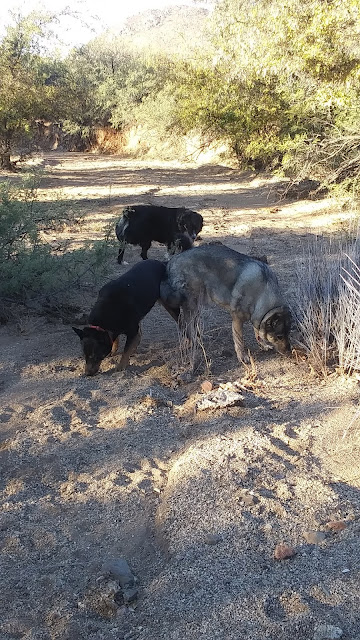
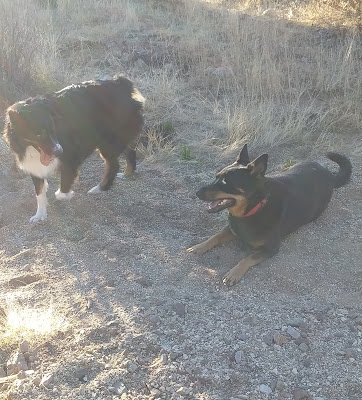
Peasy (in back) with Molly (left) & Buddy (right)

Peasy report


To say that Peasy is happy in his morning adventures with our neighborhood desert dog pack (me, Therese, Peasy, Molly, Buddy) would be understating the case. He is delirious! He is also a supremely calm and contented animal when his dog parents invite him up on the bed for a little pack time before we all go to sleep (dog on the floor). He has a good life, that little sweet Pea! He loves having a family! Staff at the Graham County animal control pound would doubtless be amazed to see this “unadoptable” dog still alive and thriving.


Another lovely morning!

It must have been confusing and unbelievable to him at first here in Dos Cabezas, after being in "prison" for so long and, before that, a homeless stray. Then, a few months after getting used to our winter desert cabin came a week of cross-country car travel to another strange new home in Michigan, where he spent long days home alone while his dog folks worked to bring home his dinner (and theirs). And just when he’s settled in there, back across the country again to Arizona! I wonder if the little guy  half-expected to be abandoned along the road (again) any day. We never considered abandonment, but there were certainly times in the past year when his future with us hung in the balance…. 


How is he here and now? We have not seen his Mr. Hyde personality for quite a while now. (Maybe his anti-anxiety meds are starting to kick in. Maybe, too, time has been working its slow magic in what is now almost a year since he came to be our dog, even if it was two steps forward and one step back for what seemed forever.) Clearly, he remembered the cabin, and he certainly remembered our neighbor, Therese, and her dogs, greeting all three with trust and enthusiasm and readiness for fun! The only other neighbor he met last year was Cheryl, and I'm pretty sure he remembered her, too, because when she drove up to the cabin, he didn’t bark. A very big deal! He also let her come inside and took treats from her hand -- a little nervously, but immediately and without the slightest hostility – and when he had had enough treats (all she’d brought!), and I told him to lie down on his rug and stay, he did it! Good dog!


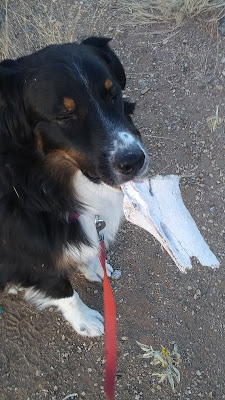
Treasures outdoors on the range!

(He is on-leash in the above photo because we were out before sunrise so I could get to a social gathering in town, i.e., Willcox, by 8 a.m.) 


We don’t have outdoor pack fun every single morning but it happens many mornings, and Peasy and Molly have learned to look for each other. Molly is definitely boss dog. When she doesn’t want to be messed with, she makes it known. I wouldn’t mess with her, would you? Anyway, I think it’s good for little Pea to play second fiddle to Molly, too. Keeps him toeing the mark.


Molly lays down the law!


Book report


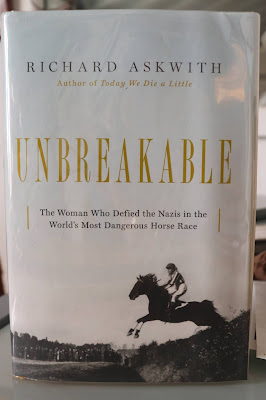
Unbreakable, by Richard Askwith, is the story of a Czechoslovakian countess but decidedly not – at all! – a tale of extreme riches, international travel and intrigue, flamboyant affairs, or social status games. Lata Brandisová’s family was pretty much on the bottom rung of the nobility and, for nobility (and unlike their wealthier relatives), lived a fairly simple farm life. Lata did grow up with horses, however, and that was the making of her. 


Steeplechase is probably horse racing’s most brutally dangerous form, for humans and horses alike, and the Velka Pardubická quickly became famous, right from the first, as the world’s most brutally dangerous steeplechase, intentionally designed to be so by hell-raising Count Oktavian Kinský, Lata’s great-uncle. Small wonder that women were barred from competition until Lata Brandisová broke that barrier. On her first attempt, she managed to complete the course – in itself, a triumph in a race that ended many lives, human and equine, over the years. One year not a single horse and rider finished. Falls, pile-ups, broken necks were an expected part of every annual event.


The story of Lata Brandisová involves politics almost as much as horses, and her 1937 win of the Velka Pardubická, following a year in which German Nazi officers swept the top places, made the formerly unwelcome and at first publicly ridiculed female jockey, briefly, a national heroine of Czechoslovakia. Friend of neither her country’s Nazi occupiers, however, nor their successors, the Russian Communist regime, Lata found her fame short-lived. For that one day, everyone in her country had loved her, but soon she was an “enemy of the people,” too dangerous to befriend closely.


The thing about Lata, though, as her biographer describes her, is that while she loved freedom and hated injustice, nothing was more important to her than God and horses.


Anyone interested in how the succession of shifting 20th-century political regimes affected life in rural central Europe find these aspects of Lata's story fascinating. Readers who love horses will be on the edges of their seats, as one exciting race after another is told. Feminists will find a new and inspiring model in this intrepid horsewoman. I loved the book for all these reasons and only hope that the author’s attempt to bring Lata Brandisová out of obscurity with this biography will be successful. 


Because life is not all about dogs. It’s about horses, too. And commitment. And staying the course.


Falling in love again --

What am I to do?


Read since last post:


Askwith, Richard. Unbreakable: The Woman Who Defied the Nazis in the World's Most Dangerous Horse Race. NY: Pegasus Books, 2019.


Sunday, May 9, 2021

Is This a "Man’s World"?


What is it about the book business, anyway, Moon wonders. Sometimes it seems like nobody on any level of it makes any money. Maybe if you’re Random House and you can figure out how to publish nobody but James A. Michener, you can make a little money. Everybody else picks up peanuts.


Why do they do it? he wonders. But he knows why.


-      John Dunning, The Bookman’s Wake


Only fitting, I reflected, to find myself reading a mystery starring a rare book dealer in a copy I scored from a ten-cent table of used books. Not a signed copy, not even a first printing, but quite a clean, decent later printing of the hardcover edition, a volume I’m sure Cliff Janeway, fictional former cop-turned-bookman, would have picked up himself for resale. Janeway is also a reader, and the quotes and references to works of literature in the stories' dialogue are part of the fun of this series.


I was about halfway through reading The Bookman's Wake when, as I turned a page, a slip of paper fell out. No, it was not a $100 bill. Not even a dollar bill. Twenty-eight years a bookseller come this summer, I have yet to find money in any book that has come my way, which seems ironic, considering how often I used to hide five-dollar bills in my own books back in a previous (pre-graduate school) life. I would move my hidden cash around so often -- in my concern that the book holding the money was far too attractive and obvious, certainly the first item a book-loving burglar (in my vivid imagination) would pull off the shelf to inspect! -- that I would lose track of it, which made a subsequent accidental finding seem like manna from heaven, an unexpected gift. A harmless eccentricity left behind but occasionally fondly recalled when I find random bits of paper other people have left behind in used books I buy. -- Are you curious? Do you wonder? Grocery lists and airline boarding passes are a couple of the most common such items. 


The slip of paper from the Dunning book made me smile as I read the lines on it made by an old dot matrix printer, words that indicated a purchase made by Mary Ann, of the former Mary Ann’s Mostly Books in Benson, Arizona, the book ordered directly from the publisher when new, its cover price $21. Two Benson bookstores we loved to visit in former years are both gone now. We found retired bookseller Lenore volunteering at the Friends of the Library bookstore, however, and learned from her that Mary Ann had moved her base of operations to Apache Junction, at the urging of (and, I hope, with a lot of help from) her children. In any case, I remember both shops fondly and enjoy my reading all the more, knowing the book came by way of Mary Ann.


- B O O K M A N -


The word ‘bookman’ (from the Dunning’s title) is interesting. Merriam-Webster defines it broadly as “a person who has a love of books and especially of reading” or “a person who is involved in the writing, publishing, and selling of books.” Dictionary.com says a bookman is “a studious or learned man; a scholar” or “a person whose occupation is selling or publishing books.” (Parenthetical note: note ‘person,’ no gender specified three times, ‘man’ once.) In the world of John Dunning and Cliff Janeway, an actual, real-life world inhabited by many world-wide, ‘bookman’ is understood more narrowly. It implies a person (man or woman) working in the secondhand book trade, especially one specializing in rare books, a dealer (occasionally a bookstore employee) with an emphasis on and knowledge of contents as well as physical attributes, as well as a deep love of same


Anyone can be a bookseller. To be called a bookman, especially by a bookman, is a compliment, an acknowledgement. When a bookman friend – another woman – told me I was a “real bookman,” I glowed!


‘Bookwoman’ is heard now and then but somehow seems to imply more what the dictionaries give as the definition rather than what we in the trade understand by ‘bookman.’ A big reader. Why is that? Is it the way 'poet' sounds serious and 'poetess' brings to mind a wannabe? No wonder women in theatre and film want to be called, simply, actorsI usually call myself simply a bookseller and leave questions of expertise and gender to others. Today, though, I’m thinking about those questions.


In The Postmistress, a novel that was one focus of my most recent post, the woman in charge of the little post office is actually called the postmaster. The character notes at one point in the novel, and the author reiterates in her afterword, that U.S. postal regulations give the position title always and only as postmaster. This fact points silently to a time in American history when having a woman in the position was unthinkable and perhaps not even recognized as legal. One female postmaster in Dos Cabezas, Arizona, did the work of the job while her husband held the official title, I have read. That’s just how it was. I wonder if the husband, the nominal postmaster, ever made an appearance behind the counter.


No post office here any more


If either my artist husband or my bookstore volunteer is in the shop at the same time I am there, and someone comes in for the first time with a question for the owner, the question is invariably directed to the man. It doesn’t matter who is sitting at the desk. It doesn’t matter what we are wearing. One dear friend of mine who suffered this indignity for years finally began to do a slow burn when her husband, jokingly, would say to the questioner, “Perhaps my assistant can help you,” the assistant being the actually bookseller – and, in her case, definitely a bookman!


But I’ve had to learn to let that stuff slide. It will never end, and there’s no point in spending the precious days of my life resenting ignorant, thoughtless assumptions over and over. 


In MY bookstore!


Whether or not ours is objectively a “man’s world” (and who in the world could take an objective position on the question?), I try to live as much as possible in my own world. I was quite entertained one time when a male friend was telling me about how he could “lose himself” in nature, on a river or in the woods, and added for my benefit that he didn’t think women ever had such experiences! "And you know that by comparing your experiences as a man with the experiences you’ve had as a woman?” I prodded gently, whereupon he had the good grace to laugh.


My darlings when they were only yearlings


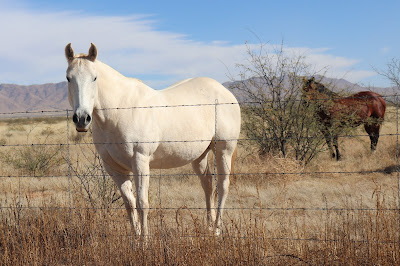
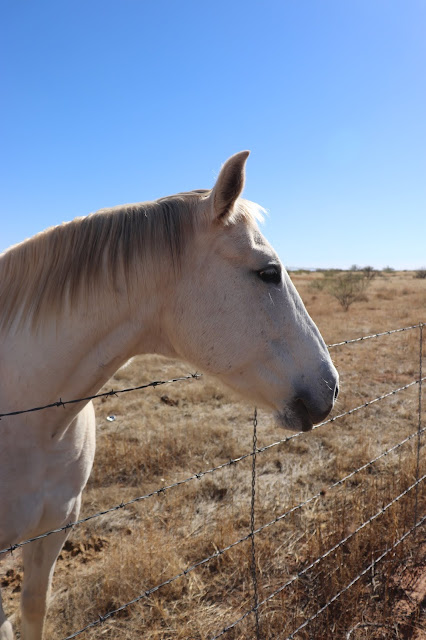
Here are a few aspects of my world. The actual owners of a pair of two-year-old horses, half-brother and -sister, have no idea that I think of those horses on the edge of Willcox, Arizona, as mine. People driving back and forth on I-10 certainly do not recognize the tree I call my tree as mine. Back in northern Michigan, there are many little rural corners and stretches for which I feel what I must admit is a proprietary kind of love. But this is not a sense of ownership as the law would understand it. These are things that have become parts of my soul. I lose myself in them.


And so yes, when I am lost in a book quest or examination of an exciting book find, just as when I am out exploring the morning world with my dog, I am not doing it as a woman but simply as myself. This is one of the glories of being lost in one’s work or in the natural world: other people’s presumptions, assumptions, expectations, and judgments fall out of consciousness. Self-consciousness evaporates.


Michigan insolite!

Off-road Arizona


Why, though, do I not call myself a ‘bookman’? Out of modesty? In part. But also out of honesty. Whatever the field of my various life endeavors – music, philosophy, books – I have never been drawn to specialization. It is the old question of depth vs. breadth, and time and time again I have chosen the latter, content to be one of life’s generalists.


As for whose world ours is, each of us is the center of our experience, and our experiences and emotions come to us subjectively, not comparatively. So I make no apology for living and working and feeling and writing out of my own little world. I say, anyone who claims to be doing otherwise is self-deluded or seeking to delude.


Outdoors with dog or indoors with books? I could not choose one over the other. Fortunately, the two come together in me. Moreover – and miraculously -- my world and the Artist’s world exist side by side and overlap! Lucky, lucky, lucky both of us!