Search This Blog

Showing posts with label Bruce Catton. Show all posts

Wednesday, August 19, 2020

I Want to Share Some of My Favorites With You

Summer Woodland, Michigan
Okay, you know I’m a devoted re-reader of my favorite books. I’ve said it often enough, and you've heard it before, so blah-blah-blah, yadda-yadda. What, however, does personal re-reading mean to me as a bookseller?

Come on in and browse!
Well, my old favorites are one reason I began my bookselling career in used books, and it’s also a reason why, when I am putting together an order for new books – things customers have asked me to get for them, as well as new titles I believe will appeal to my clientele – I often check to see which authors and titles I’ve loved are still in print so I can share them with my Northport public, locals and visitors.

For example, I’m always re-ordering Betty Smith’s A Tree Grows in Brooklyn because – well, it is a beautiful story, told with elegant simplicity, wonderfully accessible, and it also offers a window into an early time in our nation’s history, with horse-drawn peddler wagons, singing waiters, tenement buildings without elevators, and much, much more, all seen through the wide eyes of a young girl. It is a coming-of-age story, not a children’s book, and one I would list as an American classic. Have you read it yet? – A young woman came in as I was writing a draft of this post and asked if I had the book! It should arrive today! She’ll come back! This is the kind of thing that makes me so glad I am a bookseller!

Monarch time
Mark Rashid is a very different kind of author, and his nonfiction books are worlds away from fictional Brooklyn. Since I’ve written extensively about him already, I only want to say today that I am expecting delivery of a couple more of his books soon – and that you don’t have to have a horse (though how I wish I did!) or be training a horse, and maybe you don’t even have to be horse-crazy, to get a lot out of Rashid’s anecdotes and lessons about working with horses. When I read about Rashid working with horses, I am flooded with a feeling that the world is beautiful, not only because it has horses in it (see the poem by Alice Walker – and I need to re-order that book, too!) but also because there are good, decent people in it like Mark Rashid.

Now for another switcheroo: from fiction to horse training to interpersonal communication. Does the name Suzette Haden Elgin mean anything to you? I have handled and recommended and sold many copies of her original book, The Gentle Art of Self-Defense, which I absolutely love because it teaches us (1) how to recognize sneaky, indirect verbal attacks and (2) how to deflect the attack without going on a counter-attack. Brilliant! I don’t have that first title in stock and couldn’t order it new, but thank heaven The Last Word on the Gentle Art of Verbal Self-Defense was not the last word, because here are books I was able to stock, and I think the one on …Communicating with Kids will be one all parents will want to reference. 

Defend yourself gently without counter-attacking

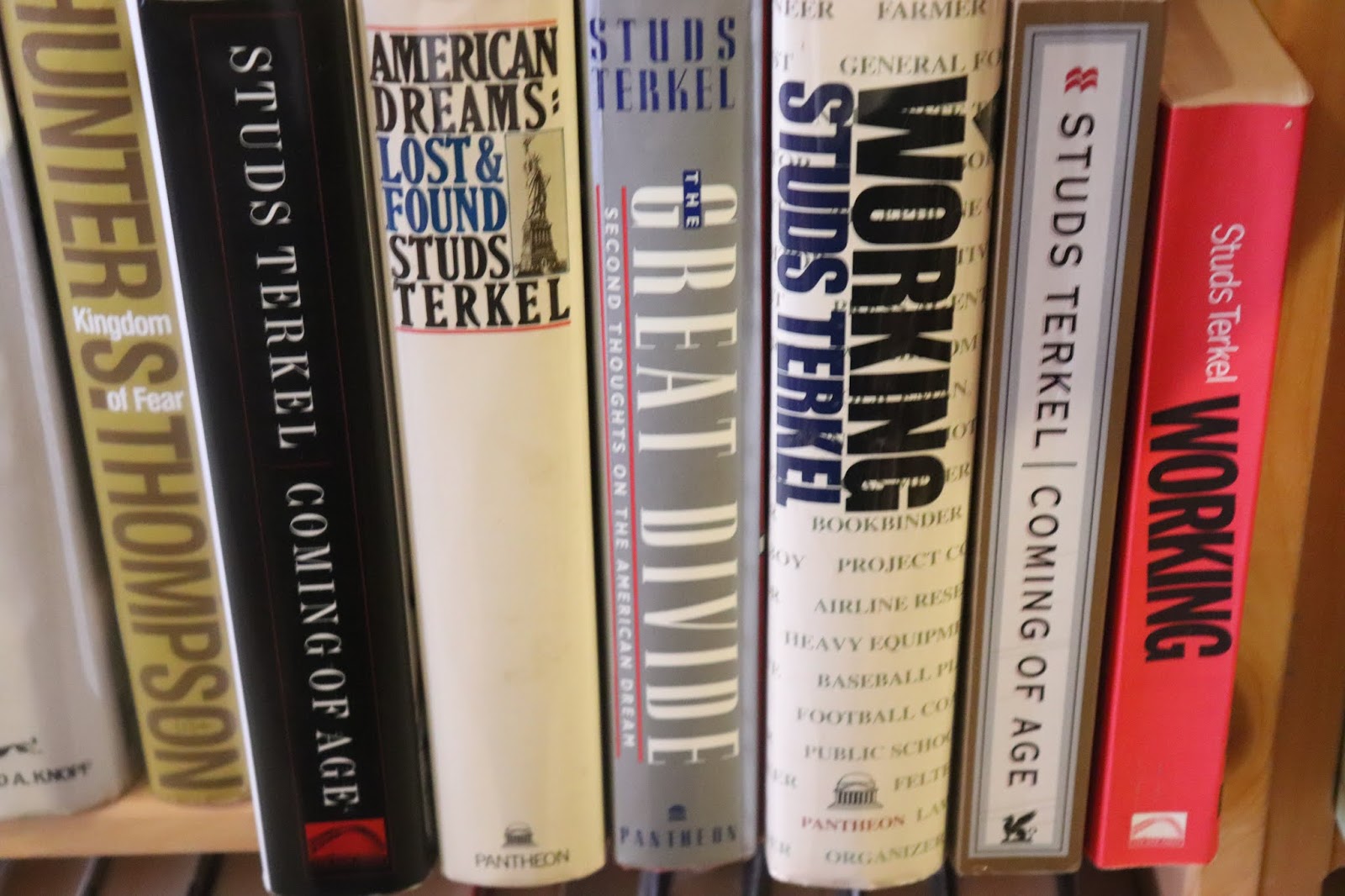
But a full and complete discussion of books I’ve read more than once and highly recommend would be a book in itself. Do you live in or live elsewhere but love Michigan? If so, and you have yet to read Bruce Catton’s history of Michigan and his memoir, Waiting for the Morning Train, put those on your list today! What about anything by Studs Terkel? All his books of interview with Americans, on a variety of subjects, are worth your time. 

Michigan's own Bruce Catton

Chicago's own Studs Terkel

Mildred D. Taylor’s novels are too good to be restricted to YA readers. Historians and lovers of good essays should not miss books by Tony Judt. If I were to begin listing books from the past decade alone, we would be here all day, though, and I know you have other things to do. Whatever you read, do make time for reading, because especially in this glorious summer of our discontent, getting lost in a good book (outdoors if possible) is good medicine for us all. As for me, I'm happy to realize that my bookshop is a Treasure Island, and if you are a booklover and know how to browse, you will never have to leave empty-handed. Only this morning, a repeat customer from Wisconsin told me, "The best part of the trip is coming to this bookstore." 

Just before this morning opening "bell"

But now -- oh, my goodness, the UPS delivery came! Another box of treasures have arrived!

And we are off to the races!


Saturday, July 25, 2020

Snippets From Township and Village -- “in these uncertain times”


It will be August in only one week! Cherry harvest is underway. Nursery stock has begun to go on sale. In the wild, chicory and Queen Anne’s-lace are joined by spotted knapweed, that invader of Leelanau hills and fields that is, however, not despised by bees. No big festivals this year, nor small ones, either. Even the Thursday Evening Author series at Dog Ears Books is not taking place in this strange summer of 2020. We do, thank heaven, have farmers market in Northport on Friday mornings, something to anticipate eagerly all week long.

Northport marina parking lot on Monday morning
Farmers market. on Friday morning

My bookstore is open Tuesdays through Saturdays. “You’re risking your life to sell books,” one local customer friend remarked yesterday in mild tones. Was he chiding me? Expressing gratitude? Did he feel his life was in danger when he came in to buy a local author’s memoir? I don’t know. These days, with all of us concentrating on wearing our masks properly, sanitizing our hands, maintaining correct social distance, and conducting business transactions as expeditiously as possible, I don’t get into many deep discussions in my bookstore.

Bruce Catton: Civil War books

My customers, however, continue to be cooperative and pleasant. They appreciate being allowed again into bookstores and libraries. And we readers are reading a lot these days, more than ever. I’m finally reading one of Bruce Catton’s books on the Civil War. 

…During the last few years events themselves had been irrational; politics in America could no longer be wholly sane. Here and there, like flickers of angry light before a thunderstorm, there had been bursts of violence, and although political debate continued, the nearness of violence—the reality of it, the mounting threat that it would monstrously grow and drown out all voices—made the debaters should more loudly and appeal more directly to emotions that made reasonable debate impossible. Men put special meaning on words and phrases, so that what sounded good to one sounded evil to another, and certain slogans took on their own significance and became portentous, streaming in the heated air like banners against the sunset; and even the voices that called for moderation became immoderate. American politicians could do almost anything on earth except sit down and take a reasoned and dispassionate view of their situation. - Bruce Catton, The Coming Fury

Long a fan of Catton’s memoir, Waiting for the Morning Train, and his Michigan: A Bicentennial History, until now I have avoided his multivolume Civil War works, because, open almost any book on the Civil War and you are confronted with more dates and battles than you can shake a bayonet at. Officers are continually changing rank and assignment, troop movements are given in what a friend called, years ago, “penetrating and remorseless detail.” (The friend was talking about something else, but his instantly memorable phrase entered our household memory bank then and there, to be pulled out whenever an occasion calls for it.) History fascinates me, but it’s ideas and politics and journalism and people’s daily lives I want, not military strategies and campaigns. Strictly military history is not for me.

But I should have known that Bruce Catton could not write history that I would find boring! 

Old favorites, highly recommended

American society was in turmoil in 1860. Underlying much of the turmoil were big changes in world economics and technology. Cottage industries were giving way to large-scale manufacturing that threatened the self-sufficiency of small farmers and villagers, and what was for so long a quiet, local American economy was becoming a global web, its threads set vibrating by events faraway and out of sight of workers. Whole populations were on the move. The North viewed immigrants from Europe with suspicion, while the South, clinging to their culture of slavery, saw their region’s dependence on imports spelling out eventual doom. 

And in the midst of all this uneasiness, 1860, like 2020, was an election year. 

The Democrats could not agree on Stephen Douglas as a candidate for the presidency – as Catton put it, “the North derided him for liking slavery too much, and the deep South hated him because he liked it too little” – and finally the party split in two, with Northern Democrats running Douglas and Southern Democrats settling for Breckenridge. Everyone in the country, including William H. Seward, viewed Seward as a shoo-in for the Republican nomination, but somehow in the end the nod went to “gawky frontiersman” Abraham Lincoln. A fourth party brought forward yet another presidential candidate. Long before votes were cast, however, Southerners were planning state conventions to decide whether or not the expected election of Lincoln would be sufficient cause for them to secede from the Union.

The Artist likes to quote what he says is an ancient Chinese curse: “May you live in interesting times.” My own feeling is that there cannot have been any time on earth when life was not interesting, but I understand that he takes the saying as a reference to times of crisis and catastrophe, fascinating in retrospect but frightening and sometimes life-threatening as one is living through them. The year 2020 has certainly given us “interesting times” already, and it’s doubtful the year will grow any less interesting or anxiety-provoking as November approaches. Again, in our own time -- corporations shipping jobs overseas to cheaper labor markets or replacing workers with robots to boost the bottom line -- as in 1860, immigrants and racial minorities serve as political footballs.

Times of social upheaval, with technological and/or social innovations throwing a market for employment into disarray, have always put human beings at each other’s throats. Choose the particular hill on which you are willing to die, conveniently setting aside other complicated issues, and you have chosen your enemy -- who may well be your next-door neighbor. The editor of the Cincinnati Commercial described attendees at the convention in Charleston as “screaming like panthers and gesticulating like monkeys.” 

Sounds a lot like Facebook, doesn’t it?

Meanwhile, recent rain swelled and split local cherries. Not good. Creeks and lakes rise to destructive levels in many places. The sun shines on a regular basis to bring the annual parade of wildflowers to blossom, each in turn, and as Northern Lights waver tantalizingly overhead the comet Neowise hangs in the evening sky, and the International Space Station circles the earth. Here in the northwest lower peninsula of our state, we view the sky over Lake Michigan. Elsewhere in the country Americans scan for heavenly bodies and activity over fields of wheat or mountains or deserts. 

And as the summer flies past, most of us, at least in Leelanau County, continue to take precautions against COVID-19. The future’s not ours to see. It never has been. But we should probably slow down and think about it a little more dispassionately. Talk less, listen more. Be slower to anger. Register to vote.