Search This Blog

Showing posts with label recommendations. Show all posts

Monday, November 13, 2023

And here is the envelope, ready to open --

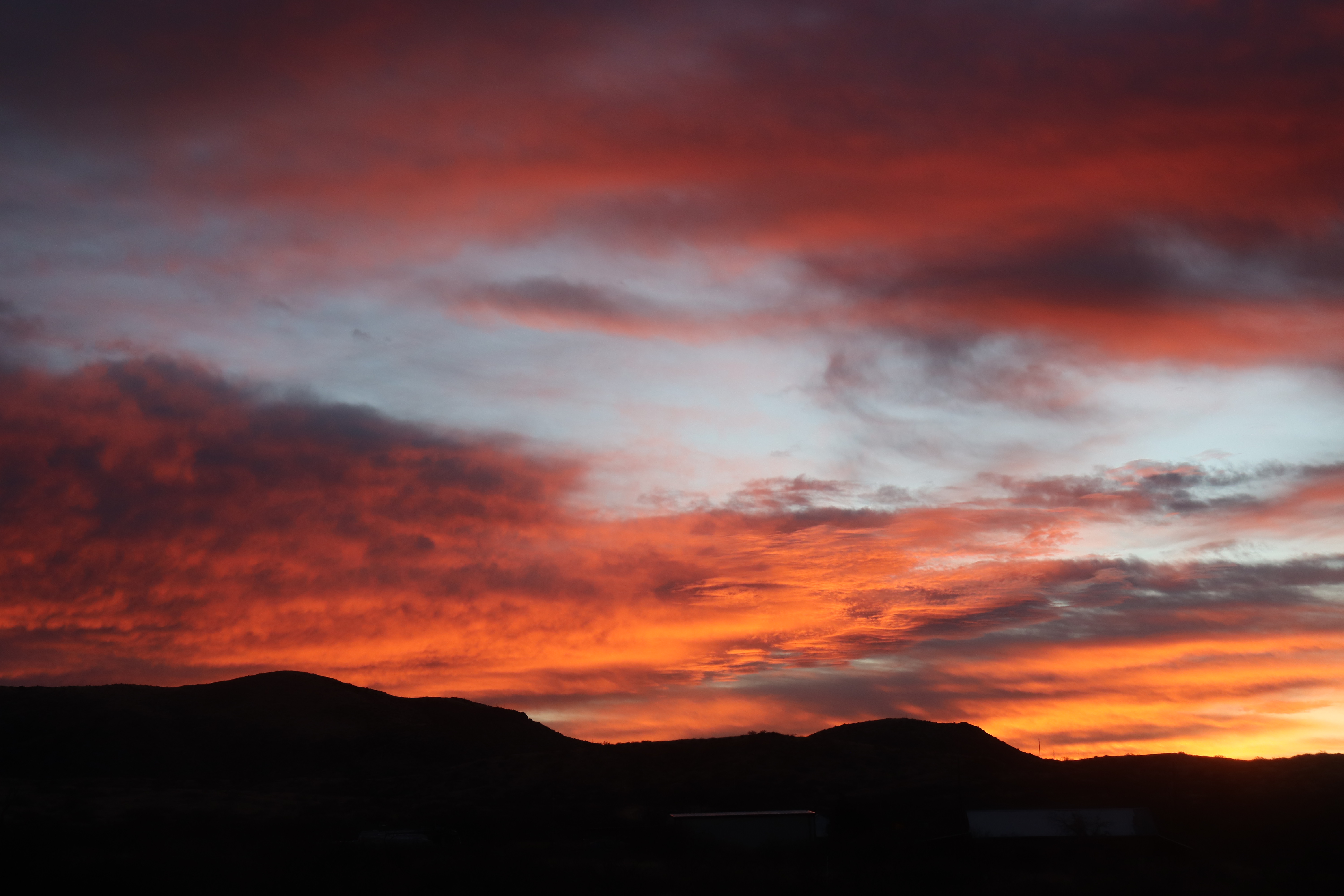
Happy morning sight, courtesy of SUNSHINE!
 

My top nonfiction picks of 2023 -- so far (the year isn't over yet) -- are not rank-ordered or alphabetical, as I limited the list to four books. First is one I read most recently, but all four work together in my mind. Maybe they would do the same in yours.


But first I should delay the opening of the envelope, shouldn't I? Quack on about the weather a bit, draw out the suspense? You already see by my opening image that we have sunshine this Monday morning in Leelanau County -- and what a lovely gift it is! I took time out from a big cleaning-sorting-reorganizing-decision project to hang laundry outdoors on the line and get Sunny up to the dog park in Northport after picking up my mail. On our way to the village, we stopped along one of my favorite back roads, too, but I'll save that image for the end of my post and use cloudier photographs between beginning and end to highlight the contrast. 


Tamarack on the first of November


But now -- the books!


Enchantment: Awakening Wonder in an Anxious Age, by Katherine May. 


Author Katherine May, though suspicious of groups, says she craves more and more being part of a congregation but doesn’t know where to start. “Nowhere has ever seemed to fit.” She doesn’t want to insult any religious community by making only a partial commitment, being a “wavering presence in the room,” and she is also “wary of stealing from traditions” and “cherry-picking the comforting parts of complex religious traditions – usually the aspects that tell us everything’s okay – and ignoring the counterbalancing obligations….”  But her strong sense is that we in the West have let ourselves lose childhood’s enchantment (“small wonder magnified by meaning”) by considering it “childish,” and let ourselves become indifferent to it. May wants enchantment back, and she courts it at the seaside, on hilltops, in the presence of stars and of fire. Who doesn’t want to be carried away, if only for a few fleeting moments? (Where do you court enchantment?)


Clouds, light, and color always enchant, don't they?

Doppelganger: A Trip into the Mirror World, by Naomi Klein. 


At first Naomi Klein paid only peripheral attention to what she refers to as the “antics” of the “other Naomi,” but as Naomi confusion grew larger and larger, Klein gradually became obsessed with her double. You would be, too, if people kept attributing views to you that you had not only never expressed but never espoused! Klein is not, however, a shallow thinker, and her investigations went much deeper than the phenomenon of finding herself confused, on social media and elsewhere, with another writer with the same first name. “As I shadowed my double further into her world … I found myself confronting yet more forms of doubling and doppelganging, these ones [sic] distinctly more consequential.” In history, literature, and myth, a doppelganger is more than a confusing double. It can also be an unwelcome mirror, a warning. On social media, Klein points out, everyone presents a doppelganger of his or her real self, and while we in our 21st-century doppelganger culture are paying attention to one another’s doubles and perfecting our own, we are distracted from and neglecting to notice more important changes in our world. This is a serious book, but it also contains funny moments. It is personal and at the same time important. I highly recommend it. (Did you ever wish you had a twin?)


Can you tell them apart? They don't care.

Bittersweet: How Sorrow and Longing Make Us Whole, by Susan Cain. 


This book by the author of Quiet: The Power of Introverts in a World That Can’t Stop Talking is probably not for everyone. Maybe there is no single book that would speak to all readers, but Bittersweet certainly spoke to me last winter with its meditation on “longing, poignancy, and sorrow; an acute awareness of passing time; and a curiously piercing joy at the beauty of the world,” and I don’t think it was only because grief had entered my life (although grief does have a way of cracking one open to small beauties and pains of everyday life, as well as to the feelings of others). But I can’t remember a time in my life without an acute awareness of passing time. “Always at my back I hear/Time’s winged chariot hurrying near” were lines that seem to have been with me always. (I wonder if there is a connection between introversion and feelings of life’s bittersweetness. If Cain addressed that question, I have forgotten her answer. What do you think?)


Sunny loves tart wild apples, both for play and for snacking.


The Master and His Emissary: The Divided Brain and the Making of the Western World, by Iain McGilchrist. 


When this dense, heavy book first came into my hands, I skimmed the brain science and impatiently turned to the second part, focused on history. On my next reading, however, I determined to read more carefully from the beginning. There is a lot of repetition (for emphasis, I’m sure, not for “padding”), and not only does McGilchrist convince me, but I now read and look back on past reading through his lens


For instance: 


(1) I see May’s search for enchantment (see above) as a longing to recover the right brain’s “desire or longing … toward the Other.” 


(2) Tempting as it is to see those lost in Klein’s “mirror world” (see above again) as suffering under enchantment, I see them more as people who have abandoned enchantment and ambiguity for certainty, the left brain’s rigidity not allowing anything into the picture that would cast doubt on what it already “knows.” 


(3) Even Cain’s “bittersweet” feelings, it seems, would be rejected by the left brain, whereas the right brain has always realized that “light and dark, birth and death – bitter and sweet – are forever paired.”


Socrates and Plato prioritized ideas [of things] over “things themselves,” and while Hume declared that neither inductive reason, deductive reason. nor both combined were adequate to put together complete knowledge (implicit bodily/sensory/social background underlies all the rest, as Bergson and the phenomenologists finally realized, also), much of science to this day, and far too much of politics, continues to be ruled by the left brain’s hierarchies, rules, categories, etc. Even religious experience, when translated into theology and creeds, loses itself in left brain re-presentations of what was once known without mediation.


Leaves in the understory, overstory bare, sky cloudy

My favorite 2023 nonfiction list was longer at first, but I decided that these four will constitute my top recommendations for the year so far, because they came together for me, ideas from each strengthening and reinforcing and enriching ideas and thoughts from the others. I was reminded of my first semester in university, when everything I was learning -- drama, psychology, rhetoric, etc. -- seemed connected to everything else in a way that astonished and delighted me. 


I have yet to read either of the new books on private equity companies (my new self-study subject), books ordered for the bookstore and in stock now (one with “Plunder” as its title, the other with “plunderers” as part of its title), but one was featured in an interview on NPR with the author only the other day. 


There were also several other beautifully done and moving nonfiction titles in my reading since January. Among the latter group were: 


Harlem is Nowhere: A Journey to the Mecca of Black America, by Sharifa Rhodes-Pitts; Becoming Animal: An Earthly Cosmology, by David Abram; Invisible Child: Poverty, Survival & Hope in an American City, by Andrea Elliott; My Venice and Other Essays, by Donna Leon; Reading the Rocks: The Autobiography of the Earth, by Marcia Bornerud; The Nature Fix: Why Nature Makes Us Happier, Healthier, and More Creative, by Florence Williams; Madam Speaker: Nancy Pelosi and the Lessons of Power, by Susan Page; and Confederates in the Attic, by Tony Horwitz. 


Every book in the longer list is worth reading, and as my short list is a highly personal selection, if my top recommendations leave you cold you may be more strongly drawn to titles in the unannotated list. Or perhaps you have (and I hope you do!) your own top nonfiction picks to share. Are there books of history, memoir, essays, science, politics, or economics that made strong impressions on you this year? Anything you wish everyone in the country would read? 


Glorious blue sky!

Wednesday, November 30, 2022

Here and Now, Our Time in the Sun

Can you see the dog?


In a recent post with my annotated list of books read in previous weeks, included was Jane Barry’s A Time in the Sun, set right here (i.e., where I am at present) in Cochise County, Arizona. When I finished the novel, I passed it along to a neighbor (who is now captivated as I was by all the familiar locales in Barry’s historical novel), so I can’t look this morning to see where the title appears in the story, but I remember it was near the end. The idea is that all of us alive have our time in the sun, limited by mortality. 


As the end of the year (with more holidays) approaches, I’ve been reading old journal entries from a year and two years ago and am struck, despite all the COVID and political horrors, by the happiness the Artist and I found in our most ordinary days, and I think what a blessing it was that we could not then see into the future. The love of my life is gone now, along with our last two beloved dogs -- a long-established pack and a pack with only a brief history -- but we did all have time together in the sun. And now it’s Sunny’s turn.


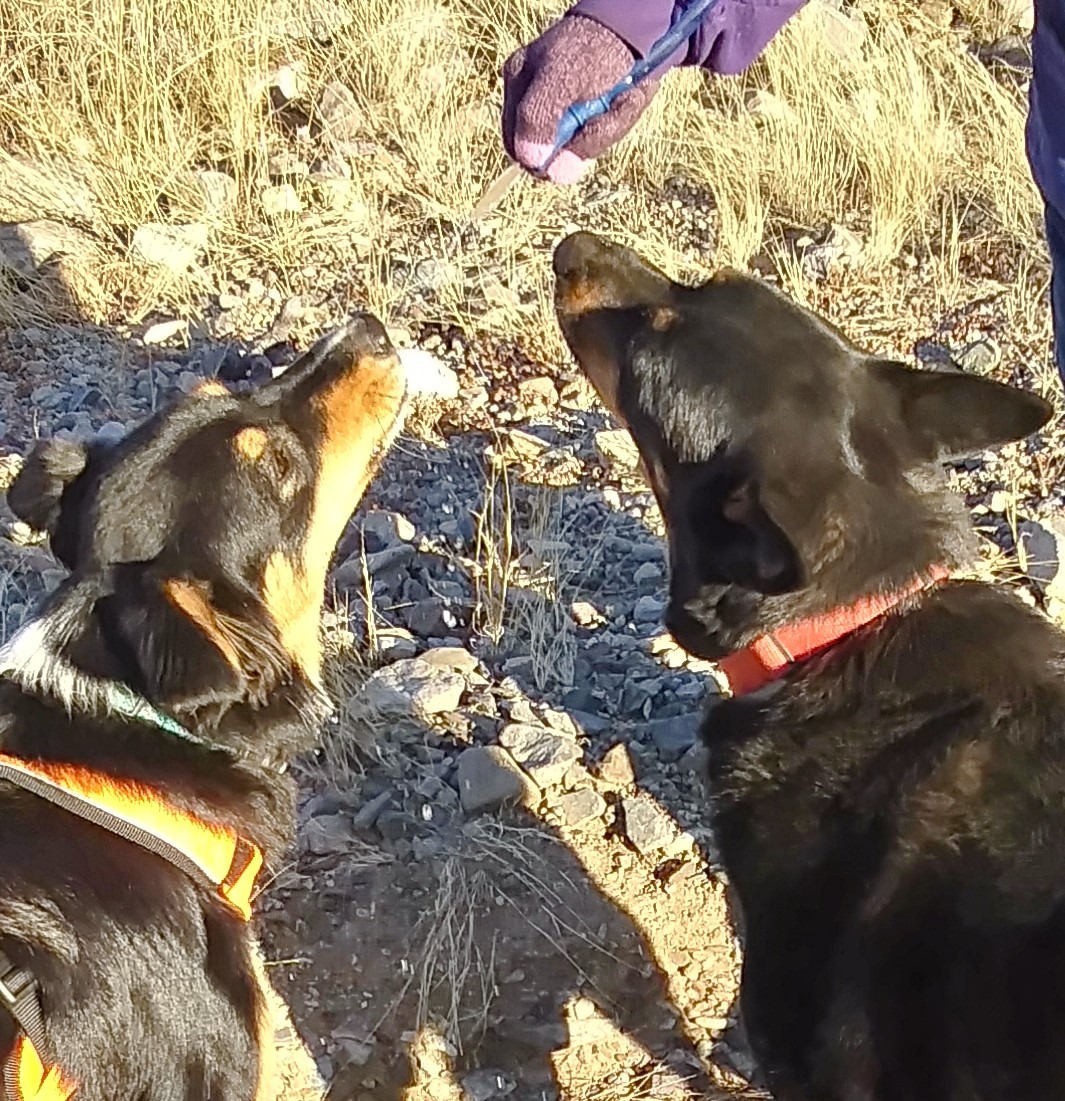
Sunny Juliet and I go out for a ramble on the range most mornings, joining a neighbor and her dog. The year-round resident canine is Boss Dog, Sunny the teasing youngster who sometimes needs to be reminded of her place, but in general they get along well, so while SJ and I also take walks on our own, we enjoy most of all being part of a ghost town foursome. 


Although I’ve only finished reading three more books since publishing the last list, I’ll add them in here, so as not to fall so far behind until the next time. 


122. Caputo, Philip. The Voyage (fiction). Honestly, I probably would not have chosen this book to read except that it was urged on me by a friend – and because both of us had met the author, separately, through another mutual friend who was also a well-known author. That said, this is a must-read novel for sailors, fresh- or saltwater! I am not a sailor, and so the detail of every move the captain and crew made went far, far over my head, but for those who understand it all, the picture would be riveting. The story, anyway, is riveting even for a non-sailor. Three teenage brothers and the friend of the oldest set off from Maine to sail to the Caribbean in the year 1901. The brothers have been seen off, unceremoniously, by their father, who tells them he doesn’t care where they go, except they are not to come home until the end of the summer. The reason for the patriarch’s abrupt dismissal and other family secrets are revealed only gradually in the course of a story of adventure on the high seas. Highly recommended for those who love adventure, mystery, and exotic locales in their reading, and especially for sailors.


123. Willard, Nancy. Telling Time: Angels, Ancestors, and Stories – Essays on Writing (nonfiction). Serendipity brought this book to my notice. I was browsing in Readers’ Cove, Deming, New Mexico, and bookseller Margaret had just happened to leave Willard’s book on the shelf facing out. “Nancy Willard!” I exclaimed. “She’s a Michigan writer!” Willard was a poet and a storyteller, and these essays are saturated with her gifts, as she writes about teaching, about her mother’s last days, about the couple who illustrated her children’s books, and about storytelling in general. Highly recommended for poets, storytellers, essayists, and anyone who loves and appreciates these literary forms.


124. Smith, Alexander McCall. Heavenly Date and Other Flirtations (fiction). Stopping in at the Friendly Bookstore in Willcox the other day, I was in the mood for something comforting, and since I am always comforted by reading McCall’s stories featuring Mma Ramotswe, the name “Bulawayo” in the table of contents of short stories in the collection led me to believe that this book would comforting, too. It was not. Publishers Weekly (on the back cover) cited the collection’s “light humor,” but I found it, for the most part, downright bleak. Not that the stories weren’t well written. They simply were not what I expected or wanted them to be. Make up your own mind on this one.


The book I’m reading now is Francisco CantĂș’s The Line Becomes a River: Dispatches From the Border, a nonfiction book that anyone with questions and/or an opinion about the border with Mexico should read. His mother is distressed and worried when her son, a recent college graduate, takes a job with the Border Patrol. He explains that in his classes, everything was theory, and he feels he needs to be “on the ground” to understand what’s really going on. You grew up on the border, she tells him, but he says it’s different and that he feels he needs to do this, at least for a while. About halfway through the book now, I am not looking at the last page to see where it ends. (People really do that???). I can tell you, though, that this true story does not loosen its grip on a reader as it moves along….


And so goes our life, Sunny Juliet’s and mine, here in the high desert as November 2022 draws to a close. The nights are cold, the days bright and clear. Down toward town, the wind stirs up dust on the playa. The puppy makes me laugh. The sun rises, the sun sets.


This morning's glorious sunrise!


Monday, November 21, 2022

Books, Grief, Hope, and Holidays

How I live now....

Desert nights are cold, already down in the 20-degree range, and for the last two nights high winds have been battering the cabin. Saturday morning was sunny, calm, still. A good morning for a walk. Sunday was a different story, with the wind continuing relentless throughout the bright daytime hours.


No one sleeps well here on windy nights, and in what my mother always called the “wee hours,” when I would turn on the light and pick up a book, Sunny would bring me a toy and nudge me to engage in play. She can be as relentless as the wind! So I would indulge her with a little gentle wrestling on the bed and tell her she’s a good girl before picking up my book again (though often I added to myself, “Not really,” if she had trouble settling down again so I could read myself back to sleep).


And now for that long-neglected topic, books. Since I haven’t given a list of the recent books I’ve read for a while, I’ll annotate today’s to help you decide whether or not you might want to read any given title.


112. Hill, Grace Livingston. The Enchanted Barn (fiction). One of my early bookstore customers, back in 1994, was a big fan of Grace Livingston Hill and told me that Hill was a Michigan writer. I have been unable to find a Michigan connection, however, and in my bookstore no longer shelve Hill in the Michigan section. While her books are generally categorized as Christian fiction or Christian romance, religion is presented gently, as are the characters’ struggles, and The Enchanted Barn is a good example. Much as did the author herself, the main character is working to support her mother and siblings (in Hill’s own life, she had children to support from two failed marriages, in addition to her mother) and struggles to keep from becoming discouraged by poverty, to find a way to a better life. Where the story will end is obvious early on, but the details of the family’s move to the country, planting gardens, and making their home in an old barn make for a charming fictional escape from modern life. The Enchanted Barn was published in 1917. 


113. Gibbon, Lewis Grassic. Cloud Howe (fiction)

and 114. Ibid. Grey Granite (fiction).

These are the second and third titles in the author’s trilogy, A Scots Quair, which I have written about previously, novels that can only be considered “escape” in the sense that one is immersed in intriguing and sometimes lovely language because, other than that, they share with most of classic literature a clear-eyed confrontation with the hardest aspects of life. Here we see poverty not simply as one family’s temporary situation but the grinding poverty of workers in general, generation after generation, as they are caught up in the social and economic forces of history, and the author provides no deus ex machina to bring about a happy ending. But these are books (along with the first of the trilogy, Sunset Song, its story beginning in 1911) that deserve to be much more widely read and known, definitely worth a reader’s time, and I would add worth reading more than once.


115. Bythell, Shaun. Seven Kinds of People You Find in Bookshops (nonfiction). If I’m being honest – and what’s the point of being otherwise? – I have to say I was disappointed with this one. A very slim volume, it comes off more like a lengthy magazine assignment than like a continuation of the author’s delightful Diary of a Bookseller and Confessions of a Bookseller. Perhaps it was a case of a publisher pushing a writer to take advantage of previous success by getting a new title out too soon. I don’t like to say that -- and wish my impressions of Seven Kinds had been different -- but there you are. Bob’s your uncle.


116. Deutsch, Jeff. In Praise of Good Bookstores (nonfiction). Obviously not a book rushed into print, this one is worth reading carefully and lovingly, as any lover of books and bookstores will. The bookseller-writer makes a case for bookstores as something distinct from retail business. His primary example, the unabashedly scholarly Seminary Co-op Bookstore in Chicago, went from a cooperative model to a nonprofit model in 2019 (after many years of having paid no dividends), and Deutsch says the nonprofit model acknowledges the store’s “financial realities” and its privileging of “cultural value over financial dividends.” Browsing here is raised to a new level. 


While I would love to browse this store, I am not convinced that nonprofit status is the only way forward for bookstores. Seeing socks for sale in a bookstore bothers Deutsch. It doesn’t bother me. I don’t sell socks myself but have no problem with other booksellers who use such items to enhance their slim profit margin, as long as they are also stocking good, important books. Most of us in the used book trade realized early on in our eccentric “careers” that following our calling (because I agree with Deutsch that it is a calling) would demand certain financial sacrifices, and for us no price can be put on our independence, so I even wonder if a nonprofit model, with all the record-keeping and particular laws governing that model, might not put a crimp in my independence. But the book – yes, I do recommend it. 


117. Leiris, Antoine. You Will Not Have My Hate (nonfiction). The Eiffel tower on this book’s cover made me reach for it. It is broadly classifiable in the category of books on grief, a category in which I have read more extensively this past year than ever before – but with a difference. The author’s wife not only died suddenly but was murdered, gunned down in the terrible scene of mass violence at the Bataclan Theatre in Paris in 2015. The title of the book comes from something Leiris posted on the Internet, refusing victory to the killers. His book is a behind-the-scenes account of that night and days and nights following, as he had to go on with life for the sake of his very young, now-motherless son. 


118. Hill, Jemele. Uphill: A Memoir (nonfiction). An interview with Jemele Hill on NPR prompted me to buy this book. Careers in journalism are very different from life as a bookseller but also focus on words and writing. Hill is from Detroit, therefore a Michigan author. Perhaps the fact that she is a sportswriter made my choosing this book surprising because, in general, I could not care much less about sports, but Hill has always gone beyond sports in her career as a journalist, and her social insights and opinions fascinate me. (When asked to write an opinion column, she wondered why anyone would care about her opinions and was astonished by how deeply her readers cared.) Also, along the way, I picked up a couple of wonderful uses of contemporary Black English, one I’d seen before on a friend’s Facebook posts, the other a new word to me: “Ride or die” was the phrase; caucasity the new word I learned. Brilliant word!


119. Barry, Jane. A Time in the Sun (fiction). This one, like the nonfiction Empire of the Summer Moon, was a book that I both wanted and didn’t want to read. Western frontier history, whether fictionalized or not, is brutal – and often, to make it worse, it is inappropriately romanticized or has a political axe to grind, so wariness is my byword. Barry’s book, as it turned out, was of particular interest to me, as the story was set in southeast Arizona, from Apache Pass (between the Chiricahua and Dos Cabezas mountain ranges) up to Fort Grant and over to Tucson. It is hauntingly well written. Of course, it ends in tragedy, for the Apaches and for more than one of the white characters, but what else could you expect? It is worth reading, both for the historical perspective, diversity of characters, and for the lyrical writing.


120. Solnit, Rebecca. Hope in the Dark: Untold Histories, Wild Possibilities (nonfiction). This book of essays is a re-issue, and re-issuing it was a good idea. Solnit’s message is that those “in love with despair” or so given over to pessimism and cynicism that they answer any bit of good news with “Yes, but –” is that there is good news, along with the bad and that it’s important to keep hope alive and celebrate victories even while continuing to fight for a better world. Hope in the Dark is a tonic, good for what ails many of us from time to time. 


And finally --


121. Penny, Louise. A Better Man (fiction). Many of my friends and bookstore customers are devoted fans of Louise Penny’s Inspector Gamache mysteries, and yet somehow I had never gotten around to reading any of them. There it was, though, on Margaret’s counter at Readers’ Cove in Deming, New Mexico, and the time seemed right. (Note: I seldom begin to read a mystery series with the first book. Instead, whatever title comes my way is where I dive in.) And now, count me as a fan of Inspector Gamache, especially of his three questions to ask oneself before speaking: Is it true? Is it kind? Does it need to be said?


So there are the books that kept me company from Michigan to Arizona. For me, the company of books has always been essential and never more so now that my only daily companion is a very vocal but not at all verbal 11-month-old puppy. 


The Artist remembered at Source of Coffee in Willcox, AZ

This morning, doing errands in Willcox, I was struck by all the places the Artist and I used to go together. In fact, nowhere did I go that we had not gone together, and every mile of the road between the cabin and town is a mile we traveled together countless times. It was – difficult. But everywhere I went, when paying for a purchase I made a point of saying, “Happy Thanksgiving” to the cashier, because while holidays can be particularly challenging for those of us who have lost a beloved partner, whenever I think (as I so often do), There are ghosts everywhere, in Arizona as well as in Michigan, I have to stop and remind myself that there are friends in both places, too, and that I have much for which to give thanks. 


Happy Thanksgiving, friends! A what have you read lately that you want to recommend?


Also how I live -- and always will.


Wednesday, August 19, 2020

I Want to Share Some of My Favorites With You

Summer Woodland, Michigan
Okay, you know I’m a devoted re-reader of my favorite books. I’ve said it often enough, and you've heard it before, so blah-blah-blah, yadda-yadda. What, however, does personal re-reading mean to me as a bookseller?

Come on in and browse!
Well, my old favorites are one reason I began my bookselling career in used books, and it’s also a reason why, when I am putting together an order for new books – things customers have asked me to get for them, as well as new titles I believe will appeal to my clientele – I often check to see which authors and titles I’ve loved are still in print so I can share them with my Northport public, locals and visitors.

For example, I’m always re-ordering Betty Smith’s A Tree Grows in Brooklyn because – well, it is a beautiful story, told with elegant simplicity, wonderfully accessible, and it also offers a window into an early time in our nation’s history, with horse-drawn peddler wagons, singing waiters, tenement buildings without elevators, and much, much more, all seen through the wide eyes of a young girl. It is a coming-of-age story, not a children’s book, and one I would list as an American classic. Have you read it yet? – A young woman came in as I was writing a draft of this post and asked if I had the book! It should arrive today! She’ll come back! This is the kind of thing that makes me so glad I am a bookseller!

Monarch time
Mark Rashid is a very different kind of author, and his nonfiction books are worlds away from fictional Brooklyn. Since I’ve written extensively about him already, I only want to say today that I am expecting delivery of a couple more of his books soon – and that you don’t have to have a horse (though how I wish I did!) or be training a horse, and maybe you don’t even have to be horse-crazy, to get a lot out of Rashid’s anecdotes and lessons about working with horses. When I read about Rashid working with horses, I am flooded with a feeling that the world is beautiful, not only because it has horses in it (see the poem by Alice Walker – and I need to re-order that book, too!) but also because there are good, decent people in it like Mark Rashid.

Now for another switcheroo: from fiction to horse training to interpersonal communication. Does the name Suzette Haden Elgin mean anything to you? I have handled and recommended and sold many copies of her original book, The Gentle Art of Self-Defense, which I absolutely love because it teaches us (1) how to recognize sneaky, indirect verbal attacks and (2) how to deflect the attack without going on a counter-attack. Brilliant! I don’t have that first title in stock and couldn’t order it new, but thank heaven The Last Word on the Gentle Art of Verbal Self-Defense was not the last word, because here are books I was able to stock, and I think the one on …Communicating with Kids will be one all parents will want to reference. 

Defend yourself gently without counter-attacking

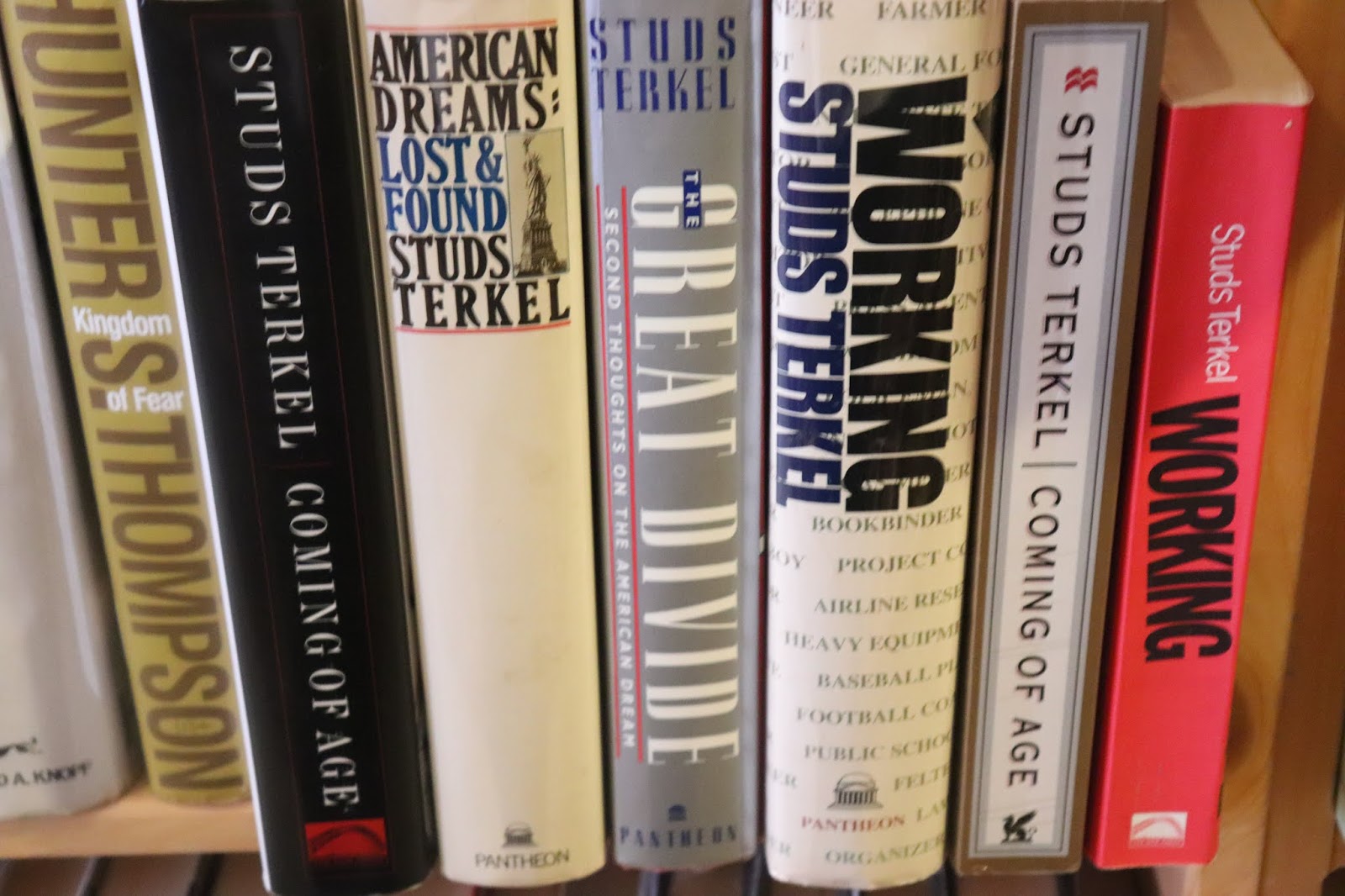
But a full and complete discussion of books I’ve read more than once and highly recommend would be a book in itself. Do you live in or live elsewhere but love Michigan? If so, and you have yet to read Bruce Catton’s history of Michigan and his memoir, Waiting for the Morning Train, put those on your list today! What about anything by Studs Terkel? All his books of interview with Americans, on a variety of subjects, are worth your time. 

Michigan's own Bruce Catton

Chicago's own Studs Terkel

Mildred D. Taylor’s novels are too good to be restricted to YA readers. Historians and lovers of good essays should not miss books by Tony Judt. If I were to begin listing books from the past decade alone, we would be here all day, though, and I know you have other things to do. Whatever you read, do make time for reading, because especially in this glorious summer of our discontent, getting lost in a good book (outdoors if possible) is good medicine for us all. As for me, I'm happy to realize that my bookshop is a Treasure Island, and if you are a booklover and know how to browse, you will never have to leave empty-handed. Only this morning, a repeat customer from Wisconsin told me, "The best part of the trip is coming to this bookstore." 

Just before this morning opening "bell"

But now -- oh, my goodness, the UPS delivery came! Another box of treasures have arrived!

And we are off to the races!


Monday, April 21, 2014

AprĂšs le Weekend


Manitou Passage from Jelinek Road
In some ways, things look much the same. There was still ice out in the Manitou Passage this morning and still patches of dirty snow on woodsy hillsides and in odd pockets. Mornings these days, however, are alive with birdsong and the gurgling or creeks, and it only took a little raking yesterday to liberate cheery, determined flowers around our old farmhouse.

Winter aconite


Hellebores -- I finally remembered the name

“What’s it like here in the winter?” That’s what summer visitors ask every year, and this year, after the winter we’ve endured, I suggested to a few friends that an illustrated poster was in order. Karen Casebeer took up the challenge on her photo blog and went beyond my conception, providing a narrative from fall to spring. Beautiful work, Karen!


Here's something exciting -- to me, anyway! The bird I misidentified on Facebook recently (and I should have known better), my friends now tell me is a meadowlark. That explains its beautiful morning song! I include a photo here, though it would be poor resolution because it's the only one I have, but you can find better images elsewhere. 

My new drawing class in Traverse City begins this coming Wednesday afternoon, and helper Bruce must be out of town all week. What that means is that Dog Ears Books will close early on Wednesday this week, around 2 p.m. Bruce should be back for subsequent Wednesdays, so the duration of my six-week class shouldn’t disrupt the bookstore schedule too much.

I don’t have a lot of deep thoughts today, but I do have a book to feature, one that I doubt many (if any) of my readers know: the English translation of Alain-Fournier’s Le Grand Meaulnes, absolutely the most romantic book I’ve ever read in my entire life. “Romantic” in the largest sense possible, that is – a story like a dream, with a mysterious, elusive, dreamlike setting. When I first described the story to David, he said it sounded like Green Mansions, which at the time of our conversation I had not yet read. Later, after reading the Hudson novel, I agreed with David that it and Le Grand Meaulnes share the ineffable quality of romance. If you seek temporary escape in literature from the ills or even simply the nonstop challenges of modern life (we all need a break now and then), The Great Meaulnes is what your bookseller prescribes today. 

Thursday, February 28, 2013

Undercover Thoughts


Thursday afternoon, last day in February: more snow sifting down. Sometimes the wind blows it at an angle, and sometimes it drifts lazily. Half an hour after David left this morning, his tire tracks no longer looked bright and new but like all the other tracks from earlier in the week. Unlike last year at this time, we have a pretty good, deep snow cover.

I’ve spent much of yesterday and today under warmer covers, woven and polar fleece throws, trying not to move too much to set up another round of coughing. It isn’t any horrible flu, just a bad cold, and I think I’m on the recovery side of the upside-down bell-shaped curve. Another upside has been plenty of reading time. Finally, after lo these many years, I’m getting around to reading Wallace Stegner’s Angle of Repose. Before that, I devoured a fascinating memoir, the subject of the remainder of this post:

Avi grew up in an Orthodox family. The basketball team at his yeshiva high school was called the MCATS, as in Medical College Admission Test. Avi quit the MCATs at the age of fourteen to devote himself to the study of Torah and traveled to the West Bank during summer vacation to study more Torah.
Talmud Camp in the ancient Judean heartland, a.k.a. the Occupied Territories -- this was my paradise. Even my parents, who were religious, were concerned about my fervor.
No who knew Avi when he was growing up would have predicted he’d end up in prison.

He didn’t go directly from the schoolhouse to the Big House. For a long time he seemed to be going nowhere. As his classmates from Harvard were establishing themselves in careers as doctors and lawyers, getting married and having children, Avi drifted into part-time work as a free-lance obituary writer.  Even a similarly rudderless friend found this development astonishing, pointing out, “You’re not exactly living the dream.” Something had to change. He saw an ad for a job and decided to apply. He had no background in library science (or in social work) and until he saw the ad hadn’t known that such a job existed, but now he set his sights on the position: prison librarian. For him the choice was clear: “It was either law school or prison.”

Running the Books: The Adventures of an Accidental Prison Librarian, by Avi Steinberg
NY: Doubleday, 2010

I was offered a loaner copy of this book with only a minimal description of what it might contain, but I accepted the loan eagerly. Our country has the largest percentage of its population behind bars of any country in the world (Russia and Rwanda come in second and third), you don’t have to live in a huge urban area to know people who have been sent to prison, and yet the average white Joe or Jane Doe whose life has not yet been touched by this reality buys into the myth that American prisoners are a privileged class. If facts about prison violence are cited, Joe and Jane shrug and shake their heads. No, no, sorry! Anyone in prison is there for having broken the law, for having violated someone else’s rights? Why should they have any rights at all? That’s the argument I’ve heard in classrooms and around coffee tables. Loss of liberty is seen as insufficient punishment: the horrors of prison life are just what prisoners deserve!

Running the Books starts off as far as possible from being a retributive diatribe. Actually, the book begins with such broad strokes of humor that I kept wondering if the author would ever say anything important, not only for society but for himself, anything that he felt and believed deeply. Was it worth taking the time to read? Would I learn anything? Oh, well, the funny parts were funny. For example, would the author pass the drug test required for employment, or would his hair sample reveal that he had smoked marijuana a few weeks before? Then, no one ever gets his name right. ‘Avi’ is too unfamiliar for inmates and fellow staff. “’What is that, French?’” And so I read on, entertained and curious. I was an unsuspecting fish, and the author was just playing with me. In time he would set the hook, so gently and gradually that I barely noticed.

Naturally, this smart, naive and inexperienced young man who looked years younger than his actual age encountered situations for which he was unprepared. Of course, he made mistakes, as he is the first to admit. On the other hand, he and the more hardened staff members didn’t always agree on what constituted a mistake. Should he, for example, file reports on prisoners he sees leaving notes in books for other prisoners, i.e., using books as illegal mailboxes? He wants to believe both what people tell him and that he can be an agent of change in their lives. Is he in for a rude awakening. Well, yes and no. Mostly yes, but not always in the ways you might expect.

One of Avi’s duties in addition to running the library was teaching writing classes, one to men, another to women prisoners, and one of the women in his class wanted to do nothing but stare out the window. What would the appropriate authoritarian response be to make clear to this prisoner that he was in charge? Jessica was the woman who stared out the window, but I’m not going to tell you why or what Avi did about it or how Jessica’s story ends.

The prison librarian finds himself helping to edit one prisoner’s life story and guiding another inmate through applications to culinary school, and in fact there are as many stories in this book as there are characters. The book is divided into only two parts, Part I and Part II, with only two “chapters” in each part, and these divisions are pretty much irrelevant. Important section divisions begin anywhere on a page, in boldface type, and are signaled by headings such as Job Training, Blueberry Muffin Day, Stopping the Waves, or some other, sometimes surprising title. And so this book contains, besides stories of individual men and women, what I called the other day “essay islands.” The first that stopped me in my tracks was a section headed Prison Doors: A Brief History. It begins like this: “The prison occupies a former dump and incinerator site.” On the following page we read --
It turned out that the common metaphor of prison as a warehouse was actually not a metaphor. South Bay was a warehouse district. There were auto-body shops, mason depots, a methadone clinic, sundry bombed-out buildings, the headquarters of the Boston Fire Department, the Transit Police. But mostly just streets of warehouses and a chorus of beeping, produced by the backing up of delivery trucks. Sometimes it felt as though the entire place was inching backwards.  
And in a way, it was. South Bay is rumored to be sinking into the sea. Although a landmass for generations – having been filled in a century ago – seagulls still swarmed the skies. Perhaps they sensed the rising tide.  
Signs of the End were everywhere.
Steinberg stands in front of the prison one day to study its architecture and compare it to what he has read of the faces of prisons at various times in American history. He sees nothing either uplifting or judgmental. “The structure,” he reports, “repelled all imagination. It was two cereal boxes.” Still less was there any of the symbolism that Nathaniel Hawthorne described in the first chapter of The Scarlet Letter. Has the modern prison abolished dread? Hardly. The true prison door today is found “safely out of public sight,” inside of the building,” and is far gloomier than Hawthorne’s old oak door surrounded by roses could ever have been. Prison Windows is another essay island, standing out nearly self-contained from the text that precedes and follows, and there are others -- yet they draw power, too, from the personal stories of the surrounding text. Without the stories, a reader might be able to shrug at the essays and dismiss them. The essay island titled Delivered, the opening section of Chapter 4, begins with the brief sentence, “There are various reasons to cry in prison” and ends with the prison librarian “initiated into an ancient club: those who cry alone in the darkness of prison.”

“What’s it about?” That is a question often asked when anyone recommends a book. In this case, the subtitle gives big clue clue, but what else can be said to someone wanting a capsule summary? I can say the following, without giving away any of the book’s specifics: Avi learns (and shows) that people inside prisons and people outside are not that different, after all, if you take away the uniforms and rules; he also learns, long after she had died, that his horrible, negative grandmother had been, like many of his inmate library patrons, a prisoner of loneliness; and he concludes, contrary to his predecessors' posted sign reading BOOKS ARE NOT MAILBOXES, that books indeed are mailboxes and that this is one of the functions of a library--to carry messages through space and across time.

This is a book review and a recommendation. Running the Books is now available in paperback for $16 and is in stock at Dog Ears Books.


Tuesday, October 9, 2012

Random Discoveries and Recommendations


This morning’s "Shelf Awareness" newsletter, which I receive by e-mail each business day, included a report from the Codex Group, including survey information showing that most “personal recommendations” gaining books new readers are for backlist titles, not new books. Codex is also concerned that recommendations themselves come from and are a form of “random discovery” and that many new books that will be overlooked, undiscovered, and thus not personally recommended.

Books recommended on this blog are definitely personal recommendations—usually mine, although there may be a guest reviewer from time to time—and “random discovery” pretty much covers the territory for how I stumble upon books I love. Not always. Sometimes a publisher offers a review copy, and if the book sounds like something I might read, I take up the offer, hoping for the best. More often, I must say, a synopsis from the publisher or author tells me it just isn’t my kind of book--and if it’s a book I wouldn’t read myself, how could I recommend it?

As for the books I find by serendipity, let’s face it: “random” in book discovery doesn’t exactly have the impersonality and lack of judgment of atoms colliding. There are clues ahead of time—the aforementioned synopsis, cover blurbs, an introduction or preface, sometimes the author’s established reputation. Books having to do with Michigan, especially northern Michigan, are apt to get my attention, whether fiction or nonfiction. The others? If the Buddha Had Kids was sent to me by the publisher after a rep inquired and I said yes, I was interested. The Tiger’s Wife has been the choice of so many book clubs I’d have had to be brain-dead not to have heard about it.  A customer brought in My Grandfather’s Blessings (see right-hand column) with a stack of other books to add to her trade credit account. High Tide in Tucson came the same way, the author’s name well known to all of us who love books. I can’t remember how The Concise Dictionary of Chinese-English Language fell into my hands, but I’m glad it did. (I think I found it somewhere in the U.P.) That covers a handful of recent Books in Northport recommendations. Typing “book review” in the search bar at the top of the page will take you to others.

A couple of the fiction titles mentioned in my third paragraph above were also part of my post on “Fiction and Judgment.” But now, my latest rave--

High Tide in Tucson, by Barbara Kingsolver (HarperCollins, 1995), is a collection of essays that defies one-word description, unless with a meaningless word like wonderful” or “fabulous.” Some of the essays are hilarious, e.g., “Life Without Go-Go Boots” and “Postcards From an Imaginary Mom.” Others are quietly thoughtful, like the title piece, “High Tide in Tucson.” Still others, such as “Stone Soup,” are justifiably angry over things more people should be angry about. Kingsolver writes of her own life and about writing, and good writing about writing always interests me, but she also writes about the world of nature and the world of artifact and artifice. In the later category are essays on prehistoric Native American sites in the Southwest and a decommissioned missile silo, both with remarkable reflections and insights.

The problem is, which essays to discuss, and what passages to quote, in recommending this book? The trouble is that with this collection, as with My Grandfather’s Blessings, I find myself wanting to quote the entire book!

While not all of Kingsolver’s essays are concerned with fiction, by a long shot, you won’t be surprised that I would read the ones that are with special attention, and so, in the spirit of some kind of continuity, or at least follow-up, I’ll focus on an essay called “Careful What You Let in the Door,” one that takes on that question of violence in fiction, part of our recent discussion.
When I watch a film whose plot capitalizes on the vulnerability of women to torturers, maimers, rapists, and maniacs, I take it personally. I feel preyed upon. I don’t enjoy sitting through another woman’s misery even if I keep telling myself that her big problems there are really all just ketchup. It still hurts to watch. For me, a recreation [read ‘re-creation’] of simple violence has no recreational value. So why would I ever create an act of violence in a novel? My answer has to do with the fact that I don’t consider a novel to be a purely recreational vehicle. ...Art is entertainment but it’s also celebration, condolence, exploration, duty, and communion. The artistic consummation of a novel is created by the author and reader together, in an act of joint imagination, and that’s not to be taken lightly.
A few readers stir restlessly. Isn’t Kingsolver missing an awful lot about of film by taking all movies to be only pure recreation? Suppose we divide movies into two groups and books into two groups, with one group of movies and one of books labeled “pure entertainment,” intending nothing serious. I don’t know about you, but that doesn’t help answer the violence question for me. Kingsolver says of what she calls “slice & dice” entertainment (I remember the righteous indignation of a young coworker many years ago over the bloody mayhem of “The Texas Chainsaw Massacre,” a film whose title apparently was insufficient to warn her away), “See enough of this bang-you’re-dead kind of thing and you’ll start to go numb around the edges, I guarantee.” But it was the more serious “Silence of the Lambs” that she felt culturally obligated to see and that made her feel “preyed upon.” (No, I didn’t see it, and I won’t.)

As a serious novelist, Kingsolver takes the question of fictional violence seriously:
I find I’m prepared to commit an act of violence in the written word if, and only if, it meets two criteria: first, the act must be embedded in the story of its consequences. Second, the fictional violence must be connected with the authentic world.
She does not create fantasies of violence to titillate and excite but conceives fictional worlds to help us—and herself--understand and find our way through the world in which we live. The caveat with which she ends her essay echoes the title of the piece:
I will not argue for censorship except from the grassroots up: my argument is for making choices about what we consume. The artist is blessed and cursed with a kind of power, but so are the reader and viewer. The story no longer belongs to the author once it’s come to live in your head. By then, it’s part of your life. So be careful what you let in the door, is my advice. It should not make you feel numb, or bored, or demented, or less than human. But I think it’s all right if it makes you cry some, or feel understood, or long to eat sand for want of more, or even change your life a little. It’s a story. That’s what happens.