Search This Blog

Showing posts with label re-reading. Show all posts

Thursday, October 23, 2025

Turn, Turn, Turn

Not AI-generated! Completely unedited!


Peak Autumn Color


People kept asking if the turning fall leaves had reached peak color, and I kept saying, day after day, no, not quite yet. There was still a lot of green left. Late Saturday afternoon’s sunshine, though, invited me for a little drive after work, and Sunday’s rain, because it put the kibosh on dog park fun, tempted me farther afield in the car. You can see more of those Saturday and Sunday scenes on my photo blog, and take a look at the Lake Leelanau Narrows on Wednesday morning, while you’re there.


When did we turn the color corner? In Leelanau Township, I’d say it was overnight from Sunday to Monday. Monday! What a perfect fall day! On Tuesday came the rain and wind. Black walnuts thumped and clattered to ground, windblown leaves tossed restlessly, yellow popples shimmered and gleamed.


My stepdaughter (Artist’s oldest child) and her husband came up on Monday, and Tuesday evening we went to the Happy Hour for dinner. I kept saying that Tuesday felt like Saturday and asking why. “Because we’re here,” she said, “so it feels like a weekend.” Also, we agreed, because it just seems that peak color should land on a weekend for all those travelers and visitors hoping to catch it.


Re-reading


At least a couple times a month I pull an old favorite book off the shelf. As October races past, after having read for the first time Le premier homme, by Albert Camus, and Medicine Walk, by Richard Waganese, I turned once more to Elliot Paul’s The Last Time I Saw Paris, the closeup portrait of a Parisian neighborhood and its denizens and how they are storm-tossed by events in the larger world.


The years Paul lived in Paris were the fraught years between the two world wars when the wounds of France and Germany were still festering, both between the two countries and within their borders. My many readings of this book have made almost personal to me the anguish of that time, as the author shows growing tensions of people living on one small street of shops and residences in central Paris, but with every reading, also, something jumps out at me that hadn’t jumped out before. Elliot Paul’s portrayal of his years in France does not spare the corruption or “backwardness” of French politics or society, but he is also put to the test to explain his own country to the French, and never more so than when Sacco and Vanzetti are put to death, news that set off demonstrations across Paris by workers sympathetic to the condemned. 


It was no new thing to the French to have undesirables railroaded and executed on one flimsy pretext or another. But, somehow, they had hoped it was different in America, and so, in my innocence, had I.


-      Elliot Paul, The Last Time I Saw Paris (1942)


His neighbors, Paul reports, were kind to him on the sad occasion and did not hold him accountable for what they saw as his country’s miscarriage of justice.


Nicola Sacco, a shoemaker, age 32, and Bartolomeo Vanzetti, a fish peddler, age 29, were immigrants from Italy and avowed anarchists. That much is fact. In 1921 they were tried and convicted of armed robbery and murder, numerous requests for appeal were refused, and they were put to death by electrocution on August 23, 1927, continuing to insist on their innocence.


Were Sacco and Vanzetti guilty? The court said they were. Some believed Sacco was guilty, Vanzetti innocent. In 1925, another prisoner in the same prison as Sacco, Celestino Madeiros, member of the Morelli gang of robbers, claimed in writing that it was he, not Sacco, who was guilty of the armed robbery and murder of the two payroll guards, and in 1927 Felix Frankfurter, later to become a Supreme Court justice, wrote that “every reasonable probability” pointed  to the Morelli gang and away from Sacco and Vanzetti. History, while not taking a definite stand on guilt or innocence, agrees that the defendants did not receive a fair trial, that they were condemned for their beliefs and their status as immigrants rather than for anything they had done or not done.


Another Four-Letter English Word


To HATE: to dislike intensely, passionately; to feel aversion or hostility toward. 


Most of us growing up in the U.S. in my generation were told as children that hating is wrong. We were even told often that we were mistaken about our own feeling. “You don’t hate your baby sister,” a parent would say patiently, if we were lucky. No, we were jealous, worried that the baby would take all our parents’ attention, etc. That wasn't hate. Later, did another child at school hate me? Or was that child jealous (for some reason) or even, if a member of the opposite sex, attracted but confused?


In the Christian Gospel of Matthew, Jesus counsels against hate and sets a high bar for those claiming to follow a God of love: 


You have heard that it was said, ‘Love your neighbor’ and hate your enemy.’ But I tell you, love your enemies and pray for those who persecute you, that you may be children of your Father in heaven.


Last Saturday across the United States of America protestors demonstrated against the current administration in joyful, high-spirited pro-democracy rallies. The president and his Cabinet members insisted ahead of time and continued, in the face of all evidence to the contrary, to claim that these were “hate America” rallies, peopled by Marxists and other extremists, including “Antifa” (which the president thinks is an organization). It was also claimed, entirely without evidence—because it was a false claim—that George Soros and other “leftist billionaires” had funded the demonstrations, paying people to attend.


HA! They would like that to be true, but it is not.


I know those demonstrators, not only in Traverse City, but in Grand Rapids, Kalamazoo, Marquette, Chicago, Joliet, Seattle, New York, Washington, D.C., and elsewhere. They were my friends and neighbors. They were my bookstore customers. They were my family. They carried hand-made signs. And yes, some of them made negative observations on the president, because “No Kings” was the theme of the day, everyone having decided ahead of time not to fragment the message with a variety of issues, because the bottom line is we do not want anyone in power running roughshod over freedoms guaranteed us in the U.S. Constitution.


Demonstrators were out on Saturday because they love this country! There were many American flags. The protests were peaceful. Counter-protestors were safe, too.


Republicans (I do not call them “conservatives” because they are not) who decry “hate” coming from the president’s opposition would be well advised to look to the president himself. “I hate my opponent! And I don’t want the best for them!” Words from the president of the United States. As for his king-in-the-plane social media cartoon, enough has been said about that. The image spoke for itself. 


Hate pours down from the top, coming from the same source since the campaign of 2016. It takes a lot of resolve not to respond to his words and actions with reciprocal hate but with determination and hope and resolve for a better future. Because there is, too, the image of the East Wing of the White House under demolition, after the president’s earlier assurances that the structural integrity of the building would be preserved. Now, it turns out, he never thought “much” of the building. It was “very small,” he says, way too small. Not the first time he’s promised one thing and done the opposite. All presidents have made changes, you say? Redecorating and even remodeling are not demolition. The demolition image is a metaphor, a friend said. Sadly, yes.


I attended Saturday’s rallies all over the country in spirit. In my bookstore, my colors were on display for everyone to see. 


Hostility, aversion, passionate dislike? Yes, I feel it. What do I hate? 


I hate the militarization of American cities, the setting aside of due process, the attempts to gag the free press and allow only government propaganda as “news.” I hate the storm trooper actions, under orders from the administration, that tear men, women, and children out of their beds and zip-tie them for hours before deciding that some of them have done nothing wrong and can be allowed to return to their ransacked apartments. 


I hate the lies. 


I hate the desecration of the White House, the attempted destruction of unions, and the executive demolition of long-established social safety nets and environmental protections. I hate the killing, by my country and therefore in my name, of unknown people from other countries in open waters with no evidence presented against them and no trial to determine guilt of any kind. I hate having my own government violating the First Amendment here at home.


I hate the lies. 


I hate the way Americans have been encouraged by a would-be dictator (“Vote for me, and you’ll never have to vote again”) to turn against each other and see their own neighbors and family members as enemies.


I hate the lies.


He would never have been put in the White House if he had told the truth all along. No one can support the current administration and the rule of law. To support one demands opposing the other. 


Did you mark your calendar yet?


The date is November 12. It’s a Wednesday. The time is 4 p.m., so it won’t interfere with any evening meetings or keep anyone away from dinner or up too late at night. We will have a special guest speaker, with a new book, in the gallery next to Dog Ears Books. I’ll tell you all about it when November arrives.... 


But first, Halloween!


A couple of young moms in Northport have been going around town to get those of us in the central part of the village on board for trick-or-treating. I’m on board. Whether or not I’ll be in costume is an open question, but I’ll be there at the bookstore door from 4:30 to 7:30 p.m. on Friday, October 31, and I hope Halloween 2025 will be as much fun as past Halloweens on Nagonaba Street years ago. Here are some trick-or-treaters from 2004. Yes, 21 years ago in Northport!


Saturday, May 4, 2024

Little Joys and Comforts


Hawthorn trees have been a recurring joy to me since I discovered the first one in my meadow. This year I’m appreciating how much earlier they leaf out than some of the other, statelier trees, how sweetly they hold raindrops, and the way last year’s berries (haws) still attract my dog. She will stand on her hind feet to reach the ones on the branches and root through the grass hunting for those on the ground. Funny girl!


Sunny Juliet herself is a joy and a comfort both. As she becomes a more relaxed and easy companion, though, I find myself addressing her and speaking of her more and more often as Sarah! Will she ever be as mellow as our practically perfect Sarah? Will her name have changed completely in my mind to Sarah by the time she reaches old age? 


These days, still Sunny Juliet, when she and I go outdoors for our morning rambles I take along a foraging bag and bring home leaves and flowers for my evening salads. Our walks and finds and my salads are all quiet joys of my country life.


Of course, not everything in life can be a joy or a comfort. Sometimes -- though I realize this may sound odd -- I find a kind of satisfaction in understanding something, some event or trend or belief system or outcome, even when I would wish it completely out of existence if I could. How does such-and-such a system work? Why do people pursue certain policies? In what ways are we manipulated to believe and act against our own interests and that of the earth? And how can human interests ever be separated from the interests of the earth’s health? (That’s a rhetorical question. The separation is impossible.) Like a farmer friend of mine, interested in economics as I am myself, I want to understand, whether or not I can change a thing. I would add, and whether or not there is the slightest hope that human beings will see the light in time to save the earth and the human race.


With that in mind, I sit down to read Naomi Klein’s bestseller, The Shock Doctrine: The Rise of Disaster Capitalism. It is not a comfort book, by any means, nor is there anything joyful in the reading (other than the intellect that put the thoughts together), but it makes so much sense that what I cannot understand is how some people think that every aspect of our lives should be “privatized” and others think that pure and complete socialism is the only answer to organizing society. How can people not see that a mixed economy is the only one supporting a society that works for all? How can the world at large not see that private enterprise has important strengths and should not be thrown out but that there are important aspects of life that cannot be left to a winner-takes-all game? 


Meanwhile, they who see clearly their own (short-term?) advantage in disadvantaging others are leading country after country, including the United States and Canada, down the winner-takes-all road, and I don’t expect to live long enough to see this turn around, though maybe I will be proven wrong. Maybe, as an optimistic friend believes, the Eighth Prophecy of the indigenous peoples of the world will turn us away from the edge of the cliff in my lifetime. I would love to be wrong in this way! 


Just because -- for the relief of beauty!

Satisfaction in inquiry, in understanding, in an exchange of reasonable views with others is all an important part of my life and always has been. I have that with books and with friends, in my work as well as in my leisure. When evening comes, however, I am ready to welcome comfort. By evening Sunny and I have been outdoors more than once, and I have surveyed the progress of spring in field and forest. We’ve had fresh air and exercise, and my salads of foraged greens are satisfying. Maybe Sunny has had the added benefit of a play session with her new friend. All in all, it’s been a good day, in the bookstore and at home, reading and talking to people and getting out into the natural world. But at bedtime, what I want is comfort. 


Maybe a new novel or a book of essays or, not infrequently, something I have read before, perhaps many times, will be my cozy bedtime reading. One favorite in the re-reading category is Christopher Morley’s novel, The Haunted Bookshop, sequel to the equally enchanting Parnassus on Wheels. Everyone in the secondhand book business knows these two novels! They were part of what seduced us, eventually, gradually, but ineluctably, into the bookselling life.


In the 1950s and 1960s, my parents were members of the Book-of-the-Month Club, a subscription book service founded in 1926. Originally, a panel of judges chose each month’s selection, and one year Morley’s novels about bookselling were chosen as a monthly selection, the two books together coming to our family home. Despite the ages of the two main characters in Parnassus on Wheels (it is a romance between two middle-aged people, as well as a paean to reading, books, and bookselling), I was captivated by a story that had, for me, all the necessary dream elements: a horse; a “gypsy” wagon; country life; travel; and books! Then came The Haunted Bookshop, with an attractive pair of young people, mystery, suspense, danger, and love in the air! As a girl, I read both books over and over, and I continue to read them over and over today, decades later.


On the subject of re-reading, as on the subject of books in general, I am passionate. Never re-read? That would be like never revisiting a place once loved, spending no more time with a friend of many years! And as every re-reader knows, each reading of the most familiar book is a new experience. New but familiar, yes. As with people we have known and loved for years, there is always room for surprising new realizations. 


When I chose The Haunted Bookshop for my bedtime reading the other night, I thought as I held it in my hands how many associations and memories the book contains. To begin with, my volume is from the same book club edition my parents had, so it brings back my earliest readings, and I pause lovingly over the illustrations, which delight me as much if not more than they did years ago. Now in my eighth decade of life, I have still never been to physical, geographical Brooklyn, but thanks to Christopher Morley, Betty Smith, Alfred Kazin, and other writers, Brooklyn has come into my life – here, in this book, in that “between the wars” period that so fascinates me. But also, the chapter headings, the paper – all these little details are important, and as I hold the open book in one hand and rub Sunny Juliet’s chest with the other – she is lying on her back, unmoving, her feet in the air -- the two of us indulge in the most contented hour of our day together. 


Charms of this story for me personally? There is the location of the bookstore, its entrance below the level of the sidewalk, exactly like the imaginary tea room the Artist and I planned for the Marlborough Building in Kalamazoo; a coal furnace, so like the furnace in the basement of my parents’ house, where I, like Roger Mifflin (only without a pipe), would gaze into the flames after shoveling coal and see another world; an Elevated railway, like the wonderful, noisy, smelly El I knew in Chicago; and, naturally, a winsome little dog, with a quaint packing case dog bed, decorated like a library.


There is the excitement of the bookseller when called to appraise an important private library; there are windows with transoms; there is corned beef hash (and that is distracting, pulling my mind away from the story and to breakfast at J&S Hamburg in Traverse City); there is that magic name, later adopted by a Sixties a cappella vocal group, Manhattan Transfer. In short (and I am reining myself in, because I could go on and on in this vein), because this book has been part of my life since girlhood, and because I have read it over and over in the ensuing years, my own life’s memories and associations are part and parcel of my re-reading. I notice in tonight’s reading but decide to overlook the sexist attitudes, including the violent impulses that accompany the leading man’s love for the ingenue, because it is all taking place so long ago, my father only a year and a half old, my mother not yet born – and anyway, it is a story, and these are fictional characters. And it means more to me now, as a story set in a bookstore, than it ever could have before my own bookstore had been around for over 30 years. 


Following the final page of his story, Christopher Morley adds a page about bookstores, first quoting from another of his own books, John Mistletoe:


The bookstore is one of humanity’s great engines, and one that we use very imperfectly. It is a queer fact that most of us still have the primitive habit of visiting bookshops chiefly to ask for some definite title. Aren’t we ever going to leave anything to destiny, or to good luck, or to the happy suggestion of some wise bookseller?


Without claiming wisdom for myself, I will urge my blog readers – because surely you are all bookstore visitors, too! – to visit bookstores as you go to a potluck dinner, ready to discover and be delighted by something you didn’t know you wanted until it came into your hands. Then your excitement will be a bookseller’s joy.


Thursday, September 21, 2023

Michigan People in the Middle: An American Classic

Sunrise over cornfield

This past week I re-read Bonnie Jo Campbell’s novels, Once Upon a River and Q Road. I could say that my re-reading was in anticipation of the new novel coming out in January 2024, but in truth that was not in my thoughts at all. I just wanted to be on the river again with Margo and on the farm with George and Rachel and David. 


I have written about these books before. In the order of writing and publication, Q Road came first; in the chronology of the two fictions, however, Once Upon a River, the second of Campbell’s novels, begins the saga. Campbell wrote Once Upon a River when readers (and probably the author herself) wanted to know more about Rachel’s shadowy mother, a strange, unsociable, gun-toting woman who had lived for years on an old homemade houseboat on the Kalamazoo River and made her living by hunting and trapping, but who disappeared early in the Q Road story, leaving teenaged Rachel to find her own way in the rural world outside Kalamazoo. 


Margo Crane fried slices of puffball fat from a duck she killed.

In my re-reading this time around, I began with the river journey that brought Margo Crane to the Kalamazoo River and followed with her daughter’s story, choosing fictional rather than publication chronology.


Campbell’s characters in these novels, as is the case with those in her short stories, do not dwell on the shores of Lake Michigan, Superior, or Huron. They live in the state’s interior, often in somewhat scruffy, forgotten corners – or, like George Harlan and David Retakker of the Queer Road neighborhood, on land originally farmed by the Potowatomi, then in the 19th century by white settlers, and now, at the end of the 20th century (Q Road is set in the year 1999), threatened by fast-encroaching suburbia. Rachel is there because her mother moored her houseboat on that particular stretch of the river, at the outlet of a freshwater creek, before Rachel was born. George is in the area because his great-grandfather was one of the pioneer white farmers. 


There is always water in Bonnie Jo Campbell's books.

The new book coming next year is simply called THE WATERS.
 

Campbell’s central characters are individuals that psychologists call satisficers rather than maximizers. They don’t ask for everything. Instead they welcome hard work and can live, satisfied, with a lot of imperfection and difficulty, as long as what is most important to them is in their daily lives. Here, for instance, is the boy David:


…If he lived with George, he’d get up early every morning and feed the animals. David would go to school if George insisted, but he would make it clear he’d rather stay home and help with farm work.


Ripening field corn

George inherited his devotion to barn and fields, but boy David and adolescent Rachel love the same acres with equal ferocity. Asked why she married an “old” man like George, Rachel replies, “I wanted his damn land.”

Field horizon


Other characters have different feelings about the land they inhabit or, in the case of George’s friend Tom Parks, the land they have lost. Sally, David’s mother, lives rent-free since her husband, George’s hired man, took off for parts unknown, but Sally longs for California: the house sheltering her and her son and the land surrounding it mean nothing to her. Another young woman, Nicole, feels that marriage brought her life to an end, rather than giving it a real beginning, and she fantasizes about murdering her husband. An older married woman on the same stretch of road, retired from her job as a school bus driver, awaits the coming of aliens from outer space.


Milton converts a barn into a bar and grill, in hopes of bringing people to Jesus, while Steve (whose wife dreams of murdering him) bemoans the monogamy imposed on him by marriage. Neither Steve nor Milton can get anywhere with Rachel, although both of them try. They just don’t have anything she wants. 


History, both recent and long ago, comes into the picture also in the minds of the key characters: the Potowatomi, marched off their ancestral lands in a previous century; a schoolteacher driven away when it was discovered she had been “in a sinful way” with one of the neighborhood’s farmhands; a barn consumed by fire when the husband of the wife whose family built it ignored her warnings and filled the barn with fresh hay not yet dry; and a tornado that blew away the house the driven-away teacher had lived in. Everywhere, too, graves marked and unmarked, known and unknown.


Q Road conforms to a classic form. Like Greek tragedy, James Joyce’s Ulysses, and Virginia Wolff’s Mrs. Dalloway, the story unrolls in a single 24-hour period. Written in the third person throughout, the novel’s point of view shifts among various characters, and thanks to Campbell’s sympathy for her characters, the reader also is able to feel sympathy for them all, though probably in varying degrees. 


George’s story began with his great-grandfather and will continue on this land as long as he lives, whereas Q Road will doubtless be only a dusty chapter in Sally’s life by the time her life story comes to an end. Rachel’s longing is clearly to imprint herself on the land and incorporate the land’s story into her own. We are also given brief glimpses of this rural world through the eyes of a cat, a bird.


Throughout the 24 hours, from one autumn morning to the following day, woolly bear caterpillars are ceaselessly performing their seasonal migration, crossing the road in an attempt that will end in death for many of them. “It is land they have occupied for centuries,” we are told in the novel’s first paragraph, and throughout the novel the woolly bears’ periodic appearances are remarked in different ways by the various characters.


Wild apples behind old barn are good eating and good keeping.


Later we are told –


Autumn woolly bears didn’t ask for much, just a little protection from automobiles, tractors, stomping livestock, and spiked golf shoes, so they could survive long enough to freeze, thaw, and build a cocoon of silk and their own bristles, so they could make it to that most remarkable of days in late spring when they would awaken into wings and become invulnerable to the old dangers. Next spring, just like this spring and the one before, a good number of the caterpillars would wake up from under logs, spin cocoons, and emerge as small white moths to dance like pieces of ash above a fire, with only a short time in which to mate before dying.


Like the woolly bears, George, Rachel, and David don’t ask for much and are willing to endure anything to hold onto the “little protection” given them by the farm. As we read, we ache for their fears and sorrows and are thoroughly invested in hopes for their future on Q Road.


For the life of me, I cannot understand why this novel is not more widely known and more highly acclaimed. As far as I’m concerned, it belongs in the all-time top rank of Michigan fiction and is a pure American classic for the perfection of its form, its deep and loving knowledge of Midwest farmland past and present, and for characters brought to life on the pages of a book, people who surely “dance like pieces of ash above a fire” in readers’ mind long after the book has been closed – until the next re-reading.


Roadside alfalfa remnants of former hayfield....

Thursday, September 16, 2021

I don’t finish every book I start.

Chaos!


I don’t finish every book I start. Life is too short. Or, you might say I am too curious and can’t help opening and reading in part books that I will not stay with long enough to finish. 


Have you heard of the rule of 50? According to that rule (if one chooses to follow it, and it is not, after all, a law), you must read at least the first 50 pages before bailing out of a book – until you reach age 50! Then, after your 50th birthday, however, you get to subtract one page for every year over 50 you are, so that at age 70, then, you only need to read the first 30 pages. It makes sense that a reader should get a break with increasing age, as the remainder of life, i.e., time to read, diminishes every year, but I’m afraid I don’t hold myself to the rule. Recently I bailed on a book because the aimless drifting-about of bored youthful characters depressed me. I don’t need happy, feel-good books all the time, but I want suffering and hardship to be met, if not with meaning and triumph, at least with character.


(When a friend recommended Vikram Seth’s novel, A Suitable Boy, my heart sank at the size of the tome. Over 1400 pages, as I recall. “Just read the first 100 pages,” she urged, “and then quit if you don’t like it.” Well, I was hooked after two pages, and reading the novel only took me a month (June), not the entire summer I had feared it would absorb.) 


So I don’t follow the rule of 50 or the rule of 100 or any other rule when deciding whether or not to continue reading a particular book, though if the beginning is dull or annoying, I’m careful about going too far, because one hates to read halfway through a book before deciding against finishing it (Lost time! And not the kind that makes for wonderful memories!) and because if I don’t read the entire book, I don’t allow myself to put it on the “Books Read” lists I’ve been keeping every year since 2009.


But lists be hanged, little dips into books I don’t devour in their entirety remain irresistible! For instance, a book of essays by Jacob Bronowski called A Sense of the Future. Published after Bronowski’s death, in these essays he is envisioning the “future” from half a century ago. Concerned with what nonscientists think about science – what they think it is, how they think it’s done, and its body of accumulated knowledge – he also believed that no meaningful division could be made marking off the humanities from the sciences. 


As for books I’ve read all the way through since the last few I listed, here they are for the week past: 


122.              Gabrielson, Catherine. THE STORY OF GABRIELLE (nonfiction)

123.              Emerson, Victoria and James J. Thompson. INTO THE WORLD (juv. fiction/sex ed. – 1950)

124.              Bell, Derrick. AND WE ARE NOT SAVED: THE ELUSIVE QUEST FOR RACIAL JUSTICE (nonfiction)

125.              Hayes, Christopher. TWILIGHT OF THE ELITES: AMERICA AFTER MERITOCRACY (nonfiction)

126.              Richards, Eva Alvey. ARCTIC MOOD(nonfiction)


The Story of Gabrielle and Into the World were quick reads. (Into the World was frank talk to a young girl, with farm scenes playing a part, the fiction a pretty obvious narrative thread on which to hang the facts of reproduction.) My reading of Derrick Bell’s And We Are Not Saved, on the other hand, and Christopher Hayes’s Twilight of the Elites both stretched out over several days each. Bell and Hayes lean heavily on history, but each finds in America’s past social and political cycles that put our future in question. How did we get here? Where do we want to go? And how can we – can we? -- get there? Such are the questions posed by these two nonfiction books.


After that serious nonfiction immersion, when I turned for relief to a comfort book read many times over the years, it was nonfiction again, the story of Eva Alvey Richards’s first year as a teacher in the Far, Far North, Arctic Mood that soothed my middle-of-the-night insomniac attention.


Time now, however, for me to re-read The Waves, Virginia Woolf’s novel that I read for the first time only this past July. But July! It seems so very long ago as September takes hold!


Wednesday, August 19, 2020

I Want to Share Some of My Favorites With You

Summer Woodland, Michigan
Okay, you know I’m a devoted re-reader of my favorite books. I’ve said it often enough, and you've heard it before, so blah-blah-blah, yadda-yadda. What, however, does personal re-reading mean to me as a bookseller?

Come on in and browse!
Well, my old favorites are one reason I began my bookselling career in used books, and it’s also a reason why, when I am putting together an order for new books – things customers have asked me to get for them, as well as new titles I believe will appeal to my clientele – I often check to see which authors and titles I’ve loved are still in print so I can share them with my Northport public, locals and visitors.

For example, I’m always re-ordering Betty Smith’s A Tree Grows in Brooklyn because – well, it is a beautiful story, told with elegant simplicity, wonderfully accessible, and it also offers a window into an early time in our nation’s history, with horse-drawn peddler wagons, singing waiters, tenement buildings without elevators, and much, much more, all seen through the wide eyes of a young girl. It is a coming-of-age story, not a children’s book, and one I would list as an American classic. Have you read it yet? – A young woman came in as I was writing a draft of this post and asked if I had the book! It should arrive today! She’ll come back! This is the kind of thing that makes me so glad I am a bookseller!

Monarch time
Mark Rashid is a very different kind of author, and his nonfiction books are worlds away from fictional Brooklyn. Since I’ve written extensively about him already, I only want to say today that I am expecting delivery of a couple more of his books soon – and that you don’t have to have a horse (though how I wish I did!) or be training a horse, and maybe you don’t even have to be horse-crazy, to get a lot out of Rashid’s anecdotes and lessons about working with horses. When I read about Rashid working with horses, I am flooded with a feeling that the world is beautiful, not only because it has horses in it (see the poem by Alice Walker – and I need to re-order that book, too!) but also because there are good, decent people in it like Mark Rashid.

Now for another switcheroo: from fiction to horse training to interpersonal communication. Does the name Suzette Haden Elgin mean anything to you? I have handled and recommended and sold many copies of her original book, The Gentle Art of Self-Defense, which I absolutely love because it teaches us (1) how to recognize sneaky, indirect verbal attacks and (2) how to deflect the attack without going on a counter-attack. Brilliant! I don’t have that first title in stock and couldn’t order it new, but thank heaven The Last Word on the Gentle Art of Verbal Self-Defense was not the last word, because here are books I was able to stock, and I think the one on …Communicating with Kids will be one all parents will want to reference. 

Defend yourself gently without counter-attacking

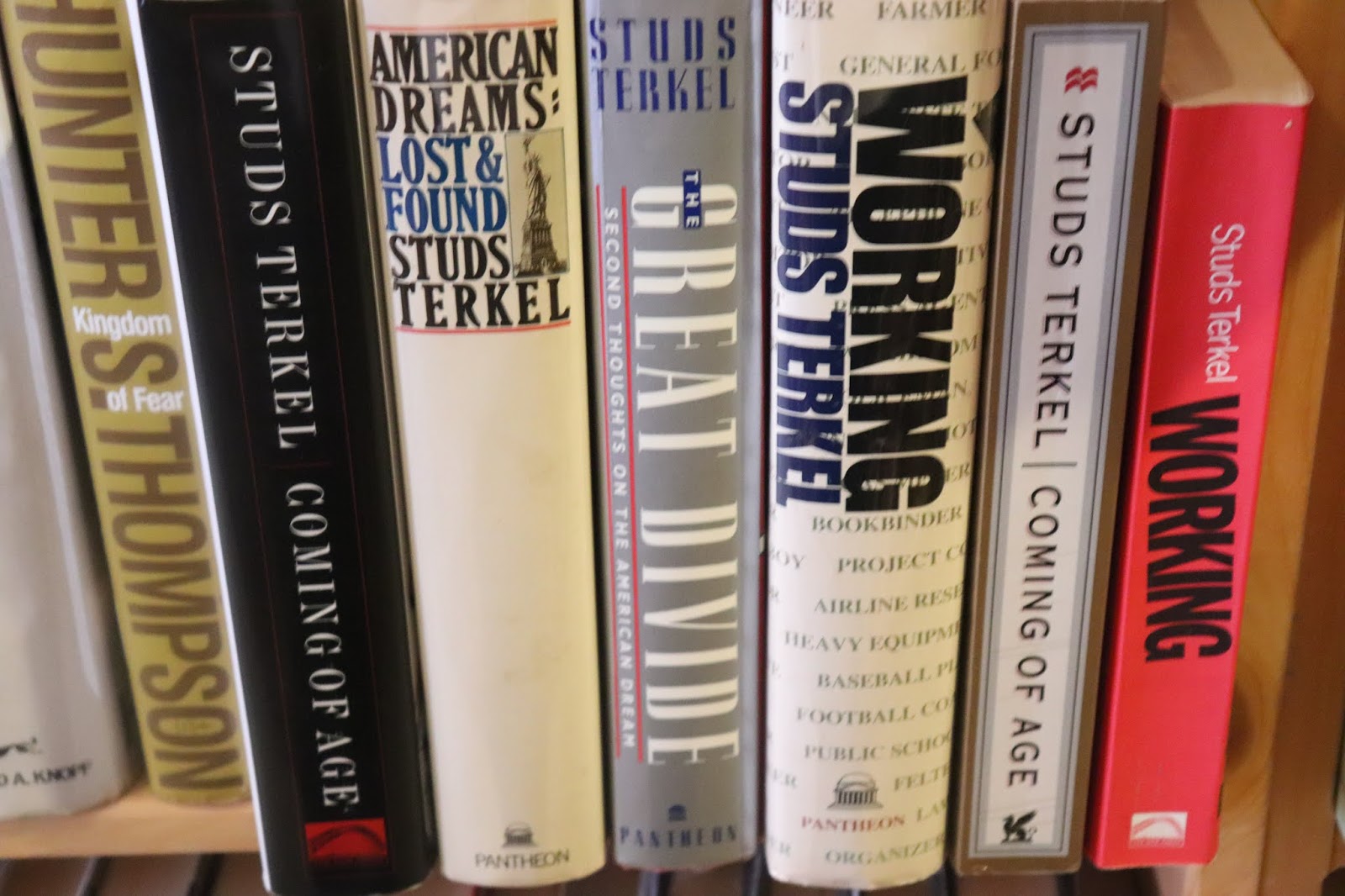
But a full and complete discussion of books I’ve read more than once and highly recommend would be a book in itself. Do you live in or live elsewhere but love Michigan? If so, and you have yet to read Bruce Catton’s history of Michigan and his memoir, Waiting for the Morning Train, put those on your list today! What about anything by Studs Terkel? All his books of interview with Americans, on a variety of subjects, are worth your time. 

Michigan's own Bruce Catton

Chicago's own Studs Terkel

Mildred D. Taylor’s novels are too good to be restricted to YA readers. Historians and lovers of good essays should not miss books by Tony Judt. If I were to begin listing books from the past decade alone, we would be here all day, though, and I know you have other things to do. Whatever you read, do make time for reading, because especially in this glorious summer of our discontent, getting lost in a good book (outdoors if possible) is good medicine for us all. As for me, I'm happy to realize that my bookshop is a Treasure Island, and if you are a booklover and know how to browse, you will never have to leave empty-handed. Only this morning, a repeat customer from Wisconsin told me, "The best part of the trip is coming to this bookstore." 

Just before this morning opening "bell"

But now -- oh, my goodness, the UPS delivery came! Another box of treasures have arrived!

And we are off to the races!