Search This Blog

Showing posts with label seasons. Show all posts

Wednesday, June 3, 2026

The Best Things in Life -- and --

Redbud on the creek, Northport

Northern Michigan is in bloom!


Let’s start with beauty, because there is no such thing as too much beauty. Leelanau County has been bursting with blossoms. Cherries first, then apple blossoms, now lilacs. Not only orchards, though. There are lots of flowering plants in the villages, too. 

Chokecherry and viburnum, Northport

Closer look at viburnum called 'Chenault' (somewhat past peak)

These blooming trees in Leland stopped me, too.

At home, wild violets gave me enough for two batches of violet jelly (lots more violets, but how much violet jelly do I need?) and made a stunning setting for photographing my dog when Sunny Juliet plunked down in another little sea of deep purple. And while there aren’t many redbud trees this far north, those few do their part, even the spindly little volunteer behind the old henhouse at my place.

Wild Violet Jelly

Redbud flower closeup

It’s worth looking close to the ground, as well, for beauty you would not be able to take in from a speeding car.

Not much to look at?

Look closer!

And gardens! This is the time of year I live for! I think of it as my real life, with before and after mostly prologue and epilogue. 


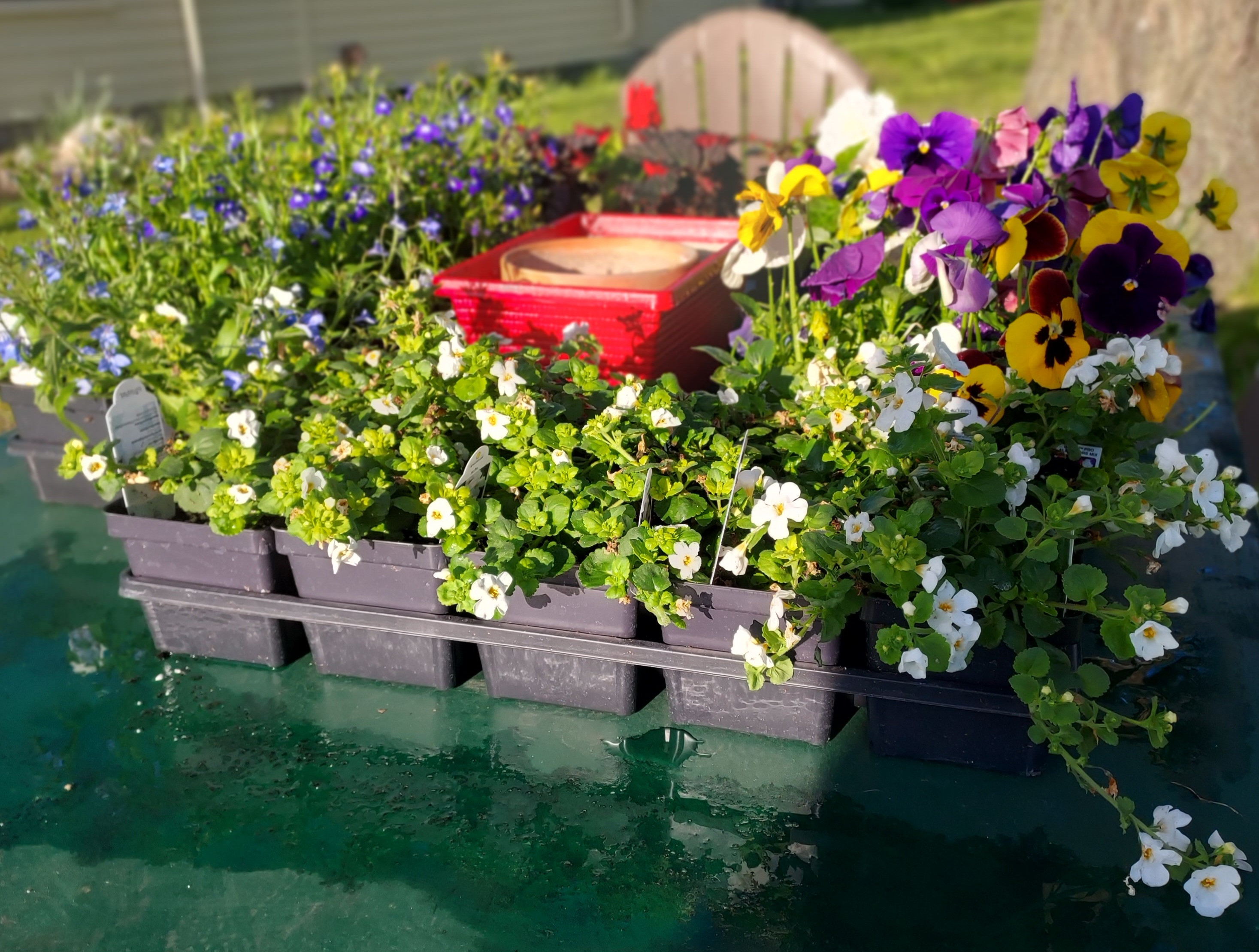
Lobelia! Need I say more?

Black petunias! Bacopa! Splendid iris from the late Al Bona!

That got me to thinking the other evening about seasons and how, for me, here in Northern Michigan, the four seasons as generally divided don’t make sense. Spring isn’t really March-April-May, but (in my opinion, in my life) April-May-June, with summer July-August-September, and so on. December is more late fall than early winter, and winter usually hangs on through most of March. What do you think about that?


My reading these days--

As is so often the case, my attention hops like a flea (or buzzes like a bee?) from one book to another. Having trouble with Faulkner’s As I Lay Dying (I could not seem to hear the characters’ voices in my head), I picked up a less demanding book, Dark Light, nonfiction about the dawn of electric light and all the promises and fears any revolutionary new technology spawns, but have yet to finish it, because morning reading on the porch for several days was Remember, by Lisa Genova, neurologist and author of the novel Still Alice, in which the main character develops signs of early onset Alzheimer’s. Not being able to recall a name, Genova assures readers in her new nonfiction book, is not a sign of dementia. It happens to 20-year-olds as well as 80-year-olds. Older people simply worry about it more. 

Remember is an easy read and a quick one. Whatever your age, and whether or not you worry about your memory, it’s worth learning what helps us remember, what gets in the way, and what we can do to keep memory as sharp as possible as we get older. Pay attention, the author tells us at the beginning. (“Stop, look, and listen,” I think to myself, remembering the lesson about crossing streets that I was made to repeat over and over when young.) You can’t remember that to which you have not paid attention. I particularly like this piece of advice, since I decided years ago that paying attention is my #1 job in life. There are other pieces of advice. Sleep, exercise, a healthy diet—all the things that are in general good for our physical health are also good for preserving our memories. Alcohol is a culprit, better avoided. Caffeine in moderation and not too close to bedtime. 

***


Then there was One Day, Everyone Will Have Always Been Against This, by Omar El Akkad, a hard book to read, not for the difficulty of the writing but for its subject matter. Still, the urgency of El Akkad’s book is such that I believe every American should read it now. Because, as he says --

No, there is no terrible thing coming for you in some distant future, but know that a terrible thing is happening to you now. You are being asked to kill off a part of you that would otherwise scream in opposition to injustice. You are being asked to dismantle the machinery of a functioning conscience. Who cares if diplomatic expediency prefers you shrug away the sight of dismembered children? Who cares if great distance from the bloodstained middle allows obliviousness? Forget pity, forget even the dead if you must, but at least fight against the theft of your soul.

- Omar El Akkad, One Day, Everyone Will Have Always Been Against This (2025)

That will be one day. What about today? Where do you and I stand today? 

Detail from book cover


I did, finally, finish As I Lay Dying. Faulkner will never be my favorite writer, but reading one of his famous works was a duty I could not neglect forever.


Big Life, Little Life; or, Macro, Micro

“Big Life, Little Life” is the title I gave to my most recently filled volume of journal writing. “Macro/Micro” are the terms used by Robert Reich and Heather Lofthouse on their Saturday Coffee Klatch videos. For those of us fortunate enough to live far from war and famine, the contrast is often stark between happiness in our personal lives and the agony we feel over our country’s disintegration and its role in world suffering. My parents were spared this, I have thought so often. My (late) husband was spared this.

Recently I had my annual Medicare wellness visit. Am I depressed? No, I can’t say that I am depressed, because my personal life is fulfilling. When I wake up in the middle of the night, however, I often wake into rather than out of nightmare, as I remember what is happening in my country and in the world. Anxiety? Yes, on a daily basis. You are not alone, I was told. “Ninety-nine point nine percent” of her patients are anxious about the country and the world, she told me. And we are the lucky ones! We did not send our children off in the morning only to have a bomb drop on their school and kill them. We are not handcuffed and shackled and herded from one “detainment center” to another, treated worse than American pet owners would ever treat their dogs and cats. We are not starving. Why are we anxious, and what do we fear—if not the theft of our souls? And the death of freedom and the actual deaths of innocent human beings, our brothers and sisters?

What can we do? First, we must speak up. Then -- what practical, doable action have you found that you can take in your community?


Here and now, though...

...Tree Guy and I are putting a life together. This is quite an unexpected late-life gift, as we see it, and Sunny Juliet, who is part of it, may not “count her blessings” in quite the same way, but she loves being part of a pack and having a home and people to play with her and provide her with special treats. She is a lucky dog, and Tree Guy and I are a couple of lucky humans.


Monday, March 16, 2026

Spring in Warwickshire, Winter Continues in Leelanau

March 20, 2025: snow

March 31, 2025: ice

Is this March all that completely different from the Marches of other years? I look back at photographs on my phone from March 2025 and see snow and ice, snow and ice. If the snow was not as deep last year, the ice was more damaging that what we have had this year—so far! Some say with Shakespeare that April is the cruelest month. I say March is crueler— more a steady, harsh prolongation of winter than a teasing alternation of winter and spring.

May 14, 2025: pear blossoms

Spring! Will we really be granted another? Will we see May blossoms again if we only hang in there patiently? Surely, yes! And every hour of beautiful May will be filled not only with that hour’s beauty but also with memories of former springs, memory deepening perception to swell each moment to overflowing.

The wood I walk in on this mild May day, with the young yellow-brown foliage of the oaks between me and the blue sky, the white star-flowers and the blue-eyed speedwell and the ground ivy at my feet, what grove of tropic palms, what strange ferns or splendid broad-petalled blossoms, could ever thrill such deep and delicate fibres within me as this home scene? These familiar flowers, these well-remembered bird-notes, this sky, with its fitful brightness, these furrowed and grassy fields, each with a sort of personality given to it by the capricious hedgerows,—such things as these are the mother-tongue of our imagination, the language that is laden with all the subtle, inextricable associations the fleeting hours of our childhood left behind them. Our delight in the sunshine on the deep-bladed grass to-day might be no more than the faint perception of wearied souls, if it were not for the sunshine and the grass in the far-off years which still live in us, and transform our perception into love.

- George Eliot, The Mill on the Floss

William Allen Neilson, who edited the Harvard Classics edition of The Mill on the Floss, calls the novel “substantially true [to the author’s life] though intentionally altered in details,” as George Eliot took her own girlhood as a model for that of her heroine, Maggie Tulliver, and the terrain of Warwickshire in the English Midlands as the inspiration for Maggie’s beloved home country. That much is hardly surprising, is it? Neilson notes that Dickens did the same in David Copperfield and Thackeray in Pendennis. Never having been an English major, I know of great literature and writers only what I have read and so was taken by surprise to learn that Mary Ann Evans (as she was born), in addition to writing novels, was first assistant editor of the Westminster Review in London and at the same time translated Essence of Christianity, by the German philosopher Feuerbach into English! Translated Feuerbach? Really?

Another surprise awaited me in the novel itself. Nothing I ever heard of George Eliot had led me to expect humor in her writing. And yet, why be surprised? Thackery’s satirical portrayals of church and society, as well as the unforgettably broad characters of Charles Dickens, surely delighted their authors in the hours of their creation, so why should George Eliot, in the same literary-historical period, not do her own skewering of pretense and eccentricity? Early on in the story, Eliot gives us a conversation between the parents of young Tom and Maggie Tulliver. The husband is more or less thinking aloud, meditating on further schooling for their son, Tom, hardly expecting thoughtful contributions from the wife he chose because she was not quick-witted enough to challenge him with ideas of her own, so he is not at all taken aback when plump, pretty, blond, shallow-minded Mrs. Tulliver replies only to what she hears and understands, rather than to what her husband says.

“But,” continued Mr. Tulliver after a pause, “what I’m a bit afraid on is, as Tom hasn’t got the right sort o’ brains for a smart fellow. I doubt he’s a bit slowish. He takes after your family, Betsy.”

“Yes, that he does,” said Mrs. Tulliver, accepting the last proposition entirely on its own merits; “he’s wonderful for liking a deal o’ salt in his broth. That was my brother’s way, and my father’s before him.”

Besides lyrical descriptions of natural beauty and sharply satirical portraits of human beings in relationships, the author makes the occasional general observation on humanity. Here is one that struck me forcibly today, as violence unleashed around the world triggers repercussions nearer home:

So deeply inherent is it in this life of ours that men have to suffer for each other’s sins, so inevitably diffusive is human suffering, that even justice makes its victims, and we can conceive no retribution that does not spread beyond its mark in pulsations of unmerited pain.

Men, women, and children, we understand George Eliot to be saying, as Tom and Maggie suffer their father’s bankruptcy, as well as the primary blame their mother’s family places squarely on their father and secondarily on their mother for having married him. (So in today’s reckless, ill-considered war, undertaken principally by two dictatorial heads of state, repercussions are being felt around the world. Will unmerited pain or “justice” will be greater in the end? What are the odds?)
Even as the girl Maggie’s repeated bursting into tears annoyed me, I enjoyed The Mill on the Floss much more than I had expected I would and put off reaching the final pages by setting the book aside over and over again. 

Thursday I got to my bookshop for the scheduled four hours (as I had on Wednesday, also), entertaining a total of two drop-in visitors in all that time (a quieter day than even Wednesday had been), and then the forecast for Friday was so dire that I planned a snow day, along with all the schools in Leelanau County, and made a lazy day of it at home, with a lot of reading and the reorganization of one cupboard. The forecast for Saturday was sunshine, however, and I planned to get back to my shop. 

Friday sun and shadows


So much for plans! My driveway wasn’t plowed until 5:30 p.m.! Sorry I couldn't get my shop open for a sunny Saturday!

Which brings me to Sunday, my usual at-home day, with a near-blizzard raging outside my blessedly warm farmhouse. I say “near-blizzard” advisedly, having been instructed that ‘blizzard’ is a very precise category of storm. So far our winds are only 23-25 mph, not the 35 mph that they would need to be for blizzard designation. In addition, we would need not just blowing snow but whiteout conditions for three hours. So today’s snowstorm is not a blizzard, but if it dumps two feet of snow, a lot of us may be snowed in for another couple of days. One can be snowbound without a blizzard.

Sunday morning

Does Sunny like the snow? She is eager to go outdoors, happy to run around the yard and "make snow angels" (in her own way—you wouldn’t recognize them as such—I think she’s only scratching her back), but there’s not much reluctance on her part when her momma tells her it’s time to go inside again. 

"Ready for breakfast, Momma!"

Sunny and I came indoors for breakfast about 9 o'clock. By 4 p.m. the walk I had cleared in the morning was buried eight inches deep in new snow. Sunny was floundering in it, up to her belly. And it was still coming down....


I hope my snowbound friends have plenty of books to get them through these days!

Tuesday, June 3, 2025

My Unexpected Vacation Day

Orchard road

[In China] I took deep interest … in the farming problems of our neighbors, the difficulties of raising crops…. I watched the turn of seasons and was anxious with the farmers when there was no rain and yearned with them in their prayer processions and was grateful when sometimes the rain did fall.


-      Pearl S. Buck, My Several Worlds: A Personal Record


Up North, when days finally grow long and bright again, the question asked between people meeting for the first time in this new year is always the same: “How was your winter?” 


My answer this year: “In retrospect, it went fast.” 


I admit that individual days sometimes felt long, and yet, each week, as I looked back on it, seemed to have flown by. Spring’s arrival, however, seemed reluctant as back and forth it went, a yo-yo season, giving us hope only to dash our optimism the following day. Yet difficult as were those days of March and April, they were cold spring days, January now only a memory.


Cherry blossom was unspectacular this year in my immediate neighborhood. We had ice and rain and wind, and though trees bloomed, I missed the usual rolling acres of brilliantly white flowering trees in the spring sun. Either I missed it, or the wind and rain tore the blossoms untimely from the boughs. If I'm correct about there having been a shorter flowering time, will it affect the harvest? Farmers need a lot of faith to keep going, it seems.


Annuals to add POP to perennial borders

One of the garden centers where I buy flowering annuals changed hands this past year, and when I asked one of the new owners how things were going he remarked—this was last Sunday morning—that people were biding their time, reluctant to plant with the weather as cool as it still was. I had risked bean seeds, and they came up, but then a chilly morning nipped part of a row. I filled in the row with new seeds. Does that take faith? I don’t know that I'm brimming with faith, but I plant and hope for the best and am delighted (by what seems a miracle!) when seedlings emerge from the soil.


Now—suddenly, it seems!—it is June, and there are no more slow days. Between sunrise and sunset we have more than 15 hours, so the days are long, but each one speeds by. As illustration and evidence, I offer below images of trees leafing out in late May. First, a roadside woods at that all-too-brief impressionist stage, the spring day when I always long for a ‘pause’ button so as to drink my greedy fill of this delicate, tender, fleeting time that is gone too soon. Then, our Leelanau woods only two days later. The first green of spring: Now you see it, now you don’t!

One spring day --

Two days later --

And THEN!  It's a jungle!

My personal and business life take on the speed of the season, which is why my recent trip to Kalamazoo was only an overnight turnaround. I could stay there for a month and still not have enough time with family and friends, but too much awaits my attention at home, so home I came the next day to tend to it all: planning for bookstore events with book orders and publicity, and planning for summer visitors to my home (and for my own stolen moments of leisure) by getting yard and gardens in shape for the season. Marilyn Zimmerman's book launch is next week!!!


Mark your calendar for June 10, Dog Ears Books, 5-7 p.m.!
 

In the midst of all this, the disappearance of my billfold, holding driver’s license and credit cards, was a minor crisis. Did I leave it somewhere? Drop it somewhere? Was it in the house “in plain sight” and I just couldn’t see it? Over and over I mentally retraced my steps ... called places I’d been on Friday and Saturday ... looked and looked and looked ... through every bag, under car seats, at home and in my shop. It is so maddeningly tedious, having to give over mental energy to such a boring, repetitive task, don’t you find? 


But on Monday morning my car had to go in for a brake job in Leland, and since I could make no progress on the search while the car was in the garage, I put the whole problem on the back burner, walking from Van's garage down Main Street to Trish’s Dishes to get a coffee to go, encountering a couple of friends along the way, and then making my leisurely way back to the river to find a perch on the dock of a shanty belonging to friends there in Fishtown. I'd texted Charlie that I would be there but hadn't had a reply, so I just made myself at home, as the Artist did so many times over the years.


Looking lake ward


A glorious morning! The sun was shining, and the breeze was alive with that wonderfully familiar, fresh-fishy aroma of the river. Men were at work on the dock opposite, where a few early morning tourists strolled. Passengers gathered to board the Mishe-Mokwa for a day trip to South Manitou Island. Gulls flew overhead, and song sparrows sang. Now and then a duck paddled about near the pilings. 


It was very near here, just south of the river mouth, that the Artist spent a night on the beach long ago and wandered into town the next morning to the Bluebird, where Grandma Telgard said immediately to a member of her kitchen staff, “This boy needs a cup of coffee!” That was years before we met, but in later years together we spent many, many hours in, around, and near Fishtown, only a pleasant walk from our old Leland home.


Back to the present. Now, in 2025, for weeks and weeks I have been carrying my sketchbook with me everywhere I’ve gone, along with a set of drawing pens sent to me by a friend for my birthday. The last serious sketches made in the book were from 2015. A whole decade ago! How is that possible? Finally, there on the dock, I took out sketchbook and pens and applied myself to the scene. The results were laughable, but results didn’t matter. I was there and nowhere else, practicing drawing as meditation. Perfectly content.


Life proceeds at a different pace on the river, I remembered then, whether one is working or relaxing. 


“I beg your pardon,” said the Mole, pulling himself together with an effort. “You must think me very rude; but all this is so new to me. So—this—is—a—River!”


The River,” corrected the Rat.


“And you really live by the river? What a jolly life!”


“By it and with it and on it and in it,” said the Rat. “It’s brother and sister to me, and aunts, and company and food and drink, and (naturally) washing. It’s my world, and I don’t want any other. What it hasn’t got is not worth having, and what it doesn’t know is not worth knowing.” 


-      Kenneth Grahame, Wind in the Willows


Illustration of Rat and Mole by E. H. Shepard

Since I’d seen no car, I thought Charlie and Sandy must be away, but it turned out that Sandy was home, and after a while she joined me outside on the dock with her own coffee mug, and the two of us caught up on each other’s lives in leisurely fashion. I showed her my sketchbook, and she showed me her tiny portable watercolor kit, small enough to fit in a handbag, and after a couple of hours we walked up to Main Street and over to the Cove, a restaurant on the north side of the river, to meet her visiting grandson and his wife and their almost-three-year-old son for lunch. 


I’d told Sandy about my missing billfold but was feeling no stress or panic. It would show up, or it wouldn’t. I had put a hold on the credit cards the day before, and although replacing cards and driver’s license would not be much fun, it was just one of those things. One foot in front of the other. Deal with it. That's life. 


Am I calmer because I’ve learned not to panic? Or is it simply a lessening of energy that comes with age? Or am I become so calm, so unlike my younger self, because after losing the love of my life nothing else that happens to me feels all that difficult? Maybe all are partial explanations.


Later, back home, I dared to plant seeds for tender annuals and vegetables. Launched tennis balls through the air for Sunny Juliet. Searched one more time through my car for the missing billfold and contemplated necessary next steps if it didn’t turn up. But the day was too beautiful for worry. I’d mowed grass on Sunday, and my yard, fresh and green, was orderly and inviting as I puttered about the perennial borders, grateful for my Michigan country life.


Sunny likes Michigan, too.

And the icing on the cake was that I found my billfold in the grass, right there at home! Now I don’t have to think about that any more! 


But have I been stingy with pictures of Sunny in this post? How about a recent scene at the dog park, Sunny and friends, with all dogs in happy motion. There! Satisfied?


Dogs having fun!

Tuesday, April 9, 2024

Is Spring in the Bag at Last?


Daffodils are in bloom and wild leeks aplenty pushing up underfoot in the woods. Sandhill cranes are back from winters in the sunny South, announcing their presence vocally in Leelanau (so far overhead that I haven’t had a glimpse of them yet, but they’re definitely here). Only last week we had another big snow, and it could always snow again; however, the air feels as if the season has turned the corner at last, not teasingly but sincerely. We shall see. I’m enjoying the increasing hours of sunlight, anyway.


Sunny Juliet and I have not yet resumed our agility work, except on an ad hoc basis in the woods, where a large fallen tree is an opportunity for her to “Walk it!” and “Table!” the signal for her to jump up on a stump. She is very happy, though, to have a new neighbor playmate and to tear around with Griffin while humans stand by and supervise. “A tired dog is a happy dog,” we tell each other contentedly. Then, “Watch out! Not right under our feet!”


[No new photos because their play date last night was cancelled.]


School is back in session in Northport following spring break, families back from their self-prescribed “cabin fever” vacations, and summer people returning to open houses and cottages for the nonwinter months. The annual migration holds once again, for cranes and humans alike.


One question bedeviling me occurred to a couple of friends, also, I learned when I mentioned it. We are struck by the number of fallen trees in the woods. It almost seems that there are as many big old trees lying on the ground, horizontal or nearly so, as there are upright specimens. Is this a misperception, or can it be true? And, if true, did the northern Michigan woods always have this appearance in the spring (and we are only now noticing), or has there been a recent massive die-off? Are all the fallen individuals perhaps ash trees and beeches, victims of recent pest invasions? Bottom line: Has the woods looked as it does now ever since county residents abandoned woodstoves for furnaces – or not?


Is there a forester out there with an answer to this question?


Three different people sent me the link to a story in The Washington Post (if you are not a subscriber, maybe a friend who is will gift you the article) about bookshops specializing in books that have been around the block before, and I appreciated most of the advice given in the article: Take your time; have a spirit of adventure; don’t crow to the owner when you find a book marked at a fraction of its value (just buy it and be happy, I say); look at the books and not at your handheld device. I loved the remark about small shops tending to be “zealously curated,” and I wanted to cheer at “Try never to leave a bookstore without making a purchase, if only a used paperback. It is the least you can do to support these defenders and bastions of civilization.” (Is that what I am? Not such small potatoes, then!) I was not as thrilled by “Bring a flashlight and expect to get dirty.” You wouldn’t want to eat off the floor of my shop, but then, it isn’t a restaurant, is it? 


In Northport, in addition to reorganizing subject areas in the bookstore recently to make room for new arrivals, I’ve also been planning for the future. Here are a few important days coming up on my calendar, which I urge you to put on your calendar, too:


Monday, April 22. Earth Day


Saturday, April 27. Indie Bookstore Day


Saturday, June 22. Visit to Dog Ears Books by author Bonnie Jo Campbell


In honor of the Earth Day 2024 theme, “Planet vs. Plastics,” and as a belated brag on 2023’s 30th anniversary of Dog Ears Books, I will be offering beautiful new canvas book bags ($12), which will be no less appropriate on Indie Bookstore Day (always the last Saturday in April, and this year I’ll be here!) and perfect for carrying home your signed copy of Bonnie Jo Campbell’s new novel, The Waters -- plus, of course, any other treasures you find in my “zealously curated” collection on Waukazoo Street!


As we were in 2011 --


Tuesday, August 10, 2021

What’s in a Book?


Better (at least more interesting) Than Money


“Do you ever find money in old books?” I’m often asked. In 28 years of bookselling, I haven’t found so much as a single dollar bill, and it seems unfair, too, considering my own long-ago habit of hiding 5s and 20s in volumes on my shelves at home. It’s been a long time since I did that, but somewhere in the world there may be paper currency inside the pages of a book that once belonged to me. 


But dollars are interchangeable. One is worth as much as another. What I found recently in an old book, on the other hand, was something unique. Since it’s a little hard to read soft pencil, especially in a photograph, here is my transcription:


Empire Mich Dec 13, 1897.

Mr. W. Benjamin

Leland Mich

Dear Sir: It is snow

ing fast today.

Our school has just 

had examination

and did fairly will.

Hoping you will

come soon I remain

Very Respectfully

Neddy Drow


Did young Ned ever send this letter to Mr. Benjamin? What were their respective ages? Their relationship? Can you believe this little epistle in pencil is almost 125 years old? Doesn’t that have much more interest (and intrinsic value) than a dollar bill?


 Books I finished reading since my last post:


I should explain that I am often reading several books in the course of a day, which means that the reading of one is often interrupted by reading others more quickly finished. Anyway, additions to this year's list since my last post --


102. McAnulty, Dara. Diary of a Young Naturalist (nonfiction

103. Washington, Mary Helen. The Other Blacklist: The African American Literary and Cultural Left of the 1950s (nonfiction)

104. Hicks, Joyce. One More Foxtrot (fiction)

105. Roberts, Tanya. A Little Italian: A Journey, A Family, and St. Francis (nonfiction)

106. Levi, Primo. If This Is a Man (nonfiction)

107. Smiley, Jane. Perestroika in Paris (fiction)


Despite the many ways in which these books differ (and they differ very widely!) from each other, I found all full of life and passion and humanity. And on the subject of life, passion, and humanity in books, I must note that my first shipment of Ellen Airgood’s new novel, Tin Camp Road, is here now, with another case arriving later this week.


Better Late Than…


My sad, dwindling selection of postcards should be beefed up with colorful images this week, too, since I finally located my “postcard lady,” who hasn’t visited the shop for three years but does have an online presence. Stay tuned also for a new line of notecards I hope to have before summer is over!


Because summer is racing by pretty quickly, fields filling with blossoming coneflowers and Queen Anne’s lace and spotted knapweed -- yes, that last an invasive alien, but it’s hard not to appreciate the lavender color it lends the hills – as September keeps appearing here and there while August is still here. Don’t you smell September in the rain? Feel it in the wind?


Peasy doesn’t take much note of wildflowers, and while this is his first round of spring-summer-fall in northern Michigan, he seems to be enjoying it. We love his joy, too. A dog’s happiness: irresistible!