Search This Blog

Showing posts with label research. Show all posts

Tuesday, August 25, 2020

Tragedy, Determination, Victory, Hope

Lake Michigan

Water: source of life on planet earth, vital and essential to all living things
Children: the future of our species and whatever kind of society our species constructs

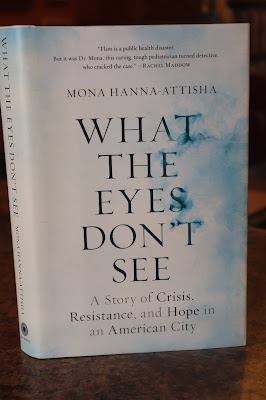
Quite frankly, I wasn’t sure I could stand to read Mona Hanna-Attisha’s book about the Flint water crisis, What the Eyes Don’t See. There are so many things wrong these days that it can be hard to sleep through the night and, when night is over, hard to face another morning. But I had to look into the first few pages, at least, and I always enjoy reading first-person accounts of childhoods, particularly when someone grew up in Michigan, and so I launched into reading the author’s prologue.

Then came the painful segue:

This is the story of the most important and emblematic environmental and public health disaster of this young century. More bluntly, it is the story of a government poisoning its own citizens, and then lying about it. It is a story about what happens when the very people responsible for keeping us safe care more about money and power than they care about us, or our children.

The crisis manifested itself in water – and in the bodies of the most vulnerable among us, children who drank that water and ate meals cooked with that water, and babies who guzzled bottles of formula mixed with that water. The government tried hard to convince parents the water was fine – safe – when it wasn’t. But this is also a story about the deeper crises we’re facing right now in our country: a breakdown in democracy; the disintegration of critical infrastructure due to inequality and austerity; environmental injustice that disproportionally affects the poor and black; the abandonment of civic responsibility and our deep obligations as human beings to care and provide for one another. Along with all that – which is a lot already – it’s about a bizarre disavowal of honesty, transparency, good government, and respect for scientific truth.

Stomach-turning. But none of it was news. The Flint water crisis, under the administration of Republican governor Rick Snyder, made national headlines while the “controversy” was going on (see here for a report on what the governor knew and a complete timeline of the crisis), and I mention the political affiliation of the governor because the story of the crisis does seem, unfortunately, typical of a party that used to be called “Grand.” The party’s history is one thing, its present reality something very different, not only in recent Michigan history but currently at the national level, “the very people responsible for keeping us safe care more about money and power than they care about us, or our children” destroying public education, cheaply selling off public lands and resources, rolling back environmental protections, giving the biggest tax breaks to the wealthiest Americans, threatening Social Security, doing everything possible to cripple the postal service (established by the U.S. Constitution they claim to worship) and to subvert the electoral process with de facto disenfranchisement. This is not the Republican Party of my parents. Of course, my opinion may not be yours. I realize that.


To be fair, I acknowledge that there was plenty of blame to go around and that one of Dr. Mona’s eventually winning team, much to her astonishment, water engineer from Marc Edwards from Virginia, told her he was a “conservative Republican." Edwards had become so disillusioned in his battle over contaminated water in Washington, D.C., however, that he was dubious about any speedy action -- or any action at all -- taking place in Flint, Michigan.

Anyway, as I say, I wasn’t sure I could handle reading the book about Flint right now. I mean, yet another environmental and human rights and government corruption nightmare! But surely I could manage the final couple pages of the prologue, I told myself, and here is where the subtitle of the book, A Story of Crisis, Resistance, and Hope in an American City, came into play:

Resilience isn’t something you are born with. It isn’t a trait that you have or don’t have. It’s learned. That means that for every child raised in a toxic environment or an unraveling community – both of which take a terrible toll on childhood development and can have lasting effects – there is hope….

Just as a child can learn to be resilient, so can a family, a neighborhood, a community, a city. And so can a country. A country can endure trauma and neglect and become a place where people are cared for, where democracy and equality and opportunity are once again encouraged and advanced….

The title, What the Eyes Don’t See, of Dr. Mona Hanna-Attisha’s book is so, so important! What the eye doesn’t see and the mind doesn’t know, doesn’t exist, wrote D. H. Lawrence in Lady Chatterly’s Lover. Numerous studies of perception have shown (e.g., “The Trouble with Eyewitness Identification of Testimony in Criminal Cases”), over and over, it’s all too easy for human beings – all of us – to see what we expect to see, much more difficult to notice something that conflicts with our expectations. This important lesson was impressed on Dr. Hanna-Attisha during her pediatric residency by Dr. Ashok Sarnaik.

…When discussing a case and trying to figure out a diagnosis, he watched us run through our limited supply of options, and he always criticized us for not reading enough and therefore not knowing enough, for not seeing the whole picture.

“How can your eyes see something,” he’d say, “that your mind doesn’t know?”

Lake Huron

Quick background for those who didn’t follow the Snyder link to find the timeline: The quick-and-dirty general story of Flint’s lead-contaminated water began in April of 2014, when the municipal water supply was switched from the Detroit, which used treated Lake Huron water, to the Flint River, “a toxic industrial dumping site for decades….” Although tap water from the new source looked and smelled and tasted bad, and the city recommended boiling the water before drinking or cooking with it, eventually an all-clear was sounded, and the State of Michigan declared it in compliance with safe water guidelines. General Motors, however, six months after the switch in water supply, was granted a waiver and allowed to return to the Lake Huron supply. Why? Flint River water was “too corrosive.” It corroded engine parts. Offices switched to bottle water. Family homes in Flint, however, despite rashes, hair loss, weight loss, and other more disturbing problems, were told their water was fine.

Fortunately for Flint residents, pediatrician, educator, and hospital researcher Mona Hanna-Attisha had a close friend from high school, Elin Betanzo, who had worked in E.P.A. during the D.C. water crisis, who shook her head at Mona’s question about Flint’s water supply being safe. “No,” she said. “It’s not.” 

She did not go looking for a problem or for a cause: the problem and cause came to her as a challenge she had to meet -- because she was a doctor, because her patients were children, because her family tradition was to stand up for others who were threatened. Her parents taught her well.

Dr. Mona, as her young patients call her, and Jenny LaChance, her research coordinator, had no funding for their initial study, and in the beginning, the two of them were the whole team. All they had was their education training, a devotion to children’s health, and obsessive determination to get their hands on the necessary data. 

I will not synopsize page by page, day by day, the story Mona Hanna-Attisha tells so capably and movingly in her book, weaving her immigrant family’s experience with an often heartbreaking but ultimately triumphant mission to secure safe water for the youngest residents of Flint, Michigan. And as I have said, the blame for the crisis cannot be laid solely at the feet of one political party. There were elected officials to whom re-election was more important than admitting the problem; officials who had no real power and saw nothing to be gained in rocking the boat; agency people afraid of being labeled trouble-makers and being forced out of their careers; and Flint’s problems had begun long before 2014.

But the author is clear about where she thinks blame lies:

If I had to locate an exact cause of the crisis, above all others, it would be the ideology of extreme austerity and “all government is bad government.” The state of Michigan didn’t need less government; it needed more and better government, responsible and effective government.

As I read about the shameful role of the MDEQ in this sad chapter of Michigan’s history, I couldn’t help thinking back to a former Republican governor John Engler, who eviscerated the Department of Natural Resources, breaking it up into smaller units to create the understaffed and politically vulnerable Department of Environmental Quality, the MDEQ that would have done nothing to protect Flint residents had not a few brave and determined individuals blown the whistle and backed up their whistle-blowing with hard-won facts and analysis until the danger finally became public knowledge. Many government officials and employees and agencies ignored the crisis as long as they could, even denied it when they knew better, but for anyone who thinks the answer is no government and the privatization of everything, please think about how much worse the crisis in Flint could have been without any accountability to an electorate. Governor Snyder had appointed a series of Emergency Managers to run the city of Flint, over and against its elected mayor, to save money, but the governor and his staff were still, ultimately, held responsible. Imagine a corporation in charge of providing water, cutting costs wherever possible to provide the best return to stockholders, with no one responsible for preventing harm to thousands of children living in poverty. Who would care?  

One of the several crises facing our nation today in 2020 is that of the coronavirus, COVID-19. And let’s be honest here: we are all tired of wearing masks, weary of keeping a six-foot distance between ourselves and our dear friends, and some of us (though there are a few exceptions, I realize!) very frustrated at not being free to hug anyone outside our close, limited bubble. But one of my favorite overheard remarks this summer came as a group of visitors to Northport were standing outside my bookstore window and looking at the sign thanking Governor Whitmer for keeping us safe, and one of the men said, “I’m a registered Republican, and I think she’s doing a terrific job!” 

Dr. Mona Hanna-Attisha is such a successful advocate for children because she has been able to build, from the initial nightmare facts, a program for going forward to build health and resilience in her patients and their community. The United States is in a bad place right now, and I have hope we can pull out of it and move forward together, but we desperately need thoughtful, informed, inspiring leaders with positive programs to bring us together and rebuilt our nation. Name-calling and scapegoating and whining, lying and denying and passing the buck -- that's not the answer. We've had that counter-productive program of destruction for four years. Enough is enough. 

And the book I didn't know if I could stand to read? I raced through it in two days, unable to put it down.

---

This, by the way, is my two thousand and tenth post on Books in Northport. The 2,000-mile marker slipped right by me, in the midst of everything else going on. Thank you, though, for staying with me all these years, those of you who have – and for joining me more recently, those of you new to Books in Northport. All readers welcome!


Tuesday, August 30, 2016

Back Again From Southern France


No jet lag this time around, as my travels were done from my own front porch. There were no photographs or other illustrations in Tony Judt’s scholarly study of Socialism in Provence 1877-1914, and yet, at the same time my brain was working overtime to take in his arguments and evidence, it was also picturing scenes from southern France – along with, I must admit, my grandparents’ modest little “farmette” (they called it that) in Ohio in the 1950s and today’s Leelanau orchards and vineyards and CSAs.

One of Judt’s quarrels with research previous to his in French social and political history was a tendency of researchers to lump regions and classes into large homogenous groups and make sweeping generalizations based on a composite portrait thus drawn of the populace. An area might be called agricultural, and a certain percentage of the population identified as peasants, and from that the researcher would assume conservatism and little active interest in politics.

Yet the difference between an isolated mountain hamlet (we ventured up a terrifying road to explore one in the Auvergne in 2000) and a bustling country village connected to other villages and towns by good roads was enormous in the time period Judt was studying. Moreover – as was true with my grandfather and as is true of many Leelanau farmers today – those working the land were not always themselves landless. They could be and often were owners of small property, working others’ land, as well as their own, or working in a small manufactory by day and on their land in the evenings (this was my grandfather’s pattern), or migrating from place to place with the seasons, following available work, or working part-time in the fields and part-time at other jobs. Artisanal workers and farm workers, laborers for others and property owners – these were not mutually exclusive categories. Judt found that while conservatism did reign in poor, remote areas, peasants on better land in the Var region, particularly farmers who actually owned property, were more likely to support socialist politics and programs. They saw collectivism as their best hope for being able to continue living on and working the land, despite bad crop years and market challenges from the larger world.

What impressed me most was the difficulty of categorizing the ways in which people earned their livelihoods. There was my grandfather, working in the casket factory by day and tending his raspberry patch and vegetable gardens and fruit trees in the evenings. There are farmers here in Leelanau who also work office jobs or hold political posts or teach school in the winter. I own a small business, and yet one fall I was among the county’s orchard workers, picking apples for a local grower. This has been the truth of country living for a long time, all over the world.

Another nonfiction book I mentioned here recently, Self-Theories: Their Role in Motivation, Personality, and Development, excited me greatly, and yet when I showed it to a very well-educated friend, with interests far beyond his own field, he laughed and said he would never have picked up a book with that title and cover, never imagined that it could be interesting, much less (as I found it) compelling, thrilling and inspiring. Here is what I sent him and another friend, by e-mail, under the subject heading “This book just keeps getting better and better,” when I was only halfway through the book:
It was published in 2000 by Psychology Press, an imprint of the Taylor & Francis Group, as part of a series called ESSAYS IN SOCIAL PSYCHOLOGY, so I'm talking about a book that is already 16 years old. One of the author's findings is that "we can influence students' theories [about themselves and their intelligence]. Although students came to our study with their own theories, what we told them had a clear impact. This means that people's theories of intelligence are malleable." So students who initially believe their intelligence is fixed can come to believe they can increase it, and this means they will be willing to take on challenges they would otherwise avoid. They can learn to learn! The author carefully says that the studies do not show such changes in belief to be permanent, but the initial belief wasn't permanent, either. Human beings can learn, not simply through trial and error, but by coming to believe they have the capacity to grow.   
She calls the two theories "entity" and "incremental." Entity theories think of intelligence as a fixed trait; incremental theorists (these "theorists" are all of us, at every age of life!) think of intelligence as knowledge and skill, something that can be cultivated and improved. The entity theorists are performance-oriented, and when they "fail," they fall into despair and helplessness, because to them failure is a sign that they are not smart, after all. Incremental theorists have a very different view of failure, seeing it as an opportunity to learn, to employ new strategies, to try harder or focus differently, etc.   
She doesn't stop there. She goes on to see if success and failure in relationships, and responses to perceived setbacks in relationships, follow the same pattern. She finds that they do. And then (I'm as yet only halfway through the book, and there are many, many studies conducted and cited), she finds that entity and incremental theorists not only judge themselves differently but judge others very differently, also. Entity theorists are quick to judge a person's character on the basis of a single action, but the author stresses that these quick judgments are not "impulsive," but "seem to grow out of a belief in character as a unitary thing that permeates virtually all actions and displays itself with great consistency."   
The really great thing is that students in a classroom can, with appropriate readings, change from entity to incremental theorists. The author does not know if the change in belief would be long-lasting [results of research do not preclude but do not establish such a conclusion], but imagine retraining the thinking of people who work in prisons to believe that prisoners can learn and become better, more self-aware people!
My excitement continued through to the last page of the book.

Similar to the way Tony Judt, in Part III of his study, extrapolated his findings to say something about socialism in France in general, Dweck takes her findings (about how people’s self-theories affect the way they view success and failure and influence responses to failure and challenges) and carries those into a larger theory of motivation and personality. In Chapter 18 she surveys other theories of personality and motivation. “Trait theories,” she tells us, are all about description but offer little in the way of explanation. They are particularly weak when it comes to explaining change. Not surprising, as Dweck notes: “In fact, many trait theorists don’t really believe much in personal change....” (This was my objection to the popular Please Understand Me and the Meyer-Briggs personality type test.)

“Motive theories” (she cites various in the group, but I am omitting the lists) leave out anything to do with goals, beliefs, or cognitions. Both biological theories and Freudian theories come in for criticism. Of course we inherit certain temperaments, she acknowledges, but “temperament is not destiny,” and biological theories “don’t look at adaptive functioning.” As for Freud, his theory left no room for impetus toward growth, ignored goals specific to a particular self, and posited all achievement as the result of defenses.

Growth, goals, beliefs – in Dweck’s theory, these are central, with the meaning given by the individual the most important factor in motivation, regardless of words used in explanations. Some “entity theorist” learners may believe luck is a factor but see luck not as unpredictable but as a feature of personality they either have or lack, just as they see ability.

In her final chapter, Dweck addresses questions and objections to her picture of human personality and motivation. One question is posed as follows: “Isn’t It Naive to Believe that Everyone Has the Potential to Change?” Excellent question! Here, in part, is Carol Dweck’s response:
...I have not tried to argue that anyone can become Albert Einstein or Mother Theresa, but I have tried to argue that we do not know what anyone’s future potential is from their current behavior. We never know exactly what someone is capable of with the right support from the environment and with the right degree of personal motivation or commitment. ... The danger of the entity theory is not so much that it argues for human limitation, but that it suggests we can know people’s limitations so quickly and then grants them so little potential for growth. I believe that people and society gain a great deal when we search for ways to help people realize their potential instead of labeling or punishing them when they do not.
Children can become “smarter” and more successful, Dweck has shown, when they incorporate into their belief system the idea that “failure” is an opportunity for learning and growth, not a sign of stupidity or badness. People who take on this new belief about themselves can also improve their personal relationships, no longer seeing setbacks as signals to give up. And everyone can see others differently, too – as capable of change and improvement.

Imagine! Imagine an electorate and a justice system, not only schools, believing in the possibility of personal growth. Imagine not writing off others (or allowing oneself to be written off) with “He can’t help it. It’s the way he is.” Being shy does not mean one must be paralyzed by shyness. That’s just one example.

And it is true at any age. I’ll let the author have the last word:
Some years ago, as I reached one of the landmark ages, I asked myself what I would like to be able to say at the end of my life, and it was this: I want to be able to say that I kept my eyes open, faced my issues, and made wholehearted commitments to things I valued. I did not want to be haunted by a litany of regrets or left with a bundle of potentialities that were never realized. As adults in this society our mission is to equip the next generations with the tools they need to live a life of growth and contribution. Can we make the commitment to help them become smarter than we were?


Friday, August 26, 2016

Facts and Stories


Hardly green cheese, eh?


As a reader and as a thinker, I am absolutely not an anti-fact person. Facts are important because truth is important. Living in the real world, as opposed to dreamy, wishful fantasy, demands recognition of reality, in all its complexity and all its myriad forms. And so, while we may have wanted nothing but fairy tales as children, as adult readers most of us mix the leaven of nonfiction into our reading.

If facts are going to appear in sentences, however, rather than in graphs or tables, I want something more than a mind-numbing recital of dates and numbers. I do not want an avalanche of nothing but facts. In fact (ahem!), when I suspect an author of trying to overwhelm rather than appeal to my critical faculties, I get downright annoyed.

Because under the avalanche, lost in the blizzard – what is the writer trying to hide? That’s what I ask myself when the fact storm gets too wild and woolly.

I’ve read a few books where a single unstated premise, when I plugged it in, was sufficient to undermine an argument otherwise well buttressed -- even overly so -- by a snowstorm of facts. (As a philosopher, I have learned to be very careful when reading historians, who are often tempted to tread lightly on argument and depend overmuch on fact storms.) Other authors, as becomes dismayingly apparent after several tedious chapters, try to cover so many bases that they are obviously trying to say everything that can be said on their subject (so as not to be wrong?), which boils down to saying nothing, once the snowdrifts are cleared away. Don’t waste my time!

Instead of a meaningless fact storm, I want at least one of the following: either a clear line of argument, leading to convincing conclusions or a compelling narrative. The nonfiction book that delivers both has knocked it out of the park.

My nonfiction reading these days is taking me far from home – up to Lake Superior, out to Arizona, and over to southern France -- and I've been reading some very good books. The most demanding in terms of argument and evidence is Tony Judt’s Socialism in Provence 1871-1914: A Study in the Origins of the Modern French Left, but the book is demanding not because the author resorts to blizzard tactics but because, on the contrary, he is very, very careful and clear about the claims he is making, the arguments he opposes, and the evidence for both sides. Painstakingly rigorous. It is exciting to be challenged by such a rigorous thinker, a writer so careful to avoid unsubstantiated generalization!

The temptation is great for me. No, not to leap into generalization but to pick up yet another book when I already have three or four others going. And so I could not resist looking into Self-Theories: Their Role in Motivation, Personality, and Development, by Carol S. Dweck. 

Wow! Again, a writer perfectly clear about what has been said before on her subject and what she has discovered, experimentally, that contradicts and disproves long-held beliefs still, unfortunately, quite prevalent. Not to give away the whole show here, but Dweck’s studies show that learners’ self-concepts influence their motivation more than initial success and more than praise. Does the learner hold what Dweck calls an “entity” theory of intelligence or an “incremental” theory? The former is a belief that intelligence is a fixed trait, a belief shoring up "a system that requires a diet of easy successes.” On the other hand are learners who believe that intelligence can be cultivated and increased. These are more eager to learn, not simply to take an easy path where they can succeed and reaffirm to themselves that they are smart. Dweck calls the patterns that emerge in the face of setbacks “the helpless pattern” and “the mastery-oriented pattern.” You can probably guess which pattern connects to which theory of self, can’t you?

Superior Land and the Story of Grand Marais, Michigan, by Karen Brzys, does not strain my brain as much as the Tony Judt book, but like Judt’s and Dweck’s it is clearly written and presents its facts in accessible form, not in a blizzard. U.P. blizzards are best kept in meteorological form, as the author well knows! Very good stories emerge from well-chosen facts in this book.

Then there is A Beautiful, Cruel Country, Eva Antonia Wilbur-Cruce’s memoir of her life in southern Arizona, near la frontera, when she was a little cowgirl of three to five or six years old. In her book, the facts are not only very local (as are the facts presented by Judt and Brzys) but also quite personal. They are also recollected many years after the events described. Some could no doubt be verified; for others, we must either take the author’s word for her account or remain skeptics.

Curious to learn more about the author, I searched online and found this piece from a Tucson newspaper. Holy cow! “La Pistolera” – what a nickname! It seems the grown woman was every bit as feisty as the little three-year-old self-described in the memoir. Follow the link, read the article, and maybe you’ll want to read the book, too. (I found A Beautiful, Cruel Country still in print and have ordered a couple copies for the bookstore.) But a word of warning: There are some terrible, terrible events reported in the book and in the newspaper article. The book ends with the sad removal of the Indians from Arivaca, leaving the land silent in its sudden isolation, and even in the story of young Eva’s very early years there are many painful episodes – indigenous Indians, then called Papago and now identified as Tohono O'odham near starvation; the little girl whipped by her father, and such. The ensuing feud described in the newspaper, not part of the book, is also nightmare stuff.

What do you know? Whose story do you believe? What do you see as the facts of your world?

Beliefs, although not material objects independent of believers, are as real as microbes, the operation in the world of beliefs and microbes both dependent on so many other factors that we human beings are continually surprising one another. “X had such a healthy lifestyle, I thought she would live forever!” we say, or, “I thought I knew Y,” or, “Z had that election in the bag – how could he have lost?” The beliefs we hold about the economy influence the direction of the economy, as beliefs about the past influence the course the future will take.

Draw your own conclusions. But think carefully. And don't stop thinking when you've reached a conclusion, either.

Can you doubt that fall is coming in?


Tuesday, June 21, 2016

I Fall Down a Rabbit Hole


My title is a phrase used by friend, fellow blogger, and intrepid historical researcher Gerry Sell, over in Antrim County. It’s what Gerry says about the way she’ll start out looking for a certain piece of information and much later find she has pursued a long series of connecting facts that led far from her original question. Curiouser and curiouser, we book people and our unplanned quests! It isn’t distraction. It’s serendipity.

And so it was with me on a quiet afternoon in my bookshop when most vacationers were out enjoying sun, wind, and water. The hunt began innocently enough in the familiar and leisurely task of rearranging books on shelves, and then I couldn’t help sitting down with one large format, staple-bound item, Currents of the Boardman, since it was compiled by the Boardman River Historical Committee under the chairmanship of Martin Melkild, whom I was privileged to know for several years prior before he died. 


Falling, falling, falling into the past – I am lost in the days of one-room schools and boarding houses, train fares of two-and-a-half cents a mile, an old Swede who kept chickens and bought a bull “yust ta pet.” Then in Chapter VIII, “Those Good Old Fishing Days,” by Gordon Charles, in an account of the Traverse City Fly Club, appears an entry quoted from “The Shack Diary” by shack guests Harold Oswald Titus (1999-1967) and Beth Vladimir Titus. Charles notes that Titus “was one of Michigan’s earliest conservation writers,” and I jump up to pull a couple old novels from my Michigan shelves.

Yes, indeed! There he is! Bruce of the Circle A (1918), a Western, is set in Arizona, but the story of a later novel, Spindrift (1925), takes place in Michigan’s Upper Peninsula, when a young sailing captain finds himself charged with murder. Carl Garrison is innocent but goes to prison, escaping after three years – and that’s about all I can tell today, because I left him, still on the run, to write this post. Oh, one other thing – at the end of Chapter VI of Spindrift, the protagonist in flight has taken responsibility for an injured dog. Lynne Rae Perkins, in her latest book, Frank and Lucky Get Schooled, observes that “every picture can be better with a dog in it,” and what’s true for pictures is certainly true for stories....


I suppose it isn’t surprising that Harold Titus would write the Western, as well as books set in Michigan. After all, he was of the same generation as James B. Hendryx (1880-1963), another Michigan novelist and outdoorsman, who wrote Westerns as well as what I call “Northerns.” Westerns were to that time in American popular literature what spy novels are today. But to my mind, there's nothing like an Up North story.

The village of Fairport strings along the shore of the Garden Peninsula just before that land reaches its extremity in Point Detour, on one side of which rolls Lake Michigan and on the other Green Bay. There are perhaps a score of houses under the balsams, scattered along half a mile of shore line, and in front of the cedars which fringe the beach itself rest the weather-beaten net houses and docks of the fishing rigs. 
 Under those cedars on fair summer evenings the village gathers.... 
 - Harold Titus, Spindrift


Wednesday, October 29, 2014

Do You Know What Makes YOU Happy?


A few research findings gleaned from STUMBLING ON HAPPINESS, by Daniel Gilbert (NY: Knopf, 2006):

Absences are difficult to perceive, thus difficult to imagine.

“Distance” in time, like spatial distance, smoothes out and erases details.

What we feel in the present, we expect to feel in the future.

Looking back, we regret inaction more often than action.

We remember highlights more vividly than slogs.

We remember how things ended better than the overall course.

Our imaginations exaggerate differences and overlook similarities.

We think we are much more different from other people than we really are.

It’s hard for us to benefit from the experiences of others because we think our experience will be different.

For all the reasons above (the foregoing is by no means an exhaustive list, but I skimmed over a lot of information in the book that wasn’t new to me), over and over, human beings misjudge how much future happiness or unhappiness a particular event or course of action will bring them. Gilbert is a psychologist, and a lot of what’s in this book is the kind of thing found in behavioral economics, that fascinating intersection of psychology, economics, and philosophy (ethics).

For the stubborn reader who will tend to brush aside research findings, toward the end of the book (following the last three points I’ve put in boldface above) Gilbert provides this kicker:
Because, if you are like most people, then like most people, you don’t know you’re like most people. Science has given us a lot of facts about the average person, and one of the most reliable of these facts is that the average person doesn’t see herself as average. Most students see themselves as more intelligent than the average student, most business managers see themselves as more competent than the average business manager, and most football players see themselves as having better “football sense” than their teammates. Ninety percent of motorists consider themselves to be safer-than-average drivers, and 94 percent of college professors consider themselves to be better-than-average teachers. Ironically, the bias toward seeing ourselves as better than average causes us to see ourselves as less biased than average, too. As one research team concluded, “Most of us appear to believe that we are more athletic, intelligent, organized, ethical, logical, interesting, fair-minded, and healthy—not to mention attractive—than the average person.”  
[BUT!!!} 
This tendency to think of ourselves as better than others is not necessarily a manifestation of our unfettered narcissism but may instead be an instance of a more general tendency to think of ourselves as different from others—often for better but sometimes for worse. When people are asked about generosity, they claim to perform a greater number of generous acts than others do; but when they are asked about selfishness, they claim to perform a greater number of selfish acts than others do. [Etc., etc.]
As a species, then, we are not all suffering from delusions of grandeur. (That’s a relief!) Asked to rate oneself on an easy task, most people say they’re superior to others, but asked how they would perform a difficult task, they generally rate themselves worse than others. As the author says, “We don’t always see ourselves as superior, but we almost always see ourselves as unique.”

And each of us is unique in our own experience, since our own experience is the only experience we ever have! Gilbert believes, however, that if we take scientific findings seriously, we’ll find plenty of reasons to learn from the experience of others, experience we never had or could have. To do so demands only that we recognize how much like other people we are.

On Monday morning, I heard the beginning of a story on NPR about a new smart phone app that would plug the user into an individualized research study on happiness. Wherever you are, whatever you’re doing, when the alert comes on you are asked to answer a number of questions, including what you’re doing, how you feel, and whether or not you have to be doing what you’re doing. (I forget the other questions. You can probably find this information somewhere online if you want to search for it.) The thing is, I was bustling around the house, getting ready for my day, and those questions alerted me to the fact that the radio voices were goading me into hurrying when I didn’t need to hurry. Summer’s over! Monday is a day off for me now! And I didn’t have to have the radio on, so I turned it—snapped it!—right off and instantly slowed down and felt more relaxed. Do I need an app to guide me to happiness? I don’t think so. Awareness is all that’s needed.

Later that day, when David and I (with Sarah in the backseat) had wandered and meandered our way deep into Benzie County, taking an unplanned, one-day vacation, I couldn’t help thinking about my mother’s report on the autumn trip she and my father took one year to New England. She said it was the most beautiful fall color she’d ever seen, and she never expected to see anything to equal what she saw then and there. Into my thoughts then came the distinction between ‘maximizers’ and ‘satisficers,’ the latter an awkward word that nevertheless captures pretty well my own approach to life, I think. Perhaps if I traveled to New England in the fall, the color there would so far exceed that of Michigan that Michigan would fall on my experiential rating scale from a 10 to a 7 or 8. The thing is, I am so perfectly satisfied with Michigan autumn that I feel no need to go in search of something better.

Similarly, on a trip out West one spring, David and I found ourselves on a winding mountain highway with views that took our breath away. The beautiful, inhuman immensity of the landscape went on and on until our souls were dizzy! We were and are, I guess, fully prepared to believe that the Grand Canyon experience, which we’ve never had, would eclipse that day’s revelations, but we felt more than completely satisfied with the experience we did have.

Then there were last winter’s ice caves out past Gill’s Pier. We didn’t go out on Lake Michigan to see them. Thirteen years before, there were ice caves out at the lighthouse, and we were fortunate enough to stumble out there by chance... to find all of Northport gathered at the shore... to be able to explore, right at the shoreline, caves of blue ice large enough to stand up in.... I know that last year’s caves were larger and more extensive and more varied and lasted longer. They were also much farther out on the frozen lake and harder to get to, and, since news of them had gone national, there were much bigger crowds. Everyone who went out said it was “worth it,” and I’m sure it was. At the same time, I’m satisfied to have had the ice cave experience I had.

And now all of this is reminding me of what so many people have said over the years in books about New York and Paris: “Oh, you should have been here [there] x number of years ago!” My father firmly believed that my Paris experience could never be as wonderful as his, and how many people have told you similar things about all kinds of places? “You should have been there then!” They were there then; you, poor thing, can only go now or in the future, i.e., too late!

Belief in a Golden Age of the past is one of mankind’s dearly held myths, difficult to demolish because it is immune to experience. Gilbert would say it depends on the second of my boldfaced points above. When I imagine myself living in 18th-century America, I focus on those aspects of life that appeal to me, forgetting all the difficult mundane, everyday details I would encounter should I be able to transport myself back in time. Woody Allen captured this belief brilliantly in his film about Paris that has the writer protagonist transported back to the postwar period he so longs to have known, only to find people there longing for the earlier Belle Epoque, and so forth.

In the past year I’ve seen friends lose jobs, lose houses and businesses, go through bankruptcy and divorce and chemotherapy, and the way they’ve met those challenges has been very enlightening. They go on. They find happiness in unexpected places, sometimes from surprising sources. Gilbert’s research confirms this. Imagining future losses, we believe we will be devastated, but the truth is that we human beings are more resilient than we imagine, and that’s a good lesson to take away from this book, from our own experience, and from the experience of others. 

For the record, I'm happy that my parents each had a chance to see Paris (they were there separately, at different times) and that they were able to make a trip together to see fall color in New England.


Tuesday, March 4, 2014

I Didn’t Guess – I Looked It Up


Lake Leelanau, hidden from sight

The weather. What else? Other conversational topics, one by one, drop by the snowy wayside. We still have a range of topics, don't get me wrong, but it's narrower, if you will. There's how cold it is, how much snow we have, how much propane we've burned, the price of propane, the cost of snow-plowing, how much longer the cold weather is going to last, how much more snow we're going to get, and so on and so forth. 

Driveway
Is anyone else out there old enough (actually, I know some of you are) to remember the slogan of our old grade school “Look It Up Club,” sponsored by World Book Encyclopedia? 

“WE NEVER GUESS – WE LOOK IT UP!”

Back when encyclopedia salesmen (as I recall, they were all men) came to a neighborhood, their first stop was the neighborhood school. Only after the school bought a set or sets of the beautifully bound, colorful volumes, and the pupils had signed pledges never to guess but to look up answers to all their burning questions, did the salesmen fan out to residential homes. My parents plunked down good money for the white binding. Why? I think it was more expensive than blue or red, and the information was the same, regardless of the binding, and my parents were generally very frugal and canny consumers (or shoppers, as we said then). The educational value of so much knowledge must have gotten in the way of the careful calculations they normally made.

Andrei Codrescu didn’t grow up in the U.S., but his wife did, and she was a member of the “Look It Up Club” in her day. Codrescu’s little essay on wasting time online – or, more to the point, having his time wasted online by others – only begins with mention of the Club and then goes on to more current concerns. Worth reading, though. Won’t take you long, either. Then -- your assignment, should you choose to accept it -- let me know what you think about what he says. 

What I set out to look up this morning online, though, wasn’t the old grade school “club” but snow and cold records for northern Michigan. (Dawn got me started.) I remember very clearly my first winter in Traverse City and how one had to enter intersections with the same caution necessary on Illinois farm roads in late summer. Illinois: tall corn. Michigan: tall snow. No visibility around the corner. No visibility until you were in the intersection. That’s how it was on the roads that winter. And the view from indoors? Snowing. Never not snowing.

"Seasonal Road" - love this designation!
Anyone who is dubious or skeptical and/or too young to have been around for the Up North winter of 1970-71 can look it up here, but if you don’t want to bother I’ll save you the trouble: 184 inches. What did I know then? I’d never lived so far north and thought that such a winter must be typical. Streets, sidewalks, and alleys were plowed around the clock, and life went on as usual, as people shoveled their roofs (I’d never seen people shovel snow from roofs before), and icicles grew two stories in length, descending from second-story eaves clear to the ground. There were a lot of “sword fights” among kids in the neighborhood.

My neighborhood is rural now
The coldest day ever in Leelanau County? We stayed overnight with friends one New Year’s Eve, and I swear the outdoor thermometer at their old farmhouse read – 40 F on New Year’s morning, but do you think I can find anything like that online? As I recall from the time (early 1980s?), the official temperature was not as low as their thermometer reading, but the air was definitely cold enough to chill lungs. We walked to the home of neighbors of our friends for New Year’s Day brunch (no way cars were going to start: ignitions just clicked when keys were turned and made no further effort) and were only able to do that because there was no wind whatsoever. No wind chill, but that’s how cold it was, children: The wind had frozen stiff and couldn’t move!

If you are interested in average temperature, snowfall, humidity, heating and A/C costs for Leelanau, you can find all that here, but I’ve looked up enough for one day. Time to read a little poetry. Or I could just close up shop and go ice-fishing. Time to toss a coin....


P.S. Karen has much more dramatic photos of mountains of snow on her photo blog. Check it out. 

Saturday, February 15, 2014

The New Golden Calf


With all the digital technology and digitized information at our fingertips these days, it’s getting harder and harder to tell who knows what. Is he smart, or is it just his phone? In some cases, both human and phone can be called smart, but you see my point, and perhaps an important distinction is lost when we apply the same word to a person and an appliance – or application – or app.

Early in the European occupation of America, indigenous peoples’ opinions on the value of the written word divided into two camps. To some it was little short of magic, while others, when they understood what was going on with reading and writing, saw the written word as compensation for the white race’s poor memory, a kind of interpersonal and historical crutch. Maybe it is a crutch. After all, no single person can hold in her head all the knowledge, all the science, history, poetry, and drama of the world’s books.

Yet as far as I know, humans have never attributed intelligence to the objects we call books. We see clearly and accurately that the written word is a means of storage and conveyance, dependant on writers and thinkers and researchers and creators at points of origin and on receptive, discerning, comprehending, critical minds at the other end. Without the critical function of intelligence in reading, readers would be nothing but “smart,” preening parrots.

Oh-oh. I see a long road unfurling before me here, the first steps taken in the paragraphs above, but I’m a couple days into a winter cold and not feeling energetic enough for a long journey. No one will mind, I’m sure, if I simply share a couple of anecdotes?

In my first year of graduate study in philosophy, a post-doctoral fellow said of someone she’d been in school with, “At first I thought he was really smart, and then I realized he was just counterexample smart.” Counterexample smart! That phrase captured so much! The counterexample smart student never saw the virtues of another’s position, never contributed to building its strength or complexity, but neither did he ever fault the position in a thoughtful way, and never did he remain a silent listener, leaving the argument to others. No, he always leapt into the fray, and his refutations invariably took the form of coming up with a counterexample, no matter how outlandish or obscure. It was the only arrow he ever had in his quiver. A counterexample can be an important, serious objection to an argument, and strengthening an argument often has to do with making it impervious to counterexamples. But there is so much more to thinking and arguing and philosophy!

My other anecdote concerns a small event that took place in my bookstore, part of a conversation I was having with a very smart, very educated friend, who is also a strong supporter of my bookstore, i.e., he buys books from me on a regular basis. All this I say to make clear that the improvised contest that popped up between us one day had nothing in it but curiosity and good nature.

We were recalling one of Ogden Nash’s silly poems, “Very Like a Whale,” and talking of metaphor and simile in general, when it suddenly became very important to me to remember the name of the poet Nash was lampooning. “The Assyrian... purple and gold.” Who was it?

My friend snapped his fingers. “Just a minute! I can tell you!”

He pulled out his cell phone, telling me that he had recently downloaded a new app that would answer the question. While his fingers repeatedly swiped the tiny screen, I went to the poetry section of my bookstore and pulled an anthology from the shelves. 

The race was on!

The chronology of the first anthology ended too soon. I pulled down a second book, which had an index of first lines. Excellent! But oh, no! Whoever alphabetized the list had included the initial words “A,” “An,” and “The” in the list! My friend’s fingers were still swiping, as mine scrolled, so to speak, down the page, through all first lines beginning with “The.” There it was! With a page number! I flipped to the page, and voilà!

“Lord Byron!” I called out in triumph. Then, joyously, I added, “Book beats app! Book beats app!” 

My best-beloved technology, the printed word bound into books, had been challenged and had met the test. My friend remained good-natured in the face of the book’s victory. If by chance he reads this, I’ll bet he even laughs out loud.

Okay, in general, most of the time, the app (how I hate that word!) would probably be faster – provided, that is, the answer to the questioned posed has somewhere, somehow, by someone, been uploaded to the world-wide web. There’s an awful lot “out there,” but it’s not true that “Everything is out there.” For example, one year I was interviewed by Fine Books and Collections magazine, and the interview appeared in print, but it is nowhere online. There is a lot of genealogy and local history online -- and there’s a lot that isn’t there, too.

More and more I feel like a character in a fantasy novel (an old, eccentric character in an odd, hidden-away corner of the world) as I think of all the “knowledge” stored in “clouds” and wonder what would happen if these clouds were to be dispersed – or censored – or if for any reason clicking and swiping stopped bringing the desired effect. Is that scenario so hard to imagine? Is it apocalyptic thinking? Paranoia?

Then again, on another level, I simply enjoy the search for answers. And in conversation, cooperative thought and figuring things out together with friends can be entertaining as well as informative. “Saving time” with instant answers can be, in fact, a conversational deal-breaker, turning what started out as conversation into a technology-worship session. Have you ever had an experience like this? Instead of the instant answer returning the group to its original conversation, the person with the “smart” phone engages in hijacking: “And look what else it can do! And I can do this! And this....” At that point, unless you’re the one with the phone, your role is reduced to ooh-ing and ah-ing.

After “book beat app” in the incident I’ve described, my friend pocketed his cell phone, I returned my book to the shelf, and we continued our enjoyable, congenial discussion of metaphor and poetry. We were happy to be surrounded by books but felt under no obligation to worship or attribute intelligence to them.