Search This Blog

Showing posts with label libraries. Show all posts

Thursday, February 26, 2026

Bookstores, Libraries, Paperbacks, and Hope


Bookstores and Libraries Together


I have written more than once on this blog about how I see booksellers and librarians as colleagues, not competitors. Today I want to take a different angle and look at the places themselves and how they operate in our communities. Again, I don’t see it as a competition. Both, in my view, fulfill essential functions, some but not all of which overlap—which is why both are essential. 


Both bookstores and libraries provide books to the reading public, hold author events (often collaboratively), and offer breathing space away from life’s hustle and bustle. A bookseller, like a librarian, is happy to answer questions and to make recommendations (although I am not the swiftest when asked on the spot for a recommendation). Our missions and our realities overlap.


Bookstore event


Library event

Coming back to add something about audiobooks. Library patrons (anyone with a library card) can order audio books through Libby. I believe those are free to borrow. Bookstore customer-friends can buy audio books through Libro.fm and choose a specific participating indie bookstore’s portal, e.g., Dog Ears Books.


A library’s advantages over those of a bookstore are probably obvious. As a local tax-supported institution, a library can loan its books out with no charge. People who worry about accumulating books need have no concerns on that score, either: they simply read borrowed books and return them. In Michigan, moreover, if a local library doesn’t have a particular book a patron wants, the book can be borrowed from another library in the state, and in Leelanau County our township libraries provide many other township contacts and services besides books.


Julie, our lovely librarian in Northport

It may be harder to see at first glance what a bookstore can offer that a library cannot, and a shop specializing in used and rare books will obviously be different from one stocking and selling new books exclusively, but I do see a few ways that my business has an edge over publicly funded libraries, and maybe—I’m not sure here; what do you think?—a lot of it boils down to eccentricity.


I don’t have to answer to a boss or a board of directors or local officials or even, except to the extent that my business must be profitable to remain in existence, public demand, which means I can give shelf room to authors whose popularity peaked 100 years ago (they are here to be rediscovered by younger generations), to books in foreign languages (despite Americans’ resolute devotion to monolinguism, as if there were something unpatriotic in knowing anything other than Yankee English), and to beautifully bound classics (for readers who like to see volumes permanently available to them on their home shelves and not just ephemeral words on the screen of an electronic device). Being “my own boss” allows me to curate a collection in line with my personal values, taking a long view on what’s worth reading, rather than having to de-acquisition books that popular culture considers past their shelf life. 


One of the few librarians I found difficult (he was not trained as a librarian, I should make clear) once justified putting a major philosophy classic and a major literary classic in the books-for-sale section on the grounds that “they’re just old books.” Yes, they were, and important ones, too. And to be fair, I have to say that the librarian in question needed shelf room for books his local public wanted to read. His was not a research library. Whereas, if I think a book has value (in the broad sense, not the narrow monetary sense), I can keep it on the shelf year after year, waiting for the person who recognizes its importance.


There’s more. Having grown up in the era of the nuclear arms race, I always tend to think apocalyptically, and so I can’t help wondering sometimes if e-books don’t constitute a danger to printed books. I am not thinking about sales figures but about the continued existence and availability of important works into the future. Think about the way that digital storage formats change over time. Quickly! Add to that the possibility that digital texts can be altered before delivery. I see part of my mission as preservation. 


If the Internet vanished tomorrow, do you have a good dictionary in your home? A copy of the U.S. Constitution? A book of maps? Plays, poems, novels? I started to use the names of playwrights and poets and novelists in that last question but then deleted them, as there is no way to list all whose work deserves to be preserved. 


So when I put on my shop door the sticker reading “Bookstores Save Democracy,” I mean no disrespect to libraries, which also serve to save democracy. Our missions are completely compatible.


Disappearance of MMPs


A comment on a recent post asked me if the coming elimination of paperback books by publishers would have an impact on my business. What’s happening is that so-called “mass market paperbacks,” the kind I refer to as “grocery store books,” are being phased out, not the better bound “trade” paperbacks. Trade paperbacks (which are much easier to hold open and read and may take the place of hardcover books as first releases, as they are much less expensive) will continue to be published. 


Robert Gray wrote on “Shelf Awareness” this Thursday that he had a “curious double response” to the news that new mass market paperbacks would no longer be published. Years ago their affordability seduced him, and yet he could not remember the last time he had bought one. 


I remember when a new bookstore came to the town where I grew up. It was on the main downtown street, all the books were new, colorful paperbacks, and all hovered around a price of 35 cents. My first purchase was a red (I remember the cover) 35-cent paperback copy of Catcher in the Rye. A few years later, when I purchased at the university bookstore a paperback copy of James Joyce's Ulysses, it was a larger format and carried a whopping price of $2.95. That book, with tape-reinforced spine, is still in my possession 60 years later.


One problem with cheap paperback books, other than cheap paper, was that their glued binding did not hold up well over time, which accounts for the prices of collectible paperback books with original covers intact, the illustrated cover often accounting for most of the value of the book.


Hope: Life’s One Essential? 


I was told there are only three essentials in life: someone to love, someone to be loved by, and hope for the future. I have been mulling over that wisdom and have provisionally concluded (willing to listen to arguments) that hope is the most essential. Because, think about it: if you love and are loved but have no hope for the future, won’t you be tempted to follow the example of Stefan Zweig and his second wife, who committed suicide together? Yet even alone, even downright miserable, if you have hope for the future, that hope can include the possibility of finding someone to love. --But then (I go on to reflect), love, once known, never really vanishes, does it? To have a future, however, demands that we hold onto hope.


But what do you think? Or should I ask, how do you feel?


Note to customers: I have restocked Blood Brothers, by Elias Chacour, with David Hazard. Talk about hope! Wow!


Spring WILL come again!


Sunday, January 5, 2025

As We Begin a New Year


Domestic vs. Wild 


Let’s lead with Sunny Juliet, looking back to see how far behind her momma is. We start out untethered when we leave the house, but I have taken to employing the leash on return to ensure that we arrive home together. Sunny doesn’t try to evade the leash. Neither captive nor wild canine, she generally accepts what I propose--though if her opinion differs from mine she will let me know. Oh, yes, Sunny still has opinions!


When she was an opinionated little puppy...

On the evening of Christmas Day—not Christmas Eve but late Wednesday, on our final sortie of the holiday at home—Sunny and I were startled to hear from across the fields a terrifying scream. Not a hooting owl or a yipping coyote but something neither of us had heard before, and I had to do some online searching later, back in the house, to identify the sound as coming from a fox. Talk about the hair standing up on the back of your neck! A screaming fox is a truly alarming wild sound!


When we’d started out the first time that day for our morning walk, the bells of St. Wenceslaus greeted us, so our Christmas Day 2024 was bookmarked by two very different voices in our country neighborhood, morning church bells and evening fox scream.


Bookstores and Libraries Are Not in Competition!


Once again the other day, someone in my bookstore referred to our township librarian as my “competition,” and once again I made my usual correction: The correct term is colleague. Booksellers and librarians are colleagues, not competitors. Other booksellers with bricks-and-mortar stores are also colleagues, not competition. (The online behemoth is something else.) There is no necessity for buying every single book you want to read, and I use the library myself. On the other hand—and I should probably explain this, too, when I make the point about librarians being my colleagues—a house without family books is incomplete as a home, and all children deserve to have a few books of their very own, books that belong to them. I’m not going to repeat today everything I’ve written before about bookstores and libraries, though, so here’s a link if you want more than this one paragraph.


Leelanau Township Library on Nagonaba St.


Past Light on Present Days


Living wholly in the past is incompatible with sanity, but living wholly in the present is no great shakes, either. Give up memories? Give up history? No, thank you. I spent a good part of 2024 in 18th- and 19th-century North America, through both fiction and nonfiction, motivated in part by a wish to retreat from the 21st century, but also, as there is no escaping one’s own time, again and again in my reading finding events and thoughts from our nation’s past shedding light on our present. 


It was James Boyd’s novel, Drums, set in the early 1770s, that got me started. My main takeaway from this book was that ours is a country that was born splintered and divided. Not every American wanted to break away from England. All on the North American continent did not see eye to eye with each other. Then I read Hodding Carter’s The Lower Mississippi, a volume from the “Rivers of America” series, and that strengthened my insight about our divided origins. What we usually learn in school about the region of our country covered in Carter’s book begins only with the Louisiana Purchase and visits the area only once again, briefly, for the Battle of New Orleans but otherwise? The Lower Mississippi, by contrast, concentrates on a complete history along the river between St. Louis and New Orleans, with a cast of characters including Spanish, English, French, European-American, African-American, and Native American, with economic and military and political plans and objectives creating dissension at every turn. A country born divided….


Neither Daniel Mason’s North Woods and Ariel Lawhon’s The Frozen River is set exclusively in the 18th century, but both continue a theme, for me, of the ways in which politics and war impinge on individuals and families and leave marks that endure sometimes past specific memories. While Mason’s time scope is broad, he limits his spatial canvas to a few acres of woods in western Massachusetts. Lawhon also places her two main speaking characters, both Black women, in a small community, a Canadian village peopled exclusively by refugees from American slavery. As different as they are, both novels incorporate voices and stories from far away and long ago, Mason more chronologically, for the most part, Lawhon in a brilliant, dizzying splendor of tales told and read within other stories shared, stories from the Underground Railway, the War of 1812, and complex relationships between indigenous peoples and those escaping slavery. Neither of these novels offers simple reading, but the challenges they present are well worth the effort.


Also during 2024 I read a couple of accounts by Englishmen who spent in the early United States and Canada. One of them, disappointed in his hopes for clerical preferment in his native land, hoped for more success in the U.S. but, again disappointed, moved to Canada and might have made a permanent home, except that his wife did not find Canadian life sufficiently civilized. Disappointed in their hopes, they returned to England after only a few months in the New World. The other man had no intention of transferring his allegiance to America, but he made a thorough, three-year tour of the country, including the Southern slave states and the Western frontier. If one were going to read only one of the two accounts, I recommend that of James Stuart, Three Years in North America, over the bare three-month account of the more self-seeking Rev. Isaac Fidler.


Margaret Van Horn Dwight’s A Journey to Ohio in 1810 told in diary form of her travels from New Haven, Connecticut, to Warren, Ohio, and was as entertaining as it was eye-opening. We like to think that settlers of that time were sober, God-fearing folk, but Margaret tells over and over of Sabbath drunkenness and “so much swearing … I have never heard before during my whole life,” such that when she encounters a Pennsylvania Dutchman not given to profanity she is amazed. As Margaret was traveling with a deacon and his wife, she had a few observations to make on religion and the clergy, but hers is a very personal account, written for her best friend; however, while not pretending to be anything else, it is a vivid picture of travel at the time. 


And then I come to a 2007 ARC, The Genius of America: How the Constitution Saved Our Country and Why It Can Again, by Eric Lane and Michael Oreskes. I am only halfway through this little paperback (which is already on my current new book order list), but the authors’ claims are that (1) the writing of the Constitution should be regarded as a second American Revolution and that (2) the Constitution’s ideas are our national political conscience—“conflict within consensus, compromise, representation, checks and balances, [and] tolerance of debate.” The authors wrote their book, they say, because they see Americans “losing touch” with these basic Constitutional values, “most particularly a commitment to compromise and a tolerance for competing ideas.” 


Michigan’s Representative Dan Kildee, who has served the 8thdistrict in the state Congress for twelve years, said in a recent radio interview that he thinks citizens often mistake disagreement for dysfunction, that disagreement is valuable and only becomes dysfunction when legislators place a higher priority on ideology than on collaborating and compromising to solve problems. This accords with Oreskes and Lane’s thesis. Unfortunately, what we see in Congress these days has been exactly that: an exaltation of ideology and a refusal to compromise.


The Framers of the Constitution debated the question of state power and federal power: Which should have priority? In what areas? They wrangled over how states would be represented in the national legislature—equally or according to population—and whether to have one legislative house or two. And when all the compromises had been accomplished and the Framers were reasonably content with what they had put together, they submitted their document to the American public, some of whom still hoped that their new government would have a king at its head. After all, monarchy was the form with which they were familiar. 


“No other nation,” the authors note, “had ever submitted its Constitution to its people.” Neither the Declaration of Independence nor the various state constitutions had been submitted for popular ratification. Patrick Henry (“Give me liberty or give me death”) was appalled (“inflamed,” the authors write) by the phrase “We the people,” which he saw as pledging allegiance to a centralized power at the expense of the states. And “in the fall of 1787 the People were divided.” There was strong feeling among many that the Constitution needed the addition of a Bill of Rights—and yet the Constitution had to be ratified by the states before it could be amended, and it took until 1791 before the amended Constitution, including the Bill of Rights, was finally ratified. 


Had it not been for compromises all along the way, the Constitution of the United States would never have come into being at all.  


What would a Constitutional Convention look like today? Here are a few thoughts (not mine). 


Looking Back and Looking Ahead


Many, many people found their way to Northport and to Dog Ears Books for the first time in 2024. What was most gratifying to me personally was how many people, both newcomers and repeat visitors, expressed appreciation and gratitude for my bookshop’s existence and the quality of its offerings. That’s a good feeling, knowing that what you are doing with your life matters to other people, and I had that good feeling frequently in the past year. Thank you so much, friends! It means more to me than I can express in words! 


Now, on the way to the 32nd anniversary of Dog Ears Books in July 2025, I’m here for another winter, with a short week and short hours while the nights are long and the village streets—let’s say, “uncrowded.” 


The shop will be closed on Thursday, January 9, for our national day of mourning and the state funeral of President Jimmy Carter. 


After that, barring holidays, the winter schedule will be Wednesdays, Thursdays, Fridays, Saturdays, 11 a.m. to 3 p.m. (weather and roads permitting, of course). And new book orders only once a month during the winter. That’s the plan.


Again, thank you for your custom, your appreciation, and for, as Mr. Rogers used to say, being my neighbor--in this hard, cold, wonderful, beautiful, miraculous world of light and life!


A patch of blue appeared!


Sunday, October 13, 2024

Medicine for Moody Times


Sometimes even mornings seem dark and brooding.

 
God forbid that I should say a word against a public library, but nothing will take the place or a rack of a shelf full of books by one’s own chair, close to a well-adjusted light, whether it be a lamp or a window. Everyone’s shelf will contain different books, and the books which give joy to youth may not delight age, but the pleasure of reading continues. I see to-day greater anxiety written on the faces of my millionaire friends than I do on the faces of the poor men who resort day after day to our public libraries, there to solace themselves with a book. In an established love of reading there is a policy of insurance guaranteeing certain happiness till death. 


-      A. Edward Newton, End Papers: Literary Recreations (Boston: Little, Brown, & Co., 1933)


Newton was writing during the years of the Great Depression (“What was so great about it?” a young person might ask, and that would be a good question), when no doubt his “millionaire friends” had plenty of anxiety. But anxiety is not limited to millionaires, nor to periods of economic depression, so it is all the better insurance to those of us further down in the world’s financial hierarchy that public libraries still thrive in our United States and that personal, private collections of books can be had for very little -- though an occasional splurge, like the occasional cheesecake wedge for dessert, is not always to be resisted.


Newton, an American, was a serious high-end book collector, and his specialty was English literature – that is to say, he preferred books from “across the pond,” as he put it. For others he recommended Americana, specifically Walt Whitman; for himself, however, a book lacking any mention of Dr. Johnson rarely attracted him. Moreover, urban to the core, he had no interest in the world of nature. 


A noted exception to his Johnson/no nature rule was the fiction of Mary Webb, and he lauded her books so highly that I rushed to my bookshop shelves to find Precious Bane, smuggled it home that very night, and began reading Webb's masterpiece as soon as I closed the cover on End Papers.  


…It was a wonderful thing to see our meadows at Sarn when the cowslip was in blow. Gold-over they were, so that you would think not even an angel’s feet were good enough to walk there. … Every way you looked, there was nought but gold, saving towards Sarn, where the woods began, and the great stretch of grey water, gleaming and wincing in the sun. Neither woods nor water looked darksome in that fine spring weather, with the leaves coming new, and buds the color of corn in the birch-tops. Only in our oak wood there was always a look of the back-end of the year, their young leaves being so brown. So there was always a breath of October in our May. 


-      Mary Webb, Precious Bane (NY: Dutton, 1926)


Blooming cowslips (Michigan’s marsh marigolds) were known as paigle, or keys of heaven, to the natives of Mary Webb’s Shropshire meres. A much-neglected classic, I was ready to agree, after only two chapters of the novel. 


It is October now in Leelanau, always a quixotic month and this year alternating summer and autumn from one day to the next. By Sunday, had it settled down? Full, peak color and cold rain seemed to say yes, and while the colors gleamed in the rain, my mood was sad, or at least bittersweet. Although the Artist always used to say he loved the leafless trees in November and the time when the “bones of the earth” are laid bare, my memory calls back so many slow county cruises in October (following a getaway to the U.P. or Lake Huron in September) that seeing the beauty of the dying leaves by myself feels almost unbearable. 


Luckily, for whatever grip on sanity I possess, there is Sunny Juliet. Like October, Sunny has a variety of moods. Here is an introduction to a few of them, as demonstrated this past mid-October weekend.  


Looking goofy

Caught a mole!

Pretending it's time to get up.

Homework!

To my way of thinking, there is nothing like books and dogs to chase away the blues of politics and the approach of winter. 


Dark is coming earlier and earlier.

But can you see the tiny sliver of moon? Look closely!

Monday, April 18, 2022

Wherever They Are to Be Found


“We’re always buying books,” the Artist used to tell people who wondered what we did all winter. We felt it as a big loss when all three bookstores in Benson closed (one because of death, one due to retirement, and one when the owner moved out of the area). The only independent bookstore I know of in Cochise County now is down in Bisbee, and getting to Bisbee always seemed to take a lot of planning, so much so that we hadn’t been there since spring of 2021. And why would I go without my husband, who loved to read the New York Times at the library in Bisbee (only library in the county to carry it) and to enjoy a generous bowl of pho at the little hole-in-the-wall Vietnamese restaurant? 


at Bisbee library


Awaiting lunch in Bisbee


As for where to find used books, there are still thrift shops and little shops run by various Friends of the Library groups in Cochise County. The Friendly Bookstore in Willcox even has an outdoor 10-cent book table, which the Artist and I have perused for years on a regular basis. (That reminds me of someone who came in my bookstore in Northport to ask where my 10-cent books were. Nowhere, sorry! I am working for a living, not on salary or pension!) Books on the table remain outdoors night and day, in all kinds of weather, enduring baking sun and punishing dust, and in the event of rain (a rare occurrence), soaked volumes are hauled off to the waste transfer station down the road and the table refilled with a “new” lot of used books. But on my own in recent weeks, I haven’t been doing much book shopping. It isn’t the same by myself, we have plenty already in the cabin, and I can borrow books from the library. 


The other day, however, a shady parking spot was available across the street (shade for puppy), so I stopped, and a glance through the 10-cent books turned up a little paperback I figured had to be worth gambling a thin dime. Author Stephen Levine’s book, Meetings at the Edge, had a subtitle that began Dialogues with the Grieving and the Dying…. Now, I do not think (or feel that) “the Universe” put that book out there for me to find. On the other hand, the subtitle did speak to my situation. 


Each chapter begins with someone calling “the Dying Project,” a free telephone consultation service provided by Stephen and his wife Ondrea (1979-82) for the “terminally ill and those working closely with a death.” Some callers had cancer, while others had family members who had received a terminal diagnosis or were already near death. One woman’s daughter had been murdered. There were occasional professionals who worked with dying patients and had a crisis of their own at the same time.


A family member wrote to me recently that “when we open ourselves to love, we open ourselves to pain,” and reading that it occurred to me that the briefest way I can describe the lessons in Meetings at the Edge is that the author gradually brings his callers to see that they – and that is, we, all human beings-- must be open to pain and loss and even to death in order to be fully open to love and to be truly alive, because if we fight against what is, we cannot be fully alive in the world as it is.


Disclosure: I am not a Buddhist. (In fact, I am so not-Zen!) And this book is saturated with Zen metaphysics. But just as I find the way people treat other people much more important than anything they say they believe, so as I read this book I set the metaphysics to one side and focus on the practice, which is not a turning away from or attempting to cover over grief but a sitting with it, acknowledging it, with all its pain, in order to get beyond pain to a core of – Levine calls it “undifferentiated,” “eternal,” or “universal,” -- I’ll call it undying love.


In my last post, I quoted myself as follows: “There is no shortcut to a long relationship.” Similarly, there is no shortcut through grief. There is no spiritual pain pill, no bromide, no set of magic words to clear away the clouds of bereavement once and for all. 


I have written about the deep gratitude I feel for my years with the Artist, for our rich life together, along with gratitude I have for the support and love of family and friends, attentive neighbors, and even a very demanding puppy that gets me out of bed one morning after another. And all that is true and real, and the sun is shining here in Arizona (even as it snows again in Michigan), and I realize I am a very fortunate woman in many, many ways . But if anyone thinks my heart is not often heavy, that my throat does not ache and that my eyes don’t fill with tears as I drive down the highway, then I have painted a very, very misleading picture. 


How to wrap up this post? Perhaps I won’t even try. It is early yet in my journey….


Summer morning light, northern Michigan


Tuesday, March 17, 2020

“You Never Know.” No, We Really Don’t.


My volunteer tutoring job having been suspended by concerns over the coronavirus pandemic and subsequent school closing, I looked forward all the more to Monday morning at the Friendly Bookstore, my remaining volunteer gig — at least for now. Run by the Friends of the Library (that’s the Elsie S. Hogan Community Library in Willcox, the Friendly is the only bookstore in Willcox, and so it has been a big part of our winters here since 2015. But should I go to work at all? Bearing in mind the current recommended six-foot social distance rule, I felt safe enough behind the bookstore counter to enjoy my three-hour stretch.


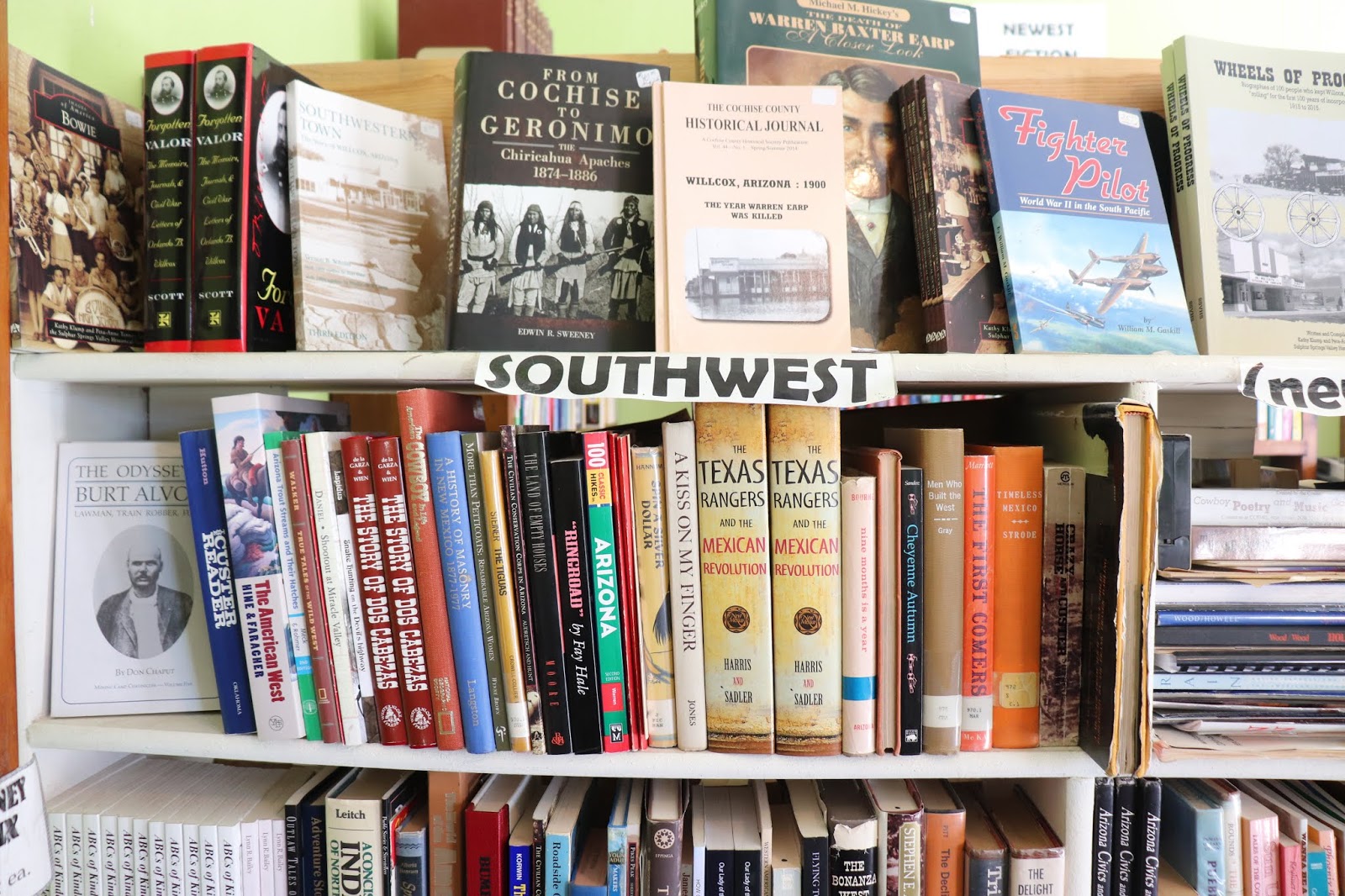
How many times over the years have I remarked that a bookstore could exist if it offered only history and mystery? The Friendly is very oriented toward both, and especially toward Arizona and Southwest history. Plus a very large selection of children's books -- and it's important to keep those kids both entertained and learning during all the school closings right now. We also offer honey, supplied to us by a beekeeper down in the southern part of Cochise County, and people come quite a distance to buy it. In fact, some days I sell more honey than books.


When the Artist and I are back at work in northern Michigan and getting ready for another day in bookstore and gallery in the village of Northport, we often wonder who will come into our establishments that day and what kind of conversations we will have. There is no predicting what any particular day will bring, and part of our pleasure at the end of each summer day is sharing stories of our respective encounters, as well as the occasional unexpected big sale. We meet so many interesting people!

I haven’t spent enough time working at the Friendly (this is my first season) to recognize a lot of repeat bookstore customers, but one man who has been in three or four times on Monday mornings is a reader of history, and there was a five-volume of Toynbee I would have liked to sell him, but he already had that work at home — and anyway, he felt Toynbee’s history was too whitewashed, too official, or, as he put it, “high school history, when what you want is college history.” That led me to ask (because staring at me over the counter, on shelves opposite, were several volumes of Bruce Catton’s Civil War series) if he had ever read Bruce Catton. He had not. I said Catton was probably best known for his work on the Civil War but had also written a very readable and not at all “whitewashed” history of the state of Michigan. Another man walked in about then and perked up at the reference to Michigan, saying he was from Michigan himself.


The Artist was on hand, and from Bruce Catton the conversation quickly moved on to where the new browser was from in Michigan. Well, he lived in two places, downstate and the Upper Peninsula, and he had an orchard in the U.P. Oh, where? West of Newberry. He grows apples, pears, and cherries, and his is the northernmost cherry orchard in Michigan. Yes, we know that area well. We have spent a lot of time in Grand Marais. Were we familiar with Jim Harrison? Yes, he was a friend of ours. Well, this man had attended a memorial gathering in Tucson for Jim, and a couple years before that he had attended a memorial gathering for Charles Bowden, at which Jim was the first speaker. Talk veered back to the U.P., via the life of Jim Harrison and his love of good food, and there we were, the three of us, mentally traveling old M-28, which prompted the Artist to ask the Yooper orchardist if he remembered Rashid’s grocery on the south side of M-28 between Newberry and Seney. Of course he did! His orchard is only about a mile from there! And as if all that weren’t enough, Jerry Bishop also speaks French and has travelled in the south of France!

There had been no way to anticipate this Friendly meeting, and it reminded me of what we say so often in the summer back in Michigan, marveling at the unexpected individuals who show up at our places of business in Northport: “You never know!” What will a day bring? We never know. We certainly would have been unable to predict on Monday morning, leaving our winter cabin for Willcox, that we would meet someone familiar with Rashid’s Grocery on M-28 and who had heard Jim Harrison speak at Charles Bowden’s memorial and who had also traveled in France and was himself a French speaker!

At the present historical juncture, the phrase “You never know” sounds a more sombre note, not only for us but for the whole world, but we do have our own personal and specific concerns. Will we be able to return to Northport as planned in May? What will be happening across the country by then? Questions closer at hand arise, too, one of them being, Will the Friendly Bookstore be open next week? Yes, we have a good supply of reading material at home (much of it from the Friendly, in fact), but if this volunteer job vanishes, also, I will miss my encounters with local and visiting readers in Willcox, just as I already miss my Wednesday morning tutoring sessions with little readers at the elementary school.

The truth is, though, that we never know, in the best of times, in the most ordinary of circumstances, what will happen in our lives from one day to the next. There is no guarantee that the future will be like the past. All the more reason, I suppose, that I am enjoying so much one of my Monday purchases from the little bookstore where I worked for three hours that day: How to Catch a Frog, by Heather Ross. And when I’ve finished reading that book and have wrapped it up to mail to my sister, who will love it, too, I’ll get back to Barbara Kingsolver’s High Tide in Tucson, and Wild Horse Country, by David Philipps, and after our evening movie, the Artist and I will snuggle down under the covers and I’ll read aloud another chapter of Chiang Lee’s The Silent Traveller in Paris, and we’ll be grateful to have had one more day together, this one under the Arizona sun, in Friendly surroundings, regardless of what the future brings.


Postscript to the nervous: We have ordered another propane delivery, gassed up the car, and have plenty of groceries and paper products, as well as paper, pens, stamps, and books in the house. We are prepared to do a lot of staying home, and you can see my first "home ground" adventure (with Sarah) here.