Search This Blog

Showing posts with label birds. Show all posts

Tuesday, April 28, 2026

As May Approaches

Do you see her?

Seasonal sights


A recurring obsession in my life, spring ephemeral wildflowers, comes into focus now for its all-too-brief season, briefer than spring itself, which began earlier with winter aconites and Siberian squills (blue flower above) in the yard and will extend beyond the days of shy woodland beauties as the first impressionist flush of returning life in the branches of trees all too quickly swells unfurling into shade-providing leaves. Right now, however, the time of ephemeral blooms is just getting underway, although my photographs here, from two and three days ago, are not an accurate report of today in the woods. 


My old news here is of Dutchman's breeches, blooming above, and of trillium and toothwort preparing to bloom. Will trillium and toothwort flowers open today before I get these words thrown out into the world?


Daily I watch buds in the orchard, as well as on my own little apple trees and solitary plum. When will the cherry trees blossom? people ask. We are all hungry for spring’s abundant, harmless beauty.

Spring rain was abundant this year, far too abundant in many places (lots of flood damage), and even in Leelanau swelling creeks and ponds and creating temporary bodies of water in low places. Some, like the ponds in my yard, lasted only 24 hours, while others deserve their lovely name, vernal pools, and these days, morning and afternoon, I visit both the ephemeral and the year-round ponds to watch ducks and geese and cranes and gulls. 

One morning I was rewarded by seeing three lesser yellowlegs, a single bird at a vernal pool and a pair on a larger, more populous body of water. The pair was gone the next day, the bachelor a day later, all of them on their way north to Canada’s boreal forest land. Hawks, too, are migrating north, but wild turkeys remain, turkeys and mallards courting and breeding here among us.

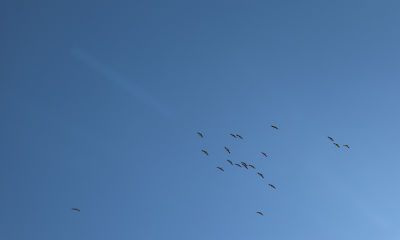
Just passing through....


A busy bookshop day

We had a lovely gathering of people for poet Fleda Brown’s reading last Saturday as we celebrated National Poetry Month and Indie Bookstore Day. I forebore photographing my guest, as it was her first public event since back surgery, and she was still strapped into a white plastic, torso-hugging brace. “A bionic poet!” I exclaimed. She may not have appreciated that name but was pleased, as was I, by her audience, and we were all very pleased with her. On the most serious of subjects, this poet manages to cast a sideways glance, providing a wry look at our human absurdity, while never losing sight of life’s priceless details. Her poems and essays are gifts to the world.


For all Saturday’s unwelcome cold (spring is a season of many short, teasing setbacks), even after the poetry crowd dispersed my day in the shop continued busy right up until 4:30. Where did all these book-lovers come from? Serious browsers, good sales, great conversations—it was like a day in July, all the more heartwarming coming as a surprise in chilly April.


Fleda Brown's 2025 visit to Dog Ears Books


Trend or anomaly?

My phone often makes a sound as for an incoming text when no text is coming in, as if the phone is tugging at my sleeve or nudging my arm to say, Pay attention to me! You’re not paying attention to me! Apparently a new "thing" for young people on college campuses these days is the phone-free gathering, where attendees sit with hands free and look into each other’s faces and talk directly to one another, making the conscious decision not to let their phones dictate their every waking minute. Isn’t that a hopeful sign?

(When an old friend and I were going to get together for the first time in many years, I suggested that we leave our phones in another room. We didn't miss them at all.)

Another development in the growing rebellion against digital technology (more astonishing to me than a return to vinyl records) is the rediscovery of VHS. Movies in boxes! Don’t have a VCR? You can rent that, too! I am told that even CD and DVD technology amazes more and more young people, accustomed as they are to streaming music and movies. What do they make of VHS tapes?

(In novels written a hundred or more years ago, we read of parties where young people gathered around a piano, singing songs, thrilled with the arrival of new, up-to-date sheet music. Country life without a piano might still feature a fiddle, guitar, harmonica, or other instruments. Stamping feet. Clapping hands.) 

I wonder (the eternal springing of hope!) if perhaps my busy spring Saturday of bookselling is related to these other stories, another turning away from tiny screens. Maybe we will have an Indie Bookstore Year!


What is on your mind these days?

This morning I watched grey clouds outside my window as they moved slowly from south to north. A south wind. Occasional glimpses of blue sky. Then a more uniform grey, devoid of contrast, reminding me of ground recently monochromatic white. My first coffee of the day, whether at 5 a.m. or 6:30, is my time to come awake to the world gradually, to look back on days past and plan the days ahead, to read or write, to—I admit it!—look at my phone to scan headlines as well as to see the weather forecast. “Violence is never the answer,” people around the world say solemnly today, a predictable chorus, as they condemn the latest lone shooter. Who would disagree? Yet if war is not violence, then nothing is. That is one of my morning thoughts.

First faint flush of green!

Trees. I think about trees daily and look forward every morning to being outdoors again among them, although I confess to taking up arms against autumn olive and popples advancing into land I want to preserve as meadow, just as I contemplate possible ways to discourage spotted knapweed in my meadow without the use of poison. Controlling nature is not possible, nor is it my wish. I am grateful for the proliferation of squills and forget-me-not in my yard and yellow-headed coneflowers in the meadow. Finding another hawthorn in the meadow delights me. I don’t want to be engulfed by autumn olive and knapweed, however, and they would take over the world if they could. Such greedy bullies! 


My constant companion

Sunny Juliet has no such concerns. Whatever grows or doesn’t around us, the outdoor world delights her, and she has a genius for turning up deer bones. It is as if she and the coyotes have made an agreement—they will make the kills, and she will scavenge the bones—while in the yard at home, life this spring involves an astounding number of tennis balls, more and more of them turning up where they had been lost in winter’s snow. 

Sunny taking a bone break from tennis ball play

It is good to have a dog in one’s life. A constraint on freedom, to be sure, but then, there are many constraints on freedom, which can never be absolute. In our family and civic lives, we are frequently held back by consideration for others; in our outdoor lives—every move we make!—nature sets boundaries on what we can do. I step carefully in the woods, watching where I put my feet and testing a slender tree before trusting it fully as a handhold. Sunny bounds ahead confidently, much more stable on four legs than I am on only two, but we are together in our enjoyment. We are here now. We are blessed to be here now.


Thursday, March 14, 2024

Morning Is Breaking More Gently


This morning I heard robins near the house. Pretty-pretty-pretty, they seem to boast proudly. Sparrows trill in the popple grove, crows call raucously from a distance, the heart-lifting sound of a sandhill crane comes from far overhead, and the woods rings with sounds of the busy cleanup crew, woodpeckers in dead and dying trees. 


Spring’s arrival varies from year to year and can be quite teasing with its advances and retreats. We may yet have another blizzard. But if we do have a big snow in April, as I used to tell the Artist, “It will be a spring blizzard!” And sooner or later the seasonal page will be turned for good, and there will be only memories with which to answer the inevitable Up North spring question, “How was your winter?”


Mornings are easier and more pleasant with less cold wind and more birdsong as Sunny Juliet with her nose, I with my eyes, both of us with our ears explore a morning world that never grows stale. No two mornings –no two moments! -- are ever identical.


Reading her morning newspaper


I’ll keep this short today. One bookish thing on my mind is the idea of a ‘page-turner.’ You know, a book you can’t stop reading until the end. It strikes me now (and I have not taken time to develop this thought) that page-turners are of at least two different sorts. Some are consumables: That kind of page-turner is like a deep tub of popcorn at a movie theatre, a near-mindless reading binge. Such books serve a purpose in our lives. They provide a day’s distraction and relief. Tomorrow we will be ready to face our own life situations again. 


The second kind of page-turner is a life-changer, or at least a mind- or heart-changer, as well as a page-turner. We find ourselves totally immersed in a new world, seeing life through freshly opened eyes. Even familiar elements encountered in such a book evoke a new surge of love from us. We can’t stop reading because we are spellbound, enchanted.


Those in the second group are likely to burrow into our lives for good, as precious as old friends of whom we never tire. At least, that’s how I see things this morning on the eve of the Ides of March. How about you? And what's going on in your neck of the woods?


Will there be more? Stay tuned!


For what I learned in a very, very important new film, tap here. For a comforting soup, winter or summer, tap here. Thank you for sharing links with anything you find worth sharing.


Sunday, June 18, 2023

My Wingèd Memories

Great blue heron, Florida, 2009


The Encyclopedia of North American Birds, by Michael Vanner, is far too large to serve as a guide in the field (or woods or mountains), but the big book is unsurpassed for indoor browsing and remembering. The wood stork and roseate spoonbill take me back to Aripeka, Florida, and the house on the island where the Artist and I spent several winter months with our beloved Sarah. A red-bellied woodpecker sometimes visited behind the house, and on the way out into the Gulf of Mexico from Weeki Wachee (other Florida years), on the road to little Pine Island, we saw sandhill cranes on their nest and raising young. The beautiful photographs in Vanner’s book bring the birds very much to life and give fresh color to my memories.


Arizona winters felt even birdier, either because we were older or because we spent more time sitting outdoors behind the cabin (especially in the spring of 2020), watching birds. 


Meep, meep!


The cactus wren was our morning rooster, the roadrunner always amusing entertainment. In the nearby Chiricahua National Monument we saw the striking acorn woodpecker, and sandhill cranes by the thousand drew us frequently farther south in Cochise County to Whitewater Draw (where I was thrilled to spot a white-faced ibis, also, one day), although we could see hundreds of the cranes just outside Willcox any day of the week. And in fact it was there, by what the Artist and I called “the ponds,” officially Twin Lakes, outside Willcox that I saw my first vermilion flycatcher, recognizing it from the pages of my field guides. 


Acorn woodpecker: He is really there.

Vermilion flycatcher

Sandhill cranes


In the spring of 2020, we stayed in Arizona late enough to see Gambel’s quail chicks. The whole family would come for a morning drink of water, filing along the old railroad ties that served to keep the backyard from washing downhill. They came in single file, and in single file they disappeared again down the hill after their visit. They made me think of a middle-class French family dressed up and out for a Sunday stroll.


Down at a neighbor’s house one morning, hoping to see a phainopepla (it never made an appearance that morning), I unexpectedly sighted a painted bunting (like the vermilion flycatcher, a bird recognized only thanks to repeated perusals of field guides) and also had an opportunity to watch orioles (I forget which kind) feeding their young under the porch eaves. Another neighbor had more hummingbird feeders, and thus more hummingbirds, than I’ve ever seen in a single place before. I had a single hummingbird feeder and the occasional black-chinned hummer. 


The dearest Arizona bird memory, though, brought back to me by Vanner’s book, is of the little canyon towhee. A canyon towhee would hop around the cabin backyard and under our car, not at all disturbed by our presence. One of my Western bird field guide authors called it the “most confiding” of the towhees (perhaps he meant confident?), and somehow the Artist took that to be its name. “Is that the confiding towhee?” he would ask me. There was something homey and comforting about that bird’s presence in our outdoor, near-home life that spring, such a troubled season in the world at large. I have searched photo files for a picture of it, unsuccessfully, so here is Vanner's:


Canyon towhee in Vanner's book

As you see, he is in many ways just another little brown bird (LBB), but I tell you, he has personality! The feathers on the top of his head are usually semi-erect and give him a perky look. Perky, yes. That word fits the confiding towhee we knew so well.


Two Michigan summers in a row, a pair of bluebirds nested in a dead popple tree near enough to our outdoor dining table that the Artist and I could watch the parents feeding their young while we enjoyed our alfresco suppers. That particular popple is history, but I bought a bluebird house at a yard sale on Saturday and hope it’s not too late to attract bluebirds again to my yard. Just have to figure out how to get the box up….


Hooded oriole in Dos Cabezes, Arizona

So many birds, so little time -- and so many memories, and they but a small fraction of the memories!


Thursday, December 29, 2022

How I Spent My Christmas Vacation

I'll explain this further down.

Here I am (since November) in what is at present my winter home, far from Michigan, a little rented cabin in an Arizona ghost town in the Sulphur Springs Valley, mountains looming all around, where a beautiful sunrise occurs just about every morning and a breathtaking sunset at the end of each day. Southeast Arizona’s landscape is austere and can seem unforgiving, forbidding, even foreboding, but in fact, the land is characterized by indifference rather than hostility, and I find comfort in Nature’s absence of malice. I also enjoy, here in the ghost town, sufficient distance between human habitations that we don’t often rub up against each other the wrong way.


My own small living space, large enough to share with my canine companion, in previous years accommodated me, our dog, and my dear husband, the love of my life. Now, there’s just me and the dog, and I miss David every minute! Make no mistake about that! Although in many ways he is still here, all around me -- in his paintings, his hats and boots, his books on the shelves with mine, unlimited memories, and constant thoughts. Every day I wear his watch and one of his favorite belts, and often I’ll reach for one of his caps or pull on a pair of his socks.


Me and my girl

On the morning of Christmas Eve, my neighbor and I took our usual long morning dog walk with Sunny Juliet. We hiked high enough in the foothills to reach ocotillo territory, and then quickly turned downhill again so Sunny would not disturb cows that had climbed high on the slope for the first sunlight of the day. Due to Midwest weather, my friend’s December 22nd flight to Detroit was cancelled, and I’d been reading books featuring travels in Mexico and Spain, re-igniting what had been until recently fairly dormant wanderlust. And so it was, as we compared notes on travels planned and desired, we decided on the spur of the moment to drive down to Whitewater Draw that very day to see the wintering sandhill cranes. 


Cranes by the thousand are very noisy, but I have always found their clattering, purling calls joyful and comforting. There were many other birds to see, as well. American shovelers, both male and female, have coloring reminiscent of mallards back in Michigan, though with much longer bills. Sweet little black coots scoot along with bobbing heads and then dive. My friend’s sudden excited cry of “Red bird!” drew my attention to a vermilion flycatcher. One waterside tree held a woodpecker (Ladderback? We didn’t have binoculars with us!), and if you look closely at the sign in the photograph below you’ll see what I think is a black phoebe.


Need telephoto for good photo of black phoebe, if that's what this is!

Long trail to largest flocks....

At the very far end of the longest path, even without the binoculars we had forgotten (along with field guides we’d also forgotten, so eager were we to get on the road), we were able to see a long line of about 100-150 snow geese, hunkered down near another even larger crowd of more sandhill cranes. I don’t ever remember seeing snow geese before, here or anywhere else, so that was exciting. 


That white line in the distance is a flock of snow geese.


Whitewater Draw was one of the Artist’s favorite places in Cochise County, its water scenes so reminiscent of the watery landscapes he loved to paint, that whenever we were there together he would ask me repeatedly to photograph certain scenes. He never painted directly from photographs, but he liked looking at them for inspiration, so on that sunny Christmas Eve afternoon I kept stopping to photograph scenes for him, a habit I’ll probably never break. 


That night I made the oyster stew (just for myself) that I’d planned for Christmas Eve supper. Lots of cubed potatoes, sliced celery, onions, mushrooms, evaporated milk, a little coarse kosher salt, and a small can of oysters. It was good. I had a second bowl. Then on my way to bed, rather than turning off my Christmas tree lights, I picked up the big platter that holds the tiny potted Norfolk pine with its battery-powered tiny lights and moved it over to the bedroom corner of the cabin where I could look up from my nighttime reading and see it from pillowland. In the morning I brought my 5 a.m. coffee and a cold blueberry pancake back to bed and shared the pancake with Sunny. “I’m glad you’re here,” I told her. “What would I do without you?”


My Christmas morning reading was the second chapter of The Mays of Ventadorn, by W. S. Merwin, a journey and exploration into a particular strain of troubadour poetry but, for me, also the story of Merwin’s finding a home away from home in a part of France that I too fell in love with.


…My vocation as a tourist has always been dubious. Reading a guidebook and then glancing up to identify what the resume has been summarizing is likely to seem to me, quite soon, like an exercise in alienation. I am more given to imagining what it might be like to spend time in a given spot, to get to know the sounds and the light, the people and the faces of the buildings, and how some of it had come to look the way it did.  


-      W. S. Merwin. The Mays of Ventadorn


This is the way I have always loved to travel and the way the Artist and I traveled together, “imagining what it might be like to spend time” here and there, which is why having a vacation “home base” – a hotel in Paris or in Michigan’s Upper Peninsula, the ghost town cabin here in Cochise County, Arizona – and making daily explorations out from that base was our perfect idea of travel, enriched and expanded always by armchair travel with our beloved books, often read aloud to each other, in whole or in part.


On the afternoon of Christmas Day, my regular hiking partner and I walked over across the highway for dinner with other neighbors and later walked home under a new moon in a lavender sky.


Then only two days later, again without planning ahead to do so, we took one of our longer, more ambitious hikes here in the ghost town environs, gaining about 400 feet in elevation and reaching an entirely different life zone, where green-leafed oak trees flourished. It was so exciting! Sunny proved herself an able rock dog, too -- explanation for my first photograph on this post.


And the day after that I accompanied my friend on a long, rainy, stressful expressway drive – to pick up her new puppy! All in all, quite a week! 


Now as 2022 draws to a close I look around this little cabin at my modest belongings and feel comfortably at home, lucky to be here, safe and warm, lucky to have little Sunny Juliet, to have good neighbors and blue skies, enough to eat, more than enough to read (no such thing as “too many books” in my lexicon!), and family and friends who keep in touch across the miles. It would be easy -- and sometimes, I admit, the temptation is more than I can resist -- for me to look at 2022 as a catalog of loss, but I guess if I have a single resolution for 2023, it is to continue to count my blessings daily and to recount them whenever I start feeling blue. But here's the tricky thing. Although people say, “Count your blessings,” they generally say it when a person is feeling more blue than blessed -- because why would you need reminding otherwise? – and yet it’s when I’m already feeling blessed and contented that I am more likely to enumerate positive reasons for good feelings. Does that sound familiar to anyone else? It’s those blue hours and moods that are difficult, although heaven knows -- and I am certainly aware -- that in this life I have been a very lucky woman.


Last Books (Almost!) Read in the Year 2022


129. Steinbeck, John. A Log From the Sea of Cortez (nonfiction)

The pattern of a book, or a day, or a trip, becomes a characteristic design. The factors in a trip by boat, the many-formed personality phases all shuffled together, changing a little to fit into the box and yet bringing their own lumps and corners, make the trip. And from all these factors your expedition has a character of its own, so that one may say of it, “That was a good, kind trip.” Or, “That was a mean one.” The character of the whole becomes defined and definite. 


Steinbeck’s chartered boat expedition with Ed Ricketts and crew to collect marine specimens in the Sea of Cortez between Baja California and the Mexican mainland in 1941 is as full of portraits of nature and philosophical topics as it is observations of the land and people encountered. Did you know that Steinbeck studied marine biology in college? Any fan of Cannery Row will find this book fascinating!


130. Lee, Laurie. As I Walked Out One Midsummer Morning (nonfiction) 

Ever since childhood I’d imagined myself walking down a white dusty road through groves of orange trees to a city called Seville. The fantasy may have been induced by the Cotswold damp, or by something my mother had told me, but it was one of several such clichés which had brought me to Spain….


Laurie Lee’s writing is magical. He walks from his home village to London, travels by boat to Spain, walks across Spain – like a mad dog Englishman, without a hat, courting sunstroke! But who else has ever written like this? 

I was awakened next morning by the high clear voice of a young boy singing in the street below. The sound lifted me gradually with a swaying motion as though I was being cradled on silken cords. It was cool crisp singing, full-throated and pure, and surely the most painless way to be awakened – and as I lay listening, with the sun filtering over me, I thought this was how it should always be. To be charmed from sleep by a voice like this, eased softly back into life, rather than by the customary brutalities of shouts, knocking, and alarm-bells like blows on the head. The borders of consciousness are anxious enough, raw and desperate places; we shouldn’t be dragged across them like struggling thieves as if sleep was a felony.
 

131. Merwin, W.S. The Mays of Ventadorn (nonfiction)


…I was twenty-six, with no money at all and a house in the depths of the country in France. In all the years that followed, the house, the remains of the farm, the village, became a constant, insistent part of my life, invaluable, cherished, demanding, inescapable. 


(from late in Chapter 2)


…One attractive element in the farming life that had evolved by then in the Quercy was an unobtrusive independence of spirit, a quality rooted in the practice of polyculture – the growing of more or less everything. It was an immemorial system encouraged by the variations of the crumpled landscape with its small irregular fields fitted into the stony contours, but deplored by theorists as inefficient…. Most families possessed a few hectares of upland woods, a few hectares of open pasture in different places, a few hectares of arable land, which they farmed on a careful four-year system of rotation, a sizable number of ritually tended walnut trees, at least one vineyard, and at least one vegetable garden…. They grew much of what they ate, and all that they fed to their animals. They sold walnuts, plums, milk, wool, calves, lambs, cheese, and they raised tobacco some years as a cash crop. They thought that was the way it had always been….


(from early in Chapter 3)


You can see how for me, this was another book with subject matter and language to work magic on my soul.


All three of the books I’ve quoted from above are books I could quote from endlessly, so I have restrained myself and leave you only with these scanty passages to illustrate, I hope, the wonders provided in these priceless works by John Steinbeck, Laurie Lee, and W.S. Merwin.


132. Smith, Betty. Maggie-Now (fiction). I have read Maggie-Now almost as many times as I have read A Tree Grows in Brooklyn, the author’s most famous novel, and I love them equally. Highly recommended, both!


133. Robertson, Thomas A. A Southwestern Utopia (nonfiction). An excessive accumulation of facts that nevertheless failed to cohere into any kind of convincing atmosphere. Disappointing but no doubt important reading for researchers into experimental utopian communities. 


December disappointment: holiday lights and decorations in Willcox taken down way too soon!


Unexpected thrill this last week of the year: Western bluebirds at my feeders here in Dos Cabezas!


Life -- it is a mixed bag, my friends!


Happy new year

and 

happy reading in 2023!!!

Monday, November 29, 2021

Who Lives Here? And How?

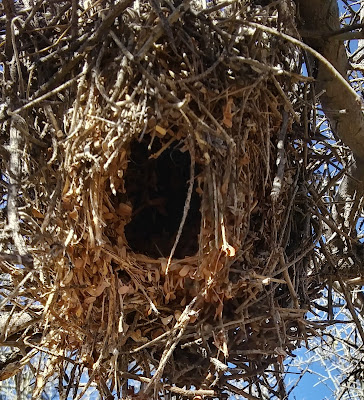
Who lives here? Or lived here?


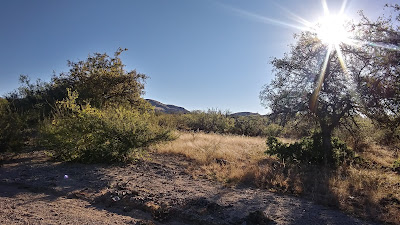
My high desert day usually begins in the dark, 5:30 a.m. on average. I like making coffee before first light and watching dawn break a while later over the low mountains to the east. Nights now are in the 30-degree range, so some mornings there is a thin skin of ice on the birdbath. The birds know when a sunny day is coming and are out calling and singing by the time the sun comes over the horizon. But that comes later. 


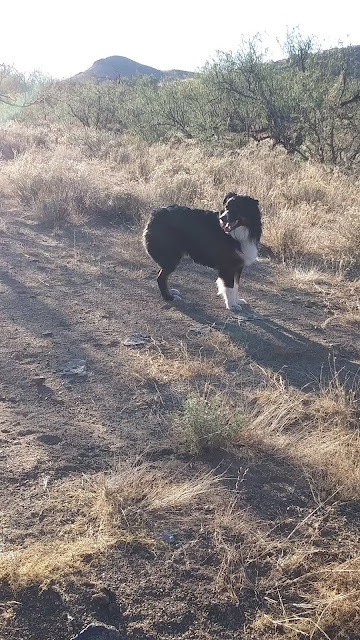
With almost a full year’s experience under his nonexistent belt, Peasy knows we won’t be rushing outdoors at first light or even sunrise, and he waits patiently (mostly) while I drink my coffee and read or write a letter or journal entry or catch up online with distant friends. But he is certainly ready for adventure and exploration the minute he senses that I am! The Artist will be ready, too, by the time Pease and I get back from our morning rambles, usually about an hour later.


Ready to go!

But Mom needs to bundle up first.

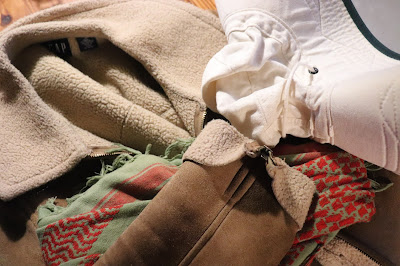
The sun is bright, but the air is cold when we first go out in the morning, and I bundle up accordingly. A jacket I found in a Traverse City, Michigan, Goodwill store in 2015, on the $1 sale rack because of a tear at the end of one sleeve, still works for me perfectly in Dos Cabezas, the rough leather brushing off thorns the way an umbrella sheds rain. Old dog-chewed shoes work, too (Peasy did that, not Sarah), as does a terribly unflattering wide-brimmed hat. Here one must protect against both cold and sun on early mornings -- go out without a brim in the morning, and walking east is walking blind.


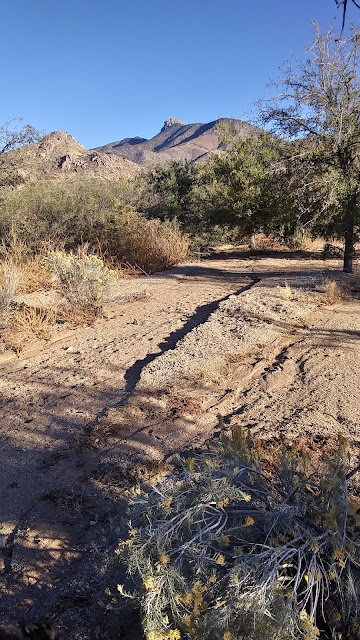
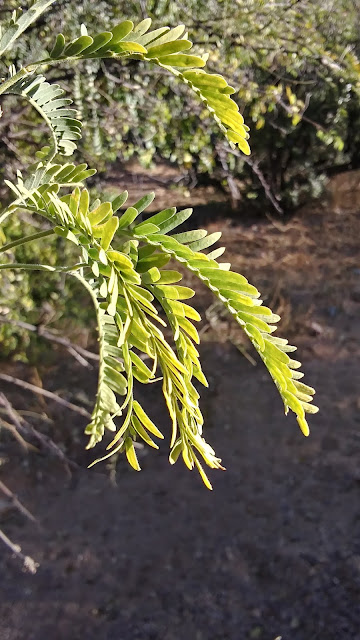
A wash tells the story of summer rains, or monsoons, as some here call them. During a monsoon, washes turn from dry, sandy beds to torrential rivers in minutes. “Do not enter when flooded,” say signs along the roads, and even now, many weeks later, ghostly images of currents remain to show paths taken by relentless, rapidly flowing water.


The color green also tells of plenteous summer rains. So much green still, in November!


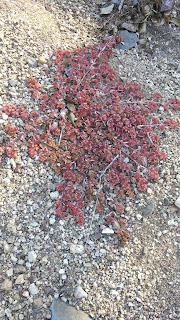
But there is red, also, and I need to learn the name of this ground-hugging plant, which can also be found along the edges of the highway, breaking through the pavement. 


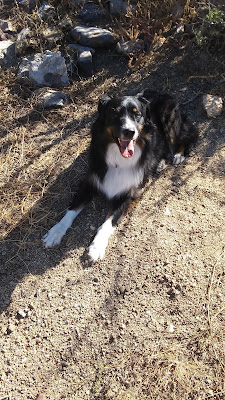
And here is Peasy again. Because you never tire of Peasy pictures, do you? Isn't he a pretty boy?


As the desert day continues, it will often include a trip into our nearby town of Willcox, but I’ll save Willcox for another day and tell you now about evening and night in the high desert. In late afternoon, an insect chorus starts up and continues into dusk. Are the singers crickets or cicadas or a blended choir of both? Whatever they are, they settle down as darkness falls. Everything goes quiet then unless a dog barks in the distance. It is then that stars take ownership of the desert – stars, jets high overhead, too far away to hear, and maybe a silent satellite zipping and blinking by. Once in a while coyotes yip, that familiar sound that reminded me of our Michigan home the first winter we spent here in the ghost town.


Morning, afternoon, evening -- I feel very peaceful here. No doubt part of my contentment is the freedom of seasonal retirement: no schedule to keep, no daily obligations except to care for my little family. I haven't yet finished the exciting book about the steeplechase riding woman in Czechoslovakia. So many possibilities present themselves every hour, it's hard to settle down! 


Who lives here in this ghost town, delighting in open space and in friendly neighbors? For now, the Artist and I and our special needs dog are right at home. I'll tell you more about desert dog's behavior here in my next post. Or the one after that, maybe. Because who knows what the future holds?


The sandhill cranes have come for the winter, too.