Search This Blog

Showing posts with label photography. Show all posts

Tuesday, November 3, 2026

Shop News and Random Musings

Me with Bonnie Jo!

Bonnie was here!

Well, of course, we had a great time! Of course, the audience was delighted! One hour became three, as the conversation just would not stop. Everyone who had a question or comment or reflection had a chance to speak, and our guest graciously gave personal attention to each individual. 

Attentive audience

"Writers are the most generous people!” I remarked to Tree Guy at home later in the evening. “Well, you know the good ones,” he observed, impressed with my guest author’s energy and presence. One audience member came back the next morning and told me she had heard Bonnie speak at a conference a few years back, and that was a good talk, she said, but rather formal, as befitted the occasion, so she really enjoyed the personal feeling of the conversation here on Friday.

“I loved her!” people keep saying to me. Yeah! BJC is the real deal!

Everyone is happy, but I am the happiest.

And this time—too often I forget!—in the midst of all the goodby hugs, almost at the last minute, I remembered to ask Tree Guy to take a photo of Bonnie and me together. 

If you missed it (or if, like me, you just can't get enough Bonnie), check out this interview with her online and read this terrific essay she wrote about her mother.


Second Harvest: Apples in My Life

Second apple harvest

Macintosh for winter storage? I don't think so! Better for applesauce in big quart jars or eating out of the hand. Larger, darker red fruits from the Baldwin tree, a nice tart pie apple, are what I will store in bushel baskets for winter. But where? Unheated basement or unheated second floor of farmhouse? Maybe a bushel in each place, this winter serving as a test for winters to come.

This fall and winter: an apple a day!

“Nous sommes devant la porte de l'hiver,” says the country wife in one of Jean Giono's novels that I read first in English and am now reading in French. November barely underway, are we in winter's doorway now here in Leelanau County? With the Sunday morning time change, we have earlier light at day's start but also earlier evening dark. Another double-edged sword, the general, universal story of life in my philosophy in a nutshell. 

But Tuesday morning the outdoor temperature was 60ºF at 6:30 a.m.! It's another open door day in Northport! I should apologize for so many exclamation marks, but the balmy day amazes me.

Summer blooms have not stopped yet.

More Words and Images in My Life at Present

Focus on mulberry leaves

Let me start with the images. We have had a splendid autumn here in northern Michigan, and the temptation to want to capture every moment can be overwhelming, as if a digital photograph on a phone could contain the feeling of sunlight and the smell of fall leaves and prolong a perfect moment endlessly in the face of oncoming winter. And our phones, they are always with us! Click, click, click! You can see on this page that I am not immune.

Popples and milkweed

But travel back to 1987 with me, the first time I went to France. I had saved up enough vacation time on my job to spend an entire month in Paris, and not once did I leave the city: On rainy days, I would rationalize that it would be silly to go to Chartres in the rain, and when the sun returned I was loath to lose a sunny day in Paris. The other limit I imposed on myself was to venture out day after day without my camera. After waiting so many years to be in Paris, finally, I wanted to be there fully—not to document my experience but to have it. The camera, however, was often in my mind when I saw something I wanted to remember, and so I returned with camera in hand to some of those sites and sights on the two days that I dedicated to photography. Other pictures are only in my mind. 

Four weeks’ residence, two days dedicated to photography: That was my month in Paris.

It wasn’t only pictures, either. There are sounds I hear in my memory, recorded only there: the purling and fluttering of pigeons outside my window, the echoing chink! of spoon on china cup, women’s voices calling to each other from window to window, a waiter or salesperson’s polite “‘sieu-dame.” And the smells of diesel fuel, of fresh-baked bread, of rotisserie chicken, of chestnut trees in blossom.

So the other day in my car, I recalled that first time in Paris and stopped along my Leelanau roads here and there not to photograph but simply to gaze and tell myself to remember. I’m here now. Is this little musing less potent because it is accompanied by images?!

What is the difference? Am I less “here” at home than I was in Paris? I don't think so. 

That month of May in Paris, so long ago, I had no business to run, no home or yard to maintain, no dog, not even meetings with friends. A stranger alone in a strange city, I wandered freely through my days. Here at home, in contrast, my life is a normal non-vacation life of responsibility. And the older one gets, the faster time hurries by!

But on Sunday afternoon, after picking apples and putting up in jars another batch of applesauce and raking more leaves and delivering them to my compost pit, I proposed a drive, and Tree Guy fell in happily with the idea. And although my phone was with me, I stopped only once to click a scene. The rest of time we both of us drank in the season with eyes and ears and noses and delighted in sharing it then and there.

Sunday afternoon, Good Harbor Road

When the person in the shop says “Good morning!”

Why do some people seem so absolutely terrified that responding to my friendly greeting when they enter my shop will commit them to—gasp!—buying a book! (A fate worse than death, right?) No, people, no, no, you can spend as much time looking (call it “browsing” if you take your time at it) as you like, and you will not be followed around or harassed in any way, and if you leave empty-handed I will wish you good day with a smile. It really is that simple. Naturally, I hope you do find something you want to purchase and take with you, along with the memory of a friendly bookseller in an adorable little village, but if not this time, maybe next time. 


Halloween

I did what I had to do. Bought candy. Showed up. Not my thing.

At Dog Ears

New Bohemian Cafe folks picked up the slack.

At New Bo

When you are starting out as a writer --

Everyone enjoys praise, which is another way of saying that everyone wants to be appreciated. Criticism, on the other hand, can be hard to take. 

And I am too old to pull punches! If everyone is handed a blue ribbon for everything they do, without reference to standards, the prizes are meaningless, and worse than meaningless prizes are missed opportunities for learning.

As a graduate assistant to a university classroom professor, one of my jobs was grading student essays, and I remember very clearly the time one student went to the professor to complain about her grade (I think it was a B+), certain she had been graded down because I disagreed with the position she took on the issue. The professor handed me her essay a second time, along with her letter of complaint, and asked me to respond to her directly. I did so, explaining that the reason for her grade was that the example she used, an analogy, did not support her argument but actually undermined it. I was grading her argument, not her conclusion. I added that her grades in the class were such that I was confident she would still be able to receive an A for the semester. Not only did she earn that A, but she also sat in the front row of the lecture hall from then on, her face open and eager and often smiling. She was a very good student and understood perfectly where her mistake had been. A couple of times in recent years I have heard a name on public radio and wondered if the reporter is that student from my graduate school days. I don’t know. But she definitely had the potential.

Fiction and journalism are important callings. The best fiction gives us intimate access to hearts and minds, experiences and motivations, unlike our own, and from that we can learn to look at people in our daily lives more empathetically. The best journalism—and by that I mean real journalism—provides us with facts, information, and understanding we would otherwise lack, important for the decisions we need to make in a democratic country, as well as in our daily personal lives. In both kinds of writing endeavors, therefore, standards are essential. Good grammar, yes, but also truthfulness and depth, if what is written is to be good for something more than mind candy or fish wrap.

I have made my own attempts at fiction and briefly tried to find a publisher. When the otherwise encouraging replies were—bottom line—rejections, I considered self-publishing but decided that the quality I wanted to see in the binding would make the book too expensive. I couldn’t ask people to pay that price. In the end, I finally decided that while my fiction writing was competent, it wasn’t exciting—and that there are plenty of gifted writers dedicating their lives to producing exciting fiction and that my role in life is to present their work, not my own.

Know thyself. (See Halloween section above.) Know thy limits and thy gifts.


My tribe

Some people’s tribes are ethnic, some religious. Some consider others from their alma mater as their tribe (e.g., Wolverines or Spartans or Broncos). My tribe is book people. There’s a bit I wrote about that in here, so I won’t say it all again. 

But claiming a tribe doesn’t mean other tribes are enemies of mine! We book people could not live without the others! The farmers and lawyers, restaurant waitstaff and plumbers, doctors, pharmacists, electricians, truck drivers, teachers, and on and on and on. The world needs a vast diversity of tribes, and it needs them to respect and value each other’s gifts and contributions to our shared world. 


Election Day

Need you ask? Of course we are a voting household! Tree Guy turned in his absentee ballot on Monday, while my plan was to be at my polling place when it opened at 7 a.m. on Election Day, so I drove to Northport this morning in the dark, on rain-gleaming roads through sleeping fall color.


Earlier in the morning, a question came into my head. Hearing echoes of Winston Churchill in the early days of World War II, I wondered: Will this be the beginning of the end, or will it be only the end of the beginning ? That is, will we see (as I hope) the end of policies of unmitigated cruelty and corruption, the destruction of physical monuments and desecration of lofty ideals—or are we only at the beginning of permanent division in a hate-filled, disunified country? Is there to be a general, belated waking up—or a plunge with eyes closed into deeper nightmare?


Halloween is over for another year. Election Day will reverberate through every day to come. Do the right thing, my friends! 


Thursday, January 25, 2024

Is Our World Black and White?


On Wednesday morning the outdoor world appeared black and white to my winter-weary eyes. Stark. Empty of color. Warmer air and absence of wind were pleasant, but I found it hard to celebrate what struck me as a morose, monochrome landscape. Sunday's blue sky and sunlight -- so joyous! -- only made the return of grey skies that much harder to bear. I pulled my phone out of my pocket to capture the scene -- but the truth is that I edited today’s opening photograph to bleed out its color. The original looked like this:


Not only the deep green of pines but that subtle, rosy-plummy color of the cherry branches. I had to admit it: there was color in the winter palette. Not exactly a rainbow, but color nonetheless.


I love black-and-white photography and often find b/w images more striking (do we see those images as "timeless" because we associate them with photographs and snapshots predating color processing?), but I’ll go in the other direction today for a rule to live by: Nothing is ever black and white. We can always find color if we look for it. 


(Lately I’ve been dreaming in startlingly vivid hues. One dream segued from soothing, muted tones to garish red and gold. In the dream, I protested the hideous decor, yet that startling scene is the one I remember.)


Children’s books, bright with illustrations, draw us into their pages at an early age, and as adults we can still be seduced by beautiful books of photographs or drawings, but think about black lines of type on the page of an unillustrated book and how easily they disappear when you read, converted to lively, moving images you "see" as if you were amidst them. “Make mind movies,” the grade school teachers now say to their pupils, because just as a movie screen takes over imaginations and erases for a time our immediate physical surroundings, so the room around us can vanish when we let ourselves be captured by a story on pages we turn one by one, barely conscious that we are turning pages. 


And so I’ve been far from Michigan lately, reading two biographical/autobiographical books, a hybrid term I use because the author of Wandering Ghost: The Odyssey of Lafcadio Hearn, Jonathan Cott, intersperses his chronological narration of Hearn’s life with many long excerpts from the subject’s own writing. Hermann Hesse’s Autobiographical Writings, on the other hand, contains short pieces all his own. Although both Hearn and Hesse led interesting lives, Hearn’s to me was fascinating, and his writing much more vivid. His early journalism, in fact, was downright lurid, his appreciation for beauty and simplicity coming to the fore in his years in Japan. But I was saving Wandering Ghost for bedtime reading, so it was the Hesse compilation I took to my neighborhood tavern, the Happy Hour, on Tuesday afternoon, anticipating that my friend would be a few minutes behind me for our rendez-vous.


How much did I read while waiting? Very little, of course! Surrounded by warmth and memories, curious about strangers at the bar and in the other booth, I spent more time soaking in the familiar, well-loved atmosphere than turning pages. How many happy hours did the Artist and I spend at the Happy Hour? And his exceeded ours together, as he often stopped on the way home from Northport while I was still in my bookstore. He was a regular....


Another friend once told me that she studied library science because she loved books, only to discover that her first job as a librarian left her little if any time to read on the job. Such is not the fate of a northern Michigan bookseller in winter. The only problem facing me most days is which book to pick up next, with so many tempting choices within reach, and I am always carrying volumes back and forth between home and bookstore. Soon, though, I will begin my second reading of Bonnie Jo Campbell’s The Waters, because that lushly sensual story is a perfect antidote for winter's silent, superficially monochrome reality. 


Tuesday, August 1, 2023

High Season


A week ago our great-grandsons from Kalamazoo were here with their parents, and this past weekend it was my sisters’ turn to visit from their homes in Illinois. Orchard crews are at last harvesting cherries around my old farmhouse (tarts are ready later than sweets), and though I think every morning that the black raspberry patches must be almost exhausted, that fruit just keeps coming on, with blackberries ripening farther afield. Meanwhile, in the garden, squashes are taking shape, and tomato plants (started from seed) are finally flowering. I’m still waiting on cucumbers but pulled out spent cilantro and transplanted butterflyweed seedlings in the space created. They look good so far.


It is summer. High season. 


Sunny Juliet and I got to Lake Michigan again, beating the crowds by going shortly after sunrise. Neither of us has gone swimming yet, though. I’m letting her get used to the Big Lake at her own pace, wading into and out of the gentle waves without urging her one way or the other. Summer here Up North is time for work and play and company. Twin great-grandsons and their parents, sisters, stepdaughters, friends. Some have been here, others yet to come. Sharing places I love is an important part of my life. 


Sharing books I love is important, too, and my latest happy discovery – for which all credit goes to the friend who sent me the book! – is Molly Gloss’s The Hearts of Horses, which is hands-down the horsiest novel I have ever read. I was disappointed when The Horse Whisperer turned out to be more love story than horse story; there is a love story in the Gloss novel, too, but horses predominate. – Which doesn’t mean there is any dearth of human interest! 


I’ve always wondered at the lack of readership for World War I history. The “Great War,” it was called back when people thought such a global conflict surely could not possibly happen a second time around. (The period between the wars fascinates me, too.) Well, lately WWI seems to be following me so closely it’s treading on my heels. Sarah Shoemaker’s Children of the Catastrophe takes place in the years 1908-1922 (Sarah was last week's speaker in the library Summer Author Series here in Northport); T. C. Corbett’s The Drums of War draws on his diaries from World War I; and The Hearts of Horses takes place in that period, also. Although far from the fighting, some of the farmers and ranchers in Gloss’s novel are swept up in a jingoism that puts their German immigrant neighbors in peril. There is also discussion between the characters of the fates of the thousands of horses shipped over to Europe to become cannon fodder or shell-shocked survivors right along with the soldiers. 


The main story of The Hearts of Horses, however, takes place out West. It is no longer open, fenceless rangeland, but big-boned teenager Martha Lessen is determined to lead as free a cowboy life as she can and rides away from home to offer her services “breaking” horses. Martha does not have much in the way of social graces, but, perhaps because she was so sensitive to the feelings of horses, she wasn’t bad at picking up cues about people’s feelings without having to have everything spelled out for her. 


…By the time she took work breaking horses for George Bliss, her method was to come into the corral with a little buggy whip and brandish it – she almost never had to touch the horse…. At the same time, Martha always acted as if there was nothing to get excited about, figuring the horse would eventually get the same idea; so she’d begin singing to him quietly….


And from a different moment in the story: 


It wasn’t clear to Martha how she could be any help to the Kandals, either of them, but she didn’t feel it would be right to leave. She stood a moment trying to think what else she could offer to do [she had fed the chickens and stirred up the kitchen fire already], and when her mind failed her she said, “I’ll just sit down with you, if that’s all right, until the doctor gets here.”


A simple story in many ways, The Hearts of Horses goes along in its steady way, documenting, if you will, the lives of fictional people in an isolated community until they are as real to us as our own neighbors. I am eager to read more of Molly Gloss, though I have to admit I hope there will be horses in her other books, too. 


Long, SURPRISING (to me) Postscript:


As I was in the midst of drafting this post, a woman brought in a box of old books she wanted to sell, and one of them was the second volume of a two-volume set showing "the World War," i.e., the one we call World War I or the First World War, in photographs. What are the odds? That war again!


The captions to the photographs are heartbreaking. The soldier sitting in a bombed-out wall opening (second of four above) is writing home from the battlefield:


‘JUST BEFORE THE BATTLE MOTHER”

“Somewhere in France,” begins the letter which Clarence E. Ford, Company C, 308th Field Signal Battalion, 83rd Div., is writing home, Sept. 1, 1918. “Somewhere in France” was a shell hole in a garden wall at Chateau-Thierry.


Following that photograph is one of the First American Army assembling, and below it a detail showing the horses. The caption to a photograph of captured German prisoners (not shown here) has a headline reading: “HATE IS A MANUFACTURED INGREDIENT ON BOTH SIDES.”


I do not focus on the horses for lack of concern for the men. In fact, more than one photograph of a destroyed village notes that the laughter of children is no longer heard there. But since it was a conversation about horses that brought the war home to Molly Gloss’s characters and her readers, I noted particularly any of the war photos showing horses. The last one here is entitled “GASSED HORSES” and reads as follows:


With their ribs sticking out as in death and white mucous [sic] coming out of their blind eyes, these gassed horses are being brought back for inspection. For many of the suffering beasts inspection will seal their death warrant. 


And what can I say after that??? Except, how can human beings do such things to horses -- and to each other, when the world we have been given is so very beautiful? 


No, I do have a more cheerful closing today: Tonight’s guest, the fourth and last in the Summer Author Series (sponsored by the Friends of the Leelanau Township Library), will be Soon-young Yoon, whose book is entitled Citizen of the World: Soon-Young and the UN. I highly recommend her book. It contains short, readable essays on various projects with which she was involved around the world, and it is full of hopeful stories of people making differences in all manner of good ways. That's 7 p.m. at the Willowbrook Inn on Mill Street in Northport.


Friday, May 5, 2023

An Adventure I Didn’t Need

Adios, las Dos!


The car was packed, dog exercised, and the fact that the U.S. road atlas had gotten buried beneath all that great packing didn’t upset me much because my planned route would be a familiar one, a trip the Artist and I had taken more than once, one Sunny Juliet had done last spring, and our first planned overnight stop in Santa Rosa, New Mexico, a town the Artist and I stayed in many times. (Sunny and I had been there last year on the very same date, May 1.) There was a little glitch when my credit card was declined in Santa Rosa – for absolutely no reason -- but after I paid cash for a room and made a call to straighten out the problem, the card was “re-set” so it would work again. 
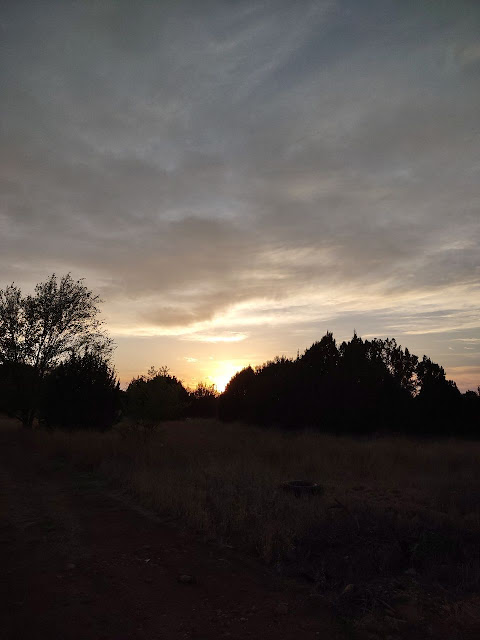

Santa Rosa sunset


I used the card in the morning (at the pump) to fill up with gas, and we were on our way again.


Route 54 is the same as I-40 between Santa Rosa and Tucumcari, but at Tucumcari I got off the “superslab” (there’s a long David Grath story associated with that term, a story for another time) for my smaller road. Somehow, though, not taking the Business 54 direction, I found myself on old Route 66, following along beside the superslab. Well, okay. While not my intention, I remembered being on I-40 and looking over with longing to the old Mother Road. Now, here I was! Serendipity.
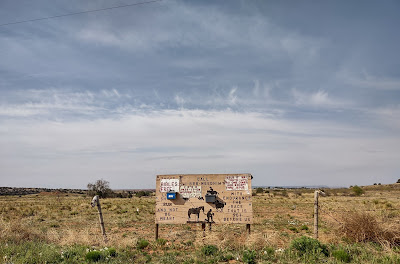

Click to enlarge for full effect.

Shoes on fenceposts


Tuesday's flower of the day


Old Route 66. Two-lane road. Right down in the landscape, not on a conveyor belt keeping me at arm’s length. So I was happy. Free to stop, to pull off the road, and photograph interesting sights, such as what I called my “sign of the day,” three different kinds wildflower, and a fence with every post topped by a shoe. Don’t ask me what was with the shoes, but I chose the Indian blanket as my “flower of the day,” so perfectly New Mexico, even as I remembered from the previous day all the beautiful blooming prickly poppies, or “fried eggs,” as the cowboys call them, along the road on the Alamogordo side of the San Augustin Pass.
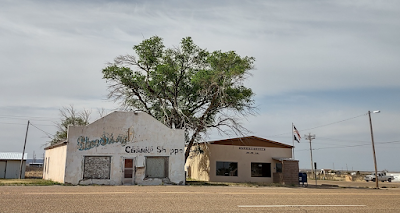

San Jon probably doesn't have many tourists.

Arriving at little San Jon, New Mexico, I took what at first I thought might be a new two-lane north, only to realize quickly, from familiar scenes, that the Artist and I had traveled that road before. We’d been on I-40 and gotten off in search of a gas station, then taken 469 north to Logan. Maybe I’d even photographed this intriguing abandoned ranch house before, but don't you think it was worth stopping for again? 


Again, click to enlarge for full effect.


Logan, New Mexico, presented another irresistible photo opportunity -- and this isn't the last you'll hear of Logan, either. 
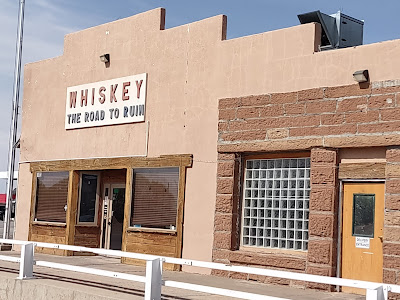

Wouldn't you have stopped for this shot?


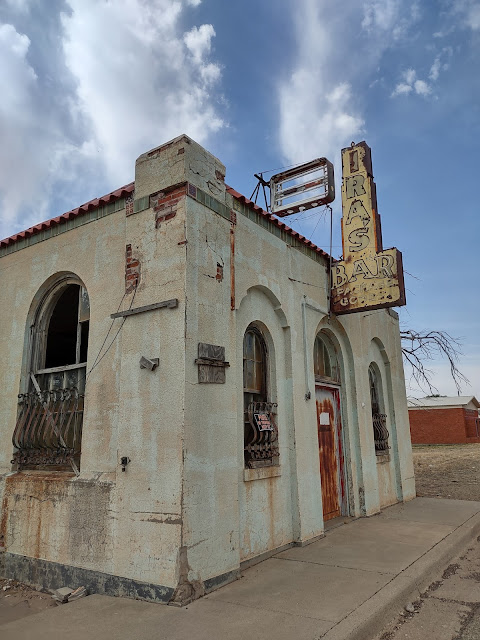
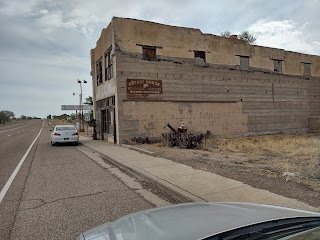
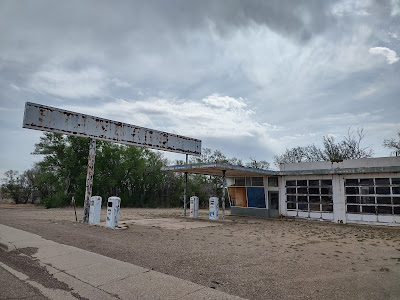
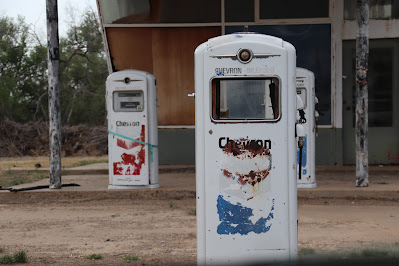
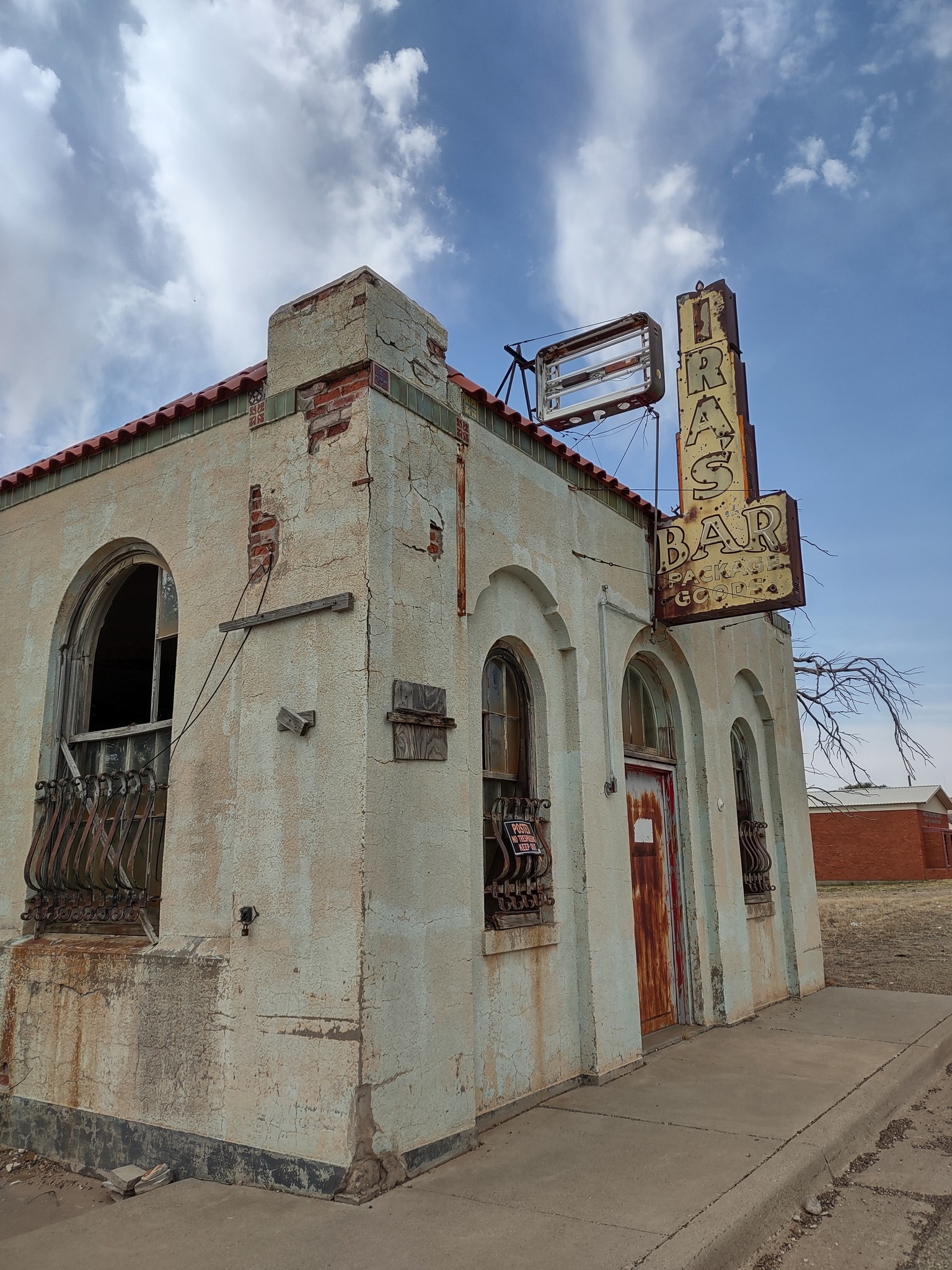
Then, Nara Vista, the last named town before the Texas state line, emptied out by changes long ago, but with some lovely old buildings, albeit abandoned and ruined. Besides the attraction of the ruins, I remembered vividly the drive east in 2020, the plague year, when the Artist and I stopped in an empty parking lot in Nara Vista to walk our Sarah. When I presented the Artist with a plastic cup of “fruit cocktail,” the ubiquitous 1950s accompaniment to cottage cheese, he was delighted to have something other than jerky and granola bars and congratulated my “brilliance.” So Nara Vista, sad though the place would be to the eyes of almost anyone else passing through, holds a happy memory for me, invisible to the rest of the world. I’d been lazily snapping away with my phone camera but got out the real camera for a couple of long shots.
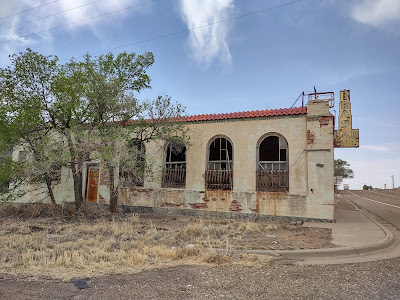

(Formerly) Ira's, #1

Ira's, #2

Ira's, #3


Most of Nara Vista looks like this.


Detail

Across the road


Next, Texas panhandle, Oklahoma panhandle – and I barreled through those two states nonstop, aiming for Liberal, Kansas, another place the Artist and I had stayed many a night, enjoying dinner at the Cattleman’s Café. Gas prices were pleasingly low in Kansas, and I was ready to gas up again.
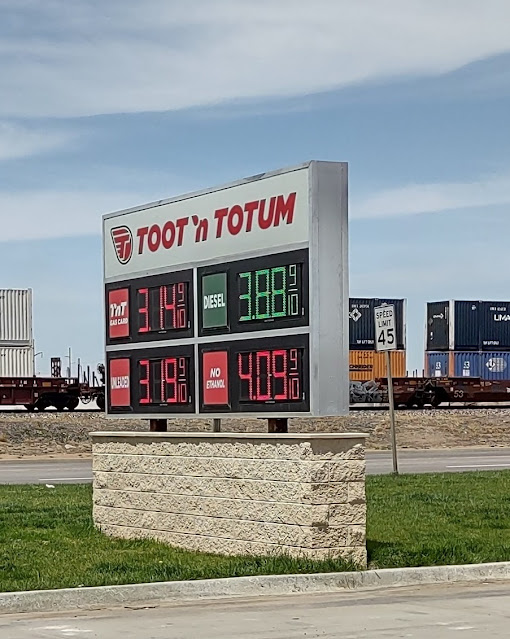
 

Photo taken for a Kansan friend transplanted to Arizonan.

That’s when terror struck! My billfold was not in my purse! I’d used it in Santa Rosa but not since. Now what?


Did I drop it at the gas station in Santa Rosa? Found their phone number on the receipt and called. No, no one had turned in any lost items that day. At the rest area on the staked plains? No luck on that possibility, either, when I called the New Mexico State Police. No, no personal items turned in at all so far that day, other than a gun. (Really! Someone lost a gun? Not me!) What to do?  This unexpected challenge was not at all the kind of adventure I’d been looking for on this trip.


Pajarito rest area in eastern New Mexico


The problem was that I’d developed the habit of sliding the billfold into my left front jeans pocket occasionally, rather than putting it in my purse. Easier to grab that way. But the jeans pockets weren’t all that deep, and it could have fallen out – almost anywhere!!! I’d been in and out of the car, photographing (as you've seen) all manner of random, rural sights. 


The most important items in the lost billfold from a practical point of view were my credit card and my driver’s license, but there was also a scrap of paper with the Artist’s last written words on it. Illegible those words had been to me at first, but I’d finally deciphered them and did not want to lose that precious note. 


And yet, I had to be practical -- thus my Tuesday thanks list:


➡️ Thanks to the UPS driver I flagged down there in Liberal, who helped me find the police station. Note: Washington Street in Liberal has two discontinuous stretches, and there is a 325 on both pieces of the street. 


➡️ Thanks to the dispatch officer at the police station, who told me I should cancel my credit card and explain the situation of the lost driver’s license, should I get stopped on the road for any reason, and then file a report from my home back in Michigan upon arrival. 


➡️ Big thanks to the pleasant, very helpful young woman at the visitors center, who did not have any Kansas state maps but printed one out for me from her computer. I knew I wanted an east-west road to a certain town but didn’t remember either the number of the road or the name of the town. U.S. 160 to Winfield. Good!


Two hours were “lost” there in Liberal, but back on the road again I felt pretty calm. With cash from an ATM in Willcox, AZ, on my way out of town, I was confident I could make it to Illinois, where I’d write my sister a check and get more cash for the remainder of the trip. I also had dried mango slices, Kind bars, beef jerky, and rice cakes for that night's dinner, along with foil packets of chicken for Sunny Juliet, plus the last of the rice and green beans from our cooler to mix with her chicken. 


So we spent the night in Winfield, Kansas, in the same friendly motel we had stayed in the year before. No time this trip for the dog park, though. We arrived too late in the evening (after sunset) and left too early in the morning. But my dog girl is a seasoned traveler now. Last year, less than five months old, she wanted to play in the evening when we arrived at a motel, when all the momma wanted to do was crash. This year she seemed to understand and settled right down. 


Sunny settles down.

Day 3 got us to my sister’s in Springfield, Illinois, after a 600-mile drive (maybe my longest driving day ever), and I slept all night, not waking once. Exhausted.


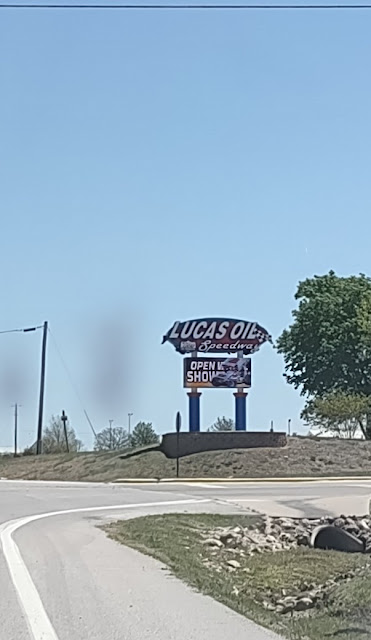
Oh, but on the way through Missouri (determined not to spend a night in that state), I had stopped again for gas in Wheatland, across the road from a little motel where the Artist and I had stayed once with Sarah. Maybe we stayed there once with Peasy, too? Wheatland is the home of the Lucas Oil Speedway (the Artist swore by Lucas products), as well as the Lucas Bull Ranch, and the Sinclair station sells much more than gas. They have seed & feed, baby chicks, nursery plants, groceries (including fresh produce), and of course anything you might need for a car or a truck. There’s a café attached, where the Artist once bought us a fried chicken dinner.
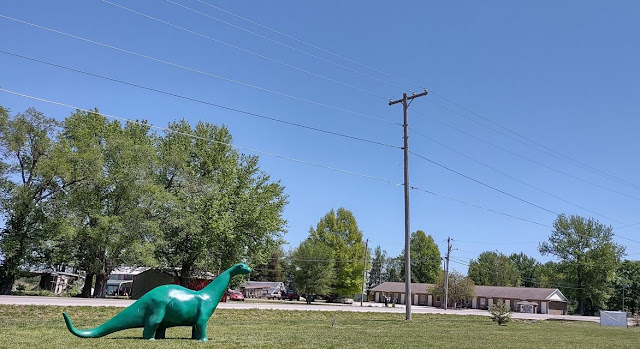


Why, other than general reminiscing, do I mention all this? Because since my New Mexico loss, I was traveling only with cash, remember. And when I went inside to prepay, I told the woman behind the counter that I wasn’t sure how much the tank would take -- I knew it would take twenty, but would it take twenty-five? -- and she said, “Why don’t you just go out and fill up and then come in and pay?” “I can do that?” “Sure.” Stranger in a strange place, and I was not made to prepay! When I went back inside to hand her a $100 bill for my $23+change purchase, I mentioned having lost my billfold back in New Mexico and not realizing it until Kansas, and she commiserated, saying how much trouble it could be to lose credit cards. I shrugged then and told her, “My husband died a year ago, and other problems that come along now --.” She interrupted to say, “I know what you mean. I lost my husband this past October, and everything else is ‘small stuff.’” “You go on, but nothing is the same, is it?” “Certainly is not.” Loss of a credit card made for kind of an “adventure” I would not have chosen, forcing me to rise to an occasion imposed on me and to improvise, but that was peanuts compared to losing the love of my life. A stranger and I had that in common.


How many strangers heard the story of my lost billfold? And yet, I didn’t share it with friends or family before arriving in Springfield. Why worry them needlessly? Once in Springfield, I wrote my sister a check, which she deposited in her bank the next day, handing me cash I knew would be sufficient for the rest of my trip back to northern Michigan. We went to the dog park. Sunny was the only dog there, but we exercised her pretty thoroughly with tennis balls, a Frisbee, and agility stations provided. After that it was on to the doggie wash to rid her of months of desert dust! 
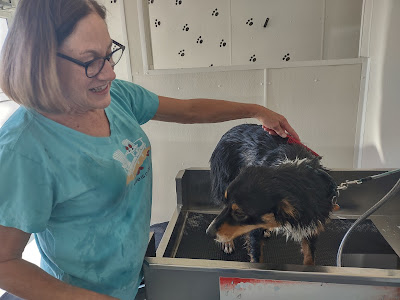

Sister Deborah helping with Sunny Juliet's bath. Easier with two!


-- And now, another unexpected development --


I was relaxing with maps and snacks, not fretting, when a call came on my cell phone. Traverse City. Not a number I recognized. Didn’t pick up. A few minutes later another call from the same number, so I answered. It was my credit union. They’d had a call from the sheriff’s office in Logan, New Mexico! My billfold had been found and turned in! I should call and tell them where to send it. Hallelujah! 


What can I say? Is there a moral to this story? Not panicking, I guess. You just do what needs to be done, what you can do, and hope for the best. Do I wish I’d stayed on expressway and not taken the road less traveled? No way! Credit cards can be replaced. A driver’s license can be replaced. My memories, though, and the familiar scenes that evoke them are irreplaceable. And how many pleasant, friendly, sympathetic, helpful people I met along the way!


Occasionally the Artist called on a phrase to describe this or that person whom he failed to find congenial: “He knows the price of everything and the value of nothing." Maybe that’s the moral of my story, the difference between price and value, between the replaceable and the irreplaceable.  
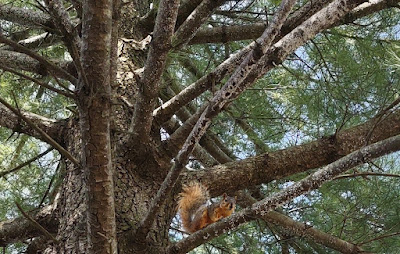

Random Illinois squirrel, just to break up the wordy stuff.

Officer Slate from Logan told me, when I asked, that whoever found and brought my billfold to the sheriff's office hadn't left their name, so I have no way to write and thank them. "There are still honest people in the world," he commented. Since I couldn't thank the finder, I offered profuse thanks to the woman at my credit union and the policeman in Logan, the people on the phone who made my day.


Another moral? It isn't only bad things that happen unexpectedly. Good things happen, too. An even better happening was a three-sisters get-together, but we all agreed the pictures taken would not be made public. We were not looking our best but were happy to be together.


So expect good things to happen, I say. Because they do. And HUGE thanks to the anonymous stranger who found my billfold and took it to the sheriff's office in Logan, New Mexico -- and to people everywhere who do kind things for strangers every day! You make the world of other people a welcoming place for us all to live.


This girl is sometimes naughty, but always pretty, especially after a bath.