Search This Blog

Showing posts with label education. Show all posts

Tuesday, August 26, 2025

Another August Winding Down


I have had a new idea (which in itself is refreshing, so many old ones emerging for another go at me most of the time): instead of a traditional book review format, I will try addressing the author of a book directly. My first trial balloon will begin today's post.


Dear Author #1: Jack Myette


Dear Mr. Myette,


Let me begin by thanking you for your 25 years of service in the Michigan prison system and for holding onto your values during that quarter of a century. There are easier ways to have a regular paycheck, but you did it the hard way.


For a while I found the going rough in your book, Prison: The Inside Story. The stories were so bleak! You don’t sugarcoat your experiences or those of the prison inmates, that’s for sure. I was eager to get to the Transforming Lives [as an Officer and Educator] part but didn’t want to skip ahead, so I set the book aside for a few days and then returned to finish it.


What I have been thinking about most since reading your book—the question that plague many of us—is why there isn’t more education in prisons, given the clear results shown in lowered rates of recidivism. Let me put the question another way: Why don’t statistics on education and recividism persuade more people that changing lives in prison is a good thing?


(Here are some overall statistics on prisons for my other readers, numbers that should give all Americans pause. The graphs are easy to read. Take a look, friends.)


Jack, you gave one part of the answer to my question in your book: “the old ‘They ain’t got nothin comin’” attitude that you found among some (many?) prison employees, but I know it is widespread among the general nonincarcerated population, as well. I had community college students who thought that whatever horrible thing happened to prisoners behind bars was in some way “deserved” and part of their punishment; that prisoners should have no rights; that they certainly should have no “privileges,” including education. Of the three aims of incarceration—deterrence, reformation, and retribution—far too many Americans focus solely on retribution. (Not as in a simple “eye for an eye” fashion, either. Is the idea of proportion too subtle to be grasped?)


So retribution (however disproportional) is one part of the answer, and saving taxpayer dollars seems a minor concern, as the people intent on causing maximum suffering to criminals don’t care if retribution costs more than reform. They probably don’t care about recidivism, either, since the former inmate who returns to a life of crime only proves to these folks that he was worthless all along. Those who change prisoners’ lives, on the other hand, are a challenge to stubbornly closed minds.


But I think there is another, less obvious reason for not addressing recividism in any meaningful way, and that has to do with money. It has to do with capitalism. 


I grew up in a town that boasted a maximum security prison. Back in the postwar 1950s, that prison had its own farm and raised its own food. You note that the Traverse City State Hospital also had its own farm, and your solution to overcrowded prisons and also homelessness and mental illness is to “turn back the hands of time,” to make prisons and mental hospitals once again “self-sufficient,” with “strong educational and vocational programs….”


The problem I see with the solution you propose is that prisons are a huge market just begging to be captured—a  captive market audience, if you will, that business loves tapping. It’s a little like your prison school principal who didn’t want student inmates graduating, because he “received kudos for the number of students in school,” and every student who graduated was one fewer student in school, so a successful student prisoner took away from his numbers! 


How, how sad that music was taken away from your students! Not only did your graduation rate subsequently fall, but the whole calming and basically human aspect of music was lost to the classroom and the students. 


Back to my point about numbers, however—. As more and more prison services are privatized, as whole prisons are privatized, why would the businesses making money from incarceration want to see fewer people in the system? A successful prison, a prison that was not a revolving door but that returned reformed criminals to society—that prison, while certainly cutting costs, would also be cutting away its own future profits. 


As long as prison populations are seen by for-profit business as fertile ground for investment, and as long as government is willing to relinquish responsibility for those it imprisons and to pay private business to take on the job, I see limited motivation for prisons to reduce recidivism. So step #1 has to be reversing and eliminating privatization of prisons and prison services. 


Step #2, then, would be tackling that extremely knotty problem of retribution-only points of view, both among prison employees and among the American public at large. 


When my Contemporary Ethical Dilemmas class discussed capital punishment, a number of students voiced the opinion that they would want death for anyone who murdered someone they loved. They imagined themselves as parents of a murder victim. None of them, until prompted by a written assignment, ever imagined themselves as the parent of a murderer. And yet, every murdered had parents and was once a child.


There are a lot of shoes we are reluctant to walk a mile in, but you have come closer to doing that than most of us, so thank you for sharing your memories and insights.


News From the Near Neighborhood


Tiny asters are left of cattail.


On Sunday I noticed the season’s first blooming asters (keystone pollinator flowers), tiny pale lavender flowers upstaged by yellow goldenrod (also a keystone pollinator flower), pink Joe Pye-weed, and the startling blue of chicory flowers in the morning sun. Clouds have been spectacular in recent mornings, too.


It's fresh corn and tomato season, back-to-school time, dark coming earlier and daylight coming later. Still, I am not eager to “fall back.” Too much remains to do, indoors and outdoors—more jam to make and get into jars, hummingbirds and bees and goldfinches to watch as they buzz and weave and swoop among the thistles, still grass to mow, dinners with friends on the porch to arrange, always books to read, fun to have with dogs, and on and on and on. 


Looking Across the Miles


Retributive and preemptive punitive actions continue to be taken by the current administration in Washington, D.C., against Americans who have dared to voice disagreement with the president. Friday it was an FBI raid on John Bolton’s home that the Wall Street Journal (hardly a “pinko” news source) called part of a “vendetta campaign” and “revenge” on the part of the president. It is completely mystifying and outright heartbreaking to see the people who worried so vocally for years and years about “creeping socialism” seemingly unconcerned about galloping fascism, a term I do not throw around lightly. Are these complacent folks just looking the other way? Will they claim later that they were in Iceland and didn’t see it happening?


The latest executive order from the White House (as I type these lines on Monday), going against the Supreme Court majority that included conservative Anthony Scalia, calls for a one-year jail sentence for anyone burning an American flag. The president holds the flag sacred as a symbol at the same time that he desecrates and denies American history and values. What, one wonders, does the flag symbolize to him, if not our history and values, freedom and the rule of law? Poor flag! Poor stars and stripes, to be so used! But it is hardly the first time and will not be the last that a scoundrel has wrapped himself in his country's flag.


No, I cannot imagine burning the flag myself. I don’t even like to see those little ones on sticks in rows in the ground, because all too frequently they fall over or the wind blows them down, and the flag is never supposed to touch the ground. (If you’re going to display it, do it right.) Do not mistake me! I am not in favor of flag-burning! But I am even less in favor of a lawless executive persecuting those whose views differ from his own. ¿Claro?


Perspective 


Early in the morning, before what can be called “first light” but when dark isn’t quite as deep as it was 30 minutes earlier, I think about the long sweep of history, about nights and days hundreds and hundreds of years ago, and how the coming morning, now almost here, is not so much as the blink of an eye in that vast time canvas. There have been upheavals—movements of land and sea, advancing and retreating glaciers, extinctions and evolutions—that have left their mark in the rocky bones of the earth, but my life will not be such, and neither will the lives of any single person alive today. 


At this point, Pompeii comes to mind, and that feels like a lit candle, because it wasn’t the views of those doomed people on law or religion or ethics that survived them but only random mundane moments of their lives, frozen by a tsunami of ash. And so, here I am, in a moment of my life: coffee mug on a table surface next to me, dog in her typical resting croissant shape on my other side, book in my hands. We see the Pompeiians caught in one frozen moment but not in their preceding moments. We don’t hear their conversations or see the daylight or darkening sky they may have seen. Their thoughts, whatever they were thinking before time came to an end for them, were completely erased. 


We don’t feel like Pompeiians, though, do we? We write our journals, publish our books, make our movies and podcasts, and hope we can somehow, in some small way, influence the direction of the future, though the unintentional and unthinking ways we daily contribute to that future are much more likely to be effective. But whatever course the future takes, we will all one day be gone.


Do you find that long view depressing? Does it seem to illustrate meaninglessness? 


I don’t see it that way. I find the long perspective calming. For me, it makes the present brighter and clearer and more precious—lamplight a pool of miraculous presence against the dark masses of trees outside the window, my dog’s warm, aromatic presence the gift of now, this moment in which we are both alive. The memory of another moment, from only the evening before, comes to mind: a viceroy butterfly motionless on a blackberry vine. And for that moment and this, for the miracle of life, my heart swells in gratitude.


Wednesday, February 7, 2024

Early Morning Musings

Today's books


“Early,” in this case, would not be when I woke at 4:30 a.m. but when I came back indoors at 7 after driving a red bag of garbage (“Red Bag of Courage,” the Artist used to say) out to the highway for pickup, which could only be done after the windshield and rear and front windows of my car had been scraped free of the night’s hard frost. Since my loving nighttime and morning companion (canine) is speechless and illiterate, there’s no point in sharing all my thoughts with her, especially when I’m thinking about books I’ve read, so I’ll put them out here.


The latest book I finished reading was one I’d read before but hadn’t remembered reading until about halfway through, at which point there was no stopping, because Tara Westover’s memoir, Educated, is not a book you put aside before reaching the end. My recent re-reading of Bonnie Jo Campbell’s novel, The Waters, was a different kind of second reading. As the first had been only a couple of months ago, I had picked up the book again not by accident or to remind myself of what happened to the characters, but rather to luxuriate, more slowly this time, in that lush Michigan-fictional world.


Nonfiction/fiction. Mountain/waters. Brothers/sisters. Yet in both stories, unlike as they are in so many ways, there is a family isolated from its own surrounding community, as well as from the larger world; a young girl, hungry to learn, who is kept out of school; a mother who knows herbs and how to take care of babies; and violence, an omnipresent threat, that breaks out from time to time without warning. 


I wonder if BJC has read TW’s memoir and if TW has read – or will read – BJC’s novel. What would they have to say to each other about their respective lives and books? Have you read both books? What do you think?


My rural world

Wednesday, August 2, 2023

Guest Blogger: Gregory Nobles on Florida's Twisting of American History


Photo from August 3, 2017


 Note: Our guest blogger today is Gregory Nobles, professor emeritus from Georgia Institute of Technology and author of John James Audubon: The Nature of the American Woodsman, and The Education of Betsey Stockton: An Odyssey of Slavery and Freedom, the latter referenced in what he writes below, a letter that appeared today (August 2, 2023) in the Atlanta Journal-Constitution and appears here with Greg’s kind permission. 
- P.J.Grath


These are dark days for history in the Sunshine State.

The Florida Department of Education’s African American History Standards Workgroup has recently put forth curriculum guidelines that include one truly bizarre benchmark: “Instruction includes how slaves developed skills which, in some instances, could be applied for their personal benefit.”

Even with the qualifier “in some instances,” the guideline implies that enslaved labor could be essentially a form of temporary apprenticeship, a useful learning process leading to individual achievement. That’s quite a duplicitous spin on the teaching of American slavery.

But it’s “factual and well documented,” the workgroup asserts. The alleged documentation provides a list of 16 enslaved people — blacksmiths, shoemakers, fishing and shipping industry workers, tailors and teachers — who “took advantage of whatever circumstances they were in to benefit themselves and the community of African descendants.” It’s a very short list from a very long history, and short as it is, the individual examples make for dubious documentation.

I happen to have written a recent book about one of the two teachers on the list, Betsey Stockton (1798-1865), and I was stunned to find her trotted out for this sort of patronizing display. Yes, beginning in the time of her enslavement, she became a self-educated, even intellectually exceptional woman. And yes, after she gained her emancipation, she became a celebrated and committed teacher, first as a missionary in the Sandwich Islands (Hawaiian Islands), then as the first teacher in the first Black infant school in Philadelphia, and finally, for over three decades, as the sole teacher in the sole public school for Black children in Princeton, New Jersey. But she did that in spite of her enslavement, not because of it.

Soon after being born into slavery in Princeton, she was given to the household of the Rev. Ashbel Green, a prominent Presbyterian pastor in Philadelphia and, from 1812 to 1822, the president of Princeton (then called the College of New Jersey). Green later wrote that she educated herself “without ever going to school at all,” and he was right about that: He certainly didn’t send her. But working in Green’s household gave her access to his substantial collection of books, and she apparently devoured them. By the time she was in her late teens, Green acknowledged that she “has a real taste for literature . . . (and) composes in English, in a manner very uncommon for one of her standing in society.”

Her standing in society, of course, was always defined by her race and gender. Even as a free woman of color, she could never ignore or escape the pervasive racism of American society, in the North as well as the South, and particularly in Princeton, at a time when the College of New Jersey actively recruited students from below the Mason-Dixon Line. Beneath the genteel veneer of this small college town simmered an ugly underside of anti-Black prejudice, at times even outright violence. Being the one Black teacher in such a town could never be easy, but she worked at it day after day, year after year, until the day she died.

Given her circumstances, Betsey Stockton stands as a success, an imposing pillar of the Black community in Princeton, where she is still remembered and revered. But to portray her success as an extension, much less a benefit, of her enslavement is to tear her out of her historical context, to embrace a benign-seeming view of the vicious institution that left its mark on her from birth, as it did so many other Black people of her era.

And yes, like Betsey Stockton, other people born into slavery did use their initiative to make their own mark on society. They were human beings, after all, with intellect and imagination, not mindless automatons merely doing rote labor. But whatever they achieved pays credit to their own effort, not to their enslavement. To suggest, as the Florida guidelines do, that slavery could have been a springboard to success is a cynical attempt to emphasize particular individuals to sanitize a pernicious institution.

“We proudly stand behind these African American History Standards,” the Florida panel concludes, but they’re really standing behind a historical smokescreen. The people of Florida — and all of us — need to see through it.


- Gregory Nobles

Northport, MI

August 2, 2023


Tuesday, May 31, 2022

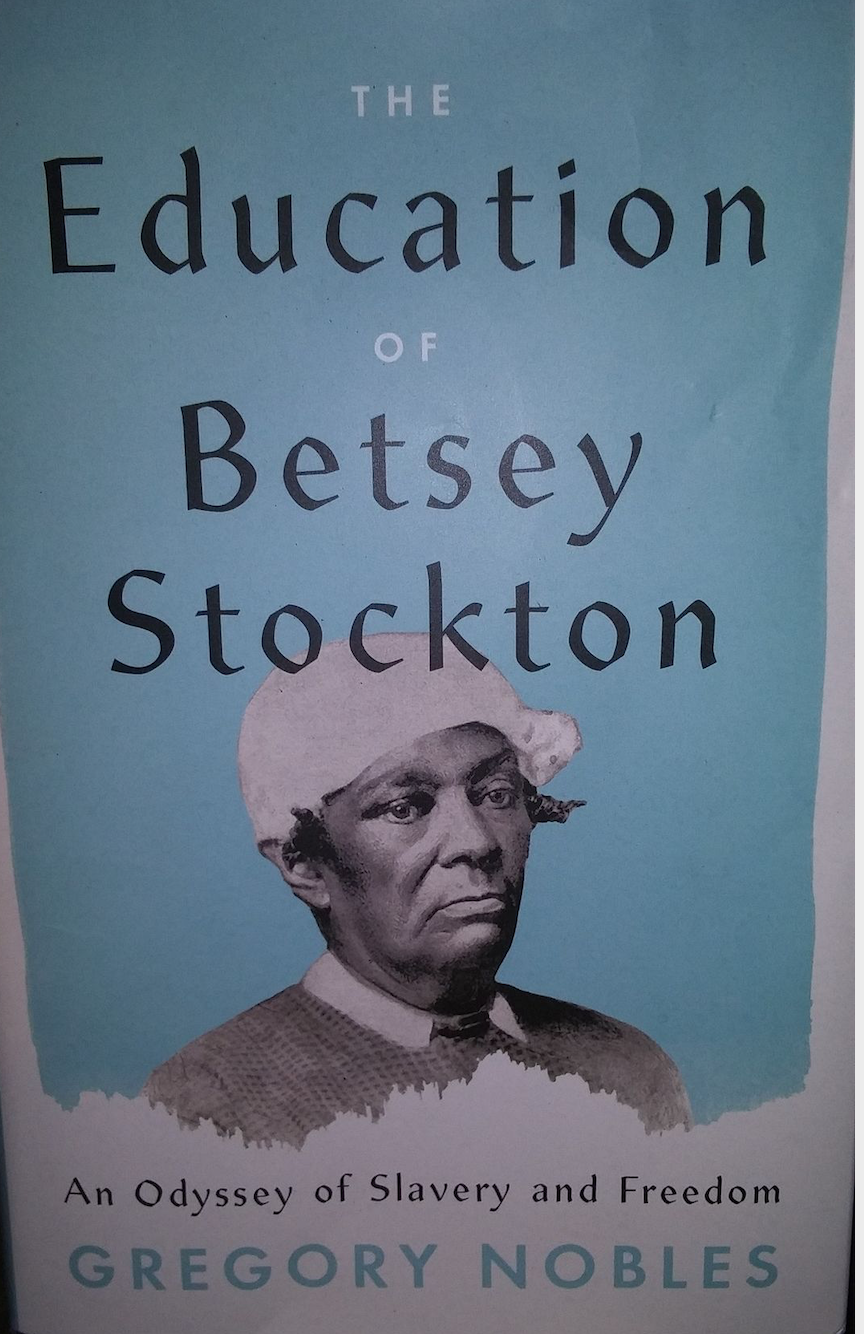
Book Review: THE EDUCATION OF BETSEY STOCKTON: AN ODYSSEY OF SLAVERY AND FREEDOM


As was true of his biography of John James Audubon, Gregory Nobles, in his new book, The Education of Betsey Stockton: An Odyssey of Slavery and Freedom, gives readers broad and deep insights into the time period of his subject and those parts of the United States in which she lived and worked. In a way, this approach was more necessary in writing of Stockton than of Audubon, since information about Stockton's life and work is fragmentary, and most of what survives was written by other people, but what it means for a reader is that we have a chance to be fully immersed in events and beliefs of our own American past while the author pieces together, like a quilt, the life of a specific historical human being.  


Nobles as historian specializes in 19th-century America. In going beyond the life of his subject, his earlier biography of Audubon explored in detail the business practices and economics of that time, what it took to be considered a serious artist then, and the state of American art and science with relation to England and the European continent, as all these larger issues bore directly on the life of Audubon, who lived from 1785 to 1851. 


Betsy Stockton, born into slavery, lived from around 1800 (exact date not known) to 1865. Given the color of her skin and the circumstances of her birth (the identity of her father can only be speculated), as well as her foreign missionary experience, long career as a teacher, and the fact that she lived through the Civil War and President Abraham Lincoln’s assassination, larger national issues explored in relation to her life are slavery, racism, public education, 19th-century American politics, and the Civil War, along with the missionary movement of the time and the role of the town of Princeton, the College of New Jersey (now Princeton University), and Princeton Theological Seminary in spearheading and shaping that movement for the Presbyterian church.


Since Stockton's unedited manuscript journal either did not survive her or has not yet come to light, only the published installments of her journal as edited by the Reverend Ashbel Green are available to account for her missionary travel to Hawaii in 1824-25, and while Green assured readers of the Christian Advocate that he made “very few corrections” to the letters before publication, there is no way of knowing to what extent he may have altered her original writing. Sadly, not many of her letters to Charles Samuel Stewart survive, either. But Nobles has brought together what scattered pieces of documentary evidence do exist, as well as the well-established basic facts of her life.


Stockton had been “given,” as an enslaved child, to Green’s wife, and it was Green himself, years later (Stockton was emancipated as an adolescent and afterward worked for wages in the household), who wrote a letter of recommendation for Stockton to Stewart. The latter was forming up a foreign mission to what were then known as the Sandwich Islands, and thus it was, author Nobles tells us, that Betsey Stockton was


…the first Black person, the first former enslaved person, the first single woman to serve as a missionary in Hawai‘i, and the first missionary to start an infant school for Black children in Philadelphia, the first name on the list of Black people leaving the main Presbyterian Church in Princeton to form a separate congregation, the first teacher in the only school for Black school in Princeton. Betsey Stockton lived a life of firsts, all of them in service to people of color. 


Racism endemic to 19th-century, pre-Civil War Princeton, both the town and the college, should not be surprising but reads as shocking nonetheless. Black men defending their own wives from harassment were set upon by groups of rowdy white students, and Black parishioners of the Princeton Presbyterian Church were denied even their traditional separate gallery seating when a new building was constructed after the old church burned, as “the white Presbyterians pressed for separation,” and Black members were “dismissed” from membership. It was at that point in history that the First Presbyterian Church of Colour of Princeton was formed. 


The College of New Jersey, with a high percentage of students from the South, attempted to remain “neutral” on the questions of slavery and secession right up to the Confederate attack on Fort Sumter, when


…several students climbed to the top of Nassau Hall to hoist an American flag, shout out some rooftop speeches, and fire a few old muskets as a show of support for the national government. This display was also an act of defiance toward the faculty, and particularly President John Maclean, Jr., who had sought to remain officially on the fence in the run-up to the rebellion. …His sympathy for southern boys led him to order the flag taken down, so as not to offend anyone who might see it as an institutional political statement. But in the context of open conflict, Maclean’s moderation had lost traction among northern students, and the flag went back up – and stayed there.


To read that the president of Princeton feared the American flag might offend some of his students and ordered it taken down astounded me. Those most likely to be offended would have been the Copperheads.  (I would say that the Princeton & Slavery Project, so recently begun, is both long overdue and a good start.) And to think there are people in our country today who consider themselves patriots and fly the Confederate flag without fear of causing offense! Or perhaps they hope to offend? But let me not get sidetracked....


Throughout The Education of Betsey Stockton, the main subject herself never appears fully in sharp focus and technicolor, but that is not the fault of the author. Nobles could have written a novel and invented a character and put words in her mouth but chose not to do so, determined instead to hunt out “traces” of the real human being wherever he could find them. The Betsey Stockton who emerges from his research, though there is only a single photograph to give us some idea of her appearance, was a woman who “knew her own mind,” was “‘deliberate and dignified,” “certainly not weak willed,” someone who educated herself throughout her life and was respected by all who knew her. Given her intelligence, her sense of calling, and the racist environment in which she lived, it is hardly surprising that throughout her life Stockton knew occasional “low spirits.” In the end, however, more important than her spells of depression or discouraging events was her strength to go on doing good work, teaching children who might well never have had an education without her efforts.


Learning about one of the many “ordinary people doing extraordinary work” behind the grand stage of historical events is sufficient reason to read this book; another,  however, is to examine in a different time period the racism that is such a deep stain on our country’s history and a painful legacy continuing in our own day. Political divisions, too, are nothing new to the never fully united United States, as this story shows so clearly, so in learning about Betsey Stockton’s life and work and the times she lived through we have yet another lens through which to examine our past – and we can never have too many of those.


Greg Nobles will give a presentation at the summer library series on Tuesday, July 19.


The Education of Betsey Stockton: An Odyssey of Slavery and Freedom

by Gregory Nobles

University of Chicago Press

Hardcover, 292pp with notes and index

$25


Read since last listing:


56. Rumi, trans. by Kabir Helminski & Ahmad Rezwani. Love’s Ripening: Rumi on the Heart’s Journey (poetry)

57. Bowen, Rhys. The Venice Sketchbook (fiction)

58. Ashenburg, Katherine. The Mourner’s Dance: What We Do When People Die (nonfiction)

59. Davenport-Hines, Richard. Proust at the Majestic: The Last Days of the Author Whose Book Changed Paris (nonfiction) 

60. Buzzelli, Elizabeth Kane. She Stopped for Death (fiction)

61. McMorris, Kristina. The Ways We Hide (fiction)

62. Nobles, Gregory. The Education of Betsey Stockton: An Odyssey of Slavery and Freedom (nonfiction)


Tuesday, March 7, 2017

“What It Is Ain’t Exactly Clear”


What is "It"? Weather? Learning? History? Class?


Weather and Stuff Like That

It was winter in Leelanau County, and then it was spring, unexpectedly and alarmingly early. The air was balmy, daffodils pushed up eagerly on Waukazoo Street, and ticks—ugh!—awoke from their hibernal slumbers. One of them found Sarah, and an assistant at the veterinary clinic said four other pet owners had called about ticks on their dogs already. Freedom from ticks is one of winter’s blessings, and the return of spring, while thrilling, also brings back dread and worry in the form of ticks.

But outraged winter roared back, with fierce winds and nearly a foot of snow (to bury the ticks—yea!) and temperatures plunging down to the single digits overnight (so cold--boo!). The old folk saying, “It’s an ill wind that blows nobody good,” encapsulates the same truth as my philosophy of life in a nutshell: Everything is a double-edged sword, all blessing mixed, fortune a matter of perspective.

Well, then the sun came out again as the mercury rose once more, and those heavy snowdrifts melted so fast they seemed to be saying with a laugh, “We’re sorry! Bad joke!”

But official spring is still two weeks off, and this is Michigan. Anything could happen.


Intellectual Cross-Pollination

My first semester of college (never mind how long ago) was an exciting time, and as I thought this morning about books I’ve been reading the past couple of weeks, I was reminded of that thrilling earlier period of my life. Can I possibly reconstruct my class schedule? Rhetoric (a required freshman class); Voice and Articulation (for my speech and theatre major); an introductory class in Psychology; Botany (big mistake: I’d been aiming for horticulture but didn’t realize the difference; wanted to work with plants, not microscopes); University Choir—but choir was only one credit, so I’m still missing something big, because I carried 19.5 credits that semester.

But of the classes I’ve remembered, what unites them? Not obvious, is it? Voice and Choir seem to go together, and Psychology might well work along with Rhetoric.... All these years later, the web of connections that I felt then, every day, has fallen into dust. All I can say is that all the learning, so much, was coming at me so fast, that it seemed to feed together like one big class.

Oh, here’s one connection I just remembered. A certain school of thought believed emotions were causative and produced actions, while another argued that actions, based on judgments, themselves produced emotions! For example, I run away, and the running produces fear; the faster I run, the more afraid I become. That theory from psychology had clear and obvious potential for the stage and was itself, to one hearing it for the first time, excitingly new and strange and wonderful.

How I managed to bring botanical insights into anything else back then, I cannot say now. Perhaps the connections I made were metaphorical. I’ve been known to do that sort of thing, once typing a book-length manuscript on welding, written by an engineer, and finding in it nothing but poetry about the successes and failures of love!


And So, About My Recent Reading

This winter/spring, it has been Nancy Isenberg’s startling new perspective on American history that set the stage for cross-pollinating streams of book-induced thought, streams first beginning to interweave when, not yet at the end of her book, I began reading the new John James Audubon, by Gregory Nobles. Here are a few ways Isenberg’s focus on class in America transferred, for me, to the story of Audubon in America.

First, there was the whole big question of what constituted science and who would be counted as a scientist. British and European intellectuals in general looked down on early pioneering knowledge efforts in the New World. The European establishment, proud of its focus on ideas and theory, denigrated American practicality. Americans, they thought, could never set aside questions of economic gain, and so the more abstract questions of science, abstractions that Europeans built into entire systems of thought, fell by the wayside. For their part, the Americans, insistent as they were on their intellectual independence, never felt their scientific reputations secure until they had been recognized in Europe.

Europeans, then, backed by tradition and the leisure of old money, held themselves the “pure” scientists. Americans (Audubon was but one example), scrabbling for financial gain and intellectual recognition, were suspect by comparison.

(I find it sadly ironic today that the nineteenth-century American insistence on facts, experiment, and observation over abstract theory seems to have been given up in today’s United States. At least, that is so in our politics, and one wonders about science. Look around. Controversies and divisions in twenty-first century America are all too often fueled entirely by ideology--backed by money, seen as the ideological measuring stick--, and in that, it seems, we have become European—gone back to the Old World way of thinking—I believe, to our peril.)

One nineteenth-century transatlantic argument in natural history was between Buffon in France and Wilson in America and concerned the mutability of species over time. Evolution and its direction.

Buffon did not visit the New World but advanced a theory, nevertheless, that species degenerated in the American climate. Alexander Wilson (against whom Audubon continued to compete long after Wilson’s death) argued that Buffon’s theory flew in the face of facts, and even Thomas Jefferson got into that fray! Here I couldn’t help making the connection between what Buffon saw as “degeneracy” in America and the class distinctions and characterizations of “degeneracy” Americans themselves made against different groups in their own country, so carefully laid out in Isenberg’s history.

Well, that was the theory/fact divide. On a much lower plane was the distinction made in nineteenth-century America between “gentlemen sportsmen” and “pot hunters,” a class distinction if ever there was one.

As Audubon himself might kill thousands of birds in scientific pursuit, so the killing of birds for “sport” was judged pure and unobjectionable, regardless of the enormity of any particular slaughter—and slaughter it frequently was, with no limits to the killing established by law or admitted according to need. Birds were simply moving targets, and the greater the number killed, the more glory to the “sportsman” who brought them down.

But a “pot hunter”? One who killed to feed himself and his family? To market the meat for gain, as a livelihood? Anathema! Motive, you see, was the dividing line, not numbers of birds killed; male bonding a gentlemanly motive for killing, making a living by killing beneath contempt.

Audubon the American woodsman occupied a strange, anomalous position in the class history of the United States. When he traveled downriver by flatboat, paying his fare by shooting birds and game to provision passengers and crew, the term “pot hunter” clearly applied to him, and all his life, from one line of business to another, providing for his family was of paramount concern. On the other hand, both as an artist and as a scientist, he found doors open to him that would have been closed to others of his social rank—even if, in the best American upstart tradition, he did have to push some of those doors open himself.


Making Me Think

“Not our kind” (or "not our class, dear") is the vaguely worded, classically voiced objection signaling the speaker’s belief in his or her superiority. I started to type the phrase in quotes and missed a key the first time around: “not our kin” is the way it came out on the screen. There you are, I thought. Who will we count as part of the “family of man”?

From Isenberg and Nobles, I turned to the fiction of Charlotte Brontë, re-reading Jane Eyre to prepare myself for Sarah Shoemaker’s new novel, Mr. Rochester, which I am now about halfway through, and again and again, in both, class distinctions come to the fore. But those observations can wait for another day.

For now I only observe that the collecting of books is traditionally a leisure class pursuit, while the selling of them locates one clearly “in trade.” It is in this that I am perhaps most stubbornly American: I have always been proud of making my way in the world. Whether cleaning cabins, picking apples, or typing manuscripts, I've never been ashamed of working for a living. And bookselling has given me much more: through my bookstore, I've grown a life.


Tuesday, August 30, 2016

Back Again From Southern France


No jet lag this time around, as my travels were done from my own front porch. There were no photographs or other illustrations in Tony Judt’s scholarly study of Socialism in Provence 1877-1914, and yet, at the same time my brain was working overtime to take in his arguments and evidence, it was also picturing scenes from southern France – along with, I must admit, my grandparents’ modest little “farmette” (they called it that) in Ohio in the 1950s and today’s Leelanau orchards and vineyards and CSAs.

One of Judt’s quarrels with research previous to his in French social and political history was a tendency of researchers to lump regions and classes into large homogenous groups and make sweeping generalizations based on a composite portrait thus drawn of the populace. An area might be called agricultural, and a certain percentage of the population identified as peasants, and from that the researcher would assume conservatism and little active interest in politics.

Yet the difference between an isolated mountain hamlet (we ventured up a terrifying road to explore one in the Auvergne in 2000) and a bustling country village connected to other villages and towns by good roads was enormous in the time period Judt was studying. Moreover – as was true with my grandfather and as is true of many Leelanau farmers today – those working the land were not always themselves landless. They could be and often were owners of small property, working others’ land, as well as their own, or working in a small manufactory by day and on their land in the evenings (this was my grandfather’s pattern), or migrating from place to place with the seasons, following available work, or working part-time in the fields and part-time at other jobs. Artisanal workers and farm workers, laborers for others and property owners – these were not mutually exclusive categories. Judt found that while conservatism did reign in poor, remote areas, peasants on better land in the Var region, particularly farmers who actually owned property, were more likely to support socialist politics and programs. They saw collectivism as their best hope for being able to continue living on and working the land, despite bad crop years and market challenges from the larger world.

What impressed me most was the difficulty of categorizing the ways in which people earned their livelihoods. There was my grandfather, working in the casket factory by day and tending his raspberry patch and vegetable gardens and fruit trees in the evenings. There are farmers here in Leelanau who also work office jobs or hold political posts or teach school in the winter. I own a small business, and yet one fall I was among the county’s orchard workers, picking apples for a local grower. This has been the truth of country living for a long time, all over the world.

Another nonfiction book I mentioned here recently, Self-Theories: Their Role in Motivation, Personality, and Development, excited me greatly, and yet when I showed it to a very well-educated friend, with interests far beyond his own field, he laughed and said he would never have picked up a book with that title and cover, never imagined that it could be interesting, much less (as I found it) compelling, thrilling and inspiring. Here is what I sent him and another friend, by e-mail, under the subject heading “This book just keeps getting better and better,” when I was only halfway through the book:
It was published in 2000 by Psychology Press, an imprint of the Taylor & Francis Group, as part of a series called ESSAYS IN SOCIAL PSYCHOLOGY, so I'm talking about a book that is already 16 years old. One of the author's findings is that "we can influence students' theories [about themselves and their intelligence]. Although students came to our study with their own theories, what we told them had a clear impact. This means that people's theories of intelligence are malleable." So students who initially believe their intelligence is fixed can come to believe they can increase it, and this means they will be willing to take on challenges they would otherwise avoid. They can learn to learn! The author carefully says that the studies do not show such changes in belief to be permanent, but the initial belief wasn't permanent, either. Human beings can learn, not simply through trial and error, but by coming to believe they have the capacity to grow.   
She calls the two theories "entity" and "incremental." Entity theories think of intelligence as a fixed trait; incremental theorists (these "theorists" are all of us, at every age of life!) think of intelligence as knowledge and skill, something that can be cultivated and improved. The entity theorists are performance-oriented, and when they "fail," they fall into despair and helplessness, because to them failure is a sign that they are not smart, after all. Incremental theorists have a very different view of failure, seeing it as an opportunity to learn, to employ new strategies, to try harder or focus differently, etc.   
She doesn't stop there. She goes on to see if success and failure in relationships, and responses to perceived setbacks in relationships, follow the same pattern. She finds that they do. And then (I'm as yet only halfway through the book, and there are many, many studies conducted and cited), she finds that entity and incremental theorists not only judge themselves differently but judge others very differently, also. Entity theorists are quick to judge a person's character on the basis of a single action, but the author stresses that these quick judgments are not "impulsive," but "seem to grow out of a belief in character as a unitary thing that permeates virtually all actions and displays itself with great consistency."   
The really great thing is that students in a classroom can, with appropriate readings, change from entity to incremental theorists. The author does not know if the change in belief would be long-lasting [results of research do not preclude but do not establish such a conclusion], but imagine retraining the thinking of people who work in prisons to believe that prisoners can learn and become better, more self-aware people!
My excitement continued through to the last page of the book.

Similar to the way Tony Judt, in Part III of his study, extrapolated his findings to say something about socialism in France in general, Dweck takes her findings (about how people’s self-theories affect the way they view success and failure and influence responses to failure and challenges) and carries those into a larger theory of motivation and personality. In Chapter 18 she surveys other theories of personality and motivation. “Trait theories,” she tells us, are all about description but offer little in the way of explanation. They are particularly weak when it comes to explaining change. Not surprising, as Dweck notes: “In fact, many trait theorists don’t really believe much in personal change....” (This was my objection to the popular Please Understand Me and the Meyer-Briggs personality type test.)

“Motive theories” (she cites various in the group, but I am omitting the lists) leave out anything to do with goals, beliefs, or cognitions. Both biological theories and Freudian theories come in for criticism. Of course we inherit certain temperaments, she acknowledges, but “temperament is not destiny,” and biological theories “don’t look at adaptive functioning.” As for Freud, his theory left no room for impetus toward growth, ignored goals specific to a particular self, and posited all achievement as the result of defenses.

Growth, goals, beliefs – in Dweck’s theory, these are central, with the meaning given by the individual the most important factor in motivation, regardless of words used in explanations. Some “entity theorist” learners may believe luck is a factor but see luck not as unpredictable but as a feature of personality they either have or lack, just as they see ability.

In her final chapter, Dweck addresses questions and objections to her picture of human personality and motivation. One question is posed as follows: “Isn’t It Naive to Believe that Everyone Has the Potential to Change?” Excellent question! Here, in part, is Carol Dweck’s response:
...I have not tried to argue that anyone can become Albert Einstein or Mother Theresa, but I have tried to argue that we do not know what anyone’s future potential is from their current behavior. We never know exactly what someone is capable of with the right support from the environment and with the right degree of personal motivation or commitment. ... The danger of the entity theory is not so much that it argues for human limitation, but that it suggests we can know people’s limitations so quickly and then grants them so little potential for growth. I believe that people and society gain a great deal when we search for ways to help people realize their potential instead of labeling or punishing them when they do not.
Children can become “smarter” and more successful, Dweck has shown, when they incorporate into their belief system the idea that “failure” is an opportunity for learning and growth, not a sign of stupidity or badness. People who take on this new belief about themselves can also improve their personal relationships, no longer seeing setbacks as signals to give up. And everyone can see others differently, too – as capable of change and improvement.

Imagine! Imagine an electorate and a justice system, not only schools, believing in the possibility of personal growth. Imagine not writing off others (or allowing oneself to be written off) with “He can’t help it. It’s the way he is.” Being shy does not mean one must be paralyzed by shyness. That’s just one example.

And it is true at any age. I’ll let the author have the last word:
Some years ago, as I reached one of the landmark ages, I asked myself what I would like to be able to say at the end of my life, and it was this: I want to be able to say that I kept my eyes open, faced my issues, and made wholehearted commitments to things I valued. I did not want to be haunted by a litany of regrets or left with a bundle of potentialities that were never realized. As adults in this society our mission is to equip the next generations with the tools they need to live a life of growth and contribution. Can we make the commitment to help them become smarter than we were?