Search This Blog

Showing posts with label West. Show all posts

Sunday, March 10, 2019

The 'Wild West' in Movies (and Books)

Sample of cowboy selection at the Mustang Mall
Out here on the range, most nights the Artist and I watch a movie before we fall asleep — or before a read-aloud session before going to sleep. Usually we stay awake until movie’s end, thus making time for reading aloud. We see more Westerns on TV and DVDs out here than we would at home in Michigan, but we don’t find all Westerns equally satisfying, and I’ve been thinking about the variety in these films over the decades.

Older Western movies fall into a couple of general categories, the formulaic and the classic. (Is it easier to see a black-and-white film as a classic? Plenty of formula movies were made in black-and-white, too, but the truth is that even those look better to our eyes than they would now if we saw the same tired story and two-dimensional characters up on the screen in full color with full, top-quality production values.) Old Westerns made on the cheap weren’t trying to be something they weren’t. The aim of the studios was to entertain and audience in order to make money. That simple. So okay, entertain me, if you can, but I’m not a 9-year-old on a Saturday afternoon, and my entertainment is often diminished by what I know about human nature and the history of my country.

Classic Westerns are something else, but what is considered an important Western film these days? “High Noon” comes immediately to my mind, but looking at a “Top 20” list surprised me: 

“Stagecoach,” from 1939, is the oldest in the list that also includes “My Darling Clementine” (1946) and “The Ox-Bow Incident” (1943), “Red River” (1948), “Winchester” (1950), and naturally “High Noon” (1952), but many movies made long after Westerns were weekly theatre fare also made the cut: “The Wild Bunch” and “Butch Cassidy and the Sundance Kid,” both from 1969; “Little Big Man” (1970); “McCabe and Mrs. Miller” (1971); “The Outlaw Josie Wales” (1976); “Dances With Wolves” (1990); “Unforgiven” (1992), a remake of “True Grit” from 2010; and “Django Unchained” (2012.

While all the films in the list are set in the West, in Westerns as in horror or gangster films it’s easy to substitute gore for character, plot, and meaningful action. To my mind, how human beings kill (each other) and die (alone) is not that interesting, in and of itself. Notwithstanding the truth that death comes to us all, for me the killing and dying is only interesting within the context of how people live and how and why they make the choices they do. 

Films from the 1990s and later look at the 19th century through 20th- and 21st-century sensibilities, with all the concomitant insights and flaws that implies. In “Dances With Wolves” a director (Kevin Costner, also the film’s star) has removed cultural blinders in his look back at the history of the American West, portraying the Native Americans in his story in their full humanity, and his story means much more to me than all the blood spilled in “The Wild Bunch.”

A recent issue of Cowboys and Indians magazine (picked up for free in the library lobby or laundromat -- I forget which -- and I'm not kidding about the name of the magazine, either) included a short list of what those who compiled it called “Top Modern Westerns.” There are only five films on this list, all of them made since we turned the millennial corner, and I have seen none of them, but “Hell of High Water” (2016) sounds like one I’d give a chance.

In any case, I have my own favorites among the more recent films set in the West, and none of them made the Top 20 list, much less the five Top Moderns. For me, “Broken Trail” is #1 — and not only for some of the best wild horse herd sequences I’ve ever seen on film. Robert Duvall and Thomas Hayden Church play down-to-earth cowboys, looking to make a buck but doing it their way and not so focused on the buck that they have put their humanity on the shelf. Another I like a lot is the almost unknown “Red Rock West,” a quirky noir Western with comic undertones that’s about as far from “Broken Trail” as a movie can be, but I like Nicholas Cage, and much of the movie is set in Willcox, Arizona, my winter stomping grounds, so I recommend it to friends for that reason alone. 

And now I have another to add to that short list. 

Tom Selleck’s “Monte Walsh” is not the most exciting movie, even the most exciting Western, I’ve ever seen. There are stretches where it’s almost dull and a couple of scenes played too hard for effect. But I didn’t mind the slow or overplayed sequences all that much, for the sake of the movie’s depiction of cowboy life, both its appeal and its disadvantages, particularly in an era (end of the 19th century) when everything is changing fast. The range is being fenced in, cowboy jobs fewer and harder to find. (Unemployment has never been unique to cities.) You sense that these characters are real people in the grip of real life dilemmas.

Why do they do it? How long can they hope to do it? What else can they do instead, when “cowboyin’ is all [they] know”?  I can’t remember any other Western film that set out to explore these questions in such detail. And there are exciting parts, too, and beautiful scenes. 

One minor character in the film is an aged Civil War veteran. “Monte Walsh” is not the only Western to feature Civil War veterans, and it’s historical fact that many Confederates came west to start new lives after the Civil War. (Many Southerners had come west before the war, too, which is not so well known.) The sad plight of “Fightin’ Joe” — the character goes by the name of his Civil War hero rather than his own name (and there’s a lot about men’s names, their real names vs. what they’re known by) — is that he’s been reduced to “ridin’ fence,” which the movie seems to be telling us is the end of the line for a working cowboy. That piqued my interest, because in what I’ve been reading about ranch life, riding fence is just part of the work — good, honest, hard outdoor work — and in none of the memoirs and reminiscences I’ve read did anyone indicate that it was below a man’s dignity to fence and keep fences in repair. But those were ranchers’ memories, and there was apparently a vast difference between a 19th-century cowboy and a 20th-century rancher. 

No, Monte and his cowboy pals are seeing their West vanish before their eyes: monied corporations, men from the East, are buying up land and fencing it in and sometimes don’t do a damn thing with it! And that poor old man ridin’ fence is all alone. He isn’t part of a working team any more, even his horse less a partner and more mere transportation to the fence line, while those other cowboys, the ones who haven’t yet lost their jobs, they’re still ropin’ and ridin’ and roundin’ up and drivin’ cattle and horses. 

“Monte Walsh,” based on the book by Jack Schaefer,  was filmed in Calgary, Alberta, and while not a perfect film, it’s worth seeing. I decided not to provide any links to reviews in this post, because some of them tell you way too much. Just take a look at the movie for yourself. That’s my advice. 

I haven’t read Jack Schaefer’s book and only learned of it via the movie. Anyone know Monte Walsh the book? Should I be read it? Warning: You’ll have to give a strong sell job, because I’m tempted to skip right to Jack Schaefer’s The Hearts of Horses, in which I read that the cowboy is a girl!

Our just-begun bedtime read-aloud book is Blood Brother, by Elliott Arnold, a fictionalized account of the friendship between Cochise and Tom Jeffords, the story made into a movie we have yet to see, “Broken Arrow.” So stay tuned, because I'll be out here for a while yet....

(Bonus scene here.)


Postscript

Since writing this post we have watched “Broken Arrow,” the movie made from Elliott Arnold’s book,Blood Brothers. I don’t know whether to recommend the movie or not. We’re not far along yet in the novel to know how far fiction departed from the account Tom Jeffords made of the meeting in the Stronghold, when he took General Howard to meet Cochise, but I’ll be disappointed if the novel veers into an irrelevant, largely invented love story, as does the movie. That, however, was the Hollywood of the time. 

My biggest disappointment was the movie’s setting, as it was clear from the initial sight of the first tall saguaro and the mountain formations surrounding the desert through which Jimmy Stewart rode (though I’m happy to say he could sit a horse just fine) that we werenotin Cochise County. The screenwriter had assumed that "all exterior scenes will be photographed in the magnificent and neglected section of Arizona, in which the events occurred,” and publiity for the film promised movie-goers that the film had been "shot in the locations where the story actually took place.” Not so! Well, some of the filming took place in northern Arizona — up on the Whitewater Apache reservation — and the rest was shot in California and Utah. Why not Chiricahua? Why not the Dragoon Mountains? All mountains are not the same! Each place is unique, as is its history.

Also, White Buffalo Calf Woman -- is that the tradition that the young female love interest was supposed to represent? And isn't this a Lakota tradition, not Apache? Perhaps the legend migrated? Someone more knowledgeable will have to set me straight on this, if I've got it wrong, but the whole business of "pan-Indians," i.e., taking different peoples from different parts of the continent and creating a composite, is problematic.

On the other hand, Hollywood did a few things right with the story. They followed the lead of both the real Tom Jeffords and also author Elliott Arnold and, finally, made a Western movie that told the Indians' side of that era’s bloody cultural conflict, and it presented the Apaches as human beings with legitimate claims to the land and their way of life, rather than simply as “savages.” Also, while major characters are played by white actors, 375 Apaches were played by actual Apaches — again, I should note, according to Twentieth Century-Fox. 

There’s also an interesting story about the House on Un-American Activities. That background, on script and other choices, can be found here.

Wednesday, January 2, 2019

New Beginnings?

Hoppin' john, collard greens, cheesy biscuits

January 1-2, 2019
Dos Cabezas

When you think about it, the idea of a ‘beginning’ to anything is strange. I wrote those words out long-hand on a pad of yellow-lined paper on the morning of January 1st, but they were really (as I also wrote) a continuation of what had begun on my laptop screen two weeks previously as “Desert Diary,” and that was only picking up again a record of descriptions and thoughts written last winter and three years before in blog posts and letters to family and friends.

Cabin from wash on snowy New Year's Day
Was 2015, then, the beginning of all this writing and of my love for mountains and high desert? If so, why did my heart leap up when the owner of our cabin first told us about it, uttering the words “high desert,” “open range,” “ghost town,” words that thrilled me even then? 

Sarah & fence
I’d never longed to see Arizona — it wasn’t a dream for me, like the dream of seeing Paris — but the truth is that I had always, as a young, horse-crazy girl, dreamed of going West, dreamed of the West from the front porch (west-facing) of our family home on the Illinois prairie as I gazed over and past the cornfields across the road and imagined myself on horseback, riding beyond those prosaic fields, into the sunset. Out under — at last! — black skies pricked by innumerable stars, far from any city or suburb. As it always had and perhaps still does to Europeans, “the West” represented freedom to the child I was, fenced about by social rules and expectations. “No running in the house!” Could they not see that I was not running but galloping? That I was not a child but a wild horse? As I galloped, indoors or out, or dreamed on the front porch, gazing across cultivated fields, I imagined boundless wilderness, open and challenging. There were pictures in my head from television cowboy shows, but there were no sheriffs or bandits or range wars in my fantasy. I had no wish to conquer anything or anyone, only to be there, to “breathe free,” and test myself, not against adults or other children or social mores or any arbitrary will or rule, but against natural reality, harsh though it might be.

[Sidebar: Some, I know, will immediately want to compare my girlhood dreams to those of a boy, so I’ll pause here to say that I am not interested at all in that comparison. Men, usually the ones to raise the comparison questions, can only speculate about how their youthful experiences compare to what they can only imagine were those of someone now a woman. They cannot truly compare, as the only experiences they had were their own. And the only experiences I had were mine, so I cannot compare, either, but comparison is not what I’m about. I am only describing my dreams, and I can say definitely that I did not dream of surviving a Western wilderness as a girl, only of meeting the challenges of nature. Perhaps a boy’s dreams center more on becoming a man. Perhaps their dreams are more gendered. I don’t know. I suspect there are as many differences among boys’ dreams as there are among the dreams of girls, but I find questions of gender when they intrude on my experiences with the natural world, whether actual or imaginary, annoying and unwelcome, because part of what I sought to escape in my childhood imagination was just such restricting social norms.]


Back to the more interesting (to me) question of beginnings, though. Did the feelings I now have for my winter Arizona surroundings begin with a child’s dreams as that child gazed across an Illinois cornfield, imagination ablaze with Gene Autry, Roy Rogers, Dale Evans, and company? Or was the beginning further in the past, when my parents attended their first rodeo out in South Dakota while I was still in my mother’s womb? South Dakota, my birthplace and scene of my conception — would such a place not mark a child with an invisible brand, not to be erased by subsequent moves and homes? Or do I go beyond reason with such a question?

On New Year’s Eve I opened a new book that I took up again in the morning, as the new year officially began. A gift from friends who were here in the cabin for six weeks before our arrival and the most appropriate possible reading for me, here, as we usher out the old and welcome in the new far from northern Michigan, the book is Drum Hadley’s Voice of the Borderlands, poetry of his cowboyin’ experience along la frontera, the mountains and high desert of Sonora, Mexico, and Cochise County, Arizona. Names of familiar places recur in narrative vignettes: Sulphur Springs Valley, Willcox Livestock Auction, Agua Prieta, and there are mentions also of places I know only from maps, such as Guadalupe and Antelope Wells. I finished the first section, “Cowboys and Horses,” with great satisfaction as the new year began and the first snow of 2019 fell on Dos Cabezas. On the morning of January 2nd, we are under a winter storm warning still, with accumulations of eight inches possible at elevations above 5,000 feet (that’s us) and temperatures not to rise above the freezing mark until Thursday.


Beginnings, endings. Human beings designate moments, days, years as such, but are those designations anything more than mileposts we drive into time as a way to organize our stories?


Wednesday, April 25, 2018

Where Teddy Bears Are Not Cuddly

Sarah had a bath, at last. She is clean and soft again, but she's never been an especially cuddly dog.

Originally, weeks ago, I began drafting a post I called “Not Barefoot Country,” having to do with the terrain around our winter ghost town cabin. In that draft I listed many reasons, with details, for not going barefoot here: thorns and spines and prickers; sharp stones (especially the little ones); cow pies (especially the fresh ones; sunning snakes; winter cold; dust and dirt; old rusty barbed wire; broken glass; old rusty nails; splinters from odd bits of old lumber; and abandoned well pits. I added the last item not only because there are abandoned well pits nearby but also because I figured that climbing out of one, should one stumble and fall in, would be easier with shoes than without. 

There was nothing particularly wrong with that draft post, and every once in a while I would look back and add or change something — for instance, inspired by cowboy lingo, I changed the tentative title from “Not Barefoot Country” to “Not Tenderfoot Country” — but somehow I kept finding more interesting things to write about for Books in Northport. And now so much has changed that “Not Tenderfoot Country” seems beside the point, like the first chapter of my dissertation, the old one I kept rewriting for two years until I set it aside and moved on to write the rest of the thesis, finally writing an entirely different first chapter when all the rest was done.

Boots on the ground are still a better idea than bare feet on the ground. That hasn’t changed. All the old hazards to unprotected skin remain. It’s just that things just look different to me now. My concerns and responses are different. For one thing, the high desert is now clothed in spring green, its look softened more every day, but even that, I realized the other day, doesn’t explain the deeper difference.


“Soaptree yucca doesn’t make me laugh any more,” I remarked to the Artist as we made our way east on Hwy. 186, home to the ghost town after a morning of exploration from Willcox to Benson to Pomerene and nearly to Cascabel. “It just looks normal to me now.” I hadn’t thought before about this change in my perceptions, but there it was. Three years ago when we first arrived, soaptree yucca brought to my mind the fantastic illustrations of Dr. Seuss, looking to my Michigan eyes more like a product of imagination than of nature. Now it just looks normal.

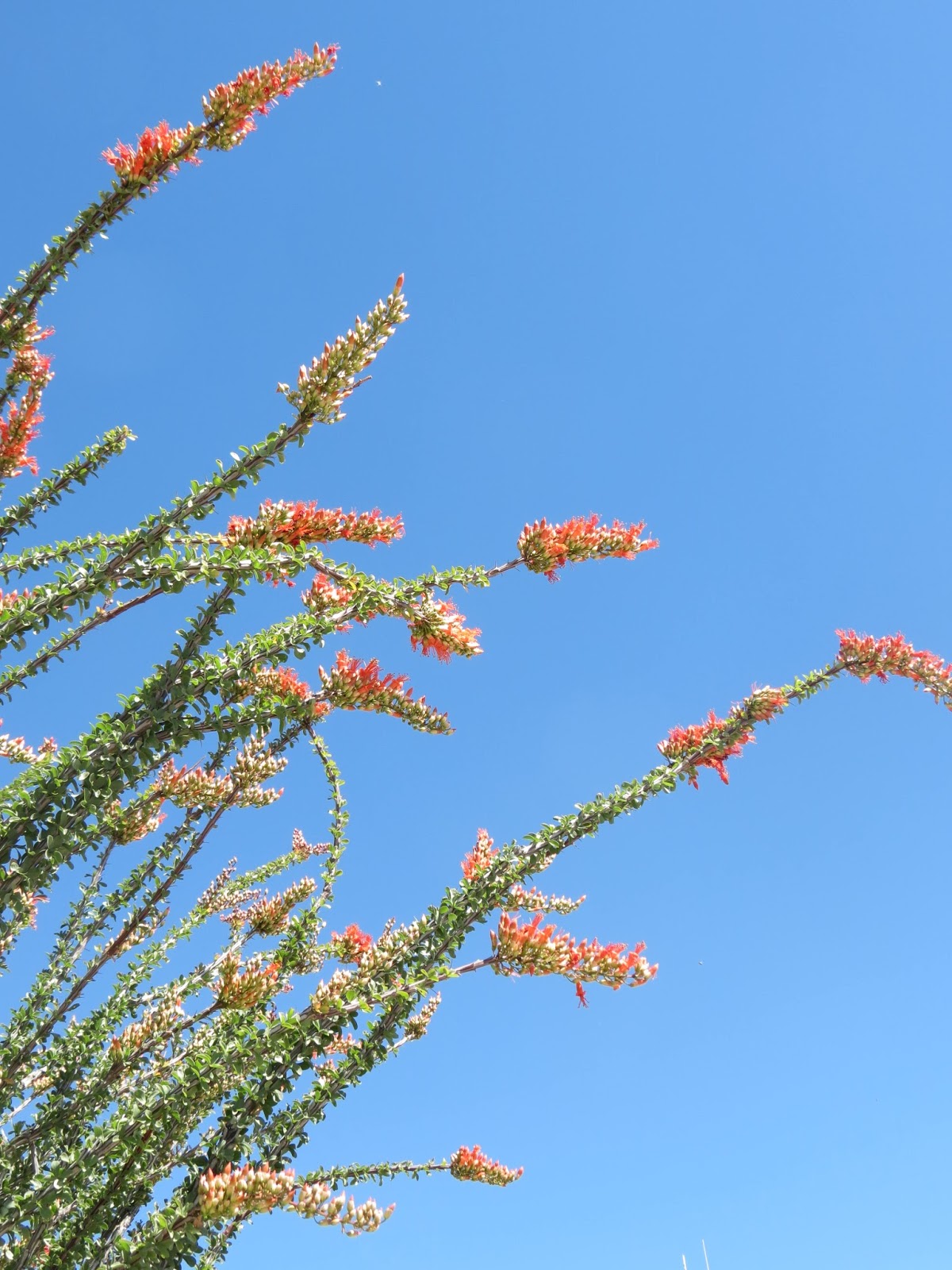
One book I read this winter, in describing Western plants, labeled the ocotillo as one of the “strangest,” and yes, ocotillo seemed pretty wild, too, when first I saw it. Now it is in bloom, and I see it as stunning and beautiful but not strange. Not at all. 

Soaptree yucca and ocotillo belong here. Strange — étrange — is another way of saying alien, and the plants native to the West are the complete opposite of alien. When the Artist and I were newly arrived, it was we who were the aliens. Now (as is true for me in Michigan, also, though not for him, Detroit-born), though we will never be native to this place, we are feeling a kind of sense of belonging. More attached, more rooted. This has been true for me for a while.

One of my Facebook friends was recently astounded by the way I thrilled to the rodeo. She didn’t know me when I was a girl on the Illinois prairie, looking out over fields of corn and soybeans across the road from my family home, looking west from our front porch, toward the setting sun, and yearning with all my heart to ride my pony (the one I never had, even after joining 4-H, but that’s another story) toward that red evening sky! My parents had bought our first black-and-white television set when I was in first or second grade, and cowboy shows — Gene Autry, Roy Rogers and Dale Evans, the Lone Ranger, Hopalong Cassidy, and later the “Spin and Marty” series on the Mickey Mouse Club show — all fueled the dreams of a little girl whose first word for horse, ‘fersie,’ had been uttered in a thrilled shriek of delight whenever, out for drives in South Dakota 
with her parents in the family Oldsmobile, she spotted a horse. Finally the parents had to save their eardrums by threatening not to point out horses to her if the child didn’t stop shrieking. She learned to whisper her excitement: “Fersie!”

As for the Artist —

“You know,” he began thoughtfully the other day at the high school rodeo competitions at Quail Field in Willcox, “if I were young and thinking about starting a family, I’d want to do it here.” Quite a surprising statement, coming from a such a staunch Piscean! I think it was the rodeo that finally won him over. As a boy in Detroit, he haunted a local riding stable and would ride horses in the spring for urban owners who needed the winter cabin fever (stable fever?) hijinks ridden out of their mounts before they dared to ride them. When he was twelve years old, his parents drove cross-country for a ranch vacation, and he rode out every day with the cowboys. “Real cowboys,” he stresses, cowboys working cows. I love stories of that vacation, imagining myself into the scene. I tell him how lucky he was! I would have been in heaven, as he was.

So we were both “horse-crazy” kids, and we both had the West in our blood, one of us by virtue of actual experience, the other only in her dreams.

I say we drove “nearly to Cascabel” the other day. Actually, we drove as far as the Cascabel Road was paved, turning back just past the intersection with Three Links Road, both roads unpaved from there on, which was exactly what I expected we would do, tempering the road to our 20-year-old van. It was for that reason, as Trail Boss, that I had chosen the Pomerene and Cascabel roads in the first place, though the route did not reach all the way to the intriguing hot springs I knew we would never reach them, anyway.


Remote! We were in in the San Pedro River Valley and could see the deeper green to our west, indicating the course of the river, and every few miles the terrain would change rather dramatically, one stretch filled with teddy-bear cholla and varieties of barrel cactus common around Tucson but not in Cochise County, certainly not in our own Sulphur Springs Valley. At the intersection where we reversed direction, I was surprised to turn the pages of the Arizona atlas and realize we were not at all far from Tucson. Not far, and yet a world away: Tucson was on the other side of the mountains to our west, and only rough trails lead across the mountains.


On the way back south to Benson, I had to stop to photograph the teddy-bear cholla. Though excited about being on foot in this very different kind of desert fauna, I thought I was maneuvering carefully around the plants until I felt stabbing pains and found myself limping, trying not to put full weight down on either foot. Well, that is hard to do! Pain did not deter me from my object, and I was pleased with the shots I got; however, when I realized the source of the pain, I was glad Sarah wasn’t out there exploring with me. This particular cholla, you see, so tall and stately in maturity, begins closer to the ground, much less obvious to a walker, and the long spines pierce leather like it’s silk.


Look like spurs? Maybe the inspiration for?
As for pulling out those spines? Thank heaven for the toolbox in the van and especially for the needle-nose pliers! And so, another desert lesson learned. Even shod feet need to be careful where they step. Bottom line, though? It was worth it. I wouldn’t have missed it for the world. 

I started this little essay without a tidy conclusion in mind. Maybe, though, it’s that a place doesn’t have to be “cuddly” or even completely welcoming to call forth love. People lived here in the West before they had running water or air conditioning or internal combustion engines. The country is challenging. If you’re going to live here, the country itself sets the terms of engagement. 

Here’s one paragraph from the discarded draft post: 

“So there you have it -- a walk in a high desert ghost town is not a walk on the Lake Michigan beach. But whoever thought it would be? One similarity is the sense of vastness -- the faraway, receding horizon by day, dazzling stars against a black night sky. Both Great Lakes and Southwest high desert offer those marvels. One big difference, other than flora and geology, is the stillness of the desert: there are no waves, and unless the wind is particularly strong there is almost no background sound, only occasional nearby sounds of fluttering, chirping birds or a bawling cow or calf off in the distance.” 


Last night the cattle were very vocal around the cabin, and this morning they are still calling to each other out in the mesquite. Their presence pleases us both, the Artist and me. We like seeing and hearing them and having them for neighbors. (Watching our step seems a small price to pay.) Birds too are vocal this morning, calling and singing all around the cabin and yard and down in the wash. Desert spring symphony, all of it pleasing. 

Yep, I like it fine. I am very happy here.


Thursday, March 10, 2016

Wilderness Boyhood with Horses


Where Rivers Change Direction
By Mark Spragg
New York: Riverhead Books
Paper, $16
...I can step my memory onto the backs of the big boulders and hear my boots scuff against the black and rust and corn-yellow lichens that covered them.
When I was a boy ... I lived on the largest block of unfenced wilderness in the forty-eight states. 
-      Mark Spragg, Where Rivers Change Direction

As a bookseller who started out (back in 1993) exclusively with used stock, I still gravitate heavily in that serendipitous direction, ready for a previously overlooked or treasure somehow previously missed to take me by surprise. I also maintain that certain words grant magic to a book title. “Rivers” is one of those words. And so it I saw and picked up Mark Spragg’s book. Turning it over, I saw a sentence fragment, “... wrangles horses for his taciturn father,...” and had to start reading. It had me at “Hello.”

I knew that David would enjoy the setting as well as the writing, so I tried reading aloud to him from the first chapter. I didn’t get very far. He was fully attentive. The problem was that I simply could not pronounce aloud, with a steady voice, sentences that had such a powerful effect on me as these:
I knew the horses as I knew my family. ... We caught them, used them, turned them back into the kidney-warm manure cake of the corrals, into the ridden-to-dust round corral. They rolled and stood and shook and milled. When I was separated from them I felt wrong in the world. When I was separated from them I took no comfort in the sound of the creek. I felt chilled without the heat of them. ...
The ranch life is a beautiful but also hard, even brutal. Much of what might sound like “hardship” was intentional, since the family business is a dude ranch in the Yellowstone Plateau, with clients looking to “get away” from civilization. Thus --
No one ever asked why we had no television, no daily paper. They came for what my brother and I took for granted. They came to live the anachronism that we considered our normal lives.
But much larger difficulties, privations, and challenges come with the territory, unsought. At least half the chapters are what a friend of mine (who speaks of certain movies she recommends as “hard to watch”) might call “hard to read.” I winced through much of the chapter titled “Bones,” in which thirteen-year-old Mark accompanies one of the older ranch hands, John, on an overnight hunting expedition for winter meat, looking for an elk to kill. They find and kill the elk, but early in the butchering process John’s hand is badly cut. The description is graphic enough that I won’t quote it but will just say that for most of the chapter that mutilated hand hangs in the balance. And that’s early on, with much more to come.

A gentler chapter is “Wapiti School.” The school is named for the valley, green only two months of the year, the valley where, scattered far from one another, some two dozen ranching households form a kind of extended family.
America was not yet rich enough for the coastal populations to buy up the hinterland and subdivide it into a patchwork of second homes. The Wapiti ranchers worked their land; they did not sell it. It was a life that lined the face, leaned the body, and satisfied. We knew our neighbors.
School days bring the author to his first shy boyhood venturings into the agonizing mysteries of love. He strives to tame his cowlicks and buys his first gift for a girl, but how to declare his feelings?

Then there is my favorite chapter, “Greybull,” the story of the boy’s first trip to the livestock auction, an hour beyond Cody, outside Greybull (population: 12), a trip made with his father in their old truck with the busted radio.
The parking lot is gravel, rutted from a recent rain, grown up at the edges in tire-broken weeds. The pickups are mud splattered, most of them hitched to trailers, their grills and windshields uneven fields of smeared insect body. There is a row of stock trucks. A semi is backed to a loading chute.
In one of the pens, a horse catches the boy’s eye,
... a single dun gelding. His mane and tail, muzzle, and stockings darkened as deeply brown as wet earth. So is the line that dissects his back, from his mane to the base of his tail. His ears are pricked. His face alive with intelligence. He’s well muscled and put together like a cutter.
The boy has eighty-nine dollars in his pocket, a fat, damp roll mostly of one-dollar bills. Reading this chapter, the reader fears not that someone or something might die, only that the boy might not be able to buy the horse.

(“Only”? Did I say “only”? I was in a fever of excitement reading this chapter, excitement similar to my grandfather’s, so long ago, as he read for himself, at my urging, one of my favorite books, The Black Stallion’s Filly, by Walter Farley. When he reached the chapter of the Kentucky Derby chapter, my grandfather gripped the book more tightly and beads of sweat popped out on his forehead.)

With Spragg’s book in hand, we know the young boy in the stories will grow up to be a writer and that he will be living back in Wyoming when this book is published. But that road away from the ranch and into the future was not an easy ride. A winter of mountain isolation following college was easier for me to understand than a later sojourn in town, both measured against the backdrop of a wilderness boyhood. His parents’ divorce, reported without explanation, struck me as unutterably sad, and his mother’s death was wrenching. But more than that -- the young boy’s openness to the world and everything in it, his early life with horses, hard and sometimes brutal as that wilderness life could be -- I wanted to turn back time.

In the end, Spragg writes that he fears having lived “a careless life.” I read those words and wonder – asking myself -- does he have horses now? Is it possible to – can anyone -- live a “careless life” with horses?


I claim no objectivity whatsoever for my post today. “When I was separated from [horses] I felt wrong in the world.” I am riveted by that sentence. Since I have been separated from horses all my life, except for whatever stolen hours I could find to be near them, seeking them out, I can’t help wondering how I would have felt in the world if my girlhood horse dream had come true or if, later, I hadn’t allowed myself to be sidetracked away from horses, again and again, by other shiny, glittery objects along the way.

But I should clarify: It is not necessary to be “horse-crazy” to appreciate Where Rivers Change Direction. Don’t expect a series of pretty postcards, that’s all: nature’s power would be cruel if not so completely indifferent. But if you can’t get yourself out to Yellowstone, read this book and you will be well rewarded, seeing things in your reading mind’s eye that you would never see out your car windows. If you’ve been to the wilderness, Yellowstone or any other, you’ll enjoy reliving the freedom of these open spaces.

Spragg’s writing is mesmerizing. The wilderness he experienced half a century ago, beautiful and brutal, makes for a compelling story, and the author's shortest, simplest sentences carry emotion and poetry. I highly recommend this unusual, startling, and vivid memoir. I have copies in stock. Come see me soon.


Horses shown today were photographed in Cochise County, Arizona, in early 2015.

Read more about Mark Spragg here


Sunday, March 8, 2015

Reading the Western News


No doubt it is possible to buy The New York Times in Tucson or Phoenix, but no one sells it here – and by “here” I mean Willcox, our nearest real town, not little ghost town Dos Cabezas, where there has been no store of any kind for many years. One can read the Times online at the library, but I say, why bother? “The News Hour” with Gwen Ifill gives me as much national and world news as I can handle. And besides, I’m keeping my online time to a minimum, averaging well under 30 minutes a day on the Internet, most of which time is spent downloading and reading e-mail, updating one or two of my blogs, and briefly checking Facebook to make sure I’m not missing an important message from anyone (though I’ve tried to get across to friends that e-mail is my preferred contact).

Anyway, in general, I like to be where I am. By that I mean that for me the point of being somewhere other than home is immersing myself in that different place. And so, here in southeasternmost Arizona for the winter, it is Cochise County news that really captures my attention. The big Arizona newspaper comes, of course, from Phoenix, but news of where we are is most thoroughly covered by the Arizona Range News, published in Willcox, Arizona, since 1882. The office on Haskell Avenue isn't in a fancy building, and it may look at first like there's not much happening there, but sit and watch a while, and you'll see people coming and going. And every week the paper comes out.


The Range News (like our own Leelanau Enterprise back home) is a weekly newspaper, generally two sections, and it covers news in the communities of Willcox, San Simon, Sunsites, Bowie, Cochise, and Dragoon, which is pretty much the whole Sulphur Springs Valley. There are feature news articles, obituaries, columns, editorials and letters, public announcements, and advertisements. When we first arrived in the area, I couldn’t get enough of the obituaries and loved the one about a woman who was a lifetime rancher and whose favorite activities were knitting, quilting, and “working cows.” Reading a local newspaper is a good way to begin getting acquainted with a community.

Is this week’s Range News particularly interesting, or am I just paying closer and closer attention, the longer we’re here? The following stories pulled me in:

1) Feeding the hungry: “Distribution center to help area hungry,” reads the headline of the story of a $1.2 million donation from the Howard G. Buffett Foundation for what will be called the Willcox Food Distribution Center and will serve Cochise, Graham and Greenlee Counties: The HGB Foundation, I learned from this article, advocates for those who are “food insecure,” not only in third-world countries but right here at home. Howard Buffett (son of Warren Buffett) was born in Illinois, and his foundation owns farmland in Illinois, Nebraska, and Arizona – most interestingly to me, this winter, a research farm right down the pike from us on the Kansas Settlement Road – and his foundation’s threefold mission is to improve lives worldwide through food security, water security, and conflict resolution. I am most interested to learn more about HGB projects, especially as they are being tested so close to Dos Cabezas.

2) Gould’s wild turkey: Have you ever heard of it? I had not, until now, but a long piece in the Range News informs me that a wildlife project in the nearby Pinaleño Mountains (north of Cochise County, in Graham County) has received national awards for habitat restoration and re-establishment of Gould’s wild turkey, the largest wild turkey in the U.S., and found only in southeastern Arizona, southwestern New Mexico, and Mexico. A partnership between the U.S. Forest Service and the National Wild Turkey Federation is “part of a broader effort to restore habitat for Gould’s Wild Turkeys in southeastern Arizona’s ‘Sky Islands,’ 12 mountain ranges primarily managed by the Coronado National Forest.” The article calls the birds “spectacular” and their comeback “incredible,” their population in SE Arizona now standing at an estimated 15,000 birds.


3) Copper mining: The brief boom that brought Dos Cabezos into its most populous era was based on copper, and it was copper and iron that fueled the mining industry in Michigan’s Upper Peninsula, so of course a headline reading “Opposition organizes for copper mine” would get my attention. I also know from what I’ve read of mining in the Dakotas (SD my birthplace) that modern mining leaves more than holes in the ground. The news is that Excelsior Mining, having “recently completed a drilling program” in the Dragoon area, is now preparing applications for permits “to inject sulfuric acid deep underground to release copper and pump the pregnant solution back out to retrieve the copper....” Concerns are about “the use of groundwater in an area where supplies are limited” and possible contamination of groundwater. Like fracking, this process bears close scrutiny and “faces a long period of review,” according to the paper. Present-day alchemists take note: there are plenty of metals besides gold and silver much needed by modern technology! Being able to manufacture (rather than mine) copper or a good substitute could solve a lot of world problems and make the successful inventor very, very rich!


4) Auctioneer recognized: Hooray for Paul Ramirez of Tucson, auctioneer extraordinaire of the Willcox Livestock Auction Market! At the Greater Midwest Livestock Auctioneers Championship in Motley, Minnesota, Ramirez carried off the Reserve Championship. We have seen and heard him at work and were very impressed, so we’re happy to see that he holds his own in competition. Good work!

5) Film Festival: This is the next big event coming to the Willcox Historic Theatre, the same little movie house where we were fortunate and privileged to see the Paris Opera not long ago. It’s only the second year of the festival, but it looks like great fun, with 20 regional independent films in competition. Expect to hear more of this in the near future.

6) Junior Rodeo: Expect to hear more of this, too! Admission is free for the two-day junior rodeo, with food concessions operated by the 4-H. “Don’t expect much,” David warned, and I told him, “Don’t expect to keep me away!” Will there be calf roping? Barrel racing? I can hardly wait to find out!

There was more in this week’s newspaper – a community service award for the Sulphur Springs Valley Electric Cooperative; results of the spelling bee in San Simon District; Willcox Middle School Honor Roll; a call to host an exchange student; local team sports news; the usual (but always unique and fascinating) obituaries and letters; and ads, display and classified, just one of which I’ll share. Under HELP WANTED is this notice:
TEMPORARY Open Range Livestock workers needed for Legacy Land & Livestock, Roswell, NM, from 2/15/15 – 11/15/15. Workers will be required to be “On Call 24/7,” perform a variety of duties related to the production of cattle and sheep; feed and water livestock; herd livestock to pasture for grazing and into corrals and stalls; distribute feed to animals; assist with calving, lambing and shearing....
Well, I can’t go on. Yes, there is castration and branding and spraying with insecticide involved, as well as cleaning stalls and pens (not as bad as castration and insecticide and branding). Oh, no, I can’t stop yet. How about this?
Must be able to find and maintain bearings to grazing areas. [Check!] Must be willing and able to occasionally live and work independently or in small groups of workers in isolated areas for extended periods of time. [Check!] Worker must be able to lift and carry items weighing up to 100 pounds. ...
Uh, okay, that’s enough. Hard outdoor work. Much as I love to work outdoors, sadly I think I’m past my cowgirlin’ prime.