Search This Blog

Showing posts with label back roads. Show all posts

Wednesday, June 5, 2024

May: One for the Books

Ground painted with sweeps of hawkweed --


May disappeared much too fast, as my "Books Read 2024" continued from #79 through #96. One book I re-read for the umpteenth time (The Haunted Bookshop), several were very short, and The Past Recaptured I re-read off and on starting in the beginning of the winter, only reaching the last page, finally -- reluctantly! -- a few days ago. If I had to select only one book to recommend from my May reading list, it would have to be Committing Journalism (comment following the title in the list will tell you why), but there are other worthwhile books here, also, so take a look and see if anything moves you.


Images today are from a drive I took (with Sunny) on Sunday down through Benzie County and over the border into Manistee County, soaking up the scenery.


Not in Europe, so, not a castle in ruins....


Morley, Christopher. The Haunted Bookshop (fiction). See this post for details.


Banks, Russell. Foregone (fiction). A famous Canadian documentary filmmaker is dying and wants to talk honestly about his early life, on film, for the first time. He feels he owes that honesty to his wife but can only lie to her unless a camera is there as witness. Fife (the man’s name) drifts between past and present, attended by his wife, his nurse, and the film crew headed by one of his former students. At the end I found myself if he had imagined all of it as he died. You tell me.


Lahey, Anita. The Last Goldfish: A True Tale of Friendship (nonfiction). What makes a friendship special when you’re young, and what makes it last? How do you stand by your best friend from 9th grade to age 22 when you realize she really is dying? How do you balance honesty with positivity? And when she’s gone, how do you go on without her?


Malamud, Bernard. Dubin’s Lives (fiction). The protagonist is a biographer and often referred to as “the biographer” rather than by name. Does he investigate the lives of others rather than living his own? Harsh focus on marriage (separate from “love”), but most disappointing to me was the lack of anything that might be called a climax or an epiphany. I’ve complained before about novelists who slam the door after their novel’s climax, giving us no denouement, but in this novel Malamud jumps straight from a meandering story line to a brief dénouement, leaving a tangle of unsatisfying loose ends.


Brodsky, Joseph. Watermark (nonfiction). A slender volume that is not exactly essays or memoir but certainly not a novel, Watermark defies classification. That a poet would write poetic prose is no surprise, and the sentences are beautiful; however, I advise not trying to make sense of every subject-verb statement. Better simply to let yourself drift sybaritically in Brodsky’s impressions of Venice, rocked by its watery waves.


Toews, Miriam. All My Puny Sorrows (fiction). I laughed out loud several times while reading the first chapter of this Canadian novel of two Mennonite sisters. Sisters in the backseat of the car, parents up front, long trip: a recipe for hilarity. Then a suicide attempt by the older sister, now a concert pianist, in the second chapter. Not so funny. But I stuck with it and am glad I did – not just for the laughs that reprised in the last few pages, either. “Life is a strange old ‘possum,” as someone I used to know used to say. But there’s also love.


McGarey, Gladys, M.D. (nonfiction). The Well-Lived Life: A 102-Year-Old Doctor’s Six Secrets to Health and Happiness at Every Age (nonfiction). A good friend recently widowed insisted that I borrow and read this book, and now I am thinking of so many friends with whom I would also like to share it. A centenarian and medical doctor, Dr. McGarey spent much of her childhood in India with her parents and siblings. Herself the mother of six children, divorced (not her decision) after almost 50 years of marriage, she is someone with a lot of life experience, and she has distilled for us young 'uns what she has learned along the way. Someone whose advice is worth heeding.


Goodman, Allegra. The Family Markowitz (fiction). I always enjoy Goodman’s fiction, and this early novel of hers was no exception. The family dynamics and characters’ shifting emotional responses are completely familiar. Sarah is nurturing matriarch, easing the way for her husband and mother-in-law, as well as the younger generations, but the author shifts seamlessly from one character’s inner self to another’s. Masterful.


Arikawa, Hiro. The Travelling Cat Chronicles (fiction). A small novel in size of book and length of story (the cover is beautiful), largely not exclusively narrated by the cat, did not thoroughly overcome my resistance to its cuteness. Was it too cute? I was not won over, though I had hoped to be. 


Bennett, Alan. The Uncommon Reader (fiction). Absolutely charming! Late in life, the Queen of England takes up reading, much to the alarm of her staff and almost everyone else. Then she goes a step further and announces that she is going to write a book! Could anyone read this tiny book (not much over 100 pages) without laughing out loud? I could not. 


Berry, Wendell. Why I Am Not Going to Buy a Computer (nonfiction). If I were to write something like this, it would be WIANGTB a Dishwasher or …a Garbage Disposal or …a Self-Propelled Lawnmower or a Computerized Cash Register for My Business or Central (Or Any Other Kind of) Air Conditioning for My Home. But I do have a laptop computer, and I am keeping this list on it and writing my blog posts with it, so there you are, but I love his arguments and would never argue against his conclusion.


Closed! That made me sad.


Martin, Dannie M. & Peter Y. Sussman. Committing Journalism: The Prison Writings of Red Hog (nonfiction). If you are an American taxpayer, you should read this book. What kind of punishments do you feel are deserved, and what do you think our prisons accomplish? How much do you know about what we call the justice system, and how much do you know about incarceration? Opinions without information are worse than no opinions at all.


Arcadia Marsh -- a watery wonderland!


Wodehouse, P. G. Jeeves (fiction). One night I needed a silly, trivial, pointless book, and Jeeves fit the bill.


de Lafayette, Marie-Madeleine. The Princess of Clèves (fiction). Persevering through the confusing and tedious opening pages, at last I reached the story proper and read through to the end of this period classic of French literature. There! That’s done! I must admit it was, though somewhat turgid, suspenseful and the end surprising, and I’m glad I read it, although it’s not something I expect to re-read.


Always impressive Lake Michigan view


Hughes, Dorothy B. In a Lonely Place (fiction). From classic French to classic noir was quite a transition. The suspense in this novel is not in whodunit but in how long he will escape detection and how he will finally meet his end. Perhaps unfairly, I read it as another reason to say “No, thank you” to California. (Very subjective response, I realize.)


Proust, Marcel. The Past Recaptured (fiction). This re-reading spread itself out over many, many weeks, as I turned to Proust again and again between other bedtime books. “Eternal existence is not promised to books any more than to men,” he wrote, and yet the life of Proust’s epic work seems only to gain vitality as years go by. I used to say (thinking myself witty) that life was “too short to read Proust.” Later I realized that it too short not to read him.


Tey, Josephine. A Daughter of Time (fiction). Apprehensive when I saw family trees preceding the story, I was relieved, surprised, and delighted to find that the story itself was neither a modern nor a historical fictional murder mystery but research into history by a couple of fictional characters thrown together when one is sent to cheer the other in his hospital bed. Did Richard III of England have two nephews murdered? Was he truly a monster so often depicted? Fascinating.


McCann, Colum with Diane Foley. American Mother (nonfiction). What would you expect if a member of your family was taken hostage by terrorists? Government assistance? Rescue? Ongoing updates? Diane Foley got little if any of this, but her son’s gruesome death did not stop her from working to make the future better for others. She even met with one of her son’s kidnappers, presumably also one of his torturers. A remarkable woman.


Quiet interior corner of Platte Township pleased me.


If you’ve read my two previous posts, you already know that I’m currently reading both Naomi Klein’s The Shock Doctrine (daytime) and Jerry Dennis’s A Place on the Water (bedtime), two nonfiction books that could hardly have less in common. Their commonality for me will be their presence, weeks from now, on my June list. Please, don’t let June speed by too fast! – Oh, but Bonnie Jo Campbell is coming to the bookstore on Saturday, June 22, so if Time does fly (as I'm only too sure it will), it will seem all the sooner that Bonnie arrives. And there you have another example of my philosophy of life in a nutshell: Everything is a double-edged sword. 


As I wended (yes!) my way south to make a circuit around Arcadia Marsh and then turn back north and head for home, I was somewhat dismayed at how up-to-date and full of people all the lakeside towns and beaches already were (the first weekend after busy Memorial Day) and how “fancy” so many new businesses seem to be. Even signage for parks and lookouts seemed excessive. Is it just me? Is it just being old? (Probably yes and yes would be the answers there.) It made me sad to see the Big Apple abandoned and derelict, as I remembered the last time the Artist and I stopped there for burgers and beer (the Big Apple opened in 1937, the year the Artist was born), while the ruins of an old building in Elberta seemed nothing short of charming. That sounds inconsistent, but it's the erasure of memories that troubles me. More about that another time.


Away from lakeshores, things are quieter, and I feel more at home. There are still unpaved roads, almost free of traffic -- though I noticed along the edges of one of my favorite back roads here in Leelanau those little orange flags telling me that fiber optic cable for Internet access had been laid down there, too. Is the expectation that this road will eventually be lined with houses? Heaven forbid!


Please do not disturb the shadows!


Tuesday, September 5, 2023

We Turned the Corner, Walking


The north wind blew for a couple of days, and Leelanau residents and visitors closed their windows against the chill night air. When the wind shifted around and came back from the south, it wasn’t any longer a summer breeze but pleasantly balmy again, as September winds and breezes can be (even with rainclouds above), and so the windows were opened again. Now along county roadsides, pinkish lavender of spotted knapweed and cornflower blue of chicory share the stage with the whites of Queen Anne’s lace umbels and white sweet clover racemes, and there are peaches and nectarines in the markets and on roadside stands.


Is September an exciting beginning to a new year for you, or does it signal a bittersweet, melancholy season? Opinions are divided, but I’m wondering if it can’t be both. So few things in life are cut and dried, black or white, don’t you find? The very idea of bittersweetness captures the absence of a clear-cut distinction, and I’m all for the William James’s non-static view of life: 


It is, the reader will see, the reinstatement of the vague and inarticulate to its proper place in our mental life which I am so anxious to press on the attention. (Principles of Psychology, 254) 


We don’t pass from one “state of mind” block to the next, with a sharp dividing line between them. Thoughts and feelings can be hazy, fringed at the horizon, spreading into one another. Certainly that sounds like the bittersweet feeling Susan Cain describes in her book, Bittersweet: How Sorrow and Longing Make Us Whole, about which I wrote a bit last winter.


September 2000 took us to Paris, France.


Whether you find September exciting or melancholy or maybe a bit of both or something else altogether (What else? Pray share!), summer’s end is a good time for poetry. Not that there is a bad time, but September’s apple-scented air seems to call for poetry in a special way, and I’ve been reading High Water Mark: Prose Poems, by David Shumate, rationing the pages so as not to run through the slim volume too fast – and then Fleda Brown’s Flying Through a Hole in the Storm, with its marvelous poem, “Milkweed,” in which these lines appear: 


            The stalks remain upright

in spite of their hollowness. Everything is hollow

      in a good way. Everything has finished its job

            and has moved on to the next thing.


Brown writes of milkweed’s “bliss of shedding.” Can we learn to do that? To shed blissfully? I need to think about whether or not I want to shed and if so, what....


After reaching the end of a very unsatisfying murder mystery on Saturday, I was ready for a dose of good nonfiction and turned to Rebecca Solnit, who never disappoints me. Her book Wanderlust: A History of Walking had a title that called my name. Solnit writes of pilgrimages and labyrinths and has this to say of the latter:


In such spaces as the labyrinth, we cross over; we are really traveling, even if the destination is only symbolic, and this is in an entirely different register than is thinking about traveling or looking at a picture of a place we might wish to travel to. For the real is in this context nothing more or less than what we inhabit bodily. A labyrinth is a symbolic journey or a map of the route to salvation, but it is a map we can really walk on, blurring the difference between map and world. If the body is the register of the real, then reading with one’s feet is real [travel] in a way that reading with one’s eyes alone is not. (p. 70)


A friend of mine who is a labyrinth facilitator (guide?) would probably appreciate this book, although I suspect she would be impatient with the way the author uses ‘labyrinth’ and ‘maze’ interchangeably, but Solnit did acknowledge on the following page that “many” people distinguish mazes from labyrinths (as does my friend), the former intending to confuse, the latter having only one possible route.


On Sunday morning, the day before Labor Day, I drove down to Cedar. There are many possible routes to take from my house to Cedar and back, and the Artist and I seldom returned north on the same roads we took south. I did not on Sunday morning, either. But, as always, I missed his presence acutely on all the familiar county roads, and so these words of Solnit’s struck a chord with me:


…Just as writing allows one to read the words of someone who is absent, so roads make it possible to trace the route of the absent. Roads are a record of those who have gone before, and to follow them is to follow people who are no longer there…. (p. 72)


Solnit had in mind “shepherds, hunters, engineers,” etc., but I had in mind my own past and a shared life. We did a lot of “riding around” and “county cruising.” Far from home, too, we sought out back roads, those less traveled, where we might explore at a slower pace than people anxious to get “from Point A to Point B” (as another friend of mine likes to travel). Most of my long walks, on the other hand, not only now that he’s gone but also in the last years of my life with the Artist, were taken with a dog or a friend or friends and dogs (example: in Arizona). He and I didn’t do a lot of walking together, I was thinking, so it’s no wonder my associations are stronger on county roads.


But as the book slipped out of my hands and I began to doze (there on the porch, a sweet breeze through the open windows and the dog lying quietly on the floor nearby), memories surged back. Walking home from downtown Kalamazoo, uphill, holding hands, past old historic houses, noticing architectural details. Long-ago nighttime walks through sleepy, dark, summer Leland. On Lake Michigan beaches and along the Lake Superior shore. Wading in the Crystal River (and picking off leeches afterward). A Christmas Day walk through deep snow in Houdek Dunes, having it all to ourselves, our footsteps the first. Strolling in Paris, in Avignon, and oh-so-memorably in Blesle, that sweet medieval village! And, of course, our last long walk through the dear meadow bordering Shell Lake.


In the Yoop


Avignon


Aux Crozes-Hauts -- and still alive!


An unexpected dream come true --

We had many, many memorable walks together over the years, I realize, and seeing them again in my mind, eyes closed, I re-read those happy days, my hand in his, the world sparkling around us.


In the meadow, two years ago --


September is a good month for walking, as well as for reading. 


And so, now that the season has turned the corner, I’ll be shortening up my open hours to take advantage of “locals’ summer,” adding Tuesday to Monday’s “by chance or appointment” on the schedule line: 


Dog Ears Books

FALL HOURS

September-October 2023


Monday-Tuesday: by chance or appointment

Wednesday – Saturday: 11 a.m. – 5 p.m.

Sunday: Closed


Time for "Locals' Summer"


Wednesday, August 23, 2023

Home and Heroes

I live in northwest lower Michigan, but for me that is not a single place. My official homestead residence is in Leelanau Township, the northernmost of our county’s township divisions. Tell that to my new phone, though! It keeps identifying my photographs near home as having been shot in Leland Township. Wrong! Trust my camera and me instead: the camera doesn’t try to be smarter than I am.


I live in an old farmhouse with a dog, but I also live outdoors (with the dog), working in the yard, going for long walks, noting the passing seasons in signs like the ripening of chokecherries and the way Queen Anne’s lace blossoms curl up into little brown birds’ nests come late summer.


During my working days, I live in my place of business, of course, the bookstore that was 30 years old in July. It wasn’t always in the same location (I’ve been in four different buildings in Northport), but whenever it’s moved I have kept the basic arrangement of books more or less the same, so there is a familiar continuity from one place to the next, and my current location has been home to Dog Ears Books since – can it really be since December 2006? Seventeen of my 30 years???


On a long drive across several states, a vehicle becomes a “mobile home,” even if it’s only a two-door sedan. A van, of course, holds even more, and on a good trip one comes to live in it (or two or more live together in it) with the feeling of being at home even when not stationary (though some days are more comfortably homey than others). Over our years in Leelanau County, the Artist and I enjoyed many a “county cruise,” as he liked to call our Sunday expeditions or slow summer evening drives down to Maple City for pizza or Cedar for ice cream. We could have found pizza and ice cream in Northport, but after being in situ all day we enjoyed the leisurely changing scenery of favorite back roads, and we sought out horse farms for the pleasure of seeing beautiful animals. 


But (my point is that) wherever the Artist and I were together felt like home to me. There was one unhappy night during our otherwise joyous time in France when we wished ourselves elsewhere, but that was due to a flat tire in the rain on a narrow road and a strangely (uniquely) unsatisfactory meal. By the time we ditched the offending rental car in Fontainebleau the next day and were on the train back to Paris, everything was fine, and once back in Paris, we were “home” again. Here is an old post I found with thoughts on travel and home


During winters in Cochise County, Arizona, the Artist surprised himself one evening when we returned to the cabin and he remarked, “It’s good to be home.” It was only a rental, but over time it filled with our own things – art on the walls, bookcases filled with books, kitchen items and linens and cowboy boots and hats picked up here and there – so that it did, indeed, come to feel like home to us. We had routines there, we had pleasant neighbors….


All earthly homes, after all, are temporary, are they not?


Anyway, as you know if you’ve read this blog before, (and as you might guess, anyway, knowing that I have a bookstore), I also live in books. Recently reading Horse, by Geraldine Brooks, I lived multiple lives stretching from 1850 to 2020, and now, nearing the last pages of Confederates in the Attic, by Tony Horwitz, late husband of Geraldine Brooks, I am traveling through the South and meeting people I never would have met in my own “real” life. Both these books have my highest recommendation. I’m not sure everyone would respond to them exactly as I did, however. 


Would other readers tremble as they turned the pages of Horse, and would their eyes fill with tears, not only over certain passages when a human or equine character is in danger or difficulty but nearly all the way through the book? And was my reaction influenced by the knowledge that Brooks had begun the novel before her husband’s sudden, unexpected death and finally returned to it as she worked through her grief at his loss? Ah, but I loved the story, and not only for its horsiness, though that was certainly part of the appeal. 


At least one reviewer felt that the author had made the characters of Jarrett and Theo, both young black men, too good. As a white female writer (Australian to boot), Brooks knew some people would fault her for trying at all to portray the inner life – thoughts and feelings – of black men, particularly the 19th-century life of enslaved Jarrett but also that of modern mixed-race Theo. But if writers only wrote characters like themselves, literature would be a rather barren field, wouldn’t it? And isn’t it strange that fictional characters might be seen as too good


I can’t help feeling that the “too good” judgment says more of our times than of the author’s choices. There are many kinds of heroes in literature, after all, and not all have to be tragic heroes, brought down by a tragic flaw. They certainly don’t all have to be anti-heroes, either, I hope! Read through this list and see – if you’ve read Horse, and if you haven’t yet, then get on it right away! – what kind of hero you might call Jarrett or Theo. Or not heroes at all? Then, why not? Another question here: Does the 21st century accept everyman or classic heroes only in fantasy fiction? That seems sad.


In Confederates in the Attic, Tony Horwitz tours historic Civil War sites in ten states and learns just how alive the Civil War still is for many Southern groups and individuals, their cast of heroes and villains very different from that of Americans in other parts of the country. That is, while I don’t recall being taught in my Illinois education that any of historical persons of the 1860s (other than anonymous slave-holders) were exactly “villains,” Illinois as the “Land of Lincoln” certainly saw Abe as a hero and martyr. Yet I always had my doubts about Sherman’s march to the sea, which appeared to me somewhat like America’s dropping atom bombs on Hiroshima and Nagasaki, the argument in both cases being that the wars came to a close sooner, thus saving soldiers’ lives. Killing civilians, including children, to save men in uniform, though, never sat right with me. And who knows when or how the Civil War and World War II might have ended without those civilian atrocities? 


Joseph Campbell, in Hero With a Thousand Faces, identified a universal hero myth, in which the protagonist leaves home, has transformative adventures, and eventually returns, changed and triumphant. I wonder about this. I’ll go along with the adventures – challenges to be met, adversities to be overcome – but is life really that much like baseball, with return to home plate the only possible good outcome? I see that homecoming can be a good way to bring a life to wholeness, but I question whether or not it is the only way. Some of us whose families have not been established in the same place for generations are fortunate, as I have been and as John Denver was, to “come home” to a new landscape and to create memories there in whatever time we have.


One man Tony Horwitz spent time with, in a little Southern crossroads called Sutherland Station, lived in the same building where he had been born. It had been a general store when his parents were alive.


We sat on the porch, spitting watermelon seeds and watching traffic pass on the busy new highway bypassing town. I told Olgers about my journey and asked why Southerners like himself revered the past. “Child, that’s an easy question,” he said. “A Southerner—true Southerner, of which there aren’t many left—is more related to the land, to the home place. Northerners just don’t have that much attachment. Maybe that means they don’t have as much depth.” He paused, then added, “I feel sorry for folks from the North, or anyone who hasn’t had that bond with the land. You can’t miss something you never had and if you never had it, you don’t know what it’s all about.”  


Someone who has never traveled 100 miles from home, I guess, can be forgiven for imagining that people in other parts of the country are not attached to their home ground. Certainly Wendell Berry has a bond with the land of his Kentucky farm, but I know people here in Leelanau County, farmers or not, with similar feelings. “I’ve come home,” one young woman told me just the other day. She had lived away for a few years but has returned now to the house her grandparents lived in when they farmed the land. And the now-vanished log cabin site I visited only the other day housed an early generation of a family many of whose members (though not all) lived and died not far from those beginnings.


My personal story is that of more restless Americans: father born in Ohio and mother in California, they married in Chicago, and I was born in South Dakota, later to grow up in Illinois where my younger sisters were born. Our family started camping in Michigan when I was 12 years old, though, and when I was 18 it became my home and has been ever since, despite my love for France and a more recent romance with the mountains of Cochise County, Arizona. “I can’t imagine not living in Michigan,” I told our grandson when he asked if I might someday want to move permanently to Arizona. 


The catalpa trees that have appeared on their own and grown since the Artist and I began living in the old farmhouse, apple trees I planted that now bear fruit every year, old maples and basswood planted by the original owners, as well as smaller discoveries, some of them new in the past couple of years, like young hawthorns and exciting wild ginger – all of this, along with every road in the county, spells home to me and is redolent of priceless memories.


I look forward to reading very soon Pamela Perro’s The Long Field: Wales and the Presence of Absence, a Memoir. That phrase “presence of absence” certainly speaks to me. My more specific expectations of this book I will save for another time, however, when I have read it and can report on what I found in its pages.


Thank you for being with me today, on  whatever “today" you are reading these words. 


Friday, May 5, 2023

An Adventure I Didn’t Need

Adios, las Dos!


The car was packed, dog exercised, and the fact that the U.S. road atlas had gotten buried beneath all that great packing didn’t upset me much because my planned route would be a familiar one, a trip the Artist and I had taken more than once, one Sunny Juliet had done last spring, and our first planned overnight stop in Santa Rosa, New Mexico, a town the Artist and I stayed in many times. (Sunny and I had been there last year on the very same date, May 1.) There was a little glitch when my credit card was declined in Santa Rosa – for absolutely no reason -- but after I paid cash for a room and made a call to straighten out the problem, the card was “re-set” so it would work again. 


Santa Rosa sunset


I used the card in the morning (at the pump) to fill up with gas, and we were on our way again.


Route 54 is the same as I-40 between Santa Rosa and Tucumcari, but at Tucumcari I got off the “superslab” (there’s a long David Grath story associated with that term, a story for another time) for my smaller road. Somehow, though, not taking the Business 54 direction, I found myself on old Route 66, following along beside the superslab. Well, okay. While not my intention, I remembered being on I-40 and looking over with longing to the old Mother Road. Now, here I was! Serendipity.


Click to enlarge for full effect.

Shoes on fenceposts


Tuesday's flower of the day


Old Route 66. Two-lane road. Right down in the landscape, not on a conveyor belt keeping me at arm’s length. So I was happy. Free to stop, to pull off the road, and photograph interesting sights, such as what I called my “sign of the day,” three different kinds wildflower, and a fence with every post topped by a shoe. Don’t ask me what was with the shoes, but I chose the Indian blanket as my “flower of the day,” so perfectly New Mexico, even as I remembered from the previous day all the beautiful blooming prickly poppies, or “fried eggs,” as the cowboys call them, along the road on the Alamogordo side of the San Augustin Pass.


San Jon probably doesn't have many tourists.

Arriving at little San Jon, New Mexico, I took what at first I thought might be a new two-lane north, only to realize quickly, from familiar scenes, that the Artist and I had traveled that road before. We’d been on I-40 and gotten off in search of a gas station, then taken 469 north to Logan. Maybe I’d even photographed this intriguing abandoned ranch house before, but don't you think it was worth stopping for again? 


Again, click to enlarge for full effect.


Logan, New Mexico, presented another irresistible photo opportunity -- and this isn't the last you'll hear of Logan, either. 


Wouldn't you have stopped for this shot?


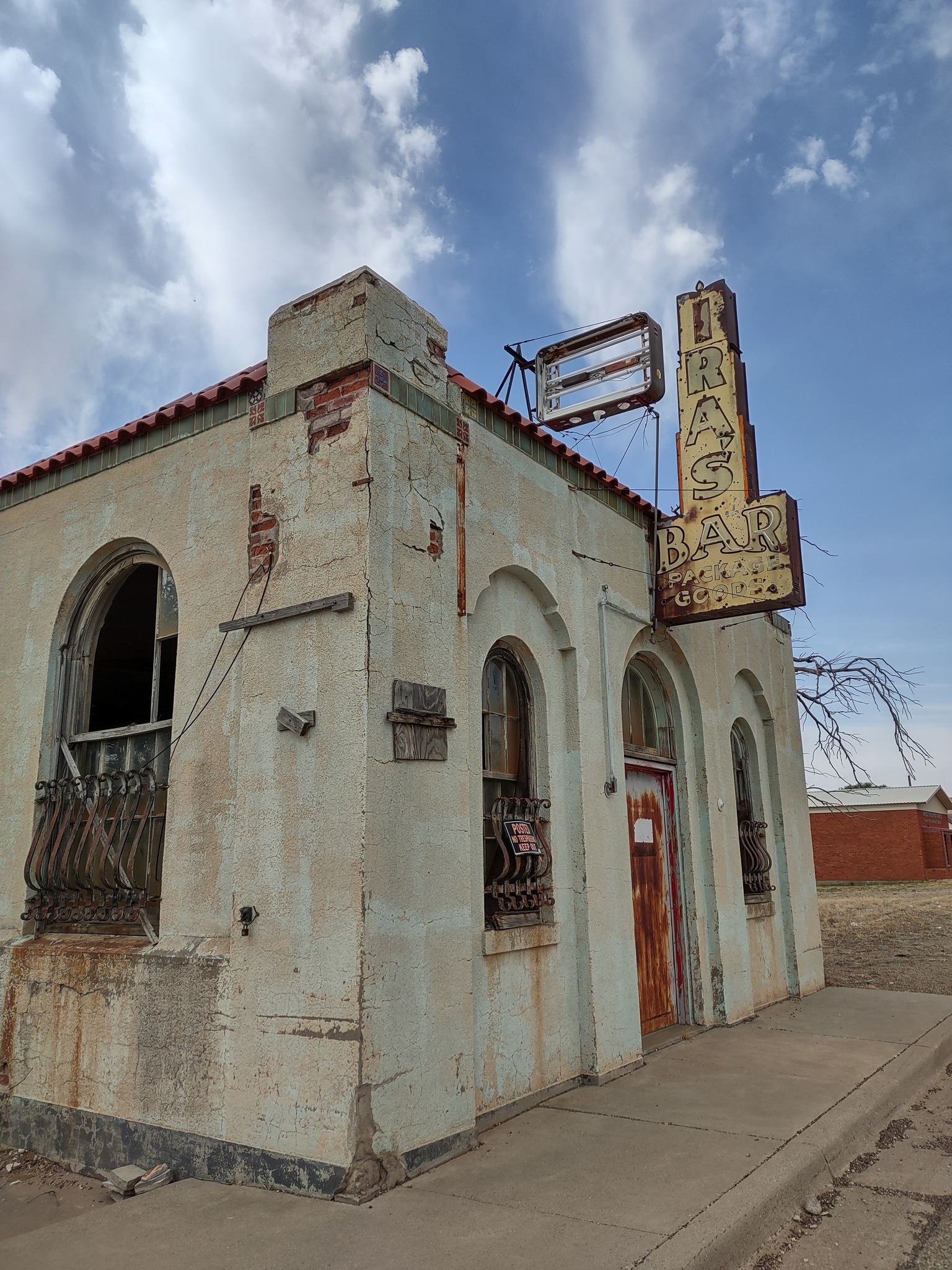
Then, Nara Vista, the last named town before the Texas state line, emptied out by changes long ago, but with some lovely old buildings, albeit abandoned and ruined. Besides the attraction of the ruins, I remembered vividly the drive east in 2020, the plague year, when the Artist and I stopped in an empty parking lot in Nara Vista to walk our Sarah. When I presented the Artist with a plastic cup of “fruit cocktail,” the ubiquitous 1950s accompaniment to cottage cheese, he was delighted to have something other than jerky and granola bars and congratulated my “brilliance.” So Nara Vista, sad though the place would be to the eyes of almost anyone else passing through, holds a happy memory for me, invisible to the rest of the world. I’d been lazily snapping away with my phone camera but got out the real camera for a couple of long shots.


(Formerly) Ira's, #1

Ira's, #2

Ira's, #3


Most of Nara Vista looks like this.


Detail

Across the road


Next, Texas panhandle, Oklahoma panhandle – and I barreled through those two states nonstop, aiming for Liberal, Kansas, another place the Artist and I had stayed many a night, enjoying dinner at the Cattleman’s Café. Gas prices were pleasingly low in Kansas, and I was ready to gas up again.


Photo taken for a Kansan friend transplanted to Arizonan.

That’s when terror struck! My billfold was not in my purse! I’d used it in Santa Rosa but not since. Now what?


Did I drop it at the gas station in Santa Rosa? Found their phone number on the receipt and called. No, no one had turned in any lost items that day. At the rest area on the staked plains? No luck on that possibility, either, when I called the New Mexico State Police. No, no personal items turned in at all so far that day, other than a gun. (Really! Someone lost a gun? Not me!) What to do?  This unexpected challenge was not at all the kind of adventure I’d been looking for on this trip.


Pajarito rest area in eastern New Mexico


The problem was that I’d developed the habit of sliding the billfold into my left front jeans pocket occasionally, rather than putting it in my purse. Easier to grab that way. But the jeans pockets weren’t all that deep, and it could have fallen out – almost anywhere!!! I’d been in and out of the car, photographing (as you've seen) all manner of random, rural sights. 


The most important items in the lost billfold from a practical point of view were my credit card and my driver’s license, but there was also a scrap of paper with the Artist’s last written words on it. Illegible those words had been to me at first, but I’d finally deciphered them and did not want to lose that precious note. 


And yet, I had to be practical -- thus my Tuesday thanks list:


➡️ Thanks to the UPS driver I flagged down there in Liberal, who helped me find the police station. Note: Washington Street in Liberal has two discontinuous stretches, and there is a 325 on both pieces of the street. 


➡️ Thanks to the dispatch officer at the police station, who told me I should cancel my credit card and explain the situation of the lost driver’s license, should I get stopped on the road for any reason, and then file a report from my home back in Michigan upon arrival. 


➡️ Big thanks to the pleasant, very helpful young woman at the visitors center, who did not have any Kansas state maps but printed one out for me from her computer. I knew I wanted an east-west road to a certain town but didn’t remember either the number of the road or the name of the town. U.S. 160 to Winfield. Good!


Two hours were “lost” there in Liberal, but back on the road again I felt pretty calm. With cash from an ATM in Willcox, AZ, on my way out of town, I was confident I could make it to Illinois, where I’d write my sister a check and get more cash for the remainder of the trip. I also had dried mango slices, Kind bars, beef jerky, and rice cakes for that night's dinner, along with foil packets of chicken for Sunny Juliet, plus the last of the rice and green beans from our cooler to mix with her chicken. 


So we spent the night in Winfield, Kansas, in the same friendly motel we had stayed in the year before. No time this trip for the dog park, though. We arrived too late in the evening (after sunset) and left too early in the morning. But my dog girl is a seasoned traveler now. Last year, less than five months old, she wanted to play in the evening when we arrived at a motel, when all the momma wanted to do was crash. This year she seemed to understand and settled right down. 


Sunny settles down.

Day 3 got us to my sister’s in Springfield, Illinois, after a 600-mile drive (maybe my longest driving day ever), and I slept all night, not waking once. Exhausted.


Oh, but on the way through Missouri (determined not to spend a night in that state), I had stopped again for gas in Wheatland, across the road from a little motel where the Artist and I had stayed once with Sarah. Maybe we stayed there once with Peasy, too? Wheatland is the home of the Lucas Oil Speedway (the Artist swore by Lucas products), as well as the Lucas Bull Ranch, and the Sinclair station sells much more than gas. They have seed & feed, baby chicks, nursery plants, groceries (including fresh produce), and of course anything you might need for a car or a truck. There’s a café attached, where the Artist once bought us a fried chicken dinner.


Why, other than general reminiscing, do I mention all this? Because since my New Mexico loss, I was traveling only with cash, remember. And when I went inside to prepay, I told the woman behind the counter that I wasn’t sure how much the tank would take -- I knew it would take twenty, but would it take twenty-five? -- and she said, “Why don’t you just go out and fill up and then come in and pay?” “I can do that?” “Sure.” Stranger in a strange place, and I was not made to prepay! When I went back inside to hand her a $100 bill for my $23+change purchase, I mentioned having lost my billfold back in New Mexico and not realizing it until Kansas, and she commiserated, saying how much trouble it could be to lose credit cards. I shrugged then and told her, “My husband died a year ago, and other problems that come along now --.” She interrupted to say, “I know what you mean. I lost my husband this past October, and everything else is ‘small stuff.’” “You go on, but nothing is the same, is it?” “Certainly is not.” Loss of a credit card made for kind of an “adventure” I would not have chosen, forcing me to rise to an occasion imposed on me and to improvise, but that was peanuts compared to losing the love of my life. A stranger and I had that in common.


How many strangers heard the story of my lost billfold? And yet, I didn’t share it with friends or family before arriving in Springfield. Why worry them needlessly? Once in Springfield, I wrote my sister a check, which she deposited in her bank the next day, handing me cash I knew would be sufficient for the rest of my trip back to northern Michigan. We went to the dog park. Sunny was the only dog there, but we exercised her pretty thoroughly with tennis balls, a Frisbee, and agility stations provided. After that it was on to the doggie wash to rid her of months of desert dust! 


Sister Deborah helping with Sunny Juliet's bath. Easier with two!


-- And now, another unexpected development --


I was relaxing with maps and snacks, not fretting, when a call came on my cell phone. Traverse City. Not a number I recognized. Didn’t pick up. A few minutes later another call from the same number, so I answered. It was my credit union. They’d had a call from the sheriff’s office in Logan, New Mexico! My billfold had been found and turned in! I should call and tell them where to send it. Hallelujah! 


What can I say? Is there a moral to this story? Not panicking, I guess. You just do what needs to be done, what you can do, and hope for the best. Do I wish I’d stayed on expressway and not taken the road less traveled? No way! Credit cards can be replaced. A driver’s license can be replaced. My memories, though, and the familiar scenes that evoke them are irreplaceable. And how many pleasant, friendly, sympathetic, helpful people I met along the way!


Occasionally the Artist called on a phrase to describe this or that person whom he failed to find congenial: “He knows the price of everything and the value of nothing." Maybe that’s the moral of my story, the difference between price and value, between the replaceable and the irreplaceable.  


Random Illinois squirrel, just to break up the wordy stuff.

Officer Slate from Logan told me, when I asked, that whoever found and brought my billfold to the sheriff's office hadn't left their name, so I have no way to write and thank them. "There are still honest people in the world," he commented. Since I couldn't thank the finder, I offered profuse thanks to the woman at my credit union and the policeman in Logan, the people on the phone who made my day.


Another moral? It isn't only bad things that happen unexpectedly. Good things happen, too. An even better happening was a three-sisters get-together, but we all agreed the pictures taken would not be made public. We were not looking our best but were happy to be together.


So expect good things to happen, I say. Because they do. And HUGE thanks to the anonymous stranger who found my billfold and took it to the sheriff's office in Logan, New Mexico -- and to people everywhere who do kind things for strangers every day! You make the world of other people a welcoming place for us all to live.


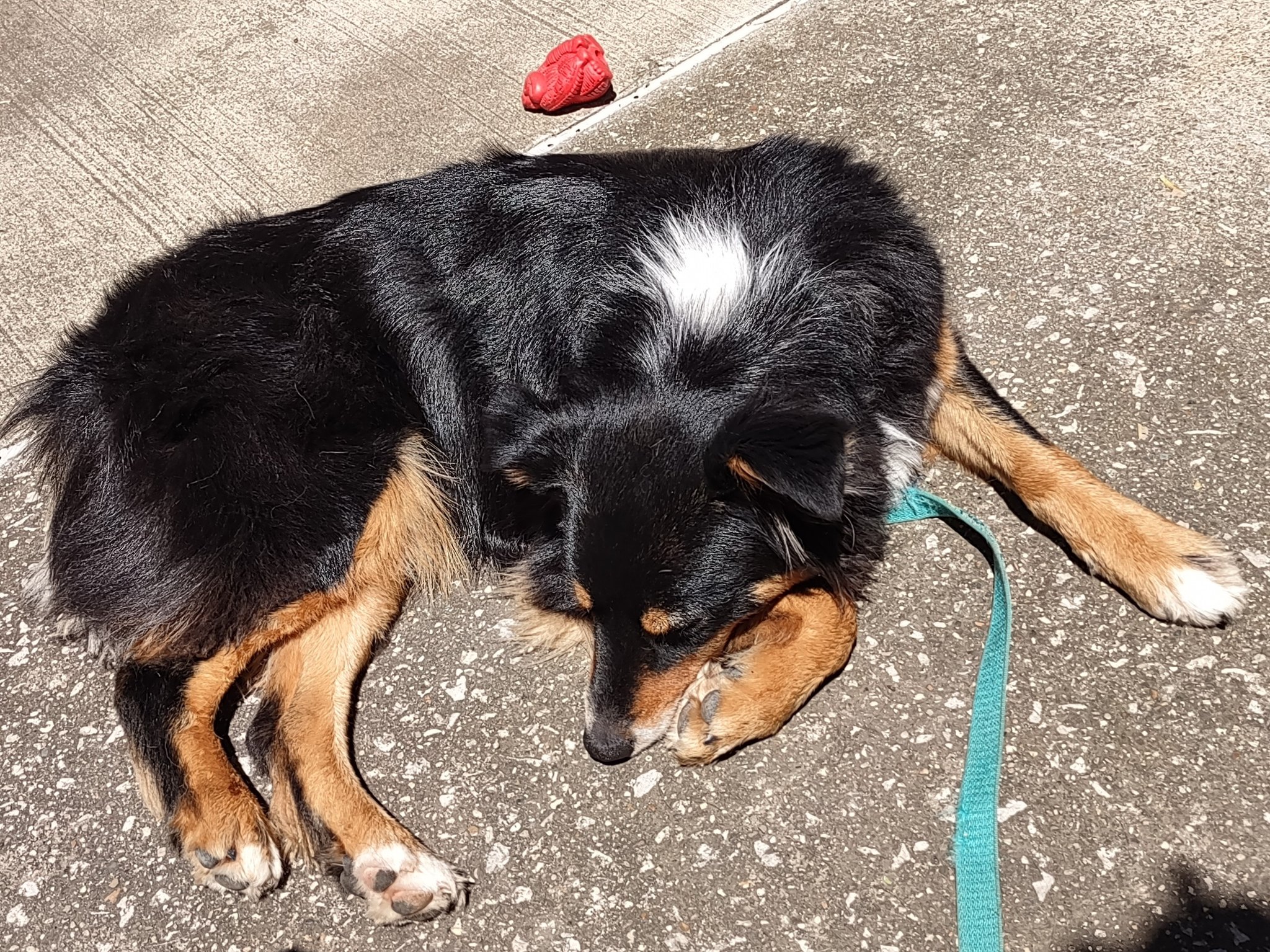
This girl is sometimes naughty, but always pretty, especially after a bath.