Search This Blog

Showing posts with label cattle. Show all posts

Monday, May 11, 2020

Take the Time, While It's Yours to Take

In the early evening, the cows pass by.

Halfway through a nonfiction book that shall here remain unnamed, I set it aside for the fiftieth but perhaps last time. The author was annoying me. He imagines an ideal world if everyone would only live as he is trying to live, but he doesn’t see that the only reason he is able to try to live that way is because only a handful of other people are doing it. Population density, I think with impatience. He ignores it utterly. 

My bookshelves, however, are full to overflowing. Maybe a novel? There is one about Custer, but I have no desire to read about Custer, novel or otherwise, and don’t care if his wife’s family did have a summer cottage in Leelanau County, Michigan (in Omena, to be precise). There must be something else….

Here is a book about wilderness with a promising introduction, in which the book’s author tells in quick outline the story of artist-poet-adventurer Edward Ruess, a well-known story but new and fascinating to me. So I pack The Telling Distance: Conversations with the American Distance, by Bruce Berger, along with sandwiches and apples and cold water on a Sunday drive to the Dragoon Mountains, and in our camp chairs at a site near the mountains that we luckily find unoccupied, I read a page or two to the Artist. 

But later, back at the cabin, I get into the book’s main text, and the first section is about one wilderness expedition after another made with large groups of friends involving complicated strategies about how many cars to take, where to leave them, how to choose each night’s campsite and each person’s tiny plot within the site -- and I grow impatient. The introduction was all about one man who went out to meet the wilderness alone. I feel like a bait-and-switch victim and set this book aside, also.

But Fate has blessed me, because in the packet of mail sent on to us from Northport by a good friend, there was within that large envelope another large envelope, and it contained – oh, joy! Bound galleys! The first volume of the Copper Canyon Press “Legacy Project” of Jim Harrison’s poetry, Collected Ghazals. 


Images, not argument. Experience, but also fantasies and daydreams. No chronological or logical arrangement. Couplets, most often six to a page, sometimes related but more often not. 

Surreal jump cuts. This. Then that. Now something else. Each couplet presenting an image complete and perfect in itself --

A pure plump dove sits on the wire as if two wings emerged 
from a russet pear, head tucked into the sleeping fruit.

But to slice a couplet from its ghazal home, separating it from couplets before and after, is to render it false, because directly following the dove pear of peace we are slapped with --

Your new romance is full of nails hidden from the saw’s teeth 
a board under which a coral snake waits for a child’s hand

It takes my breath away. No act of violence, but the readiness of it, the inevitability of blood and death. Nor is that, however, where the poem ends on that particular page – but I leave that for you to discover. 

Here are words on paper that carry me aloft on wings, float me on water’s surface like air sacs, and drag me through knife-edged grass and mud. Here are lines that toss and slap and lull and discard but never make me feel manipulated. The poet is not trying to be other than who and what he is, and he doesn’t care what I think of what he has to say. Each page is a dose of strong medicine. Swallow it down or spit it out – it’s all the same to the poet. And I am right there with him in city, on the farm, in the wilderness. This. Then that. Now something else. Here. There. 

When I lay this book aside – temporarily -- it is not with impatience or disappointment or boredom but only with a glutton’s desire not to have “more” be too soon consumed, even as I know (oh, joyful thought!) that I can feast again and again without the pantry ever being any less full. Glutton, miser, spendthrift, sybarite – with this precious slim volume, I can be all at once, every time I take it in hand. 

Then they go on their way.

Now I conduct an experiment: pick up again the Berger and open to an entirely new section, almost 200 pages in, and see how it reads after Harrison’s ghazals. My mind takes two sentences and pulls them from the page, making of them a couple of two long lines:

Is this the record of two animals that passed at separate times, sharing the canyon’s life blood? 
Or is this evidence of mortal chase, a frozen moment before deer’s narrow survival or lion’s successful kill? 
[from the essay “Cold Pastoral," lines rearranged]

And instead of hurrying on to the bottom of the page, I read these lines over and over and take in the entire scene they evoke, until it is spread out before me and surrounding me, all at once.

Some essay collections make a continuous argument from first to last and need to be read in order, as one reads a novel or a philosophical or historical treatise, but I don’t think The Telling Distance is that kind of collection. I’m not going to read it that way, anyway.  “Make every sentence count” is a piece of advice often given to aspiring writers. How long did any written sentence take to form in a writer’s mind before it was committed to a page -- and then, not deleted or erased or written over, but maybe it was -- or maybe it came back in some new form or was replaced by something entirely different. This sentence, these lines, as deserving of careful contemplation as the sleepy, lethargic bees that spent the night in the white bowl of a prickly poppy flower.

When have we ever had as much discretionary time at our disposal as in these days in the time of coronavirus? At last, there is time to pay attention to the world. To the nuances of a loved one’s face, to the unfolding of green leaves and the opening of flowers, to the habits of birds that were always there, perhaps unnoticed, to the way a line of poetry or prose unfurls and then the one after it does the same so very differently.

And if you've read this entire post, thank you for spending the time with me. I appreciate company here in life's slow lane, still out in the Arizona ghost town, far from my northern Michigan bookstore. Although, truth be told, northern Michigan has plenty of slow lanes, and I have always sought them out.

We hope they will visit again soon.

Thursday, May 7, 2020

Sheltering Far From Home

No, we are not open!
The only home we own is an old farmhouse in Leelanau County, Michigan. The Artist and I are 83 and 72 and still self-employed in side-by-side seasonal businesses in Northport, my bookstore and his studio/gallery. We came out to the Southwest in December, for a few months of “seasonal retirement” in a rented ghost town cabin, expecting to return home in the spring. Now spring is here, but for the present we are sheltering in place in Cochise County, Arizona, far from our Up North home. 

Family members and some friends urge us to stay where we are, understanding that we feel safe here and dread travel and that there is no real urgency calling for our immediate return. Other friends (a mix of the encouraging and the impatient) tell us that travel is no big deal and we should get right on the road and come home now. They say that -- although still others back home write letters to the editor of the county newspaper saying that “summer people” should not come north! 

Are “snowbirds” and “summer people” one and the same? I don’t think so. We are not “summer people”! But does the virus care? I doubt it. The way I’m pretty sure the virus sees it, travel is travel.

When we peruse the road atlas and read advice about where to find food and restrooms and overnight accommodations, we look up at each other nervously and ask, “What do you think?” Our car is old, our dog is old, and we are old. The decision to stay or go – that is, when to go – seems overwhelming.

Cochise County morning
Setting that troublesome question aside, our life here is peaceful. Yes, the days have heated up, but it is the famous “dry heat” we’ve heard about forever, and in the shade, with a gentle mountain breeze stirring the air, the hottest days are quite tolerable. At night, the high desert cools down quickly, and we welcome the onset of cool darkness. 

Never birders before, we have taken to putting out water and feeders and watching the passing parade at all hours of the day. On a regular basis we see finches and sparrows, cardinal and pyrrhuloxia, hummingbirds and ladderback woodpecker, the curved-bill thrasher, canyon towhee, and cactus wren. It’s big excitement when Mr. and Mrs. Quail come to visit or when Pete the Roadrunner hurries through the yard, as if late for some important engagement.

Gambel's quail

roadrunner

The Artist paints. I write. We both read. Now and then we must screw up our courage, don our masks, and make a run to the grocery store, hardware store, or (yikes!) laundromat. Otherwise, every day is pretty much the same, one “month of Sundays” now having segued into another. 

Back home in Michigan, it is the time of wildflowers in the woods, the lovely spring ephemerals. We are missing the gone-wild daffodils planted long ago by someone who lived in our old house way back when. Soon the grass will be ready to mow, and front porch season will be underway. I think of that porch with longing.

Porch shadows, Michigan

At the same time, we are enjoying more desert greenery than we have ever been here to see before, and a short evening drive only a few miles down the road gives us the opportunity to watch colors in the sky – the sky stretching above the grasslands, pressing against the mountains -- change gradually, imperceptibly, seamlessly from blue through all the warm colors of sunset and beyond, to star-pierced black of night. Next morning, we are wakened by a neighbor’s rooster and the lowing of cattle as close as our windows. Yes, there is a cow with a couple of little calves, right by our gate! I cannot express what joy and contentment the cattle bring, especially now, against the current social background of anxiety and existential dread.

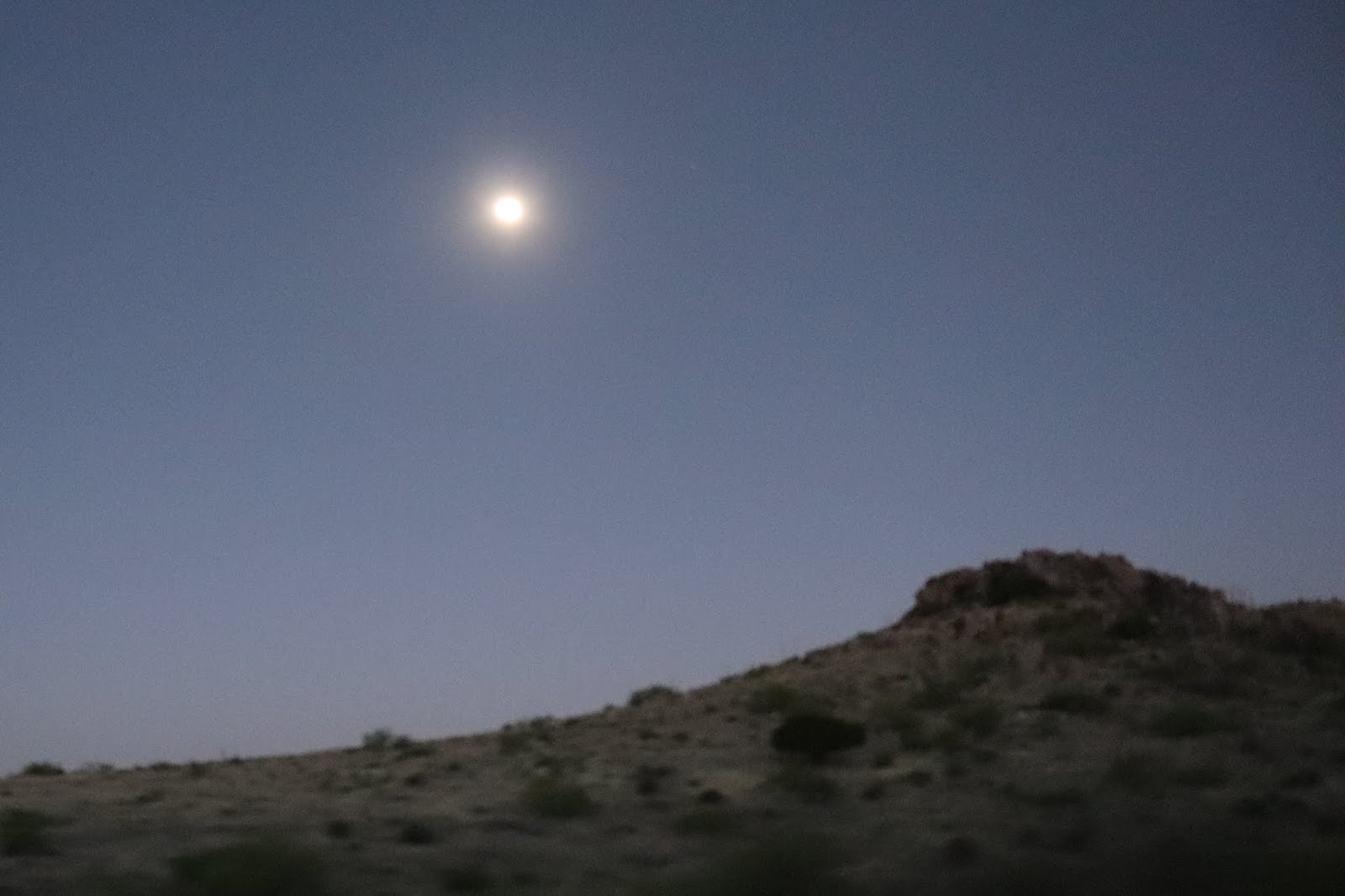
We have been here another moon already
If we left the ghost town today and were home by the end of the week, we would face a 14-day quarantine, but I doubt I would feel comfortable opening my bookstore to the public after those 14 days – or that many of the public will be strolling up and down the streets of our little northern village and in and out of shops. I miss my bookstore and am anxious for its future. I don’t see myself going in the direction of online sales. It isn’t me. Then what? Right now, I have no clue. 

Here and now, anyway, far from home and bookshop, I can still read and write and share books with readers of my blog.  Because connecting readers to books and authors has always been the core of my mission as a bookseller, posting book reviews is my #1 mission at present. It’s something I can do that feels worth doing.

And so, day after day, we postpone our travel decision. The default is doing nothing, staying put. Deciding not to decide brings us relief from anxiety, temporary though that relief must be.


5/7/2020
Dos Cabezas, AZ


Saturday, March 28, 2020

Can This Be Real?

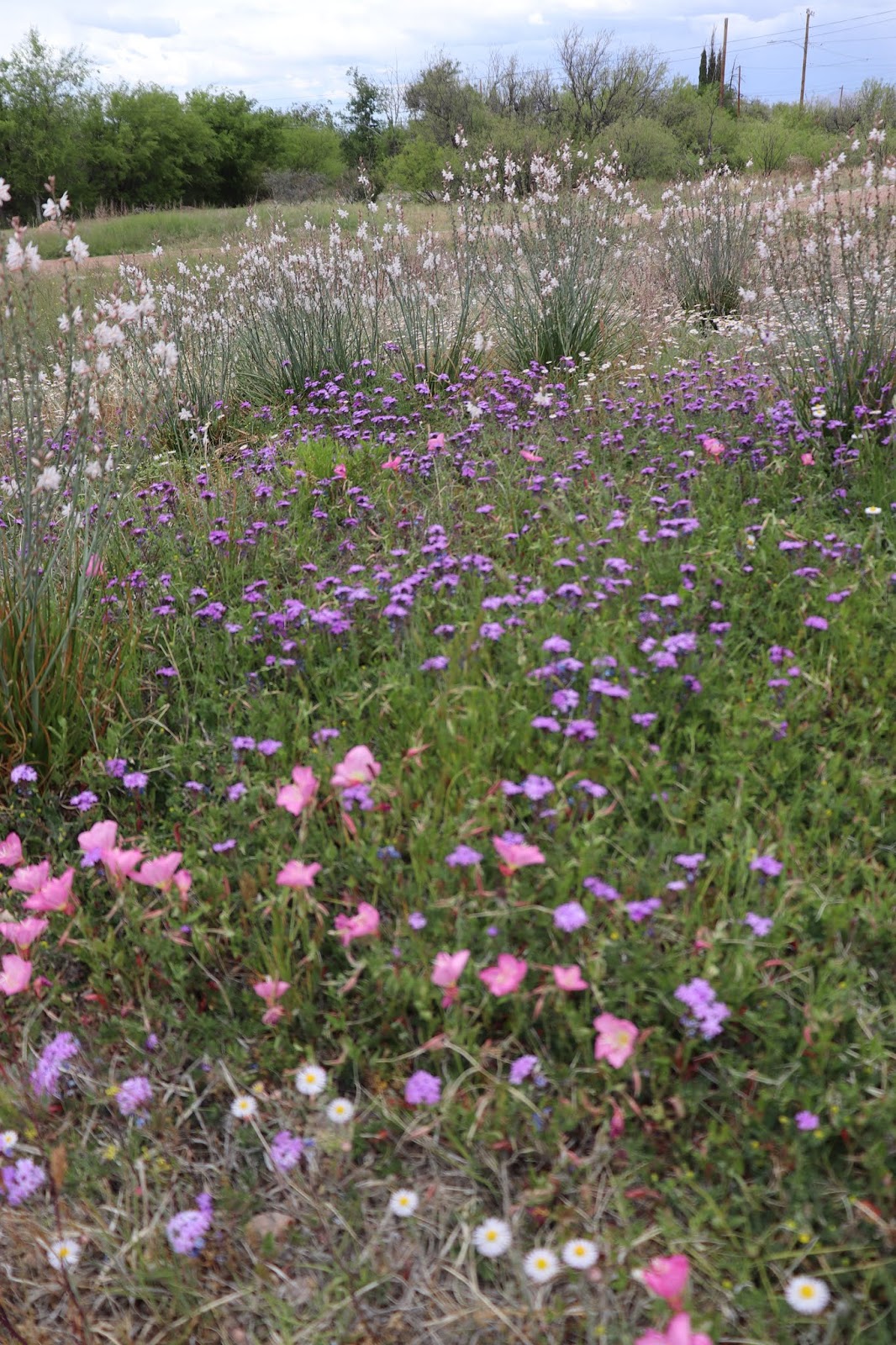
Spring comes to southeast Arizona
I had a sudden insight upon awakening this morning, because, you see, we went for a drive yesterday, our first pleasure trip since we started hunkering down. Sky, clouds, grasses, cattle, wildflowers, mountains! They are all still there! In fifty miles we encountered only a single other vehicle, when the Artist had stopped so I could jump out with my camera, and the driver of a pickup truck loaded with hay bales stopped to see if we needed help. 


“Everything okay?” “Yes,” I told him, “it’s just so beautiful!” 

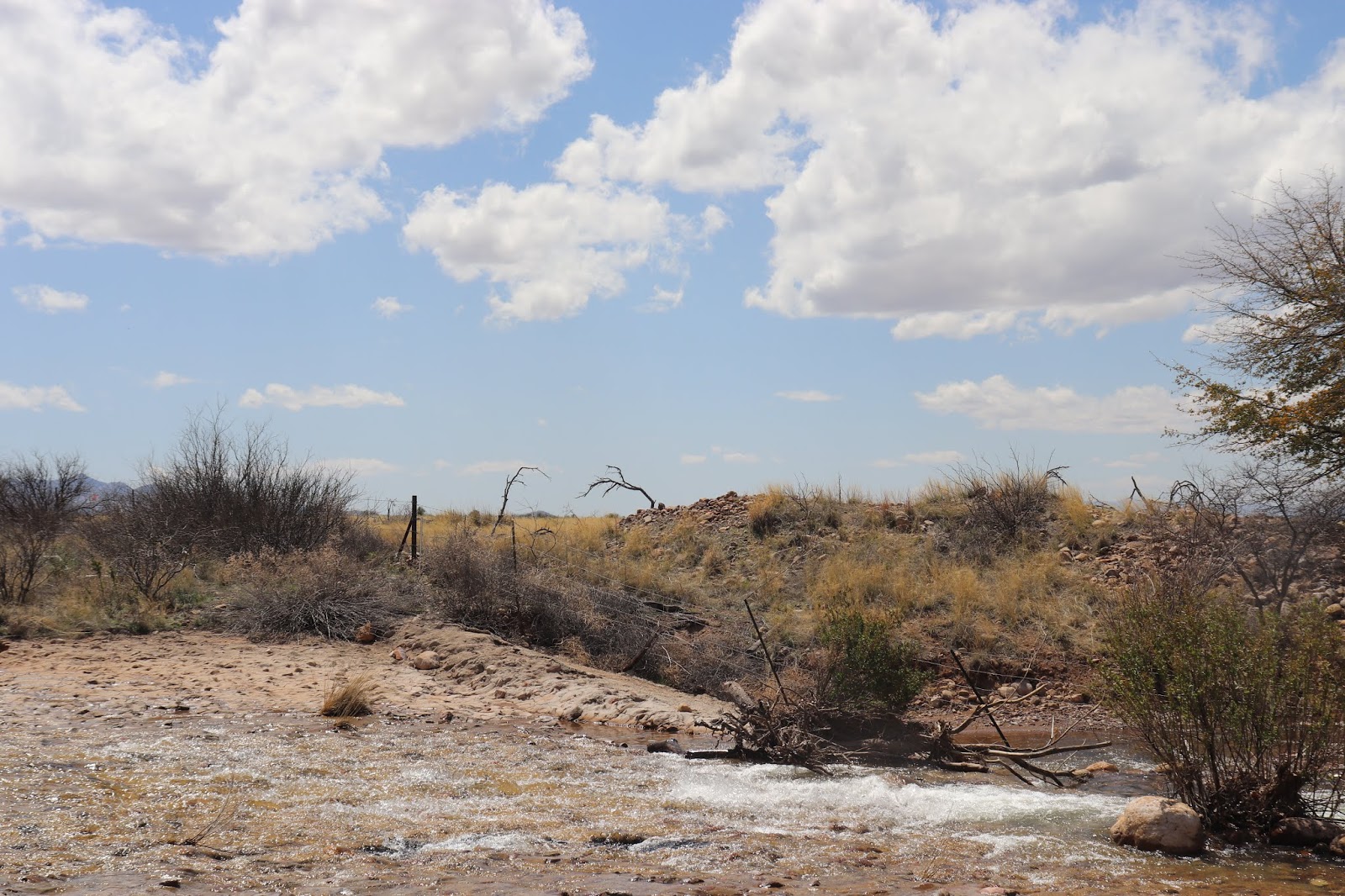
We went on, past the road to the Chiricahua National Monument, continuing south. Prickly poppies all along the road will be blooming by next week. We always appreciate places where water flows across the road. The day was golden, and we stopped again and again.

Turkey Creek


I walked a while along Turkey Creek Road, in  surroundings so heartbreakingly lovely I was holding back tears when I returned to the car and could not speak for several minutes. Finally I said softly, “It doesn’t seem possible, does it?” And the Artist answered, also in a low, reverent tone, without losing a beat, “No, it really doesn’t.”

These days we all, especially people our age, consider the possibility of dying. Even without coronavirus, the future grows shorter the longer we live. 

“We might never have seen this,” I begin haltingly.

“What do you mean?”

“Well, for instance, it’s unlikely I’ll ever see Ireland.” 

My mother and father made that trip before they died, and both my sisters have visited the land of our maternal grandfather. One of my old boyfriends, who lives in Ireland with his wife, invited us to visit! But travel by plane to a foreign country may not be on our agenda any longer. 

“Why not?”

“Well, we can’t drive there, and if we were there we couldn’t rent a car.” 

Friends told of the cut-off age for car rentals, and the Artist had been appalled. 

“But,” I go on, getting to my real point, “we’re here. We’ve seen this. I’ve seen this.” 

We continued along the way, leaving private land for national forest, climbing into an entirely different life zone and following the beautiful creek that rushed along beside and below us, loving every inch of our road.


The Coronado National Forest isn’t the Grand Canyon, and I don’t mind a bit. It’s enough for me. More than enough. The various pieces of the Forest in the Chiricahua, Dragoon, and Pinaleño Mountains fill my heart with joy, lift it with silent song. I can hardly believe I have been so fortunate as to be here, sometimes can hardly believe this land exists at all.

So my insight was about Americans who still think the coronavirus danger is a “hoax,” “fake news,” even while their Great Leader has changed his tune and admitted it’s real and is acting to mitigate the danger in various ways. It’s so peaceful here, so normal, and we don’t know anyone who has the virus. It doesn’t seem real at all from here. 

And yet the virus is real. The danger is real. But unbelievable beauty is real, too. Love is real. The danger of the virus, the beauty of the mountains and high desert, the gifts of love — at times all these realities seem equally hard for the human mind to encompass. This world of ours is amazingly complex, and both what we love and what we fear can be overwhelming at times.

So I do all I can to protect myself and others from the virus and take every opportunity to drink in and feel gratitude for beauty and love, and I hope you are doing the same. Today is the day we have. We're here now.

Spring comes even in dark times.


Thursday, January 30, 2020

Turkey Creek Deep

Where are we? Where are we going?
TURKEY CREEK
El.: c. 5000’ 
From 1880 to 1884 a man named Morse had a sawmill on turkey Creek where he prepared lumber for use in the Copper Queen Mine at Bisbee. The timbers measured one foot in diameter, and Turkey Creek was the only place where timbers of such size could be found. Morse is said to have named Turkey Creek for the wild turkeys found along it.  
- Will C. Barnes, Arizona Place Names, revised and enlarged by Byrd H. Granger

When I look at a map of the state of Arizona, the more so a map of the entire United States — all of North America, a map of the entire world — I realize how small is the majestic expanse of Cochise County that I call my winter home. Though two valleys, the Sulphur Springs Valley and the San Pedro, stretch through it from north to south, and along the easternmost side of the former lie the Dos Cabezas, Chiricahua, and Peloncillo mountain ranges, most Americans have never heard of the Chiricahua Mountains and never visited the Chiricahua National Monument. Those who make the visit usually drive down from I-10, venture up Massai Point, and then leave. It’s understandable. Ours is a big country, and even a vacation of several months is insufficient to cover the West.


Just as there are two schools of thought about life experience in general, so there are two schools of travel thought. Basically, the question is whether to go deep or wide. Whether to sample as many experiences as possible, though it means each sample will be, of necessity, strictly limited — or to stay with one mate, in one line of work, through thick and thin, to settle down in one place (or a few chosen places), to sink roots, to go ever deeper. I propound no single, universal decision here for all human beings. The decision can only be made by each individual.

Long before I made my first trip to France, though, I knew what I wanted from being there. I wanted to live, in Paris, for the four weeks I had. That meant I would not see the chateaux along the Loire (I still have not and perhaps never will) or the Normandy coast or the glitz of the French Riviera. When it came right down to it, I did not even see Chartres Cathedral that year, reasoning on rainy days that it would be a shame to visit Chartres without sun coming through the famous stained glass windows — and, on sunny days, feeling it would be a shame to give up a single sunlit day in Paris! When the sun was shining, I could make a cup of espresso on the sidewalk last two hours, and when the weather was cold and wet I could milk a single museum entrance fee for an entire day. Shopping? On my income? Please! Being there was all I asked. 

Just so, now, I find a great deal of contentment in my quiet Arizona ghost town, building a personal Southwest home library and making small increases to the comforts of seasonal retirement housekeeping with additions to our simple kitchen — one day a beautiful used stock pot from a thrift shop, another, a fresh jar of mesquite flower honey for the table. Expeditions from the cabin to the greater world outside are not always grand adventures, either. Sometimes only mundane errands. And that’s all right, because we are not on a cruise — we are living here. 

But oh, those glorious adventures! 

A year ago we turned one day onto Turkey Creek Road, but the jarring washboard surface quickly convinced the Artist, who was driving, to turn around. This year our first venture took us as far as the first creek crossing, and that was a thrill. So when the Artist proposed on Wednesday that we should explore farther up the road, he got no argument from me. 

The dry wash behind and alongside our rental cabin only runs with floodwater during summer monsoons, when we are back in Michigan, so the very sight of a small stream of flowing water within the largely dry banks of the San Pedro River is a rare treat. Imagine, then, our delight over a roaring, rushing, tumbling, foaming creek! We could not stop grabbing for our cameras — and yet, I realize that no photograph will convey a fraction of our excitement, just as photographs of Paris from the Seine did nothing to prepare me for standing on a bridge, being there. We had been exclaiming with wonder at the beauty of our surroundings long before we came to a sign alerting us to prepare for a “scenic road” along the next five miles. The sign struck us as very funny, as if the road commission thought we might have been unaware of beauty ahead without the sign. And what of the beauty we had already enjoyed that had not been noted with signage? 


Our wonder did increase as we penetrated farther into the forest, however, I must admit. It didn’t feel as if we were climbing, and yet we must have been gaining elevation, because there were more and taller and different species of trees as we went along, with mountain rocks much closer to our ever-narrowing road. 


Only many miles in did we reach public land of the Coronado National Forest, which, like the Marquette National Forest in Michigan, consists of discontinuous pieces of land in the Pinaleño, Chiricahua, and Dragoon mountain ranges. Beware of bear, and watch out for water and fire debris and rock slides, signs warned. 

What ruins lurk behind this alligator juniper?
Ruins of stone cabin lost in forest fire

There were other cabins in the forest land, obviously still rentable, and yet we saw no signs that anyone was staying in any of them. There were deer here and there, but no other human beings. Well, fine! When the rocky road reached a campground, it seemed incredible that there was not a single tent in sight and no picnickers at the tables, either. We left our car and settled down long enough to eat a simple late lunch and enjoy the creek (at our very feet!) before deciding that the air was already very cold and would quickly grow colder as dappled sunlight retreated up the mountainside. Short winter days are even shorter in the mountains, nothing at all like prairie evenings or the late afternoon light on the eastern shore of Lake Michigan.

Reluctantly leaving Turkey Creek, we sped east to the Mustang Mall and returned to the ghost town by way of the Kansas Settlement Road, looking across the valley to what looked like a big, dark storm over the very mountains where we had spent our afternoon. We arrived home before sunset (as splendid in the east as it was in the west) and were delighted to have visitors before darkness fell. It was another deeply satisfying day in our little corner of the world. We did not drive all that many miles, but most of them were deliciously slow.


Looking west

Looking east

Enjoying evening visitors

Wednesday, May 1, 2019

They came in the gloaming to bid us farewell


It was the hour past sunset, with light leaching away imperceptibly but steadily from land and sky when we, inside the cabin, heard them lowing close by. “They’re in the yard!” we told each other. Their nearness was not unusual, but as it was our last evening we couldn’t help being pleased that they had come as we hurried to step outside for one more close encounter. 

Earlier in the day, on our way back from errands in town, we had stopped for a visit with a small family group of horses grazing by their shrinking seasonal pond — two mares, their spring foals, and the pater familias. Every time our road took us past their spot, we looked for them. Sometimes they were off in the far distance, the little ones lying down in the grass, invisible to our searching gazes, and occasionally we saw them not at all, but on the best days there they were by the pond, tantalizingly close. 

The family that grazes together...
My little darling on the left, but "the other one" is pretty, too.

Some of life’s last times we realize only long afterward. We look forward confidently to another meeting, “the next time we see each other,” only to find, at times, our best-laid plans and confident expectations overthrown. And really, we never do know for sure. We say, “Until we meet again!” ignorant of whether or not that next coming-together will ever take place. 

Gloaming is a sweet time of day, giving yet enough light to justify our calling it day, even as we know night is falling. The word comes from an Old English word meaning to glow. Some definitions give dusk as a synonym, but to my ear dusk emphasizes the coming darkness (as does for me the French word crépuscule), while gloaming speaks of the lingering light. Just so, at parting with friends and places we can choose to emphasize to ourselves the coming separation or hold to the warm glow of friendship and love.

How can I claim to love this part of the country, a Facebook friend asks, when I have known it so briefly? She did not know me as a horse-crazy girl, gazing over the cornfield across the road and dreaming on my parents’ front porch of riding my horse off into the sunset! How could John Denver claim to have been “born in the summer of his 27th year/coming home to a place he’d never been before”? (How, really, does any of us ever decide to marry? The love of forty years is different from and deeper than the excitement of new love, but only the latter makes possible, eventually, the former.) And I have immersed myself in the Southwest while here, exploring it by car, on foot, and through reading its history. 

Arizona has its problems and shortcomings and shameful aspects to its history, as no one would deny. So does Michigan. We do not love places or people for their perfection, since that is nowhere to be found, but for their beauties and despite their imperfections. And does not every human love bear within it a seed of sadness, a heartache that is part and parcel of love, emblematic of our human mortality?

Mountain hidden in snow clouds

Adobe ruins in snow

This has been the third long visit the Artist and I have made to southeast Arizona, and as we came earlier this time than in previous years, arriving in mid-December, we were surprised to find summer’s leaves still clinging to the mesquite. Mid-December was only autumn, not yet winter! Then winter arrived, with heavier and more frequent snows and much colder nights (several times below zero) than usual for this part of the country, and it was a beautiful if challenging season. Now it is spring, and after a bountifully rainy winter and spring, the high desert spring is unusually green this year. 


Tombstone flora
Our three stays taken together, I realized this morning, add up to almost a year, and we have now experienced three seasons out of four. Summer here would be the most difficult season, of course, for Northerners, but here in the ghost town, at an elevation of almost a mile above sea level, I’m sure it is much more bearable than Phoenix! Besides, my ghost town hiking partner tells me, the key to summer is to get up and out early, at “first light,” and that would suit me fine.  That time of morning before sunrise when the sky gradually grows light is my favorite time of day. 


But summer and fall call us back to Michigan. Wildflowers must be blooming already in the woods, the sweet, precious spring ephemerals! Favorite walks will be there again for my morning rambles outdoors with Sarah. Memorial Day weekend will be Cars in the Park in Northport, and late September will bring Leelanau UnCaged! And every morning and night our dear home, every day our dear friends…. Another place, another love.

Back now, though, to the cattle, right here. As the high desert grows greener, it is becoming more difficult with each passing day to keep track of cows in the mesquite, but one can follow their voices, and we do that until we catch a glimpse of one, then two, then another pair, and down by the highway a delightful, very little scampering calf! I will miss them, their voices and their smells and their rich, beautiful colors.


I remember her face from last year.
Northern cardinal -- see you in Michigan!
So bless the cows and horses, the birds and deer! Bless our human ghost town neighbors, too, who have made us feel so welcome! We plan a return next winter. At hand now, however, is our return to northern woods and shores, to our old farmhouse set amid cherry orchards, and our places of work in a harbor village, a scant 607 feet above sea level. And so for now we bid farewell to mountains and mesquite, dry washes and agave, mule deer and pyrrhuloxia and cactus wren and canyon towhee and wish all in southern Arizona a happy and healthy summer and fall. And we thank the cattle for coming to bid us farewell on our last evening of this particular long visit.

Yes, it is very possible to love more than one world, and the love for one does not diminish or denigrate love for the other. As Jane Austen had one of her characters in Northanger Abbey observe, “It is well to have as many holds on happiness as possible” -- and I have been very happy here.