Search This Blog

Showing posts with label imagination. Show all posts

Wednesday, September 13, 2023

Of Two Minds

Clouds and chill do not dampen a dog's view of the world.

The grass is bright green, almost an unnatural-appearing green, so lush after recent heavy rain, but trees in the orchard, prematurely (from my perspective) shedding their leaves, had an almost wintry look recently against lowering grey skies. Not quite a contradiction, it was a scene to illustrate lack of demarcation between what we humans think of as one season and another – in this case, summer and fall. Seasons, like human emotions and states of mind, blend and interpenetrate more than they conform to any kind of calendar.


Which leads me – or, at least, I want to use it to try to lead you to think about fact and imagination, reasons and dreams, and the different ways our brains go at the work of knowing ourselves and the world. For Henri Bergson, my "main man" in philosophy (as the Artist liked to refer to him), two different ways of knowing came out as intellect/intuition. Gaston Bachelard's distinction was reason/imagination. It was psychobiologist Roger Sperry at Cal Tech whose experiments in the 1960s led to the idea that the two hemispheres of the brain specialized in different tasks, the left devoted to language, the naming of objects, and the right to visual construction of what we receive as “the world.” 


The left brain/right brain idea was grabbed up in simplistic dress by the general public, only to be rejected by science as myth and now resurrected in more nuanced form. There is more than one book on this fascinating subject, but the one I’ve been reading is The Master and His Emissary: The Divided Brain and the Making of the Western World, by Iain McGilchrist.


Reading is a good activity on a chilly day.

McGilchrist’s is as far as possible from a simplistic view. He stresses, for example, that mathematics (and by that we don’t mean simple bookkeeping) is creative as well as logical and that the “indirect, connotative language of poetry,” dependent on the brain’s right hemisphere, 


...underlies all forms of understanding whatsoever, science and philosophy no less than poetry and art.


-      McGilchrist (p. 71)


It is the working together of the two hemispheres, he underlines, that allows us to put a world together at all. 


The sun returned!

Most brain scientists these days would have no quarrel with McGilchrist thus far. Where some dig in their heels and think he goes off the deep end is with his thesis that Western culture (going back to the 5th century BCE and Socrates/Plato) has lost left/right balance (except for a few brief periods) and become overly dependent on – and dominated by – the left hemisphere’s narrowly focused rationality, its impatience and inability to deal with ambiguity and to make “big picture” connections. Although both parts of the brain deal both with units and with aggregates, he writes, the right hemisphere sees individuals and unique instances in holistic, always changing context, while the left categorizes and therefore can deal only with generic objects, types, and a fixed, static world.


Doggie nose prints on the inside of the windshield I just cleaned!

McGilchrist asked himself a question previous brain scientists seem not to have asked: why would mammalian brains, even brains of birds, divide their work in the first place? His answer is that life demands of us two different kinds of attention: first, a broad, flexible, sustained vigilance to everything around us; second, a focused attention on a task at hand (e.g., capturing prey). A machine model of animal behavior is a left-brain re-presentation. All left-brain re-presentations are based on what is already known. They are good at routine. They run as if on computer programs. They are, however, bad at revising in the face of the unexpected: what doesn’t fit is rejected. If McGilchrist hadn’t wanted to make as much reference as he does to Nietzsche, he might have called his book The Sorcerer and the Apprentice. (Don't miss Mickey Mouse in that link!)


The Master and His Emissary takes its title from Nietzsche, however, McGilchrist identifying the left brain as the “emissary” that has taken over the role of the “master” right brain, and it is a dense read at almost 600 pages, 54 of them notes and a hefty 67 pages of bibliography. The index, I must say, is disappointing and could have included much more than it does. This book is fascinating reading, though, for anyone interested in how we humans perceive and think.


That’s my nonfiction reading for sunlight hours. In the dark of the morning or evening dusk, I turn to the philosopher Gaston Bachelard’s Poetics of Reverie and am amazed and delighted again and again. In fact, even my use of different times of day for these two books conforms to Bachelard’s idea that even words can have different psychic “weight” 

…depending on whether they belong to the language of reverie or the language of daylight life (la vie claire) – to rested language or language under surveillance – to the language of poetry or to the language hammered out by authoritarian prosodies.

I don’t think I am stretching a point at all to seeing Bachelard in this passage agreeing with McGilchrist as to how the different brain hemispheres construct a world. And when he, Bachelard, uses Jung’s animus and anima language, again McGilchrist’s brain hemisphere distinctions, rather than any gendered differences, make sense of the distinction. Projects and worries, Bachelard says, belong to the animus, while “tranquil images” from the anima … “meld together in an intimate warmth.” And thus there are also two different kinds of reading, one in animus, the other in anima.


…I am not the same man when I am reading a book of ideas where the animus is obliged to be vigilant, quite ready to criticize, quite ready to retort, as when I am reading a poet’s book where images must be received in a sort of transcendental acceptance of gifts. Ah! to return the absolute gift which is a poet’s image, our anima would have to be able to write a hymn of thanksgiving. 


The animus reads little; the anima reads a great deal.


Sometimes my animus scolds me for having read too much. 


Reading, ever reading, the sweet passion of the anima. But when, after having read everything, one sets before himself the task of making a book out of reveries, it is the animus which is in the harness. Writing a book is always a hard job. One is always tempted to limiting himself to dreaming it. 


-      Gaston Bachelard, The Poetics of Reverie


And yet, I think to myself now, reflecting on these two books, on the work of the different hemispheres of the brain (my brain!), and on the expressions and statements of these two writers, I seem to sense the right and left brains, the anima and animus, in dialogue. Or is that the right brain, synthesizing facts handed to it by the left? At any rate, as I read, I take notes (left brain) and smile happily (right brain).


View without doggie nose prints --

And view without the road --
--

Today’s images have nothing to do with today’s text and are only included for relief from what might otherwise seem like overthinking. 

Saturday, October 29, 2022

Characters Not Like Me

Copy of my mother's well-loved book


It’s wonderful that more and more books are being written by American authors across a wide range of racial and ethnic, ability and gender identities, books in which children who don’t fit the 1950s “Dick and Jane and Sally” mode can recognize themselves, maybe for the first time. I also hope, however, that children who do fit the “Dick and Jane and Sally” mode will explore and enjoy books with characters who come from backgrounds different from their own, because that’s what made the world richer and more complex for me when I was growing up.


My mother loved Anne of Green Gables. Anne was an orphan; I was not. Anne was Canadian; I was not. Anne's lifetime came well before mine in history. Anne was red-haired, outgoing, and had an impulsive temper, whereas I was a quiet, brown-haired, painfully shy child, but reading a book that featured a main character so different from myself gave me insights into what it might be like to be a another kind of person, someone whose responses to situations were very unlike my own. 


The book Janitor’s Girl, by Frieda Friedman, introduced me to urban apartment living and a family of immigrants in New York City, a neighborhood and characters and living situation nothing like my own suburban life. Again, I lived that urban immigrant life vicariously while reading the book. How dull my childhood would have been if I had read only books with characters whose lives were like mine!


The Black Stallion, by Walter Farley, was a favorite book of mine for many years, and there weren’t any girls in it at all. (Funny that girls will read books with a boy as the main character, but boys shy away from books in which the main character is a girl.) A boy and a horse, shipwrecked on an uninhabited island? How would they survive? In my imagination, I lived that story over and over as if it were my own life.


I was 12 years old, about Anne’s age, when I read the much more serious The Diary of Anne Frank, and the effect on my heart and mind was profound. A Jewish girl, forced into hiding with her family, their circumstances horribly and unimaginably constrained during the Nazi Occupation of Holland. But there – reading it, I did imagine and was horrified and wanted so much for that little girl to survive and be my friend! These days some people don’t want young people Anne’s age to read her story, and that breaks my heart all over again for her. She wanted to be a writer. She was a writer, young as she was, and although she died, she left her diary for us, the story of a real girl with hopes and dreams and feelings and ambitions. Everyone should read her diary!


Mildred Taylor is not all that much older than I am, so she had not yet written her books when I was a schoolgirl, but discovering them in adulthood has opened new worlds to me. The first Taylor novel I read was The Land – again, a book I wish every American would read. Click here for a review that will give you reasons. 


My mother loved the novels of Gene Stratton-Porter, but only in recent years did I finally read Freckles, astonished to learn that the main character had only one arm! Yet the author hardly dwelled on what the young man lacked: the emphasis was on what he had and could do. Although this author was as popular in her day as J. K. Rowling is in ours, her stories are very different from today’s popular literature for young people. They are unabashedly “wholesome” and sentimental. Still, the freedom and beauty of the natural outdoor settings remains.


My friend the author Ellen Airgood has written two books for young people, Prairie Evers and The Education of Ivy Blake. Ivy appears as Prairie’s friend in the first book and takes center stage in the second. Ivy’s mother probably should never have had a child, but we don’t choose our parents, and it is Airgood’s gift to show us Ivy finding her way without ever sugar-coating or sentimentalizing her discoveries or stooping to unbelievable miracles. 


Well-written stories of difficult lives and challenging life situations help stretch our imaginations and expand our circle of empathy. They let us travel outside and beyond the limits of our own skins. This is a good thing! 


Today – Saturday, October 29th -- is the last day of my Dog Ears Books 2022 season, but I will keep in touch via this blog throughout my winter seasonal retirement, and my bookstore will re-open in the spring of 2023 for its 30th anniversary year! Can you believe it? It’s amazing to me.


Were there books you read as a young person that opened your eyes to lives very different from your own? What were they? What are you reading now, and what do you look forward to reading over the winter? 


Last day of 2022 season is today!


Thursday, December 9, 2021

Yes, We Have No Saguaro


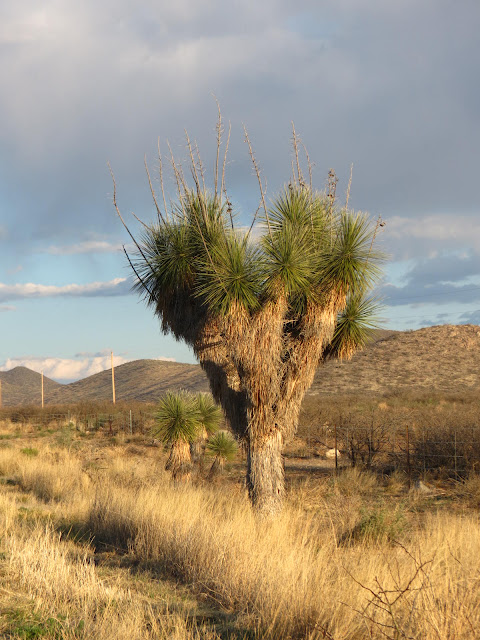
Soaptree yucca

My title today may give a chuckle to the few who remember the old song about bananas. I did not see the original cartoon when it came out in 1930 (not that long in the tooth!), but it replayed on 1950s television and was still amusing then. All of which has nothing to do with plants of the high desert, my topic of the day -- .

Prickly pear

cholla 


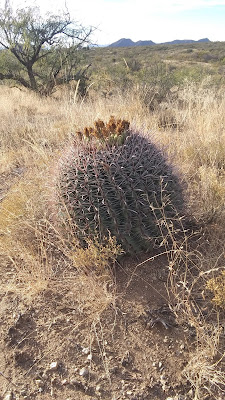
A friend back in northern Michigan asked about plants here in the high desert, speculating that we “don’t have cactus” here. Well, we have a lot of cholla (though not the full range of varieties), and there is prickly pear, too, more often on higher slopes than down on the range, and also here and there a squat barrel cactus, though these last are not as plentiful here as they are in the low desert. Along our Cochise County roadsides, soaptree yucca is ubiquitous, and down the road apiece from our ghost town are rocky foothills stuck all over like giant pincushions with sotol and century plant (the latter a kind of agave), as well as the striking ocotillo (more common around Benson and Bisbee than here in Dos Cabezas). During our first winter here, it took me a while to sort out yucca, agave, and sotol. But yes, we have no saguaro. That, along with "teddy bear" cholla, grows down in the lower elevation of Tucson, 100 miles away.


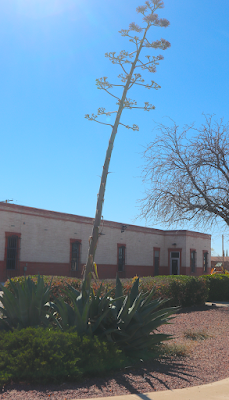
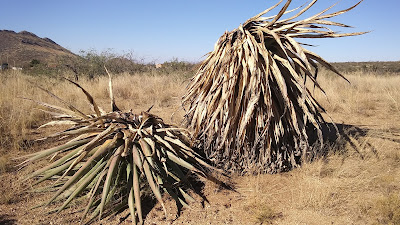
The life cycle of the century plant is interesting, though. It doesn’t really take 100 years to come into bloom (for the one and only time in its life), but it is a long wait. Meanwhile, however, the plant grows larger and larger, making a nice focal point for desert landscaping. 


When it reaches maturity, it sends up an immense, asparagus-like stalk (this plant and asparagus are in the same family), and after flowering the plant dies. 


Where did the stalks go?


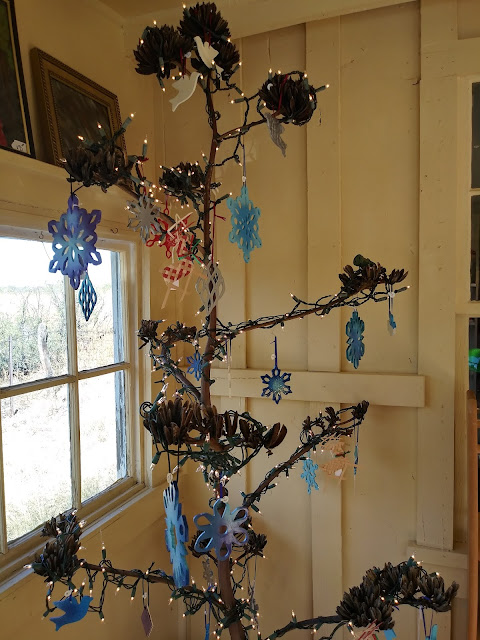
But that is not the end. From the plant's seeds will come a new generation, while the impressive, sculptural dry stalk is favored by desert dwellers for a Christmas “tree.”


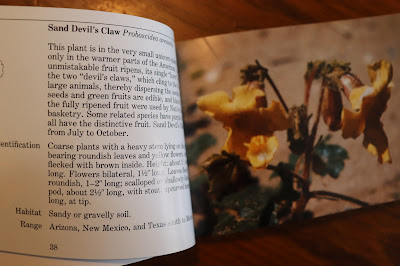
Also, along with cactus and other plants with spines, are many thorny deciduous plants, primarily (around Dos Cabezas) but not limited to the mesquites. One that looks a lot like a mesquite is in the same family (leguminacae, though some botanists break the family down further into subfamilies) but is a different genus. Mesquite genus is Prosopis, catclaw is Acacia. Even that can be confusing, however, as catclaw acacia or Gregg’s acacia, formerly Acacia greggii, now classified as Senegalia greggii, sometimes goes by the common name devilsclaw, but more often “devil’s claw” refers to a different plant altogether, Proboscidea arenaria, from (I kid you not) the unicorn-plant family! 


Chain of devil's claw (unicorn-plant family) pods

book showing flowers of that devil's claw


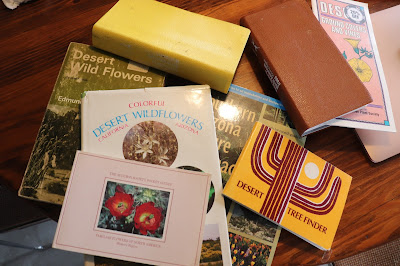
And this, as my friend Ellen would remind you, is why the Latin names of plants are so crucial to identification: What your grandmother in Ohio knew and taught you as “devil’s paintbrush” is not the “devil’s paintbrush” of the American Southwest. What I’ll remind you is that this is a reason for not relying on one plant guide but having access to several.


some of my printed resources

Back to those thorny shrubs --


mesquite leaves

catclaw acacia leaves


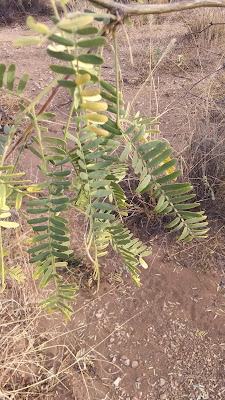
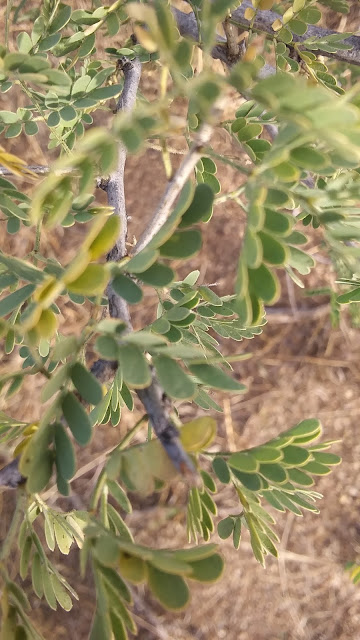
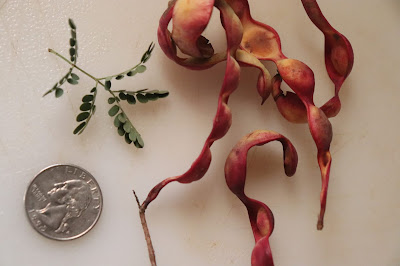
And back to identifying catclaw acacia. Its bipinnately compound leaves are much smaller than the leaves of mesquite, and its thorns are curved like a cat’s claws. Hence the name. Once you note the difference between the two shrubs, it’s obvious, even when they are growing all tangled up in each other, as they sometimes do. I found some catclaw pods the other day, too. They curve and twist, and while The Audubon Society Field Guide to North American Plants, Western Region, authored by Elbert L. Little, calls them brown, the ones I gathered the other day are more reddish to my eye.


catclaw pods


Mr. Little is no fan of catclaw; nor are many hikers or others: “one of the most despised southwestern shrubs,” the Little-authored Audubon guide says of it. And yet, besides the region’s delicious catclaw honey and the plant’s useful hardwood (for fuel and tool-making), catclaw beans are a native food, ground when dry to make pinole, which now seems to be making a comeback as foodies rediscover ancient local foods. Interesting that another common name for catclaw acacia is wait-a-minute bush. Your shirt gets caught on a thorn, and you have to stop to free yourself. Get it? 


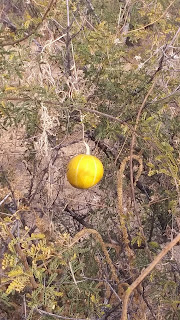
Whether thorns grab your clothes or you have, as I do, the perfect thorn-shedding jacket, it’s always worth stopping to look more closely at what the high desert has to offer. Coyote gourds are not considered edible (except by wildlife) but were used by Native Americans to make soap.


And here in December, when the morning sun comes through mesquite draped with dry vines of the summer’s vanished morning glories, don’t they look like strings of Christmas lights? Look at them with your imagination turned on.


Postscript 12/11/21: A friend's comment about this post being "comprehensive" made me think of all that I had left out -- and I'm not going to try to put everything here, but it seemed wrong to have left out the netleaf hackberry trees, so numerous in the wash and still holding onto their green leaves this December. Though when we first met (one January in maybe 2015?), I was not terribly impressed, I have since then become very fond of this species. Like a U.P. Finn, it has sisu. 


Wednesday, January 2, 2019

New Beginnings?

Hoppin' john, collard greens, cheesy biscuits

January 1-2, 2019
Dos Cabezas

When you think about it, the idea of a ‘beginning’ to anything is strange. I wrote those words out long-hand on a pad of yellow-lined paper on the morning of January 1st, but they were really (as I also wrote) a continuation of what had begun on my laptop screen two weeks previously as “Desert Diary,” and that was only picking up again a record of descriptions and thoughts written last winter and three years before in blog posts and letters to family and friends.

Cabin from wash on snowy New Year's Day
Was 2015, then, the beginning of all this writing and of my love for mountains and high desert? If so, why did my heart leap up when the owner of our cabin first told us about it, uttering the words “high desert,” “open range,” “ghost town,” words that thrilled me even then? 

Sarah & fence
I’d never longed to see Arizona — it wasn’t a dream for me, like the dream of seeing Paris — but the truth is that I had always, as a young, horse-crazy girl, dreamed of going West, dreamed of the West from the front porch (west-facing) of our family home on the Illinois prairie as I gazed over and past the cornfields across the road and imagined myself on horseback, riding beyond those prosaic fields, into the sunset. Out under — at last! — black skies pricked by innumerable stars, far from any city or suburb. As it always had and perhaps still does to Europeans, “the West” represented freedom to the child I was, fenced about by social rules and expectations. “No running in the house!” Could they not see that I was not running but galloping? That I was not a child but a wild horse? As I galloped, indoors or out, or dreamed on the front porch, gazing across cultivated fields, I imagined boundless wilderness, open and challenging. There were pictures in my head from television cowboy shows, but there were no sheriffs or bandits or range wars in my fantasy. I had no wish to conquer anything or anyone, only to be there, to “breathe free,” and test myself, not against adults or other children or social mores or any arbitrary will or rule, but against natural reality, harsh though it might be.

[Sidebar: Some, I know, will immediately want to compare my girlhood dreams to those of a boy, so I’ll pause here to say that I am not interested at all in that comparison. Men, usually the ones to raise the comparison questions, can only speculate about how their youthful experiences compare to what they can only imagine were those of someone now a woman. They cannot truly compare, as the only experiences they had were their own. And the only experiences I had were mine, so I cannot compare, either, but comparison is not what I’m about. I am only describing my dreams, and I can say definitely that I did not dream of surviving a Western wilderness as a girl, only of meeting the challenges of nature. Perhaps a boy’s dreams center more on becoming a man. Perhaps their dreams are more gendered. I don’t know. I suspect there are as many differences among boys’ dreams as there are among the dreams of girls, but I find questions of gender when they intrude on my experiences with the natural world, whether actual or imaginary, annoying and unwelcome, because part of what I sought to escape in my childhood imagination was just such restricting social norms.]


Back to the more interesting (to me) question of beginnings, though. Did the feelings I now have for my winter Arizona surroundings begin with a child’s dreams as that child gazed across an Illinois cornfield, imagination ablaze with Gene Autry, Roy Rogers, Dale Evans, and company? Or was the beginning further in the past, when my parents attended their first rodeo out in South Dakota while I was still in my mother’s womb? South Dakota, my birthplace and scene of my conception — would such a place not mark a child with an invisible brand, not to be erased by subsequent moves and homes? Or do I go beyond reason with such a question?

On New Year’s Eve I opened a new book that I took up again in the morning, as the new year officially began. A gift from friends who were here in the cabin for six weeks before our arrival and the most appropriate possible reading for me, here, as we usher out the old and welcome in the new far from northern Michigan, the book is Drum Hadley’s Voice of the Borderlands, poetry of his cowboyin’ experience along la frontera, the mountains and high desert of Sonora, Mexico, and Cochise County, Arizona. Names of familiar places recur in narrative vignettes: Sulphur Springs Valley, Willcox Livestock Auction, Agua Prieta, and there are mentions also of places I know only from maps, such as Guadalupe and Antelope Wells. I finished the first section, “Cowboys and Horses,” with great satisfaction as the new year began and the first snow of 2019 fell on Dos Cabezas. On the morning of January 2nd, we are under a winter storm warning still, with accumulations of eight inches possible at elevations above 5,000 feet (that’s us) and temperatures not to rise above the freezing mark until Thursday.


Beginnings, endings. Human beings designate moments, days, years as such, but are those designations anything more than mileposts we drive into time as a way to organize our stories?


Saturday, January 20, 2018

The Dawns, the Cities, the Lives: Written Words and Visual Images

My only "leisurely" day in Mexico

Latent in me, I suppose, there was always the belief that writing was greater than other things, or at least would prove to be greater in the end. Call it a delusion if you like, but within me was an insistence that whatever we did, the things that were said, the dawns, the cities, the lives, all of it had to be drawn together, made into pages, or it was in danger of not existing, of never having been. There comes a time when you realize that everything is a dream, and only those things preserved in writing have any possibility of being real.

 - James Salter, Don't Save Anything: Uncollected Essays, Articles, and Profiles, Reviews

These lines clearly spoke to me, because I copied them down almost the moment I read them, quickly shared them on Facebook, and sent them in an enthusiastic e-mail to a friend. But is this my belief, that writing is "realer than other things"? 

This friend and I correspond in the form of written letters and are almost compulsive about not e-mailing each other, except on rare occasions, and as briefly as possible, to arrange a meeting or send each other photographs or quick, pithy notes. For us, writing, on paper, is very important. Escribir nos importe. But she also is a visual artist, a painter, as is my husband, and would I want to say their work, their painting, is less than writing? That feels all wrong. 

And so, in a letter to my friend (which I hope she will forgive my raiding for pieces to use here), I began to think through the question -- thinking, as I so often do, by exploring my thoughts in writing to see where they would lead.

I asked my friend (in writing, in a letter she will not yet have received) if she felt with her drawing and painting what Salter felt about writing, that her art preserves what otherwise would, in the end, lack reality, that her paintings of (for instance) Scotland draw together for her what otherwise would be in danger of not existing. In posing the question on paper, I realized that I feel that way with even the most pathetic of sketches I make on paper with pen or pencil, such as the one at the top of this page of the beach at Cancun. I also feel it to a lesser degree with photography. But I feel it most of all with writing. I am not claiming that writing is objectively "best" at drawing together and preserving reality -- only that it is the first toolkit I reach for.

"Most of all," I wrote above, using those words to emphasize that I feel I am preserving the world of my own experience (though not some objective, God's-eye world), when I write about it. Next question: Why, for me, this "most of all"?

The contrast with photography is striking, as I see it. Look at any snapshot or photograph, and how often can you tell who was holding the camera? Occasionally it's clear from the location, the time period, the subject, and the chosen framing that the photographer was, say, Eugene Atget, but in most photographs, even the best (and all the more so for amateur results such as my own), whoever clicked the shutter is absent from the image. In a family snapshot, a missing family member is obviously the photographer, but the image below of dawn over the city of Mérida could have been made by anyone.


When I compose a written "picture," on the other hand, I put myself into it. The place I write about, when I write about a place, isn't just the place by itself but a place I inhabited for some period of time, however brief. Like Kilroy, "I was here."

Where does that leave drawing and painting? I will not be so bold as to speak for painting or for painters. The Artist with whom I share a life paints from memory and imagination, not to preserve details of a particular scene, and there are as many styles and subjects of painting as there are painters. What I will say is that -- again, for me -- I find sketching intermediate between photography and writing and feel it closer to writing, for me, than it is to my photography. 

(For a couple years, I took drawing classes and tried to spend part of every day quietly looking and drawing my world. More recently I have hardly touched a sketch pad, so what you saw at the top of this post is very much what I would call a sketch rather than what I would call a drawing, but the distinction does not matter for my purposes in today's musings.) 

In writing and thinking about this subject, then, I discovered my feeling about sketching/drawing, that I feel it closer to writing than to photography is to writing, but then I had to ask again, Why? Is it because a hand guiding a pen or pencil cannot help being more personal than the instantaneous click of a camera shutter? Because the lines on the paper cannot be other than a personal, individual expression? Maybe in part, but that can't be the whole story. Or -- and this feels right to me -- is it because of the time spent making those marks on paper that I feel I have preserved a bit of the world? That feels closer to my intuition.

Living is always a journey through time. When I write about anything in my life -- or even, as today, writing about a developing train of thought -- the writing takes time, and anyone reading it must also take time. When I write about dogs in the Yucatan, during the time I spend writing I re-live my time there, and when you read, you are journeying through time with me. 

"I should tell you that there were stray dogs all over the Yucatan, and they all look pretty much alike, differing only in color — about 20-25 pounds, short-haired, with skinny tails and sticking-up or -out ears. Some were black, some tan, some bicolor, but it was almost as if we saw the same dog everywhere in a different costume. Mutts, like my dear old Nikki. Leonore couldn’t help worrying about them: were they sick? did they have worms? did they get enough to eat? As for me, I really, really liked the fact that they were tolerated everywhere and could go about their lives unmolested (I never saw a dog on a leash), as if they were people. They are very traffic-savvy, naturally, as they have to be to survive and never seemed to beg from tables, even when people dining outdoors had very good food."

My photographs of one of those same dogs tells no story at all and serves only (and not very well at that, since this was not a city dog) to illustrate my words. 


Because we had so few days and a very full schedule, there was no time for me to sketch any of the dogs I saw in Mexico, but that would have meant more to me than a camera image, because when I look at an old drawing that took me a long time to produce I feel again the whole being-there of that time. I do not appear in the drawing, any more than I appear in any of my own drawings or sketches, but I can feel myself there in a way I don't with a photograph. A drawing for me is a diary entry without words. Those below were made around my Michigan home and down in Florida years ago.


Be that as it may, though, for better or for worse, words have always been and will no doubt remain my first toolbox.

*. *. *

It was at this point in my musings that I was joined over morning coffee by the Artist, who asked what I was working on. I gave him a quick synopsis of the thoughts expressed above. Surprisingly, perhaps, he gave the written word highest priority. 

"A photograph becomes another object in the world," he began. "It shows objects but is also itself an object. A written description, on the other hand, has no representative existence except in the mind of the writer and readers."

"So what about a drawing?" I asked. "Isn't it an object, too? The way I was looking at it, a drawing is closer to writing, but the way you're looking at it, it's closer to photography."

"Yes, a drawing is also an object and exists as an object. What is written exists only in imagination."

Well, that was interesting! We would have continued our conversation, except that Sarah, the dog, had gotten tired of waiting for her morning sortie, and I had to get dressed to get her outdoors. 

Walking can be an aid to thinking, however, and so my thoughts continued, and I realized that my seeing a drawing as preserving and recreating time rested on the assumption of a first-person experience -- me, looking at one of my own drawings -- whereas another person looking at one of my drawings might as well be looking at one of my photographs. The time I spent drawing, the time that comes back to me when I look at an old drawing, is not present for another viewer. A written description -- or any kind of writing, for that matter -- is different not only because it can only be "seen" in a reader's imagination but also because the reader must take time to read the words that compose the piece. David's point about imagination is important, then, but so is my emphasis on time.

How about you? Did you follow my thoughts along this meandering path? Did you stop and argue with me or bring in examples of your own, either to confirm or refute any points made along the way? Were you walking in my shoes, or were we walking side by side, in dialogue?

Words. I cannot stop generating them. Will my written work be fiction this winter? (Michigan dreaming from the far Southwest?) Or drawing dear, scruffy Cochise County with words? The dawns, ... the lives....  

However the winter experience develops, along with studying Mexican history and the Spanish language and doing a good winter's worth of writing, as well, I want to use some of my Arizona time wordlessly, too, being-there in unhurried fashion with paper and pencil.