Search This Blog

Showing posts with label high desert. Show all posts

Monday, February 6, 2023

She Took No Books!


On Sunday I woke up crabby. The heater had gone off in the middle of the night, and the house was cold. Getting up to deal with that, I remembered another reason to be crabby: my coffee house in Willcox is closed. Not “on vacation,” but closed, its future dim with mystery. Source of Coffee, my David place in Willcox! The name, Source of Coffee, soon had me thinking about the Marcel Pagnol character Jean de Florette and his back-breaking and ultimately fatal trials in  Provence [movie review here but note an error in the telling: Ugolin is not Papet's son but his nephew]: When conniving neighbors block up his spring and all his farming efforts fail, he rages against God. It was, after all, the livelihood of his family, he had struggled manfully to succeed, and then, to be deprived of his source (spring)! All right, I know, I know – his deprivation and mine are hardly equal, but it was not yet 5 a.m., and I’ve already admitted to crabbiness.


With heat back on and fresh, home-brewed coffee in mug in hand, my livelihood not facing any new or unusual threats during seasonal retirement (just for the winter: I’ll be back at work in late spring), I felt better when I took Sunny Juliet out on her leash in the dark and saw a perfect moon preparing to set in the west and heard, at the same time, a mockingbird singing in the dark, not even waiting for sunrise to begin rejoicing in the day. 


It was early. I was up. But not in a reading mood. Scanned through a few Facebook posts, listened to a little news on the radio. I was probably as impatient as Sunny on Saturday to get outdoors for our morning walk, so once the sun was up, we started out east on the range. East from the cabin means uphill, then down into what I call Peasy’s Gulch. Then we usually go north to the wash and follow it east. 


It’s a fine walk, one that can stretch to an hour easily, what with investigations along the way (mine mostly visual, SJ’s mostly with her nose). But I was in the mood for a change of scenery, and Sunny is always amenable to a change of plan, as long as we’re still having a good time.


See the arrow in the image above, pointing to a little tree on the distant slope? Doesn’t look very high, does it? Not much of a challenge? Actually, there is no simple and direct path, and while the tree is much higher than it looks from afar, I’d always had it in mind as a destination “someday.” This, I decided, would be the day. 


My morning preparations for the walk had been nothing more than the usual list: leash, treats, water, keys, phone, hat. That’s it. I added gloves, since it had been chilly when we started out, but camera stayed home, as did all field guides. No books on hikes! One thing I learned about field guides when I hiked the Dragoons years ago with a friend is that they become increasingly heavy with every step. I can’t live without field guides – don’t get me wrong – but I’ve learned to photograph whatever I want to identify and look it up in my guides afterwards. Sometimes I carry a camera, as on New Year’s Eve for the Town Hill climb; otherwise, my phone has to serve camera duty.


In Dos Cabezas, in the mountains, foothills, and the ghost town itself, everything (as my hiking partner noted one day as we were driving the straight, flat Kansas Settlement Road) is “up and down.” In summer, when monsoon rains come to the Southwest, water floods the washes and carries downstream rocks, trees, and anything (or anyone) else that it catches up in its torrential flow. On lower ground, the washes in winter are broad, sandy, and relatively clear of obstacles, as if designed for walking, whereas on higher ground and steep slopes, the story is vastly different. There a wash originates as a gully, and there will be several gullies to every slope. Moreover, there is loose rock everywhere, along with shrubs with thorns and spines. -- And I'm coming back to add that there are also gopher holes, holes made by rooting "pigs" (javelina), and now, another neighbor warns me, abandoned mine shafts!


My destination that small dark tree to the northwest


Dark shade is first gully, from the destination side.


Having gone farther east than necessary before making the decision to climb, I had two major gullies to clamber down into and up out of on my way to that tree. Sunny negotiated them easily, but then, she has four legs and four feet and is only a year old. The second gully, in particular, gave me pause. (No, not paws! Please!) Could I do it? Without falling? I put on the gloves I’d taken off when feeling too warm in order to be able to grab handy branches along the way. On the upside of the gully, there was a cow path (quite surprising how good cows are at climbing steep slopes), and I made cautious use of their bovine wisdom. 


For reference: cows on a different hillside on a different day

For scale: same cows as above without the magic of zoom


On Saturday: my cowpath, up out of the second gully
 

My report, in brief: The climb, la montée, ça en valait la peine! Definitely worth the effort! The view of my little ghost town down there in the distance – even, between two local hills, a view out across the playa to the Dragoon Mountains and Cochise Stronghold – was worth every cautious, foot-dragging step that got me there, and it was very satisfying to stand under a tree I’d been looking at from my winter back door and imagining meeting “in person” since 2015.


View attained.

Tree up close.


From my new, lofty vantage point, I could see an easier route to take down than the one I’d used coming up. I’ll remember that for the next time I climb to the tree. I have also installed an altimeter on my new phone now, so when I make the climb again I’ll know exactly how much higher the tree is than the cabin down below, which stands at a mere 5,030 feet above sea level. – Not quite a mile high, the cabin, but that almost explains our freezing temperatures during these winter nights. 


Yes, a very satisfying adventure – and I rationed the water supply carefully so that a certain energetic little doggie would not have to go thirsty, either. We had a terrific time!


Thursday, December 9, 2021

Yes, We Have No Saguaro


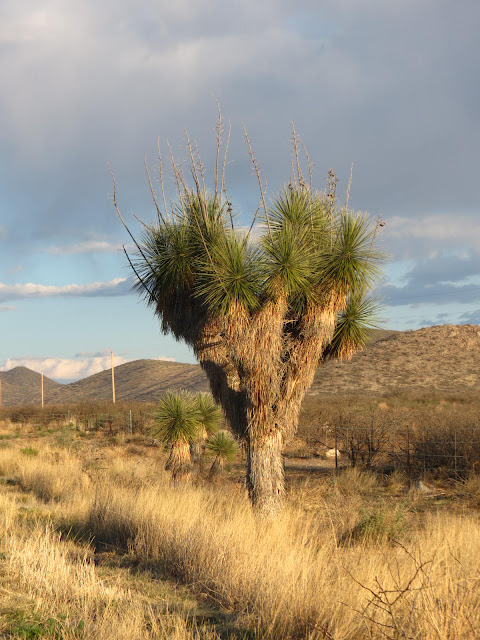
Soaptree yucca

My title today may give a chuckle to the few who remember the old song about bananas. I did not see the original cartoon when it came out in 1930 (not that long in the tooth!), but it replayed on 1950s television and was still amusing then. All of which has nothing to do with plants of the high desert, my topic of the day -- .

Prickly pear

cholla 


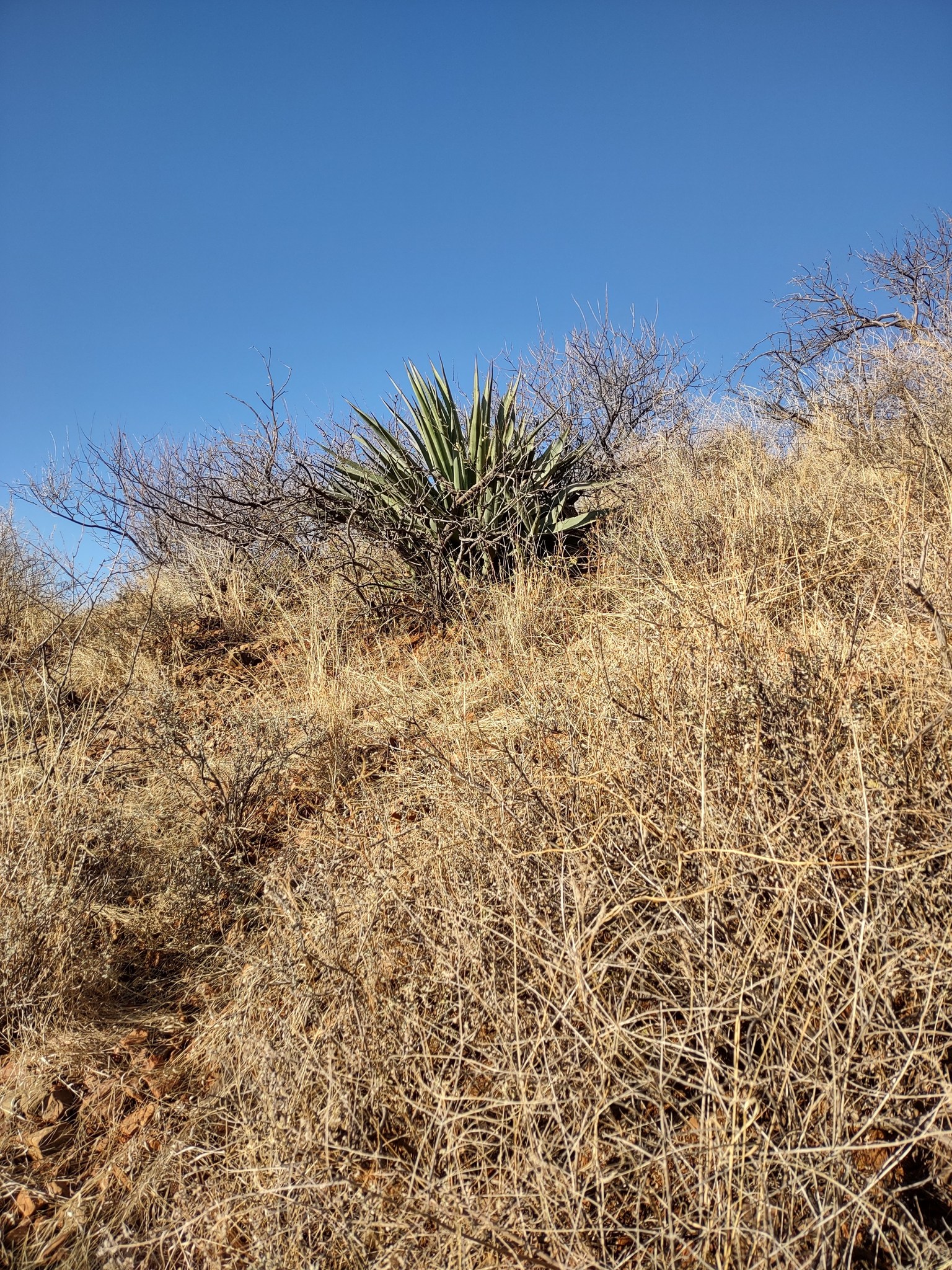
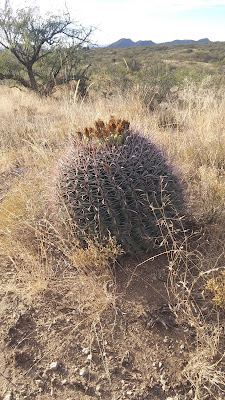
A friend back in northern Michigan asked about plants here in the high desert, speculating that we “don’t have cactus” here. Well, we have a lot of cholla (though not the full range of varieties), and there is prickly pear, too, more often on higher slopes than down on the range, and also here and there a squat barrel cactus, though these last are not as plentiful here as they are in the low desert. Along our Cochise County roadsides, soaptree yucca is ubiquitous, and down the road apiece from our ghost town are rocky foothills stuck all over like giant pincushions with sotol and century plant (the latter a kind of agave), as well as the striking ocotillo (more common around Benson and Bisbee than here in Dos Cabezas). During our first winter here, it took me a while to sort out yucca, agave, and sotol. But yes, we have no saguaro. That, along with "teddy bear" cholla, grows down in the lower elevation of Tucson, 100 miles away.


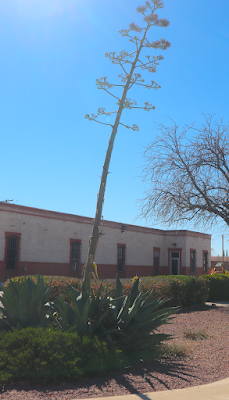
The life cycle of the century plant is interesting, though. It doesn’t really take 100 years to come into bloom (for the one and only time in its life), but it is a long wait. Meanwhile, however, the plant grows larger and larger, making a nice focal point for desert landscaping. 


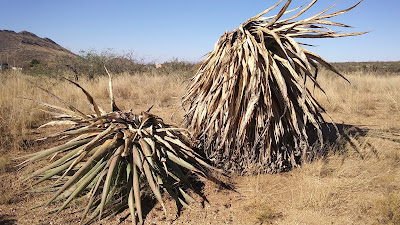
When it reaches maturity, it sends up an immense, asparagus-like stalk (this plant and asparagus are in the same family), and after flowering the plant dies. 


Where did the stalks go?


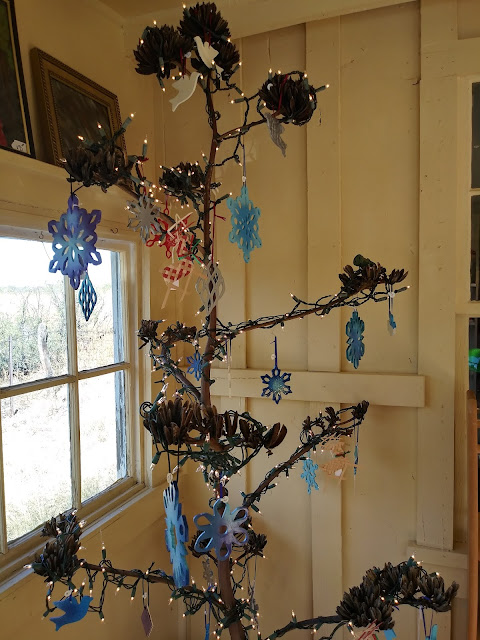
But that is not the end. From the plant's seeds will come a new generation, while the impressive, sculptural dry stalk is favored by desert dwellers for a Christmas “tree.”


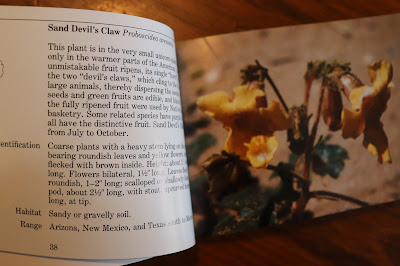
Also, along with cactus and other plants with spines, are many thorny deciduous plants, primarily (around Dos Cabezas) but not limited to the mesquites. One that looks a lot like a mesquite is in the same family (leguminacae, though some botanists break the family down further into subfamilies) but is a different genus. Mesquite genus is Prosopis, catclaw is Acacia. Even that can be confusing, however, as catclaw acacia or Gregg’s acacia, formerly Acacia greggii, now classified as Senegalia greggii, sometimes goes by the common name devilsclaw, but more often “devil’s claw” refers to a different plant altogether, Proboscidea arenaria, from (I kid you not) the unicorn-plant family! 


Chain of devil's claw (unicorn-plant family) pods

book showing flowers of that devil's claw


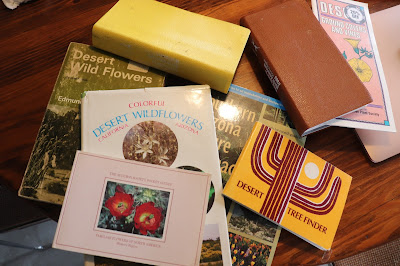
And this, as my friend Ellen would remind you, is why the Latin names of plants are so crucial to identification: What your grandmother in Ohio knew and taught you as “devil’s paintbrush” is not the “devil’s paintbrush” of the American Southwest. What I’ll remind you is that this is a reason for not relying on one plant guide but having access to several.


some of my printed resources

Back to those thorny shrubs --


mesquite leaves

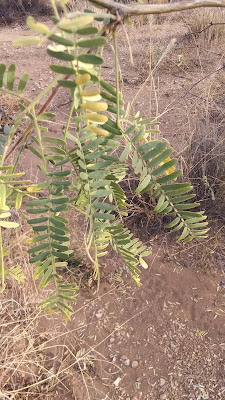
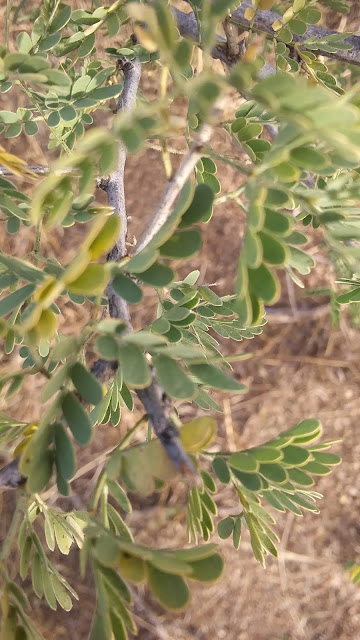
catclaw acacia leaves


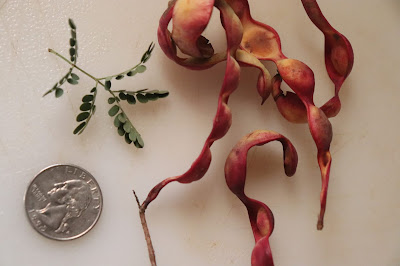
And back to identifying catclaw acacia. Its bipinnately compound leaves are much smaller than the leaves of mesquite, and its thorns are curved like a cat’s claws. Hence the name. Once you note the difference between the two shrubs, it’s obvious, even when they are growing all tangled up in each other, as they sometimes do. I found some catclaw pods the other day, too. They curve and twist, and while The Audubon Society Field Guide to North American Plants, Western Region, authored by Elbert L. Little, calls them brown, the ones I gathered the other day are more reddish to my eye.


catclaw pods


Mr. Little is no fan of catclaw; nor are many hikers or others: “one of the most despised southwestern shrubs,” the Little-authored Audubon guide says of it. And yet, besides the region’s delicious catclaw honey and the plant’s useful hardwood (for fuel and tool-making), catclaw beans are a native food, ground when dry to make pinole, which now seems to be making a comeback as foodies rediscover ancient local foods. Interesting that another common name for catclaw acacia is wait-a-minute bush. Your shirt gets caught on a thorn, and you have to stop to free yourself. Get it? 


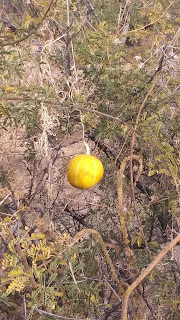
Whether thorns grab your clothes or you have, as I do, the perfect thorn-shedding jacket, it’s always worth stopping to look more closely at what the high desert has to offer. Coyote gourds are not considered edible (except by wildlife) but were used by Native Americans to make soap.


And here in December, when the morning sun comes through mesquite draped with dry vines of the summer’s vanished morning glories, don’t they look like strings of Christmas lights? Look at them with your imagination turned on.


Postscript 12/11/21: A friend's comment about this post being "comprehensive" made me think of all that I had left out -- and I'm not going to try to put everything here, but it seemed wrong to have left out the netleaf hackberry trees, so numerous in the wash and still holding onto their green leaves this December. Though when we first met (one January in maybe 2015?), I was not terribly impressed, I have since then become very fond of this species. Like a U.P. Finn, it has sisu. 


Monday, November 29, 2021

Who Lives Here? And How?

Who lives here? Or lived here?


My high desert day usually begins in the dark, 5:30 a.m. on average. I like making coffee before first light and watching dawn break a while later over the low mountains to the east. Nights now are in the 30-degree range, so some mornings there is a thin skin of ice on the birdbath. The birds know when a sunny day is coming and are out calling and singing by the time the sun comes over the horizon. But that comes later. 


With almost a full year’s experience under his nonexistent belt, Peasy knows we won’t be rushing outdoors at first light or even sunrise, and he waits patiently (mostly) while I drink my coffee and read or write a letter or journal entry or catch up online with distant friends. But he is certainly ready for adventure and exploration the minute he senses that I am! The Artist will be ready, too, by the time Pease and I get back from our morning rambles, usually about an hour later.


Ready to go!

But Mom needs to bundle up first.

The sun is bright, but the air is cold when we first go out in the morning, and I bundle up accordingly. A jacket I found in a Traverse City, Michigan, Goodwill store in 2015, on the $1 sale rack because of a tear at the end of one sleeve, still works for me perfectly in Dos Cabezas, the rough leather brushing off thorns the way an umbrella sheds rain. Old dog-chewed shoes work, too (Peasy did that, not Sarah), as does a terribly unflattering wide-brimmed hat. Here one must protect against both cold and sun on early mornings -- go out without a brim in the morning, and walking east is walking blind.


A wash tells the story of summer rains, or monsoons, as some here call them. During a monsoon, washes turn from dry, sandy beds to torrential rivers in minutes. “Do not enter when flooded,” say signs along the roads, and even now, many weeks later, ghostly images of currents remain to show paths taken by relentless, rapidly flowing water.


The color green also tells of plenteous summer rains. So much green still, in November!


But there is red, also, and I need to learn the name of this ground-hugging plant, which can also be found along the edges of the highway, breaking through the pavement. 


And here is Peasy again. Because you never tire of Peasy pictures, do you? Isn't he a pretty boy?


As the desert day continues, it will often include a trip into our nearby town of Willcox, but I’ll save Willcox for another day and tell you now about evening and night in the high desert. In late afternoon, an insect chorus starts up and continues into dusk. Are the singers crickets or cicadas or a blended choir of both? Whatever they are, they settle down as darkness falls. Everything goes quiet then unless a dog barks in the distance. It is then that stars take ownership of the desert – stars, jets high overhead, too far away to hear, and maybe a silent satellite zipping and blinking by. Once in a while coyotes yip, that familiar sound that reminded me of our Michigan home the first winter we spent here in the ghost town.


Morning, afternoon, evening -- I feel very peaceful here. No doubt part of my contentment is the freedom of seasonal retirement: no schedule to keep, no daily obligations except to care for my little family. I haven't yet finished the exciting book about the steeplechase riding woman in Czechoslovakia. So many possibilities present themselves every hour, it's hard to settle down! 


Who lives here in this ghost town, delighting in open space and in friendly neighbors? For now, the Artist and I and our special needs dog are right at home. I'll tell you more about desert dog's behavior here in my next post. Or the one after that, maybe. Because who knows what the future holds?


The sandhill cranes have come for the winter, too.


Wednesday, May 20, 2020

How Green Is My Desert

Flowering shrub is bird-of-paradise

The Artist and I have never stayed in southern Arizona this late into the spring before, never seen the desert so green, and every day the change from bare, dead-looking winter trees and shrubs becoming vibrant with leaves and blossoms astonishes us anew. “Are there many deciduous trees where you are?” my son asked me on the phone this morning. Oh, goodness, yes! The mesquite is often more of a large shrub than a tree, but it is ubiquitous, and it is deciduous, and some individuals reach tree size and can have beautiful shapes, and right now all are leafed out, providing shade for cattle and hiding places for birds to build nests. But mesquite is only the beginning. In the photograph just below, looking past the bird-of-paradise and down into the wash, there are at least four more large, green, deciduous plants, three of them trees. At the far right top (back corner) is a walnut tree. 


Nogal in leaf and bloom

The walnut tree’s leafy crown dances in the afternoon wind, and suckers sprout at the base. For five years I’ve been wondering what kind of tree this was, and how I see another farther back behind the neighbor’s fence, and down the road just past another neighbor’s house I’ve spotted a whole row. I don’t know if this is the Arizona or the Texas walnut, but either one goes by the Spanish name nogal, the plural of which is nogales. It’s walnuts that give the name to that Mexican border town, and I am happy to know this beautiful neighbor tree by name at last.

In the center background (and not sharply in focus) of green things growing along the wash is a netleaf hackberry tree, a tree I've written about before. In winter there have always been enough dried berries and dead leaves on the hackberry that I have been able to identify it almost from the beginning of my desert stays, but it looks very different now, clothed in green. 


Center left of that composite shot but not all the way to the left, the light green tree you see is desert willow, another newly learned-by-name tree to me and one that charms me in every way. Since learning it, I’ve found myself photographing the desert willow at different times of day. It is not, you should understand, a true willow. It is a different genus and member of a completely different botanical family from the willows along the no-name creek just north of my Michigan farmhouse. 


Flowers on the desert willow below the cabin have not yet opened, but when we went for a little ride down Chiricahua way, I was happy to spot a desert willow in bloom. 


Does that flower remind you of a catalpa blossom? Both trees belong to the Bignonia family, the desert willow’s flowers smaller and more colorful but very like those of catalpa trees back in Leelanau County, Michigan.

We have never seen the wash flowing with water, a phenomenon that arrives only with the summer monsoons, each flood lasting only a few hours. Over closer to the Chiricahua Mountains, though, where streams flow for much of the year, water-loving sycamores are found. Some are of magnificent size, although during the winter, when they look like ghost trees, it’s hard to believe they are alive. 

Arizona sycamore in winter 
Now look at the difference! It seems nothing short of miraculous. 

Arizona sycamore mid-May


Oaks are deciduous, also, but in this climate they hold onto their leaves through the winter and bring forth new leaves in the spring, at the same time that they begin to drop the old, gradually, with never a bare season to them. Oak trees near streams and in mountain canyons are peaceful places to rest the eyes all year-round.


Cochise County and I have been getting acquainted since January of 2015, but my desert is still full of surprises. Of course, what surprises me is familiar to those who have lived here all their lives. How can I call the desert “mine” at all? 

It’s true I’m a newcomer, but I do love it, more deeply each year, and this year – this strange spring of the COVID-19 pandemic, with stay-at-home orders in Arizona from mid-March until the end of April, being here in a whole new and unexpected way, I feel I have paid a few odd dues and earned at least a beginner’s merit badge in Arizona living. 

Our resident roadrunner has accepted us unconditionally. Bless his little heart!