Search This Blog

Showing posts with label cowboys. Show all posts

Sunday, March 10, 2019

The 'Wild West' in Movies (and Books)

Sample of cowboy selection at the Mustang Mall
Out here on the range, most nights the Artist and I watch a movie before we fall asleep — or before a read-aloud session before going to sleep. Usually we stay awake until movie’s end, thus making time for reading aloud. We see more Westerns on TV and DVDs out here than we would at home in Michigan, but we don’t find all Westerns equally satisfying, and I’ve been thinking about the variety in these films over the decades.

Older Western movies fall into a couple of general categories, the formulaic and the classic. (Is it easier to see a black-and-white film as a classic? Plenty of formula movies were made in black-and-white, too, but the truth is that even those look better to our eyes than they would now if we saw the same tired story and two-dimensional characters up on the screen in full color with full, top-quality production values.) Old Westerns made on the cheap weren’t trying to be something they weren’t. The aim of the studios was to entertain and audience in order to make money. That simple. So okay, entertain me, if you can, but I’m not a 9-year-old on a Saturday afternoon, and my entertainment is often diminished by what I know about human nature and the history of my country.

Classic Westerns are something else, but what is considered an important Western film these days? “High Noon” comes immediately to my mind, but looking at a “Top 20” list surprised me: 

“Stagecoach,” from 1939, is the oldest in the list that also includes “My Darling Clementine” (1946) and “The Ox-Bow Incident” (1943), “Red River” (1948), “Winchester” (1950), and naturally “High Noon” (1952), but many movies made long after Westerns were weekly theatre fare also made the cut: “The Wild Bunch” and “Butch Cassidy and the Sundance Kid,” both from 1969; “Little Big Man” (1970); “McCabe and Mrs. Miller” (1971); “The Outlaw Josie Wales” (1976); “Dances With Wolves” (1990); “Unforgiven” (1992), a remake of “True Grit” from 2010; and “Django Unchained” (2012.

While all the films in the list are set in the West, in Westerns as in horror or gangster films it’s easy to substitute gore for character, plot, and meaningful action. To my mind, how human beings kill (each other) and die (alone) is not that interesting, in and of itself. Notwithstanding the truth that death comes to us all, for me the killing and dying is only interesting within the context of how people live and how and why they make the choices they do. 

Films from the 1990s and later look at the 19th century through 20th- and 21st-century sensibilities, with all the concomitant insights and flaws that implies. In “Dances With Wolves” a director (Kevin Costner, also the film’s star) has removed cultural blinders in his look back at the history of the American West, portraying the Native Americans in his story in their full humanity, and his story means much more to me than all the blood spilled in “The Wild Bunch.”

A recent issue of Cowboys and Indians magazine (picked up for free in the library lobby or laundromat -- I forget which -- and I'm not kidding about the name of the magazine, either) included a short list of what those who compiled it called “Top Modern Westerns.” There are only five films on this list, all of them made since we turned the millennial corner, and I have seen none of them, but “Hell of High Water” (2016) sounds like one I’d give a chance.

In any case, I have my own favorites among the more recent films set in the West, and none of them made the Top 20 list, much less the five Top Moderns. For me, “Broken Trail” is #1 — and not only for some of the best wild horse herd sequences I’ve ever seen on film. Robert Duvall and Thomas Hayden Church play down-to-earth cowboys, looking to make a buck but doing it their way and not so focused on the buck that they have put their humanity on the shelf. Another I like a lot is the almost unknown “Red Rock West,” a quirky noir Western with comic undertones that’s about as far from “Broken Trail” as a movie can be, but I like Nicholas Cage, and much of the movie is set in Willcox, Arizona, my winter stomping grounds, so I recommend it to friends for that reason alone. 

And now I have another to add to that short list. 

Tom Selleck’s “Monte Walsh” is not the most exciting movie, even the most exciting Western, I’ve ever seen. There are stretches where it’s almost dull and a couple of scenes played too hard for effect. But I didn’t mind the slow or overplayed sequences all that much, for the sake of the movie’s depiction of cowboy life, both its appeal and its disadvantages, particularly in an era (end of the 19th century) when everything is changing fast. The range is being fenced in, cowboy jobs fewer and harder to find. (Unemployment has never been unique to cities.) You sense that these characters are real people in the grip of real life dilemmas.

Why do they do it? How long can they hope to do it? What else can they do instead, when “cowboyin’ is all [they] know”?  I can’t remember any other Western film that set out to explore these questions in such detail. And there are exciting parts, too, and beautiful scenes. 

One minor character in the film is an aged Civil War veteran. “Monte Walsh” is not the only Western to feature Civil War veterans, and it’s historical fact that many Confederates came west to start new lives after the Civil War. (Many Southerners had come west before the war, too, which is not so well known.) The sad plight of “Fightin’ Joe” — the character goes by the name of his Civil War hero rather than his own name (and there’s a lot about men’s names, their real names vs. what they’re known by) — is that he’s been reduced to “ridin’ fence,” which the movie seems to be telling us is the end of the line for a working cowboy. That piqued my interest, because in what I’ve been reading about ranch life, riding fence is just part of the work — good, honest, hard outdoor work — and in none of the memoirs and reminiscences I’ve read did anyone indicate that it was below a man’s dignity to fence and keep fences in repair. But those were ranchers’ memories, and there was apparently a vast difference between a 19th-century cowboy and a 20th-century rancher. 

No, Monte and his cowboy pals are seeing their West vanish before their eyes: monied corporations, men from the East, are buying up land and fencing it in and sometimes don’t do a damn thing with it! And that poor old man ridin’ fence is all alone. He isn’t part of a working team any more, even his horse less a partner and more mere transportation to the fence line, while those other cowboys, the ones who haven’t yet lost their jobs, they’re still ropin’ and ridin’ and roundin’ up and drivin’ cattle and horses. 

“Monte Walsh,” based on the book by Jack Schaefer,  was filmed in Calgary, Alberta, and while not a perfect film, it’s worth seeing. I decided not to provide any links to reviews in this post, because some of them tell you way too much. Just take a look at the movie for yourself. That’s my advice. 

I haven’t read Jack Schaefer’s book and only learned of it via the movie. Anyone know Monte Walsh the book? Should I be read it? Warning: You’ll have to give a strong sell job, because I’m tempted to skip right to Jack Schaefer’s The Hearts of Horses, in which I read that the cowboy is a girl!

Our just-begun bedtime read-aloud book is Blood Brother, by Elliott Arnold, a fictionalized account of the friendship between Cochise and Tom Jeffords, the story made into a movie we have yet to see, “Broken Arrow.” So stay tuned, because I'll be out here for a while yet....

(Bonus scene here.)


Postscript: 

Since writing this post we have watched “Broken Arrow,” the movie made from Elliott Arnold’s book,Blood Brothers. I don’t know whether to recommend the movie or not. We’re not far along yet in the novel to know how far fiction departed from the account Tom Jeffords made of the meeting in the Stronghold, when he took General Howard to meet Cochise, but I’ll be disappointed if the novel veers into an irrelevant, largely invented love story, as does the movie. That, however, was the Hollywood of the time. 

My biggest disappointment was the movie’s setting, as it was clear from the initial sight of the first tall saguaro and the mountain formations surrounding the desert through which Jimmy Stewart rode (though I’m happy to say he could sit a horse just fine) that we werenotin Cochise County. The screenwriter had assumed that "all exterior scenes will be photographed in the magnificent and neglected section of Arizona, in which the events occurred,” and publiity for the film promised movie-goers that the film had been "shot in the locations where the story actually took place.” Not so! Well, some of the filming took place in northern Arizona — up on the Whitewater Apache reservation — and the rest was shot in California and Utah. Why not Chiricahua? Why not the Dragoon Mountains? All mountains are not the same! Each place is unique, as is its history.

Also, White Buffalo Calf Woman -- is that the tradition that the young female love interest was supposed to represent? And isn't this a Lakota tradition, not Apache? Perhaps the legend migrated? Someone more knowledgeable will have to set me straight on this, if I've got it wrong, but the whole business of "pan-Indians," i.e., taking different peoples from different parts of the continent and creating a composite, is problematic.

On the other hand, Hollywood did a few things right with the story. They followed the lead of both the real Tom Jeffords and also author Elliott Arnold and, finally, made a Western movie that told the Indians' side of that era’s bloody cultural conflict, and it presented the Apaches as human beings with legitimate claims to the land and their way of life, rather than simply as “savages.” Also, while major characters are played by white actors, 375 Apaches were played by actual Apaches — again, I should note, according to Twentieth Century-Fox. 

There’s also an interesting story about the House on Un-American Activities. That background, on script and other choices, can be found here.

Wednesday, January 2, 2019

New Beginnings?

Hoppin' john, collard greens, cheesy biscuits

January 1-2, 2019
Dos Cabezas

When you think about it, the idea of a ‘beginning’ to anything is strange. I wrote those words out long-hand on a pad of yellow-lined paper on the morning of January 1st, but they were really (as I also wrote) a continuation of what had begun on my laptop screen two weeks previously as “Desert Diary,” and that was only picking up again a record of descriptions and thoughts written last winter and three years before in blog posts and letters to family and friends.

Cabin from wash on snowy New Year's Day
Was 2015, then, the beginning of all this writing and of my love for mountains and high desert? If so, why did my heart leap up when the owner of our cabin first told us about it, uttering the words “high desert,” “open range,” “ghost town,” words that thrilled me even then? 

Sarah & fence
I’d never longed to see Arizona — it wasn’t a dream for me, like the dream of seeing Paris — but the truth is that I had always, as a young, horse-crazy girl, dreamed of going West, dreamed of the West from the front porch (west-facing) of our family home on the Illinois prairie as I gazed over and past the cornfields across the road and imagined myself on horseback, riding beyond those prosaic fields, into the sunset. Out under — at last! — black skies pricked by innumerable stars, far from any city or suburb. As it always had and perhaps still does to Europeans, “the West” represented freedom to the child I was, fenced about by social rules and expectations. “No running in the house!” Could they not see that I was not running but galloping? That I was not a child but a wild horse? As I galloped, indoors or out, or dreamed on the front porch, gazing across cultivated fields, I imagined boundless wilderness, open and challenging. There were pictures in my head from television cowboy shows, but there were no sheriffs or bandits or range wars in my fantasy. I had no wish to conquer anything or anyone, only to be there, to “breathe free,” and test myself, not against adults or other children or social mores or any arbitrary will or rule, but against natural reality, harsh though it might be.

[Sidebar: Some, I know, will immediately want to compare my girlhood dreams to those of a boy, so I’ll pause here to say that I am not interested at all in that comparison. Men, usually the ones to raise the comparison questions, can only speculate about how their youthful experiences compare to what they can only imagine were those of someone now a woman. They cannot truly compare, as the only experiences they had were their own. And the only experiences I had were mine, so I cannot compare, either, but comparison is not what I’m about. I am only describing my dreams, and I can say definitely that I did not dream of surviving a Western wilderness as a girl, only of meeting the challenges of nature. Perhaps a boy’s dreams center more on becoming a man. Perhaps their dreams are more gendered. I don’t know. I suspect there are as many differences among boys’ dreams as there are among the dreams of girls, but I find questions of gender when they intrude on my experiences with the natural world, whether actual or imaginary, annoying and unwelcome, because part of what I sought to escape in my childhood imagination was just such restricting social norms.]


Back to the more interesting (to me) question of beginnings, though. Did the feelings I now have for my winter Arizona surroundings begin with a child’s dreams as that child gazed across an Illinois cornfield, imagination ablaze with Gene Autry, Roy Rogers, Dale Evans, and company? Or was the beginning further in the past, when my parents attended their first rodeo out in South Dakota while I was still in my mother’s womb? South Dakota, my birthplace and scene of my conception — would such a place not mark a child with an invisible brand, not to be erased by subsequent moves and homes? Or do I go beyond reason with such a question?

On New Year’s Eve I opened a new book that I took up again in the morning, as the new year officially began. A gift from friends who were here in the cabin for six weeks before our arrival and the most appropriate possible reading for me, here, as we usher out the old and welcome in the new far from northern Michigan, the book is Drum Hadley’s Voice of the Borderlands, poetry of his cowboyin’ experience along la frontera, the mountains and high desert of Sonora, Mexico, and Cochise County, Arizona. Names of familiar places recur in narrative vignettes: Sulphur Springs Valley, Willcox Livestock Auction, Agua Prieta, and there are mentions also of places I know only from maps, such as Guadalupe and Antelope Wells. I finished the first section, “Cowboys and Horses,” with great satisfaction as the new year began and the first snow of 2019 fell on Dos Cabezas. On the morning of January 2nd, we are under a winter storm warning still, with accumulations of eight inches possible at elevations above 5,000 feet (that’s us) and temperatures not to rise above the freezing mark until Thursday.


Beginnings, endings. Human beings designate moments, days, years as such, but are those designations anything more than mileposts we drive into time as a way to organize our stories?


Monday, April 6, 2015

A Star in the Western Tradition


Railroad Street, Willcox, Arizona

I vowed not to leave the Willcox, Arizona, area without paying a visit to the Rex Allen Museum, and now I can highly recommend it! Here’s how to get there:

To reach old historic Willcox from I-10, take the middle of three available exits and you’ll find yourself on Rex Allen Drive. Follow that to Haskell and turn right. (On Haskell you’ll pass the Motel 8, which occupies the site of the old house where Rex Allen was born, contrary to what you might read in Wikipedia about his being born 40 miles to the north where, it’s true, his parents did live before moving to Willcox.) At the intersection of Haskell and Maley, turn left, then turn left again at Railroad Street, and you’re right there, with a couple of museums and wine-tasting rooms on your left in the Old Town buildings and a beautiful park on your right. (Across the railroad tracks are yet more wine-tasting rooms. Willcox wineries outnumber those of Sonoita.) In the park is a bronze sculpture of Rex Allen himself.

Those approaching from Chiricahua National Monument on Hwy 186 have only to cross the railroad tracks and turn right, and there you are.

Intersection of Willcox and Railroad streets

 Before we came to Willcox, David and I were not familiar with the name Rex Allen, but since the name is everywhere in town, with “Rex Allen Days” the well-publicized high point of the summer season, we asked one of the first residents we spoke with and were told that he was one of the mid-century singing cowboys, along with Roy Rogers and Gene Autry. Well, those names we knew, but the name Rex Allen still didn’t ring a bell with us.

Admission to the Rex Allen Museum, which also includes the Cowboy Hall of Fame, is only two dollars. I want to emphasize this: it only costs two dollars to tour this museum! And so, friends and other readers, if you’re traveling west to Tucson, take the time to get off the expressway and detour through the old town of Willcox, because you are in for a big surprise!


When Roy and Gene read the writing on the wall and saw that television was the up-and-coming entertainment venue, they started making their own TV shows, the ones I grew up with in the 1950s. Who else remembers? Besides Roy Rodgers and Dale Evans and Gene Autry, Hopalong Cassidy and the Lone Ranger were favorites of mine. Who else am I forgetting? My point here is that when Roy Rogers stopped making films, an opening was created, and it was Rex Allen who filled it. Between 1950 and 1954 he made 19 feature films, all with cowboy themes. The advantage to the studio was that no one had to teach him how to ride. 

his first guitar
He was not an actor needing cowboy lessons. Starting out from Willcox after high school graduation (“Willcox, Home of the Cowboys”), he went to Tucson with dreams of being a rodeo bull rider. He’d worked cows before. His first ride on a Brahma bull, however, persuaded him to concentrate on his music instead. That’s another thing. Rex Allen wrote the “Arizona Waltz” when he was only 14 years old, and his recording of “Crying in the Chapel,” long before Elvis touched the song, went gold. He recorded “Frankie and Johnny.” He had his own long-running regular radio show on WLS in Chicago. His recording career with Decca spanned 35 years!

And as for the movies, even after Western films faded away Rex Allen kept working in the film world. Have you seen “Charlotte’s Web”? That narrator’s voice is Rex Allen’s. He also narrated “The Incredible Journey” and many other Disney nature documentaries. “So,” as the volunteer museum host for the day put it, “even if you’ve never heard of Rex Allen, you’ve heard Rex Allen.”


David wasn’t sure he needed the Rex Allen Museum experience, so he strolled around in the park across the street, admiring the sculpture and looking it over carefully while I went in to begin my tour. But there in the museum I found a different, smaller, limited edition sculpture David just had to see ... an exhibit on the making of the large outdoor sculpture ... and then, capping it all, a photograph with accompanying note to Rex Allen from the Lucchese boot people! “Oh, my god!” escaped me at that last one. David could not miss this museum!

(David's boots, not Rex's)

Lucky for me, too, that I got David into the museum, or I might have missed, in my hurrying to rejoin him outside, the Cowboy Hall of Fame. 


In the parlance of baja Arizona, a “cowboy” isn’t only a lariat-slingin’ vaquero (although he can be that): he’s any horse-riding, cow-working rancher or ranch employee. Naturally, I am especially interested in the women ranchers, and in the book of “cowboy” mini-biographies, the only one I was in its entirety, with pleasure, was of a “cowgirl.” The guys and gals pictured here in the Hall of Fame are all the real deal.


When Rex Allen’s horse died, Koko’s ashes were buried in the park in Willcox. Rex himself, with failing health, spent his last days in Tucson, but he never forgot his hometown. “He’s the reason we have a hospital,” the museum volunteer told us. While still alive, Mr. Allen often came to sit in the front window of the museum bearing his name and chat with visitors.

I didn’t get the name of that volunteer at the museum, but he and his spiel were memorable. Born in Tucson himself, he came to Willcox and taught for 28 years in the public school, and when he retired, he stayed, because, “Where am I gonna go?” Small town life and higher elevation climate had spoiled him for city life. When I told him where we had spent the winter, he told me a personal story, about singing for a burial at the cemetery in Dos Cabezas. His speaking voice was gorgeous, and I can only imagine how thrilling his singing voice would have been, out there under the open sky. Here is a rendition by Vince Gill of “Go Rest High on That Mountain” to give you a taste of the goosebumps I felt hearing the story.

Even when you feel very much at home somewhere, it's worth taking a day to play tourist. I wouldn't have missed this for the world.


Monday, March 16, 2015

The Rodeo Imperative


Maybe somewhere in the West there’s someone (most likely a transplant from the Midwest) who utters the words “I wasn’t born yesterday,” but I have yet to hear our familiar Michigan phrase out here. Instead, from goofy celebrity talk show through serious political discussion to a couple of guys out on a sidewalk or standing around a pickup truck, whenever one person states the obvious or starts to give unnecessary advice or asks if the second person knows something that of course anyone around here would know, the laconic response is, invariably, “This isn’t my first rodeo.”

When we read a bare-bones announcement in the local newspaper – surprisingly, no times or schedule were given, no list of events or enticing photograph from last year – about a junior rodeo to be held March 14 and 15 out at Quail Park on the north side of Willcox, I put it on my calendar immediately.

“Don’t expect much,” David warned. The word “Junior,” to him, meant there would be no professional bull-riding, his favorite rodeo event. 

I didn’t care. “There’ll be plenty of horses,” I said confidently.

(There was to be a huge book fair in Tucson the same weekend, on the University of Arizona campus. Books in the city vs. horses in the country? I have books every day of my life! But I do have a kind of professional obligation.... Okay, a compromise: rodeo on Saturday, book fair on Sunday. My argument was that city traffic would not be as crazy on Sunday, and besides, David thought we might stay overnight near Tucson and ride up to Oracle the next day.)

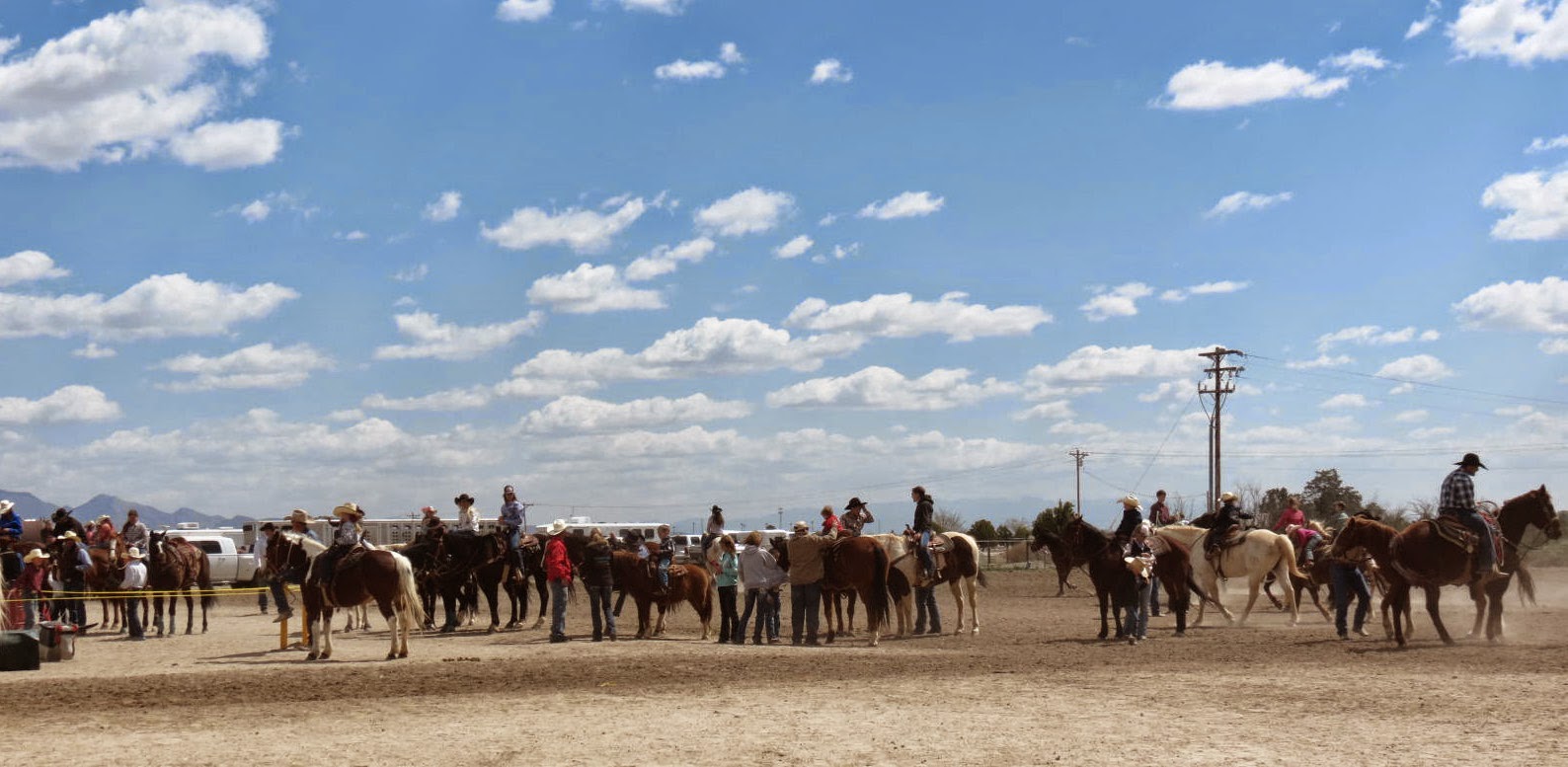
There were horses and horse trailers everywhere. Every size and color and look of horse, and every make and size and age of trailer. We were surrounded by horsiness, immersed in an equine world. Immediately, before we got out of the car, the event had already surpassed my expectations.


(Look at background: Dos Cabezas!)


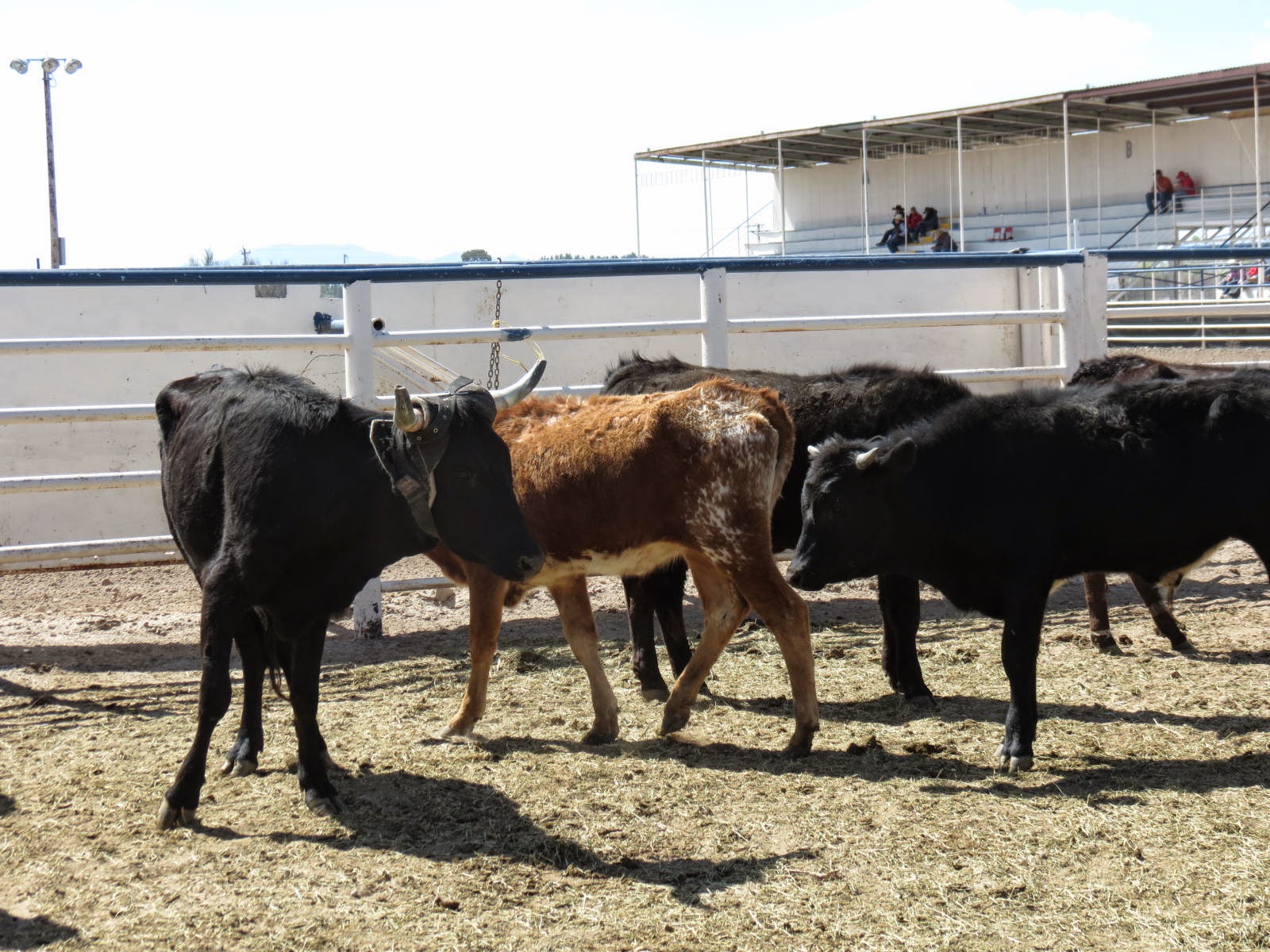
There were calves, too, ready for the roping.


There were a few dogs of appropriate cowdog appearance among the spectators, one almost as cute as Sarah. (Which one below do you think I mean?)


We arrived for the end of the “flags” event and the beginning of “poles,” the first poles competition for the “Six and under” age group, with older age groups following. I couldn’t help suspecting that for a few of the youngest competitors, this might indeed be their first rodeo.


The announcer was clear and encouraging. Here’s how she would periodically remind riders of their turns in the arena, after beginning by reading the complete lineup of competitors: “Next is So-and-So One, followed by So-and-So Two, and So-and-So Three, be thinkin’ about it.”


(Yes, there were young cowboys, too, but it was the girls who were living my girlhood dream.)

It was a very windy day -- consequently very dusty. Back behind the entrance gate, where horses stood waiting to be ridden and young cowboys and cowgirls warmed up horses for upcoming events or simply socialized on horseback, the dust was fierce, but the horsiness was intense.


We didn’t stay all day. The next morning, though, before getting on I-10 to Tucson, we stopped in again briefly for the beginning of the rodeo day. Again we were surrounded by horses, and again I heard the announcer’s voice pronouncing the names of kids I’d seen ride the day before, the same formula making the order of competition clear. “Next... followed by... and ... be thinkin’ about it.”

The rodeo imperative: “Be thinkin’ about it.” I was still thinkin’ about it halfway to Tucson.

Ride‘m, cowgirl! Live my dream!


Beautiful, beautiful, beautiful! Dare I confess that it was -- my first rodeo?!