Search This Blog

Showing posts with label American West. Show all posts

Sunday, April 14, 2019

Western Books, Boots, Blooms

"New" to me
You see above books purchased on a single day here in the Southwest. Not that I go this wild every day, mind you. Occasionally I come home without any additions to my ghost town library. On this particular day, except for the books of poetry, an old Nancy Drew, and an Alexander McCall Smith novel, Western themes predominate, as is often the case here. You can see books of memoirs, essays, horses in fiction and nonfiction, and a novel by Edward Abbey. That’s because reading, like walking and driving and eating regional food, is part of how I immerse myself in my surroundings, wherever I am. 


Freely (albeit sadly) admitting to anyone who asks that I have never had a horse of my own (the tragedy of it!), I can’t help looking at boots, either, and the other day Fate put a pair directly in my path, saying, “Take these home!” Definitely riding boots, don’t you think? It happens that they are more comfortable for walking than my other Western pair, the fancier boots probably intended for dancing, and either pair will do for public and social events, don’t you think?


The Artist says I am becoming a “modern person,” basing this on a paucity of evidence, one bit being that I recently downloaded a free plant identification app for my android phone. It hasn’t made me a part of the educational community using the app, since I don’t recall signing up for a password when I downloaded (and if I did, don’t remember what it was), so I cannot submit my findings to have them included in the database, and the whole thing doesn’t work as instantly as you might expect, either. It isn’t as if I click a photo and get an immediate and definite identification. For one elusive little specimen, I scrolled through many rows of suggested possibilities, finally referred to one of my print wildflower field guides, and then took what I had gleaned from those two sources to the Internet to find at last the undistinguished and easily overlooked little blossoms at my feet — a lengthy bit of detective work that allowed me at last to give a name to Phacelia arizonica. Now where did that photo go?

toadflax
Linaria purpurea (common toadflax - above) was much easier. Quite honestly, though, you could be trampling all over these little flowers with your cowboy boots and never notice them, unless there are a couple thousand plants crowded together. You really have to care. Single specimens do not stand out in the larger landscape.

Up at 5:30 a.m. to meet a neighbor at 6:45 for a hike up to old mining ruins, I was ready to hit the hay early on Friday evening, falling asleep over my book while the Artist watched something on television. On Saturday evening, at the end of another day in the mountains we both sat down with books after supper. I wonder if you can guess which of the pictured books at the top of this post entertained me for two evenings in a row? You might be surprised.


Monday, February 5, 2018

Views, Texts, and Subtexts


We had an interesting if ordinary weekend. No huge adventures, but we stumbled on a little flea market in Willcox on Saturday, where I was happy to find a woman with lot of housewares priced to sell. I found this lovely coffee mug, three others not quite as stunning (but the Artist is happy with solid black), and a steamer pot, with steamer but without lid. I love the Southwest colors of my mug. David bought a few DVDs he can watch on his laptop if he gets too desperate without movies.

But we went to the movies, too. On Sunday afternoon we went to a matinee at the Willcox Historic Theatre, down on Railroad Street. The movie was “Hostiles,” one a lot of friends back in Michigan have seen recently. 


In discussing the film afterward, we agreed that “Hostiles” was pretty much a set piece. You knew right from the beginning that the Indian-hating cavalry officer would come around to an understanding with his old enemy, Chief Yellow Hawk, and you knew the chief would survive the trip to die on his home ground, or at least in sight of it. (Spoiler: He makes it all the way.) Once the woman whose family was murdered joins the group on the trail, you know she’s going to end up with the cavalry officer, and you also know that the captain’s friend, the bearded one who has lost track of how many people he’s killed (he tells a young soldier, “You get used to it”) and says his soldiering days are over — you know he’ll be dead before the last frame. 

I’m not saying I didn’t enjoy aspects of the film, but what I enjoyed most was the scenery. The opening scenes in New Mexico, vast grassy desert and rocky mountains (though not the Rocky Mountains) were very much like the scenery here in Cochise County, Arizona. So if you see the movie, you’ll have a good idea of what we see every day when we go outdoors from our cabin. 


Back to the movie, though. It was very much a white man’s movie. The chief is noble and stoic, the settler woman whose family was murdered is blonde and beautiful, the cavalry captain ruggedly handsome. Both the captain and his doomed, bearded friend come around in the end to realization of the white man’s sins against the Indians, and the captain “does the right thing” by the chief and his family, but in the end all the Indians are dead except the little boy, who is taken under the wing of the woman who lost her own children, and we’re pretty sure the captain will complete that little family circle. As I say, a white man’s movie. 

It reminded me of the French movie, “Indochine,” with Catherine Deneuve. That film was set in Indochina, obviously — Vietnam — and clearly the challenge to the movie makers was how to make a film about colonialism and war in Vietnam, a sad chapter in the history of France, palatable to a French audience. I’m hazy now on the details but retain a general impression that the young Vietnamese man, near the end of the film, acknowledges Catherine Deneuve as his “real mother,” which I took as an intentional subtextual metaphor, Vietnam acknowledging France as its cultural parent. Again, white man’s view.

We'd been to the only bookstore in town on Saturday, a little shop run by the Friends of the Library, where books are cheap and where local honey and jam can also be purchased (mesquite blossom honey seemed an appropriate choice), and among a selection of battered volumes in French and Spanish -- Spanish because I'm learning and French because I don't want to lose it -- I also bought a river story. David and I both appreciate river stories, and I thought Swift Flows the River might be good for bedtime reading aloud, an imaginary travel up the Columbia. Wouldn't you know! The novel begins with an Indian massacre! I didn't even get through the whole scene before laying the book aside. I'll probably go back to it, because the map endpapers promise quite a lot in the way of upriver exploration, but why did it have to begin the way it did? I feel trapped in the history of my country.

And aren't we all? Trapped in the histories of our various countries, trapped in world history and world "progress," such as it is? There was a quote from D. H. Lawrence at the beginning of "Hostiles" that I'll have to look up online....

The view of the country around here pleases me, but I cannot claim the view of the hawk. What does she see from her high, slow swoops across the sky? I read the Range News and wonder at the subtext of stories on various local and regional issues. The starting point for any view I have, on any subject, is that of a white Midwestern American woman of my generation, but I hope I can imagine, if only imperfectly, how those of different backgrounds might see my view and how it surely differs from their own. 

I have reviewed the first eight chapters in Ultimate Spanish that I'd labored through back in Michigan and am now launching into Chapter 9. Clearly, any success I manage to achieve will be due to review, review, review. ¡Siempre me olvido! It is so easy to forget what one has "learned" only recently, easy to fall back on what is familiar but wrong in the new context, since ça fait longtemps or it's been a long time is not the same as hace mucho tiempo

And isn't that exactly the problem with the subjective, parochial, and monocultural points of view that all human beings can't help having? It takes a lot of work to get outside and stay there for any length of time. The filmmakers tried with "Hostiles," but the pull of unconscious and deeply held narrative expectations and standards brought them in the end to dead Indians and a conventionally handsome white couple left with the Indian boy they would adopt and raise. 

What would that boy's life be? What was it up to this point, and what would it be from now on? Through his eyes. Now there would be a movie.

And here's the D.H. Lawrence quote:

"The essential American soul is hard, stoic, isolate, and a killer. It has never yet melted."

Agree or disagree?


Monday, January 29, 2018

Are We Homogenized Yet?

Does every place look like any other place?

People often think of the United States as one big, commercial, undifferentiated whole, and it’s certainly true that one finds many of the same chain motels, chain restaurants, big box stores, etc. almost anywhere from coast to coast. Yet how much variety exists alongside and amongst and in the large spaces between this sprawling sameness!

Land


Pancake-flat prairie gives way to rolling prairie that in turn gives way to taller and taller wooded, rolling hills overlaying limestone ledges and underground caverns that go on until they flatten out again in plains and eventually (we are not there yet today), rise up as mountains. The earth itself changes color as one moves through the landscape, and so do the rocks and even the soil. 


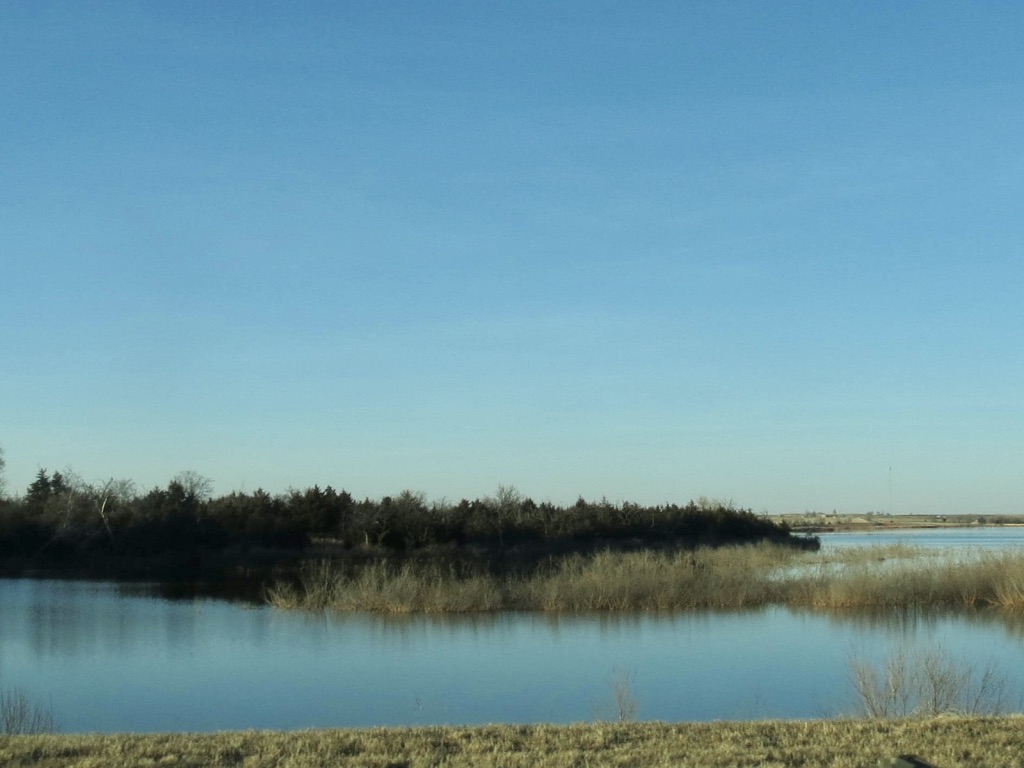
And through the land run the rivers and creeks, and in it lie innumerable lakes and ponds. In Missouri and eastern Oklahoma, it seems that every river of any size has been dammed, such that the map shows huge, meandering impoundment lakes, surely the joy of recreational fishermen, but the smaller bodies of water constantly tug at me as we pass them. 


Traveling with no more detailed map than a U.S. road atlas, I find myself constantly frustrated by not knowing the names of little creeks and minor rivers we cross. It seems wrong to take so little note of them, glancing ignorantly and never learning their names. But then, the little ponds and rivulets probably have no names at all.


Fauna

Most of the animals we have seen in the past two days have been cattle, because serious Western cattle country begins in western Missouri and continues into and across Oklahoma. I love seeing them, cattle of all colors, here a group of calves, there a couple heavy bulls fenced separate from the rest, frequent herds scattered across enormous open pasture land.


We took a little break from the toll road to explore a two-lane road for 30 miles or so, however, and there I was rewarded by five horses out in a pasture and, by the side of the road, an armadillo! The Artist said the detour would really be worthwhile if only he could spot a Rolls Royce, but the odds were against him there. Armadillo 1: Rolls Royce 0.

For some reason, I keep noticing hawks on this trip west. Today — again, without really looking for them — I managed to spot six. The first one was perched in a tree. The second and third were perched on one branch, side to side but looking in opposite directions, so that between them they would not miss anything. Hawk #4 was on the ground, in the grass, standing there as if waiting for a bus; #5 perched in a nut tree (in the first nut grove we saw), and #6 was, sadly, roadkill.

Flora

Missouri is thick with sycamores. It’s thick with trees in general, endlessly rolling, wooded hills except where cleared by the hand of man. So many outstandingly beautiful trees appeared during the course of the day’s drive, and yet how many will I remember? Most have already vanished from memory. There was one sycamore, though, its branches as white as sun-bleached bones, and at another spot along the road a lightning-killed pine stood blackened, broken stubs branches still reaching for the sky. 

Only when we stopped for gas at the start of that little detour did I finally have a chance to make a single tree portrait. Farther down that two-lane road I spotted the trip’s first soap tree yucca (another one appeared later in the day in Elk City), but you’ll have to take my word for it.


People

For much of this Monday, January 29, we were on the Will Rogers Turnpike, but other people were here before Will Rogers, and as our road continued west, signs along the way reminded us that we were entering the Cherokee Nation, Sac Nation, Fox Nation, Cheyenne-Arapaho Nation. Also, when we paused to take a break, we found ourselves among people of all ages and ethnic backgrounds and skin tones. Americans and visitors, everyone takes to the road!


The toll road we were on for most of today runs parallel to old Route 66. Pieces of the old road remain, as do remnants of former lives along it.


Monday, February 1, 2016

The West Continues to Tug at My Sleeve


Arizona neighbors


I have two books to share today, but first I’ll be taking a brief memory trip. By this time last winter, David and Sarah and I were in the high desert of southeast Arizona, bedding down in a small cabin in a ghost town, with mountains on all sides, and as I told David the other day, I think about it more than he would ever guess.

“What do you miss most about it?” he asked curiously. He never fell in love with the area the way I did. 

That kind of question, though, is almost impossible to answer! It’s like asking what you love most about someone you love: features and qualities of a person or place are not discrete building blocks, not elements at all. Everything goes together. But it seemed a worthwhile question to try to answer, so I thought a while and then said, “Maybe the light. The way the sun shone almost every day and the cabin was so bright and full of light.” 

Michigan winter

Continually overcast winter skies in Michigan are much harder to bear than snow and cold, although with the beginning of February our days are already significantly longer, and, I say happily (on a good morning), “Spring is only two months away!” Here at home, our beloved old farmhouse is divided into small rooms in the way people built in the old days in northern Michigan. Also, the gracious, windowed front porch, where we spend so many evenings in other seasons but which is unheated in winter, forms an insulating barrier along the front of the house, as does the woodshed in back, meaning that our central room, the one where we do most of our winter living, has no exterior walls and is thus protected from cold winter winds. Evening coziness is the room’s strong suit. During the day, however, it is almost as dark as tiny-windowed Basque stone farmhouse in the Pyrenees.

Contrast that with --

Dos Cabezas sunrise


Light comes in!
The ghost town cabin in the high desert was basically one large room, with uninsulated plywood walls and lots of windows. I was up every morning before or as the sun’s first light broke over the mountains to the east, and as the morning progressed I moved between my writing table and the cabin windows, with pleasure and satisfaction at the routine, first lost in working and then called to adjust, once more, the slant of the blinds. The idea was to close them against the night cold of the desert when darkness fell in the evening, open them slightly for the first morning light, open fully once the sun’s warmth became available, and then, later, angle them half-closed again to keep the cabin air from becoming uncomfortably hot. The regularity of light and darkness governed the hours of the days and nights.

I could go on at this point and start listing other things I miss, but my main point at present is only that the desert and mountains carved a place for themselves in my heart, so now I read books set in the West with greater interest and feel a personal sympathy that landscape and culture did not call forth for me before our time there.

One heart-rending book I finished reading last week was Dead in Their Tracks: Crossing America’s Desert Borderlands in the New Era, by John Annerino, and I wish I’d known about this book when Trinity was choosing to read on the subject of migrant workers from Mexico. The author’s research went further into the dangerous experience of border crossing than anything else I know or can imagine. At one time he and the four Mexican immigrant workers he was accompanying on their desperate bid to find work were out of water and facing death. His book, in fact, documents as many as possible of the lives that have been lost over the years in this dangerous crossing.

Art at border crossing
Annerino pursued his story mostly in northern Sonora, Mexico, and southwest Arizona, U.S. My little cow town in southeast Arizona, Willcox, was mentioned only two or three times in passing, Dos Cabezas (the ghost town) not at all. The low “killing fields” desert of saguaro is not the high desert of cows. Still, my single experience of being overcome by sun and heat in the Dragoon Mountains -- the part of the hiking story that I left out of my online account -- gave me some small sense of what those crossing the desert must encounter.

(One question: everyone stresses water, but no one, in either movies or books about la frontera, seems to mention electrolytes. I had plenty of water on my hike with a friend in the mountains – water, food, sunshade, sunblock – but it took me many months later, in conversation with someone who has spent years in Africa, to realize that as perspiration and breathing wicked moisture from my body, I was also losing salt and that water alone was doing nothing to replace the salt. I think, in fact, that the more water I drank, the faster I was washing out and depleting my electrolytes, because gulp as I might, I kept having spells of dizziness when my entire field of vision became nothing but buzzing light, and I had to sit down to keep from falling. Not many times in my life have I felt life’s fragility so keenly. So what about salt tablets? Does anyone carry them in the desert? If not, how do they manage without them? If so, why are they never mentioned?)

My head is spinning, my body is convulsing with chills and nausea, and the ground is heaving at me in dizzying waves of sand and rock when Marcelino first sees Interstate 8: “Mira! La carretera!” (Look! The highway!)
Some would fault -- have, I’m sure, faulted -- Annerino for lack of journalistic objectivity, but I have no criticism of his book on that count. Here is a writer who walked way more than “a mile” in the shoes of his subjects – and walked with them for miles, too. Is an objective account of such an experience possible? Where is another journalist who has had the guts even to undertake such an experience, let alone attempt to write about it dispassionately? Besides, any reader is free to dismiss or skim over the writer’s pleadings on behalf his subjects, and still the bare, unadorned, hard facts remain, facts that must give rise to urgent questions demanding answers.

If you are an American, whatever your views on immigration and border control, you should read this book.

My only disappointment with this book was technical, in that the copyediting left a lot to be desired. For that I do not fault the author, however, but the publisher, the University of Arizona Press. The editing buck always stops with the publisher, as I see it. So what gives here? I expect any book from a university press to have regularity of pronouns and agreement between nouns and verbs. I do not expect to find infelicitous, badly chosen adjectives or confusing syntax. When my inner editor has to work as hard as it did with this book, more than one someone has seriously fallen down on the job.

I’ll zero in on one very specific criticism, too. With any obscure technical jargon or regional idiom, i.e., in this book, “cutting sign” -- a phrase that appears as early as the introduction and repeatedly through the book, sometimes as frequently as two or three times on a single page -- I expect the first instance to be accompanied by a definition for the uninitiated reader. In context, we gradually figure out that “cutting sign” has something to do with tracking, but is it different from tracking or just another way of saying the same thing? If different, in what way? Informing and being mysterious are mutually incompatible goals.

Still, read the book. Read the book. Read the book! Too many people with strongly held and very loud opinions about the border know nothing of its reality in the lives of desperate men, women, and children.

From the borderland, my reading next took me northward to Nevada. Sweet Promised Land, by Robert Laxalt, first published in 1957, is now considered a classic of the American West. Where Dead in Their Tracks informs readers about the present and challenges them to envision a better future, Sweet Promised Land looks backward to the rough frontier days of Nevada in the early 20th century, open range, cattlemen vs. sheepmen, towns not yet come into their own, and immigrants who came primarily to make money, perhaps also to learn English, with always the dream of returning home to their native European villages as self-made American success stories.

Such is the time and setting of Sweet Promised Land, but that description tells you nothing of the reading experience. Part memoir, part biography, with much necessary history woven in, it is a book that rises above genre, but not with fireworks or the least pretension. A small book, only 158 pages, it begins modestly and proceeds quietly. You take it up with mild curiosity and find yourself drawn into another world – another life, that is, stretching between two very different worlds – and you are reluctant to have it far from your hand when you stop to do something else for a while.

“My father was a sheepherder, and his home was the hills.”
How does that simple sentence cast such an immediate spell? It reminds me of Isaak Dinesen’s “Once I had a farm in Africa” and also puts me in mind of the story of a nonbeliever who demanded of Hillel that he explain the Torah to him while he was standing on one foot. Hillel's response? “Love your neighbor as yourself. The rest is commentary.” In a very real sense, the life of the author’s sheepherding father in America, Basque origins in the Pyrenees, the long-delayed visit home to aged family back in that mountain range between France and Spain, and the realization of father and son that Nevada, not the Basque country, was now their own family home – all is contained, in seed form, in the book’s perfect opening sentence.

First the son tells of his own childhood and the relationship of his largely absent father to the family. While their mother managed family businesses in town, the father was in the mountains most of the time in his sheep camp, not a fixed abode but one that shifted as the sheep were moved to new grazing. All the Basque sheepherders talked of going back to France “next year” to visit families, but very few ever made the trip. But with Laxalt’s aging sisters back in the old country longing to see him again, Robert and his brothers conspire to arrange for their father to take, at last, the long-delayed trip.

And with that we leave the modern world behind altogether. In the Basque villages, following two world wars, nothing in the way of life had changed since Dominique had left:
...There was a little boy in a beret and short trousers, and under his arm a loaf of bread that seemed as long as he was. There was a crude, wooden cart pulled by two oxen, whose nodding heads kept rhythm with the gay fringes on their horns. There was a girl in a scarf and bright peasant dress....
Men still wore wooden shoes to work outdoors, and women still cooked in huge iron pots hung in fireplaces. Nothing had changed -- except the man returning to the country and everyone he had left behind almost half a century before. Years that left stone buildings exactly as they were had left their mark on human beings. Dominique would see a familiar face and think he recognized an old friend, only to learn that the friend was dead, and this was the friend’s son.

My inner editor lay back, mental pencil hand idle, while I lost myself in Sweet Promised Land. The effect of beautiful prose is to carry a reader effortlessly forward, its only drawback that the end comes too soon!

Besides nonfiction categorization and Western subject matter, the third commonality of these two books, and the most important, is the American immigrant experience. In both stories we as readers encounter the hopes of immigrants and the new land’s promise of a better life, if the newcomers only have the determination to work very, very hard to conquer poverty, overcome prejudice, and win a place for themselves in the sweet promised land.

Determination, willingness to work, and, it must be added, the good fortune to see their adventure through. One of Dominique’s fellow immigrants was not lucky. Many of those whose stories Annerino tells are not.


Poverty in Agua Prieta

And I want to dedicate today's post to my dear friend Helen. She will understand why.

Saturday, May 30, 2015

Surprisingly, Back in the High Desert


Just when I think I’m out, they pull me back in. Just when I think my head and heart have fully returned to Michigan, the Southwest borderland re-exerts its tug.

Last night it was a movie we’d seen before that I watched with new, Western-wise eyes. The opening shot was all it took. It looked like the road through Dos Cabezas to the Chiricahua Mountains – that ribbon of two-lane through golden grassland. The story was set in Wyoming, which set me to musing how many places in the West might look like Cochise County, Arizona. We watched on, caught up in the story, but I continued to eye background mountain ranges carefully.


Then it came – a sequence with Nicolas Cage driving the car, Dennis Hopper in the front passenger seat, and two other actors in the backseat: the luckless, unemployed veteran, the hired killer, the shady sheriff, and the sheriff’s wife. The car approaches a railroad crossing at high speed. Along comes a train. The driver, ordered to keep accelerating by the killer with a gun in his hand, swerves at the last minute, bumping and bouncing along parallel to the tracks and the speeding train before, overtaking it in a burst of speed, catapulting over the tracks in front of the train for a hard landing and getaway.

I come from a railroad family. Railroad safety was the gospel in our house. Scenes like this in movies always trouble me, as I think about impressionable young people seeing only excitement and not their own wrecked bodies. That’s my background.

But this time, watching the sequence, all I could think about was where it was being shot. It looked so much like Willcox, Arizona, that the make-believe of the story was suddenly secondary. There! The depot! But a big semitrailer truck strategically parked on Maley Street hide the WILLCOX sign at the end of the depot (now City Hall) from sight. And too soon the action moved to another location.


At the end of the movie, I wanted to see all the credits. Sure enough! Thanks to Willcox, Arizona! “I knew it!” I exclaimed in triumph. “I knew it was my little cow town!” Patiently, David searched back through the movie for the car-train sequence, and, like a pair of detectives carefully screening film from a surveillance camera, we watched it all again, frame by frame.


There! This scene I photographed after a rainstorm are in the movie! Even more exciting, in two different shots the twin peaks of Dos Cabezas can be clearly seen by anyone familiar with them and looking for them, as I certainly was. And finally, a local sign not hidden from camera view: Maid-Rite Feeds! The wonderful feed store east of the railroad tracks!


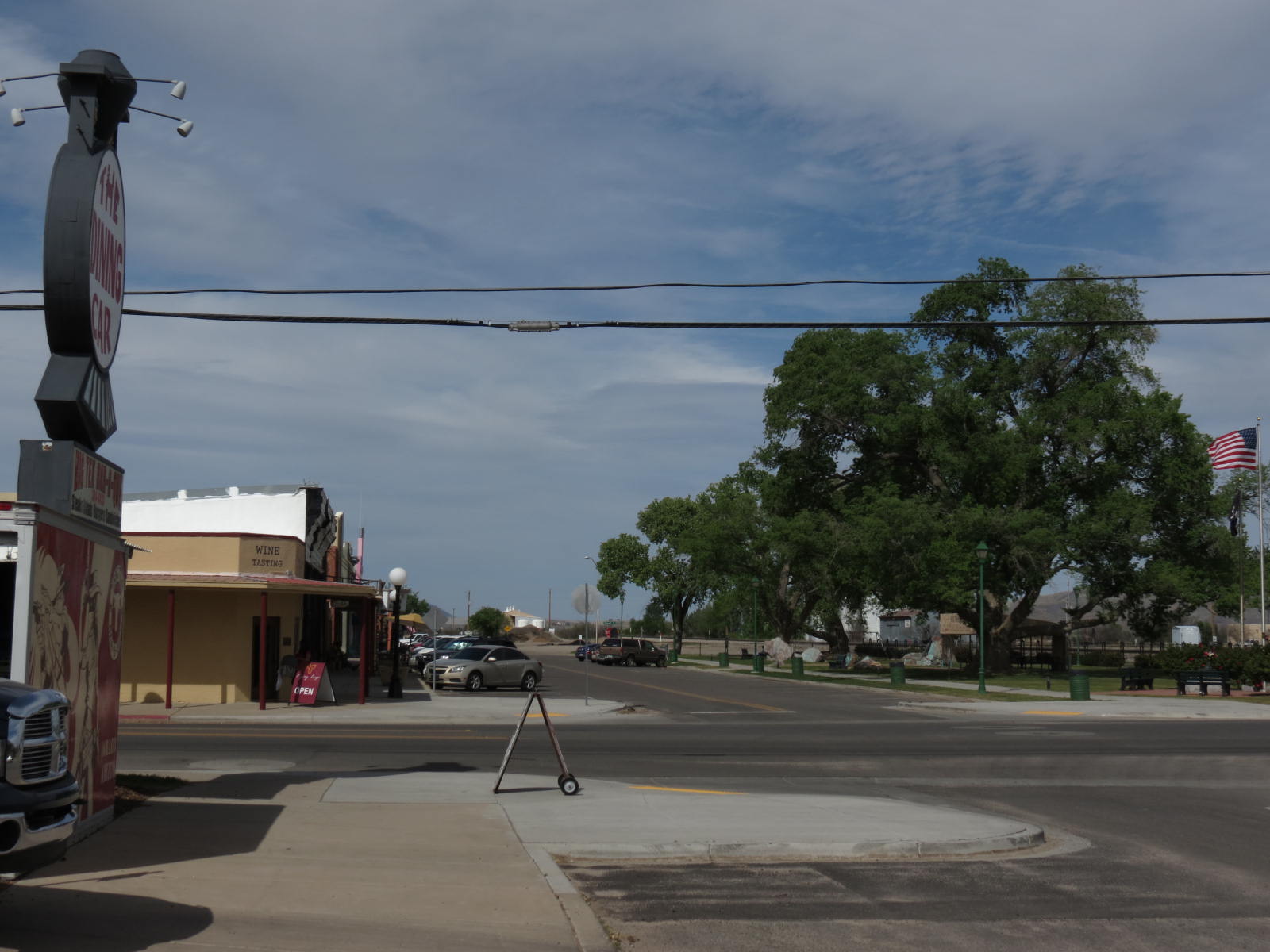
“Red Rock West” was made in the 1990s. The sculpture of Rex Allen was not yet in place in Railroad Park, but the park itself was recognizable, with its enormous trees, as was the block of old buildings facing the tracks. “Where’s Rodney’s?” we asked each other and were disappointed that while we could spot the tiny building in an out-of-focus background, the identifying sign was never visible. COMMERCIAL BUILDING on a corner was the only store sign we could see on the strip. But there! The sheriff’s office in the film had used the interior of one of the buildings, Railroad Park and its trees visible through the front windows!

All photographs above are mine, from our winter near Willcox. To take my tour through the ordinary little town (and to see Rodney and his place), click here. Below are some shots from early in the movie.

In the morning we returned once more to the opening sequence, certain now that it was not Wyoming and not WY 487 but my own beloved AZ 186. How could I have doubted for a moment? I took the shots of the opening scenes this morning but did not go all the way through to the car-train sequence. 

Opening shot: "Red Rock West"


Name that road!

Not its real name!

To see all the shots of old historic Willcox, you need to rent the movie, “Red Rock West.” (Roger Ebert loved it.) It will be an action-packed visit to my little cow town! And be sure to watch for the twin peaks of Dos Cabezas in the background.

Dos Cabezas, Willcox, Cochise County -- the movie made me "homesick."


Thursday, January 15, 2015

The Road West: Conversation Sampler


Topic 1: Which is lovelier, a herd of cattle all one color, such as all white Charolais or all black Angus, or a mixed-color herd? David plumped for an all-one-color herd, and I could see the beauty in that scheme, yet when I saw mixed-color herds, they were beautiful, too, in a different way. It’s still a limited palette, after all: black to reddish-brown through the lovely tan of
Jerseys to the cream color of Charolais. That palette (and I remember thinking the same thing in southcentral France) seems to echo the colors of the rocks and earth and trees. And to digress from cattle, sometimes those rocks along the highway look almost fake, like the big faux rochers of the Buttes de Chaumont in Paris. Or so they struck me, and David agreed.

Topic 2: When pioneers were plodding west in ox-drawn carts, did they stop and settle down in Missouri because that’s where an ox died or an axle broke? David’s hypothesized thusly, while my speculation went in a different direction. Had they continued to California, I said, they knew they would have to cross serious mountains, so why wouldn’t they have looked around the rolling, wooded hills west of the Mississippi and said to each other each other, “Why kill ourselves dragging over mountains? What could be better than this? Pretty little creeks, clean water, rich soil, plenty of stone and wood for building.” That’s how Missouri looked to me. Very appealing, a place it would be easy to call home. And again we agreed. Interesting how often we come at a topic from very different starting places and agree on a conclusion -- though admittedly one not derived logically from the original question.

Topic 3: Those neat trees in orderly rows, plantings that look so much like pecan groves -- they can’t be pecan trees, can they? We’re not that far south! But wait! All those signs advertising hand-turned walnut bowls – can these be walnut groves? Walnut trees grow as far north as Michigan, so Missouri would probably be congenial. What the trees are, of course, is a matter of fact, not opinion, and we may be wrong in what we’ve agreed is a good guess, but it doesn’t matter as we’re rolling west. We’re just keeping eyes open and minds in gear.

Topic 4: Any travel brings to mind former travels. The rocks reminded me of a park in Paris, the sycamores of southern Illinois and Ohio. Signs for particular exits brought to David’s mind trips he made one year between Arkansas and Michigan. He recalled a memorable conversation between two strangers in the seat in front of him on a Greyhound bus, both of them returning home to family after adventures gone very wrong. He described to me the worst lightning storms he’d ever been in. The next day, in Oklahoma, I told him the story of our junior high school band and orchestra raising money to charter a train to go to the National Music Festival in Enid. We lived on the train during the festival and were the talk of the town. “You’re the kids on the train!” Yep.

So there we were, rolling along at 70 mph, talking about Paris parks, 19th-century pioneers in ox-carts, trips to and from Arkansas, lightning storms in Arkansas and in Leelanau County, Michigan, cross-country train travel, and I happened to glance across a pasture where one black Angus steer had taken it into his big beefy head, for who knows what purpose, to stroll downhill like a busy, self-important lawyer headed to a newsstand. There were David and I, existing in multiple times and spaces, and this animal was busy enough living his own life, with no thought to ours. Parallel worlds.

Later (still rolling along) we began listening to a book on tape, Anthony Bourdain reading his A Cook’s Tour: In Search of the Perfect Meal, all about traveling around the world seeking good food and adventure. Our adventures are more modest, but we enjoy them. 

We're somewhere different!


Texas uses wind

New Mexico -- landscape changes again

Cowboy country, all of it
And here, in closing tonight, is a song of the West, the link sent to by friend Marjorie back in Northport, Michigan.