Search This Blog

Showing posts with label landscape. Show all posts

Wednesday, May 18, 2022

Day By Day

A new day dawns...


My “New Normal” Life


There were a couple of big songs with the title "Day By Day," very different in nature. Sarah Vaughn sings the first one, a love song, here. For the song from “Godspell,” sung by the Fifth Dimension, visit this video


My own “day by day” life is something else right now: the challenge of another 24 hours without the love of my life but with a challenging little puppy for a companion. If I’d been offered the trade – cute as the puppy is -- I would not have taken it. This is, however, what life has given me, and having Sunny Juliet as companion is better than being all alone. Also, everything is beautiful these days in Leelanau County, orchards full of bloom along nearly every road. “We live in a beautiful place,” the Artist so often remarked. I mustn’t lose sight of that truth.


When SJ and I arrived home from our cross-country odyssey a week ago Saturday, and she was introduced to her Michigan house and yard for the first time, the air felt like June, at least. It cooled down to an April kind of evening, but those first spring days back in Leelanau were followed by others that felt way too much like summer. “If May is this warm, what will July be like?” everyone wondered. Kind of worrying.


Then my puppy didn’t feel well the following weekend. (Of course, the weekend! When the vet’s office was closed!) Her little head and tummy felt unnaturally warm, feverish. She was lethargic and had no appetite. That was very worrying! Her behavior and demeanor were so unlike her that I yearned for her usual maddening naughtiness. Please, let my puppy not be sick!


Not herself

Monday I took her to see the vet, and by that evening, after IV fluids and antibiotics, she was ready for a good dinner. The furnace came on that night, also, and Tuesday morning was so chilly I had to layer up to go outside, with Sunny so much herself again that I could hardly get my socks on, what with her wanting to make a game out of pulling them off my feet before they were all the way on. Cool weather, challenging puppy. Back to normal. 


"Mine!" She has recovered!


And so we go forward, Sunny and I, day by day. 


...and comes to an end.


My Recent Reading


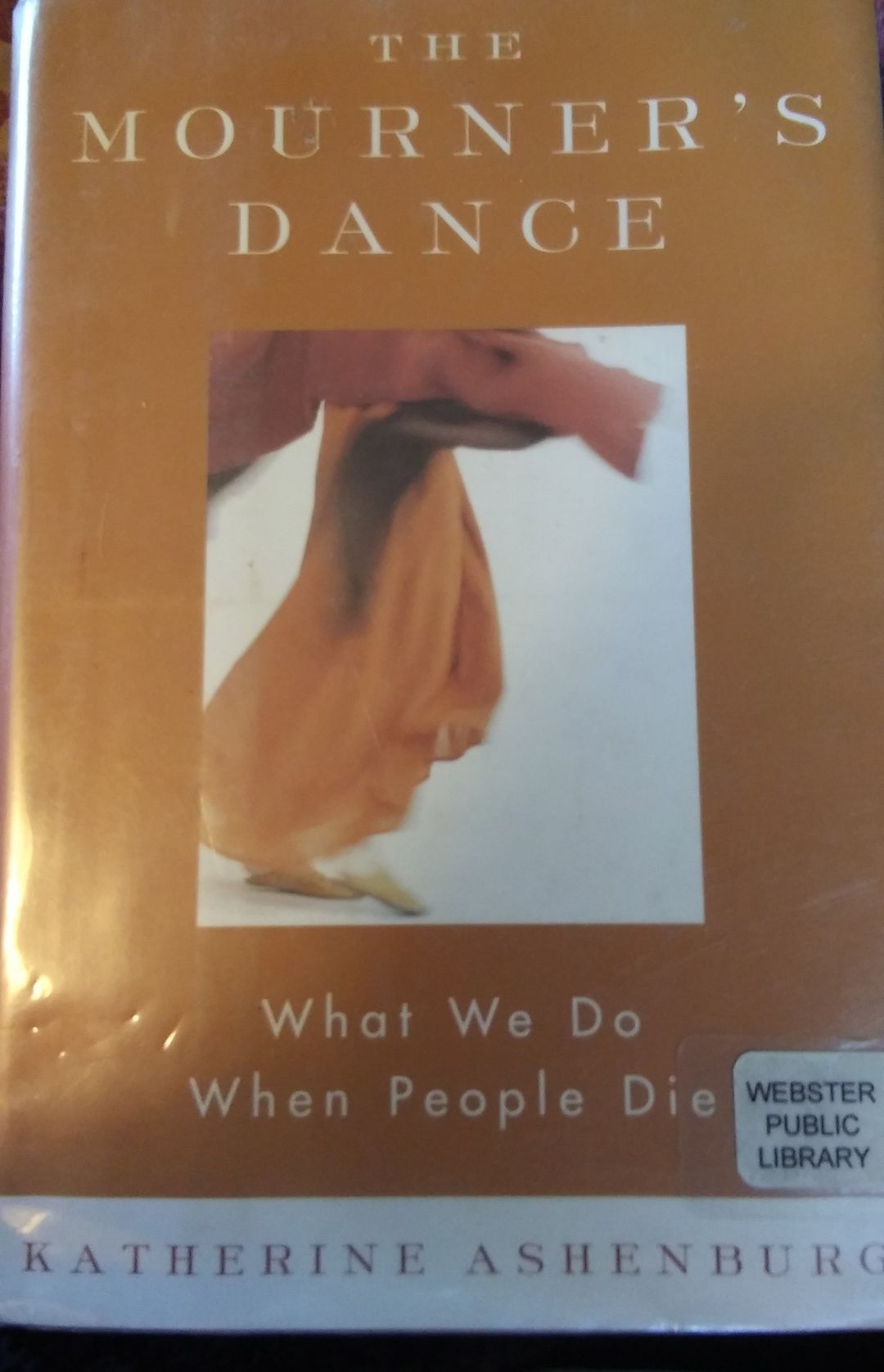
Last night I finally finished a nonfiction I began reading while still out in Cochise County, Arizona. The Mourner’s Dance: What We Do When People Die, by Katherine Ashenburg, was inspired by research she undertook after her daughter’s fiancé was killed in a road accident, so that, instead of the wedding she had been planning, Hannah found herself participating in a funeral for the young man she had planned to marry. Ashenburg reviews mourning customs around the world and historically in Western culture but comes back again and again to mourning rituals that Hannah devised for herself, since in today’s United States there are no universally prescribed and accepted forms. 


At first, I was interested in how naturally Hannah’s homegrown practices had welled up in her, and how similar they were to age-old ways. More and more, as I thought about mourning customs, many of them made psychological sense to me. 


This is an unusual book, both personal and general survey, but the two aspects join well. For example, in the chapter entitled “Sad Clothes,” a history of mourning dress (with Queen Victoria centrally featured), the author reports that she asked her daughter --


…if she wished she lived in a world where she could wear a universally understood mourning sytmbol, like an armband, and she said simply, “I would love that.” …Other mourners corroborate Hannah’s feeling. A few months after her father died, the writer Barbara Gowdy was walking down the street, missing him. A stranger in the opposite direction took note of her woebegone face and jokingly ordered, “Smile!” Months later, she was still angry as she remembered the episode: “That never would have happened if I had been able to show by my clothes that I was in mourning.”


Hannah’s personal mourning garb was a “vivid orange vest made of padded parachute silk,” a Christmas gift from her fiancé. My own widow’s weeds are an old, faded t-shirt of the Artist’s, and I also wear his watch and, almost every day, with jeans, one of his belts. 


The author mentions more than once that during gatherings of mourners, Hannah was offended by social conversations having nothing to do with Scott, her deceased fiancé. It is all too true that "life goes on" and that people have many personal concerns of their own besides the loss of a friend or acquaintance. But grief is unavoidably self-centered. Regardless of how many friends and relatives I lost prior to losing the love of my life, with the loss of him I felt like -- knowing full well that it was not at all the case -- the first widow in the world and the most deeply bereaved lover of all time. So when someone says helplessly, "I don't know what to say," I am not offended in the least; when they utter stock phrases, such as "I'm sorry for your loss," I appreciate the effort; and any time someone has a story or a personal reflection on my husband to share with me, I am grateful. When no reference is made to his death, however, I feel as Hannah did, resentful and aggrieved. One world has vanished, and another, left behind, has been shattered. How can that be ignored?


Another nonfiction book I read in the past week concerned the last days of the author Marcel Proust. Proust at the Majestic: The Last Days of the Author Whose Book Changed Paris, by Richard Davenport-Hines, started off slowly for me, with far too many facts and names crammed into the first chapter, and there were many repetitions through the work, but it held my interest and kept me company and lulled me to sleep for my first week back in Michigan. The detailed report would be meaningless to anyone not familiar with Proust’s work, but for those in love with A la recherche du temps perdu it is fascinating to see the concentrated effort needed for the writer to finish his work, as well as to learn that all Paris, from titled nobility to cab drivers, came to a shocked standstill when they heard of his death. 


County in Bloom


Cherry blossom time!

I was only home a week before the cherry orchards burst into full bloom, along with all the wild cherries, and now my little apple trees, too, are flowering, and I find myself telling Sunny frequently what David so often exclaimed to me, “We live in a beautiful place.” I imagine Sunny appreciating the landscape with her nose, taking deep draughts of orchard tree and dandelion perfume. Lilacs will open soon. Orioles are passing through! (See more blooms here.)


And I will be opening the bookstore soon, though "regular" hours may be elusive for a few more weeks, as my life remains in disarray, regardless of how many tasks I check off the list of things to do.


Monday, February 5, 2018

Views, Texts, and Subtexts


We had an interesting if ordinary weekend. No huge adventures, but we stumbled on a little flea market in Willcox on Saturday, where I was happy to find a woman with lot of housewares priced to sell. I found this lovely coffee mug, three others not quite as stunning (but the Artist is happy with solid black), and a steamer pot, with steamer but without lid. I love the Southwest colors of my mug. David bought a few DVDs he can watch on his laptop if he gets too desperate without movies.

But we went to the movies, too. On Sunday afternoon we went to a matinee at the Willcox Historic Theatre, down on Railroad Street. The movie was “Hostiles,” one a lot of friends back in Michigan have seen recently. 


In discussing the film afterward, we agreed that “Hostiles” was pretty much a set piece. You knew right from the beginning that the Indian-hating cavalry officer would come around to an understanding with his old enemy, Chief Yellow Hawk, and you knew the chief would survive the trip to die on his home ground, or at least in sight of it. (Spoiler: He makes it all the way.) Once the woman whose family was murdered joins the group on the trail, you know she’s going to end up with the cavalry officer, and you also know that the captain’s friend, the bearded one who has lost track of how many people he’s killed (he tells a young soldier, “You get used to it”) and says his soldiering days are over — you know he’ll be dead before the last frame. 

I’m not saying I didn’t enjoy aspects of the film, but what I enjoyed most was the scenery. The opening scenes in New Mexico, vast grassy desert and rocky mountains (though not the Rocky Mountains) were very much like the scenery here in Cochise County, Arizona. So if you see the movie, you’ll have a good idea of what we see every day when we go outdoors from our cabin. 


Back to the movie, though. It was very much a white man’s movie. The chief is noble and stoic, the settler woman whose family was murdered is blonde and beautiful, the cavalry captain ruggedly handsome. Both the captain and his doomed, bearded friend come around in the end to realization of the white man’s sins against the Indians, and the captain “does the right thing” by the chief and his family, but in the end all the Indians are dead except the little boy, who is taken under the wing of the woman who lost her own children, and we’re pretty sure the captain will complete that little family circle. As I say, a white man’s movie. 

It reminded me of the French movie, “Indochine,” with Catherine Deneuve. That film was set in Indochina, obviously — Vietnam — and clearly the challenge to the movie makers was how to make a film about colonialism and war in Vietnam, a sad chapter in the history of France, palatable to a French audience. I’m hazy now on the details but retain a general impression that the young Vietnamese man, near the end of the film, acknowledges Catherine Deneuve as his “real mother,” which I took as an intentional subtextual metaphor, Vietnam acknowledging France as its cultural parent. Again, white man’s view.

We'd been to the only bookstore in town on Saturday, a little shop run by the Friends of the Library, where books are cheap and where local honey and jam can also be purchased (mesquite blossom honey seemed an appropriate choice), and among a selection of battered volumes in French and Spanish -- Spanish because I'm learning and French because I don't want to lose it -- I also bought a river story. David and I both appreciate river stories, and I thought Swift Flows the River might be good for bedtime reading aloud, an imaginary travel up the Columbia. Wouldn't you know! The novel begins with an Indian massacre! I didn't even get through the whole scene before laying the book aside. I'll probably go back to it, because the map endpapers promise quite a lot in the way of upriver exploration, but why did it have to begin the way it did? I feel trapped in the history of my country.

And aren't we all? Trapped in the histories of our various countries, trapped in world history and world "progress," such as it is? There was a quote from D. H. Lawrence at the beginning of "Hostiles" that I'll have to look up online....

The view of the country around here pleases me, but I cannot claim the view of the hawk. What does she see from her high, slow swoops across the sky? I read the Range News and wonder at the subtext of stories on various local and regional issues. The starting point for any view I have, on any subject, is that of a white Midwestern American woman of my generation, but I hope I can imagine, if only imperfectly, how those of different backgrounds might see my view and how it surely differs from their own. 

I have reviewed the first eight chapters in Ultimate Spanish that I'd labored through back in Michigan and am now launching into Chapter 9. Clearly, any success I manage to achieve will be due to review, review, review. ¡Siempre me olvido! It is so easy to forget what one has "learned" only recently, easy to fall back on what is familiar but wrong in the new context, since ça fait longtemps or it's been a long time is not the same as hace mucho tiempo

And isn't that exactly the problem with the subjective, parochial, and monocultural points of view that all human beings can't help having? It takes a lot of work to get outside and stay there for any length of time. The filmmakers tried with "Hostiles," but the pull of unconscious and deeply held narrative expectations and standards brought them in the end to dead Indians and a conventionally handsome white couple left with the Indian boy they would adopt and raise. 

What would that boy's life be? What was it up to this point, and what would it be from now on? Through his eyes. Now there would be a movie.

And here's the D.H. Lawrence quote:

"The essential American soul is hard, stoic, isolate, and a killer. It has never yet melted."

Agree or disagree?


Monday, May 25, 2015

Beautiful Landscape in Human Scale


We went downstate on Friday for a family wedding on Saturday and spent two nights in rural Van Buren County, stopping in Plainwell (Allegan County) on our way and then taking D Avenue west to Van Buren Youth Camp, the setting for the weekend wedding party. Although there were plenty of cows and horses in the neighborhood, it was nothing like our past winter's digs, and we observed once again how human is the scale of Michigan landscape. Lake Michigan, of course, is magnificent in scope and grandeur, as are the Sleeping Bear Dunes, but most of what lies inland -- woods and fields or meadows bordered by woods -- has a quieter, more ordinary kind of beauty that speaks to us of home.

In the Southwest, geology on a vast scale of time and space obsessed us. Not so Michigan. "The four ice ages that we define as Pleistocene are relative recent geologic events," writes Thomas H. Hooker in his new book, The Last Ice Age and the Leelanau Peninsula: Pleistocene and Lake Michigan. Glaciers and dunes, moraines, old Lake Nipissing, the ancient Algonquin shoreline -- it's all here in this little book, itself presenting a story in manageable scale. The glossary brings back to me memories of misty, long-ago high school earth science classes, as do helpful charts and tables, while color photographs make clear that this is the story of our very own Up North neighborhood.


The Last Ice Age and the Leelanau Peninsula beautifully complements Dennis Albert's Born of the Wind: Michigan Sand Dunes, along with The Lake Michigan Rock Picker's Guide, a perennial favorite and must-have northern Michigan cottage title. Yes, it's good to be home again.


Monday, May 4, 2015

Back to the Blue


A good friend here in Leelanau County commented that she didn’t care much for the Arizona high desert, all that “brown landscape.” It’s true, there is not a lot of color in the prismatic sense. I found, however, a lot of local color, to use the term in something other than its literal sense, and I loved being immersed in a culture so different from what I’ve known for most of my life. But it’s good to be home, too.

Home. Michigan. Coming home to Michigan from Arizona feels much more different from years-ago homecomings from Florida, the Southwest itself much more different, mostly in the absence of greenery and blue water (both of which are abundant in Florida), so that what strikes me most this spring on re-entry is seeing Lake Michigan again, Grand Traverse Bay, Lake Leelanau, even the little creeks running everywhere through the county. We were driving a few days ago on a road down by Cedar, and I remarked to David, commenting on a ditch running with fresh, clear water, “In Arizona, that would be considered a river.” More than that, in the Southwest I oriented myself by mountain ranges, whereas now, back home, I have returned to orienting by bodies of water.

Another friend reminded me, when I was rhapsodizing online about Arizona horses, that we have horses here, too. Indeed we do, and also cows, and I have been seeking them out in the landscape. To make sure I see horses every day is one of my personal "goals" for 2015. Cows are good, too. Horses: exciting. Cows: calming.


For yet another friend, who mentioned that I hadn’t posted any photos of the outside of our winter getaway cabin, here's one for Joanne, though it has nothing to do with anything else in this post.


Returning to the land of blue water has also brought me back to new books by Michigan authors, another refreshing source of joy. I have come home to In Pursuit of Birds, by Ladislav Hanka of Kalamazoo, and Testimony of the Senses, by Cory Oldweiler of Leland, to mention only two outstanding examples. There are many more, and I’ll be writing about some of them soon in this space.

My hours for May are Wednesday through Saturday, 11 a.m. to 5 p.m., except for Memorial Day weekend, when we will be --unthinkably! -- closed to attend a family wedding. Stop by soon when we're open to put your name on the reservations list for the Hanka book, which I will have in stock later this month.


Books are alive and well in Northport, I am happy to report. The first day of the Dog Ears Books season, Saturday, May 2, was filled with friends and customers, hugs and sales. It is a rich life here in the Upper Midwest, on our peninsula on a peninsula in the Great Lakes.