Search This Blog

Showing posts with label Southwest. Show all posts

Wednesday, May 1, 2019

They came in the gloaming to bid us farewell


It was the hour past sunset, with light leaching away imperceptibly but steadily from land and sky when we, inside the cabin, heard them lowing close by. “They’re in the yard!” we told each other. Their nearness was not unusual, but as it was our last evening we couldn’t help being pleased that they had come as we hurried to step outside for one more close encounter. 

Earlier in the day, on our way back from errands in town, we had stopped for a visit with a small family group of horses grazing by their shrinking seasonal pond — two mares, their spring foals, and the pater familias. Every time our road took us past their spot, we looked for them. Sometimes they were off in the far distance, the little ones lying down in the grass, invisible to our searching gazes, and occasionally we saw them not at all, but on the best days there they were by the pond, tantalizingly close. 

The family that grazes together...
My little darling on the left, but "the other one" is pretty, too.

Some of life’s last times we realize only long afterward. We look forward confidently to another meeting, “the next time we see each other,” only to find, at times, our best-laid plans and confident expectations overthrown. And really, we never do know for sure. We say, “Until we meet again!” ignorant of whether or not that next coming-together will ever take place. 

Gloaming is a sweet time of day, giving yet enough light to justify our calling it day, even as we know night is falling. The word comes from an Old English word meaning to glow. Some definitions give dusk as a synonym, but to my ear dusk emphasizes the coming darkness (as does for me the French word crépuscule), while gloaming speaks of the lingering light. Just so, at parting with friends and places we can choose to emphasize to ourselves the coming separation or hold to the warm glow of friendship and love.

How can I claim to love this part of the country, a Facebook friend asks, when I have known it so briefly? She did not know me as a horse-crazy girl, gazing over the cornfield across the road and dreaming on my parents’ front porch of riding my horse off into the sunset! How could John Denver claim to have been “born in the summer of his 27th year/coming home to a place he’d never been before”? (How, really, does any of us ever decide to marry? The love of forty years is different from and deeper than the excitement of new love, but only the latter makes possible, eventually, the former.) And I have immersed myself in the Southwest while here, exploring it by car, on foot, and through reading its history. 

Arizona has its problems and shortcomings and shameful aspects to its history, as no one would deny. So does Michigan. We do not love places or people for their perfection, since that is nowhere to be found, but for their beauties and despite their imperfections. And does not every human love bear within it a seed of sadness, a heartache that is part and parcel of love, emblematic of our human mortality?

Mountain hidden in snow clouds

Adobe ruins in snow

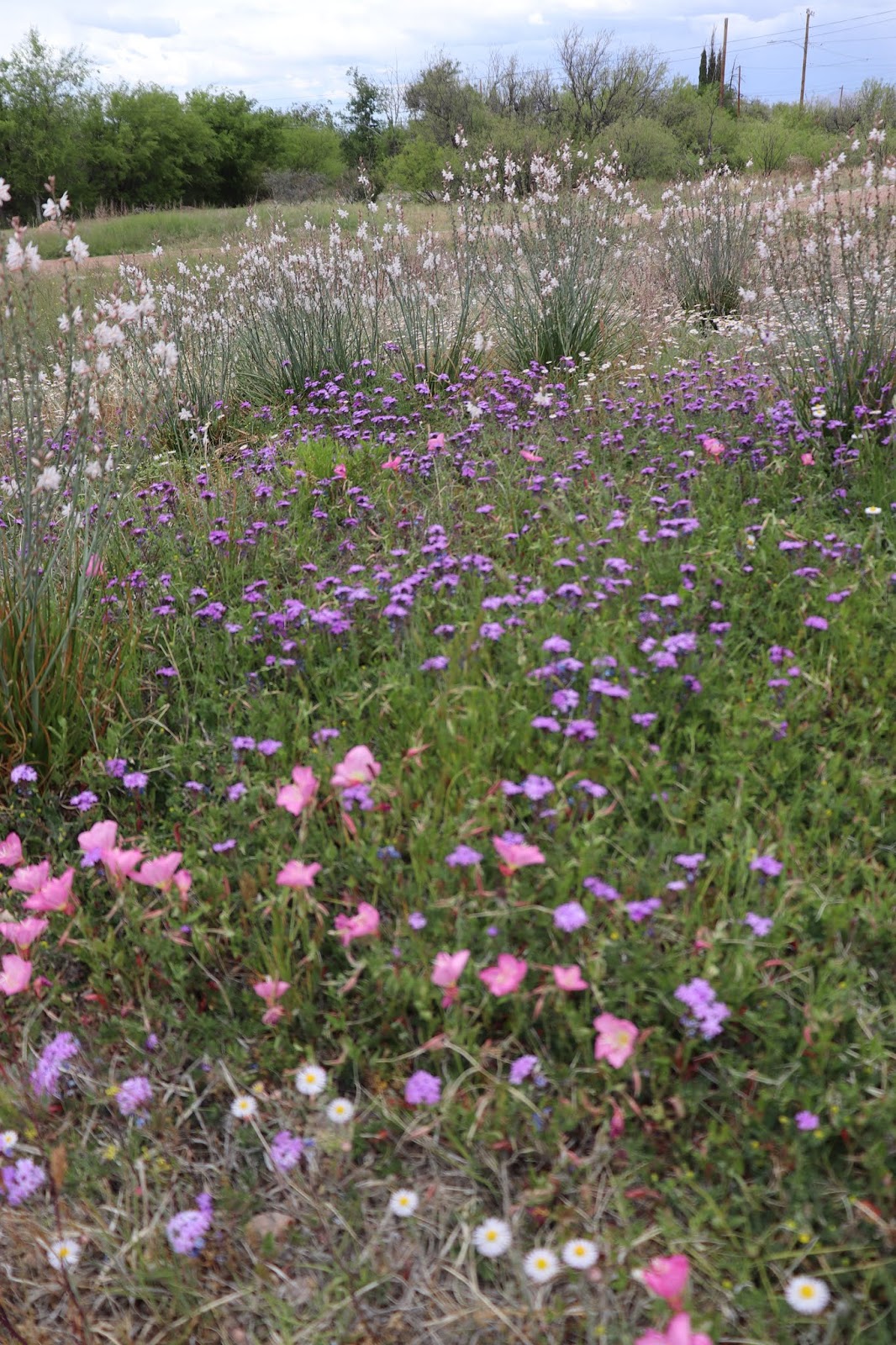
This has been the third long visit the Artist and I have made to southeast Arizona, and as we came earlier this time than in previous years, arriving in mid-December, we were surprised to find summer’s leaves still clinging to the mesquite. Mid-December was only autumn, not yet winter! Then winter arrived, with heavier and more frequent snows and much colder nights (several times below zero) than usual for this part of the country, and it was a beautiful if challenging season. Now it is spring, and after a bountifully rainy winter and spring, the high desert spring is unusually green this year. 


Tombstone flora
Our three stays taken together, I realized this morning, add up to almost a year, and we have now experienced three seasons out of four. Summer here would be the most difficult season, of course, for Northerners, but here in the ghost town, at an elevation of almost a mile above sea level, I’m sure it is much more bearable than Phoenix! Besides, my ghost town hiking partner tells me, the key to summer is to get up and out early, at “first light,” and that would suit me fine.  That time of morning before sunrise when the sky gradually grows light is my favorite time of day. 


But summer and fall call us back to Michigan. Wildflowers must be blooming already in the woods, the sweet, precious spring ephemerals! Favorite walks will be there again for my morning rambles outdoors with Sarah. Memorial Day weekend will be Cars in the Park in Northport, and late September will bring Leelanau UnCaged! And every morning and night our dear home, every day our dear friends…. Another place, another love.

Back now, though, to the cattle, right here. As the high desert grows greener, it is becoming more difficult with each passing day to keep track of cows in the mesquite, but one can follow their voices, and we do that until we catch a glimpse of one, then two, then another pair, and down by the highway a delightful, very little scampering calf! I will miss them, their voices and their smells and their rich, beautiful colors.


I remember her face from last year.
Northern cardinal -- see you in Michigan!
So bless the cows and horses, the birds and deer! Bless our human ghost town neighbors, too, who have made us feel so welcome! We plan a return next winter. At hand now, however, is our return to northern woods and shores, to our old farmhouse set amid cherry orchards, and our places of work in a harbor village, a scant 607 feet above sea level. And so for now we bid farewell to mountains and mesquite, dry washes and agave, mule deer and pyrrhuloxia and cactus wren and canyon towhee and wish all in southern Arizona a happy and healthy summer and fall. And we thank the cattle for coming to bid us farewell on our last evening of this particular long visit.

Yes, it is very possible to love more than one world, and the love for one does not diminish or denigrate love for the other. As Jane Austen had one of her characters in Northanger Abbey observe, “It is well to have as many holds on happiness as possible” -- and I have been very happy here.


Sunday, April 14, 2019

Western Books, Boots, Blooms

"New" to me
You see above books purchased on a single day here in the Southwest. Not that I go this wild every day, mind you. Occasionally I come home without any additions to my ghost town library. On this particular day, except for the books of poetry, an old Nancy Drew, and an Alexander McCall Smith novel, Western themes predominate, as is often the case here. You can see books of memoirs, essays, horses in fiction and nonfiction, and a novel by Edward Abbey. That’s because reading, like walking and driving and eating regional food, is part of how I immerse myself in my surroundings, wherever I am. 


Freely (albeit sadly) admitting to anyone who asks that I have never had a horse of my own (the tragedy of it!), I can’t help looking at boots, either, and the other day Fate put a pair directly in my path, saying, “Take these home!” Definitely riding boots, don’t you think? It happens that they are more comfortable for walking than my other Western pair, the fancier boots probably intended for dancing, and either pair will do for public and social events, don’t you think?


The Artist says I am becoming a “modern person,” basing this on a paucity of evidence, one bit being that I recently downloaded a free plant identification app for my android phone. It hasn’t made me a part of the educational community using the app, since I don’t recall signing up for a password when I downloaded (and if I did, don’t remember what it was), so I cannot submit my findings to have them included in the database, and the whole thing doesn’t work as instantly as you might expect, either. It isn’t as if I click a photo and get an immediate and definite identification. For one elusive little specimen, I scrolled through many rows of suggested possibilities, finally referred to one of my print wildflower field guides, and then took what I had gleaned from those two sources to the Internet to find at last the undistinguished and easily overlooked little blossoms at my feet — a lengthy bit of detective work that allowed me at last to give a name to Phacelia arizonica. Now where did that photo go?

toadflax
Linaria purpurea (common toadflax - above) was much easier. Quite honestly, though, you could be trampling all over these little flowers with your cowboy boots and never notice them, unless there are a couple thousand plants crowded together. You really have to care. Single specimens do not stand out in the larger landscape.

Up at 5:30 a.m. to meet a neighbor at 6:45 for a hike up to old mining ruins, I was ready to hit the hay early on Friday evening, falling asleep over my book while the Artist watched something on television. On Saturday evening, at the end of another day in the mountains we both sat down with books after supper. I wonder if you can guess which of the pictured books at the top of this post entertained me for two evenings in a row? You might be surprised.


Wednesday, May 9, 2018

Traveling Around Home — Any Takers?

They do things a little differently in other places
My sister handed me a book the other day that she thought I might enjoy and/or add to my used inventory at Dog Ears Books. The title is Bucket List Adventures: 10 Incredible Journeys to Experience Before You Die (I always think that’s the best time to do things, don’t you?), and while as I turned pages, I realized that author Annette White’s idea of travel adventures was much more ambitious than my own — Tokyo, Costa Rica, Jordan, etc. — some of her ideas on how to travel struck a chord with me. For instance, this section heading, “Immerse Yourself in the Culture.” 

When many arrive to a foreign destination they make the mistake of visiting without ever really leaving their own world. They choose the route of being a tourist looking from the outside in. … They are spectators…. 

… The deepest travel happens when you integrate into a community by actively participating, opening yourself to interact with the locals, and understanding the way they live. This can be as easy as actively participating in their rituals, eating traditional dishes from the region, or learning the history that makes the city [sic] what it is today. 

White has much more to say on the subject, but that was enough to get me thinking. I thought about eating octopus seviche in the Yucatan, trying cheese on my grits in Savannah, cheering the junior rodeo contestants in Willcox, AZ, and walking in the washes of Dos Cabezas with a ghost town neighbor. If you’ve followed Books in Northport this past winter, you know we made many good friends in Dos Cabezas, but even three years ago, as strangers, we made it a point of to explore the whole of Cochise County and to learn about its history and natural history, as well as attending public events from art shows to rodeos.

Letting down personal barriers, going beyond one’s own cultural comfort zone, meeting strangers on their own ground and on their own terms, listening and learning and looking to understand — it doesn't have to be as big a deal as crossing a swinging rope bridge over a yawning chasm.

Let me address the simple grits with cheese in Savannah. How much simpler can travel get? The outdoor restaurant was busy that late morning, and our server had probably been running ragged for hours. He was formal and attentive but distant, just doing his job. He asked if I wanted cheese on my grits. Automatically I said no, then stopped and said, “Wait! Is it good that way? Do you recommend it?” He said yes, and so I said I’d try my grits with cheese. Such a small "adventure," hardly meriting the name, wouldn’t you say? As it turned out, I did enjoy grits with cheese. But the food was secondary to my happiness when I thanked the waiter for his recommendation and saw his face break into a smile for the first time. We had broken through to each other and, for a moment, connected. Even if I had hated cheese on my grits, I would have be glad to order my breakfast that way for the sake of the waiter’s smile.

During our ghost town winter, we met people who live very differently from the way we live in northern Michigan — those who carry guns on their hips (only one neighbor but a nice man), those who hunt (as do some of our Michigan friends, though we don’t), and those who are happy, for one reason or another, with the political direction our country is taking these days (which we, I admit, are not). I will emphasize that there is no more unanimity among Arizonans than there is among Michiganians. Nevertheless, we were on Arizona turf and not looking for arguments. We were the aliens, the strangers, visiting and trying to get to know another (diverse) culture. 

So now, looking back at the Southwest from the familiar Midwest, I wonder how it would be if more of us approached each other at home as if we were travelers in a new land, listening rather than arguing, trying to understand, extending a hand in goodwill rather than standing back with arms crossed tight against our chests. 

One of my winter projects in Arizona was studying Spanish, and for weeks I made good progress. Then an unexpected, though brief, hospitalization threw a monkey wrench into my routine, and I never did get back into it with the same discipline. No matter. I really did have enough of the language to order my Sonoran hot dog in Spanish. Only timidity held me back. Why? Why so timid, self? I was disappointed in myself. Finally, however, at the Blue Hole in Santa Rosa, New Mexico, a nice man stopped to admire Sarah and began speaking to her in Spanish. My opportunity! “Se llama Sarita,” I told him. His daughter’s name was Sarah. I admitted that ‘Sarah’ was my dog’s name, too. 

It was only a moment, like the waiter’s smile, but that moment made my day. Could we do more at home to make each other’s day? I’m going to try to keep that in mind over the season ahead. 


Dare to cross the bridge?

Saturday, April 28, 2018

After Breakfast With “The Girls”

Driver Cheryl & Guide Terry
I didn’t ask permission from the whole group to picture them on my blog, so you’re not seeing eight women here, but I was pleased to be invited out to breakfast with a group of our ghost town neighbors. We met at the Hitchin’ Post in Willcox and all had a real good time around the big round table. After breakfast came more fun, a delightful surprise, though not actually planned for my delight. Here’s what happened.
We were four in the car on the way to town, but Dorothy’s husband picked her up at the restaurant (they were driving down to Sierra Vista on errands for their B&B), which left Cheryl, Terry, and me to return to the ghost town together. While I was saying good-byes to other women I probably won’t see again this year, Cheryl and Terry were conferring in the car, and when I got in they asked, “Do you mind if we swing by the sale barn? Do you have time?” I asked what the “sale barn” was, thinking it might be some kind of rummage sale I’d somehow missed. No, it was the cattle sale barn, the Willcox Livestock Auction! Terry had worked there for years, first on horseback, working cows, and later in the office, and she needed to stop by to pick something up. As it turns out, the auction wasn’t set to start until 11 a.m. (which surprised me; I’d thought they would start earlier), but we took time for a short tour. I’d been afraid I wouldn’t get to the auction grounds this year at all (after a memorable time there in 2015) and had never been in the office area before, worth seeing for its signage. 

Two diff'rent fellas? 


I remembered the sale arena, with wrought-iron designs made by Future Farmers of America students marking the end of each row of seats. Terry pointed out the scale and explained that the whole process is much easier now with the scale in the auction “ring.” But there was no action yet in that area, so we quickly proceeded out to the pens and chutes, where gorgeous sights met my gaze — cowboys on horses, cows and calves of all colors and sizes — along with the incomparable, heavenly aroma of sweet hay and fresh cow manure. Ahhh! Cheryl and Terry kept asking if I needed to hurry back home, and I kept assuring them we could take all the time we wanted!


“Do you know how the auction works?” Terry asked when we were back outside. She pointed out the area where cattle for sale were unloaded and their ear tags recorded before they went by the state inspector who checked the brands on each animal. It’s a good system, protecting the ranchers from having rustlers steal and sell their cattle. I remembered that cattle are sold either individually or by groups, with prices offered per hundredweight, and I got the basic gist of the other rules and procedures but was somewhat distracted, honestly, because — well, what is better than the sight and smell of cows? You guessed it, right?


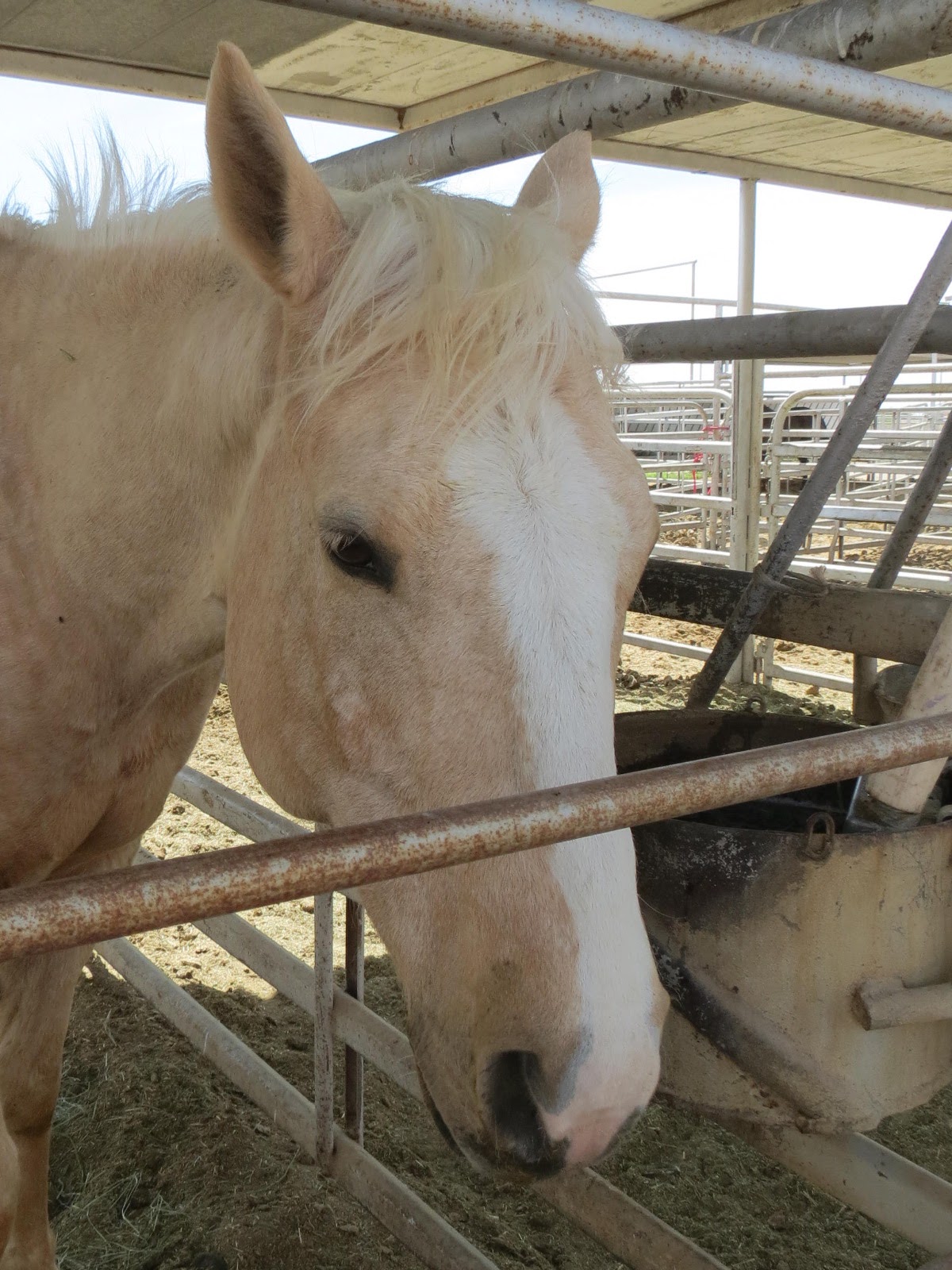
The big blond beauty had the sweetest horsey temperament in the world! At last, after three months in the Southwest, I get my hands on a horse! Was it love at first sight (on my part)? Another horse, a little paint, was a more appropriate size (for me) and had the prettiest little head, and it wouldn’t be right to have only one horse, would it? Horses are herd animals, after all, so if a person is going to have one, that person had better have at least two. And look at the pretty little mini-braids in the painted pony’s mane. 


As if this weren’t enough, further distractions (albeit minor in comparison) were provided by the presence of poultry wandering aimlessly wherever they pleased. Handsome roosters, aren’t they? “People just drop ‘em off,” Terry said. “One day someone dropped off ducks!”


Later, when Cheryl pulled up in front of Terry’s house in the ghost town, I understood the significance of the faux license plate on the fence. Terry not only worked at WLA but grew up on a ranch (as had three other women in the group around the breakfast table), and out here, on the ranches, it’s all about the cows. Well, and about the horses, too, even in these high-tech days, thank heaven! 


And thank you, Cheryl and Terry, for a wonderful surprise breakfast “dessert”!


Thursday, April 5, 2018

Faraway Jewels


I bought the book Chiricahua Mountains: History and Nature, by William Ascarza (Charleston, SC: Natural History Press, 2014) over at the Southwestern Research Station near Portal, an expedition you haven't heard about yet, but only started reading it after David and I took a picnic lunch over to Faraway Ranch at the Chiricahua National Monument. The deeper one gets into Chiricahua history, the richer every visit to the place becomes. Coincidentally, we had also met a member of the Riggs family a few evenings before at a gathering here in our ghost town neighborhood. On our next drive to Chiricahua, then, we stopped at the Riggs Family Cemetery on the way. 


I did not photograph every grave in the cemetery and do not now remember the oldest person buried here, but I'm pretty sure she was 97 and born before the Civil War. My favorite headstone, though, was the one just above, a large natural rock erected on the grave of Edward Murray Riggs, son of Thomas J. and Eula Lee Riggs. Edward lived from 1885 to 1950, and I'll transcribe for you the entire text that appears on his stone, because it tells a lot about why the family is so important in this area, other than their considerable ranching history:

HE GAVE TO THE WORLD THE WONDERLAND OF ROCKS. HE ENGINEERED THE CONSTRUCTION OF ECHO TRAIL. HE WISHED THIS TO BE HIS MONUMENT. HIS CURIOSITY AND LOVE OF NATURE INSPIRED HIS DISCOVERIES. HIS ENTHUSIASM AND TACT ATTRACTED OTHERS TO HIS FIND. HIS TIRELESS EFFORTS OPENED THE AREA TO THE WORLD. WHERE HE BUILT THE FIRST TRAILS, THE TRAILS OF TODAY FOLLOW.  
HIS WAS A FAITH THAT LOOKED ACROSS THE RUGGED MOUNTAINS TO THE PLEASANT VALLEYS BEYOND; A GENTLE KINDLINESS LIKE THE WARM SUN ON A SHELTERED SPOT ON THE TRAIL; A REGARD FOR BEAUTY THAT MADE LIFE A PLEASANT VALE; A SKILL AND PERSEVERANCE THAT CONQUERED HIS WORLD. 

The Chiricahua Mountains are a most appropriate backdrop for this small jewel of a cemetery. 


Faraway Ranch itself was the homestead of Neil and Emma Erickson, Swedish immigrants who settled in Bonita Canyon in 1888. Three miles from the the Erickson ranch was that of Brannick Riggs and his wife, and it was Lillian Erickson, daughter of Neil and Emma, who married Ed Riggs, grandson of Brannick. 


Ed and Lillian operated their property, as had Lillian and her sister previous to the former’s marriage, both as a working cattle ranch (500 head) and as a guest ranch, offering horseback tours through what they called the "Wonderland of Rocks." Chiricahua National Monument was established by President Calvin Coolidge in 1924, largely due to the efforts of Ed Riggs. The National Park Service acquired the Faraway Ranch property in 1979. A more beautiful -- or more remote -- setting for a home can hardly be imagined. Familiarity could never, of this I am sure, breed contempt for Faraway Ranch. Stunning mountains, sheltering trees, gracious home, dear domestic details, and lovely nearby Bonita Creek (not to be confused with the crossroads of Bonita and its creek up in Graham County) insure that every visit will increase love for this exquisite place. Completely content forty miles from Willcox, Lillian Erickson Riggs herself had no desire to live anywhere else. Here are her words, reproduced on a sign on the land she called home:

“The only sure thing, Lillian Erickson Riggs wrote in 1954, in the early days of her widowhood, “is that I love my home. And there is a feeling of safeness and security in the very walls and in the length and breadth of the spacious rooms.... Death will be far preferable to giving up my Faraway home.”

Chiricahua National Monument is less well known than other, larger federal monument and parks in the West. Before we came to Dos Cabezas in 2015, we had never heard of it. Now, however, we treasure its nearness to us -- just down the road -- and at the same time rejoice in its remoteness from urban sprawl, which exists even in parts of Arizona. A certain amount of effort is required to reach Chiricahua National Monument and Faraway Ranch — we wouldn't have it any other way. 


Thursday, February 8, 2018

Not a Serious Birder (But a Serious Reader)


No excuses. I lay it up to personality. Serious birders, like serious collectors, possess a compulsive gene that I lack, so when it comes to birding (as, I fear, many other life activities), I will never be more than a dilettante. Life holds forth too many other compelling distractions. 

But birds themselves often serve to distract us from other concerns, bless their tiny hearts! The Artist, famously an aviphobe from childhood, was delighted to see a pair of northern cardinals near the ghost town cabin, the male a striking patch of color against the winter-dull high desert background, and I was thrilled when we were visited by a roadrunner, right in our own backyard. But no, I have no photo of the latter. He disappeared into the dry grass like a ghost, and I think he will be my ghost town ghost from now on: I'll go on looking for him every day and probably never see him again, though he will haunt my winter.


On our first visit to the library in Willcox, I went immediately to the Arizona section to find Birds of Southeast Arizona, by Richard Cachor Taylor. That afternoon, using my camera as both binoculars and recording device, and then consulting Taylor's book, I sighted and identified a northern mockingbird and a canyon towhee. The mockingbird is beautiful -- so elegant! 


The towhee, on the other hand, is a drab little bird and spends a lot of its time on the ground and blends in with its surroundings that it is hard to see at all. But the canyon towhee is handsome in his own quiet way once you pay attention to him. Taylor says of him,"Forages for seeds and insects on the ground," and that fit. Another comment I find utterly charming is this characterization: "This is the most confiding towhee...." Oh, sweet! A little ghost town confidante!


Two other birds had me flipping pages back and forth and reading descriptions carefully, over and over. Was the flicker I photographed a gilded or a red-shafted northern? At last (somewhat regretfully, I admit) I decided it was the latter, owing to the bit of salmon-pink visible under the wings.


Then the sparrows! Oh, lord, the sparrows! I think it was sparrows that discouraged my girlhood birding so long ago -- so many of them, and so similar, with males, females, and immature birds all different, plus differences in summer and winter coloration. And they are so small, and they never seem to hold still for two minutes! Not holding still, in general, is my biggest complaint against birds and probably why I have always found wildflowers more congenial.

But how about these sparrows (and are they all even the same species)? My best guesses are that they are either chipping sparrows or rufous-crowned sparrows. 


The white eye ring I think I detect by zooming in on one bird leads me to say rufous-crowned, but the photograph of that species in the Taylor book does not show back or wings at all. The rufous-crowned sparrow is common around here, and a common species is usually a good guess, but then chipping sparrows have been common in many places I have lived. Here is one noteworthy bit of minutae on the chipping sparrow: "In SE Arizona, Chipping Sparrows breed regularly only in the Chiricahua Mountains." That means they would not have far to fly from Dos Cabezasto to reach their breeding grounds. But how far does a little sparrow fly in a day?

There is a lot of bird activity around the cabin in the mornings, but in the afternoons the birds seem to go elsewhere, and that gave me time yesterday to complete the tenth lesson in Ultimate Spanish, the first chapter in the book to finish off with a short (two-paragraph) reading. As is customary with learning another language, I am much better at reading comprehension than at originating sentences of my own, and the reading exercise gave me no trouble at all. Listening comprehension -- to native speakers -- is something else again! I can read at my own speed but have to try to listen at a speaker's speed! Need I say more? But there is no point in becoming discouraged. Practice, review, immersion, perseverance -- repeat, repeat, repeat. No other way.

Ultimate Spanish is a book I brought with me from Michigan, a book my friend and I had with us in the Yucatan and which she generously said I could keep. The other two books I checked out of the library were Sky Island, by Weldon F. Heald, and Old Southwest New Southwest: Essays on a Region and Its Literature, edited by Judy Nolte Lensink and published by the Tucson Public Library in 1987. I recommend the latter to all my friends and readers who are students of American literature, noting to general readers that it is a collection of essays on literature and not a literary anthology.

I was particularly struck by "The Other American Literatures," by Rolando Hinojosa-Smith. He sets the stage by citing a brouhaha at Harvard University in 1896 when one of the professors set out to teach the writings of Hawthorne, Poe, Melville, Whitman, and Dickinson as "American literature." Threatened with dismissal the following semester, he caved in and went back to teaching standard English writers. Writers from England were established and recognized; American writers at that time were not. 

Another important point Hinojosa-Smith makes is that all writers in the United States are American writers, regardless of their ethnicity or birthplace or place of residence. I am reminded of Jim Harrison's complaints at being labeled a "regional" writer, and I know other Michigan writers who still find it difficult to be recognized simply as "American," a label that somehow gets assigned to those from the East and West Coasts.* Even the term "local writer" can be a double-edged sword, as I have found in my bookselling life: sometimes tourists are looking for "local color" and hope to find it in a book by a "local writer," while other times the tag "local" seems to put a book down the ladder from national bestsellers presumed to be of greater significance. 

I am with Hinojosa-Smith on this matter. Writing quality is not dependent on region or writer's background.** Writing deserves to be judged on its own merits. 

--------

*Is the Midwest (let's say Minnesota, Wisconsin, Michigan, Iowa, Illinois, Indiana) a region? (Does Chicago stand out from its Midwest background as more cosmopoligan, more like New York?) Does the Midwest, like the West, the Southwest, the South, have a recognizable literature? Should we expect and look for such a category? 

**What are the purposes of dividing American writing and writers into regions? What are the pros and cons of categorizing writers by ethnicity? How do you see it?