Search This Blog

Showing posts with label Rex Allen. Show all posts

Saturday, May 30, 2015

Surprisingly, Back in the High Desert


Just when I think I’m out, they pull me back in. Just when I think my head and heart have fully returned to Michigan, the Southwest borderland re-exerts its tug.

Last night it was a movie we’d seen before that I watched with new, Western-wise eyes. The opening shot was all it took. It looked like the road through Dos Cabezas to the Chiricahua Mountains – that ribbon of two-lane through golden grassland. The story was set in Wyoming, which set me to musing how many places in the West might look like Cochise County, Arizona. We watched on, caught up in the story, but I continued to eye background mountain ranges carefully.


Then it came – a sequence with Nicolas Cage driving the car, Dennis Hopper in the front passenger seat, and two other actors in the backseat: the luckless, unemployed veteran, the hired killer, the shady sheriff, and the sheriff’s wife. The car approaches a railroad crossing at high speed. Along comes a train. The driver, ordered to keep accelerating by the killer with a gun in his hand, swerves at the last minute, bumping and bouncing along parallel to the tracks and the speeding train before, overtaking it in a burst of speed, catapulting over the tracks in front of the train for a hard landing and getaway.

I come from a railroad family. Railroad safety was the gospel in our house. Scenes like this in movies always trouble me, as I think about impressionable young people seeing only excitement and not their own wrecked bodies. That’s my background.

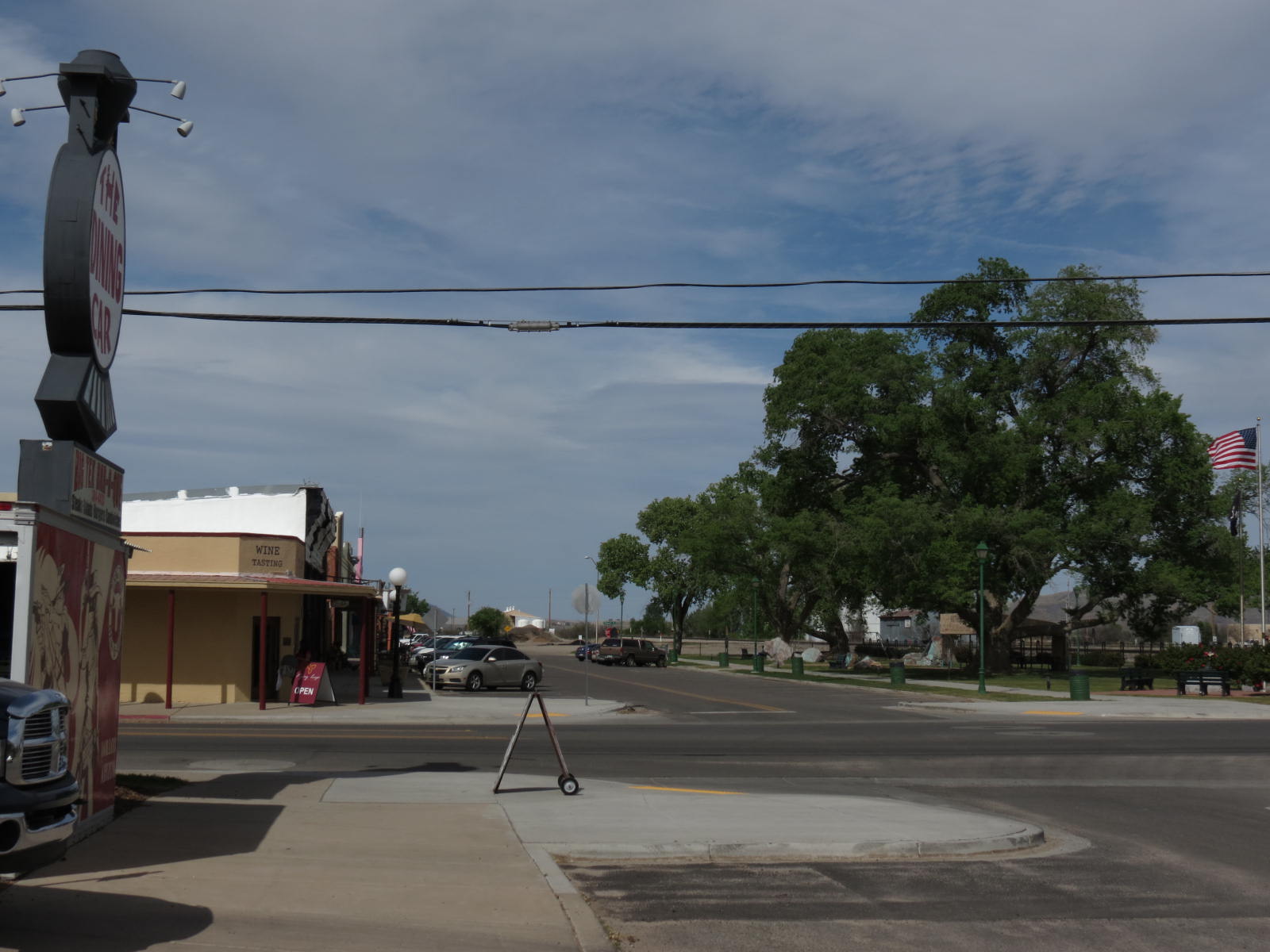
But this time, watching the sequence, all I could think about was where it was being shot. It looked so much like Willcox, Arizona, that the make-believe of the story was suddenly secondary. There! The depot! But a big semitrailer truck strategically parked on Maley Street hide the WILLCOX sign at the end of the depot (now City Hall) from sight. And too soon the action moved to another location.


At the end of the movie, I wanted to see all the credits. Sure enough! Thanks to Willcox, Arizona! “I knew it!” I exclaimed in triumph. “I knew it was my little cow town!” Patiently, David searched back through the movie for the car-train sequence, and, like a pair of detectives carefully screening film from a surveillance camera, we watched it all again, frame by frame.


There! This scene I photographed after a rainstorm are in the movie! Even more exciting, in two different shots the twin peaks of Dos Cabezas can be clearly seen by anyone familiar with them and looking for them, as I certainly was. And finally, a local sign not hidden from camera view: Maid-Rite Feeds! The wonderful feed store east of the railroad tracks!


“Red Rock West” was made in the 1990s. The sculpture of Rex Allen was not yet in place in Railroad Park, but the park itself was recognizable, with its enormous trees, as was the block of old buildings facing the tracks. “Where’s Rodney’s?” we asked each other and were disappointed that while we could spot the tiny building in an out-of-focus background, the identifying sign was never visible. COMMERCIAL BUILDING on a corner was the only store sign we could see on the strip. But there! The sheriff’s office in the film had used the interior of one of the buildings, Railroad Park and its trees visible through the front windows!

All photographs above are mine, from our winter near Willcox. To take my tour through the ordinary little town (and to see Rodney and his place), click here. Below are some shots from early in the movie.

In the morning we returned once more to the opening sequence, certain now that it was not Wyoming and not WY 487 but my own beloved AZ 186. How could I have doubted for a moment? I took the shots of the opening scenes this morning but did not go all the way through to the car-train sequence. 

Opening shot: "Red Rock West"


Name that road!

Not its real name!

To see all the shots of old historic Willcox, you need to rent the movie, “Red Rock West.” (Roger Ebert loved it.) It will be an action-packed visit to my little cow town! And be sure to watch for the twin peaks of Dos Cabezas in the background.

Dos Cabezas, Willcox, Cochise County -- the movie made me "homesick."


Monday, April 6, 2015

A Star in the Western Tradition


Railroad Street, Willcox, Arizona

I vowed not to leave the Willcox, Arizona, area without paying a visit to the Rex Allen Museum, and now I can highly recommend it! Here’s how to get there:

To reach old historic Willcox from I-10, take the middle of three available exits and you’ll find yourself on Rex Allen Drive. Follow that to Haskell and turn right. (On Haskell you’ll pass the Motel 8, which occupies the site of the old house where Rex Allen was born, contrary to what you might read in Wikipedia about his being born 40 miles to the north where, it’s true, his parents did live before moving to Willcox.) At the intersection of Haskell and Maley, turn left, then turn left again at Railroad Street, and you’re right there, with a couple of museums and wine-tasting rooms on your left in the Old Town buildings and a beautiful park on your right. (Across the railroad tracks are yet more wine-tasting rooms. Willcox wineries outnumber those of Sonoita.) In the park is a bronze sculpture of Rex Allen himself.

Those approaching from Chiricahua National Monument on Hwy 186 have only to cross the railroad tracks and turn right, and there you are.

Intersection of Willcox and Railroad streets

 Before we came to Willcox, David and I were not familiar with the name Rex Allen, but since the name is everywhere in town, with “Rex Allen Days” the well-publicized high point of the summer season, we asked one of the first residents we spoke with and were told that he was one of the mid-century singing cowboys, along with Roy Rogers and Gene Autry. Well, those names we knew, but the name Rex Allen still didn’t ring a bell with us.

Admission to the Rex Allen Museum, which also includes the Cowboy Hall of Fame, is only two dollars. I want to emphasize this: it only costs two dollars to tour this museum! And so, friends and other readers, if you’re traveling west to Tucson, take the time to get off the expressway and detour through the old town of Willcox, because you are in for a big surprise!


When Roy and Gene read the writing on the wall and saw that television was the up-and-coming entertainment venue, they started making their own TV shows, the ones I grew up with in the 1950s. Who else remembers? Besides Roy Rodgers and Dale Evans and Gene Autry, Hopalong Cassidy and the Lone Ranger were favorites of mine. Who else am I forgetting? My point here is that when Roy Rogers stopped making films, an opening was created, and it was Rex Allen who filled it. Between 1950 and 1954 he made 19 feature films, all with cowboy themes. The advantage to the studio was that no one had to teach him how to ride. 

his first guitar
He was not an actor needing cowboy lessons. Starting out from Willcox after high school graduation (“Willcox, Home of the Cowboys”), he went to Tucson with dreams of being a rodeo bull rider. He’d worked cows before. His first ride on a Brahma bull, however, persuaded him to concentrate on his music instead. That’s another thing. Rex Allen wrote the “Arizona Waltz” when he was only 14 years old, and his recording of “Crying in the Chapel,” long before Elvis touched the song, went gold. He recorded “Frankie and Johnny.” He had his own long-running regular radio show on WLS in Chicago. His recording career with Decca spanned 35 years!

And as for the movies, even after Western films faded away Rex Allen kept working in the film world. Have you seen “Charlotte’s Web”? That narrator’s voice is Rex Allen’s. He also narrated “The Incredible Journey” and many other Disney nature documentaries. “So,” as the volunteer museum host for the day put it, “even if you’ve never heard of Rex Allen, you’ve heard Rex Allen.”


David wasn’t sure he needed the Rex Allen Museum experience, so he strolled around in the park across the street, admiring the sculpture and looking it over carefully while I went in to begin my tour. But there in the museum I found a different, smaller, limited edition sculpture David just had to see ... an exhibit on the making of the large outdoor sculpture ... and then, capping it all, a photograph with accompanying note to Rex Allen from the Lucchese boot people! “Oh, my god!” escaped me at that last one. David could not miss this museum!

(David's boots, not Rex's)

Lucky for me, too, that I got David into the museum, or I might have missed, in my hurrying to rejoin him outside, the Cowboy Hall of Fame. 


In the parlance of baja Arizona, a “cowboy” isn’t only a lariat-slingin’ vaquero (although he can be that): he’s any horse-riding, cow-working rancher or ranch employee. Naturally, I am especially interested in the women ranchers, and in the book of “cowboy” mini-biographies, the only one I was in its entirety, with pleasure, was of a “cowgirl.” The guys and gals pictured here in the Hall of Fame are all the real deal.


When Rex Allen’s horse died, Koko’s ashes were buried in the park in Willcox. Rex himself, with failing health, spent his last days in Tucson, but he never forgot his hometown. “He’s the reason we have a hospital,” the museum volunteer told us. While still alive, Mr. Allen often came to sit in the front window of the museum bearing his name and chat with visitors.

I didn’t get the name of that volunteer at the museum, but he and his spiel were memorable. Born in Tucson himself, he came to Willcox and taught for 28 years in the public school, and when he retired, he stayed, because, “Where am I gonna go?” Small town life and higher elevation climate had spoiled him for city life. When I told him where we had spent the winter, he told me a personal story, about singing for a burial at the cemetery in Dos Cabezas. His speaking voice was gorgeous, and I can only imagine how thrilling his singing voice would have been, out there under the open sky. Here is a rendition by Vince Gill of “Go Rest High on That Mountain” to give you a taste of the goosebumps I felt hearing the story.

Even when you feel very much at home somewhere, it's worth taking a day to play tourist. I wouldn't have missed this for the world.