Search This Blog

Showing posts with label Indians. Show all posts

Wednesday, December 11, 2019

The Twisting Road of History

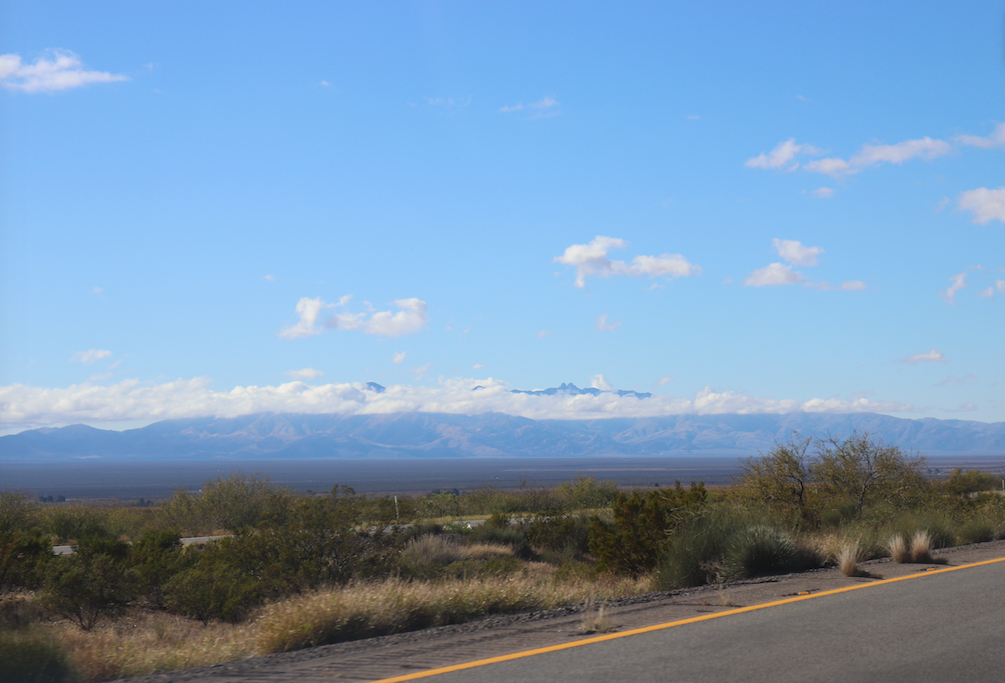
Peaks of Dos Cabezas seen from New Mexico state line
We have arrived at last! We were six days on the road, rather than the usual five, owing to an unexpected, migraine-motivated, two-night stay in Alamagordo, New Mexico. (We had also stayed two nights in Springfield, Illinois, but that was planned and enjoyable.) We were able to make the last leg of our cross-country journey on Tuesday, however, and it was an easy drive on a clear, sunny day. My heart leaped up when I spotted the twin peaks of Dos Cabezas as we crossed the state line from New Mexico into Arizona, and later on, everything in the car dragged into the cabin, as we prepared to hit the road once again, briefly to stock up at the grocery store in Willcox, we were both thrilled to see the moon rising gloriously over the mountains. 


For me, the drive from central Illinois to southeast Arizona presents not only challenges of the road and beautiful scenery and whatever surprises we encounter in towns we visit along the way — it’s also puts front and center in my mind the history of our country. For instance: we see enormous bales of cotton (size and shape of the large round hay bales sometimes seen back in Michigan), and I wonder how it was that the growing of cotton moved west to Kansas and Oklahoma and Texas and even as far as Arizona and how much of that crop’s westward migration story is tied to the larger story of slavery and the Civil War and the migrations of Southerners to the West and Southwest and when the growing of cotton on former buffalo lands came about and how it affected the lives of the Plains Indians. A bit of searching on my phone delivers a fact that surprises me: that the Choctaw began planting cotton in 1825. Unsurprisingly, cotton's history in the second half of the nineteenth century was complicated, to put it mildly. If you're interested, the link is there to follow and read more.


But every mile of the road is saturated with history and the effects of history’s unrolling on the present. Cities are booming, in the Great Plains as elsewhere (we avoided cities as much as possible so as not to deal with the traffic), but across the country the pain of nearly forgotten small towns is palpable. On the two-lane roads we travel -- sometimes detouring a bit off the road to find what is called hopefully a business district -- we see towns where beautiful old buildings stand empty of commerce, wide streets empty of traffic, towns with not a soul on the sidewalks. The scene is the town correlate of the abandoned and derelict farmhouse, an empty house falling into ruins among sheltering trees as cattle graze up to the edge of the front porch, farms having grown larger and larger although country cemeteries tell of larger populations in times past.

Intersection of brick streets, Medicine Lodge, KS


We detoured off the road Saturday morning to explore one formerly prosperous Kansas town and admired beautiful brick streets and buildings in our search for breakfast but were unable to find a single place open for business. We fared better down the road in Medicine Lodge, another town of brick streets. The “Welcome” sign on Frosty’s Donut Shop was contradicted by a “Closed” sign on the same door, but down the block a few doors we found an open cafe. (I neglected to photograph the front of the business but think I recall its name as Latte-Da.) Fancy European coffees have penetrated the heartland! We stuck with straight American brew, fresh and dark and delicious. The sweet white china cups were so much more luxurious than mugs and light years better than gas station styrofoam! Avocado toast, my menu choice, came to the table topped with cheese and a fried egg and was a breakfast worth the wait and the search that had led us to Medicine Lodge. 


Medicine Lodge calls hard on history for recognition. Along with being the one-time home of temperance agitator Carrie Nation (there is an oxymoron for you: temperance agitator), it was also the scene of 1867 Medicine Lodge Treaty between the U.S. government and “more than 5,000 representatives of the Kiowa, Comanche, Arapaho and Kiowa-Apache nations,” joined soon by members of the Southern Cheyenne. The town of Medicine Lodge celebrates the colorful treaty gathering annually, despite its short-lived success. 
…[C]ontinual attempts to renege on the 1867 Medicine Lodge Treaty came to a head in 1903 in the landmark Lone Wolf v. Hitchcock case, in which a member of the Kiowa nation filed charges against the Secretary of the Interior. The Supreme Court ruled that Congress had the right to break or rewrite treaties between the United States and Native American tribes however the lawmakers saw fit [my emphasis added], essentially stripping the treaties of their power.
Read more at this site from which my quote is drawn. 

Visual support for the local high school team on one store window aroused my curiosity, and I looked up the town on City Data, an online site that helps me see beneath appearances, where the report (this would be from the 2010 census) told me that the Native American population of Medicine Lodge, Kansas, is 0.00%. But history is what the town has, and it’s clear they are struggling to hold onto some kind of identity.  When a young woman with a hauntingly plaintive country voice sang “I’ll Be Home for Christmas” in the little cafe, our feelings for the place and its people were warm, and we wished everyone well as we said goodby. I remember struggling years in Northport, Michigan, and can’t help being sympathetic to other small towns fighting an Interstate highway system, flight to cities, and online shopping. As for the burden of history, it is one none of us can escape. All we can choose is how we will go on from where we are.


I won't try to give a day-by-day or mile-by-mile or even road-by-road account of this year’s trip west but will skip now from Kansas to New Mexico, where our last stop on our last day of travel was in the town of Deming. Remembering a very pleasant visit to a little bookstore called Readers' Cove in December 2018, I had been looking forward to stopping there again this year. First, however, we sought out a downtown cafe — and again, as in Medicine Lodge, fortune smiled on us. “Rise and Shine” was drawing in others besides ourselves for their gourmet coffee, but we took a table and made it a lunch stop, as well. Then on to Readers' Cove. 


Margaret was still there, the little dog, the cat (I was told there is more than one cat on the premises), and again I found enough books to carry off a little stack, although we did not tarry as long this year, eager as we were to reach our ghost town destination. 


… And then there it was, finally coming into sight a bit farther down the road (I-10 now), the twin peaks of Dos Cabezas visible from the New Mexico/Arizona state line. (See back to my top photo of today's post, if you've forgotten.) I was so happy to see my mountains again! We took the first of the three exits to Willcox, so as to enter past the livestock auction grounds and the old town along the railroad. Later, having unpacked at the cabin and returned to Willcox for the shopping expedition, we saw the old town strip after dark, beautifully lit up for the holidays — a photo op that must wait for another evening, however, as road weariness was overcoming us. And so, home and to bed, with a short spell of reading aloud, and then to sleep, at last, in our winter ghost town stomping grounds.

Until a high desert dawn brought another day, much calmer and more relaxed than the week past has been. I note today the birthday of Michigan, Montana, and Arizona writer and our good friend, the late Jim Harrison. Here's to you, Jim! You got your work and paid your rent in the universe!

Ghost town dawn

Monday, February 5, 2018

Views, Texts, and Subtexts


We had an interesting if ordinary weekend. No huge adventures, but we stumbled on a little flea market in Willcox on Saturday, where I was happy to find a woman with lot of housewares priced to sell. I found this lovely coffee mug, three others not quite as stunning (but the Artist is happy with solid black), and a steamer pot, with steamer but without lid. I love the Southwest colors of my mug. David bought a few DVDs he can watch on his laptop if he gets too desperate without movies.

But we went to the movies, too. On Sunday afternoon we went to a matinee at the Willcox Historic Theatre, down on Railroad Street. The movie was “Hostiles,” one a lot of friends back in Michigan have seen recently. 


In discussing the film afterward, we agreed that “Hostiles” was pretty much a set piece. You knew right from the beginning that the Indian-hating cavalry officer would come around to an understanding with his old enemy, Chief Yellow Hawk, and you knew the chief would survive the trip to die on his home ground, or at least in sight of it. (Spoiler: He makes it all the way.) Once the woman whose family was murdered joins the group on the trail, you know she’s going to end up with the cavalry officer, and you also know that the captain’s friend, the bearded one who has lost track of how many people he’s killed (he tells a young soldier, “You get used to it”) and says his soldiering days are over — you know he’ll be dead before the last frame. 

I’m not saying I didn’t enjoy aspects of the film, but what I enjoyed most was the scenery. The opening scenes in New Mexico, vast grassy desert and rocky mountains (though not the Rocky Mountains) were very much like the scenery here in Cochise County, Arizona. So if you see the movie, you’ll have a good idea of what we see every day when we go outdoors from our cabin. 


Back to the movie, though. It was very much a white man’s movie. The chief is noble and stoic, the settler woman whose family was murdered is blonde and beautiful, the cavalry captain ruggedly handsome. Both the captain and his doomed, bearded friend come around in the end to realization of the white man’s sins against the Indians, and the captain “does the right thing” by the chief and his family, but in the end all the Indians are dead except the little boy, who is taken under the wing of the woman who lost her own children, and we’re pretty sure the captain will complete that little family circle. As I say, a white man’s movie. 

It reminded me of the French movie, “Indochine,” with Catherine Deneuve. That film was set in Indochina, obviously — Vietnam — and clearly the challenge to the movie makers was how to make a film about colonialism and war in Vietnam, a sad chapter in the history of France, palatable to a French audience. I’m hazy now on the details but retain a general impression that the young Vietnamese man, near the end of the film, acknowledges Catherine Deneuve as his “real mother,” which I took as an intentional subtextual metaphor, Vietnam acknowledging France as its cultural parent. Again, white man’s view.

We'd been to the only bookstore in town on Saturday, a little shop run by the Friends of the Library, where books are cheap and where local honey and jam can also be purchased (mesquite blossom honey seemed an appropriate choice), and among a selection of battered volumes in French and Spanish -- Spanish because I'm learning and French because I don't want to lose it -- I also bought a river story. David and I both appreciate river stories, and I thought Swift Flows the River might be good for bedtime reading aloud, an imaginary travel up the Columbia. Wouldn't you know! The novel begins with an Indian massacre! I didn't even get through the whole scene before laying the book aside. I'll probably go back to it, because the map endpapers promise quite a lot in the way of upriver exploration, but why did it have to begin the way it did? I feel trapped in the history of my country.

And aren't we all? Trapped in the histories of our various countries, trapped in world history and world "progress," such as it is? There was a quote from D. H. Lawrence at the beginning of "Hostiles" that I'll have to look up online....

The view of the country around here pleases me, but I cannot claim the view of the hawk. What does she see from her high, slow swoops across the sky? I read the Range News and wonder at the subtext of stories on various local and regional issues. The starting point for any view I have, on any subject, is that of a white Midwestern American woman of my generation, but I hope I can imagine, if only imperfectly, how those of different backgrounds might see my view and how it surely differs from their own. 

I have reviewed the first eight chapters in Ultimate Spanish that I'd labored through back in Michigan and am now launching into Chapter 9. Clearly, any success I manage to achieve will be due to review, review, review. ¡Siempre me olvido! It is so easy to forget what one has "learned" only recently, easy to fall back on what is familiar but wrong in the new context, since ça fait longtemps or it's been a long time is not the same as hace mucho tiempo

And isn't that exactly the problem with the subjective, parochial, and monocultural points of view that all human beings can't help having? It takes a lot of work to get outside and stay there for any length of time. The filmmakers tried with "Hostiles," but the pull of unconscious and deeply held narrative expectations and standards brought them in the end to dead Indians and a conventionally handsome white couple left with the Indian boy they would adopt and raise. 

What would that boy's life be? What was it up to this point, and what would it be from now on? Through his eyes. Now there would be a movie.

And here's the D.H. Lawrence quote:

"The essential American soul is hard, stoic, isolate, and a killer. It has never yet melted."

Agree or disagree?


Monday, February 25, 2013

Essay Islands


The phrase ‘oak openings’ is saturated with romance, its meaning not on the surface of the words but hidden in history, evoking a landscape long ago erased by settlers and farmers. If you visit today what was once the tall grass prairie, you will see only flat, cultivated fields laid out in squares and rectangles, bounded by straight country roads. Before the white man came? It was a sea of grass, grass as tall as a man, a sea extended as far as the eye could reach. The wind played on its rippling, swaying surface as wind plays on the waters of the ocean. Only movement in the grass gave away the presence of animals making their secret ways beneath the surface. And the oak openings were not clearings in a forest but occasional islands of tall trees interrupting the otherwise featureless expanse of grass. The ground stood higher there. The trees soared. The ‘opening,’ reached by myriad secret paths worn by paw and moccasin through the tall grass, provided shelter for many different varieties of prairie life.

Sometimes in a longer book, one of fiction or memoir, islands of essays stand out. This is famously true of Melville’s Moby-Dick, and it is true of Alexis de Tocqueville’s Journey to America. The latter work boasts two essay islands rising up following pages of notebook entries alphabetic and nonalphabetic, de Tocqueville’s various American experience told and retold in different forms according to the focus the author was bringing to it at that time. The notebooks are fascinating and well written but workmanlike and repetitious. And then come the very brief “Journey to Lake Oneida” and the longer “A Fortnight in the Wilds,” standing out from the rest and calling unforgettably.

“Journey to Lake Oneida” shows de Tocqueville and Beaumont at the height of their youthful romantic dreams. Years before Alexis had come upon a book called Journey to Lake Oneida, the story of a young French couple who fled early revolution to take refuge on a remote island in America.
There, cut off from the whole world, far from the storms of Europe and rejected by the society that saw them born, these two unfortunates lived for one another, each consoling the other for their unlucky fate.
“The book,” de Tocqueville wrote, “left a deep and lasting impression on my mind.” The story makes a deep impression on readers’ minds--not only the story of the young French couple but the effect it had on Alexis and Gustave who searched for their traces years later. Before they made their journey the two dreamed of searching for this couple on their island.
We often talked about it, and always ended by saying, sometimes laughing, sometimes sadly, ‘The only happiness in the world is on the shores of Lake Oneida.’
It was a place they felt they had known long before they ever saw it.

If “Journey to Lake Oneida” is a romantic island in de Tocqueville’s book of numbered and dated notebook entries, “A Fortnight in the Wilderness” is much, much more. The essay was begun on the first of August, 1831, written in its entirety on the steamboat The Superior, and concerns not the tall grass prairie of lower Michigan but the stands of virgin forest that covered its eastern and northern parts and the native populations of these lands. He notes in beginning that “the further we got to the northwest, the further did the end of our journey seem to flee before us.” Valleys and rivers bore Indian names, and they were told in one place that there had been Indians there ten years before, five years before in another place, but the forest had been felled before their arrival, the Indians disappeared.
Man gets accustomed to everything. To death on the field of battle; to death in hospital; to kill and to suffer. He gets used to every sight. An ancient people, the first and legitimate master of the American continent, is vanishing daily like the snow in sunshine.... In the same spots and in its place another race is increasing.... It fells the forests and drains the marshes.... The wilds become villages, and the villages towns. The American [settler], the daily witness of such wonders, does not see anything astonishing in all this. This incredible destruction, this even more surprising growth, seem to him the usual progress of things in the world. He gets accustomed to it as to the unalterable order of nature.
Searching and wondering, following the forested shores of Lake Erie, Beaumont and de Tocqueville come at last by steamer to bustling Detroit.
So nothing is harder than to find anyone able to understand what you want. You want to see forests, our hosts said smiling, go straight ahead and you will find what you want. They are there all right around the new roads and well-trod paths.
When I expressed my own impossible wish to see the southern Michigan prairie, meaning to see it as it had been, an endless sea of grass punctuated by isolated oak openings, I was told to drive south of Kalamazoo, and there it was. No, that wasn’t what I wanted to see. The two Frenchmen were more fortunate in their wish. When they mention wanting to visit Saginaw, the response tells them they are on the right track, much to their host’s incredulity. Uninhabited wilds! Woods full of Indians! Meant as warnings, the words fall like promises on the ears of the Frenchmen.

Finally the real journey is at last underway, travel into the heart of wild America. At Flint Rock, “fifteen leagues” from Saginaw, the Europeans on horseback entrust themselves to a pair of teenage Indian guides for a sum of two dollars, and now they learn what it is to be utterly dependent on others for their survival. The Indians were at home in the forest, a white man “incapable not only of being his own guide . . . but even of finding the means to sustain life.” The forests too were utterly unlike anything in Europe. Here dead trees were never cleared away, and among the fallen, often half-rotted limbs and trunks all manner of other plants pushed and climbed and twined. “Life and death meet here face to face as if they wished to mingle and confuse their labours.” At midday, when the wind and birds fell silent, the absence of sound filled the immensity, filling the Europeans with a “sense of isolation and of abandonment.” They had at last found the elusive American wilderness.

Reaching Saginaw the next day, they find Indians, French, English, Americans and mixed-blood residents, and de Tocqueville notes that, even in a settlement numbering only thirty souls,
Colour of skin, poverty or affluence, ignorance or enlightenment have already built up indestructible classifications among them; national prejudices, and prejudices of education and birth divide and isolate them.
In separate paragraphs he adds and details the divisions made by religious differences.

The romance of “Journey to Lake Oneida” was certainly touched with tragedy and melancholy, but it was quieter and more remote, more imaginary, existing in the minds of the foreign visitors who knew only the merest outlines of the story. “A Fortnight in the Wilds” tells of more immediate experience, of tragedy unfolding and growing alongside happy and confident progress in what was for Europeans the “New World.” Like another son of civilization, historian Bruce Catton, de Tocqueville sees back into the past and forward into the future to realize the tragic losses that are the cost of progress. Even as he is privileged to see with his own young eyes some of Michigan’s still-trackless forests, he is every moment aware that they will soon be gone.
The facts are as certain as if they had already occurred. In but few years these impenetrable forests will have fallen. The noise of civilisation and of industry will break the silence of the Saginaw. Its echo will be silent. Embankments will imprison its sides, and its waters which today flow unknown and quiet through nameless wilds, will be thrown back in their flow by the prows of ships. . . .
 It is this consciousness of destruction, this arrière-pensée of quick and inevitable change that gives, we feel, so peculiar a character and such a touching beauty to the solitudes of America. One sees them with a melancholy pleasure; one is in some sort of a hurry to admire them. Thoughts of the savage, natural grandeur that is going to come to an end, become mingled with splendid anticipations of the triumphant march of civilisation. One feels proud to be a man, and yet at the same time one experiences I cannot say what bitter regret at the power that God has granted us over nature.
“I cannot say what bitter regret”—these are the words of a sensitive nature combined with piercing vision and range of comprehension.

In my Faber and Faber edition of Journey to America (London, 1959), “A Fortnight in the Wilds” is less than fifty pages long. By itself it would be a small book, but I have long wished that someone would publish it on its own, perhaps with an artist’s illustrations. Nothing else I have read gives such a picture of Michigan’s forests before the days of large-scale lumbering, and nothing else gives, either, the “mixed blessing” sense of civilization come to the wilderness.

We cannot travel today to the tall grass prairie or to the virgin forested expanses of our home state, except in books and imagination, so with this post you must make the pictures in your mind.