Search This Blog

Showing posts with label colonialism. Show all posts

Monday, October 30, 2023

Pointless Rambling Thoughts

How many leaves remain on this tree today?

We are slip-sliding into winter. Is that an excuse for my lack of focus? In my last post I used a French phrase, sous un ciel couvert, which means under a cloudy sky. Not actual rain but “menacing,” or (I would say) threatening rain. Here is another French word, one that moves easily and frequently from skies to moods: maussade, which means gloomy, dreary, dismal. 


A customer from France brought me this little souvenir!


I love French words the way so many of us also love music. It makes me happy to hear them, to speak the language (to the best of my abilities), to read and write the words. In an often cold, hard world, it is one of my little comforts, a small joy. Malheureusement (unhappily), we have been in greater-than-usual need of comforts if we’re paying attention to world news, but to imagine how comfortless their world must be for those in the midst of war is heartbreaking and goes far beyond first-world self-care.


I’m ditching most of what I had composed for today as a draft in the past week. The first frost in my garden feels like old as well as trivial news, along with that green tomato chutney project. Also, I’d written about a forecast for snow “in the coming week,” but now that forecast is only scant hours away. And other parts of the country have the same, so it’s hardly a headline story.


For no other reason than because it’s somewhat cheery, I’ll insert here a couple pictures of my latest kitchen production. It’s applesauce with pears cooked along with the apples and a homemade drizzle of black raspberry syrup added for color.…


I like it chunky.


And now I’ll use that food theme to segue to books and at the same circle back to the French. A friend tells me she doesn’t mind being alone but does mind eating alone. I told her I always have a dinner book nearby. The book that has seen me through many dinners lately, a few pages per meal, is Fernand Braudel’s L’Identité de la France


On our side of the Atlantic, in a country stretching from ocean to ocean, we tend to think of France as medium-sized and  unproblematically unified, but Braudel tells a different story. For reasons entirely different from those pertaining to the United States, as he sees it France is almost two different nations, north and south, with an intermediate buffer zone separating the two, and even that is an oversimplification. Histories, languages, soils, customs – la belle France is one nation politically in the larger world, but its peoples are diverse even from one village to the next.


But stop and think. Isn’t that the reality of human life everywhere? We may live under one law, but we inhabit multiple different and distinct smaller worlds. An Ethiopian friend of mine was astonished at how strong regional loyalties were in the United States, e.g., my ties to Michigan, she having expected we would all identify simply as Americans. My friend and I were in graduate school together for two years in Cincinnati (before I transferred to the University of Illinois), and in that unique river city – neither purely northern or southern, eastern or western -- each neighborhood had not only its own name (Clifton, Hyde Park, Over-the-Rhine, etc.) but also its own complete shopping district, so that the neighborhoods were like villages clustered to form the larger city but retaining their village identity. 


Similarly, in Leelanau County, still largely rural, every village (incorporated or not) and every informal lake community has, if not always its own grocery store or library, certainly its own history and traditions. Northport and Leland schools resist consolidation – that is, Northport resists being incorporated into Leland schools – because of Comet vs. Wildcat pride. Empire and Northport are worlds apart! I only get south to Empire maybe once a year and always feel, when I do, that I’m very far from home.


Now let me express my increasing crankiness about the term “community” that’s being thrown around so continuously and haphazardly in ways inappropriate to my ear and sensibilities. The word has become ubiquitous, with people (on the news, at least) now speaking of the “world community,” as in, “What has been the response of the ‘world community’ to the crisis in [fill in the blank]?” As if there could possibly ever be a unitary response across all the nations and peoples of the world unless we were invaded from outer space! A local union of musicians or plumbers or autoworkers or screenwriters may put out an official statement, but how long did it take to hammer out something on which all members could agree even in such a limited case?


Okay, back to my sheep. My Ethiopian friend was proud of the fact that her country had never been a European colony, but she acknowledged that it had been “colonized from within” by the Amhara group, who dominated politics under the country’s period of monarchy. One could say of France, also, I suppose, that it was “colonized from within” by the powers of the Île de France region, as it was their language that eventually became the official national tongue, edging out Latin (brought by the Romans), Basque, Provencal, Occitan, etc., etc. Free, mandatory, secular education instituted in 1882 prohibited regional languages in French public schools after, as I understand it, the Franco-Prussian war (1870-71) convinced the government that in times of war, soldiers needed to understand each other and their commanders. A young generation growing up across the country with one language was also ripe for the subsequent age of empire – wars and annexations and conquests around the world – but that’s another story. Colonialism within preparing the way for colonies overseas? 


Years ago, when we lived in Leland and started our mornings with coffee at the Early Bird, the Artist and I sometimes had conversations with an older man who had been – or his father had been; I forget which – superintendent of county schools here. It was he who made the decision, finally, that all public instruction should be in English. Before that, various small country Leelanau schools conducted classes in the dominant language of that area’s immigrants. Note: As for Catholic schools in Leelanau County, St. Mary’s School in Lake Leelanau had classes in English, but Holy Rosary for a long time had Polish nuns teaching Polish-American farm children in the Polish language. Then there is the history, now well known, of Native American children in boarding schools being forbidden to use their native languages, which was the case for many Ojibwa and Odawa from Leelanau. 


And now, all over at least the Western world, the Odawa, the Irish, the Welsh, etc. are reclaiming the language lost by the generation before them.


Curious, I looked up sites discussing the Tower of Babel and found this one interesting, but the idea of verticality led me to think of homo sapiens beginning to walk upright, and then I questioned the writer’s conclusion that humans seek verticality to escape the earth’s surface. Did early bipedal humans want to escape the earth’s surface or simply be more at home on the ground than in the trees?


My friend Laura calls this the coming-home tree.


I have no conclusions today, only questions and sadness, because what more can we ask other than to feel at home on the earth, wherever we are? But being driven from home, cut off from the place of memories, or having that place invaded and stolen – sadly, this is a major theme in human history. Une idée maussade, vraiment. Truly a dismal idea – but accurate, isn’t it?


If only humans could see difference among our species as enriching rather than threatening -- 


Le monde est un souk énorme!


My plan for my next post is happier and more book-focused. Although the year is not yet at an end, I am too impatient to wait: I want to share with you a few novels I read this year for the first time (not necessarily newly published, in every case, but I’m not including those I re-read) and highly recommend without reservation. Maybe you will want to think about your top fiction picks for the year so far, too. I’d like that. 


Happy Halloween (if that's your thing)!


New Bohemian Cafe folks do holidays well. (They do everything well.)


Monday, February 5, 2018

Views, Texts, and Subtexts


We had an interesting if ordinary weekend. No huge adventures, but we stumbled on a little flea market in Willcox on Saturday, where I was happy to find a woman with lot of housewares priced to sell. I found this lovely coffee mug, three others not quite as stunning (but the Artist is happy with solid black), and a steamer pot, with steamer but without lid. I love the Southwest colors of my mug. David bought a few DVDs he can watch on his laptop if he gets too desperate without movies.

But we went to the movies, too. On Sunday afternoon we went to a matinee at the Willcox Historic Theatre, down on Railroad Street. The movie was “Hostiles,” one a lot of friends back in Michigan have seen recently. 


In discussing the film afterward, we agreed that “Hostiles” was pretty much a set piece. You knew right from the beginning that the Indian-hating cavalry officer would come around to an understanding with his old enemy, Chief Yellow Hawk, and you knew the chief would survive the trip to die on his home ground, or at least in sight of it. (Spoiler: He makes it all the way.) Once the woman whose family was murdered joins the group on the trail, you know she’s going to end up with the cavalry officer, and you also know that the captain’s friend, the bearded one who has lost track of how many people he’s killed (he tells a young soldier, “You get used to it”) and says his soldiering days are over — you know he’ll be dead before the last frame. 

I’m not saying I didn’t enjoy aspects of the film, but what I enjoyed most was the scenery. The opening scenes in New Mexico, vast grassy desert and rocky mountains (though not the Rocky Mountains) were very much like the scenery here in Cochise County, Arizona. So if you see the movie, you’ll have a good idea of what we see every day when we go outdoors from our cabin. 


Back to the movie, though. It was very much a white man’s movie. The chief is noble and stoic, the settler woman whose family was murdered is blonde and beautiful, the cavalry captain ruggedly handsome. Both the captain and his doomed, bearded friend come around in the end to realization of the white man’s sins against the Indians, and the captain “does the right thing” by the chief and his family, but in the end all the Indians are dead except the little boy, who is taken under the wing of the woman who lost her own children, and we’re pretty sure the captain will complete that little family circle. As I say, a white man’s movie. 

It reminded me of the French movie, “Indochine,” with Catherine Deneuve. That film was set in Indochina, obviously — Vietnam — and clearly the challenge to the movie makers was how to make a film about colonialism and war in Vietnam, a sad chapter in the history of France, palatable to a French audience. I’m hazy now on the details but retain a general impression that the young Vietnamese man, near the end of the film, acknowledges Catherine Deneuve as his “real mother,” which I took as an intentional subtextual metaphor, Vietnam acknowledging France as its cultural parent. Again, white man’s view.

We'd been to the only bookstore in town on Saturday, a little shop run by the Friends of the Library, where books are cheap and where local honey and jam can also be purchased (mesquite blossom honey seemed an appropriate choice), and among a selection of battered volumes in French and Spanish -- Spanish because I'm learning and French because I don't want to lose it -- I also bought a river story. David and I both appreciate river stories, and I thought Swift Flows the River might be good for bedtime reading aloud, an imaginary travel up the Columbia. Wouldn't you know! The novel begins with an Indian massacre! I didn't even get through the whole scene before laying the book aside. I'll probably go back to it, because the map endpapers promise quite a lot in the way of upriver exploration, but why did it have to begin the way it did? I feel trapped in the history of my country.

And aren't we all? Trapped in the histories of our various countries, trapped in world history and world "progress," such as it is? There was a quote from D. H. Lawrence at the beginning of "Hostiles" that I'll have to look up online....

The view of the country around here pleases me, but I cannot claim the view of the hawk. What does she see from her high, slow swoops across the sky? I read the Range News and wonder at the subtext of stories on various local and regional issues. The starting point for any view I have, on any subject, is that of a white Midwestern American woman of my generation, but I hope I can imagine, if only imperfectly, how those of different backgrounds might see my view and how it surely differs from their own. 

I have reviewed the first eight chapters in Ultimate Spanish that I'd labored through back in Michigan and am now launching into Chapter 9. Clearly, any success I manage to achieve will be due to review, review, review. ¡Siempre me olvido! It is so easy to forget what one has "learned" only recently, easy to fall back on what is familiar but wrong in the new context, since ça fait longtemps or it's been a long time is not the same as hace mucho tiempo

And isn't that exactly the problem with the subjective, parochial, and monocultural points of view that all human beings can't help having? It takes a lot of work to get outside and stay there for any length of time. The filmmakers tried with "Hostiles," but the pull of unconscious and deeply held narrative expectations and standards brought them in the end to dead Indians and a conventionally handsome white couple left with the Indian boy they would adopt and raise. 

What would that boy's life be? What was it up to this point, and what would it be from now on? Through his eyes. Now there would be a movie.

And here's the D.H. Lawrence quote:

"The essential American soul is hard, stoic, isolate, and a killer. It has never yet melted."

Agree or disagree?


Thursday, January 18, 2018

Beautiful Merida, Yucatan, Mexico


Three Roads at Once, Part II: 
Evening and Morning in Merida

After a day visiting Ek Balam and Chichen Itza, our group of four — guide Angelo with ducklings Bill, Leonore, and I, ducklings because by now the three of us have completely imprinted on Angelo — proceeded to Merida, capital of the state of Yucatan, for the night. Angelo has lived in Merida since he was one year old and knows the city so well he zoomed us through fascinating, narrow back streets. The majority of buildings in the capital (population 1,000,000) are only one story high, and even downtown one- to three-story hotels are the norm, with only a very few taller buildings. Our hotel was one of those tall ones, offering a panoramic view over the city by night.

Rather than dining in the hotel, however, Leonore and I decided to venture down Calle 59 to the Plaza de Santa Lucia to look for a restaurant, and we were not disappointed. My seviche (which the program I’m using wants to spell ceviche, and that may be more Spanish — I’ll have to check — but I’m used to spelling the word with an ’s’), made with octopus (an important regional ‘crop’), shrimp, grouper, two or three mussels, delicately julienned vegetables and the characteristic Yucatan lime, was the most memorable of many good meals in Mexico. We dined outdoors, looking out on the lighted plaza, where the people-watching was as good as the food.


Morning brought the rising sun through a romantic haze, providing an even more spellbinding view over the city. When we convened as a group after breakfast, Angelo took us on a tour of his city, beginning with the lovely Plaza Mayor or Plaza Principale — officially the Plaza de la Independencia, though no one calls it that, he told us — and important, imposing buildings surrounding it. In addition to shade and convenient benches, the plaza offers free wi-fi. One of the municipal buildings facing the plaza provides free coffee, as well, making the square a natural gathering place, while nearby architecture features a variety of styles, from classic colonial to Victorian to art deco, and Mayan stones from the older city once here can occasionally be spotted in the walls. An entire day, educational and leisurely at once, could easily be spent here.


They contain so much architectural beauty that it would be a mistake not to visit churches and cathedrals in traditionally Catholic countries, and I was glad to see the lovely interior of the cathedral (above) in Merida. I was also happy to see horses in downtown Merida (does this one, however, need hooves trimmed?) and liked to imagine I detected a descendant of Andalusian horses from Spain. It is true that the people who inhabited the Yucatan had no horses before the Spaniards came….


But the municipal building featuring paintings of the history of Mexico by Castro Pacheco (see all here) provided the makings of a unique set of memories. 


Like the history of our own country, that of the United Mexican States is soaked with blood, from the violence of the Mayans through the Spanish conquistadores and on. Heroes and villains abound. I only wish I had made notes of all the names of men in the portraits, but I will be looking for their faces as I pursue the study of Mexican history this winter. For now, please notice also the faces of the crowd of indigenous children, collateral damage in the making of a temporary empire.


On a smaller nearby square, we had a chance to see a couple of beautiful old hotels. The first below is the oldest in the city, the second equally lovely. 


For my part, however, I found ordinary houses on side streets as fascinating as all the monuments, hotels, and churches. I like to see ordinary life in general, wherever I travel, but in Mexico, bright paints make the most ordinary scene, and even the smallest and shabbiest dwelling, wonderfully colorful and cheerful-looking. As a wonderful example of bright colors, I was fortunate to capture from a moving vehicle a fantastic tiled wall along one very ordinary urban street. 


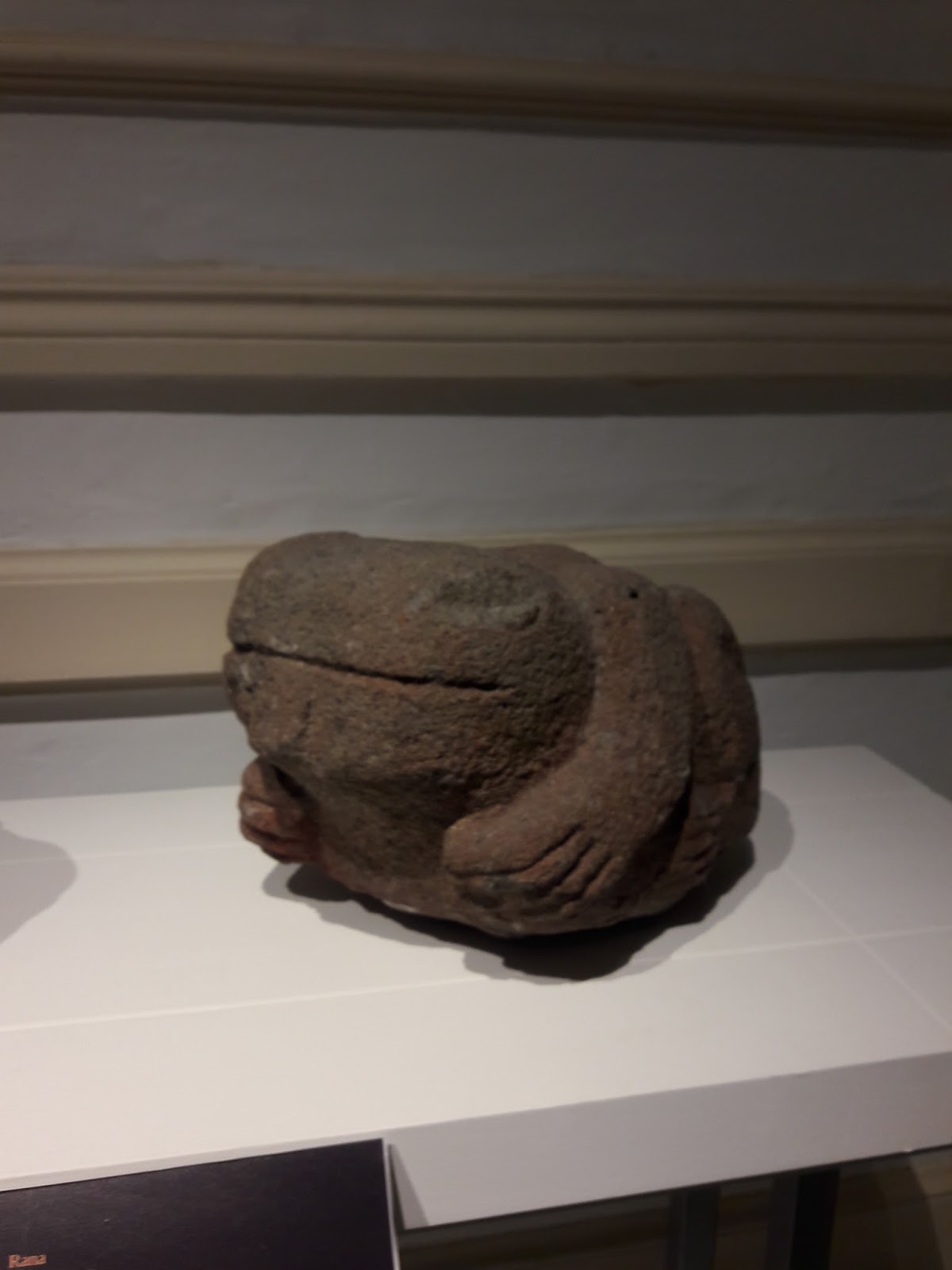
We drove to a very different part of town to tour the archaeological museum. The museum is housed in a former private residence on a wide boulevard lined with similar mansions of the rich, most still in private hands. Photography is permitted inside the museum, but my camera was acting up, so Leonore took this photograph of the stone frog for me, a little artifact I found very appealing.


The broad Paseo Montejo, named for the founding family, ends at a roundabout encircling a beautiful monument to Mayan myth and history. 


Before leaving town, we did something different. Leaving the ancient world for the most modern, Angelo took us for lunch to a Mexican fast food chain restaurant, Los Trompos. “This is where the locals eat,” he told us. Un trompo is a spinning top, the name of the restaurant coming from the shape of the huge, hanging, pressed-together pork (similar to the lamb in a Greek restaurant) from which pieces of meat are sliced. Images of tops decorate the walls. We had plenty of tortillas, with different fillings, and what instantly became our favorite luncheon beverage, cold sweet hibiscus flower tea.


But now, although I had planned to present my Yucatan trip in two parts, the flurry of images from Merida has me somewhat overwhelmed (again) in retrospect, and I’m thinking that Merida deserves to hold the stage alone today. You do see, I hope, that the city of Merida, like my days of travel in Mexico, is composed of multiple historical layers? Starting with re-used Mayan stones from the original city, there are colonial buildings, Victorian, modern, and reminders everywhere of the entire history covered by Paz — indigenous peoples, conquest, colonial times, independence, reform, revolution — to the present day with free wi-fi in the beautiful principal plaza. Yes, the twenty-first century has arrived in Mayaland. 

And now the words of Octavio Paz from the latter half of the twentieth century seem a good way to close this second of my three posts on the Yucatan. 

The contemporary crisis is not a struggle between two diverse cultures, as the conservatives would have us believe, but rather an internal quarrel in a [global] civilization that no longer has any rivals, a civilization whose future is the future of the whole world. Each man's fate is that of man himself. 

...The past has left us orphans, as it has the rest of the planet, and we must join together in inventing our common future. World history has become everyone's task, and our own labyrinth is the labyrinth of all mankind. 

- Octavio Paz, The Labyrinth of Solitude 

And we are moving on....


Tuesday, March 8, 2016

Another Outsider


The Mersault Investigation
By Kamel Daoud
Translated from French by John Cullen
(Original title: Mersault: contre-enquête)
New York: Other Press, 2015
Paper, $14.95

This book was not exactly what I expected. It was what I expected and much more.

I knew it would begin, “Mama’s still alive today,” announcing at the outset the contrast between this book and the classic twentieth-century French novel, and I knew some of what would appear in the story, such as --
The word “Arab” appears [in the book narrated by the character of Mersault] twenty-five times, but not a single name, not once.
That much I had read in several reviews. I understood that Daoud had written another version of The Stranger, had written about the fictional murder and its consequences as experienced not by the killer but by the victim’s family, and so the deep grief and implacable resentment of the surviving brother, narrator of this new story, was hardly unexpected.

Daoud’s narrator, Harun, is an old man recounting his story in a bar to a stranger, compulsively digressing and repeating himself as he speaks of his brother, his brother’s death, and the years that followed. I cannot say “as he remembers” these things, because he has been living over and over them for decades, the past more real to him than the present, memories more present than the flow of life. In a very real sense, he has had no life since his brother was killed but has been forced by his mother to live as his brother’s ghost.

Born in an occupied land, Harun was a child in the days of colonial power, and so we expect that the theme of colonialism will play a part, understanding that this story is being told from “the other side.”
He was Musa to us, his family, his neighbors, but it was enough for him to venture a few meters into the French part of the city, a single glance from one of them was enough, to make him lose everything, starting with his name....
There is a mother, and there are originally two sons, but the father disappeared from the family so long ago that he is little more than a name to Harun – and not much of a name at that.
Everything revolved around Musa, and Musa revolved around our father, whom I never knew and who left me nothing but our family name. Do you know what we were called in those days? Uled el-assas, the sons of the guardian. Of the watchman, to be more precise.
It was the way families were identified in those days.

Before I go further, I want to pause and speak of the writing itself. The controlled power is stunning.
The sun was overwhelming, like a heavenly accusation. It shattered into needles on the sand and on the sea but never flagged.
Or this:
It was a heavy old revolver that looked like a metal dog with one nostril and gave off a strange odor. I remember its weight that night, not pulling me down to earth but toward some obscure target.
A reader reaches hungrily from the end of one sentence to the beginning of the next, captivated and enthralled.

What I was surprised to find in the narrator of The Mersault Investigation was a man every bit as alienated from himself and society as was Camus’s Mersault. Harun wonders how two people in this world can ever love each other, when all are ”born alone and will die separate.” Life is absurd; therefore, Harun believes only in death. “All the rest is nothing but rituals, habits, and dubious bonding.” Like Mersault, Harun is an outsider, a stranger.
A stranger possesses nothing—and I was one. I’ve never held anything in my hands very long, I start to feel revulsion for it, I have the sensation of excessive weight.

The likenesses continue. Like Mersault, Harun rejects religion, belief in God, and conformity to social conventions. The scene he recounts of his violent rage at the imam who would pray for him is a direct counterpart of the prison cell scene between Mersault and the priest who comes to hear his confession. After he has killed the Frenchman, Harun longs to be punished for his crime and identifies with Mersault’s desire to be hated by the crowd he imagines at his execution. Those expressions of hatred, finally, would grant his life meaning.

There is a parallel in their crimes and also in the way society interprets their guilt. Mersault took the life of an Arab, Mersault the life of a Frenchman, but Mersault was convicted of failing to mourn his mother’s death properly and Harun accused for not having joined the fighters for Algerian independence.

The list could go on.

For all their similarities, however, the two characters are two opposite sides of a coin, distinct and different, rather than mirror images. Harun is telling his story to correct the absence of his brother in Mersault’s story, to bring his brother back to life, in the sense of restoring him to history with a name. Harun tells his listener (and us, his readers) early in the book that what he wants is justice.
I think I’d just like justice to be done. That may seem ridiculous at my age...But I swear it’s true. I don’t mean the justice of the courts, I mean the justice that comes when the scales are balanced.
When he kills the Frenchman, Harun briefly feels the scales have been balanced, but his sense of relief and justice is short-lived. He is given no trial, set free without punishment, not even officially charged with murder. He has gained no notoriety. Worse, his brother’s name is still unknown, while Mersault, also dead, is world-famous.

Which brings us around to the original story, narrated by a character named Mersault, the famous novel that serves as the springboard for this brilliant new novel. Daoud deals with Camus in a manner audacious and breathtaking. He treats the fictional Mersault, a literary device, not only as the first-person narrator but also as the author of The Stranger --  and the “famous book” itself is never mentioned by its title, any more than there is mention of the writer Albert Camus.

Harun speaks of Mersault and the book he wrote,
If only your hero had been content with bragging, without going so far as to write a book! There were thousands like him back then, but it was his talent that made his crime perfect.
As Hurun tells the story, Mersault not only killed Musa but also wrote the book that became world-famous, the book in which Musa’s name and everything else about him have been left out, the book in which Musa is “the Arab,” twenty-five times, but always nameless.
Judging from your enthusiasm, the book’s success is still undiminished, but I repeat, I think it’s an awful swindle.
The book was, in Harun’s eyes, Meursault’s second crime, although he is fascinated by the criminal with whom he shares so many qualities.
Read what your hero wrote about his stay in a prison cell. I often reread that passage myself. It’s the most interesting part of his whole hodgepodge of sun and salt. When your hero’s in his cell, that’s when he’s best at asking the big questions.
Drawn in spite of himself to the original outsider’s philosophy, sharing so much of his view of life, Harun continues to recoil from Meursault’s colonial blindness.
Do you understand why I laughed the first time I read your hero’s book? There I was, expecting to find my brother’s last words between those covers, the description of his breathing, his features, his face, his answers to his murderer....
Now, when Harun tells the story, in Daoud’s novel, it is Camus the writer who has been erased, blended into the character he created. The book’s title is just as thoroughly omitted. There was no Musa in The Stranger? There is no Camus in The Meursault Investigation. “Not once.”

Under colonialism, colonizers and colonized alike suffer from alienation and the corrosive effects of man’s injustice to man. In these two novels, neither fictional outsider narrator Meursault nor fictional outsider narrator Harun expects or receives understanding or justice. But Meursault has at least been visible to the larger world, in retrospect, thanks to the talent of the writer Camus, while Harun, his brother Zusa, and all their family have all been without names, as if without existence. Until now.

It is unlikely that the name of Camus will vanish from world literature any time soon, and I doubt Kamel Daoud would even wish for its disappearance. Surely Daoud and Camus, were they able to meet, would express appreciation of one another’s talent and vision, just as Mersault and Harun would recognize in each other many mutual philosophical affinities. And yet, isn’t the erasure of Camus from the history of his own novel, in the end, a triumphant literary balancing of the scales at last?

Camus is one of my heroes, and, as I have written very recently, Camus was not Mersault. Camus was not deaf and blind to Algerian suffering – quite the contrary. I think, however, that he would have been among the first to understand and admire and recommend this new version of the story and that he would have recommended it in the name of justice, as well as in the name of art.

Were she still alive today, instead of having died at age 30, my friend Annie would have been 53 years old on March 14, and I can see clearly another version of reality, one that finds Annie once again in front of a classroom, her topic again ‘alterity’ – i.e., otherness, her reading assignment this week Kamel Daoud’s The Mersault Connection. How Annie would have loved this book! How I wish we could sit down and talk about it together! Annie, dear, today’s post is for you!