Search This Blog

Showing posts with label sheltering in place. Show all posts

Wednesday, May 20, 2020

How Green Is My Desert

Flowering shrub is bird-of-paradise

The Artist and I have never stayed in southern Arizona this late into the spring before, never seen the desert so green, and every day the change from bare, dead-looking winter trees and shrubs becoming vibrant with leaves and blossoms astonishes us anew. “Are there many deciduous trees where you are?” my son asked me on the phone this morning. Oh, goodness, yes! The mesquite is often more of a large shrub than a tree, but it is ubiquitous, and it is deciduous, and some individuals reach tree size and can have beautiful shapes, and right now all are leafed out, providing shade for cattle and hiding places for birds to build nests. But mesquite is only the beginning. In the photograph just below, looking past the bird-of-paradise and down into the wash, there are at least four more large, green, deciduous plants, three of them trees. At the far right top (back corner) is a walnut tree. 


Nogal in leaf and bloom

The walnut tree’s leafy crown dances in the afternoon wind, and suckers sprout at the base. For five years I’ve been wondering what kind of tree this was, and how I see another farther back behind the neighbor’s fence, and down the road just past another neighbor’s house I’ve spotted a whole row. I don’t know if this is the Arizona or the Texas walnut, but either one goes by the Spanish name nogal, the plural of which is nogales. It’s walnuts that give the name to that Mexican border town, and I am happy to know this beautiful neighbor tree by name at last.

In the center background (and not sharply in focus) of green things growing along the wash is a netleaf hackberry tree, a tree I've written about before. In winter there have always been enough dried berries and dead leaves on the hackberry that I have been able to identify it almost from the beginning of my desert stays, but it looks very different now, clothed in green. 


Center left of that composite shot but not all the way to the left, the light green tree you see is desert willow, another newly learned-by-name tree to me and one that charms me in every way. Since learning it, I’ve found myself photographing the desert willow at different times of day. It is not, you should understand, a true willow. It is a different genus and member of a completely different botanical family from the willows along the no-name creek just north of my Michigan farmhouse. 


Flowers on the desert willow below the cabin have not yet opened, but when we went for a little ride down Chiricahua way, I was happy to spot a desert willow in bloom. 


Does that flower remind you of a catalpa blossom? Both trees belong to the Bignonia family, the desert willow’s flowers smaller and more colorful but very like those of catalpa trees back in Leelanau County, Michigan.

We have never seen the wash flowing with water, a phenomenon that arrives only with the summer monsoons, each flood lasting only a few hours. Over closer to the Chiricahua Mountains, though, where streams flow for much of the year, water-loving sycamores are found. Some are of magnificent size, although during the winter, when they look like ghost trees, it’s hard to believe they are alive. 

Arizona sycamore in winter 
Now look at the difference! It seems nothing short of miraculous. 

Arizona sycamore mid-May


Oaks are deciduous, also, but in this climate they hold onto their leaves through the winter and bring forth new leaves in the spring, at the same time that they begin to drop the old, gradually, with never a bare season to them. Oak trees near streams and in mountain canyons are peaceful places to rest the eyes all year-round.


Cochise County and I have been getting acquainted since January of 2015, but my desert is still full of surprises. Of course, what surprises me is familiar to those who have lived here all their lives. How can I call the desert “mine” at all? 

It’s true I’m a newcomer, but I do love it, more deeply each year, and this year – this strange spring of the COVID-19 pandemic, with stay-at-home orders in Arizona from mid-March until the end of April, being here in a whole new and unexpected way, I feel I have paid a few odd dues and earned at least a beginner’s merit badge in Arizona living. 

Our resident roadrunner has accepted us unconditionally. Bless his little heart!


Thursday, May 7, 2020

Sheltering Far From Home

No, we are not open!
The only home we own is an old farmhouse in Leelanau County, Michigan. The Artist and I are 83 and 72 and still self-employed in side-by-side seasonal businesses in Northport, my bookstore and his studio/gallery. We came out to the Southwest in December, for a few months of “seasonal retirement” in a rented ghost town cabin, expecting to return home in the spring. Now spring is here, but for the present we are sheltering in place in Cochise County, Arizona, far from our Up North home. 

Family members and some friends urge us to stay where we are, understanding that we feel safe here and dread travel and that there is no real urgency calling for our immediate return. Other friends (a mix of the encouraging and the impatient) tell us that travel is no big deal and we should get right on the road and come home now. They say that -- although still others back home write letters to the editor of the county newspaper saying that “summer people” should not come north! 

Are “snowbirds” and “summer people” one and the same? I don’t think so. We are not “summer people”! But does the virus care? I doubt it. The way I’m pretty sure the virus sees it, travel is travel.

When we peruse the road atlas and read advice about where to find food and restrooms and overnight accommodations, we look up at each other nervously and ask, “What do you think?” Our car is old, our dog is old, and we are old. The decision to stay or go – that is, when to go – seems overwhelming.

Cochise County morning
Setting that troublesome question aside, our life here is peaceful. Yes, the days have heated up, but it is the famous “dry heat” we’ve heard about forever, and in the shade, with a gentle mountain breeze stirring the air, the hottest days are quite tolerable. At night, the high desert cools down quickly, and we welcome the onset of cool darkness. 

Never birders before, we have taken to putting out water and feeders and watching the passing parade at all hours of the day. On a regular basis we see finches and sparrows, cardinal and pyrrhuloxia, hummingbirds and ladderback woodpecker, the curved-bill thrasher, canyon towhee, and cactus wren. It’s big excitement when Mr. and Mrs. Quail come to visit or when Pete the Roadrunner hurries through the yard, as if late for some important engagement.

Gambel's quail

roadrunner

The Artist paints. I write. We both read. Now and then we must screw up our courage, don our masks, and make a run to the grocery store, hardware store, or (yikes!) laundromat. Otherwise, every day is pretty much the same, one “month of Sundays” now having segued into another. 

Back home in Michigan, it is the time of wildflowers in the woods, the lovely spring ephemerals. We are missing the gone-wild daffodils planted long ago by someone who lived in our old house way back when. Soon the grass will be ready to mow, and front porch season will be underway. I think of that porch with longing.

Porch shadows, Michigan

At the same time, we are enjoying more desert greenery than we have ever been here to see before, and a short evening drive only a few miles down the road gives us the opportunity to watch colors in the sky – the sky stretching above the grasslands, pressing against the mountains -- change gradually, imperceptibly, seamlessly from blue through all the warm colors of sunset and beyond, to star-pierced black of night. Next morning, we are wakened by a neighbor’s rooster and the lowing of cattle as close as our windows. Yes, there is a cow with a couple of little calves, right by our gate! I cannot express what joy and contentment the cattle bring, especially now, against the current social background of anxiety and existential dread.

We have been here another moon already
If we left the ghost town today and were home by the end of the week, we would face a 14-day quarantine, but I doubt I would feel comfortable opening my bookstore to the public after those 14 days – or that many of the public will be strolling up and down the streets of our little northern village and in and out of shops. I miss my bookstore and am anxious for its future. I don’t see myself going in the direction of online sales. It isn’t me. Then what? Right now, I have no clue

Here and now, anyway, far from home and bookshop, I can still read and write and share books with readers of my blog.  Because connecting readers to books and authors has always been the core of my mission as a bookseller, posting book reviews is my #1 mission at present. It’s something I can do that feels worth doing.

And so, day after day, we postpone our travel decision. The default is doing nothing, staying put. Deciding not to decide brings us relief from anxiety, temporary though that relief must be.


5/7/2020
Dos Cabezas, AZ


Saturday, April 25, 2020

Borrowed Time

And so the long winter passed. Until—at last, at last!—came the first intimations of spring. And (for all the characters concerned) a strange spring it turned out to be . . .  
-      Mary Norton, The Borrowers Avenged

In this strange spring of ours, 2020, when every day feel like Sunday, I got up at 6 a.m. this Saturday and worked outdoors on writing the entire morning – journal entry, draft of a book review, grocery list notes -- sitting with my coffee at our “new” outdoor porch table. Spring has definitely reached southern Arizona, and these days that feel like Michigan summer days call me out the door as soon as the sun is up. My son in Kalamazoo, Michigan, and sisters in northern Illinois are having grey, rainy days today. We could use a little rain here in Cochise County. The ground is much too dry. But it’s hard to complain about a clear blue sky and weather warm enough for shorts.

Yesterday I made sourdough bagels from scratch, a task that took up the better part of a day. The Artist pronounced them “Perfect!” So this afternoon, positively lounging on my laurels, I gave myself a break and only mixed up a pan of banana bread. 


Banana bread makes the house smell so delicious! And getting my baking done early in the day leaves plenty of time for a refreshing breeze to move through and cool the house. Doors and windows open! What luxury!

So now, with a good morning’s and early afternoon’s work behind me, I am relaxing with a story from the Borrowers series, perfect light reading for what feels like a summer’s afternoon. Except –

Arietty was silent…. Three human beans at least, perhaps four—perhaps even more—knew they had been here, knew they had departed, but (unless they gave the game away) there was no one, as yet, who knew they had returned.    
It was for this reason Pod had forbidden them the use of light or fire, had kept them away from the windows, and throughout the daylight hours had confined them to the miniature house. Such days, with Pod and Spiller away, could sometimes seem very long. It was late March, and three days had passed…. And still Pod and Spiller had not come.

Here in our rented ghost town cabin, the Artist and are not absolutely “confined” to the house (we have wide, open spaces all around) and need not avoid windows (people know we are here, and that’s fine). But are the days long?

My son and I discussed that question by phone recently. He says that for him a day can seem long as it’s passing, but at day’s end it seems to have gone by quickly. For me, an occasional day can seem slow in its passing, but mostly time flies by, even now, even without any kind of scheduled obligations. Making bagels, for instance – as I say, that’s a project that takes up most of a day. I meant to make them on Thursday but forgot until too late in the day, pushing the task off to Friday, which meant after a long hike through the wash with my neighbor and our dogs. As a consequence, Friday flew by, I fell asleep early, and was not up this morning until, as I say, 6 o’clock.


Writing a book review takes hours of writing and rewriting and revising before I deem it worthy to go up on my blog. Every week or two, also, I plan a serious floor scrubbing, but somehow that job can be put off day after day until finally tackled and accomplished. And while I did find a nice, clean window squeegee in one of the sheds recently (perhaps one we brought with us from Michigan in December for the car windows), I have yet to wash the windows of our little cabin. Again, day after day slips away, and the window-washing job remains on the to-do list. 

Because every day there are meals to plan and prepare and to wash up after, walks to take with Sarah, books to read, and letters to write. There are phone calls to make and texts to send and e-mail messages and Facebook comments to check and reply to. (Please note: “The language has a rule absurd/which I would call an outworn myth:/A preposition is word/you mustn’t end a sentence with.” My father loved that little rhyme.)


So the days do not hang heavy, and my hands are not idle, but still --

Pod, from where he stood, leaned forwards, placing two tired hands on the shelf above the fireplace. He bowed his head. Then, after a moment, he slowly raised it. “Homily,” he said, “I don’t want to scare you. Nor you neither, Arietty. But you got to realize that every minute we’re here, we’re in grave danger.”


The Artist and I are not in grave danger where we are, sheltering in place far from our Michigan farmhouse, and we would not be in grave danger there, either, but the necessary travel to get from Point A  in southern Arizona to Point B in northern Michigan gives us serious pause. Added to that, we ask ourselves, What's the rush? Most businesses remain closed, people are still asked to avoid unnecessary travel, and the likelihood of any kind of tourist season this summer seems slim if it's going to happen at all. These facts conspire to keep us from feeling much urgency about taking on the perils of travel until we feel good and ready.

So when we will be back? We. Don’t. Know. It’s like the question, "When will things get back to normal?" Or the question, "When will the economy recover?"  No one knows! Everything is uncertainty and speculation, and we’re all taking life one day at a time, which is the only way it can ever be taken, although in "normal" times we forget that simple truth.

Meanwhile, today I’m relaxing with the Borrowers and trying not to let too many questions about an uncertain future intrude on my escape reading, even when the reading itself keeps reminding me of the questions.


P.S. You can find my last "adventure close to home," i.e., close to the rented cabin we are calling home at present, here

Thursday, April 9, 2020

How Long Will It Last?


How long will what last? The pandemic, the staying at home, the anxiety, fear, worry, anger? The arrival of sudden, piercing stabs of fear in the middle of a sleepless night? 

Household food supplies???


Long before the stay-at-home order came to Arizona (where we remain until confident of a safe return to northern Michigan), even before the nationwide toilet paper panic and frenzy, wise and forward-thinking authorities recommended that every household have a minimum of two weeks of food and necessities on hand, in case quarantine became necessary. So I shopped then and found everything we needed and felt we were well supplied. I even bought a two-pack of giant-size containers of antiseptic wipes, wondering if we could ever possibly need that many. Was I overreacting? Flour, yeast, canned tomatoes, pasta, canned milk, onions, soap, yada-yada-yada — all the things you’d need if you couldn’t get out of the house for two weeks. 

But hand sanitizer? I never buy that stuff, just soap. So when I returned to the store for hand sanitizer a week or two later, while other shoppers were panicking over shelves stripped bare of toilet paper and paper towels [actually, no one looked panicked at the Safeway in Willcox: that was literary hyperbole], I was stunned at the sight of an empty aisle where hand sanitizer and other such products used to be. On my next and I hope last trip, there was still none to be had. We are told to keep in the car and use it constantly, but the Artist and I are using those antiseptic wipes I thought I might not need. Not the kind made for hands, but the harsher cleaners intended for household use. Now even those are nowhere to be found for sale! How long will what we have left last?

I chickened out of going to the grocery store again last Friday, as planned, and made a new plan for Tuesday, when the dairy and egg supply would be restocked. And yes, on Tuesday the store had eggs, and I bought another container of yogurt so I’ll have starter to get back to making my own with raw milk from the feed store, but once again there was no hand sanitizer, no antiseptic wipes, and no yeast. I almost wept. I'd been so nervous about going at all, and then these empty, gaping shelves! I think of certain friends in Northport who have for years found it amusing to refer to our grocery store there, especially in winter when the summer people with their big bucks are not in residence, as "Moscow Market." Ha! Eat your words, guys! We always had everything we needed, didn't we?

Catching wild yeast from their air, on the other hand, is something I think I can manage, so before we run out of yeast, I will finally attempt to make sourdough starter. Old dog, new trick. I have read up on it and feel confident. 

But aren't these strange times when a trip to the grocery store or laundromat feels dangerous? How long will these feelings last?

We went to a different laundromat this week, a less frequented washateria with cheaper washers than our usual but busier, more crowded place (hence our avoidance) — sadly, also with dryers that have an insatiable appetite for quarters. But never mind! All I wanted to do was wash the clothes and get back to the cabin and hang them on our new clothesline. Finding almost all the machines in use when we arrived — very unusual! — and four people inside, we made ourselves comfortable in the car with books and cold water and snacks, in a quiet, shady spot, with a nice breeze filtering through the new leaves of a velvet ash tree, waiting for the coast to clear, as it eventually did. So it all worked out.

Still, we were relieved to be home again, even though a single clothesline and limited supply of clothespins meant that I spent the remainder of the day hanging up as many items at once as possible and whenever a few were dry, pulling those dry items off the line to make way for more. It really did take all afternoon, too, despite sun and a stiff breeze, and the last towels were still on the line when meatballs for dinner went into 
the oven.


Funny how one's perceptions change with changed circumstances. Familiar sights evoke new thoughts. These days when I’m out walking and see dried cow dung, I think, fuel. When we’re driving, wild rhubarb along the roadside says to me, food. Prickly pear still poses a question: how does one harvest and prepare that to eat? So far, however, we have not retreated that far back into the past.


I’m not exactly living the life of my grandmother’s, she who had to pump water to heat on the stove to do her laundry outdoors in washtubs. (One of those washtubs was my first “swimming pool” when I was a toddler.) She also milked her own cow and slaughtered her own chickens, and my grandfather had an enormous vegetable garden, huge raspberry patch, and their entire backyard was given over to growing fruit.


My mother on her parents' country "farmette"
My parents' first home in South Dakota
My mother, with indoor plumbing, had a wringer washer in the basement and lines both in the backyard (for summer) and in the basement (for winter). When my sisters and I were young, we had three apple trees, one pear tree, and a raspberry patch (that last, thanks to our grandfather who brought the canes from Ohio for us). My mother baked her own bread, put up homemade jam, and made her own perfect piecrust from scratch, so these days I’m kind of living my mother’s life — without the little children, but it’s still amazing how cooking and baking and cleaning have expanded to fill the days, now that we are staying at home.


And I ask myself, how long will these new habits last? As long as the pandemic or longer? When these times are “over,” and we can return to something resembling “normal life,” will we continue to bake our own bread and hang our laundry out in the sun?

Well, I routinely hang laundry on the line back in Michigan, though I do not bake bread in the busy months when I'm running a business fulltime and doing my share of keeping grass mowed around our old farmhouse and barns. Anyway, truthfully, I wonder more about other changes in our lives these days, too, the way we are considering and treating one another, not only within our households but in our communities and across the country and beyond. 

How long will we continue communicating with loved ones on our present, new, more frequent basis and, in addition, find time to reconnect with friends forgotten or neglected for years? How long will we keep up the habit of thanking family members, friends, and strangers for each kindness, large and small? How long will we remember to give thanks, each and every day, for each and every day we’re alive?


Tuesday, April 7, 2020

Spring Turned Upside-Down


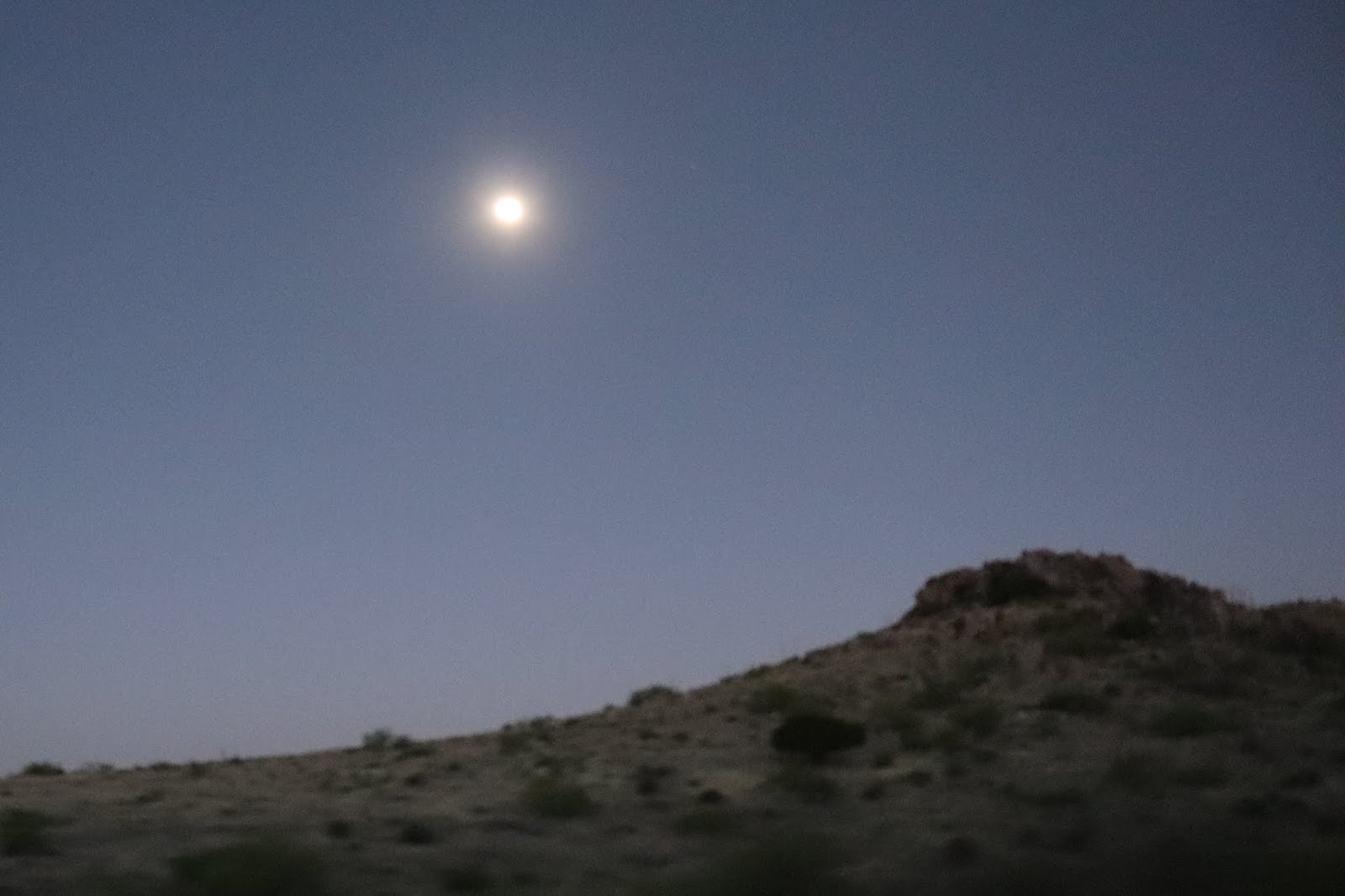
We had a full moon over the high desert and mountains last night, and it was lovely. Days are longer now than nights here in the northern hemisphere. As I think about that, and about how it is autumn, not spring, in the southern hemisphere (which always seems so strange to me), and as I hope every morning to have word from dear friends “down under,” I can’t help reflecting that the world has been turned upside-down for all of us this spring, life in both of earth’s hemispheres topsy-turvy and unfamiliar in ways we’ve never known before.

I read that domestic abuse rates in general are up, with all this mandated staying at home and sheltering in place. Young families must be feeling a lot of stress: that time of life is stressful enough in ordinary times, and many marriages founder on rocky shoals. Bless them all, keep them safe, and give them strength! 

For this particular old couple, the Artist and me, sheltering in place in a small rental cabin in an Arizona ghost town far from our beloved old northern Michigan farmhouse, somewhat surprisingly our tolerance levels for annoyance with each other have risen rather than plummeting. Little things we might have found maddening in each other a month ago we shrug off now with a smile. Door slammed? --Who cares? Crumbs on the counter? --What does it matter? Sometimes one of us reaches for the other’s hand — not for any special big reason — and then tears come to my eyes, because, whatever happens, we are together now.


The desert is greening up. The first few flowering plants are blossoming, while others — ocotillo higher in the mountains, a cactus in front of a neighbor’s house, penstemon in the wash — are, thrillingly, right on the verge. Early yesterday morning I saw a lithe red fox running across another neighbor’s fenced yard. Every day brings gifts. But every day also I wonder about the days and weeks to come. 


Once in the kitchen, with a blanket wrapped about her waist, Mma Ramotswe switched on Radio Botswana in time for the opening chorus of the national anthem and the recording of cattle bells with which the radio started the day. This was a constant in her life, something that she remembered from her childhood, listening to the radio from her sleeping mat while the woman who looked after her started the fire that would cook breakfast for Precious and her father, Obed Ramotswe. It was one of the cherished things of her childhood, that memory, as as the mental picture that she had of Mochudi as it then was, of the view from the National School up on the hill, of the paths that would through the bush this way and that but which had a destination known only to the small, scurrying animals that used them. These were things that would stay with her forever, she thought, and which would always be there, no matter how bustling and thriving Gaborone might become. This was the soul of her country, somewhere there, in that land of red earth of green acacia, of cattle bells, was the soul of her country. 
- Alexander McCall Smith, The Good Husband of Zebra Drive

Where will we be, the Artist and I, on May 7th, when the moon comes round and full again? For now we are here, in what has become a second home to me, and it is a good place. But I had been, I admit, mourning the absence of any of Smith’s Botswana novels on my shelves. I needed Mma Ramotswe. Then I found The Good Husband of Zebra Drive in my book corner! What a comfort! Dear Mma Ramotswe and her loving reflections always calm my own soul. That fictional character is a gift in my life today.


Friday, April 3, 2020

“Last Times,” Free-Floating Anger, and Short Attention Span (a temporary condition, I hope)

Little sunshines on the ground....
Read the small print
As consequences of the pandemic spread along with the virus, and as days at home lengthen for everyone, all over the world, we’re all feeling the pinch and looking for ways to adapt to this new, albeit temporary, “normal.” For those of us with homes and plenty to eat, self-indulgence and gratitude exist side by side. 


Our dear, aging puppy!
Phone conversations with my son, texting with my sisters, and this morning’s messaging back and forth with a grandson — all of them back in the Midwest — are all bright spots in my days. I am sheltering in place with my husband and our dog. We have plenty of books. We have a working radio and a television with a roof antenna that brings in more stations than the two we regularly watch. Still, we ration our pleasures. We don’t eat all the cookies or muffins the same day they come out of the oven, and while we have movies on DVD we don’t binge-watch the flat screen all day.


Muffin "flower," sisters!
It is not a time to take anything for granted. A day of sunshine — thank you! Distance visit from a neighbor (we sat out in the driveway, chairs a safe distance apart, enduring wind that was really too strong for pleasure) — thank you! Letters and cards in the mail from distant friends — thank you! Our precious, precious, aging puppy — thank you! Cardinal at the feeder, bagels that turned out delicious, a forgotten box of facial tissue that turned up in the cupboard — thank you, thank you, thank you! Surprise phone call from the friend with whom I share a birthday, day, month, and year -- thank you, darling Helen!!! 

We really are very fortunate, and when I think of other parts of the world where life was hard before this, my imagination recoils in horror. 


Birthday flowers! Thank you, Cheryl!
Still, we fortunate ones feel sadness, too. These days are days of grief -- even "anticipatory grief" -- alongside gratitude.

When we made our last trip over to Tucson, we had no idea it would be the last. We were then planning to visit friends there a week later. Another Tucson friend and I were looking forward, maybe in Benson and at the monastery south of St. David, where we enjoyed spending time the past two years. And now, only as recently as Monday — hours before the governor of Arizona issued a stringent stay-at-home order — the Artist and I had driven over the monastery by way of one of our favorite back roads, only to find the gates closed upon our arrival. 

"Closed" -- sign of the times

On that recent trip, I was happy to jump out of the car over and over again, photographing the magnificent scenery, but it might be the last time I’ll see it this year. 


The last time we had visited the monastery, we didn’t know it would be the last time. More recently, driving a favorite beautiful road, we could not keep the thought at bay. And now the stale peanuts we would have fed to the peacocks are going to wildlife here in Dos Cabezas: I’m in hopes the little rock squirrel will show itself soon; meanwhile, we watch birds at our suet feeder, and I try to lure hummingbirds by hanging orange sections in a red net bag.


I have plenty of time to conduct experiments

Beautiful blue
But my Pollyanna attitude is learned, not genetic. I came to it late in life and still have to work at it. And I admit that there are gaps in my positive thinking, especially in these days of uncertainty, because uncertainty is really the worst of it for me. It is impossible for me now to plan more than one day ahead, and that’s pretty hard for someone far from home, someone whose small business has survived for over a quarter-century in a small village with a seasonal economy and who had counted on her “seasonal retirement” lasting only five months, December through April, before she put herself back in harness, like a farmer, to earn another year’s harvest. Others in our home village in Michigan have already decided their season is lost to them this year — I am hardly alone. Still I wake in the middle of the night, eyes wide open or squeezed shut in the surrounding dark, and what I feel is fear and anger, and I feel it not for myself only (though quite a bit for myself, of course!) but for all of us. 


Is it wrong to escape into baking?

You’ve heard of free-floating anxiety. I’m thinking that what I experience in the middle of the night is free-floating fear -- stronger than anxiety, though I wouldn't say I am not anxious; who isn't? -- and anger. Because the future is so uncertain, what I fear has no definite shape, and because the threat comes from a virus, something completely impersonal, the anger has no clear target, either. Oh, there are times when a certain face and voice on TV elicits from me a string of profanity. I’ve also noticed friends’ Facebook posts veering into anger and profanity, even when what they’re posting has to do with basically simple suggestions about staying home right now, for everyone’s safety. And when we’re fearful and angry — fear fueling the anger — it’s all too easy to look for targets. 


To escape into pruning mesquite?

One friend whose blog I have followed for years took her dog to the park the other day before she realized there were too many people there -- and that none of them should have been there! They had all now made themselves targets of other people angry at those not staying home. So Dawn felt guilty. And she realized it was her last expedition to the park for the duration. Guilt — another feeling that can accompany our “last times.”


Go home!

Kathy, another long-time blogging friend whom I “met” on her first blog, “Opening the Door, Walking Outside,”  back in 2007, posted something today that all of us probably need as we deal with all the emotions churning within us, alternately emerging and being suppressed. Kathy’s advice is that we need to let ourselves feel all our feelings rather than trying so hard to escape them. I’ll work on that, Kathy. Thanks. The journal I’ve been keeping, the one that didn’t start out to be a plague journal, is my primary safe space to explore all those feelings without inflicting them on anyone else.

We were never in control
My reading has suffered lately from a shortened attention span, a condition I hope will prove in future to be acute rather than chronic. Typically these days I read a few pages, and then my mind jumps to something else, and then I jump up, physically, and turn to a different activity, now cooking, now cleaning, now taking the dog out for another walk or checking the birds’ water tray outside once more. Sit out in the sun? I can do it for a while but then need to get up and do something. The Artist joked the other day that the bathroom was so clean after one of my flurries of scrubbing and sanitizing that he wondered if he could have his lunch in there! No, I had cleaned the table, too.

One cure for my lapses in reading attention is reading aloud, and fortunately the Artist is more than willing to listen, so we both benefit. Reading aloud is another way for us to share the world, too. So yesterday, out in the sunshine, dog lying nearby in the shade, birds flitting to and from the feeder, we enjoyed another chapter of Emita Hill’s Northern Harvest: Twenty Michigan Women in Food and Farming. In yesterday’s chapter, we heard the voice of our Leelanau friend Anne Hoyt, talking (these are oral histories Emita has put together) about the cheese she and John have been making now for a quarter of a century. I just love Anne’s mind and her solid values!
In a perfect world it would be local and organic and at a good price. What a dream! At a price we can all afford. Because we are feeding people. And we need to keep that in consideration. We are not only feeding the rich people. … Everybody is telling us to raise our price, but my goal is to actually sell the cheese we make. I’m not going to keep it in my cellar forever and take care of it. I want to make it and sell it. I want people to enjoy it. That’s very important to me. 
I remember Anne showing me their cheese cellar years ago (and I remember the procedures we went through to make sure we were not bringing germs into the cellar, too) and saying to me as we looked at rows of cheeses aging on the shelves, “These are my children!” The Artist refers to his paintings the same way. And it is always the intention that these beloved “children” eventually go out into the world and bring joy to others.


Artist David Grath's Northport, MI, gallery

Last night I was going to read myself to sleep with Wild Horse Country, by David Philipps, an often very depressing book about the fate of mustangs in the American West, a penetrating examination of the story of mustangs from their origin, through a series of American myths … chased down by helicopters, crammed into stock trailers, canned for dog food, “saved” by public protest … then through a bureaucratic maze, starving on overpopulated lands and finally warehoused far from home by the thousands, no longer wild at all, and with no wild future. It is not comforting bedtime reading, by a long shot. But I was close to the end of the book and wanted to finish it. The last chapter I’d read told of people managing wild herds by darting mares with birth control drugs — not a “wild” solution, but more upbeat than previous chapters. 

The Artist wanted me to read aloud for a while, so I read from the chapter I had reached, that of certain geographically isolated wild horse herds whose population is held in check by mountain lions. The lions, unable to run down adult horses on flat land, prey seasonally on spring foals born in the mountains, subsisting the rest of the year on deer and smaller mammals. Mountain lions here in southeast Arizona are as elusive and legendary as they are in northern Michigan, so I had my listener’s full attention, and my mind did not wander from the text, either. 

So there you have it — our lives in the time of coronavirus. We read. We listen to the radio. We watch television and movies. I cook and bake and clean. The Artist spends time in his makeshift studio, and I write letters and random journal entries. We walk and sit in the sun. We are grateful for everything we have, nervous about the future, cautious in the present, and there are times when I give in and shout angrily at the TV news. 


Where does our road lead?
The future has never been “ours to see,” but we used to live as if we could see it. Now we’re all on hold. And sometimes the mental wheels spin, going nowhere. That’s our world today.

But the birds go on singing --