| That green pointillist flush I love! |
Season’s Progress
| Black cherry at the edge of the woods |
| Looking up through its crown |
| Blossom cluster |
| Changing the subject: Isn't my hellebore beautiful? |
| I highly recommend this brilliant first novel! |
Please remember, if you find something meaningful here in Books in Northport, share a link with your friends. Sharing is good! Pass it along! Your readership means the world to me.
| That green pointillist flush I love! |
Season’s Progress
| Black cherry at the edge of the woods |
| Looking up through its crown |
| Blossom cluster |
| Changing the subject: Isn't my hellebore beautiful? |
| I highly recommend this brilliant first novel! |
![]() |
| Choosing a book is like choosing a road. |
Going Places In Fiction
Mutual understanding in the world being nearly always, as now, at low ebb, it is comforting to remember that it is through art that one country can nearly always speak reliably to another, if the other can hear at all.
- Eudora Welty, “Place in Fiction”
I want to pause here after this sentence, written by Eudora Welty in an essay called “Place in Fiction,” because I want to call your attention to the first thirteen words: “Mutual understanding in the world being nearly always, as now, at low ebb….” This essay of Welty’s, which I encountered in a collection entitled The Eye of the Story: Selected Essays and Reviews, was originally published in 1957. The 1950s are generally portrayed as a time of calm prosperity in America, and yet Eudora Welty, a writer from Mississippi, would have had a front row seat from which to observe battles over school desegregation,
yet another reminder that there is no short, simple answer to the question of what the Fifties were “like,” those years (as was true of the Sixties and any other era in the life of our country) having been different for different people in different parts of the country with different skin color or economic status. How much “mutual understanding” was there between the races, between regions of the United States in the 1950s?
But let us return to Welty’s discussion of place in fiction:
Mutual understanding in the world being nearly always, as now, at low ebb, it is comforting to remember that it is through art that one country can nearly always speak reliably to another, if the other can hear at all. Art, though, is never the voice of a country; it is an even more precious thing, the voice of the individual, doing its best to speak, not comfort of any sort, indeed, but truth.
Fiction, Welty writes in the middle of the following paragraph, “is properly at work on the here and now.” Even a historical novel must transport us to “the past made here and now,” and that is because for us to enter the world of the novel “we have to be there.” And so it is that “fiction is all bound up in the local.”
A few of my friends become impatient with descriptive passages in fiction. They want action and accept dialogue only insofar as it advances plot. Not me. For me, whether in a short story or a memoir, classic novel or murder mystery, I take pleasure in the time an author takes to draw me into the locale of the story. Alan Paton’s Cry, the Beloved Country begins with a lyrical passage:
There is a lovely road that runs from Ixopo into the hills. These hills are grass-covered and rolling, and they are lovely beyond any singing of it. The road climbs seven miles into them, to Carrisbrooke, and from there, if there is no mist, you look down on one of the fairest valleys in Africa. About you there is grass and bracken and you may hear the forlorn crying of the titihoya, one of the birds of the veld. Below you is the valley of the Umzimkulu, on its journey from the Drakensberg to the sea….
- Alan Paton, Cry, the Beloved Country
Immediately we are in a specific place. Then, downhill from the grassy hills, he takes us to a different specific place.
The path is dropping into the red land of Ndotsheni. It is a wasted land, a land of old men and women and children, but it is home. The maize hardly grows to the height of a man, but it is home.
--It is dry here, umfundisi. We cry for rain.
--I have heard it, my friend.
--Our mealies are nearly finished umfundisi. It is known to Tixo alone what we shall eat.
The path grows more level, it goes by the little stream that runs by the church. Kumalo stops to listen to it, but there is nothing to hear.
The stream, dry for a month, does not run, and the women must walk to the river every day for water.
Kumalo is the individual through whose eyes we see his home, and when he makes the long journey to Johannesburg to search for his son and his sister, we hear the noise of the city through his ears and feel his confusion and fear. It is Kumalo’s truth, at home with his wife and in his meetings with other individuals in Johannesburg, that the novel allows us to see.
![]() |
| It can take you somewhere you've never been before. |
...For Book Reviews
Big news in the book world is the demise of The Washington Post’s “Book World” section, with its small number of fulltime reviewers and an ever-changing cast of guest reviewers. Was it reviewer Ron Charles who commented on NPR that there are now fewer fulltime book reviewers in the U.S. than the number of people who have walked on the moon? Whether fact or hyperbole, you get the point. As the number of newspapers shrinks, fewer and fewer of the surviving papers give any space at all to newly released books. Bestselling, big-name authors have the money of their publishing houses behind them because sales of their books keep the publishers alive, but what of small publishers, new authors, books that don’t fit neatly into a genre or niche with a loud and loyal fan base?
![]() |
| My customers and I trade recommendations. |
Where do you learn about new books? I read reviews in the New York Review of Books (an article there persuaded me to read, at last, Larry McMurtry’s Lonesome Dove) and local publications, listen to reviews and interviews on NPR, read my daily “Shelf Awareness” newsletter, and make notes of books and authors recommended to me by my friends and bookshop customers and authors (overlapping categories).
I look over the new arrivals at our local library. Also, as a dealer in used and rare books, as well as a reader of the old, I often follow up clues, learning of an author or a title in something I’m reading and then searching out the writers or work mentioned, which is what led me to Mary Webb’s Precious Bane.
...In Books and Memory
Armchair travel! How I love it! Four decades or so ago, I was obsessed with the Arctic and sought out everything I could find about that part of the globe, particularly books written by women, such as Arctic Mood, by Eva Alvey Richards; Woman in the Polar Night, by Christiane Ritter; and Spring on an Arctic Island, by Katharine Scherman. There is a wealth of armchair travel available in fiction, too, and I have loved visiting on pages of books lands I will never see in person. Thanks to reading, I have also “owned” horses!
![]() |
| I thought of them fondly as mine. |
My memory travels are made possible by daydreams, old journals, photo albums, even by digital images stored on my phone. Looking this morning at images from three years ago in Arizona, I thought for the first time that, odd as it may sound at first, Arizona gave me something of what I longed for in my Arctic dreams—a challenging environment. The Arctic would have given me the challenge of cold and treelessness. Cochise County challenged me with relentless sun, with dry, thin air (thinner with every hundred feet of altitude), primitive roads beneath my tires, and loose, unstable gravel and rock underfoot. There were times when my endurance was tested.
![]() |
| Solo destination was more challenging than photo portrays. |
While my yearning for the Arctic has evaporated with age, I am sometimes “homesick” for the Chiricahua and Dragoon Mountains, and reliving hikes with friends and dogs is a pleasure I feed by (besides my own writing and photographs) reading books set in the area, such as stories of Cochise and the Chiricahua Apaches, as well as J.A. Jance’s Sheriff Joanna Brady series.
“Were you homesick for Michigan when you were in Arizona?” a friend asked. “No,” I said, “I didn’t have to be, because I knew I would be back.” Every winter in Arizona, on the other hand, was a gift I knew might not be repeated, and indeed my last winter in the ghost town was 2022-23, but I remain grateful to have had my time there and for the friends I made.
...At Home in Michigan!
“We live in a beautiful place,” the Artist used to say often, and since he’s been gone I’ve made that remark frequently to Sunny Juliet, as my dog rides shotgun with me in Leelanau County.
![]() |
| With dog on Michigan back road -- heaven! |
Michigan’s two green peninsulas, their lakes, rivers, creeks, fields and hills, sandy beaches and rocky shores—my family fell in love with Michigan when we came camping in a heavy old canvas umbrella tent, back when I was 12 years old, and it has been my great good fortune to call Michigan home for decades since.
What do you look for in a companion? Common values, interests, background? Sharing a love for Michigan, both the familiar places and those not yet explored, is essential to me. Then, please, let him be a woodsman. Well, okay then!
| Do you know where Sunny Juliet was on Monday? |
First, a little book stuff --
My Sunday evening bedtime book was America for Beginners, by Leah Franqui, a fairly light-hearted fictional tale of multicultural America that manages to address some heavy themes in an entertaining manner. It is a make-you-laugh, make-you-cry novel with a road trip as its centerpiecer, and what could be better to read the night before I embarked (“Sunny, stop that barking!”) on an ambitious one-day road trip of my own? I came back to it Monday evening, at home again, and reached the last page Tuesday morning. I loved the book, the characters, and the way they learned about each other almost in spite of themselves.
Here's the thing: Unless it is a review that leads me to a book, I don’t read reviews until after reading the book and forming my own opinion. Then sometimes I’m curious and wonder if other people found the same delights or food for thought or glaring faux pas – whatever I found in a particular book – that I did, and that’s when I search out reviews.
From Goodreads, I more or less expect mostly personal and subjective responses, although at times there is a deeper take, but whatever different readers have to say, it’s always interesting to see what they liked and disliked, what they found to admire or criticize. If a review is badly written there, I take it with a grain of salt, not having had high expectations.
It's different when I look to Kirkus reviews. Kirkus has been around since 1933 and has always had a high reputation. If you look up ‘Kirkus’ on your phone, you’ll see a list of questions “People also ask” about it, one of them “Is Kirkus reputable?” The online answer is “Kirkus is a credible, industry-renowned resource among authors, publishers, the media, booksellers, and readers.” A Kirkus review is a Very Big Deal for an author.
Since 2005 Kirkus has been reviewing self-published books but only if paid by the author to do so. Established publishing houses that send books to be reviewed do not pay a fee. Neither the paid nor the unpaid reviews are guaranteed to be positive. Well, sure – they wouldn’t be reviews otherwise.
The Kirkus review of this book I found delightful was not itself delightful at all. The reviewer had not been charmed, as I had been by the novel. Fair enough. But why? The reviewer called the book “tolerable, if not utterly original,” certainly deserving some kind of “damning with faint praise” award. -- But was the reviewer saying the book is “utterly original”? I doubt that was the intention, and yet the effect points in that direction, so my suspicions were aroused by the reviewer's misuse of "if not." The author is accused of “road trip-novel cliches.” Such as? An example is given for the criticism that the author over-explains characters’ inner lives. Okay, I guess the reviewer and I simply disagree on that one.
Let me be clear. My big problem with the Kirkus review wasn’t that the reviewer and I disagreed. It was that the review itself seemed amateurishly written, no better than anything any random reader might post on Goodreads and not as good as some to be found there. This is a Kirkus review? I read a few more Kirkus reviews of other books and found all too many of them disappointingly brief and lacking textual support for opinions rendered.
Foreword magazine, published nearby in Traverse City, Michigan, also reviews books, many from small presses, some by self-published authors. Reviewers’ names are attached to the reviews, which are generally longer and, I find, more in-depth than what I’m seeing on Kirkus these days. While applauding Foreword (and yes, I do know the publishers), I have to wonder if anyone else has noticed a decline in the quality of Kirkus reviews. Is something going on there? I asked a published author this morning (Wednesday) what he thought of Kirkus reviews, and his answer was, "Not much."
The foregoing discussion, you will have noted, is more a review of reviews than of the novel that kicked off my musings, but feel free to comment on either. For myself, I am eager to read more of Leah Franqui.
So yes, Sunny Juliet and I went on a road trip.
![]() |
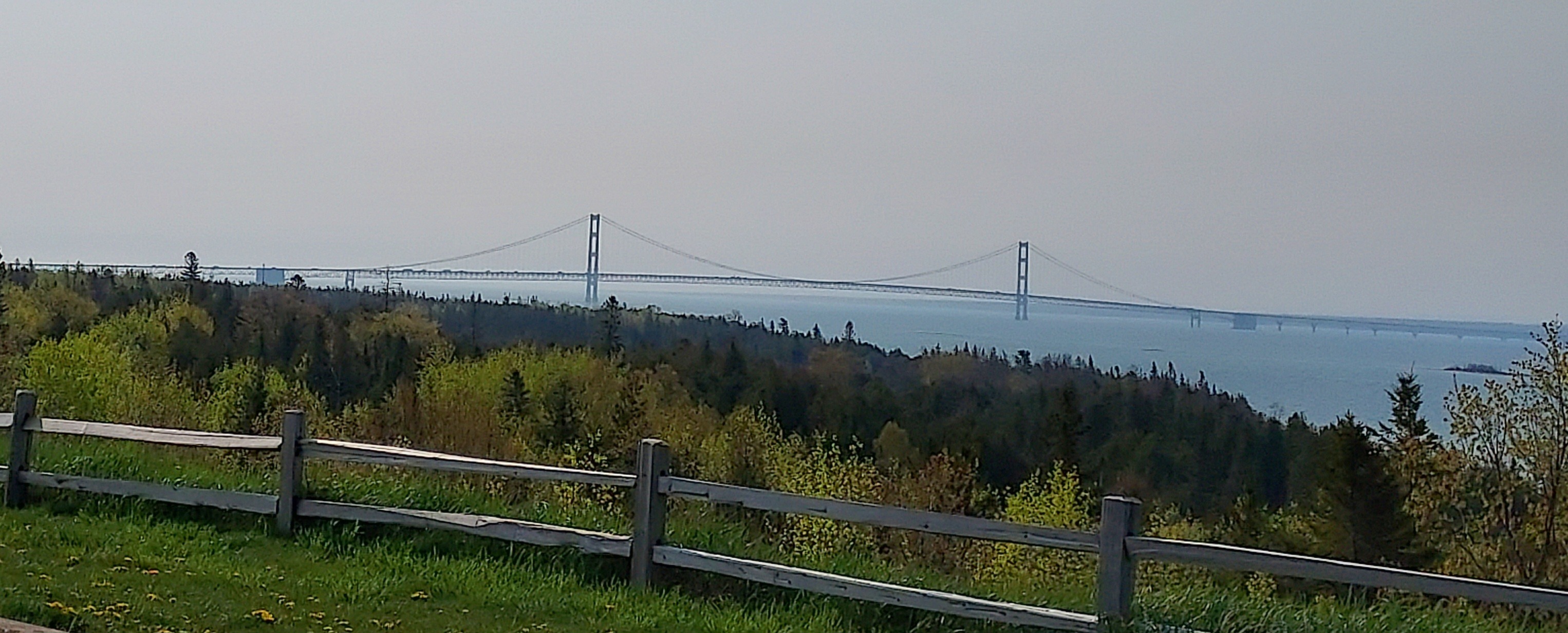
| I hope you recognize this. |
Somewhere near the approach to the Mackinac Bridge from the south is a big billboard that reads, “Same state. Different state of mind.” Rarely have I driven across the Mackinac Bridge without the Artist, and almost always there was a dog with us. First Nikki, then Sarah, except for that one post-Nikki, pre-Sarah trip when we took the ferry from St. Ignace to Mackinac Island. All of which is only to say that the entire U.P. is as saturated with memories for me as Leelanau County, where I live.
![]() |
| A MUST stop for me |
![]() |
| Sunny's first visit |
![]() |
| A pause along U.S. 2... |
![]() |
| ...for sharing time. |
![]() |
| The pickle barrel! Grand Marais! |
I parked Sunny in the shade in Grand Marais and quickly took care of my town errand, then drove us out to Coast Guard Point, where I let my girl get her paws wet in Lake Superior water while I relived memories of picnics, naps, reading, and conversations in our folding chairs -- days of contentment the Artist and I shared with first-Nikki-then-Sarah at that dear spot.
Some things in Grand Marais are the same, others different. The Lickety-Split ice cream place is now the Sherpa Shack, but Arbutus is still where it was the last time the Artist walked around it, dreaming boat dreams.
Then it was east on H-58, past the old two-track (entrance now so grown over!) to Jim Harrison’s writing cabin on the Sucker River, past the old fisheries building on the other side of the road, past School Forest, past this, past that…. Reaching the end of the pavement, I was surprised not to encounter washboard. Ellen had told me the road was “pretty good” (my next destination was the Uglyfish Baking Company, latest joint endeavor of author Ellen Airgood and her husband, Rick Guth, both formerly of the West Bay Diner in Grand Marais and before that, for Rick, as the Earl of Sandwich), and indeed the drive had never been so easy, but I wasn’t sure what to make of that. It didn’t feel or look familiar at all. Like the paved portion west to Munising, road long more of a safari track than anything else, this segment to the east now seemed almost – to me – dismayingly civilized.
![]() |
| Can this be H58? |
| Ah, yes! |
| THIS is the U.P.! |
![]() |
| You can't miss it! |
I had no trouble at all spotting Ellen and Rick’s little trailers on the other side of Muskallonge Lake State Park. How wonderful to see these dear people and to catch up on each other’s lives! Other than being much too short (there is never enough time with friends!), our visit was lovely, and I was very glad to have made the quick trip north. It’s good to talk Michigan, talk outdoor life, talk books and business, even to talk ticks with good friends.
![]() |
| Ellen! |
![]() |
| Remembering the beginning: the Earl of Sandwich! |
![]() |
| Me and Rick, photographed by Ellen |
![]() |
| My new cap! |
Note to readers: If you find yourself north of the bridge and west of Newberry, stop for coffee and a brownie with Ellen and Rick. Visit the gift shop in the smaller of the two trailers (the larger is the Uglyfish kitchen) and buy a mug, t-shirt, billed or knitted cap to take home with a bag of cookies and jar of maple syrup. And Ellen’s books, for sure – for yourself, if you haven’t had the treat of reading them yet, otherwise for someone you love. Ellen will be happy to write a dedication to you or your favorite reader.
![]() |
| Life Up North |
Back home in Leelanau well before dark, I was happy to see my little apple trees blossoming. Same state, different state of mind. Two beautiful peninsulas. Michigan! Isn’t it wonderful?
![]() |
| My little blooming apple tree at home |
Donald Lystra's latest book, Searching for Van Gogh, is a great read, combining a coming-of-age story with a road trip adventure to the top of Michigan's Upper Peninsula. Don't miss this one.
According to Hemingway, "The writer's job is to tell the truth." He also said, "All you have to do is write one true sentence." Lystra is obviously a Hemingway devotee, as evidenced not only by his writing style, but also by his relentless efforts to create characters that are true to life, as well as situations and story lines that ring true. He did it in his award-winning debut novel, Season of Water and Ice, continued in his story collection, Something That Feels Like Truth, and the commitment is evident in his latest book, Searching for Van Gogh. And it works, as I was immediately drawn into his tale of Nathan and Audrey, as unlikely a pair as Lenny and George or, more recently, Joe Buck and Ratso Rizzo (names familiar to readers and moviegoers).
Of the pair, seventeen year-old Nathan is the innocent, a whiz in mathematics and electricity, newly on his own in 1963, living in a rooming house and working in an auto plant in Grand Rapids while pursuing a new interest, trying to paint like Van Gogh. Audrey is a few years older, living in a rundown hotel and working a drugstore lunch counter, and, on the side, offering guided tours of the city's downtown and "companionship" to lonely businessmen from out-of-town. The two meet when Nathan is painting on the bank of the Grand River, and Audrey, watching from the street, offers him advice on "color theory." She reveals her own dream of being a furniture designer, and how, although she's unable to afford the Kendall School of Design, she sits in the hallway outside classroom doors there and listens in.
There are, however, darker sides to both their stories. In Nathan's case it is an uneasy relationship with his stern father and the recent, mysterious death of his older brother, Gary, on a firing range at an Upper Peninsula Army camp where he was stationed. Gary, we learn was "different" -- a highly sensitive and very talented pianist, forced into the Army by their father to “make a man” out of him.
With Audrey, it's a little darker. Nathan gradually learns she'd had a child out of wedlock and was estranged from her parents. (There's more to it, but I don't do spoilers.) There are a couple of road trips, a short, nearly disastrous one to Newaygo, Audrey's hometown, and a much longer one to the top of the U.P., to the Army post where Gary died. Both trips contribute to Nathan's 'education,' sexually and emotionally, but the longer one is especially meaningful, as it takes place concurrently with the national shock and tragedy of the assassination of President Kennedy.
As was true of Danny, the teenage protagonist of Lystra's first book, Nathan is a true innocent, trying earnestly to learn the ways of the world without hurting anyone along the way. There is a scene, in which Nathan has an encounter with a prostitute in a cheap hotel, that immediately calls to mind a similar situation with Holden Caulfield in Salinger’s Catcher in the Rye, and of the two characters, although Nathan is a couple years older, he seems even more innocent than Holden. Yeah, almost that hesitant, that fearful of crossing that line from childhood to the adult world.
In the end, Nathan does cross that line, and there is a sadness in all that he learns, but he keeps on with his painting, even knowing that –
... I'd never find Van Gogh's passion, but it - that failure - didn't seem to matter. The world as it existed was enough. For me and for that time it was enough. I didn't need to change it to make it interesting or to find out what was true.
A deliberate carefulness, a delicacy even, characterizes Lystra's writing, even as it incorporates the twin influences of Hemingway and Salinger. I'm not sure how he does it, but it works to the -nth degree, and in the process, he does the writer's job – he tells the truth, one true sentence at a time.
This is fine writing of the highest caliber and has my very highest recommendation.
- Tim Bazzett, author of the memoir, Booklover
***
Reader and writer Tim Bazzett lives in Reed City and frequently reviews of some of the many books he reads. Thanks, Tim!
| No, we are not open! |
| Cochise County morning |
![]() |
| Gambel's quail |
| roadrunner |
| Porch shadows, Michigan |
| We have been here another moon already |