Search This Blog

Showing posts with label anxiety. Show all posts

Wednesday, June 3, 2026

The Best Things in Life -- and --

Redbud on the creek, Northport

Northern Michigan is in bloom!


Let’s start with beauty, because there is no such thing as too much beauty. Leelanau County has been bursting with blossoms. Cherries first, then apple blossoms, now lilacs. Not only orchards, though. There are lots of flowering plants in the villages, too. 

Chokecherry and viburnum, Northport

Closer look at viburnum called 'Chenault' (somewhat past peak)

These blooming trees in Leland stopped me, too.

At home, wild violets gave me enough for two batches of violet jelly (lots more violets, but how much violet jelly do I need?) and made a stunning setting for photographing my dog when Sunny Juliet plunked down in another little sea of deep purple. And while there aren’t many redbud trees this far north, those few do their part, even the spindly little volunteer behind the old henhouse at my place.

Wild Violet Jelly

Redbud flower closeup

It’s worth looking close to the ground, as well, for beauty you would not be able to take in from a speeding car.

Not much to look at?

Look closer!

And gardens! This is the time of year I live for! I think of it as my real life, with before and after mostly prologue and epilogue. 


Lobelia! Need I say more?

Black petunias! Bacopa! Splendid iris from the late Al Bona!

That got me to thinking the other evening about seasons and how, for me, here in Northern Michigan, the four seasons as generally divided don’t make sense. Spring isn’t really March-April-May, but (in my opinion, in my life) April-May-June, with summer July-August-September, and so on. December is more late fall than early winter, and winter usually hangs on through most of March. What do you think about that?


My reading these days--

As is so often the case, my attention hops like a flea (or buzzes like a bee?) from one book to another. Having trouble with Faulkner’s As I Lay Dying (I could not seem to hear the characters’ voices in my head), I picked up a less demanding book, Dark Light, nonfiction about the dawn of electric light and all the promises and fears any revolutionary new technology spawns, but have yet to finish it, because morning reading on the porch for several days was Remember, by Lisa Genova, neurologist and author of the novel Still Alice, in which the main character develops signs of early onset Alzheimer’s. Not being able to recall a name, Genova assures readers in her new nonfiction book, is not a sign of dementia. It happens to 20-year-olds as well as 80-year-olds. Older people simply worry about it more. 

Remember is an easy read and a quick one. Whatever your age, and whether or not you worry about your memory, it’s worth learning what helps us remember, what gets in the way, and what we can do to keep memory as sharp as possible as we get older. Pay attention, the author tells us at the beginning. (“Stop, look, and listen,” I think to myself, remembering the lesson about crossing streets that I was made to repeat over and over when young.) You can’t remember that to which you have not paid attention. I particularly like this piece of advice, since I decided years ago that paying attention is my #1 job in life. There are other pieces of advice. Sleep, exercise, a healthy diet—all the things that are in general good for our physical health are also good for preserving our memories. Alcohol is a culprit, better avoided. Caffeine in moderation and not too close to bedtime. 

***


Then there was One Day, Everyone Will Have Always Been Against This, by Omar El Akkad, a hard book to read, not for the difficulty of the writing but for its subject matter. Still, the urgency of El Akkad’s book is such that I believe every American should read it now. Because, as he says --

No, there is no terrible thing coming for you in some distant future, but know that a terrible thing is happening to you now. You are being asked to kill off a part of you that would otherwise scream in opposition to injustice. You are being asked to dismantle the machinery of a functioning conscience. Who cares if diplomatic expediency prefers you shrug away the sight of dismembered children? Who cares if great distance from the bloodstained middle allows obliviousness? Forget pity, forget even the dead if you must, but at least fight against the theft of your soul.

- Omar El Akkad, One Day, Everyone Will Have Always Been Against This (2025)

That will be one day. What about today? Where do you and I stand today? 

Detail from book cover


I did, finally, finish As I Lay Dying. Faulkner will never be my favorite writer, but reading one of his famous works was a duty I could not neglect forever.


Big Life, Little Life; or, Macro, Micro

“Big Life, Little Life” is the title I gave to my most recently filled volume of journal writing. “Macro/Micro” are the terms used by Robert Reich and Heather Lofthouse on their Saturday Coffee Klatch videos. For those of us fortunate enough to live far from war and famine, the contrast is often stark between happiness in our personal lives and the agony we feel over our country’s disintegration and its role in world suffering. My parents were spared this, I have thought so often. My (late) husband was spared this.

Recently I had my annual Medicare wellness visit. Am I depressed? No, I can’t say that I am depressed, because my personal life is fulfilling. When I wake up in the middle of the night, however, I often wake into rather than out of nightmare, as I remember what is happening in my country and in the world. Anxiety? Yes, on a daily basis. You are not alone, I was told. “Ninety-nine point nine percent” of her patients are anxious about the country and the world, she told me. And we are the lucky ones! We did not send our children off in the morning only to have a bomb drop on their school and kill them. We are not handcuffed and shackled and herded from one “detainment center” to another, treated worse than American pet owners would ever treat their dogs and cats. We are not starving. Why are we anxious, and what do we fear—if not the theft of our souls? And the death of freedom and the actual deaths of innocent human beings, our brothers and sisters?

What can we do? First, we must speak up. Then -- what practical, doable action have you found that you can take in your community?


Here and now, though...

...Tree Guy and I are putting a life together. This is quite an unexpected late-life gift, as we see it, and Sunny Juliet, who is part of it, may not “count her blessings” in quite the same way, but she loves being part of a pack and having a home and people to play with her and provide her with special treats. She is a lucky dog, and Tree Guy and I are a couple of lucky humans.


Thursday, February 12, 2026

I’ve just been living my life.

Someone to walk with...


Except for a letter or two, I haven’t been writing. More astonishingly, I’ve hardly been reading. 


Still having coffee every morning, getting outdoors with my dog, going to my bookshop four days a week (Wednesday through Saturday) for four hours a day, then back home and outside with the dog again before supper, but it’s been different for the past week because, in addition to Sunny Juliet, I have had a constant human companion. I have slept better and have awakened happy, despite  continuing corruption and chaos abroad in the land. 


Oh, my country! Cry, the beloved country! 


I need to read Alan Paton’s novel again, set in the era of racial tension that directly preceded the 1948 election of the National Party government. The party's appeal to white fear and white supremacy, as well as strong anti-British sentiment (subsequent to the Boer War) and promises to improve the economy for farmers and (white) laborers, put them in power and inaugurated apartheid in South Africa. Their rule lasted for 46 years, with apartheid the law of the land. 


Paton’s book, because a novel, focuses on individuals affected by conditions in their country rather than the more abstract march of history, and I have been thinking of how easy it can be to ignore issues not part of our immediate daily lives, events that do not touch us personally. Almost every life is touched by tragedy sooner or later. But it is the specific nature of the tragedy touching any particular person that usually dictates the cause or causes that that person finds urgent, while other people’s tragedies and other people’s causes never feel as desperately compelling.


Thus it is that the large group of people who care deeply about something, whether mental illness or abused children or cancer research or autism treatment or whatever (and a majority of people in any country, I feel sure, care about at least one issue and usually more than one) can accuse one another, because their cares and concerns are different, of not caring. 


For instance, ICE raids continue in Minneapolis and elsewhere, abducting first and asking questions later, with families and whole communities living in emotionally crippling anxiety day after day. Although we haven’t heard as much about it in the past week, because ICE hasn’t murdered anyone in the streets in the past week, a family member in the Twin Cities tells me nothing is better there and that the daily stress and anxiety continue, along with volunteer operations to help the terrified. 


But if no one in your family or group of friends has dark skin or was born in another country or is of a “nonconforming” gender or practices a faith tradition outside of Christianity, perhaps you don't consider the current administration dangerous. And so it is with every heartbreaking issue. As for immigration raids far, far from the border, even when American citizens are picked up and held without being charged, perhaps it's still easy to look away and say that, well, of course a few mistakes will be made, but ICE troopers, after all, are “just doing their job.” It shouldn’t be easy to look away and dismiss concerns, I keep thinking. If you’re at all concerned about legal vs. illegal (as ICE supporters insist they are), then you ought to care, I fervently believe, for little aspects of American law such as probable cause and due process. But maybe some people haven’t followed those events too closely, because other issues that do touch their own personal lives take all their attention. Or because they don't want to know?


Can people be persuaded to care? How? 


My life has been more peaceful during the last two weeks, not because various horrible conflict situations in our country have been resolved or even improved but because I have stopped trying to make people care who have not yet seen the horror. I have not given up all hope that their eyes will eventually be opened—if only when they are personally touched, at last, by some aspect of it—but I have given up the hope that any information and opinions I might share will make a difference to them. When their eyes are opened, they will see, and not before, and when they see, good people will care.


There are always, of course, a minority of people (I feel certain they are the minority of human beings on earth) who care only for themselves and whose “care” for themselves is so fixed on money and what it can buy that they are willing to sell their very souls to see their worldly wealth increase, and unfortunately, those presently in power in Washington seem to belong to that don’t-care-for-others group, their greed and aggressive natures giving them outsized visibility on the national and world scene. —Perhaps you say not all in that highly visible cabal are motivated by money? Some are afraid! Ah, but what do they fear? Losing their jobs? Doesn’t that come down to sacrificing integrity in order to hold onto wealth and position?


Read my friend Dawn’s pithy summary of the Gordie Howe Bridge brouhaha, written before the news came out that it isn’t about “Canada” or “respect” or “fairness” at all but—surprise!—the old billionaire club protecting one another’s interests, and to hell with American (and Canadian) workers! Grift and corruption, old political allies. 


Another current issue, one bound to affect generations of Americans yet unborn (think about it, you who advocate tirelessly for the “unborn,” with nary a thought for living children and their families), is the threat to the “endangerment finding.” (Update: More than a threat.) The name alone may not tell you much, but the endangerment finding has to do with environmental pollution and public harm. In 2007 SCOTUS recognized the responsibility of the EPA to limit greenhouse gases, citing public harm. Now in February 2026, the current administrator of the EPA, Lee Zeldin, a 46-year-old Republican from New York State and father of two, appointed in January of 2025 by then-incoming president DJT, is poised to stop protecting the American public. Pollute, baby, pollute! Your investment portfolio will love it!


(But of course! In department after department of the federal government, the current administration’s strategy has been to find someone not to direct valuable operations but to gut said department of its budget, expertise, and the ability to fulfill its mission, with the overall goal of eliminating government services and turning them all over to the highest bidder, i.e., to those who can guarantee squeezing the last dollar out of the American public for private profit.)


Threats to free elections? Don't even get me started. Anyone who isn't concerned is just not paying attention.

Midday Thursday, Northport

So I come back to Alan Paton’s novel, which begins with a contrast between green, grassy land and overgrazed bare earth, a contrast of human wealth and poverty mirrored by the land itself, and I think of aquifers in North America depleted by CAFOs, wells polluted by mining and other industry, water made undrinkable and air made unbreathable by industrial and automotive effluents and emissions. I think also of the deepened and still deepening divisions in this country of ours, the widening gap between the haves and have-nots, racial divides that I had hoped were healing back when President Obama was elected, splits political, dogmatic, religious, and also (because the issues have to do with our most dearly held values) deeply personal, such that it seems the legacy of the current administration will, for the remainder of my life, be a tragically divided national landscape. 


“Cry, the beloved country,” wrote Alan Paton of South Africa in 1948, a country he loved deeply and gave generously of himself to try to heal.


Cry, the beloved country, for the unborn child that is the inheritor of our fear. Let him not love the earth too deeply. Let him not laugh too gladly when the water runs through his fingers, not stand too silent when the setting sun makes red the veld with fire. Let him not be too moved when the birds of his land are singing, not give too much of his heart to a mountain or a valley. For fear will rob him of all if he gives too much.


-      - Alan Paton, Cry, The Beloved Country (1948)

- 

Will the legacy of our time on earth be a Divided, Poisoned, Polluted and Hate-Filled States of America? Will those of us who have loved our country “too deeply” have our hearts broken over and over before we die? And if that happens, if we do not live to see our country turn back from fascism and oligarchy, will a future generation yet be able to regain the betrayed ideals our parents lived by and some died for? Will American children not yet born have another chance to find healing and to make of this country a shining city on a hill? Or will America go the way of so many former empires, a story of the dead past for history books written and read in a few surviving free nations? 

My father, WWII


Friday, January 14, 2022

Much Too Much (Happening)

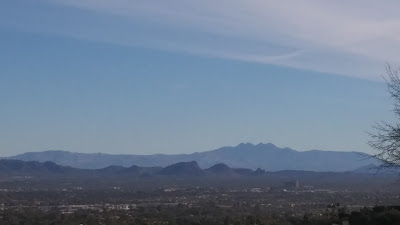
View from Paradise Valley to Four Peaks in the distance


A friend from Leelanau County, Michigan, called me a few days ago. I forget what day it was. She had been looking for a new post on this blog, and when nothing appeared she began to worry. What was going on? Were we all right? What a loyal blog reader! The thing is (I told her), I hadn’t wanted to put our family news out publicly until we were “out of the woods” and had answers to all the inevitable questions. In the midst of so much waiting and uncertainty, that was part of my way of dealing with things.


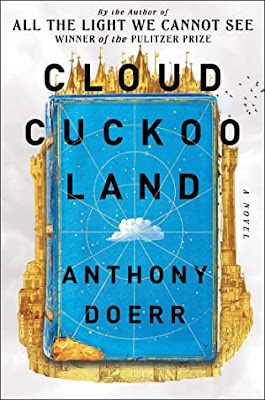
…Each morning comes along and you assume it will be similar enough to the previous one—that you will be safe, that your family will be alive, that you will be together, that life will remain mostly as it was. Then a moment arrives and everything changes.


-      Anthony Doerr, Cloud Cuckoo Land


So here is what happened in our lives.


The Ordeal (or, Life Throws Another Unexpected Curve Ball)


Exactly a week after we bid an emotional farewell to Peasy in the morning and then had a last conversation with a dear friend the same night -- Wednesday to Wednesday, that is -- Fate ambushed us again. The Artist, a.k.a. David, woke without feeling in his left hand, and when I asked if he could lift that arm over his head, he could not. So as soon as we could hastily pull our clothes on and get out to the car (he was able to walk to the car, which was a good sign), we were on the road to the emergency room of the little hospital in Willcox, Northern Cochise Community Hospital (NCCH). Before we even arrived, David was regaining feeling and use of his left hand and arm, and the first word to me out in the waiting room was further cause for relief. The relief was short-lived, however, as more tests that same day revealed a serious blockage in his right carotid artery, bad enough that the ER doctors did not want him leaving the hospital. 


Everyone knows hospitals are overcrowded these days (with COVID patients) as well as understaffed (partly for the same reason), so it was no surprise that he could not be moved to a regular room at NCCH. None was available. Nor was it a surprise that Tucson Medical Center (TMC), where the ER docs at NCCH wanted to send him, had no available beds, either. So he lay in the ER where he started from Wednesday morning until Friday night. The transfer then, by ambulance, was to St. Joseph Hospital in Phoenix – more specifically (and miraculously), to the world-class Barrow Neurological Institute, where on the following Monday morning he went into surgery for a carotid endarterectomy. 


Good message!

At no time did David have any blurred vision or mental confusion. Speech was unaffected. His wicked sense of humor and quick thinking were and remain intact. When he was released on Wednesday, I was able to bring him back to the cousin’s house, where we could stay in the guest suite together. (Jim, the cousin, also has a wicked sense of humor.) So we were very, very fortunate in more ways than one, i.e., 


o  The stroke was a mild one.


o  We got him to the hospital within the hour.


o  Staff at NCCH were diligent in their testing, and the doctor there told us plainly that he should not leave to go home just because he was feeling better.


o  The next shift ER doctor at NCCH somehow managed to get David into St. Joseph in Phoenix – and not only St. Joe but the Barrow Neurological Institute, a world-class teaching and research hospital. 


o  I was able to stay with David’s relatives and eventually bring David back here, too.


o  The surgeon who performed the procedure was Dr. Michael Lawton, “head honcho” of Barrow. (David’s cousin and wife and their friends could hardly believe he was able to get into Barrow from Willcox – and so fast! – and to have Lawton as the surgeon had their heads spinning.)


o  I was able to be with David (no small matter in these COVID days!) in his double room over the weekend and in pre-op, recovery, and in the ICU Tuesday, in addition to his private room on Wednesday while we waited for his discharge (always a long drawn-out affair, as many of you know).


So all in all, if he had to have a stroke, this one may have been a blessing, revealing as it did a blockage that might well have caused a much more severe stroke if left untreated. And if he had to have major surgery so far from our Michigan home and friends, having it done in a world-class hospital, by a world-class surgeon, was a miraculous piece of good fortune. Finally, as if that weren’t enough good luck, he now has had the luxury of very comfortable recovery time here in Jim and Carol’s home before we undertake the long return drive to our ghost town cabin, which is a little over 15 miles from the little hospital in Willcox and over 200 miles from Phoenix.


The Different Week We Lived


Generally speaking, we are (to use the Artist’s phrase) “joined at the hip” all winter long during our seasonal retirement. It is rare that one of us goes somewhere without the other, and three hours is about the longest separation we experience even then.


This past week was completely different from our usual way of life, winter or summer. David was flat on his back for eight days, in two different hospitals and, between hospitals, in an ambulance. Meanwhile, I commuted between Dos Cabezas and Willcox, then trekked to Phoenix, and then commuted between Paradise Valley and St. Joseph Hospital. While I was by myself, navigating unfamiliar streets and heavy traffic in a strange big city, David was being asked his date of birth multiple times a day, subjected to sophisticated diagnostic tests, and monitored every minute. His attempts at sleep were fraught. My nighttime situation could not have been more comfortable, from a physical point of view. Of course we were in contact by cell phone and spent as much time together as possible, most of it waiting for one thing or another to happen.


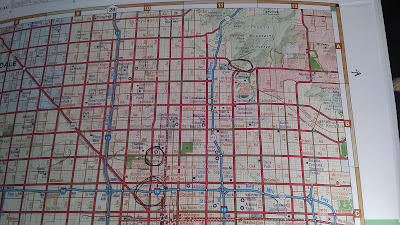
Strategizing my route

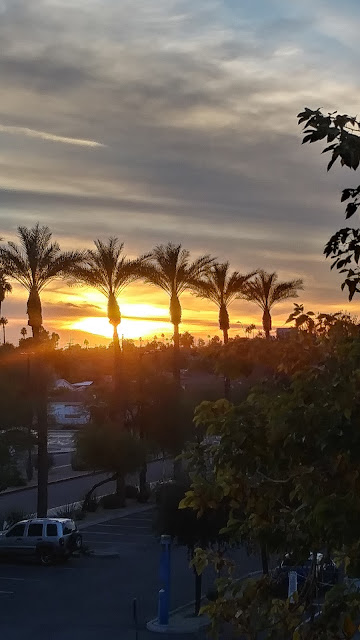
Another sunset from the hospital parking garage


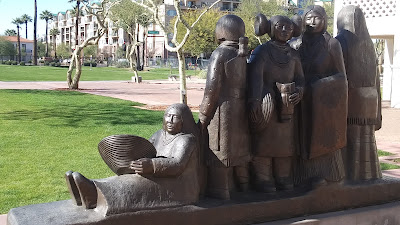
One thing about traveling separate daily roads was that we had a lot to tell each other when together. On Sunday (since nothing much was going to happen that day), I took an afternoon break from the hospital, giving David’s cousin Jim a chance to visit, and I went a short distance away to the Heard Museum, “world's preeminent museum for the presentation, interpretation and advancement of American Indian art….” What a fabulous place! The Art was beautifully displayed, and I didn’t even try to see everything. Sometimes I didn’t even read the information but only stood in front of a work and let its power move me.

Sculpture group outside Heard Museum, Phoenix

If the Artist and I were here in Phoenix for other reasons and both of us feeling tip-top, we would be visiting galleries and museums and bookstores galore, but such was not the case this trip.


Reading


The Artist’s cousin’s wife, Carol, is a champion reader, beside whom I feel like the rankest of amateurs. She not only keeps lists of all the books she reads but writes up an entire journal page for each book. (She is also a wonderful cook and gardener and sits on many civic boards and committees. A superwoman, in other words.) The first evening I was here, she brought an entire bag of books to my room that she had finished reading and was passing along to me, and by the next day four more books were stacked next to the bag, one being Cloud Cuckoo Land. 


It isn’t often that I am reading a book on the New York Times bestseller list, as I’m frequently years or even decades behind the rest of my fellow book-loving Americans, and in that context I have to admit that I have yet to read Anthony Doerr’s previous bestseller, All the Light We Cannot See. But Cloud Cuckoo Land has been the perfect book for me to lose myself in off and on during the past week. The time span of the story is incredible, and we are not simply flashing back and forward in a single country or family, but hopping from one country to another and even into a future far beyond our own, with a complicated cast of apparently unrelated “main” characters. The only link seems to be the Greek story of Ulysses. 


“Stranger, whoever you are, 

open this to learn what will amaze you.”


Will Zeno and Anna and Konstance and Seymour and Omeir all be somehow saved by books? By stories? At about the midway point in this 626-page novel, I cannot presume to guess, but I can tell you that these characters have been good company for me during a time of anxiety in my own life.


Monday, November 8, 2021

Escaping the Most Beautiful Autumn?

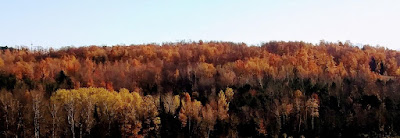
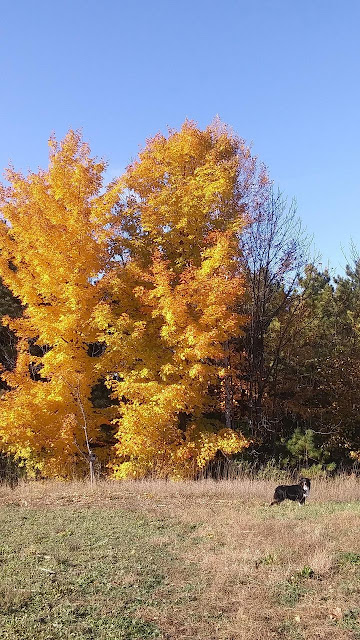
The hills are alive with gorgeous color.

It’s official: my seasonal retirement is underway, now that Saturday, October 30, my last official bookstore of 2021, is in the rearview mirror. It was a fantastic season, both in the bookstore and the gallery, we are deeply grateful to everyone who made it so, and now we’ve been getting at projects long postponed -- such as, for me, my “blackstraw” jam (a mix of black raspberries and strawberries, fruit from earlier months that’s been in the freezer all this time) and, with the remaining raspberries, a fruit syrup that will be delicious in Italian sodas as well as on ice cream and waffles.


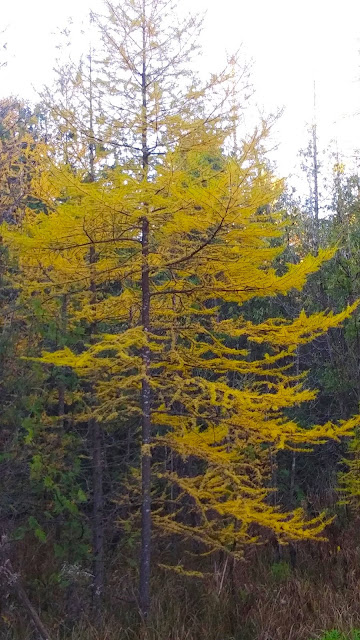
Tamarack in wetland woods glows gold.


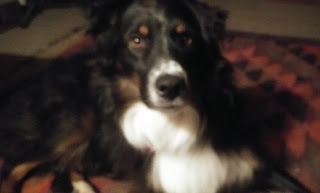
As beautiful as was October and as lovely as November yet continues to be, however -- and is this not one of the mildest and most colorful fall seasons northern Michigan has ever seen, or is only Leelanau County so blessed? Gaylord, over in the middle of the northern mitten, had almost a foot of snow last Tuesday! -- my days have not been all light-hearted bliss.  Social strife and politics afford sufficient fuel for anxiety and heartache, but quite honestly it’s my dog whose fate occupies my nighttime waking hours. We have met with a special trainer and consulted our vet about medication and hope to hear soon what vet and trainer together think about Peasy’s chances at rehabilitation. I have minimized his problems here in my blog, but believe me, it has been and continues to be a difficult path forward, involving many sleepless nights. Little guy has no idea how many people he's never met are pulling for him! If only he could be as sweet with the rest of the world as he is with me!


My boy loves his outdoor world.


Each of us is the center of her or his experience. There is no getting around that fact. For me, the social and political climate of the last decade have been such a source of agony that I explain my obsessive focus on one little stray dog against this larger background. How can I not take refuge from intractable national and global problems in one very personal issue that will – perhaps -- with all my determination and a wide, winning smile from Lady Luck -- show itself to be meliorable (and did I just make up that word?). The other side of the coin is that it's no wonder to me at all that a dear friend with Stage IV cancer has no emotional energy whatsoever to worry about politics. But what a wonderful example of positivity she is, and how we have enjoyed our five fabulous "special Sundays" together this fall! Love you, Mel!


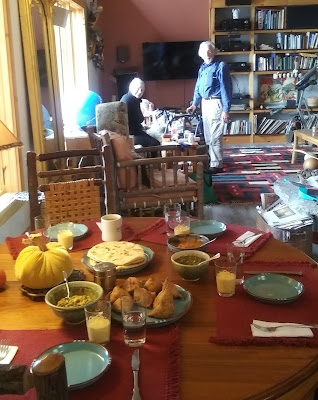
Precious times together with human friends!


At any rate, these nights in the wee dark hours my coping strategy is frequently a retreat from insomnia into the world of fiction, and here are the books I've read since my last post:  


Chinua Achebe’s Things Fall Apart (#151 on my list of books read this year) furnished our old reading circle with plenty of food for discussion, and those new to the novel were very glad to have read it, while I was glad to have read it again.


The Music Shop, by Rachel Joyce (#152), was a lighter novel but more than I expected. 


Then there was Paradise (#153), a work by this year’s Nobel prize winner, Abdulrazak Gurnah, and I’m still trying to figure out what to make of the ending. Have any of you read it? What did you think?


For several of the early chapters of Jay McInerney’s The Good Life (#154), I wondered why I was reading the book at all. Was it a roman à clef, and should I have been picking up on all kinds of Manhattan gossip? Either the book deepened as it went along, or the time I invested in it heightened my appreciation.


Women Talking (#155), by the Canadian writer Miriam Toews, was a story the author imagined after reading of an actual event. True to its title, the novel was almost exclusively conversation among illiterate women in an isolated rural religious community trying to make the biggest decision of their lives.


Anne Lamott's Blue Shoe (#156) was my first foray into her fiction, but I couldn't help wondering how autobiographical the story was, although the central character was not a writer....


After all that, seeking cuddly comfort, I turned to Elizabeth Enright’s Gone-Away Lake (#157), a children’s story, with illustrations by Beth and Joe Krush, who also illustrated my beloved books about the Borrowers. Elizabeth Enright, Eleanor Estes, Palmer Brown -- I always find comfort in these children's books, which are also books from my own childhood.


-- Then came Mary Elizabeth Pope’s The Gods of Green County (my 158th book read in 2021), a truly spell-binding experience and an early reason, already, for me to look forward to re-opening in May 2022, when I can press this book into the hands of customers looking for a fiction recommendation. 


That the evil manipulations and outright brutality of the novel’s villain (I think it’s fair to call the sheriff that) take place almost exclusively “offstage,” reported only second- or third-hand by other characters, seems altogether appropriate. It keeps the story's focus on Big Earl and Coralee, Leroy and Cole, and the young boys, Little Earl and Caleb. Other characters who seem minor early in the novel, come into their own as the fictional years go by. And always we are surrounded by the flat cotton fields and woods of Arkansas. Here, for instance, is Coralee:


...Sometimes I felt like I lived in a world of fields and trees and spirits when everyone else lived in a world of bricks and clapboard and bodies. Maybe that is why I never could make conversation. There were rules about who talks first, and for how long, and about what, and also when it was your turn to say something funny. I never could get the knack of it. 


Coralee and Big and Little Earl will insinuate themselves into your heart, I guarantee.


Nearing the last few short chapters of The Gods of Green County, I almost succumbed to disappointment (will not say why, because I don't do spoilers!), but the remaining pages did away with any incipient negative judgment, and I closed the book with deep satisfaction. Not only can Mary Elizabeth Pope “tell a story,” she has shaped her novel in such a way that everything that happens in her characters’ lives seems inevitable – and it all brings us home in the end. Catharsis achieved -- something rare so far in 21st century literature.


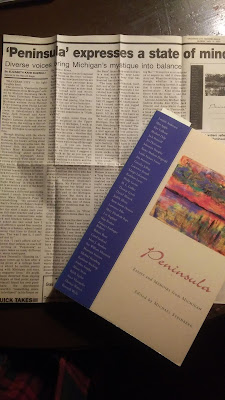
Pope did a reading at Dog Ears Books years ago from her collection of short stories, Divining Venus, and a memoir essay, “Downshifting, included in Peninsula: Essays and Memoirs from Michigan, edited by Michael Steinberg, tells of her summer job at Barb’s Bakery in Northport, so perhaps you met her at the bakery or the bookstore or both. Whether or not you did then, you will not want to miss The Gods of Green County. Really!


Friends past and present gathered together


So even in “escape,” you see, I have not been wasting my time. I’ve been getting out in the sunshine and under cloudy skies, too, as much as possible, enjoying the beautiful Michigan autumn and the companionship of a dog who doesn’t love the whole world (as did Sarah) but who does, at least, demonstrably love the Artist and me. And I am doing the best I can to deserve the love of them both.


That clueless heartbreaker!


Thursday, April 9, 2020

How Long Will It Last?


How long will what last? The pandemic, the staying at home, the anxiety, fear, worry, anger? The arrival of sudden, piercing stabs of fear in the middle of a sleepless night? 

Household food supplies???


Long before the stay-at-home order came to Arizona (where we remain until confident of a safe return to northern Michigan), even before the nationwide toilet paper panic and frenzy, wise and forward-thinking authorities recommended that every household have a minimum of two weeks of food and necessities on hand, in case quarantine became necessary. So I shopped then and found everything we needed and felt we were well supplied. I even bought a two-pack of giant-size containers of antiseptic wipes, wondering if we could ever possibly need that many. Was I overreacting? Flour, yeast, canned tomatoes, pasta, canned milk, onions, soap, yada-yada-yada — all the things you’d need if you couldn’t get out of the house for two weeks. 

But hand sanitizer? I never buy that stuff, just soap. So when I returned to the store for hand sanitizer a week or two later, while other shoppers were panicking over shelves stripped bare of toilet paper and paper towels [actually, no one looked panicked at the Safeway in Willcox: that was literary hyperbole], I was stunned at the sight of an empty aisle where hand sanitizer and other such products used to be. On my next and I hope last trip, there was still none to be had. We are told to keep in the car and use it constantly, but the Artist and I are using those antiseptic wipes I thought I might not need. Not the kind made for hands, but the harsher cleaners intended for household use. Now even those are nowhere to be found for sale! How long will what we have left last?

I chickened out of going to the grocery store again last Friday, as planned, and made a new plan for Tuesday, when the dairy and egg supply would be restocked. And yes, on Tuesday the store had eggs, and I bought another container of yogurt so I’ll have starter to get back to making my own with raw milk from the feed store, but once again there was no hand sanitizer, no antiseptic wipes, and no yeast. I almost wept. I'd been so nervous about going at all, and then these empty, gaping shelves! I think of certain friends in Northport who have for years found it amusing to refer to our grocery store there, especially in winter when the summer people with their big bucks are not in residence, as "Moscow Market." Ha! Eat your words, guys! We always had everything we needed, didn't we?

Catching wild yeast from their air, on the other hand, is something I think I can manage, so before we run out of yeast, I will finally attempt to make sourdough starter. Old dog, new trick. I have read up on it and feel confident. 

But aren't these strange times when a trip to the grocery store or laundromat feels dangerous? How long will these feelings last?

We went to a different laundromat this week, a less frequented washateria with cheaper washers than our usual but busier, more crowded place (hence our avoidance) — sadly, also with dryers that have an insatiable appetite for quarters. But never mind! All I wanted to do was wash the clothes and get back to the cabin and hang them on our new clothesline. Finding almost all the machines in use when we arrived — very unusual! — and four people inside, we made ourselves comfortable in the car with books and cold water and snacks, in a quiet, shady spot, with a nice breeze filtering through the new leaves of a velvet ash tree, waiting for the coast to clear, as it eventually did. So it all worked out.

Still, we were relieved to be home again, even though a single clothesline and limited supply of clothespins meant that I spent the remainder of the day hanging up as many items at once as possible and whenever a few were dry, pulling those dry items off the line to make way for more. It really did take all afternoon, too, despite sun and a stiff breeze, and the last towels were still on the line when meatballs for dinner went into 
the oven.


Funny how one's perceptions change with changed circumstances. Familiar sights evoke new thoughts. These days when I’m out walking and see dried cow dung, I think, fuel. When we’re driving, wild rhubarb along the roadside says to me, food. Prickly pear still poses a question: how does one harvest and prepare that to eat? So far, however, we have not retreated that far back into the past.


I’m not exactly living the life of my grandmother’s, she who had to pump water to heat on the stove to do her laundry outdoors in washtubs. (One of those washtubs was my first “swimming pool” when I was a toddler.) She also milked her own cow and slaughtered her own chickens, and my grandfather had an enormous vegetable garden, huge raspberry patch, and their entire backyard was given over to growing fruit.


My mother on her parents' country "farmette"
My parents' first home in South Dakota
My mother, with indoor plumbing, had a wringer washer in the basement and lines both in the backyard (for summer) and in the basement (for winter). When my sisters and I were young, we had three apple trees, one pear tree, and a raspberry patch (that last, thanks to our grandfather who brought the canes from Ohio for us). My mother baked her own bread, put up homemade jam, and made her own perfect piecrust from scratch, so these days I’m kind of living my mother’s life — without the little children, but it’s still amazing how cooking and baking and cleaning have expanded to fill the days, now that we are staying at home.


And I ask myself, how long will these new habits last? As long as the pandemic or longer? When these times are “over,” and we can return to something resembling “normal life,” will we continue to bake our own bread and hang our laundry out in the sun?

Well, I routinely hang laundry on the line back in Michigan, though I do not bake bread in the busy months when I'm running a business fulltime and doing my share of keeping grass mowed around our old farmhouse and barns. Anyway, truthfully, I wonder more about other changes in our lives these days, too, the way we are considering and treating one another, not only within our households but in our communities and across the country and beyond. 

How long will we continue communicating with loved ones on our present, new, more frequent basis and, in addition, find time to reconnect with friends forgotten or neglected for years? How long will we keep up the habit of thanking family members, friends, and strangers for each kindness, large and small? How long will we remember to give thanks, each and every day, for each and every day we’re alive?