
It was the hour past sunset, with light leaching away imperceptibly but steadily from land and sky when we, inside the cabin, heard them lowing close by. “They’re in the yard!” we told each other. Their nearness was not unusual, but as it was our last evening we couldn’t help being pleased that they had come as we hurried to step outside for one more close encounter.
Earlier in the day, on our way back from errands in town, we had stopped for a visit with a small family group of horses grazing by their shrinking seasonal pond — two mares, their spring foals, and the pater familias. Every time our road took us past their spot, we looked for them. Sometimes they were off in the far distance, the little ones lying down in the grass, invisible to our searching gazes, and occasionally we saw them not at all, but on the best days there they were by the pond, tantalizingly close.
 |
| The family that grazes together... |
 |
| My little darling on the left, but "the other one" is pretty, too. |
Some of life’s last times we realize only long afterward. We look forward confidently to another meeting, “the next time we see each other,” only to find, at times, our best-laid plans and confident expectations overthrown. And really, we never do know for sure. We say, “Until we meet again!” ignorant of whether or not that next coming-together will ever take place.
Gloaming is a sweet time of day, giving yet enough light to justify our calling it day, even as we know night is falling. The word comes from an Old English word meaning to glow. Some definitions give dusk as a synonym, but to my ear dusk emphasizes the coming darkness (as does for me the French word crépuscule), while gloaming speaks of the lingering light. Just so, at parting with friends and places we can choose to emphasize to ourselves the coming separation or hold to the warm glow of friendship and love.
How can I claim to love this part of the country, a Facebook friend asks, when I have known it so briefly? She did not know me as a horse-crazy girl, gazing over the cornfield across the road and dreaming on my parents’ front porch of riding my horse off into the sunset! How could John Denver claim to have been “born in the summer of his 27th year/coming home to a place he’d never been before”? (How, really, does any of us ever decide to marry? The love of forty years is different from and deeper than the excitement of new love, but only the latter makes possible, eventually, the former.) And I have immersed myself in the Southwest while here, exploring it by car, on foot, and through reading its history.
Arizona has its problems and shortcomings and shameful aspects to its history, as no one would deny. So does Michigan. We do not love places or people for their perfection, since that is nowhere to be found, but for their beauties and despite their imperfections. And does not every human love bear within it a seed of sadness, a heartache that is part and parcel of love, emblematic of our human mortality?
 |
| Mountain hidden in snow clouds |
 |
| Adobe ruins in snow |
This has been the third long visit the Artist and I have made to southeast Arizona, and as we came earlier this time than in previous years, arriving in mid-December, we were surprised to find summer’s leaves still clinging to the mesquite. Mid-December was only autumn, not yet winter! Then winter arrived, with heavier and more frequent snows and much colder nights (several times below zero) than usual for this part of the country, and it was a beautiful if challenging season. Now it is spring, and after a bountifully rainy winter and spring, the high desert spring is unusually green this year.


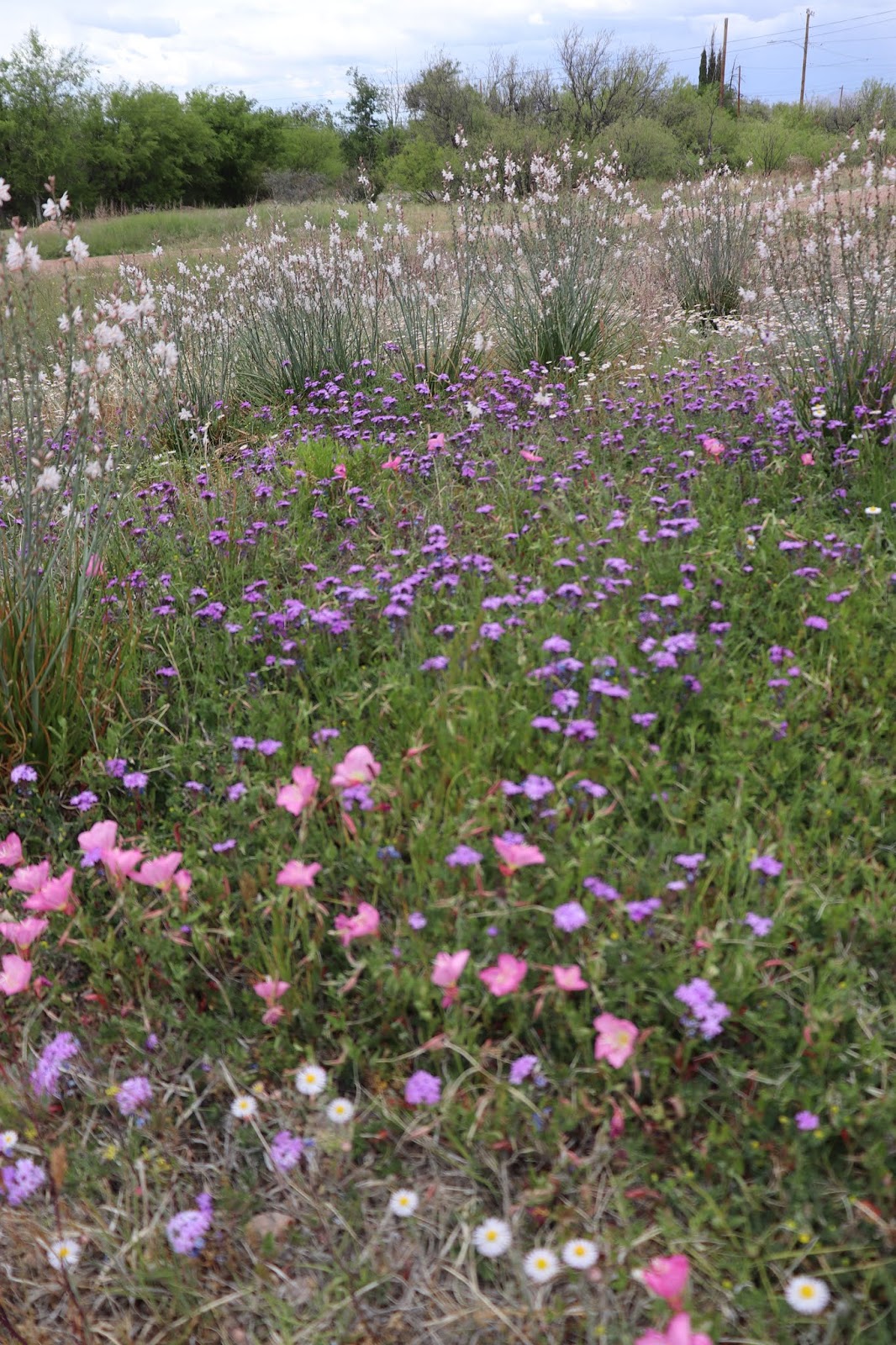 |
| Tombstone flora |
Our three stays taken together, I realized this morning, add up to almost a year, and we have now experienced three seasons out of four. Summer here would be the most difficult season, of course, for Northerners, but here in the ghost town, at an elevation of almost a mile above sea level, I’m sure it is much more bearable than Phoenix! Besides, my ghost town hiking partner tells me, the key to summer is to get up and out early, at “first light,” and that would suit me fine. That time of morning before sunrise when the sky gradually grows light is my favorite time of day.


But summer and fall call us back to Michigan. Wildflowers must be blooming already in the woods, the sweet, precious spring ephemerals! Favorite walks will be there again for my morning rambles outdoors with Sarah. Memorial Day weekend will be Cars in the Park in Northport, and late September will bring Leelanau UnCaged! And every morning and night our dear home, every day our dear friends…. Another place, another love.
Back now, though, to the cattle, right here. As the high desert grows greener, it is becoming more difficult with each passing day to keep track of cows in the mesquite, but one can follow their voices, and we do that until we catch a glimpse of one, then two, then another pair, and down by the highway a delightful, very little scampering calf! I will miss them, their voices and their smells and their rich, beautiful colors.

 |
| I remember her face from last year. |
 |
| Northern cardinal -- see you in Michigan! |
So bless the cows and horses, the birds and deer! Bless our human ghost town neighbors, too, who have made us feel so welcome! We plan a return next winter. At hand now, however, is our return to northern woods and shores, to our old farmhouse set amid cherry orchards, and our places of work in a harbor village, a scant 607 feet above sea level. And so for now we bid farewell to mountains and mesquite, dry washes and agave, mule deer and pyrrhuloxia and cactus wren and canyon towhee and wish all in southern Arizona a happy and healthy summer and fall. And we thank the cattle for coming to bid us farewell on our last evening of this particular long visit.
Yes, it is very possible to love more than one world, and the love for one does not diminish or denigrate love for the other. As Jane Austen had one of her characters in Northanger Abbey observe, “It is well to have as many holds on happiness as possible” -- and I have been very happy here.


