Search This Blog

Thursday, April 12, 2018

Book Review: WHAT DID YOU DO IN THE WAR, SISTER?

My books in Arizona
My reading year started off slowly in January. All a-flutter over a trip to the Yucatan with an old friend, to be followed by the cross-country trek with Artist and dog to our winter quarters in the high desert, I could hardly concentrate on books and think I only read the first three on my “Books Read 2018” list that month. Even once we were here in Arizona, all the business of getting settled in and reacquainted with our surroundings and meeting new neighbors and, in my case, studying Spanish meant that it was quite a while before I could settle down to books. 

As it has turned out, much of my reading this winter and early spring has been history and economics (though that fat volume of Adam Smith’s Wealth of Nations got shoved aside rather abruptly by more reading I found compelling in the moment) — the world, the Southwest, and Mexico. And now, for a couple of days this past week, I found myself completely immersed in a different side of the European World War II experience, thanks to Dennis J. Turner’s What Did You Do in the War, Sister? How Catholic Nuns in Belgium Defied and Deceived the Nazis in World War Two. 

Book in focus
Dennis Turner, professor of law at the University of Dayton in Ohio, is a summer resident of Leelanau County, where he and I met (no surprise!) at Dog Ears Books. Lately we have had quite a bit of e-mail correspondence about his book. The subject intrigued me, and equally intriguing was Turner’s approach to writing the story. 

Beginning with a wealth of source material, including letters and journals written by a group of nuns in Nazi-occupied Belgium, the author made the decision to create a fictional nun to serve as his narrator and then wove together various strands of history — troop movements, bombings, strictures of wartime civilian life and in the life of different religious orders — to show the war in Belgium and France through the eyes of his fictional main character, a young American nun from Ohio, sent by her order shortly before the war began to a convent and girls’ school in Belgium.

This is one book that compels the reading of every page, including sections preceding and following the main story. Turner begins by giving a timeline of events beginning in 1932 and 1945, an extremely helpful historical review. The preface then tells his own personal story — his initial introduction to the Belgian nuns’ story, his own experiences with Catholic education, the atheism he now espouses, his role on the faculty of a Catholic university — as well as background on the particular order of nuns whose experiences inspired his book. His acknowledgements section (“Author’s Reflections”) serves in part as a continuation of the preface, his expressions there truly reflective and grateful for experiences that made his book possible and indicative of learning that, while it did not convert him, enlarged his perspective on religion.

Of course, it is the story that is primary. We first meet Sister Christina in December 1944. The town of St. Hubert and the nuns of Our Lady of Namur had thought the Nazi occupation was over when American soldiers arrived in September, but now they are enduring a second occupation by German troops. Sister Christina recounts her struggle with fear of death, likening it to that experienced by a soldier in battle. Her religious training had schooled her in acceptance, and she had done well in difficult circumstances for several years; however, when she is wounded and a fellow nun beside her killed in a bombing raid, she is gripped by fear. Not wanting the  bravery of the Sisters of Our Lady to be forgotten, should they not survive the war, Sister Christina resolves to write the story of their wartime life and activities, relying on the detailed diary she had always kept. 

Sister Christina speaks German as well as French and, as an American, is a native English speaker, so her linguistic abilities repeatedly make her a logical choice for special responsibilities. When the nuns become active involved in the Resistance, for instance, and men claiming to be downed American pilots come to the convent seeking shelter, it is Sister Christina who is asked to determine whether they are genuine Americans or German imposters. Here she faces a moral dilemma she never expected would be hers in a life of strict obedience, since judging a man to be an imposter meant sending him to certain death.

The convent had not prepared me for these kinds of choices. If any decisions needed to be made, my Sister Superior made them. I naively assumed that if I were somehow given the power of choice, it would simply be a matter of choosing the obvious good and rejecting the obvious evil. The options were black and white, like our habits. Thus, it was a distressing surprise to discover that having freedom of choice drops you into a world of moral ambiguity. Evil may be wrapped in goodness, and good may have evil buried inside.  

… Of course, I might let Sister Ursula carry the entire moral burden of choice. I could escape responsibility by claiming that … I was just obeying Sister Ursula’s orders. I am sure, however, such a rationalization would not have eased my troubled conscience much.

The nuns sheltered and concealed many kinds of fugitives behind their walls. Some were other Resistance fighters, others American pilots shot down by German guns.

In the fall of 1941, persecution of the Jews increased. As a result, Sister Ursula quickly agreed with [Father] Cyril’s request to give refuge to Jews. 

In addition to those Jews literally hidden in the convent, there were Jewish girls “hidden in plain sight” as regular Catholic students of the nuns’ school. These girls were given Christian-sounding names and taught basic prayers and responses. They had to eat whatever was served, including non-kosher pork; they were to speak only French at all times; and their identities were to be kept hidden even from one another. They were not, however, to be baptized or in any way pressured to convert, and a complicated system was developed whereby the Jewish students lined up to receive communion were given an unconsecrated wafer from a secret portion of the ciborium. Their own religion was respected at the same time that they were disguised as Catholic students.

We had built a delicate house of cards based on complete silence, and it would entirely collapse if the Abwehr heard we were knowingly sheltering even one Jewish girl. A mere rumor could trigger a full-scale invasion of the convent and school by Abwehr agents. 

Sister Christina thought when initially sent to Belgium that she would remain in the one sheltered convent, but war shattered that expectation. Neither German nor American bombs spared civilians or those in religious orders. Villages, homes, farms, churches, and convents were equally at risk. (Sister Christina says that she and the others, irrationally, did not have the same fear of American bombs as they did of the Germans, because they realized the Americans were there to liberate them from Nazi occupation.) When their convent home is destroyed, the sisters have to take to the road with other refugees, and throughout the story they are given refuge as often as they give refuge to others.

Her own role is one of increasing complexity, as Sister Christina must wear different masks in the fulfillment of her wartime duties. Her impassive nun’s face at times had to be replaced by a shy, coy flirtatiousness designed to stall German officers so that resident refugees would have time to hide before a search of the convent. With men coming as downed pilots, in order to determine their authenticity she had to set aside silent reserve to engage in lively conversation about American life. And occasionally with stubborn bureaucrats or soldiers it was necessary for her to raise her voice and scold, as if bringing unruly schoolboys to order. 

In the reality of life in occupied Belgium, for everyone concerned, fear alternates with hope, doubt with certainty, and the relief of liberation with the return of occupying forces, occupiers more desperate than ever as their cause becomes more hopeless. At one point the cellar of the convent (serving as bomb shelter) is divided into sections for housing German soldiers, Belgian nuns, and wounded American soldiers who are technical prisoners-of-war. It is a complicated time, and when Sister Christina sees the extreme youth of German boy soldiers she can’t help feeling sorry for them, realizing that “he and his generation would pay the bitter price” for the indoctrination to which they had been subjected. 

While the author carefully notes each instance in the story where he changed or fabricated an event or a conversation, the illusion of reality will not be disturbed for any but the most hidebound literal readers. To read, after all, is frequently to enter into the life of fictional characters. Moreover, not only the background but the majority of facts in this story are documented, making the fictional narrator perfectly believable.

I will bestocking Dennis Turner’s book this summer in my Northport bookstore and hope to have the author on hand at least once to meet a local reading public I know will be appreciative of his efforts and the results. What Did You Do in the War, Sister? is a book that will have have broad appeal and broaden anyone’s historical knowledge of World War II with its page-turning story.

We shall return -- in mid-May!


Wednesday, April 11, 2018

Beautiful Mornings Not For Sale


On one morning’s drive into Willcox, a song came into my head, and once it was there it stayed for several days. “Who Will Buy?” My first and unforgettable introduction to it came during a high school talent show, when a schoolmate sat alone on a stage and sang her heart out. “Who will buy this wonderful morning?” the song begins. A later verse asks, poignantly, “Who will buy this wonderful feeling?” and the song’s final, plaintive question, “What am I to do/to keep the sky so blue?” is answered only by the desperate, doomed wish: “There must be someone who will buy.” 

We cannot, of course, put a beautiful morning or a wonderful feeling in a box, tie it up with ribbons, and take it out when we feel blue. We know very well that life doesn’t work that way. But having such mornings and such feelings — and remembering them — and holding onto the likelihood that they will come into one’s life again, no matter how bleak a particular present moment might appear — those are the realizations that song has always brought me. And while the idea of buying special moments and feelings is a strange one, something we know to be impossible, at the core of the absurd idea is an essential and crucial knowledge, that of value beyond price. 

A friend sent me The Moth Snowstorm: Nature and Joy, by Michael McCarthy, a nonfiction book filled with sobering facts, to put it mildly: The world population of human beings doubled between 1960 and 2000, from 3 billion to 6 billion, while at the same time the world economy was multiplied by a factor of six; we have done away with fully half of the world’s rainforests; twenty percent of vertebrates are threatened with extinction; etc. We human beings have become aware of the problems created by our species, and we see what needs to be done, but our habits and desires and super-monkey ingenuity get in the way of reducing our destructive impact on the planet that is our home. Instead, our impact grows by leaps and bounds, and the natural world of which we are a part, on which we depend for our very lives, is destroyed piece by more and more enormous piece.

One argument frequently advanced to convince us to change our ways is that of “sustainable development.” It’s an idea we can understand, but it demands the sacrifice of self-interest — a tough sell. Another attempt at persuasion is the utilitarian argument, appealing to our self-interest. The second argument relies on the fact that we are dependent on nature, which implies that the value of saving our natural environment far exceeds the quick profits to be made by destroying it. But the utilitarian argument’s recognition of value requires commodifying nature and putting a price on various obviously useful aspects of it, leaving other features without defense. 

Hence McCarthy’s attempt at a wholly different kind of defense of nature, an argument for protecting the air, earth, water, and living species of our world that relies unabashedly on his own personal experiences. 

We should offer up not just the notion of being sensible and responsible about it, which is sustainable development, nor the notion of its mammoth utilitarian and financial value, which is ecosystem services, but a third way, something different entirely: we should offer up what it means to our spirits; the love of it. We should offer up its joy. 

Joy is the feeling expressed in the song that came to my mind as we crossed the desert and drove along the edge of the playa with mountains surrounding us in every direction. Beautiful morning, wonderful feeling. Why do I love this bleak landscape so? It is nothing at all like northern Michigan, with its lush green, moist spring, and yet the same joy that lights so many of my Michigan mornings comes to me here in Arizona. Like the Great Lakes hills and shores, the desert offers a vast expanse and offers room for the spirit to expand. My Michigan eyes, drawn at home to lakes and tree-crowded horizons, here are drawn again and again to mountains. 


And, as happens so often in Michigan, smaller details of my desert surroundings gladden my heart. A sudden splash of color along an otherwise muted roadside — “Oh, stop! Go back! What was that?”

desert verbena
One day it was desert verbena, and having seen it once I look for it again and again, even as other blossoms come along to delight my eye, and even as I scour the more distant views in hopes of seeing species of the wild animal kingdom.

golden smoke

penstemon

Mexican poppy
A group of eight to ten deer one morning surprised Sarah and me on our morning walk. (Sarah noticed them first, when one of the animals shifted position.) The group was initially only fifty or sixty feet from us, but as we turned to watch, they began moving slowly back toward the mountains, vanishing silently into the mesquite as if they had never been there at all. I kept looking, however (as did Sarah), and after a minute or two, one at a time, like a Jack-in-the-box, a deer would appear above the mesquite, as if propelled upward on springs! After the third or fourth deer-in-the-air, I realized they were jumping a barbed wire fence. No photographs of that episode in our desert morning, but it’s bright in my memory.

Another morning’s expedition, a walk around the bird-watching lake, brought another wildlife surprise when a jackrabbit ran across the road in front of us. Those ears! Wow! No time to employ the camera, not for that hare or for a second jackrabbit bounding away from the lake and into the tall grass, but seeing them was thrilling. Then there are hawks….


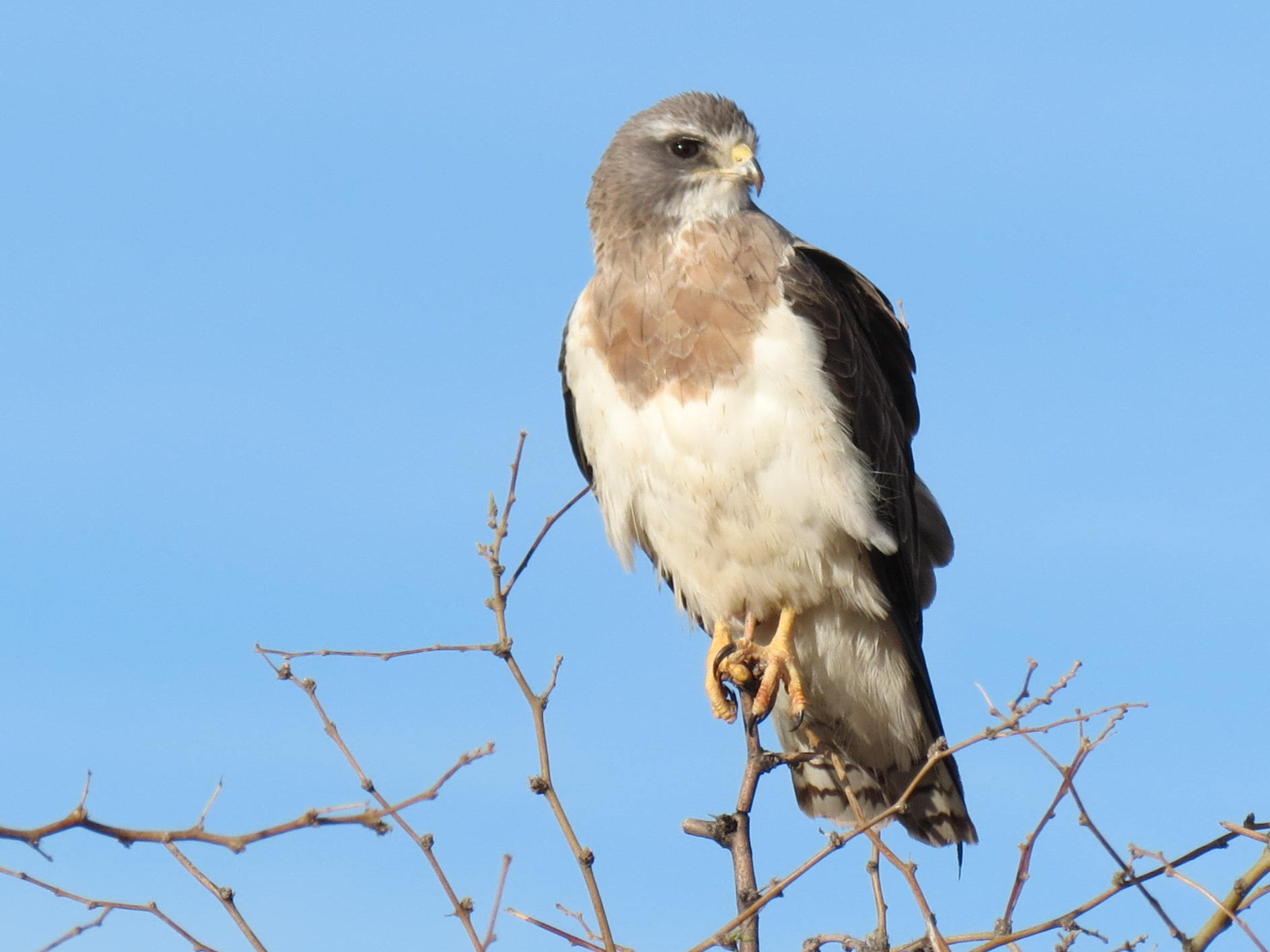
Morning or evening, hawks are easier to photograph, as they are so often to be found, like the verbena, right along the road, and just outside the back door of the ghost town cabin, the little canyon towhee is a frequent visitor. “Confiding,” one of the bird guides calls this species. I might call the bird “brave” or just plain “sensible,” as it seems to realize we pose no threat and that we can happily co-exist in close proximity, and I love to sit out in the sun with my book and camera and wait for opportunities to photograph the sweet little towhee. Such a simple pleasure feels extraordinary.

Here’s something else I’ve realized about my joy in the desert and mountains: The weather right now is as warm as any Michigan summer, but at home in the summer in Michigan, where vacationers will be relaxing on the beach, frolicking in the waves, and hiking woodsy trails, I will be spending most of my days indoors, in my bookstore. Here and now, though, I can be outdoors all day long, if I so choose — feeling the sun and breeze, soaking in the warmth, hearing and watching the birds, and generally drinking in my surroundings with all senses open to the world. It is this freedom to be out in the open spaces and to feel part of the world, rather than apart from it, that makes every ordinary day an adventure and every moment a fresh and priceless joy.

I cannot put these mornings in a box, and they cannot — thank heaven! — be bought and sold, but I will take precious memories home with me, in the words of the song, “to last my whole life through.”


Saturday, April 7, 2018

Winter Is Over at Whitewater Draw


At Whitewater, as in other southern Arizona winter gathering places for migrating birds, the thousands of sandhill cranes have now vanished, gone back to northern breeding grounds. (I wonder if birds arriving in northern Michigan the day before yesterday were surprised by the twelve-inch April snowfall.) Arizona skies seem almost empty now, bereft of the cranes’ ecstatic calls and flights, their winter “beach” at Whitewater fallen silent, where only a month ago thousands of stately birds waded and preened in the sunlight. 

March -- birds!

April - birds gone!

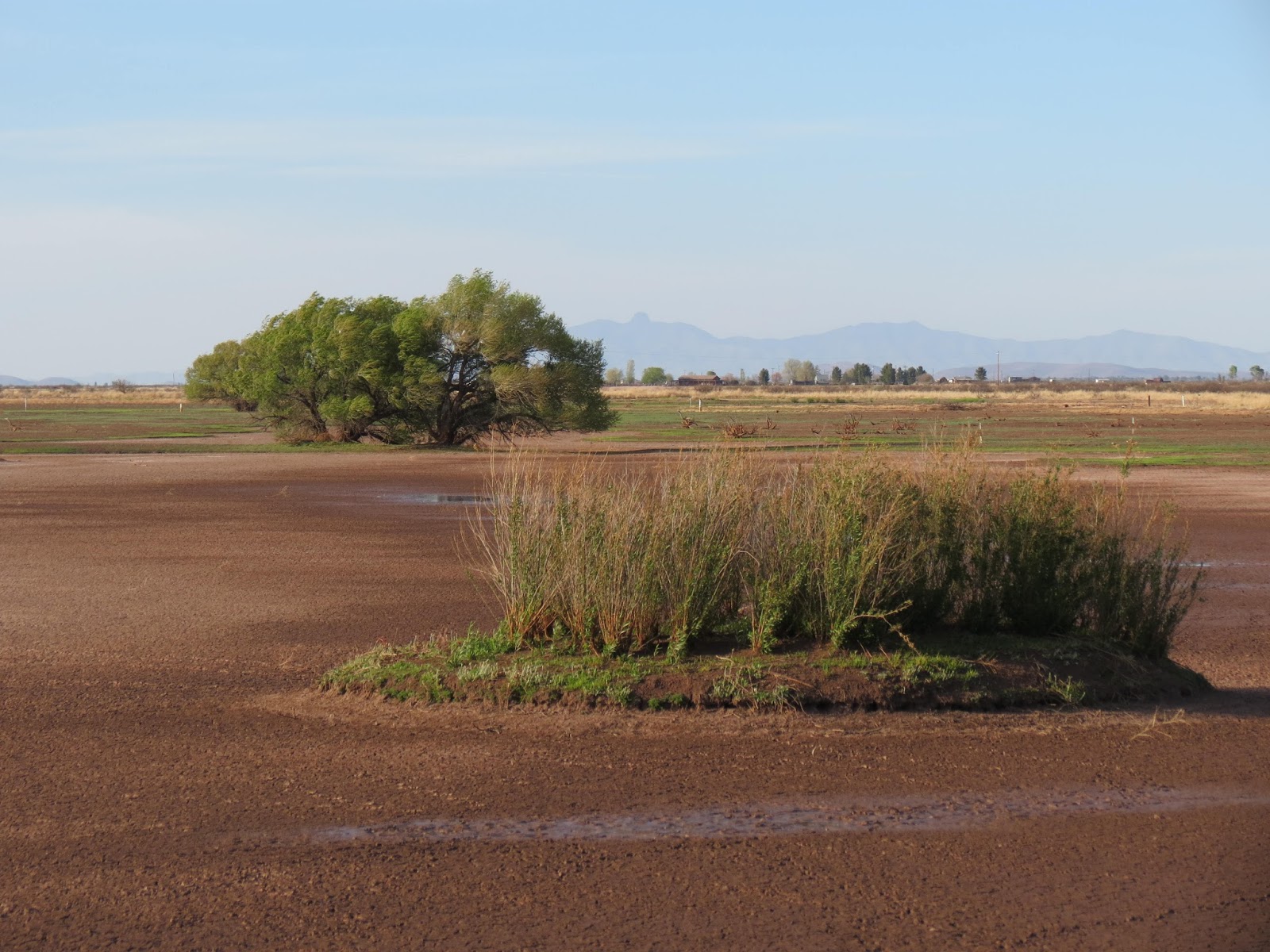
The waters are vastly diminished, also. Pools remain in places, but vast expanses formerly covered by water are now only bare, cracked mud, criss-crossed by mammal tracks. 

March mud with birds

April mud with tracks
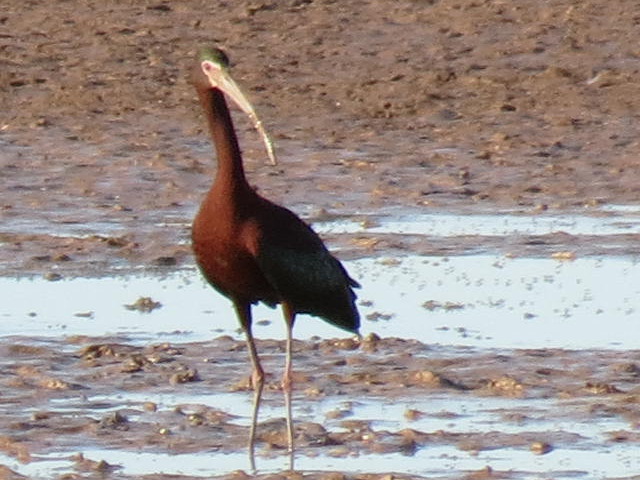
Looking out across stretches of mud to a distant puddle in the distance, however, I could see a fairly large bird, and the magic of zoom revealed it to be a white-faced ibis. 


Perhaps in a couple of months there will be a flock of hundreds of ibis in this place. Perhaps by then the summer rains will have recharged the draw. And perhaps this solitary bird came early on a reconnaissance mission. Whatever his story, he is the first white-faced ibis I have ever seen in the wild, my reward for our long drive in search of watery landscapes for the Artist’s (Pisces) soul.


Despite the disappearance of so much water, we found enough to make our pilgrimage worthwhile, and it was thrilling also to see trees green-leafed and flourishing, some by water’s edge and others out across the mud flats.

Trees (and birds) in March

Same trees (minus birds) in April
A final unexpected excitement of the day for us — and the best excitement is often that which comes unexpectedly — was seeing a large bobcat padding across an open area between marshy growth, into which it disappeared much too soon to be captured on camera. 

Direction taken by bobcat and, later, owl
It was a quiet day at the draw, two campers near the entrance and no one else at all on the trails. We went purposely in the late afternoon, for the sake of slanting light, and were rewarded by having the place almost entirely to ourselves. As we were leaving, a young couple in search of the great horned owl under the large roofed structure were foiled in their photographic desires (as I had been with the bobcat) when the owl took flight and sailed out over the wilds, but four humans were treated to the sight of the bird sailing through the air, and that had to satisfy. I was happy for the owl and the bobcat. Soon night would fall, and their domain would be exclusively theirs again. 


Thursday, April 5, 2018

Faraway Jewels


I bought the book Chiricahua Mountains: History and Nature, by William Ascarza (Charleston, SC: Natural History Press, 2014) over at the Southwestern Research Station near Portal, an expedition you haven't heard about yet, but only started reading it after David and I took a picnic lunch over to Faraway Ranch at the Chiricahua National Monument. The deeper one gets into Chiricahua history, the richer every visit to the place becomes. Coincidentally, we had also met a member of the Riggs family a few evenings before at a gathering here in our ghost town neighborhood. On our next drive to Chiricahua, then, we stopped at the Riggs Family Cemetery on the way. 


I did not photograph every grave in the cemetery and do not now remember the oldest person buried here, but I'm pretty sure she was 97 and born before the Civil War. My favorite headstone, though, was the one just above, a large natural rock erected on the grave of Edward Murray Riggs, son of Thomas J. and Eula Lee Riggs. Edward lived from 1885 to 1950, and I'll transcribe for you the entire text that appears on his stone, because it tells a lot about why the family is so important in this area, other than their considerable ranching history:

HE GAVE TO THE WORLD THE WONDERLAND OF ROCKS. HE ENGINEERED THE CONSTRUCTION OF ECHO TRAIL. HE WISHED THIS TO BE HIS MONUMENT. HIS CURIOSITY AND LOVE OF NATURE INSPIRED HIS DISCOVERIES. HIS ENTHUSIASM AND TACT ATTRACTED OTHERS TO HIS FIND. HIS TIRELESS EFFORTS OPENED THE AREA TO THE WORLD. WHERE HE BUILT THE FIRST TRAILS, THE TRAILS OF TODAY FOLLOW.  
HIS WAS A FAITH THAT LOOKED ACROSS THE RUGGED MOUNTAINS TO THE PLEASANT VALLEYS BEYOND; A GENTLE KINDLINESS LIKE THE WARM SUN ON A SHELTERED SPOT ON THE TRAIL; A REGARD FOR BEAUTY THAT MADE LIFE A PLEASANT VALE; A SKILL AND PERSEVERANCE THAT CONQUERED HIS WORLD. 

The Chiricahua Mountains are a most appropriate backdrop for this small jewel of a cemetery. 


Faraway Ranch itself was the homestead of Neil and Emma Erickson, Swedish immigrants who settled in Bonita Canyon in 1888. Three miles from the the Erickson ranch was that of Brannick Riggs and his wife, and it was Lillian Erickson, daughter of Neil and Emma, who married Ed Riggs, grandson of Brannick. 


Ed and Lillian operated their property, as had Lillian and her sister previous to the former’s marriage, both as a working cattle ranch (500 head) and as a guest ranch, offering horseback tours through what they called the "Wonderland of Rocks." Chiricahua National Monument was established by President Calvin Coolidge in 1924, largely due to the efforts of Ed Riggs. The National Park Service acquired the Faraway Ranch property in 1979. A more beautiful -- or more remote -- setting for a home can hardly be imagined. Familiarity could never, of this I am sure, breed contempt for Faraway Ranch. Stunning mountains, sheltering trees, gracious home, dear domestic details, and lovely nearby Bonita Creek (not to be confused with the crossroads of Bonita and its creek up in Graham County) insure that every visit will increase love for this exquisite place. Completely content forty miles from Willcox, Lillian Erickson Riggs herself had no desire to live anywhere else. Here are her words, reproduced on a sign on the land she called home:

“The only sure thing, Lillian Erickson Riggs wrote in 1954, in the early days of her widowhood, “is that I love my home. And there is a feeling of safeness and security in the very walls and in the length and breadth of the spacious rooms.... Death will be far preferable to giving up my Faraway home.”

Chiricahua National Monument is less well known than other, larger federal monument and parks in the West. Before we came to Dos Cabezas in 2015, we had never heard of it. Now, however, we treasure its nearness to us -- just down the road -- and at the same time rejoice in its remoteness from urban sprawl, which exists even in parts of Arizona. A certain amount of effort is required to reach Chiricahua National Monument and Faraway Ranch — we wouldn't have it any other way. 


Sunday, April 1, 2018

You Too Can Sleep in a Ghost Town


You would not be sleeping in the “old hotel” (ruins above), as neighbors tell us used to stand where only remnants of old adobe walls now stand beside of the winter-dry bed of the Philadelphia Wash. Although I am re-reading The Story of Dos Cabezas, by Phyllis de la Garza, with photos and captions by Carol Wien, I’m still hazy on the exact identity of these particular adobe ruins. Are they what remains of the “Central Hotel,” owned by Mrs. Hicklin or perhaps the house rented by “some ladies” from Henry Goetgens, who apparently did not inquire too closely into their source of income? Phyllis de la Garza also writes that a certain Major Downing, retired military (later murdered by persons unknown in Pinery Canyon), once ordered 20,000 adobe bricks to build a hotel in Dos Cabezas, “convinced that a big mining boom was on its way….” At any rate, whether tourist hotel, miners’ quarters, or “sporting house,” these crumbling walls no longer provide overnight lodging.


There is, however, a bed-and-breakfast establishment here in the ghost town, combining historic architecture with gracious modern accommodations. I had looked at the website back in 2015, before we ever landed in Dos Cabezas, and this year a social invitation from the proprietors, Sam and Dorothy Laage, gave me a chance at last to satisfy my curiosity.  

Where, other than Australia, is Kangaroo Island? Very, very far from Dos Cabezas, Arizona, but since my “pen pal” in Australia, Kathy, also operates a bed-and-breakfast — hers in rural New South Wales — I’m posting this photo with the sign especially for her. Both Arizona and New South Wales are “Lands of Little Rain,” with thirsty cattle and red earth….


A labyrinth at the B&B in Dos Cabezas invites participation along with meditation: guests may pick up stones at the entrance and add them to the farther reaches. 

I have to admit, though, that I noticed the chinaberry tree before the labyrinth caught my eye. Not sure what it is about me and chinaberry trees, but this one, I think, would command anyone’s attention: over a hundred years old, it has long stood a mute witness to the full panoply of human behavior, and the present owners of the property are doing all they can to insure its continued life. Think what conversations this old tree might have overheard in more than a century. 


What corresponds (in my mind, if nowhere else) to the front porch of our old farmhouse back in Michigan is called the “Arizona Room” (above). It is a long enclosed but unheated porch that faces north across the labyrinth to one of the twin peaks of the mountains that give the ghost town its name. Knowing where to look, I can spot our cabin through the branches of another tree (I forgot to ask what species) that provides privacy to the Arizona Room from the highway. Th Arizona Room was added to the original adobe structure in about 1905. 

Thomas Newton McCauley, a reputed business “genius” from Illinois who had come West both for his health and in hopes of making another fortune, entertained visitors here, in hopes of impressing them with the future of the Mascot Mine and selling them shares in the venture at $10 a share. I first read the history of mining in Dos Cabezas three years ago. Being in a building dating back to the ghost town’s boom days, however, make the historical details of that time much more vivid. 


How thick were the original adobe walls? The doorsill between the Arizona Room and the Community Room tells that story. Dorothy and I stopped to add our feet to the photo for scale, and then we stepped back another quarter-century into the oldest part of the building, called the “Community Room.” 


The paintings on the walls of the Community Room were done by self-taught artist Mary Laage, Sam’s aunt, from Carmel, CA. “Bohemian Carmel,” adds Dorothy. I loved the vivid colors and lively composition of the paintings and was happy to hear the Artist praising them to our hostess. There is a fireplace in the Community Room, for evenings when it's too cool to sit out in the Arizona Room, and there are shelves of books and games and other quiet entertainments. Despite the money-grubbing hopes and dreams of those who entertained here long ago, guests staying here now will find they have more than escaped the modern rat race: the old mining rats having long deserted the ghost town for more remunerative locales. The Community Room -- between Arizona Room and bedrooms -- dates back to the 1880s, but life is much more tranquil now. In its heyday, Dos Cabezas boasted saloons and grocery stores, a railroad, a school (by the 1920s “several” schools), and was a stop on the Butterfield Stage Line. These days there would be little traffic at all on Hwy. 186 if not for the Chiricahua National Monument 20-some miles down the road. The word "retreat" in the name Dos Cabezas Retreat is certainly apt.


Behind the headboard in one of the two bedrooms is the outside of the original adobe back wall. A recent guest in the smaller bedroom, born in Dos Cabezas, remarked to Dorothy that her great-grandmother had slept in this same bedroom, only the bed was turned 90 degrees now from its placement in her great-grandmother’s time. I cannot even imagine having a family history going back four generations in such an out-of-the-way place as Dos Cabezas — but then, my ancestors were seldom in one place for more than a single generation….


Sam Laage is the chef. He makes breakfast for guests and upon request will also put together picnic lunches. An even more romantic option, though, depending on your preferences, might be the candlelight dinner, prepared and served by Sam in the newly refurbished dining hall behind the building we have just toured. Sam and Dorothy are well acquainted with local wineries, those in Willcox and others down off the Kansas Settlement Road, and I’m sure Sam’s dinners are memorable.

Only one morning this recently past winter did we wake to snowfall, so my last image of the day is hardly characteristic, either of the weather or the B&B across the road, but my sister had been curious about both, so for her I photographed Dos Cabezas Retreat from my uphill vantage point that snowy morning. Don’t let the wintry image scare you, though: you could come to Dos Cabezas for years and never see it looking like this. The only snow you might usually hope to see would be on the highest peaks in the nearby Chiricahua Mountains. And you’ll definitely want to stay at least two nights in Dos Cabezas, so you will have a full day to explore Chiricahua and another evening ghost town to relax in the glow of your mountain memories.