Search This Blog

Showing posts with label outdoors. Show all posts

Thursday, July 9, 2026

Of Farms and Books


The days were long and fine and very warm. They practically abandoned the house. They worked together, all three of them in the hay-field.

- Adrian Bell, Shepherd’s Farm

If Shepherd’s Farm is, as I suspect, typical of Adrian Bell’s fiction, many readers I know would not care for it. I can easily imagine some literary critics calling it a weak novel, if a novel at all. There is little drama; what there is of conflict never boils over. Our main characters work hard and strive patiently and gradually achieve their goals, and while they ultimately lose, in a material sense, all they have gained, it is not through tragic flaws of their own or wickedness on the part of some antagonistic force or other character in the narrative, and they are not driven to despair or madness by their losses. Simply, life goes on.

Since I don’t believe Shepherd’s Farm has ever been published in the U.S. (Bell's stories are set in England), I'll give here what would be ‘spoilers’ if I expected any of my blog readers to be picking up the novel: 

We fear initially that Miriam will choose the wrong man and create tragedy for three people. She does not. When the wrong man marries elsewhere, it seems he may go frightfully more wrong and lose himself entirely. Nothing like that ensues, and his life goes on as it was expected to go on, in conformity with his family values. When Miriam’s uncle, who is her guardian, opposes her marriage to Luke, threatening to have Luke's dear-won farm bought out from under him if she persists in wedding plans, she and Luke quietly agree to wait, not seeing each other at all for the time being. Eventually the uncle dies, and they marry. Again, quietly. Everything is done quietly, without, as I say, drama. The gypsy girl does not seduce Luke. The horse does not trample the child. There are no murders, no suicides, no hatred-fueled feuds. 

I loved the book and only wish it had been three times as long and three times fuller of agricultural and environmental detail, all those descriptive passages that readers longing for action find tedious. 

All summer, market day at Winslowe was desultory and unsatisfactory. People would run in for half an hour and then hurry back to their hay-carting. There was a sense that the centre of gravity was elsewhere. But now winter bore in; the town was cheery; farmers came early and left late. Down the street pigs and cattle went in droves; barley, wheat and oats lay spilled about the steps of the Corn Exchange, where farmers appraised each other’s samples.

Or --

…It was a bad time with the ewes. The weather had been so wet that they had strained themselves heaving their heavy bodies through the mud from the field to the yard, and several lambs were born dead. In the living room of the farmhouse there were always one or two new-born lambs before the fire hand their bleating sounded loud indoors.

On the shepherd’s farm, horses are of prime importance. It’s horses that make or break a farm, and it’s best to have a pair that pull well together, plus a third that can do other jobs when the pair are harnessed together. Feeding the horses is Luke’s first job every morning. Miriam will make the fire, milk the cow, and churn butter. Luke loves the feel of the horses’ oats running through his fingers. Miriam pitches into the hay-making from the start of the book to the end.


A dear, loyal bookstore customer and reader of this blog once mused that perhaps I romanticize farming life, which is in reality dirty, hard, repetitive work, but I don’t see the contradiction. A career in fashion design or event planning would never have suited me, but if I had married differently and had farm work all my life, I don’t think I would have been discontented. Outdoor work that challenges physical strength and perseverance is much more to my liking than housework, although without livestock or poultry and with no field crops, my work life outdoors is limited to mowing grass, planting and tending gardens, pruning my apple trees once a year, picking fruit in season (soon, black raspberries; later, apples), and keeping the dread autumn olive at bay—that last a never-ending chore but one I keep at, year after year, because I will not give over my small piece of land to the invader. There is satisfaction both in the work and in surveying the results, temporary (the grass grows back, and the autumn olive rears its head in new corners) though they will always be. 

The other day I was thinking of books I love and feel are not well enough known, and I realized how many of them have agricultural or at least outdoor themes: Mary Webb’s Precious Bane; Louis Bromfield’s Malabar Farm; Conrad Richter’s The Trees and The Fields. Richter was awarded the Pulitzer for The Town, the third book of his “Awakening Land” trilogy, but it’s the first two that I love. Even in Mary Norton’s series of children’s books about the little people called borrowers, it’s the second in the series, The Borrowers Afield, that is my favorite, the time in the little family’s life when they live out-of-doors and must live off the land. 

Why would anyone think life has to be easy to be good? Where is the pleasure in not working? In my winters of seasonal retirement with the Artist, our seasons in the Arizona ghost town cabin, my days were filled with hiking, learning the desert vegetation, feeding wild birds, cooking and baking and writing and studying Spanish, all that indoor activity with sun flooding through the windows and, whenever possible, doors open to the air, so that—not in the middle of winter but as winter segued into spring—indoors and outdoors became one.

Indoors and outdoors as a seamless whole, going from one to the other without putting on or shedding extra clothing—that is another glory of summer, along with the outdoor work. “They practically abandoned the house,” writes Adrian Bell, and I smile happily at that sentence, although I certainly do love my porch!


For now, the grass in my yard is mowed (hours of satisfying work for me, my exercise, lots of “steps,” as people say) and Sunny’s jumps set up again so we can keep at our agility teamwork, also. She and I did well at last Monday's session after a winter away from the sport.


Getting there --

Black raspberries are beginning to ripen, and I have warned Tree Guy that soon we will be harvesting berries morning and evening, day after day, filling the freezer against the time of jam-making. In the orchard surrounding me, many varieties of grasses grow tall, and there is alfalfa blooming now, its flowers from deep purple to pale lavender and even a light yellow. Alfalfa is so lovely! Farmers Tom and Kathleen Koch down on South Lake Leelanau (he also has the Polish food truck in Cedar, behind his wife’s wonderful shop of Polish wares) feeds his animals on barley, not corn. It was good to enjoy Polish food and farming talk one evening with Tom. I'll bring photos from Cedar the next time we go.

Grasses in morning rain

Alfalfa, coming back year after year --

Adrian Bell again --
Hill Field was the best of it: this field would grow the finest malting barley, with that delicate almost silky look to the skin and pale golden. And when one cracked a grain it was not steely inside like that which grew on the light land, but white and mealy.

Meanwhile, of course, for me, my bookshop life continues, and lest I grow melancholy over reminders that I am not a farmer and don’t have time left in my life to become one, I thank my lucky stars ever day that I am a bookseller. (Especially, yes, a bookseller lucky enough to live in the country!) Schlepping heavy boxes of books, I think of my graduate school friend James, who when we were graduate assistants to professors called us “donkeys for philosophy” and then of the Artist, who, loving James’s phrase, when joining me in a big book move (such as Tree Guy and I undertook last week), called himself a “donkey for literature.” Bookselling is a much more physical line of work than many casual shoppers might imagine! 


Just as many people claim affiliations to larger groups, groups so large they can never know all the members personally, some political, and others consider themselves related by a sports team or a university (and of course there are many other possibilities), thinking it over I realize that book people are my tribe. 

Ah, yes, book people are my tribe, farmers are my neighbors, and I am a lucky woman!

In the shop

Outdoors

Visual fruits of my labors

P.S. To see some cool barn stuff, visit here.

P.P.S. I come back to add a few lines from Delacroix’s journals written in the 1850s, a page I opened to only because it was a July entry. He notes that man can often take comfort in misfortune, thinking himself so much better than his situation —

...but it far more frequently happens that man is bored in the midst of prosperity, that he even considers himself unfortunate while possessing. LaFontaine’s shepherd, when he had become prime minister and was surrounded in his elevated position by jealousy and intrigue, must have been an object of pity and must have felt himself to be one; he must have experienced a vivid moment of happiness, when he had donned his simple shepherd clothes and when they gave him his standing in the eyes of all men, so that he could return to the scenes and the life where, with this costume, he had tasted the happiness the most genuinely suited to man, that of a simple life devoted to work.

- Eugène Delacroix, Journal, the Walter Pach translation with a new introduction by Robert Motherwell

Thursday, September 12, 2024

“Locals’ Summer” Is Underway


Friends of the heart

Labor Day is past, but for locals who work all summer, it has only just arrived, and I started the season with Sunday and Monday (September 8 & 9) spent mostly outdoors, under alternate cloudy skies and sunshine, when Sunny and I hosted our hiking buddies from Arizona, who now live in southeastern Michigan. The four of us picked up right where we left off with our last visit. 


Auntie Therese is Sunny Juliet’s second mom and young husky Yogi SJ’s best friend. Wrestling in the yard, chasing tossed balls, walking on the beach, wading in Lake Michigan, or just lying down near each other, Sunny and Yogi reunited were in seventh heaven. We left them alone in the house for a couple of hours (first time ever!) and returned to find everything exactly as we’d left it. Happy dogs, happy dog moms!


Lunch without dogs, can you believe it?

Then Tuesday it was back to work for me, refreshed and relaxed, bookstore door open to balmy September air. The giant book purchase and move, all seven or so trips with car loaded down with heavy boxes, was finished before our friends’ visit, so I was able to start my slower season without the sword of Damocles hanging over my head.


Of course, besides integrating as many as possible of the “new” additions into my preexisting collection, I squirrel away a book here and there for home reading this fall and winter, awaiting a future time when shelf space opens up on Waukazoo Street. One book I took home expecting something very different was an exciting surprise. The cover didn’t look like much, the dust jacket was missing, and the title didn’t tell me anything at all, but a little voice whispered in my ear, and home with me it went. 


Faint pine cone only clue....

How wonderful! Driftwood Valley, far from being the Western novel its title and brown cloth-covered boards seemed to indicate, turned out to be – well, a reissue of the book in 1999 by Oregon State University Press clearly informed potential readers what to expect with a subtitle: A Woman Naturalist in the Northern Wilderness. 


The author, Theodora C. Stanwell-Fletcher, and her husband, Jack, entered the wilds of northern British Columbia in 1937 and lived for a year and a half on an otherwise uninhabited lake (after building a log cabin) hundreds of miles from towns and roads, in country noted on maps only as “unexplored” and “unsurveyed.” Their nearest neighbors were Indian trappers; their work was “collecting” (she generally wrote of “collecting” and avoided calling “killing” by that name) animals to ship skins and skulls to an American museum. They returned in 1941 for another couple of seasons before world war intervened.


Prior to their marriage, Theodora Stanwell-Fletcher had accompanied her naturalist father on many of his travels and earned her doctorate in animal ecology from Cornell in 1936, while her husband, John Stanwell-Fletcher, had experience in the Arctic. Their modes of travel including snowshoes, canoe, pack horses, and pack dogs, Teddy and Jack traveled and hiked by themselves at times, other times with Indian guides. They camped outdoors in temperatures as low as 40 degrees below zero, when managing to make a fire meant the difference between life and death, as did succeeding in killing a few grouse – better yet, a moose -- for meat to sustain them on the trail. Following the text at the end of the book are lengthy lists of plants and animals the Stanwell-Fletchers collected in the wilds of British Columbia. The lists alone, with genus and species names, is impressive. Four varieties of horsetail alone!


Only the first page of the lists --
 

Driftwood Valley, I learn online, was Wendell Berry’s favorite book during a period of his boyhood in Kentucky, and it's no wonder. Wilderness adventure! I reached the final page on Tuesday morning before breakfast with my company and a long walk with our dogs, drinking in the beauty of Michigan at the same time as we reminisced about our hikes with these same dogs in the mountains of southeastern Arizona. My Michigan country life is tame and domestic compared to northern British Columbia in the 1930s and ’40s or even Cochise County ghost town winters, but I am happy to live where I live. It's a very good place!


Happy dogs off-leash in the yard.

Tomatoes seen behind non blooming (so far) morning glory vine


Tomatoes are ripening at last in my garden, and jalapeno peppers have formed nicely. Okra was a total bust, even though started early from seed, and my friend said hers in southeast Michigan didn’t do anything, either, though she’d had success in warmer Arizona summers, but Japanese anemones have bloomed at last (they need a tomato cage support to keep from falling over) ...


... and the brilliance of velvety scarlet snapdragons rewards my decision to introduce a few annuals in pots among the perennials. Only one chrysanthemum blossom so far, and that’s fine, because ’mums need to wait their turn, and it is not their turn yet. Plaintively, however, I cry out, “Where are my purple coneflowers?” Little grey-headed coneflowers in the meadow have been prolific again this year, and asters are coming along nicely, but not a sign of the purple coneflowers do I see. 


Wednesday:


I began writing this post on Tuesday before remembering the evening’s scheduled presidential debate. I had no intention of watching (no TV) or streaming (my watching would not affect the outcome), and I didn’t even want to get into the frequent Facebook checking with friends who would be watching and commenting, because Wednesday morning, I assured myself, would be soon enough to hear what happened. Meanwhile, having wrapped up the story of the Stanwell-Fletchers in British Columbia, I chose for Tuesday evening’s bedtime escape reading a John Dunning murder mystery, Booked to Die, something I read long enough ago that I didn’t remember anything about the plot, only that the used and rare book business played a prominent part in the story.  


Denver homicide detective Cliff Janeway, a compulsive book collector outside of work hours, finds in the murder of a book scout all the earmarks of the same murderer who has eluded him multiple times. By the middle of the book, Janeway has gone beyond the law to punish the murderer, turned in his badge, and is preparing to open his own shop on Denver’s Book Row.


…Bobby [the book scout] had come to Madison Street alone. … He had insisted on loading the books himself, which was fine with the two heirs, who had no intention of helping, anyway. Bobby had brought hundreds of cardboard boxes and had spent all night packing and loading the books. … [He] loaded the last of the books as dawn broke in the east.

        - John Dunning, Booked to Die 


The paragraph quoted speaks not of the romance of rare books but of the physical reality of a big book “deal,” the one where you get a good price because, rather than being able to cherry-pick a collection, you agree to take everything. This is the part of a bookseller’s life that does not involve “thinking outside the box” but thinking constantly, obsessively, about boxes: Too small, and they won’t hold enough books; too large, and they’re too heavy to lift. They need to be sturdy. Cartons from the grocery store that held jugs of water or bottles of wine are a good size and appropriately sturdy, but storage boxes for legal files have handholds and lids so are more readily stackable. 


Object of bookseller obsession
.
Too many when you don't need them, too few when you do.

Yes, it’s mundane, but the mundane is often a crucial consideration in any endeavor, and it cuts a lot of ice in bookselling. As a colleague likes to say, “You only get one back.” A good sturdy handcart with tires that won’t go flat is also worth its weight in gold. So it is that the concerns of Janeway’s murdered book scout resonate with my experience, as does advice Janeway’s new colleagues give him. 


People often say, “advice is cheap,” because people give it for free usually when you don’t ask for it. Over the years, I’ve learned to smile when people who have never owned or managed a bookstore or any other kind of business tell me what I “should” be doing. Once, though – and I’ve never forgotten it – a seasoned bookseller turned around in my doorway as he was leaving and said, “A word of advice --.” I smiled, and he said, “Good shoes.” That’s all he said. Years later he reappeared in Northport and said, “You probably don’t remember me.” I said, “Yes, I do. ‘Good shoes’! It was the best advice anyone’s ever given me!” Good shoes and a well-cushioned mat behind my desk are my recipe for extending the health of my feet and back, and the shoes also go well with dog walks and agility practice. 


Back to Tuesday --. As I say, I figured my watching or not watching the debate wouldn’t change the outcome and that I’d hear all about it the next day. Then Wednesday morning I woke to realize that it was once again 9/11, that infamous date on which our country was attacked. No rush, then, I thought, to post to my blog. What with the debate the night before and the sad anniversary come around again, who could possibly care about the life of one little small-town bookseller, even if she also has a dog whose online face makes strangers smile?


Sunny says, "I'm the cute one."

So now it’s Thursday, and here’s my post for the week, with bits from my reading, my business, and my life with friends and dog, here on a little northern Michigan peninsula, now all-too-thoroughly discovered but still quite beautiful and with protected public shoreline for us all to share. We are so lucky!


Wednesday, April 24, 2024

(My) Earth Day 2024 in Northern Michigan

How green is the woods, at last!
 

Out in the Woods, Foraging


Earth Day breakfast salad

Sunny and I are out earlier and earlier these days. I find my treasures, and Sunny finds hers. Mine on Earth Day were leaves of the toothwort plant for my breakfast salad. Sunny didn’t turn up any “new” skeletal remains on Monday, but she’s already done pretty well for herself this year in that regard.

Her latest score


In the Bookstore, with Bags


The first people in the bookstore door on Earth Day came for book bags, and I was happy to accommodate, quite pleased with the look of the new bags, glad I went that route instead of t-shirts. After all, plenty of other businesses in town have t-shirts (very attractive ones), but mine is Northport’s only bookstore, so…. 


Also, with book bags, one size fits all -- unless, that is, a customer buys too many books for a single bag, but then the fix is as simple as a second bag.


Earth Day Reading


If I want to be righteous and largely ineffective [my emphasis added], I can hold onto my rage and resentments. You have the same choice. You can target me and others for our blind spots. Or you can get about the process of transforming yourself and one another. 


-      Chuck Collins, Born on Third Base: A One Percenter Makes the Case for Tackling Inequality, Bring Wealth Home, and Committing to the Common Good


Born on Third Base might not be an obvious choice for Earth Day reading, but it certainly worked for me. As Collins points out in his foreword, earth’s natural ecosystems are the basis for all wealth, so even the richest people alive (and those to come) are dependent on the health of the planet. Collins wants the 1% to realize that their self-interest is at stake in narrowing the wealth gap. He also wants the 99% to realize that, in order to protect our home communities, we need to forge alliances with the wealthy, and he has suggestions for how to do that.


…I urge us all to proceed with empathy, adopting powerful tactics of active love and nonviolent direct action to make this happen. Instead of a class war of shame, I advocate an appeal to common humanity and empathy.


I want to add here that partisan antagonism is no more likely to reform our troubled world than is class antagonism. Collins points out that no one responds well to being targeted, blamed, shamed, ridiculed, and treated as an enemy. It’s a stark choice: stand apart and feel superior and watch the world go to hell while blaming others -- or recognize the fears of, as well as contributions made by, those on “the other side.” I say we need to acknowledge our common humanity and reach out, because no one is right about everything, and no one is wrong about everything. 


It was, after all, President Richard Nixon who declared the first Earth Day in 1970, spurred to it by the massive Santa Barbara oil spill in 1969. It was also Nixon who first proposed the Environmental Protection Agency realizing that regulation was necessary to protect natural resources. Wouldn’t it be wonderful if today’s Republican Party were to rediscover their stake in the common good? How might that come about? Will demonizing help? Something to think about, because Earth Day isn’t something to put behind us until next year. Every day needs to be Earth Day.


Our beautiful home

Looking Ahead


Meanwhile, on the nearer horizon, this Friday, April 26, is Arbor Day, and in Northport a new tree will be planted in Marina Park, down at the south end near the little sailing school building, with the Tree Committee, Northport students, and community members all on hand for the 10 a.m. planting. 


The following day, Saturday, April 27, is not only Independent Bookstore Day all across the United States but also, here in Leelanau Township, the kickoff day for Northport Omena Restaurant Week. As there are five participating food purveyors within easy walking distance of Dog Ears Books, I figure Saturday should be a double-header day in Northport, eh?


Saturday, April 20, 2024

Explaining Myself

Will be open on Monday, 4/22, for Earth Day!


Bookstore Notes


Maybe I got some ‘splainin’ to do. “Disproving skeptics for over 200 dog years”? What does it mean?


Well, when I opened Dog Ears Books in 1993, many people told me, shaking their heads sadly, “No one reads books any more.” The people uttering the gloomy words had voluntarily entered a bookstore and were happy to be there, but each one believed he or she was the last of a dying breed, the earth’s last living reader. 


Original Dog Ears, Waukazoo Street, 1993

Fast forward three decades, and I don’t hear that particular line as much. Many people still say, however, “Bookstores are going the way of the dinosaur” (or words to that effect), because while it’s become obvious that reading has not died out, doesn’t everyone order their books online or read on their electronic devices? 


No, not everyone. 


My bookstore would not be the self-supporting business it needs to be if the skeptics were right. So now here we are, coming up on 31 years later, and I am so confident going into the 2024 season that I have gone out on a limb and ordered canvas book bags emblazoned with my business name, logo, and that line about the mistaken skeptics, confident that yet another year will continue to prove them wrong and keep me here on Waukazoo Street, just up the block from where I started in 1993.


Back on Waukazoo Street since -- 2006?


Committing to a bookstore in a small village at the end of a peninsula means life in the slow lane for all but a few summer weeks. Nevertheless, it’s a life I chose with my eyes open, telling a new Northport landlord in 1997 that I was “in it for the long haul.” And almost 31 years later I have no regrets, because besides making a modest living, I meet interesting people all the time, and many have become my friends over the years. It’s a rich life.


Reminder: If you come to the bookstore for a book bag on Monday, 4/22, and bring a copy of our ad in this week’s Leelanau Enterprise, your bag will be $11 instead of $12. In-person, Earth Day special!


Outdoor Notes


First leeks
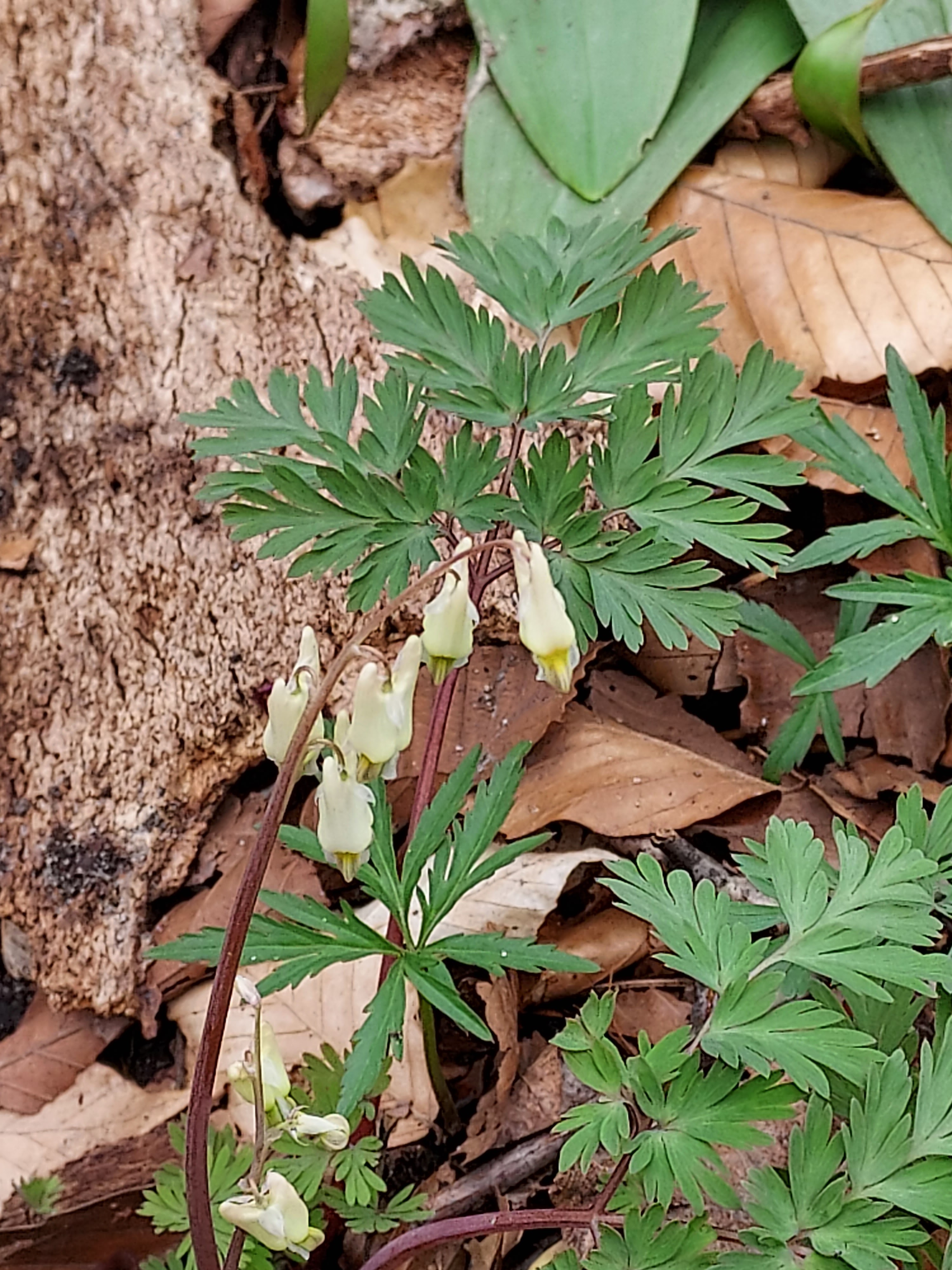
First spring beauties spotted, their petals furled, on April 12th, by the next day opening their faces to the sun. Before that, wild leeks were already turning the woodland floor green. On the 14th I saw my first trillium – again, flower bud closed tight. It won’t be long, I thought, until they are blooming madly, and in the meantime the first Dutchman’s breeches began coming shyly onstage. 


Spring beauties


I’d been thinking this Sunday would see a riot of spring ephemerals in bloom, but then our yo-yo temperatures took another plunge, snow threatened, and the little buds pulled their heads back underneath the covers for the chilly weekend. But soon!


First Dutchman's breeches


Dog Notes


Giving me a look!

Here’s a question: Do dogs understand the cycle of the seasons? Wild animals appear to do so, but dogs have been companions of humans for so long that maybe their seasonal sense has atrophied. Does Sunny remember last summer? Does she realize that another summer is on the way? Sometimes, when she has that “Oh, mom, you’re so boring!” look on her face, I would love to remind her of the fun she had the evening before and the fun that awaits her in the morning. If only I could explain! There’s a downside to living in the moment.


But co-evolving with self-centered humans, dogs have had to learn patience. No wonder we love them so! And isn’t it a joy when we can make them happy?


Meeting with friends!


Friday, April 12, 2024

The Mood Wasn’t Right

Sunny and a plethora of leeks

Lame Excuses


In the past two or three weeks, I have begun and discarded at least four posts for Books in Northport. Titles were: Tough Tourism; The House That Had Everything; “You Should Write a Book”; and Where do I want to go? Abandoned, all of them (though the draft beginnings still reside on my laptop desktop), and I know such finicky self-judgment is probably misplaced, as the nearly formless meanderings I occasionally throw out into the world, posts without any central theme or narrative thread, are often more popular and gain more comments than others I labor over to achieve a “finished” feel.


Leaves of dogtooth violet, a.k.a. trout lily


Ah, but then someone visiting my bookstore says, “I always read your blog,” and a note from a friend (received two days after a post finally went up) mentions that she has been looking in vain on Books in Northport for something new, and I know it’s time to kick-start my online presence. You don’t have to be “in the mood” – or inspired – to write! You just sit down and do it! And in the case of a blog, call a draft post good enough and hit that publish button!


Random Fungus (until someone identifies it for me)


Outdoors


Beginning with Sunny Juliet never hurts (see again opening image), because most people love dog stories or photos, my girl is lively and photogenic, and we get outdoors a couple times every day. Even in this morning’s light rain, we were out for a good hour, and as usual there was so much going on (every day at this time of year bringing signs of new life) that I was pulling my phone out of my pocket over and over to photograph my finds. The rain had decided me against taking the camera, but by Saturday, or Sunday for sure, the sun will be shining and those spring beauties – all over the woods! -- will have opened their petals to the light. 


Spring beauties are biding their time.


Plentiful though the wild leeks are, I never harvest them for my kitchen. If you do, never take more than 5% of a patch, and try to harvest where no one else has taken plants before. That will leave enough for coming years, as leeks are slow to mature and proliferate. 


Leeks close up

Toothwort leaves -- no flowers yet
 

We all have different tastes, in food as well as in books. Toothwort, now, is a different story for me, and I look forward to those peppery-spicy leaves and flowers in spring salads very soon. 


Everything is beautiful in its own way, isn't it?


That fungus close up looks almost like a rose.


In the Bookstore


Thursday, between customers (all from out of town and all gratifyingly appreciative), I worked with the advertising department at the Leelanau Enterprise on an ad to run in next week’s paper. Since Monday, April 22, is Earth Day 2024, I’ll depart from my usual schedule and have the bookstore open that day – if I’m lucky, with my beautiful new canvas book bags to sell, in keeping with Earth Day’s theme this year, “Planet vs. Plastics.” My regular customers know by now that any plastic bags I put their purchases in have been donated for re-use by other customers, but we really do need to eliminate plastics from our lives wherever possible, in the Great Lakes and across the nation. Agree?


And there will be, as there are just about every week, new books and “new” used book additions to store stock. As for me, I’ve been reading a lot of books set in the West lately, books full of mountains and dry washes, scarce water and hard living. I also made my way through a new memoir – what I call a “grief memoir – by Amy Lin called Here After. Although her husband was so much younger when he died than was mine, there was much that resonated with me in her experience. This, for instance: 


We shared a language that was all our own. I am now the last speaker of it.

- Amy Lin, Here After 


What must it be like for older adults who have to leave a country they've known all their lives and go to make a new life in a strange land with a whole new language? I am blessed to be able to remain in familiar and beloved surroundings.


Finally, Sunny's Mystery Treasure


Smaller than my hand...


Something's -- someone's -- partial skull, but whose?