Grand Marais, Michigan
Yes, it’s another day of potpourri rather than an extended theme, and I’ll open with the news that
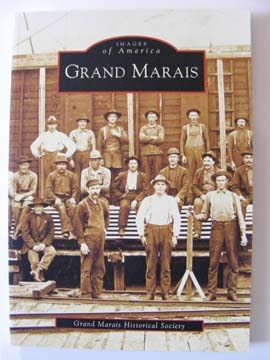
Grand Marais, Michigan, our favorite little town in the Upper Peninsula, is the winner of a Reader’s Digest contest in which anyone could vote, and anyone could vote any number of times. Given that latitude and the monetary incentive, little Grand Marais turned up the heat and beat the drums and managed to accumulate 1,281,724 votes--not bad for a town with a population of 350, eh? The good news is that the town will receive $40,000 for the civic project of their choice. The not-quite-as-good news is that estimated costs for needed work on the harbor run into the millions. Anyone have grant money available for a good Up North cause? Harbors of refuge are few and far between on Lake Superior. A book on Grand Marais published by Arcadia in their “Images of America” service is available at Dog Ears Books, for those who want to explore from the comfort of an easy chair until snowmobile season gives way to black fly season. GM, you know I’m teasing! You know I love you dearly!
 Seeds of Dreams
Indeed, it is that time of year, the time when a northern gardener’s thoughts turn to spring and the planting of this year’s garden. It will be many weeks until the soil is clear of snow and ready to be turned, and I never plant anything “tender,” such as tomato plants, outside until Memorial Day, no matter how warm the weather in May, but gardens are made as much of faith and hope as of sweat and toil, and before the time for hard labor arrives it’s glorious to revel in seed catalogs like these gorgeous beauties!

When I take a break from the catalogs, I turn to books, and one I’m discovering for the first time this year (a “classic” in its field, I’m told by those who are way ahead of me) is Suzanne Ashworth’s
Seed to Seed: Seed Saving and Growing Techniques for Vegetable Gardeners. General chapters begin the book: “Botanical Classifications”; “Pollination and Flower Structure”; “Maintaining Varietal Purity”; “Seed Cleaning Methods”; and “Seed Storage Techniques.” I should say, perhaps, though the subtitle already said as much, that this book is not a technical treatise for botanists but is a truly practical guide. Where in your home will you find a spot that provides “constant warmth at a specific temperature”? Ashworth suggests the top of a refrigerator, warning against trying to germinate seeds from the
Solanaceae family (tomatoes, eggplants, peppers) near a gas stove or water heater, as natural gas can inhibit germination. Who would have known or guessed that? Germination rates over years of storage for different vegetable seeds is another example of a handy tip. For example, half of the onion seeds you save, if properly dried and stored, will be viable two years later.
The bulk of the pages of
Seed to Seed deal not with generalities but with specifics—families and species of vegetables, the families arranged alphabetically, beginning with
Amaryllidaceae, the onions, leeks and chives, and proceeding through
Valerianaceae, Indian corn salad, with all your common favorites in between and a few you might never have tried before. For instance, I’m keen on attempting to grow okra this year (“Okra seeds will maintain 50% germination for five years when stored under ideal conditions”), and while I knew the plant came from West Africa, I am surprised and oddly delighted to see that it is a member of the
Malvacea family, a relative of the humble and lovely old-fashioned farm hollyhock.
Supplementing my garden, whatever I end up planting and growing, will be the summer farm market in Northport, and a book to help me with new ideas for the tables will be
Fast, Fresh & Green: More than 90 Delicious Recipes for Veggie Lovers, by Susie Middleton. Oh, boy, sweet potato fries!!!
Mark Twain’s MeanderingsFirst, my confession: I’m not a huge fan of Mark Twain. When I finally got around to reading
Huckleberry Finn, I was astounded and dismayed by the last few chapters of the book and the way the whole story fell apart. It reminded me of movies where the people making them started with a good idea and then didn’t know how to wrap it up. I mentioned here in the blog a while back that David and I were reading
Life on the Mississippi at bedtime. For quite a while we were thoroughly engrossed and entertained; disappointment came when the narrative (to use the word loosely) jumped a large chunk of years, skipping from the author’s days as a pilot to a later pleasure trip he made down the river with a friend. Those later chapters weren’t nearly as good as the ones that had gone before.
Now a review by Andrew Delbanco in the
New York Review of Books of the new Twain autobiography (the first of three volumes came out this winter) confirms my feeling about Twain’s writing, while offering the reviewer’s positive assessment of what he calls “incoherence” in Twain’s books. Delbanco quotes from a 1895 essay by Twain, “How to Tell a Story,” in which the author admits (boasts?) that “to string incongruities and absurdities together in a wandering and purposeless way” is his way of going about the task. Well, that explains that, doesn’t it? (Does it?)
I was particularly struck by Twain’s complaints about writing, as opposed to talking, which was his real talent. Another passage quoting the famous story-teller was this:
“With pen in the hand,” he said, “the narrative stream is a canal: it moves slowly, smoothly, decorously, sleepily, it has no blemish except that it is all blemish. It is a little too literary, too prim, too nice.”
What would Mark Twain have to say about writing on a laptop computer, with AutoFormat and spelling and grammar checking programs second-guessing the writer at every turn, all this in addition to the neatness of typeface on a screen, which seems to shout at the writer to produce finished, blemish-free prose or poetry? On the other hand, the speed of typing on a keyboard (as evidenced by sloppy and/or fiery, spontaneous e-mails from friends who hit “Send” in the heat of emotion without saving to a “Draft” folder for later, calmer revision) would seem to bring writing closer to speech, and thus closer to the “wandering and purposeless” style, the unpolished spontaneity favored by Twain.
So here’s one question for today: Is the computer keyboard or the yellow pad and pen more likely to prime the writing pump and make a story flow?
Did Reading Change Her Life? Yours? Mine?
Going through boxes under my desk at home (same place I found the treasure box of postcards), I ran across a book loaned to me by a friend with a “Please return” Post-It note inside. The book was
How Reading Changed My Life, by Anna Quindlen. It’s a very small book, and I enjoyed reading it but commented to David that I didn’t see how reading had changed the author’s life at all: She began as a reader and has remained a reader, to the extent that she prefers reading to all other activities, including travel and outdoor recreation. (Hmmm, always? I’m a book-lover but can’t go that far.) What I want to get into today, however briefly, is Quindlen’s speculation that women read differently from men, men for information and women for “connection,” and this, she thinks, explains why so many women are in book clubs, while so few men are. Do women more often than men share books with friends? Is reading more often part of a basis for friendship between women than it is constitutive of friendship between men? My own experience is that we readers, male or female, often form relationships with other readers, and these relationships often involve the sharing of books, but I don’t see the gender difference Quindlen finds. How do you see it? Sarah awaits your comments!