Search This Blog

Showing posts with label children’s books. Show all posts

Tuesday, October 8, 2019

Finding Treasure -- in Northport!


The book I was so excited to find at a sale recently doesn’t look like all that much at first glance. Unfortunately, the dust jacket is missing. The spine ends are somewhat, though not horribly, bumped. Slight fraying starting to appear at the ends, too. But I was excited, because the title is one I remember from my girlhood and have never forgotten, though this is the first copy of the book I’ve seen since the library copy I read in the 1950s. 
The flying sand and salt spray were in her eyes, in her mouth, in her hair. Her lips tasted of brine and her teeth felt gritty with sand. She was too occupied keeping out of reach of the roaring surf to care, and she had to jump about constantly to avoid the crawling, spreading edges of the breakers that frequently crept up on her unaware. For this was a howling northeaster on lonely Heron Shoals Beach. But Posy had no thought of its inconveniences or dangers. She was enjoying it to the full, chasing retreating waves and flying before oncoming breakers. This was life! This aroused a fire and enthusiasm that she had never known before! 
from The Vanishing Octant Mystery, by Augusta Huiell Seaman
Then Posy spots a treasure on the waves! It eludes her grasp, and she spends the rest of the book searching for it on the beach, where her family has rented a house for the summer.

I cannot recapture my feelings as a youthful, first-time reader of this novel, but I do remember that it was one of those books (like The Silver Nutmeg, by Palmer Brown) that I checked out of our grade school library to read over and over. Today I read online that Augusta Huiell Seaman’s novels for young readers predated the Nancy Drew books in offering adventures and mysteries to girl readers. I may not have read any of her other books and first read The Vanishing Octant Mystery (originally published in 1949) years after the author had died. (Not that I knew or cared about that at the time!) But Seaman was born in 1879, for heaven’s sake, and published her first book, The Boarded-Up House, in 1915, before either of my parents was born! In fact, The Vanishing Octant was her last book, appearing) in 1950, the year before her death, and by then Nancy Drew and all manner of other mystery series and stand-alone titles for young people had appeared. 


(Another favorite of mine was The Boxcar Children, by Gertrude Chandler Warner, though I could never accept the idea of sequels to the original book — sequels I only learned about as an adult — since the entire premise at the beginning was that the children had no family and had to fend for themselves in the world, and in that first book they are reunited with their grandfather. But I digress….)

When I first read The Vanishing Octant Mystery, it transported me through time and space in more than one sense. Let’s say I must have been nine or ten years old; the girl sleuth in the story is 13. At that time in my life I had never seen the ocean, let alone studied ocean navigation. (Still have not done the latter.) But also, the instrument at the heart of the story, the octant, was originally invented around 1699 and produced in the eighteenth and nineteenth centuries until superseded by the more familiar sextant. I’d never heard of such a thing. The description and history of the octant fascinated me. For me, then, the octant itself would have been a mystery, even had it not disappeared.

We see very little of the inner life of characters in this story — only a hint, now and then, of Posy’s thoughts, no one else’s. There are no murders, no dead bodies, no guns or knives or other weapons. No characters are involved in flirtations, let alone love affairs, doomed or otherwise. The most vivid “character,” if I may put it that way, is the ocean itself. The story opens with a foretaste of the ocean’s violence, violence that reappears, magnified, in the form of the hurricane that blows through several chapters, bringing various other characters together and the story to its surprisingly undramatic conclusion. I am tempted to summarize the finale, but that would constitute a spoiler.

Local sweet water equivalent: Lake Michigan

Many of the author’s books are now in public domain and available as cheap paperback reprints ($9-10 range). Some were published earlier in paperback by Scholastic. Note that The Vanishing Octant Mystery was published 1949, which is 70 years ago, so will it be coming into public domain this year? I don’t have an answer, but a signed first edition with worn, chipped dust jacket is offered by one bookseller for $327, and another, not signed but priced at $80 online, is described as follows: No dust jacket. Ex-library. Cover is bumped to boards on corners, spine tips are missing, spine is faded, cover is rubbed with water spots on front. Front binding is loose. When you are looking at descriptions of books online and can’t hold them in your hands to examine, it’s imperative to understand the grading system — and, if possible, to know and trust the dealer from whom you’re buying. As my copy (not ex-library) is much better than the $80 book online, I’m pricing mine at $100. 
In the story, Posy’s father explains to his housekeeper the instrument his daughter saw in the surf in these words: 

“[It’s] … an old instrument they used to have on ships, to sight the sun with at noon every day and get their positions, like they do now with a newer kind called a sextant. This one was an earlier kind called an octant. They don’t use octants any more, and they are considered rare.”
There are enough copies of The Vanishing Octant Mystery available online that I wouldn’t call it rare, but it is fairly scarce. As I say, I haven’t seen a copy since the 1950s, and since entering the book business I’ve been looking for favorite old titles in bookstores, thrift shops, and antique stores, at estate sales and garage sales. 

It’s always exciting when the wind and waves toss up something I never expected to see again. So I can’t help imagining some unsuspecting browser in my bookstore suddenly coming upon this book — or another from his or her past — and exclaiming over it in delight. It’s like finding treasure on the beach. Serendipity! That thrill of discovery is difficult to match with online searches, and I know, because I’ve done plenty of those, too, over the years. 


Monday, July 16, 2018

Busy and Challenged


Having murdered my camera by leaving it out in the rain (so maybe not murder, because not intentional), I am not 100% satisfied with the substitutes I’ve tried. Neither of the Artist’s little cameras nor my own new smart-aleck phone does what I used to do so easily with my Canon. Meanwhile, every week brings another Thursday Evening Author, which translates to another camera challenge. We did have a good time last week with poet Richard Gilmore Loftus, though, even if my photographic documentation leaves something to be desired. 


I’m camera-challenged in the outdoors, too. The baby robins with their characteristically hungry open beaks opening this post aren’t bad, but I would have liked a better, i.e., sharper, clearer image of their earlier sleepiness, seen here in less-than-optimal detail.


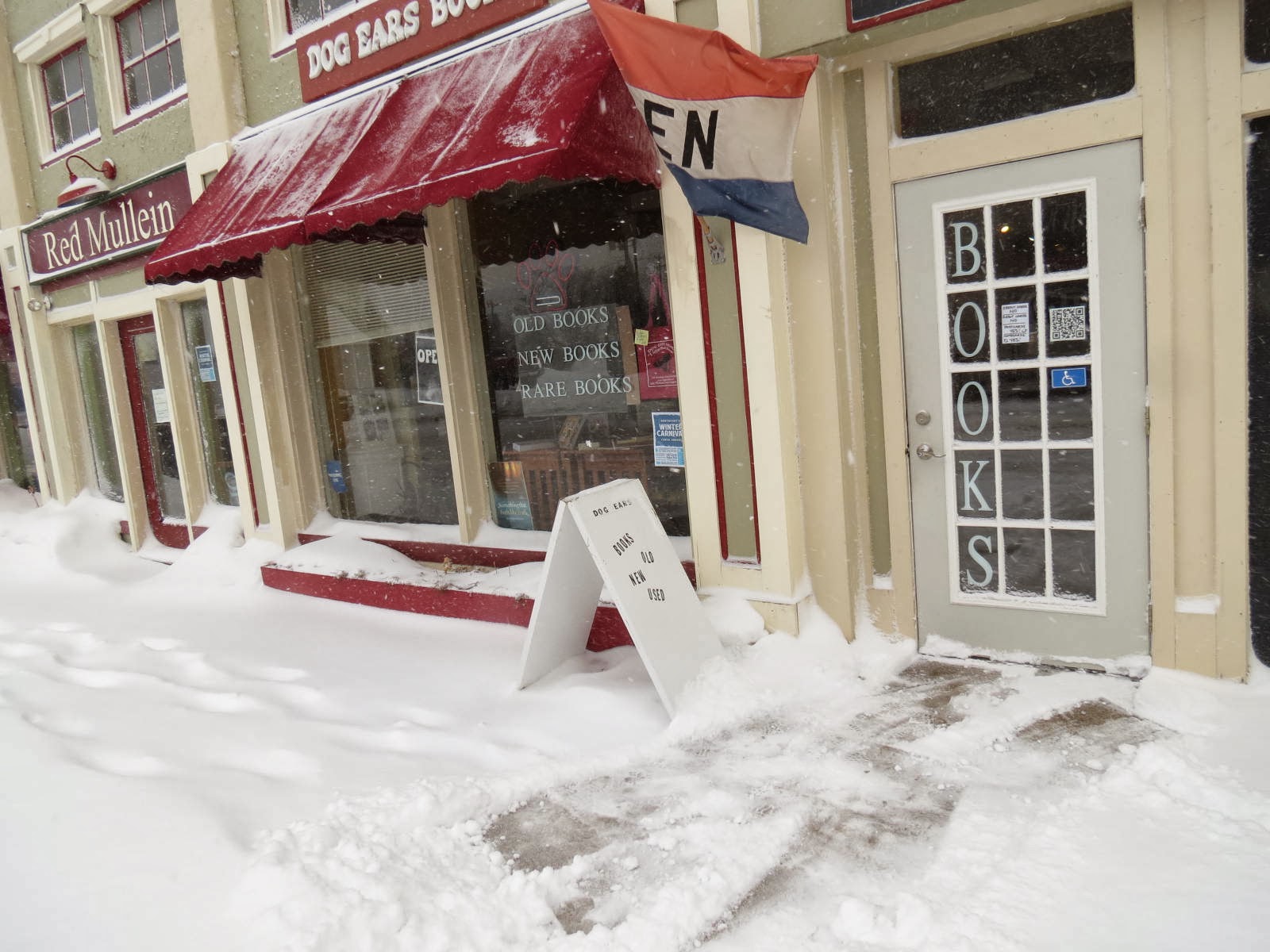
But on with the show, camera or no, because as bulletin board and counter attest, the summer beat goes on at Dog Ears Books, as it does everywhere Up North.


This Thursday will be very special, with not one but three authors joining us for TEA at 7 p.m. When Lynne Rae Perkins and Anne-Marie Oomen agreed to share the stage, it looked as if Anne-Marie’s co-author would not be available, but now poet Linda Nemec-Foster’s calendar has cleared, and she will be with us, too. (Linda was last here in 2014, when thirteen Michigan poets helped us celebrate the 21st anniversary of Dog Ears Books. How the last four years have flown!) So, two books, three authors — both books and all authors fabulous and pure Michigan! Please come if you can. You won’t be sorry!


Postscript 7/17: Now it appears that Linda will not be able to make the date, after all, but I know we will be sufficiently entertained and delighted by Anne-Marie and Lynne Rae, so keep that date circled!


Saturday, November 28, 2015

New on Waukazoo Street Now


What makes a book special varies, of course, from one reader to another, but whenever I put in a new book order to fill specific customer requests, I add a few titles “on spec,” choosing what I hope will be irresistible not only to me but to bookstore browsers, too. Approaching winter holidays are a great time for these special items. Buyer’s remorse may follow purchase of an expensive exercise machine or clothing that’s the wrong size, but who can regret buying a book? As I remind readers every year, books are easy to wrap, eminently shareable, and serve as magic carpets to carry us to other worlds.

Plotted: A Literary Atlas, by Andrew DeGraff, with essays by Daniel Harmon is perfect for literary readers with a taste for maps and quality graphic novel illustrations. DeGraff was inspired by teachers, maps, and history, as well as by classic literature, short stories, and fantasy novels. In this quirky book you will find his visual rendition of Homer’s Odyssey,  Jules Verne’s Around the World in Eighty Days, and the castle Shakespeare imagined as the setting for Hamlet. Mark Twain is here, as are Kafka and Melville, Frederick Douglass and – surprise! – Flannery O’Connor. What would the book authors make of this book? Give it to an English major and pose the question! Hardcover, $24.99

Lynne Rae Perkins first called my attention to Maira Kalman when she asked me to order one of her books. Warning: this author/illustrator’s works are addictive. And how could I not order a book with Beloved Dog for a title? Kalman has my number.
You, reading this book, mostly likely have, or had, a dog. You certainly know that your dog is, or was, the dearest, funniest, lovingest, loyalest friend you ever had.
You will meet many dogs in these pages, dogs of all sizes and kinds. You will also take a walk in New York City, stroll through Paris, France, and find yourself in Washington, DC, in cherry blossom time. If you haven’t met Maira Kalman before, now is the time. Hardcover, $29.95

This one is as quick and simple as its title: Big Bear, little chair, by Lizi Boyd, is a book for young children that explores the world of BIG and little, with examples taken from different natural objects and human artifacts. Some are surprising. Would you think a big zebra would wield a little broom? This book is just plain fun! Hardcover, $16.99


Then, do we ever outgrow Charles Dickens’ Christmas Carol? This new edition begins with historical background and goes on to give us every word of the familiar story, beautifully and memorably illustrated by Australian artist Robert Ingpen. The pictures somehow make the story seem brand-new, while at the same time transporting me to Victorian England, where I am encouraged not only to enter the characters’ lives (all good books do that) but also to dwell lingeringly on the daily details of the way they live. Magic! Hardcover, $24.99


Another familiar classic appearing in new guise is Alice’s Adventures in Wonderland, by Lewis Carroll. The 150th anniversary edition illustrated by Salvador Dali, the first “affordable” edition with Dali’s art, is as psychedelic as any Sixties flower child could possibly wish. 

I love the semi-abstract illustrations rhr remind me of the first “abstract” art I ever saw, dreamy watercolor illustrations in the two-volume book club edition of Kipling’s Jungle Books. There is also a description of Dali’s mathematical interests, the “math connection” between the artist and Oxford mathematician Charles Ludwidge Dodgson, better known as Lewis Carroll. In other words, this book has in it something for every age and every interest. Hardcover, $24.95

Art and literature combine again in Sunlight on the River: Poems About Paintings / Paintings About Poems, edited by Scott Gutterman, pairing over fifty masterpieces of art with poetry from across the ages. Charles Wright meets Paul Cezanne, Jane Flanders and Anne Sexton both dance with van Gogh, and many other poets and artists are brought together in sometimes surprising juxtaposition. Hardcover, $34.95

Finally, we leave the realm of literature and art for memoir, but the new memoir I have in stock is also a travel book: The Only Street in Paris: Life on the rue des Martyrs, by Elaine Sciolino. Moi, je connais la rue des Martyrs. I would never have claimed it as the “only street in Paris,” but neither could I resist revisiting la rue qui monte (the street that climbs) de Notre-Dame-de-Lorette au Sacré-Coeur. Alas! I learn that the famous Poissonerie Bleue, one of the premier Paris fish shops, closed three years ago. But there is still some of the best food shopping in town on the rue des Martyrs, and the book makes me long again for the wonderful cheese shops of the unfashionable but lively 9th arrondissement. One merchant complains to the author that foreigners sometimes come in and don’t say Bonjour. (And then they think the French are rude!) Ah, yes, that is the Paris I remember! Would you like to make the trip? Hardcover, $25.95


So there you have it, this week’s sampler of new titles newly available for in-store purchase at Dog Ears Books, an island of treasures, where every day brings unexpected encounters between people and books.

There will be cookies today, also, at Dog Ears Books, and horse-drawn wagon rides -- free! -- through our sunny little village, and when darkness falls, lights will appear on the big Christmas tree on Nagonaba Street, and carol-singing will follow. 'Tis the season. Bundle up! Come and enjoy!


Saturday, September 20, 2014

Squirrels and Nuts Gather in Northport


Me with Lynne Rae Perkins

Along with bookseller and hostess roles, I am generally the photographer of my own bookstore events and thus, all too frequently, appear in none of the pictures. Determined to avoid that pattern on Friday, here I am (thanks to friend Dan Stewart) with Lynne Rae Perkins-- writer, artist, friend, fellow Leelanau County resident (Suttons Bay), and our county’s only Newbery medalist (Criss Cross, 2006). We were launching her new book, Nuts to You, at Dog Ears Books, with chairs for the reading set up next door in my husband David Grath’s gallery.

Lynne's art from her book, NUTS TO YOU
David’s paintings graced the walls, but Lynne also brought some of her own art, delightful illustrations from Nuts to You. Fun!

Jed
She brought a squirrel, too! This one is named Jed, after one of the characters in the book, and for a squirrel (I was somewhat nervous when I heard he was coming) he behaved pretty well at the party. And Lynne’s husband, Bill Perkins, known more as a maker of artisan rustic furniture rather than jewelry, contributed little acorn necklaces (Lynne gathered the acorns), and every book purchaser received one, and we wore them all evening long. Is this adult behavior or squirrelly behavior?


There were raffle items, also: a Nuts to You t-shirt; a Nuts to You iron-on patch (to put on anything the winner wanted to put it on); and a brown knitted acorn cap, knitted by the artist-writer herself.

Raffle items

Early arrivals had a chance to visit with Ms. Perkins before her reading, and I know they were grateful and happy to have the opportunity.

Fans of all ages


Kids meet Newbery author
It’s a good turnout when the chairs in the gallery are all filled and the crowd spills through the doorway and back into the bookstore. It’s fun to have some little kids come, too. Someday they can tell the story to their kids: “We were on vacation, and our mom took us to meet Lynne Rae Perkins. I don’t remember much about meeting her, but we read the book over and over, year after year.” That’s what they’ll say.

Punch bowl needs refilling again
We had punch and cookies and peach pie. (My latest brainstorm for punch—I share it freely—is Kilcherman's fresh apple cider and Vernor’s ginger ale.) The honored guest herself made the sugar cookies in squirrel and acorn shapes, and another guest brought the pie. More acorns? I assembled a few out of tiny crackers, peanut butter, Hersey’s chocolate kisses, and butterscotch chips.


Author-illustrator baked treats

Bookseller assembled hers
So what do you think? Are we all nuts here in Northport, or is it only writers, artists, booksellers and booklovers? No matter, we all had a wonderful time, and I’m not embarrassed that Lynne Rae Perkins and I look like a couple of kids playing grownup in the photo below. Nuts to You is a book for all ages, I love it madly, and Lynne is one of the funnest (not a typo: I mean that just the way it reads), most talented, and most generous people it’s possible to imagine! Lynne, thank you again and again and again!

We had fun! We sold out! We are happy!


Monday, August 4, 2014

It Can't Be August Already, Can It?


This busy past week, as time came to turn the calendar page from July to August, I did the following (a partial, not an inclusive list):

Observed Cherry Harvest in Progress

You can’t help observing it if you’re out on the roads this time of year. Cherry shakers and haulers, crew and tractors, are on the move throughout the county, and orchards enclose our home on all sides. My own farm dreams don’t involve fruit trees (a few chickens, a couple beef cattle, a field of alfalfa, and I’d settle for half a dozen chickens and time for a productive, well-tended garden), but I like living in a region of working agriculture and having farmers for neighbors.

Got in a Bunch of New Books for Young People

Some of them, for young adult readers, were recommended to me. Others, like the Beezus and Ramona books (and others) by Beverly Cleary, were my own personal brain wave. Oh, the bright, happy colors!

Started Reading a New Book

World War I began a hundred years ago this past week. (Not such a happy thought.) It isn't a war that gets a lot of play in bookstores, where customers much more often look to the Civil War or World War II than to the “Great War” (WWI) or even the Revolutionary War. Why is that? Too long ago? But not as long ago as the Civil war. It's a mystery to me.

My own horrified fascination, beginning with Elliott Paul’s The Last Time I Saw Paris, focused for years on the interval between World War I and II. More recently I have found myself reading further back in history, back into the 18th and 19th centuries, but having received a review copy a few days ago of David Laskin’s The Family: A Journey Into the Heart of the Twentieth Century (now out in paperback), I plunged right in and on Thursday morning reached Chapter Eight, “First World War,” coincidentally with the historic anniversary. A review will have to wait until I’ve read the entire book, but the story is gripping, especially with the Eastern Front bisecting the Pale....

Had a Beautiful Friday in Northport

Last Friday morning, after home chores and country dog walk, began in town with the farm market, where I bought bread, croissants, lovely red onions, little striped purple-and-white eggplant, fresh fennel, two kinds of goat cheese, and some irresistible organic beef. It continued in the bookstore, selling out of the second printing of The Ice Caves of Leelanau, and wrapped up with Music in the Park, for which I was a co-sponsor, this time around, of the Claudia Schmidt Funtet. It was a “good day from morning ‘til night,” but I was too busy and relaxed—yes, sometimes both at once!—to photograph the passing hours.

Thought a Lot More About Writing

William Zinsser’s classic On Writing Well: An Informal Guide to Writing Nonfiction is so lively, as well as helpful, that once I started reading it, I couldn’t stop, so I was glad to find it’s still available in paperback. Much of what he writes is applicable for fiction as well as nonfiction. After all, good writing is good writing (as bad is bad), so any writer can learn from good advice about the craft, whatever its genre focus. I’m ordering this for my bookstore, along with books on writing by Eudora Welty, Stephen King, and Anne Lamott. Any other suggestions for books on writing that have been important to you?

Started Reading Another Book

The Family is my morning book. At night, before sleep, I’m reading Elizabeth Gilbert’s novel, The Signature of All Things. Fiction, history, botany – all in one book. Only thing is, the edition I’m reading is LARGE PRINT, and I’m finding the LARGE PRINT makes me read differently. It’s very strange and more distracting than I’d thought it would be, but I’m persevering.


Took Note of Spotted Knapweed in Bloom

I know, I know! It’s a horrible, nonnative, invasive species, and it doesn’t do our fields and meadows any favors at all. The feeling I most associate with the blooming of this plant, however, is a sense of poignant urgency, coming from my knowledge that we have now reached late summer. After that, of course, comes summer’s end. But before the end come waves of lavender and gold, soft living colors threaded through the green, and my breath catches in my throat. Is this a response to beauty or to the passing of a season that is never long enough?

Invited Four Friends for a Dinner, al Fresco

It can be hard to find time and energy for entertaining during the summer, but in other ways summer is the best time for inviting people, since we don’t have to be crowded into the tiny rooms of our old farmhouse but can stretch and spread out under the black walnut and basswood trees. But the weather was unsettled on Sunday, and as I was driving home dark clouds loomed. I found David in the yard, scanning the sky and making dubious noises about the dinner plan. Those clouds were going to clear off, I told him confidently. The sky cleared for a while, then more dark clouds came; in the end, however, we were able to have our dinner outside under the trees, with just a little breeze and a question of rain in the air but no falling drops.

Baked a Lemon Polenta Pound Cake

This recipe was from The Cake Chronicles, and I think the author said there that she’d gotten it from some other book, but I’m at the bookstore now, and the copies I ordered to sell are still on back-order. Anyway, heavenly smell! Heavenly taste! A bit overdone on top, but the nice lady who brought me a whole quart of fresh-picked black raspberries, after I mentioned that I’d only been able to harvest a handful from my yard – she’s the one who made this dessert a real glory! Now, the next time she comes in, I’ll have to get her name! Nothing like the excitement of raspberries distracting me while bookselling to make me forget the basics. Well, I did say “Thank you,” but that hardly covers it, do you think?


Felt Deep Gratitude

I love our old farmhouse and the surrounding farm neighborhood. I love all of Leelanau Township. I feel so very fortunate to live here, so blessed, so thankful for my life. I’m also feeling grateful for friends old and new, present and distant, young and old. And I can feel that our dog, Sarah, shares all these feelings. Sarah loves her home! She loves company! She loves the yard! She loves her life!


Tuesday, February 25, 2014

The Only Constant: Change


Snow and cold are not news.
Maybe you’ve heard of Esther Forbes. In children’s literature, she made her name as the author of Johnny Tremaine, the 1943 winner of the Newbery Medal, but she also in her lifetime was one of the foremost scholars of Paul Revere and won the Pulitzer in 1942 for Paul Revere and the World He Lived In. Her first published short story, “Breakneck Hill,” won the O. Henry prize for short stories in 1915. The author was then 24 years old. You can read more about this fascinating American writer here. 

A novel by Esther Forbes that I’d never heard anyone mention fell off the shelf and into my hands not long ago. Rainbow on the Road tells the story, from the perspective of an old man in Kansas looking back on one summer in his youth, of an itinerant portrait painter in 18th-century New England. No less than John P. Marquand wrote of Rainbow on the Road (he is quoted on the flyleaf):
A while ago I wrote a paper in which I tried to show that no historical novel can recapture the true spirit of the past, since its writer must always present it in terms of the present. I was amazed at how mistaken I was in this idea when I read Esther Forbes’s last novel. I have never seen the illusion of a period so beautifully presented. Somehow she has caught the whole spirit of New England, which I used to recognize when I talked to very old people during my childhood. In my humble opinion, it is outstanding in every way. It is literature and by far the best thing she has ever written.
It is interesting to see that Marquand called Rainbow on the Road the “best thing she has ever written,” considering Forbes had won the O. Henry in 1915, the Pulitzer in 1942, and the Newbery in 1943. Looking back on the fact that Johnny Tremaine has never been out of print, what would anyone say now was Esther Forbes’s “best” book? And what of John P. Marquand? Sixty or seventy years ago, who would have predicted that he would be found on a website (could websites have been predicted!) calling him one of America’s “Forgotten Writers”? Sic transit gloria mundi.

Book Club edition, 1954
This morning I was telling David the bare bones of the story of Rainbow on the Road – the unschooled portrait painter, trained by apprenticeship when young as a “limner,” who painted bodies and backgrounds all winter and then traveled the countryside come summer, filling in faces and selling his canvases for $3 to $5 apiece; the handsome, womanizing highwayman whose description was close enough to the painter’s that the two were often confused in pre-photography New England; the life of all the various peddlers on the road in late 18th-century New England, days of horse-drawn coaches and stages, small town inns and public houses, rocky hills grazed by sheep, isolated farmhouses, flatboats and canals as good transportation, and political speeches as good entertainment.

Close to a third of the novel (this is only an impression, not anything I measured, and my impression may exaggerate the facts) is taken up with stories told by various characters. Speechifying, story-telling, and the making up and passing along of original ballads were ways that Yankees passed the time in those days. Their stories, added to the author’s descriptions of the countryside and plot complications as Jude Rebough is confused with Ruby Lambkin, make for a very entertaining novel. Historical verisimilitude, which Marquand praised so highly, is rich icing on a hearty cake.

One of the great themes of Rainbow on the Road is that of social change. The narrator was thirteen years old, he tells us, when he spent that summer on the road with the man who stood in the place of an uncle to him. (His “Aunt Mitty” was not a blood relative but had taken him in when his parents were killed in a road accident near her house.) As an old man looking back, he tells us, along with his story, about the way things were done then.
I guess I’ve made it clear by now that these days were before the time an artist (and seems like everybody is an artist now) could buy paint in a compressible tube with the oil and the pigment already mixed together. The powdered colors, each ground to the proper coarseness or fineness best for it, came to Dr. Bloomer in containers about like what rare tea come in. On selling them they were transferred to bladders of small animals. When Jude wished to use a certain color he’d prick the bladder with a bone tack, sprinkle out the amount he’d need, and mix in the linseed oil. But I associate the smell of oil of lavender with his work, and turpentine as well. From then on, the bladder having been breached, the tack served as a stopper....  
The biggest bladder used was that of a rabbit. If you wanted more, instead of going into sheep or swine bladders, you bought two rabbitsful. As I remember, this was about an ounce. A rat’s bladder was smaller. These were commonest but other animals served. A mouse’s bladder was the smallest unit.
I found these descriptions mesmerizing. The boy, accompanying the artist as an apprentice, never did learn to paint, but he learned to make brushes (also described), and he took over the handling of money, something for which the artist had no gift.

One of the novel’s minor characters is a peddler of broadside ballads, Phineas Sharp. Sharp puts words to tunes of his own invention and sings his way along the road, keeping his overhead low and selling copies of his lyrics. The last time Jude and Eddy meet with Sharp, the latter tells them abruptly, “I’m sixty-four,” adding, “What’s more, when I die there will be no more like me coming on.” This meeting, coming near the end of the book and near the end of the summer’s adventure for the painter and the boy, begins to sum up the changes that were in the wind all along.
“My trade’s done. Pianofortes and music stores. Sheet music. Music books. I’m the tail-end of the last. People, learned people, have told me there have always been singing men upon the road since the beginning of time. But I know they will not last on into time to come. If I had a son, or a grandson rather, I’d never learn him my trade.”  
We had come to the edge of the high ridge on which Bennington sits. Below us was the great valley into York State. The road he would follow on dipping and appearing and disappearing across it. 
 “Ballad singers and broadside men are done for,” he said.
That was the last they ever saw of Phineas Sharp, footing it along that ridge road, appearing and disappearing over and over until he passed forever out of their sight. In retrospect, the narrator sees that limners like Jude were as much a disappearing breed as broadside men.
...[Jude] was just about the tail-end of his trade too. Not the last of people like H. H. Hooper, who called themselves artists and had studios. But he was among the last of the traveling limners, for already (unbeknownst to any of us) that Frenchman, name of Daguerre, had done his work. Before you could guess it the itinerant limner was clean off the road and the daguerreotypist and the tintype men were on it.
The days of canal boats and rivermen were coming to an end, too. Soon the railroads would arrive, and the strong horses on the towpaths would disappear along with the ballad singers and limners.

As a bookseller for over 20 years, I am forced to think about and adapt as best I can to constant change. To extinction, however, one does not adapt: one succumbs. The question is, which is it to be? Bookshop proprietors have been worrying about their own demise since the first appearance of the newspaper. Movies and television and electronic games all presented new threats, while more recently it is the online world of virtual text, amusement, instant answers, and distance socializing that some think has booksellers doomed. What is the future for books? Many hazard predictions and have ideas, but no one really knows.

Lately I’ve been fretting (winter tends to encourage all kinds of fretting) about what seems like a new, disturbing development in the world of books and reading. Ten or twenty years ago, whenever anyone in my bookstore gave a sly little smile and referred to the local library as my “competition,” I’d shake my head and say, “Every town deserves a library and a bookstore. A library is not a bookstore, and a bookstore is not a library. There’s room for both.” I said that, and I believed it. For several years (two years practically single-handed) I helped run our local library’s summer guest author series. But recently I’ve felt a rumbling underground, changes beneath my feet, the carpet moving under me, and I’m wondering more and more if bookstores and libraries are complementary, as I have been invested in believing for so long, or if economic reality has conspired to cast booksellers and librarians as competitors.

Research into recent developments is better done online than in old books, so I began poking around. One library site, rather than describe or predict, went in for prescription: 
In the end, there should be no competition between bookshops and libraries.    Authors, publishers, booksellers, and libraries would do well to view each other as allies in the struggle to preserve literacy and instill a passion for reading and learning in all of mankind.  When everybody reads, everybody wins.
Sounds good, doesn’t it? That is definitely the world I want to see, the one I love to believe in, as I’ve loved libraries and librarians all my life -- and still do! On the other hand, here’s a retired librarian proposing that librarians become booksellers. What happens then to “no competition” between us? 

I found some ideas from the year 2010 for ways bookstores and libraries can collaborate, and I found an opinion from 2014 from a radio talk show host who believes bookstores should be more like libraries and libraries more like bookstores. Problem: Library funding is discussed; bookstore revenue is pretty much glossed over. Numbers of people through the door mean nothing to a bookstore’s bottom line. Nothing counts but sales.

A piece from Forbes magazine was the scariest. The writer, Mark Bodnick, predicts that public libraries will go extinct, following the disappearance of bookstores, because anyone will be able to download whatever they want to read without going to either a bookstore or a library.

I cannot read the future. Quite frankly, I find more enjoyment visiting the past via books – and visiting real, live friends face to face, whenever possible, spending time with them in the same room, although we have no “need” to do more than call each other on the phone or chat through Facebook. But that’s just me, and my feelings prove nothing about what will come to pass with books in the years ahead.

I could be that I am one of the last of a vanishing breed. If that’s the way things turn out, I will be grateful to the end of my days for such a wonderful experience: my own bookstore, surrounded by books, meeting strangers, making friends, helping customers, and getting to know writers in this world we shared as the 20th century turned to the 21st on planet Earth.


Friday, December 6, 2013

What Title to Give This Posting about Holiday Gift Ideas?


First, the reminder that Sunday afternoon is our bookstore event with Traverse City artist Glenn Wolff. Again, that's from noon to 2 p.m. Books, notecards, posters, and a gift to each Wolff book purchaser. See right-hand column for details, if you’ve somehow missed the blitz of publicity on my blog recently. As Northporters and 2013 bookstore visitors know, I don’t have quite the space up front for holiday decorating that I’ve had in years past, so this year my “tree” (thanks, Mom!) is not quite 11 inches tall. It does light up though (from the inside), and the even light changes color. (Don't ask me how.) I’ll try to make up for the absence of a real tree on Sunday (and that good spicy fir tree smell) with the presence of home-baked cookies. (Blogger, what is it with you and the parentheses today, anyway?)

Looking at another bookseller’s blog earlier today, I realized I’ve been rather neglecting the historic nature of my larger collection, so that’s where I want to put the focus today. Old books. To me, they're treasures, and sometimes I don’t do enough to showcase them to casual browsers. I mean, a lot of these  are classics!  To begin under a fairly broad umbrella of what constitutes a classic, for example, how about the two children’s books below?

You remember Eloise, don’t you? She lives -- by herself, mind you -- in the Plaza Hotel in New York City.


Book cover


Detail of book illustration
The Eloise book is pretty pricey, but The Littlest Christmas Tree can be taken home, tax included, for under $10. And can you believe no child has yet written his or her name inside this 1954 Wonder Book by popular children's author Thornton W. Burgess?

Book cover

Illustrated endpapers

Book slides in and out of slipcase
Moving on to more adult fare (and staying with bargains), here's the kind of books I love to find under my tree (or wherever!). First, Anne Morrow Lindbergh’s A Gift From the Sea, illustrated and in a slipcase. I love slipcases! Tucking the book into own little bed is a delicious thing to do.

Chapter illustration

Then a sweet old volume of essays by the incomparable Charles Lamb. Book spines and covers just don't look like this any more, more's the pity.

Pretty spine

Ordinary old book cover
Or any of the little Peter Pauper Press editions shown below, all with original dust jackets. Yes, I do have a thing for small books, as well as for slipcases....


Books from Peter Pauper Press

But my big excitement earlier this week was taking delivery of a mammoth box of old books on Michigan. Unpacking, pricing, shelving -- such are the joys of a seller of used books, and great her satisfaction as she stands back to admire newly restocked shelves.


Partial view of overflowing Michigan section


Small AND local!
There are three of the Great Lakes series (Michigan, Superior, Huron – i.e., our western lakes), several titles on early days when timber was Michigan’s main attraction, and many books, large and small, on various Michigan cities and villages and islands.

David and I were saying only this morning how fortunate we feel not to have workplace politics as part of our lives. Neither of us -- he, the artist, and I, the bookseller – have either bosses to please or employees to oversee. Sometimes, though, I sigh over the concept of retirement. Yes, it’s only a concept, as far as my life is concerned, but I would love to spend a year reading in a more focused and continuous way, being transported back 50 or 75 or 100 years to Michigan’s past.

I live on my own little Treasure Island!