Search This Blog

Showing posts with label Traverse City. Show all posts

Friday, July 11, 2025

Do you wanna be Up North? Are you here already?

Sandhill cranes return every year.
 

Everyone wants to be here! Is that a problem?


Bear with me while I start far from Michigan....


Wilma Dykeman, in the volume of the “Rivers of America” series entitled The French Broad, which gives the history of a river region that encompassed western Tennessee and eastern North Carolina, writes in one chapter of a boom in tourism set off initially by “lowlanders” on the coast seeking to escape heat and malaria by summering in the mountains. At first conditions were rustic, but as time went on more and more elaborate hotels and resorts were built. The boom did not last forever—as transportation alternatives came along that allowed greater distances to be covered, the lowlanders were able to vacation much farther from home than Appalachia—but while it was on, it was definitely on, enticing foreigners from England, Scotland, and Germany as well as residents of North Carolina’s seacoast. In the 19th century, the region of the French Broad River saw “a mingling of Northern wealth and Southern abandon.” 


Everyone, it seemed, wanted to be there. 


It was the peak of the boom for the watering places in the French Broad country. To these springs and hotels came people who at a later date would be gasping over the canyon of the Yellowstone rather than the canyons of the French Broad. The ‘Lowlanders,’ who set out from their malarial flatlands with a caravan of carriages and trekked up through the foothills and into the mountains on a journey that cost at least two weeks every year, were looking for the same things many of the tourists who hurry through so rapidly today are seeking: A combination of comfort and ruggedness, the uneasy balance between a luxurious personal surrounding and an untamed natural background. They simultaneously sought new experiences yet managed to establish many of their old ways of life in the country they visited. 


-      The French Broad, by Wilma Dykeman, from the Rivers of America series, edited by Carl Carmer, as planned and started by Constance Lindsay Skinner


The French Broad was published in 1955, that post-World War II era when Americans began vacationing in automobiles, when motels began to replace earlier “tourist resort” campgrounds, but are Americans who leave home today, whether for two weeks or permanently, much different? Don't most still want new places to offer both comfort and ruggedness, nature and luxury, the excitement of new experiences along with the familiarity of their old ways of life?


My bookstore is in Leelanau County, Michigan, and these days it sometimes seems to locals as if everyone wants to be here. Or in Grand Traverse or Benzie County or Antrim or Charlevoix or – well, a bookseller friend in the U.P. feels as if everyone wants to live on her road! But the other side of the coin is that businesses rely on customers, whether locals or weekenders or new residents. Then, too, not all of us who live here were born here, by a long shot. I was born in South Dakota myself, of an Ohio-born father and a California-born mother!

***

Who wouldn't want to be here?

[PLEASE NOTE: I was still reading the two books discussed below, i.e., had not finished either one, when I put this post out into the world, because I could not wait!]


Tim Mulherin’s This Magnetic Book: Candid Conversations on a Changing Northern Michigan explores the “relocation phenomenon” that is swelling the population of places like Traverse City. Northern Michigan, of course, is not the only destination of people fleeing crowds and climate disasters. Arizona and New Mexico and Idaho and Montana are all getting their share of well-to-do “climate refugees” from California. Some people are still moving to the South for warmer winters and sunshine, but others are moving away from the South. 


Americans on the move! Pulled by magnetic forces away from home to new homes!


Mulherin begins with his own migration story, but then in Chapter 2 ups the ante seriously with “An Indigenous Perspective,” interviewing several members of the Grand Traverse Band, whose people were here long before Europeans “discovered” North America. In fact, a list of chapters will tell you a lot about the scope of Tim’s book: 


Chapter 1. “A Migration Story”

Chapter 2. “Indigenous Perspectives”

Chapter 3. “Welcome Wagon”

Chapter 4. “Settlers”

Chapter 5. “A Taste of Northern Michigan”

Chapter 6. “Invasive Species”

Chapter 7. “America’s Most Beautiful Place”

Chapter 8. “Protecting Paradise”

Chapter 9. “Eyes to the Sky”

Chapteer 10. “Every Day is Earth Day”


Mulherin interviewed over 75 Northerners from various walks of life and a multitude of backgrounds. Pandemic & climate refugees or lifestyle migrants? Which label fits better as you see it? If you came here from downstate or farther away, does either label seem to fit your move to Leelanau or the greater Grand Traverse area? If you’ve lived here all your life, how do you view newcomers and change? 


One fruit grower Mulherin interviews points out that the very places seen as most desirable for new houses are also the most advantageous locations for orchards.


Growing specialty fruit crops in northern Michigan calls for being close to Lake Michigan, within several miles, and on sloping ground. This, of course, also makes for perfect view property. ‘Our desirable fruit-growing land is getting turned into golf courses and subdivisions and wonderful view mansions that can see Grand Traverse Bay,’ King McAvoy explains with a tinge of cynicism.


The lake offers protection, cooling the land in summer and keeping it warmer in winter, but property prices keep going up, while farming remains a gamble from year to year.


Mulherin, who still maintains a home in Indiana, does not presume to have answers or give prescriptions, but it’s clear that no one he talked to wants change and growth to destroy what makes this part of the country such a magnet for vacationers and relocators alike. Unfortunately, where some see destruction, others see improvement. 


I admit that part of my pleasure in reading Mulherin's book is encountering so many old friends, but anyone who loves our area and cares about its future will want to read This Magnetic North.


***


Now, can work be a vacation? Maybe that depends on where you are.


When Robert “Carlos” Fuentes introduced himself and his book to me recently, my enthusiasm was immediate. The Vacation: A Teenage Migrant Farmworker’s Experience Picking Cherries in Michigan is a personal account of what it was like to work in a Leelanau cherry orchard a few decades ago. Robert’s family were not year-round farm workers—his father had a floor cleaning business—but the summer he was 14 Robert was told by his father that the family was going to Lake Leelanau for vacation. The only catch was that they would be picking cherries from 8 a.m. to 5 p.m. on weekdays and for a few hours on Saturday mornings. 


The day before they left home, when Robert tells his friend Luis that he’s going to Lake Leelanau for a cherry-picking vacation, Luis scoffs at the idea of picking cherries as a “vacation.” 


He tells me it is hard, dirty, thankless, and physically strenuous work. His family is still partly in the migrant farmworker stream. All Mexican American families in our neighborhood were from Texas and came to Michigan as migrant farmworkers. Luis tells me that he and his family have already done two weeks of hoeing at some local fields and will soon be heading up north to pick cherries at a farm on Old Mission Peninsula.


Robert was grateful he didn’t have to move around the country harvesting different crops. He liked having a settled home in Alma, Michigan. But he was excited about the “vacation” his father had planned for the family on the Esch Farm in Leelanau County, where his grandfather had first come (from Texas) to pick cherries in 1946 and, in later summers, had led church services in Spanish in the barn for the migrant workers.


Before mechanical shakers came along, cherries, like apples, were picked by hand. The author writes in his brief introduction that when machines came to the orchard,


…the backbreaking tradition of handpicking gave way to mechanized efficiency. In a matter of years, the thousands of workers who had once filled the orchards, their laughter and voices rising with the rustling leaves, were no longer needed. A way of life was disappearing. 


With these few, spare introductory lines, Fuentes reminds us that change is nothing new in northern Michigan. 


Robert’s cherry-picking vacation was in 1969, just a year before I moved to Traverse City from Lansing, and I remember the era well: “muscle” cars, Wolfman Jack, the miniature model Traverse City and the zoo in Clinch Park. I don’t remember ice cream at NJ’s. The Twister for ice cream (where Fiddleheads is now) must have come along much later.


But whether you knew the area in 1969 or not, the author will take you back in time, as he seamlessly weaves facts about the cherry industry with personal experience (Robert could pick enough to fill an average of 22 lugs in eight and a half hours; the best pickers could fill 25-30 lugs a day but worked longer hours; growers were paying 80 cents a lug in 1969; and growers were paid by the pound, varying from seven to 15 cents in those days), and his story includes not only facts and sights but also sounds and tastes and smells of those days, as well as descriptions of his own thoughts and moods. 


As we read, we hear the whine of mosquitoes and the strains of Tejano music from car and truck radios, taste a special lakeside supper of grilled hot dogs with catsup and mustard (a change from the family’s customary and probably more delicious Mexican fare), smell the Zest soap in the cold shower, and see the roadside daylilies that catch Robert’s eye. He is nervous about talking to a girl he finds attractive, but when she smiles at him all the world is bright.


On a typical day, he and his siblings would have cereal for breakfast, pick fruit until stopping for a half-hour picnic lunch, pick again until quitting time, and then enjoy a trip to a Lake Leelanau beach for another picnic meal, maybe later to NJ’s for ice cream, winding up, for Robert, with an evening gathering of teen boys in their “clubhouse” in the barn, where they would trade baseball cards and have farting contests, which he acknowledges was totally a guy thing. Outside the clubhouse, however, his sensitive nature responded to northern Michigan.


Walking back to the tent through dew-covered grass, I take in my surroundings. I gaze at the sky, marveling at the stars and planets. The wind rustles the leaves, their sound blending with the chorus of crickets and katydids…. This place feels so peaceful right now….


***


I am reading Mulherin and Fuentes almost simultaneously--toggling back and forth between them, that is. I’m enjoying the experience, immersed in how life was then compared to how it is now in the same region, and I recommend you do the same. 


The big question is, of course, what do we want this part of Michigan to be in the future, and what can we do about it? Your thoughts?


P.S. Current summer bookstore hours here. 

Wednesday, December 13, 2023

Everything is Different Everywhere

Wednesday morning, 12/13/23

Everything is different not only from year to year but also from day to day. Yesterday’s fierce, bitter west wind made the air feel ten degrees colder than the temperature reading. Today is still cold, but the sun is shining, and there are more smiles on the faces of even the most rushed pedestrians in Northport. I did my village errands before opening and then found contentment in adding ornaments to my little Charlie Brown tree.


Happy in the bookstore window, sunny today


A Recent Encounter and Thoughts It Sparked


“It’s not the same town it used to be,” the salesperson muttered bitterly. I was trying on boots and had asked specifically for footwear made in the U.S. or Canada. Her remark about change in Traverse City came as a response to my request and followed her more immediate response: “You won’t find them. No one here wants to work any more. The only boots we can get from China or Vietnam or ….” I forget the third Asian country she named, but in the moment I thought instantly about the wage scale in China, where factories workers are housed in clusters of high-rise dormitories in the middle of nowhere, and so I remarked, “Well, people here don’t want to work for nothing,” but that was the wrong thing to say, because although my tone wasn’t angry, the words were argumentative. I wish it had occurred to me then (and not an hour later) to ask curiously, “Why do you say that?” Maybe we could have had a conversation. Instead, she countered quickly, “They don’t want to work at all!” I still could have asked the question, if I hadn’t let her words and demeanor put me off so completely, but next she made that remark about Traverse City not being the town it used to be, adding, “And it isn’t the same country it used to be, either.”


Of course, she was perfectly right to say that Traverse City has changed. Nothing like the small town I moved to in 1970, Traverse City now seems to exhibit growth as such a fast pace that the Artist and I were always exclaiming over new buildings whenever we made the trip to town. Big condominium complexes everywhere, multistory hotels, city traffic! Downtown is still attractive and walkable, and the sidewalks are usually filled with foot traffic (a good sign for a downtown), but the newfangled parking arrangement – meters that take credit cards instead of quarters – discourages some (I am one) from making the effort to shop downtown. Maybe it’s out-of-town visitors in the big hotels who shop Front Street boutiques these days.


Luckily, when I inspected the label on the inside of the second pair of boots the gloomy salesperson brought out (the ones I’d initially pointed to in the display), I saw that they were made in Canada. They fit. They were warm and snug and simple. No need to look further. So I got what I came for, and we ended with smiles, but the transaction as a whole left me feeling sad and discontented over a missed connection. I wish I’d had my wits about me in the moment. But going to Traverse City overwhelms me, too, most of the time….


Stores and restaurants and traffic and high rises are hardly unique in the American landscape. When I am back in Kalamazoo, there are parts of that city that I barely recognize, and the same is true of Joliet, Illinois, where one of my sisters still lives. Cities everywhere are sprawling outward. Growth in Tucson and Phoenix made those cities’ outlying areas look different from one week to the next as I traveled from ghost town to city hospitals and back in early 2022. Apartment buildings and condos are rising skyward in all American cities. Shops and restaurants have become more expensive (and more like New York) than they ever used to be.


Nothing is the way it used to be. Anywhere.


Part of this sea change is population growth. The world population, 3,695,390,336 in 1970, had grown to 8,045,311,447 by 2023, more than doubling. The population of the United States went from 203,392,031 to an estimated 339,996,563 in the same time period, not doubling but greatly increasing. How could we ever imagine that the world would not change with so many new people in it, including the babies we welcome so joyfully into our own families? 


Another aspect of changes, however, as I see it, has to do with expectations, which are much higher than those of the postwar twentieth century. Is it also a greater willingness to carry debt? Refusal to delay or do without gratification? Resignation to “just the way things are”? The average new car today costs two and a half times what my first house cost and five times what my parents paid for their first house. Not that my parents ever bought new cars, and I never have, either, and both of those first houses, I should note, had three bedrooms and a single bathroom -- but who expected more? Our family’s vacations in the 1950s consisted of two weeks in Ohio, one week with one set of grandparents, a second week with the other set – and that was a summer vacation. Winter vacations were unknown except for “jet-setters,” back when only the rich and famous flew around the world for pleasure.


Materially speaking, the growing world population on average is richer than ever. Many middle-class Americans are drowning in their own toys! (Are they happier?) However the average is calculated, though, many are left behind, as what was a gap between highest and lowest income levels threatens to become a chasm.


Somehow – and I have no basis other than intuition for saying this – I doubt that the unhappy salesperson in the shoe store and I would agree on which changes we see as the most negative or what might be done to mitigate negative effects. Of course, I don’t know that, and obviously she was having a bad day. I remember a day 28 years ago when I had to close my bookstore early, realizing that my mood was not one that walk-in customers should have to meet, and a couple years after that, during summer tourist season, annoyed by being asked the same questions over and over, I had to slap myself upside the face, metaphorically, and tell myself either to get a new attitude or find a different line of work. Attitude is what I changed.


I’ve moderated both my moods and my expectations since those early years and grown accustomed to the rhythms of the calendar. I’ll never be rich, but I manage to make a modest living doing something I love in a place where I feel comfortable and visible. A first-time visitor recently assured me that no reader need ever leave my bookstore empty-handed, as there is something for every reading taste. “Write in my guest book!” I urged him shamelessly. Everyone loves to be appreciated! I certainly appreciate my customers and am happy that so many have become my friends over the years. What more could I ask? I am a lucky human being.


Welcome!


Additions to Top Recommendations From My 2023 Reading


Added to my top fiction and top nonfiction book picks of the year are now: 


For fiction, it is, of course, The Waters, by Bonnie Jo Campbell, which I read in an advance review copy, though the release date was pushed from October to January 2024. I’ll be writing more about that novel after the first of the year and hope the author can come to Northport! 


For nonfiction, it’s Isabel Wilkerson’s Caste: The Origins of Our Discontents, published back in 2020. I read The Warmth of Other Suns earlier but only very recently Caste. Such a brilliant writer and thinker she is, and while you probably know, as I did, the basic historical events, her analysis puts them in a new, pitiless light. How did 2016 happen? Read Chapter 26. That is, read the first 25 chapters, and then Chapter 26. Every American needs to read this book. If you need more convincing, here's an article for you. 


Time Is Slipping Away!


How does it happen? One day the holidays are visible on a distant time horizon, with weeks available to plan and make ready, and then suddenly  Hanukkah is almost over, and it's less than two weeks until Christmas! Whatever the day on which these thoughts occur to us, however, we are here now. Take a deep breath. Sun or clouds, you are here now.


Saturday, July 7, 2018

Inspired to Take a Different Road -- Slowly


We are now in “high season.” This very week was 4th of July and, of course, still is Cherry Festival in Traverse City. Cherry harvest is a little late here in the northernmost part of Leelanau County, due to an unusually cold April. We’ve certainly had warm weather lately, though, and the summer people and tourists are swarming to restaurants, shops, tasting rooms, and beaches. High season is the busiest time of year for almost everyone in Leelanau County. 


But Kim Schneider, my July 5 TEA guest, must have inspired me, because on Friday morning I jumped the traces for a modest morning adventure. 


After hanging laundry out before sunrise, I made it to the farm market before official opening hour (most of the vendors ready for business), did bank and post office errands, and then took myself, with Sarah, out for a slow drive to Peterson Park and a stroll around the grounds for — hard to believe — my first visit of the year. Peterson Park looks different with the old dead trees taken down and new little trees of various species planted. Probably a lot like the early days, one third-generation local observed, except that this time a monoculture planting was avoided, which bodes well for the park’s future. With more open area, the views are longer and wider. There is a shaded picnic shelter and also tables in the sun, so take your pick. Whenever I go up there in the morning, with coffee or without, I think what a lovely vacation breakfast gathering spot the place would make, especially on summer Fridays. Fruit and croissants from the farm market, fresh coffee, maybe cook up some bacon and eggs on one of the park grills. 


Sarah and I didn’t take the rustic stairs down to the beach. (That much time we didn’t have.) Peterson Park beach, though, is my favorite place to send people who want to hunt along the shore for Petoskey stones. Kim Schneider asked people who came to her TEA event for their suggestions of ideas she could add if 100 Things to Do in Traverse City Before You Die goes to a second edition. (Would an enlarged second edition have to be called 150 [or however many] Things to Do, etc.? I don’t know.) I’d definitely have Peterson Park on my list, and my other suggestion would be the pow-wow in August in Peshawbestown, an event I sometimes find difficult to fit into my calendar — so much going on all summer! — yet whenever I get there, the chance to relax under the trees and watch the dancers brings peace to my spirit. I call it “that pow-wow feeling,” and it’s another way for me to slow down and simply be here. Important to take advantages of quiet moments and hours along the way, isn’t it?

Back in town, I did my last pre-opening errand on foot, pausing on the corner of Mill and Nagonaba to appreciate what I've always called my "lipstick" roses. I rescued the bush when I was working in a friend's garden business and one client wanted all his old roses dug out and replaced with new hybrid teas. Unable to throw these old-fashioned darlings on the compost pile, I put the bush in my car instead to take up to Northport and plant next to my bookstore, back when Dog Ears was housed in the little bark-covered building on that corner that is now the home of Porcupine. They bloom still, my lipstick roses, with their brilliant shade that reminds me of the lipstick my mother used to wear when I was a little girl. 

My mother's lipstick, working in my friend's garden business, the early days of my bookstore -- to me, all this history is contained in these colorful blooms. 


Monday, October 23, 2017

A Really Big Evening


Down by a couple of ponds outside Willcox, Arizona, back in early 2015, I pursued a flash of brilliant red with my camera and captured, to my great delight and excitement, an image of a vermilion flycatcher, a bird I had never expected to see. I am hardly what might be called a “birder,” serious or otherwise, but even my aviphobic husband, the Artist, became somewhat interested in the birds of Arizona. We went out of our way, for instance, to pilgrimage to the western wintering grounds of sandhill cranes. But that solitary vermilion flycatcher was more a private triumph for me, one I could hardly wait to share. “Is it a big deal?” David asked. Not excited. So when we planned a trip from our Cochise County home base to Santa Cruz County to visit old friends, I was eager to share my sighting, knowing they would appreciate what a big deal it was. And that was a lovely evening we had in Patagonia, sitting outdoors outside the restaurant (so Jim could smoke) long after dinner was finished and darkness fallen. I hoped for many more such evenings, but that was our last with Jim and Linda, as she died the following fall and Jim less than half a year later.


Saturday evening at the Opera House in Traverse City we attended an event billed as “A Really Big Tribute: An Evening of Life, Art, and Stories,” the event taking its name from a posthumous collection of Jim’s essays on food (and life and art and stories) titled A Really Big Lunch. We had no idea what to expect. Also, while I had taken my camera in the car, I decided against taking it in with me for the evening (though I’m sure other people will be posting pictures on Facebook and elsewhere), so my report will be idiosyncratic and sketchy at best.

Okay, here goes.

In the course of the evening, various people from Jim’s life spoke of their friendships with him and their work with him, and they read from his work and from work that he had found meaningful. I cannot attempt to capture the overwhelming flood of detailed memories, but here are the speakers, in order of their appearance:

Joseph Bednarik, co-publisher of Copper Canyon Press

Michael Delp, Traverse City poet

John Evans, bookseller, Lemuria Bookstore, Jackson, Mississippi

Andrew Harrington Bahle, family friend

Lucy Fisher & Douglas Wick, American film producers

Robert DeMott, Montana poet

Will Hearst, chairman, Hearst Corporation

Anne-Marie Ooman, Leelanau County poet and essayist

Les ValMadre, Australian architect & yachtsman and former Leelanau County resident

Norm Wheeler, retired teacher, Leelanau School

Judy Hottensen, associate publisher, Grove Atlantic

INTERMISSION

VIDEO PRESENTATION

J. Stephen Sheppard, New York attorney and Jim’s literary agent since 2005

Chris Walton & Steve Byrne, co-directors and co-producers of the evening’s video presentation

Doug Stanton, bestselling nonfiction author from Traverse City and founder of the National Writers Series

Amy Reynolds, sales manager, Horizon Books, Traverse City

Colum McCann, novelist and short fiction writer and National Book Award winner, born in Ireland, now residing in New York

Ray Zepeda, award-winning poet and professor of English at California State University, Long Beach

Michael Ondaatje, acclaimed writer of fiction and nonfiction, born in Sri Lanka and now residing in Toronto

Gary Snyder, poet, environmental activist, Pulitzer Prize winner

Joyce Harrington Bahle, Jim’s aide-de-camp and personal assistant since 1979

Gary Wilson, event planner and “silent partner” in planning the evening of tribute

I am serious when I say that the deluge of personal memories presented by this cast of participants was overwhelming. So many people, so many stories, so many different perspectives on a man and writer so many of us loved! All the words continue to roil and tumble in my heart and mind, but certain phrases struck deeply in the moments they were uttered: 

  • Colum McCann noted that Jim had created, in all of us, a community, “a community of feeling.” 
  • In the video presentation, one clip caught Jim saying to an interviewer that a poet’s job is “to bring the gods back to life.” 
  • And then Joyce, at the end, using a phrase David and I often use as an accolade of someone we admire who has passed on, stated simply that Jim “got his work done.”

Afterward, old friends were gathering here and there in Traverse City to continue the evening, but David said if we went anywhere at all, he would be most inclined to stop at the Blue Bird in Leland for a drink, “for old times’ sake,” since in many ways that's where it all used to happen. We wondered a bit what we would find there and if the bar would be filled with rowdy young strangers up for fall color. "If it looks impossible, we just won't go in." Fine.

Happily, not so. There were half a dozen or so people seated at the bar, one of them old friend Cris Telgard (who had been at the "Tribute," too), and the atmosphere calm and welcoming. We were happy to “belly up to the bar” with Cris and have him introduce us to a couple of new Leland residents -- with ties of blood, as it turned out, to old Leland friends. David was soon engrossed in conversation with the new couple, and Cris and I fell into Arizona talk. Then --

“Wait a minute,” he said. “I have to run out and get something from my car.”

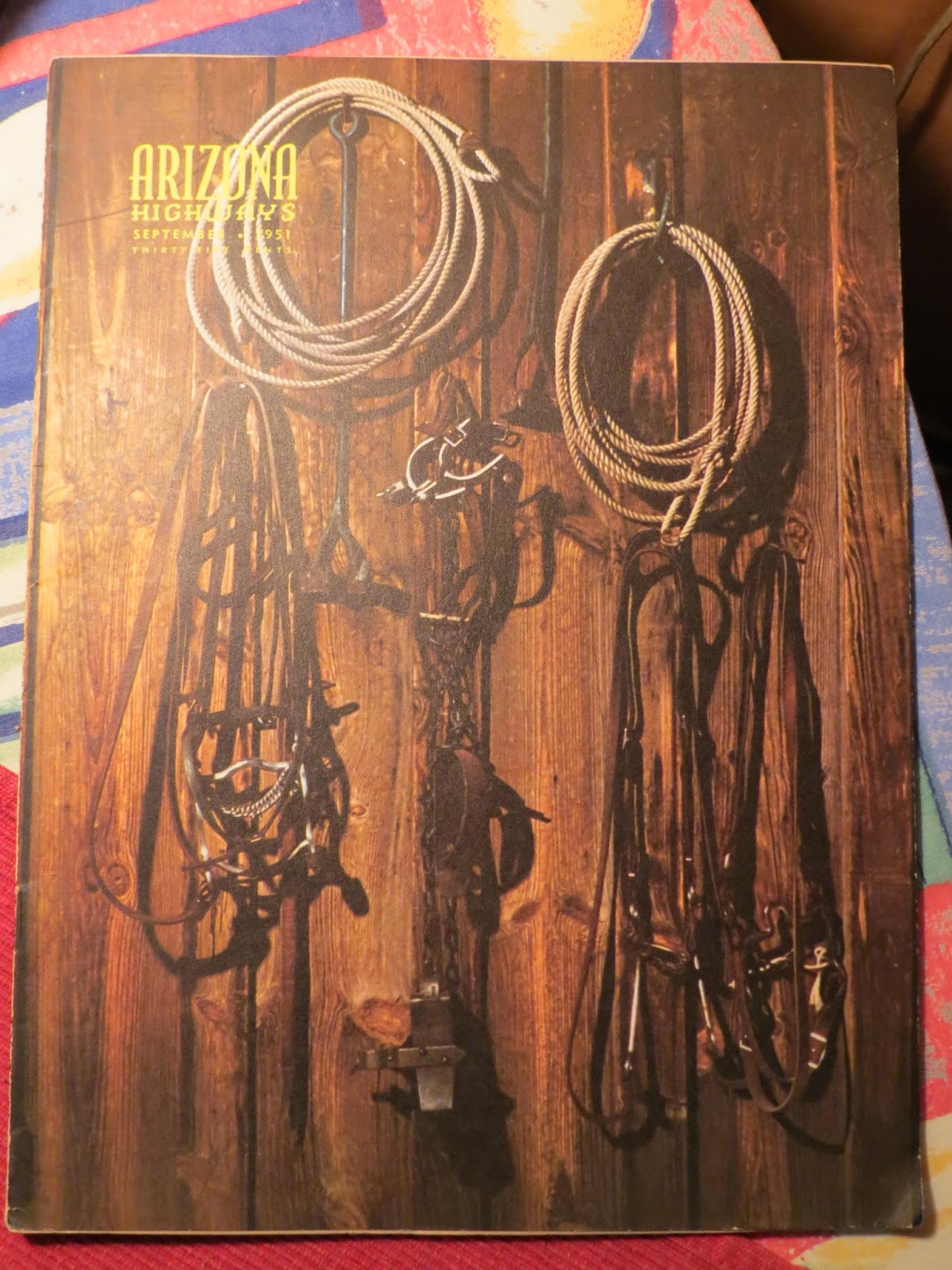
It was a magazine. 

About a year earlier, he had bought an old copy of Arizona Highways from September 1951, the month of his birth, in near-mint condition, with the entire issue devoted to cattle ranching and cowboys. Cris didn’t find much in the issue that spoke directly to him, but there was one feature he knew would speak to me, and so he had been carrying the magazine around in his car for months, waiting for our paths to cross. Never mind that we live only about 7 miles from one another – all of us tend to become very busy with our own lives, especially when we have businesses to run.


Cris encouraged me to open the magazine and look for the reason he was giving it to me. “Keep going,” he said – and there it was! “My little cow town!”


I’m sure the residents of Willcox would be taken aback to hear their town called “little” and particularly to have someone who spent only three months there – and not even in Willcox but out in the ghost town beyond the playa – using a possessive pronoun in connection with it. I wrote down “Red Rock West” and the name Nicholas Cage on a bar napkin for Cris so he wouldn’t forget to look for a film I love because of its Cochise County setting, and Cris urged us to stop overnight in Mesilla on our way West this winter. Because – yes – after three years of wondering if I would ever see the ghost town again, we will be returning to Dos Cabezas. 

There will be bittersweet moments, I know. For one thing, we will not have the happy thoughts of Jim and Linda over in Patagonia, an easy day trip away. But we will once again have cows in the yard and coyotes yipping and howling and singing in the mountains at night (as they do here at home in the woods and fields of northern Michigan). We will have Arizona’s winter birds and the dry mountain air that lets me breathe so easily. We will have yellow legal pads (I have already bought a pack) for our winter’s writing, along with David’s paints and canvases and my sketchbooks and pencils. And we will have, besides memories of our first sojourn on the frontera, time for new experiences to form new memories, attached to the former like a new layer of sediment on older solid rock.


When we finally got home on Saturday night, we were shocked to discover that it was already Sunday morning, 1:45 a.m. to be precise. In the old days, that would have been no reason for a party to end, but these days are different. We couldn’t remember the last time we had been out so late.

It was more than worth it. The memories, the old friends, the stories -- then wrapping up the evening with Cris at the Bird to bring it all back home again. Perfect.

And it was 2 a.m. before we went to bed! In the old days, that would have been nothing, but nowadays that spells a really big evening.

Thursday, September 7, 2017

When Does Summer End?


The official first day of autumn this year is September 22, making the 21st the last official day of summer, but for many families of schoolchildren and for those whose traditional minds can’t help seeing Memorial Day and Labor Day as summer’s bookends, the season ended last weekend For some others (I heard them muttering!) the end came earlier, with a couple of summer vacationers in late August shivering in their jackets and sweatshirts, feeling that fall had arrived in northern Michigan before they got here. Isn’t that always the way, though? Beginnings and endings of seasons are not like doors opening and closing all at once. Any two adjacent seasons interpenetrate and play tug-o’-war for a while before settling down to the new one.


For many years, David and I used to take off for the U.P. the Tuesday after Labor Day. (Once we fled north on Labor Day itself but only had to learn that lesson once, sitting for hours in a long line of unmoving traffic during the annual Mackinac Bridge walk.) Northport, however, is livelier these days than it was a dozen years ago: no one is rolling up the sidewalks yet, a week into September, though there are more strolling older couples now than young families in town. Two years ago we didn’t make our getaway until October, and it was short then. So yes, there have been changes over the years, some more gradual than others.


But this year has been entirely different in one very important way, and that has been David’s one-man exhibition at the Dennos Museum Center in Traverse City. A career milestone for him, it has been the focus of the season for both of us, and that’s why my bookstore, open on Labor Day itself until 3:30, was closed the Wednesday following Labor Day when old friends from Kalamazoo came up to see the show.


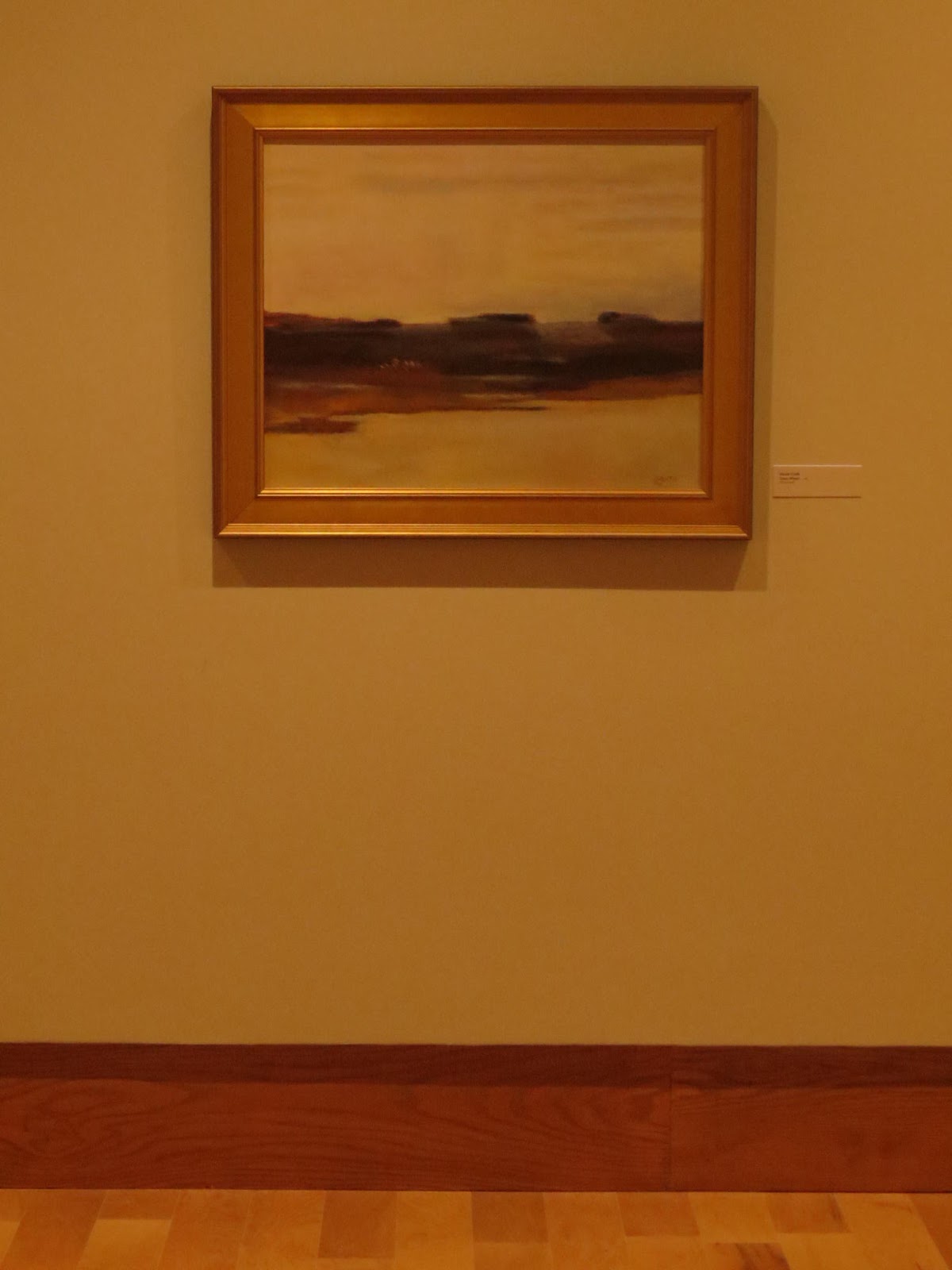
Since David and I were at the museum before our friends, I took the opportunity to photograph the artist with several of his paintings (below), photographing individual paintings, also, and several more inclusive groupings (above). 


When they arrived, of course my camera and I were eager to capture David and our friends surrounded by his work.


I guess it rained a bit while we were in the museum. I didn’t notice. We toured the sculpture of Sally Rogers and the Inuit gallery, as well as David’s painting exhibit, explained the new additions underway, and our friends were quite impressed by the museum in general.


Tearing ourselves away at last, we adjourned to downtown and, creatures of habit, suggested to our friends Cafe Amical, an iconic Traverse City restaurant for (I’m going to say) 23 years. Our table was back by the fireplace, and so, again, I didn’t notice any rain until we left the restaurant to stroll up and down a couple blocks of Front Street and saw that the pavement was gleaming wet. Anyway, the rain had let up, and we had dry walking, and coming back east on the other side of the street, we stopped in at the old U&I (an even older landmark than Amical) for one last round of drinks and then strolled together to the big new parking structure down by the Park Place.

(It occurs to me that I’ll probably be saying “the new parking structure” as long as I live, just as the Civic Center, or whatever it’s called, will always be, to me, “the old fairgrounds.”)

Old friends! Time together! David’s beautiful show! One more Kalamazoo friend comes up on Friday, and then Saturday will be the last day of the exhibit, and we will go in Sunday to pack up the paintings, and that will be the close of summer for us. But oh, what a summer it has been! One for the memory book!