Search This Blog

Showing posts with label gardening. Show all posts

Wednesday, June 10, 2026

And Then It Rained


(I am in love with pagoda dogwood!)


Reminder: This Thursday, June 11, at 4 p.m. at Dog Ears Books, author Robert Downes will give his presentation on Native American history prior to European exploration. This is a free event and one you can take in before your dinner hour!


Seasonal thoughts and projects

Reading one of Jean-Luc Bannalec’s murder mysteries the other evening at bedtime, I ran across a phrase—and here I have to paraphrase what would be a translation, anyway—about summer always arriving on a certain day. That is, there is a day when you feel, at last, Yes, this is summer. I felt that way last Friday. It wasn’t the first day I’d been able to have the bookshop door open, nor the first day warm enough to go about in sandals and without a jacket, but it felt different. Not just a temperate spring day, but summer. 

That being the case, my two “days off,” Sunday and Monday, were busy ones at home. Accomplishments included getting my lawn mower working again (it had gone on strike, and I was able to persuade it back to work again all by myself!), mowing grass, running out to a couple of nearby garden centers for more plants (both flowers and vegetables), getting all the new arrivals in soil (either in the ground or in planters), along with catching up on laundry, hanging the heavy items out on the line and later bringing them indoors to fold, wrapping up the day by watering everything, even though rain was in the forecast for after midnight.

The garden is coming together.

Did it rain overnight? If so, I slept through it. Morning was misty and calm, my world jungly green, only a sweet, slight breeze through the open window. No need to water on Tuesday, so, after her morning sortie, Sunny and I had a leisurely porch breakfast. Later in the day, it rained for sure. 

Poppy after rain

All three cuttings I took from my cranberrybush viburnum survived the winter well, one of them even flowering its very first solo season, which encourages me to try more of this manner of propagation. For 2026, the experiment I have in mind is pagoda dogwood, Cornus alternifolia, which I am delighted to discover blooming very close to my house as a volunteer, not far from the legion of volunteer black raspberries I depend on harvesting every summer for my signature ‘blackstraw’ jam, a combination of black raspberries and good local strawberries. Yum!

Dogwood again...

...and raspberry-to-be!


Again, reading

Besides the Bannalec mystery, I’ve been reading, a few pages at a time and in English translation, Rabelais's big work, Gargantua and Pantagruel, but don’t know if I’ll get through the whole fat paperback volume. It is entertaining, I admit, but entertaining in the way of “Saturday Night Live” rather than as a movie with a strong narrative from beginning to end. Lots of smart-aleck nicknames and jokes. Lots to do with controversies of the time of Rabelais and his opinions. A few pages at a time, I can do. The whole thing? In my mother’s deadly phrase, We’ll see!


Thoughts on “being an author”

An author is the originator of a written work. Some authors are writers by profession, while others are not. 

Being a professional writer, like being a professional musician or fine artist, involves long-term commitment, sometimes lifetime commitment. Other people come late in life to writing, often as a second (or even third) career in retirement. 

Not all professional writers are book authors; they may author (the word here functions as a verb) articles or short magazine stories. Some are journalists or columnists or grant writers. Also, not all authors of published books consider themselves—or even aspire to be—career writers.

I’ve been sorting through my thoughts on this because a couple of women visited my bookshop recently with a new book written by one of them. “I’m not really an author,” Jennifer Sager said, modestly introducing her book. “She keeps saying that!” her friend protested. After the three of us conversed for a while, and I took a careful look at the book they had brought in to show me, I said to Sager insistently, “You are the author of this book!” And she is, whether or not she ever writes another. 


Steph’s Story, published by a relatively new small press in Bloomington, Indiana, Filibuster Press, is a story Jennifer Sager felt “compelled” to write. Jennifer is a middle daughter who grew up with an older and a younger sister. The oldest, Stephanie, was born with Down syndrome. In telling of her sister’s life, the author of Steph’s Story also tells her own journey from sheltered childhood to dawning realization of handicaps faced by many different groups of people for various reasons. Because her parents did not heed doctors’ advice to put Stephanie in an institution (and “try again” for a “normal” child), Jennifer’s growing up introduced her to a range of other young people with disabilities, from those in wheelchairs to those with high-functioning autism. Only as she grew older and had experience outside her immediate neighborhood did she realize that poverty and skin color, like disability, could trigger discrimination. 

All of the author's factual information, history, and advocacy, however, is woven into a very personal, engaging story. I started reading on Monday evening and had soon eagerly devoured over 100 pages.

Three sisters! For me, as the oldest of a trio of sisters, that idea alone sparked my interest, but it was Jennifer’s love for Steph and her joy in their bond that is holding me page after page. Who wouldn’t enjoy this book? I’m sure the affirmative messages will be especially important for anyone with a child or grandchild who diverges from the “norm,” but I’m also sure that anyone at all interested in families—and who of us is not?—will enjoy reading Steph’s Story. 


From where I stand

Is this section a rant? Call it what you will.

Let me first note, briefly, that a request for evidence is not satisfied by insults, name-calling, or the sheer repetition of an unsupported claim. However loudly you may yell, however nasty you get with the person who asked for evidence, if yelling and name-calling and hurling insults is all you can do, that just tells me is that you have no evidence, no ground for your claim. (You know who and what I'm talking about here.) 

Day after day, it remains astonishing to me how many Americans are willing to accept not only patently false claims but outrageously bad public behavior from someone elected to serve our country. Serve, not harm, not injure, certainly not destroy. What are they, those sticking with him, getting from supporting loss of dignity and destruction of hope for others? Anything other than the satisfaction of seeing their opposition’s misery and frustration? 

Now, something else: Less than 1% of the American population identifies as transgender. One percent. Of this one percent, only 0.002% (ten out of 500,000) are college athletes. How and why did transgender people come to be such a huge political issue? 

Two words: smoke screen. 

Just say the word ’transgender,’ and certain groups of people completely freak out. They are filled with fear, their fear fuels their rage, and they forget everything else. Jobs are vanishing while wars are not, and the rich get richer and richer as the poor get poorer and sicker and more and more disenfranchised. 

Someone must be blamed for the woes that afflict us! Where do we look for a scapegoat? Let’s find a very small, vulnerable population and focus fear and anger on them!

I am so tired of that cruel strategy and sick of watching people fall for it!


On the other hand--a life well lived!

Leelanau Township lost a priceless citizen recently. At 99 years of age, however, Julia Brabanec was ready to go. “I don’t know why I’m still here,” she had confided to me in one of our visits in her last year. 

Julia's contributions to the northern Michigan food landscape were featured in Emita Brady Hill’s 2020 nonfiction book, Northern Harvest: Twenty Michigan Women in Food and Farming.  In fact, the first chapter in the book is “Julia Brabanec,” in the opening section, “Two Orchards and a CSA: Becoming Organic.”


Julia and her late husband John first came to Leelanau County on their honeymoon in 1948. Later they bought land here and on it developed an organic orchard. The Brabanecs lived simply, pumping water from their well and lighting their house with kerosene lamps until a home wind generator enabled them to electrify. They did almost everything themselves, too, so although they built the foundation for their new (second) home on the property in 1985, the house was finished only in 2005 with the help of their children. Julia and John were always too busy farming to build a house. One thousand, one hundred trees—apples and peaches—“mom & pop” doing it all, from planting to delivery.

If you haven’t read Northern Harvest yet, you really should, to learn the rest of Julia’s story, as well as that of other women in food and farming in Northern Michigan. 

My late husband always referred to John and Julia as “the Helen and Scott Nearing of Leelanau County.” John died 16 years ago, and I remember his funeral well. Julia wanted to go out more quietly, and she got her wish. 

It’s easy sometimes to say and think, as we witness the passing of the old guard, that the future will never again know such good people, and yet I see men and women in younger generations already coming up with solid values such as Julia and John lived by: love of the land; belief in organic methods; a strong work ethic; and dedication to the future. That last is what it all comes down to, isn’t it? Care for the future and all who live on the land, urban and rural. Respect for life and the dignity of all.

I am honored to have a beautiful portrait of Julia Brabanec, a photograph by author Emita Brady Hill, behind my bookstore desk, as I am honored to have known Julia Brabanec and to have counted her as a friend.

Julia Brabanec: A good life, well lived!


Sunday, October 12, 2025

Side Roads


Closeup in the blogosphere


Occasionally (not continually or compulsively) I look at the stats for this blog and learn how many people for a given period—24 hours, 30 days, all time—have looked at the blog and also how many looked at specific posts. The latter numbers always interest me, showing me where something I might have written years ago has suddenly found new life for a handful of readers. I always wondered why an old post reappears that way in a particular day’s stats. Why, for example, did three people on Thursday morning look at from my old 2018 post on writer Thomas Mann? I was curious enough to give it another look myself to see what I’d said about that German writer seven years ago.


Our “intrepid Ulysses reading circle” had decided to read The Magic Mountain after realizing that we had read classics from France, Italy, Spain, Russia, and Japan, as well as from the U.S. and England, but had read nothing from the German tradition. I even admitted to the group that I had avoided German literature and felt I needed to get over my prejudice. I tried The Glass Bead Game, by Herman Hesse, but thought it would unduly tax the patience of group members (it’s a very strange “story,” if it can even be called a story), and so, somehow, we landed on The Magic Mountain, and I wrote about it for Books in Northport.


By early Friday morning, when I looked again (my curiosity now augmented by having begun a post on the subject), I saw that over 30 people had chosen to view a 13-year-old post about art, old books, and ephemera. Why? Was there something in the labels that attracted them? Heaven knows. I don’t.


Oh-So-Ordinary!


My reactivated appreciation for flowering annuals steadily increases. For years, I looked down on them, wanting only perennials (more expensive), but one genus and species at a time the annuals have crept back into my heart. 


Lobelia may have been the first to return. That intense blue! And the way it keeps blooming throughout the season, while perennials come into bloom once and all too soon finish up for the year. Three or four years ago I discovered bacopa and have bought plants every summer since. Like lobelia (and they go together beautifully), it continues from time of purchase until frost, blossoming and fading and blossoming, again and again and again. I like bacopa with begonias, too, tender begonias that make such a splash all summer long. It’s October now, and they are still going strong. 


The really ordinary annuals, of course, are the ones you can easily and successfully plant from seed, such as marigolds or snapdragons. Snaps often volunteer (from the previous year’s seeds?) or—believe it or not, this happened with one clay pot I left on the porch last year—occasionally go dormant and revive in the spring, without benefit of warmth or watering while they chill! I wouldn’t count on it, but it's happened in my life. 


And as for marigolds? How could I ever have thought marigolds weren’t special enough to be part of my life? Outdoors and indoors, they continue to brighten into the fall. They also remind me of “The Best Exotic Marigold Hotel,” an enchanting movie, and the wonderful, long novel by Vikram Seth, A Suitable Boy. Here is a strange thing, though, in that link to the movie. The site omits on its list of “stars” (you can find him by digging deeper) Dev Patel, who was, in my mind, the heart and soul of the film! 


Does old-fashioned mean outdated?


A recent article in the Wall Street Journal was headlined “Young People Are Falling in Love With CDs and Digital Cameras.” The young woman introduced at the beginning of the piece also uses paper maps and “calls the local cab company when she needs a ride.” (I want to cheer for maps and cabs!) A certain segment of teens and twenty-somethings, we are told, has had it with screens and “are resurrecting digital cameras, flip phones and CDs.” Maybe, too, they want to have their own music and photographs safely in their possession and not off in a “cloud,” which, my son informed me long ago, is nothing but “someone else’s much bigger computer” (which also requires ENORMOUS energy inputs and maintenance!).


My digital camera's storage card,
compared to size of postage stamps


I shared the article with a bookseller colleague, commenting to him, “They forgot books,” because I have noticed in the past few years that more and more young people, who have grown up with electronic devices and see them as completely ordinary and unexciting, albeit useful, are thrilled to get their hands on a book printed, bound, and published in the 1800s. They hold such a book carefully and turn its pages with something like reverence. Again, and even more so than with keeping digital images in digital files, these objects are something you can take home and possess securely. They aren’t going to disappear, as items from a digital library can do, and when the power goes out, you can read a book by kerosene lamp, as I have done. 


My colleague agreed with me about books and added that the WSJ article had also forgotten to mention typewriters. He, Paul Stebleton of Landmark Books in Traverse City, has made a sideline specialty of manual typewriters. While I don’t use one these days (there are one or two in my house), I remember my first one fondly. When a key stuck, I could turn the old black machine upside-down and fix it myself. I could and did change the ribbon myself. Maintaining that typewriter gave me a kind of independence that few of us have when our electronic devices malfunction.


***


Blogging, gardening, legacy media (!) – where can I go next? How about specific books? The last one I finished was E.B. White On Dogs, edited by his granddaughter, Martha White. Long a staff writer at the New Yorker, White is probably most widely known for his children’s books, Charlotte’s Web and Stuart Little, and for The Elements of Style, but Here Is New York also remains a classic. On Dogs (how could I resist?) includes some of the author’s short New Yorker pieces, a couple or so longer essays, and quite a few personal letters. Often the letters have only a brief passage about dogs, but I was glad to have the entire letter each time and to read about the author’s homey country life, with pigs and chickens and other animals, in addition to dogs. 


Martha White writes in “A Note to the Reader,” following her introduction, 


…The letters … are more casual in style, and my Tilbury House editor was surprised to find that the co-author of The Elements of Style did not always get his that and which correct, especially in the early years. Our hands-off policy [not correcting the writer’s grammar] nearly killed her.


Which goes to show that all of us have things to learn as we go through life!


And there! I have kept things light today, for a change. Feel free to breathe a sigh of relief and thank me, but do not mistake this lightness as a promised change of direction for future posts.


Daisy and Sunny take a break.


Thursday, June 19, 2025

Not Yet the Solstice, But—the Race Is On!


Reminder First, Right Up Front


Next Tuesday, June 24, at 4 p.m., Dog Ears Books in Northport will host a poetry reading featuring Jennifer Clark from Kalamazoo. Jennifer will read from her new book, Intercede: Saints for Concerning Occasions, and visit with audience members following her reading. She is the author of three previous poetry collections, author of a children’s book, and co-editor of the anthology, Immigration & Justice for Our Neighbors. She is so much fun that this is her third appearance at Dog Ears Books, so do yourself a favor and don't miss her!


Poet Jennifer Clark

Racing Season


Not a season of races, that is, but a season racing by, as summer always does. (Yes, even before it officially arrives!) Overnight, it seems, the rivers of gold that were the blooming cowslips (marsh marigolds) turn to wet-footed, narrow meadows of lacquer-yellow buttercups; sweeping white hills of woodland trillium fade and disappear; the tree canopy grows dense; and yellow-eyed white daisies (the happy days’ eyes) dance along roadsides in sun or in rain. Forget-me-nots have gone to seed for another year, and so has the first round of dandelion blossoms, but cheery little English daisies enliven otherwise monochrome green lawns, and now—coreopsis already!!!


Coreopsis here before the longest day!

Gardening


My fall bulb catalogs arrived in May, and I am determined to order early this year, because if I wait too long I will forget again … or decide not to bother … even knowing what pure delight those flowers that bloom in the spring (“tra-la!”) will give.


Meanwhile, there is always “just one more” trip to a garden center or nursery, “just one more” plant that my garden must have! Oh, yes, borage! 


Magical borage --


Books


Did you ever read this one?

Do you remember some of your favorite books from grade school? One of mine was Oliver Butterworth’s The Enormous Egg. I was reminded of that favorite story when a little boy visited my bookshop wearing a striped t-shirt with a line of Triceratops dinosaurs marching along every other stripe. In the book, young Nate Twitchell is almost as faithful as the family hen in taking care of the unusually large, leathery egg in hopes it will hatch—and it does! But the little dinosaur does not stay little for long. 


I didn’t remember the ending, so I had to order and reread the whole book. Thus I traveled with Nate and Dr. Ziemer and Uncle Beazley (the triceratops) from New Hampshire to Washington, D.C., and then right into the halls of Congress, where a United States senator proposed legislation that would outlaw Uncle B. and have him killed and stuffed! Given the expense of housing a dinosaur over the course of its lifetime, there is support in the Senate for the bill. Uh-oh! What hope does young Nate have of saving his rapidly growing pal? Wonderful story!


A much older book that went home with me for bedtime reading was a falling-apart copy of Rudyard Kipling’s Second Jungle Book, in which we meet again Mowgli and his animal friends. 


There are also other stories in the book, including one that takes place in the high Arctic, but Mowgli and friends are the center. As captivating as the stories, once I stopped to look at them more closely, are illustrations by the author’s father, John Lockwood Kipling, the smallest seeming at first glance only decorative. But no! Each one clearly depicts something in that particular story.


John Lockwood Kipling deserves a new paragraph. Although his career was overshadowed by that of his famous son, Lockwood was an astonishingly accomplished polymathic artist in his own right, producing drawings, furniture, sculpture, pottery, and more. During his 25 years in India, as teacher and later museum curator in Lahore, he was also active in a revival of traditional Indian arts and crafts.


And let me say right here that wonderful as much of Walt Disney’s work was (and his "Jungle Book" film was the last for Walt), Disney’s Mowgli is not Kipling’s Mowgli, and people need to read the books to learn the Law of the Jungle as the man-cub learned it. 


Alongside these deep and deeper dives into the past, I read also a novel published only two years ago, inspired because the author came to Northport. Mary Kay Zuravleff gave a reading and presentation following the business portion of the annual meeting of the Friends of Leelanau Township Library (FOLTL) on Saturday, June 14. When she and local author Karen Mulvahill stopped by the bookstore ahead of her FOLTL appearance, they took a couple extra books from my stock, in case they ran short. And they would have! Note: I am ordering more and will be restocked by this Friday.


The title of Zuravleff’s novek, American Ending, comes from the fictional narrator’s mother, a Russian immigrant. When telling her children bedtime stories, she would ask, “Russian ending or American ending?” In the Russian ending of a fairy tale, the wolf eats the bride who wanted a ride on his back to her wedding, while the American ending has the groom slicing open the wolf’s belly and the bride leaping out unharmed.  But even as a child Yeleni doesn’t fully trust American endings, suspecting that good luck isn’t necessarily permanent and that life can take sorrowful turns. 


The setting is a coal-mining town in Pennsylvania, and the story opens in 1908. It is a complicated family saga, with a large cast of characters, but American-born Yeleni’s voice, steadily throughout the book, keeps us oriented. This is a world where girls are married as early as 13 years old to grooms chosen by their parents, young boys taken from school and sentenced to dangerous lives underground, and adults too often seek solace from poverty’s troubles in alcohol. Yet, for all that, it is also a life of tradition and memory and feasting and celebration. When Yeleni’s mother invites the schoolteacher to Thanksgiving dinner, the whole neighborhood contributes.


It was a miracle the way people pitched in when they weren’t even invited, and not with a shriveled turnip or the stringy end of a roast either. Here came a sturgeon turnover to fatten up the schoolteacher, poppyseed bubliks for the single men, cherries in a jar if Lethia wanted to bake pie. Lethia collected candle stubs at church and polished the table with beeswax and beef tallow, another miracle. Robert and Pa captured two wild turkeys. Really, Kostia did. The birds were always in the meadow nipping at him, and Kostia led them into a trap….


-      Mary Kay Zuravleff, American Ending


Despite being a story set in the America of over a century ago, the novel is also very much a story of today. Late in the novel, when Yeleni urges her husband to apply for U.S. citizenship, he answers, 


“I’ll need a witness willing to swear I’m not a phut.”


“English, please,” I said, “or they’ll send you back on the next boat, crook or not.” 


It was one of my fears, though Erie Russians scoffed at the idea of anyone being sent back. Who would make the town’s streetcars, engines, or boilers; their boots and buttons; their paint, paper, or pickles? Who would slaughter the meat or tan the leather if Russians were sent back?


Sound familiar? Since summer is my heaviest work season, both at home and in my bookshop, reading time is at a premium, but I still manage to squeeze it in. (Not having TV helps!) American Ending is Mary Kay Zuravleff’s fourth novel and the first of her work I have read, but it certainly will not be the last.


And then one night I turn to an old favorite, Harlan Hubbard’s Payne Hollow: Life on the Fringe of Society, a sequel to Shantyboat, the story of Harlan and Anna’s river adventure years. 


I love Harlan's sketches in the book


Returning at last to the Ohio River as to an old friend, the Hubbards settled down and built a house on the river bank (shades of Rat and Mole), put in a garden, raised goats, and continued their evening practice of reading aloud to each other and playing duets. Their “bijou riverside residence” (as the Mole called Rat’s hole in the bank) was larger than their old shantyboat but, like it, lit by fireplace and oil lamps and complete with cunning cupboards for the storage of food and a bed that slid away out of sight when morning came. Harlan and Anna kept to old, simple ways. 


…So many times have the advantages of a garden tractor or tiller been pointed ot to me that I half believe the argument myself…. My strength returns when I am alone in the garden, working with some beloved tool, the birds whistling overhead. Even on a sultry July morning, when not a breath of air stirs, when the sun’s heat is magnified by the encircling trees, and weeds are sprouting everywhere, not even then could I welcome one of those nondescript, unlovable gadgets, brightly painted and streamlined, which make an intolerable noise and smell bad. They get the work done, you say? I say they are expensive and insidiously destructive. I will get the work done in my own way. Save time? The best use of time is to enjoy it, as I do when working in peaceful silence. 


-      Harlan Hubbard, Payne Hollow


Oh, that is exactly how I feel about working outdoors! No string trimmers or leaf blowers for me, please!


How economically he captures chickadee and woodpecker!


Agility work


Sunny Juliet and I had our first session of the year with Coach Mike, who is very enthusiastic and encouraging and genuinely loves the sport and all his doggie pupils. He is an excellent teacher!


Agility work is as challenging—maybe even more so—for the human member of the team as it is for the dog. The sport was inspired by equestrian show jumping, and more and more I realize the strong parallels between work with horses (which I must admit, sadly, I know about almost exclusively from reading) and work with dogs. We humans are a talky species, and we are usually so busy talking and listening to each other and thinking about what we want to say next that we lack awareness of what our bodies are telling us and telling others. 


Anyone knows that riders “tell horses what to do” by applying reins and knee pressure, but horses also respond to much more subtle signals, whether or not the rider intends the signaling. How one sits and every little shift of the seat is information to the horse. A well-trained dog responds to voice commands, but any dog is also, and much more continually, paying attention to physical cues. 


In our agility work Sunny is aware of every little move or gesture I make, intentional or inadvertent, although I am not physically in contact with her. If I shift my shoulders slightly or vary the height of my hand from the ground or speed up or slow down or merely glance off to the side—all that is telling her something, which means that I too have to be aware of my body in order to give her the proper signals. 


And have you ever thought about the difference in peripheral vision between humans and canines? (Don’t feel bad. I never had.) We see about 180 degrees, or half of the circle of which we are the center, but dogs’ eyes are spaced more widely apart than ours, so their peripheral vision is much wider, 250 to 270 degrees (depending, I guess, on the shape of a particular dog’s head, which would vary from one breed to another), which means Sunny is still seeing me after she runs past, so if I stop and turn around, she thinks she needs to do that, too! 


It’s a lot to think about. It’s also impossible, as you can imagine, for me to get video or even still footage in the middle of our demanding work!


But now—oh, dear! Sunny has developed a limp that seems to come and go, as if maybe she pulled a muscle or something (it started with that porcupine chase), so for now my girl needs to rest from strenuous activity. She’s to be on-leash for a week, with aspirin or Tylenol twice a day, the vet says. Poor Sunshine! She thinks “taking it easy” is a great big bore!


Tenting Tonight


My birth family went on our first camping trip when I was 12 years old, five of us sleeping in a borrowed tent, a heavy canvas umbrella tent. It rained all week. And we all wanted to do it again! 


Jack and his crew

Now grandson Jack from St. Paul, Minnesota, a newly graduated art student from Kalamazoo College, is here this week, rain and/or shine, with his ten senior-year classmate/housemates, the whole crew camping in the yard and eagerly exploring Leelanau. (I know the kids would love to play Frisbee with Sunny, and ordinarily I’d have been all for it, but not right now, as she needs to rest her jumping muscles. If only she would rest her barking muscles, too!) What a happy scene the tents and hammocks and everything else make in our usually empty yard! At last it felt as if there had been a point to all that grass mowing! 


Fog rolled in, but the campers are happy.

While all of the young people are delightful, naturally grandson Jack is very special to me. When I look at a closeup of Jackson examining a camera I found for him, I see his grandfather, alive and young again.


Thursday, May 30, 2024

Bedtime Books

Iris time


May and June are when those of us who make our living chiefly thanks to summer tourism are gearing up for July and August, and at the same time we are busy at home – outdoors, that is – mowing grass and putting in and tending gardens, because this is the time it must be done. I can put off painting a hallway but cannot put off planting my summer garden.


Not looking like much so far,

but I hope there will be a lot to see a month from now.


So for me right now it’s gardening and errands in the morning, bookstore during the day, more gardening and mowing grass in the evening, dog work and play morning and evening – and who has time (or inclination) for housework? Come the end of the day, it's time to collapse into bed with a book. 


Morning: between errands


During the day in my bookstore, between customers, I’ve been reading a couple of very unsettling books. One by Naomi Klein, The Shock Doctrine: The Rise of Disaster Capitalism, contains much that I knew in vague outline but with nightmare details and repetitions and seemingly endless repercussions throughout the world, all so infuriating that I can only read a few pages at a time before I need to set the book aside to protect my blood pressure. The other is Diane Foley’s story, told by Colum McCann and titled American Mother. Seven years after her journalist son, Jim Foley, was kidnapped, held, tortured, and finally beheaded by ISIS, his mother had an opportunity to meet with and have conversations with one of the men convicted of Jim’s murder. (Reading The Shock Doctrine has influenced the way I read or hear any world news, and it had affects how I’m reading American Mother, too.) Both Klein’s and Foley/McCann’s are important books for anyone who cares what the U.S. does in the name of American citizens; I don’t think I need to explain, though, why I do not consider them “bedtime books” and why I wouldn’t want to read either of them right before falling asleep.


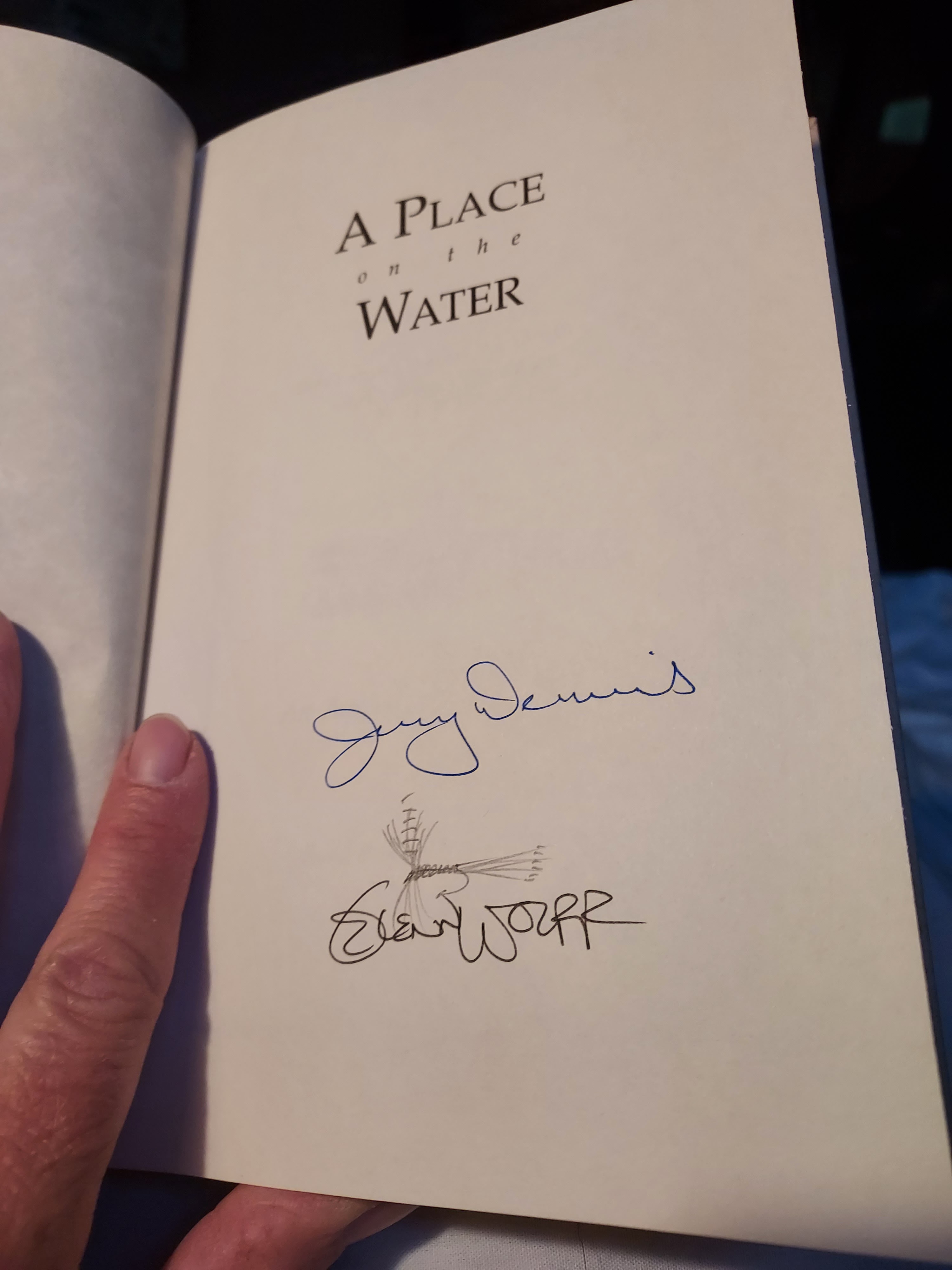
So last night I opened A Place on the Water: An Angler’s Reflections on Home, by Jerry Dennis, a copy signed by both Dennis and his illustrator, the wonderful Glenn Wolff, a copy I had given the Artist (a.k.a. the River Rat) for Christmas in 1993. Do not trust Publisher’s Weekly when they say that “home” for Jerry Dennis is the Upper Peninsula. It is not. Dennis grew up in the greater Traverse City region. Take Macmillan’s word for it, however, that this book published under their St. Martin’s Press imprint is “a passionate and eloquent exploration" of the natural world. It had been years since I’d read it, but the first page satisfied me that I had chosen the perfect bedtime book after a long evening of mowing and dog play.


"Can we go outside again? It isn't dark yet!"


This morning, reflecting with satisfaction on my reading of the night before, I thought about different categories of what I consider bedtime books. There are light or genre fiction novels (genre conventions can be soothing, even with dead bodies, as long as the story doesn’t get too graphic); books of serious literature so familiar to the reader that they can be opened anywhere and re-read over and over (Jane Austen; James Joyce's Ulysses; Thoreau; Proust); memoirs and travel books (other people’s lives and explorations); and, for me, essays, that last group often overlapping with the second, as with A Place on the Water.


How do you feel about essays, or are you put off by the name of the category? If you haven’t fallen in love with them already, try a few. Here are a few wholehearted recommendations from yours truly: 


High Tide in Tucson, by Barbara Kingsolver (Arizona)

Mountain Time: A Field Guide to Astonishment, by Renata Golden (Arizona)

Anything by Adam Gopnik (New York; Paris)

Anything by Kathleen Stocking (Michigan and beyond)

Anything by Jerry Dennis (Michigan)

Anything by Fleda Brown (Michigan)

Flesh and Stones: Field Notes from a Finite World and Slow Learner: Essays, by Jan Shoemaker (Michigan)


That’s only a starter. Maybe some of you have suggestions?


Roadside splash of color