Search This Blog

Showing posts with label botany. Show all posts

Thursday, December 9, 2021

Yes, We Have No Saguaro


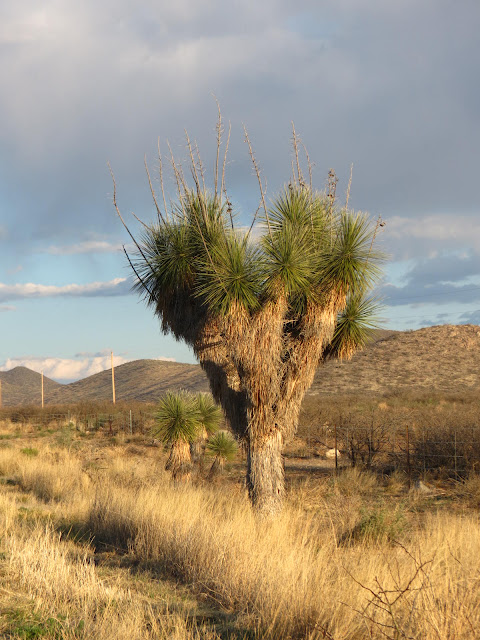
Soaptree yucca

My title today may give a chuckle to the few who remember the old song about bananas. I did not see the original cartoon when it came out in 1930 (not that long in the tooth!), but it replayed on 1950s television and was still amusing then. All of which has nothing to do with plants of the high desert, my topic of the day -- .

Prickly pear

cholla 


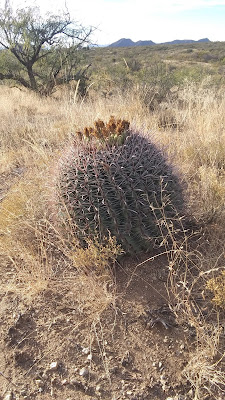
A friend back in northern Michigan asked about plants here in the high desert, speculating that we “don’t have cactus” here. Well, we have a lot of cholla (though not the full range of varieties), and there is prickly pear, too, more often on higher slopes than down on the range, and also here and there a squat barrel cactus, though these last are not as plentiful here as they are in the low desert. Along our Cochise County roadsides, soaptree yucca is ubiquitous, and down the road apiece from our ghost town are rocky foothills stuck all over like giant pincushions with sotol and century plant (the latter a kind of agave), as well as the striking ocotillo (more common around Benson and Bisbee than here in Dos Cabezas). During our first winter here, it took me a while to sort out yucca, agave, and sotol. But yes, we have no saguaro. That, along with "teddy bear" cholla, grows down in the lower elevation of Tucson, 100 miles away.


The life cycle of the century plant is interesting, though. It doesn’t really take 100 years to come into bloom (for the one and only time in its life), but it is a long wait. Meanwhile, however, the plant grows larger and larger, making a nice focal point for desert landscaping. 
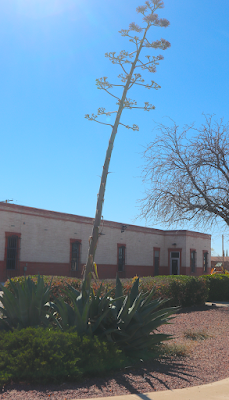


When it reaches maturity, it sends up an immense, asparagus-like stalk (this plant and asparagus are in the same family), and after flowering the plant dies. 
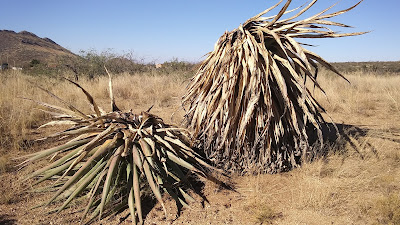

Where did the stalks go?


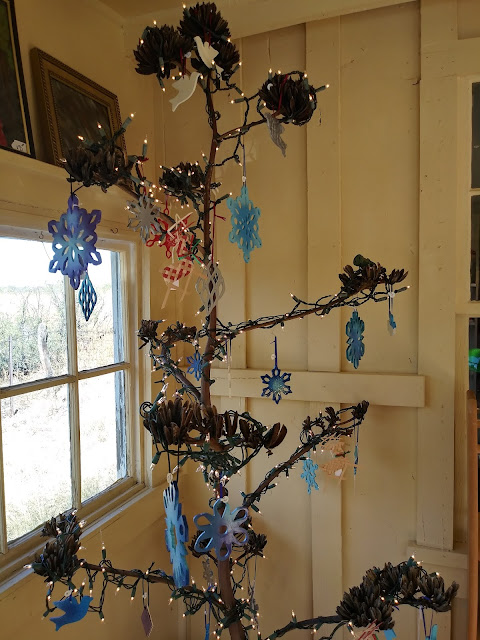
But that is not the end. From the plant's seeds will come a new generation, while the impressive, sculptural dry stalk is favored by desert dwellers for a Christmas “tree.”


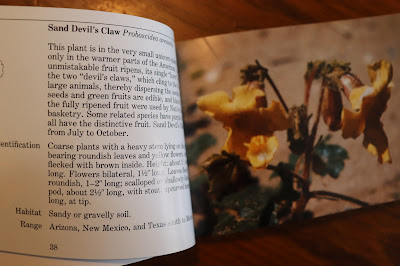
Also, along with cactus and other plants with spines, are many thorny deciduous plants, primarily (around Dos Cabezas) but not limited to the mesquites. One that looks a lot like a mesquite is in the same family (leguminacae, though some botanists break the family down further into subfamilies) but is a different genus. Mesquite genus is Prosopis, catclaw is Acacia. Even that can be confusing, however, as catclaw acacia or Gregg’s acacia, formerly Acacia greggii, now classified as Senegalia greggii, sometimes goes by the common name devilsclaw, but more often “devil’s claw” refers to a different plant altogether, Proboscidea arenaria, from (I kid you not) the unicorn-plant family! 


Chain of devil's claw (unicorn-plant family) pods

book showing flowers of that devil's claw


And this, as my friend Ellen would remind you, is why the Latin names of plants are so crucial to identification: What your grandmother in Ohio knew and taught you as “devil’s paintbrush” is not the “devil’s paintbrush” of the American Southwest. What I’ll remind you is that this is a reason for not relying on one plant guide but having access to several.
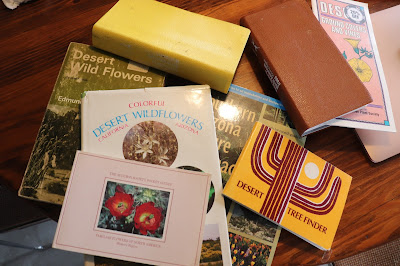

some of my printed resources

Back to those thorny shrubs --


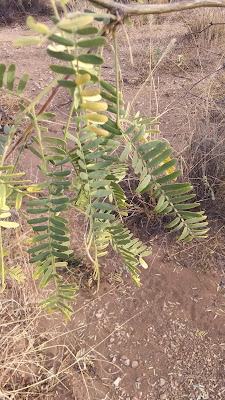
mesquite leaves

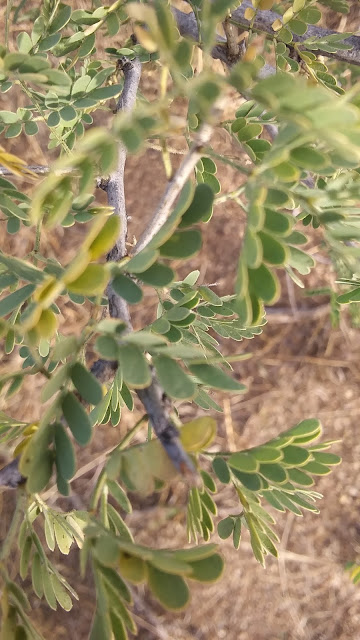
catclaw acacia leaves


And back to identifying catclaw acacia. Its bipinnately compound leaves are much smaller than the leaves of mesquite, and its thorns are curved like a cat’s claws. Hence the name. Once you note the difference between the two shrubs, it’s obvious, even when they are growing all tangled up in each other, as they sometimes do. I found some catclaw pods the other day, too. They curve and twist, and while The Audubon Society Field Guide to North American Plants, Western Region, authored by Elbert L. Little, calls them brown, the ones I gathered the other day are more reddish to my eye.
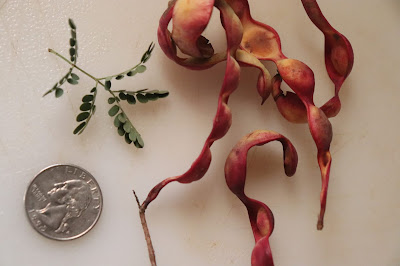

catclaw pods


Mr. Little is no fan of catclaw; nor are many hikers or others: “one of the most despised southwestern shrubs,” the Little-authored Audubon guide says of it. And yet, besides the region’s delicious catclaw honey and the plant’s useful hardwood (for fuel and tool-making), catclaw beans are a native food, ground when dry to make pinole, which now seems to be making a comeback as foodies rediscover ancient local foods. Interesting that another common name for catclaw acacia is wait-a-minute bush. Your shirt gets caught on a thorn, and you have to stop to free yourself. Get it? 


Whether thorns grab your clothes or you have, as I do, the perfect thorn-shedding jacket, it’s always worth stopping to look more closely at what the high desert has to offer. Coyote gourds are not considered edible (except by wildlife) but were used by Native Americans to make soap.
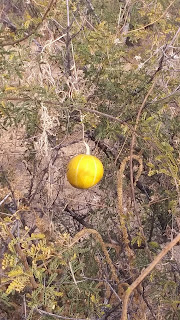


And here in December, when the morning sun comes through mesquite draped with dry vines of the summer’s vanished morning glories, don’t they look like strings of Christmas lights? Look at them with your imagination turned on.


Postscript 12/11/21: A friend's comment about this post being "comprehensive" made me think of all that I had left out -- and I'm not going to try to put everything here, but it seemed wrong to have left out the netleaf hackberry trees, so numerous in the wash and still holding onto their green leaves this December. Though when we first met (one January in maybe 2015?), I was not terribly impressed, I have since then become very fond of this species. Like a U.P. Finn, it has sisu


Saturday, March 28, 2015

Blooming, Blossoming, and Generally Bursting with Life


The sky after sunset on Friday was the color of globemallow. Littleleaf globemallow is blooming now near the cabin. One of its common names is “sore-eye poppies,” which is a clear warning and evidently the reason the Mexicans in baja California call globemallows “plantas muy malas” (very bad plants). The color, however, is welcome after the brown and grey of winter, relieved only by the perennial bright green of creasote bush.


Also blooming in Dos Cabezas now are primroses, their happy faces brightening mornings and evenings. 


The second plant above, showing a spent blossom, I believe is the stemless primrose.

Also, down along the dry wash can be seen the bright magenta of Mexican vervain, and mixed in with grasses above the wash are the tiny but vivid blue flowers of desert hyacinth and blue toadflax.


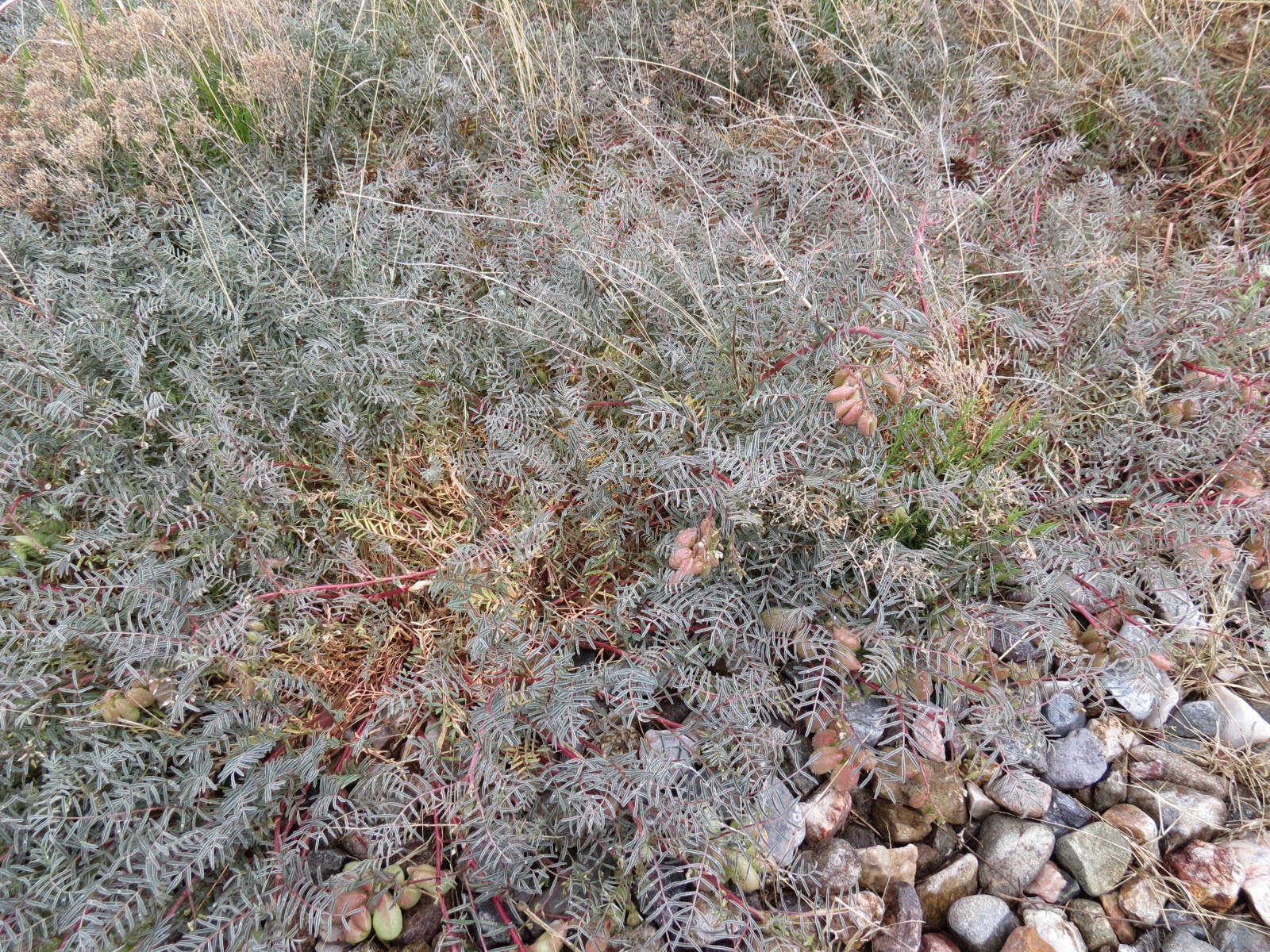
I was somewhat dismayed to learn that in addition to plantas muy malas, another represented near the cabin is locoweed, which sounds muy mala to me. Before knowing what they were, I had found the clumps of astralagus muy bonitas, with their dark green, pinnately compound leaves against the winter dust and gravel and their purple, pea-like blossoms that remind me of cow-vetch back in Michigan. Now the seed pods, green and not completely “ripe,” crack underfoot when stepped on. One book says of one variety that it is “highly toxic to sheep,” another book of another variety, “dangerous ... to livestock.” Una planta muy mala, no?


Then there is corydalis, lots of corydalis, bright yellow, the first flower I saw here in Dos Cabezas. Wouldn’t you know it “contains poisonous alkaloid”? Made me almost afraid to look up the little pea-like blooms called Green’s lotus and wiry lotus, but the books I consulted didn’t say anything terrible about those yellow and yellow-orange flowers. Anyway, for what it’s worth, the cattle seem educated enough in the ways of their territory to avoid poisonous plants, for the most part, just as Sarah learned almost instantly to avoid cacti, thorny bushes, and barbed wire.


And here are flowering plants that remain a mystery to me. I include them here in case anyone can identify them for me.


While David has told me repeatedly that a “smart” phone would yield the identification instantly, I was encouraged in my old camera-and-books method by a recent article in the New York Review of Books, citing a study showing that instantaneous answers do not generally constitute long-term learning. Being able to identify an increasing number of plants on my own as we drive or walk along is very satisfying to me; other people might not want those names “cluttering up” their mental landscape. As with so many issues in life, it comes down to a question of values.

This past week we made an overnight trip, down to Patagonia (to see friends) and Nogales. On the way back north the next day, however, we left the highway to explore a road along another dry riverbed, where trees were exploding into green and the bright flowers of poppies and one of what botanist-author Janice Emily Bowers calls DYCs (“damn yellow composites,” because there are so many of them to distinguish among) formed rivers of bloom that made up for the lack of water.


Encouraged by the loveliness we’d found, a bit further along the highway we popped for the $10 day use fee to get into Patagonia Lake State Park and luxuriated for an hour or two in the presence of real water! The lake, of course, would be a trickling creek were it not for Man the Engineer. Does that surprise anyone? But how calming, how soothing to the spirit is water! Perhaps our spirits are as great a percentage of body as our bodies are of water?


And here is my mystery flower from Patagonia Lake --


We were very happy to spend time with old friends, and the charm of shady, tree-lined Patagonia was not lost on a couple of Midwesterners. In fact, I think David fell head over heels in love with the place, as do many people from Michigan. And I see it. I get it. Yet on our way home, when I caught my first glimpse of the playa, I couldn’t help a big smile and sigh. The playa! I was happy to shop for dinner at KT’s Market. The sight of the twin peaks of Dos Cabezas said “home” to me, and out among the mesquite with Sarah, before dark had fully enveloped the land, I was happy to see again the happy yellow primroses that had been blooming when we left only thirty-six hours before.

Then in the morning, the quiet of the ghost town, with only the occasional car or truck-and-horse-trailer passing on the highway, headed for Chiricahua, felt familiar, reassuring, and peaceful. Yes, I have bonded to my little ghost town winter hide-out.


Saturday, March 14, 2015

Dr. Seuss and Other Desert Lilies


Agave (left) & sotol
When we first arrived here, the plant life had me completely bewildered. There was almost nothing in the Southwest that I could recognize from my life in the Midwest. About the only thing I could look at and name was prickly pear cactus, but no, that’s not a lily. The lilies I’m talking about are plants consisting basically of big rosettes of leaves on the ground -- some then rising up like trees, others not; some with flower stalks, some without; some with fleshier leaves than others – all plants we sped by along the highway while I tried to make rudimentary sketches to aid memory until I could get my hands on a book.

Now, two months later, their differences seem so obvious that it’s hard to remember how clueless I was at first. What I thought were four different plants are in fact only three, and they no longer confuse me at all.

Soaptree yucca

Yucca with last year's flower stalk
Soaptree yucca is very common in the area around Dos Cabezas. It’s the one I thought was at least a couple of different plants, because the young ones are just ground height, older ones more like trees, and some that are tree-height also branch. Soaptree yucca is the one I call the Dr. Seuss plant. Doesn’t it look like one of his drawings? Like tumbleweed, like roadrunners – both frantically animated in a herky-jerky cartoon manner – soaptree yucca strikes me as very droll. Seeing it always makes me smile, and so I’m usually smiling as we roll along, because soaptree yucca is ubiquitous in Cochise County.


Yucca branched like a tree
Agave
Less common near us, but even showier, and considerably slower to grow to its climactic flowering stage, is the century plant. My friend Helen had one outside her living room in Carefree. Friend Clare over outside Benson used a dry flower stalk for a spectacular Christmas tree. Century plant is agave, grown commercially in Mexico for the production of tequila. There are a few young plants near the cabin, but will they even flower in my lifetime? It doesn’t really take a complete century (just as a centipede doesn’t really have a hundred legs), but it’s a long wait for the blossoms. Even after the flower stalk begins to emerge, years into the plant’s lifetime, it takes weeks and weeks. (Right, Helen?) And then, after it flowers and scatters its seeds, it dies.


Agave stalk
Does the agave stalk above look like a giant asparagus spear to you? Did you follow the link in the last sentence? Are you astonished? I was.

Sotol

The third plant I originally confused with soaptree yucca and century plant is the sotol (above). How could I ever have mixed them up? The shape of the sotol’s flower head, even in its dry winter form, is completely distinctive! It looks like a spear or a flame. There are lots of sotol over to the west of us, in Texas Canyon and beyond, and there’s a colony a few miles east, on the way to Chiricahua, but of the three, it’s the plant I see least often. All three, however, are frequent along the I-10 corridor.

Can you believe these plants are all members of the lily family? Lilies? Isn’t ours an amazing world?


Yucca