Search This Blog

Showing posts with label seasonal retirement. Show all posts

Monday, November 8, 2021

Escaping the Most Beautiful Autumn?

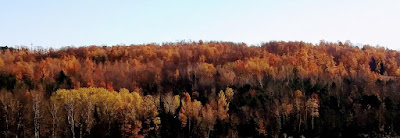
The hills are alive with gorgeous color.

It’s official: my seasonal retirement is underway, now that Saturday, October 30, my last official bookstore of 2021, is in the rearview mirror. It was a fantastic season, both in the bookstore and the gallery, we are deeply grateful to everyone who made it so, and now we’ve been getting at projects long postponed -- such as, for me, my “blackstraw” jam (a mix of black raspberries and strawberries, fruit from earlier months that’s been in the freezer all this time) and, with the remaining raspberries, a fruit syrup that will be delicious in Italian sodas as well as on ice cream and waffles.
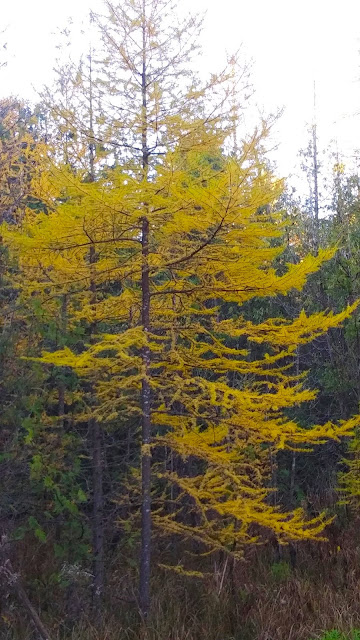

Tamarack in wetland woods glows gold.


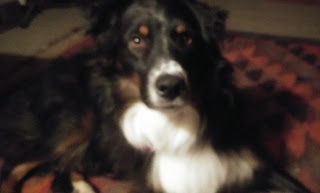
As beautiful as was October and as lovely as November yet continues to be, however -- and is this not one of the mildest and most colorful fall seasons northern Michigan has ever seen, or is only Leelanau County so blessed? Gaylord, over in the middle of the northern mitten, had almost a foot of snow last Tuesday! -- my days have not been all light-hearted bliss.  Social strife and politics afford sufficient fuel for anxiety and heartache, but quite honestly it’s my dog whose fate occupies my nighttime waking hours. We have met with a special trainer and consulted our vet about medication and hope to hear soon what vet and trainer together think about Peasy’s chances at rehabilitation. I have minimized his problems here in my blog, but believe me, it has been and continues to be a difficult path forward, involving many sleepless nights. Little guy has no idea how many people he's never met are pulling for him! If only he could be as sweet with the rest of the world as he is with me!
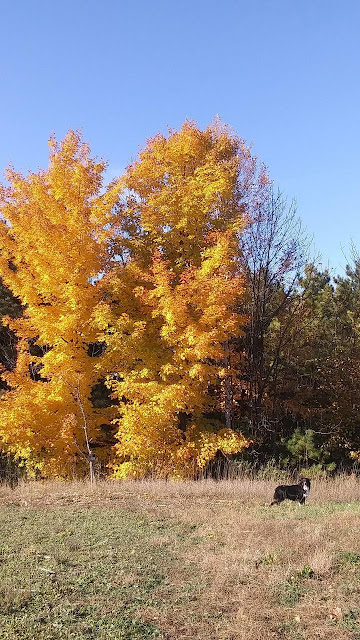

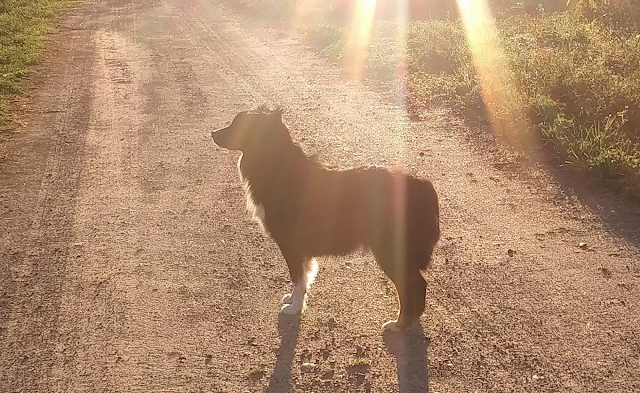
My boy loves his outdoor world.


Each of us is the center of her or his experience. There is no getting around that fact. For me, the social and political climate of the last decade have been such a source of agony that I explain my obsessive focus on one little stray dog against this larger background. How can I not take refuge from intractable national and global problems in one very personal issue that will – perhaps -- with all my determination and a wide, winning smile from Lady Luck -- show itself to be meliorable (and did I just make up that word?). The other side of the coin is that it's no wonder to me at all that a dear friend with Stage IV cancer has no emotional energy whatsoever to worry about politics. But what a wonderful example of positivity she is, and how we have enjoyed our five fabulous "special Sundays" together this fall! Love you, Mel!
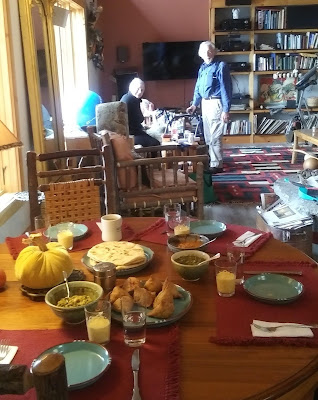

Precious times together with human friends!


At any rate, these nights in the wee dark hours my coping strategy is frequently a retreat from insomnia into the world of fiction, and here are the books I've read since my last post:  


Chinua Achebe’s Things Fall Apart (#151 on my list of books read this year) furnished our old reading circle with plenty of food for discussion, and those new to the novel were very glad to have read it, while I was glad to have read it again.


The Music Shop, by Rachel Joyce (#152), was a lighter novel but more than I expected. 


Then there was Paradise (#153), a work by this year’s Nobel prize winner, Abdulrazak Gurnah, and I’m still trying to figure out what to make of the ending. Have any of you read it? What did you think?


For several of the early chapters of Jay McInerney’s The Good Life (#154), I wondered why I was reading the book at all. Was it a roman à clef, and should I have been picking up on all kinds of Manhattan gossip? Either the book deepened as it went along, or the time I invested in it heightened my appreciation.


Women Talking (#155), by the Canadian writer Miriam Toews, was a story the author imagined after reading of an actual event. True to its title, the novel was almost exclusively conversation among illiterate women in an isolated rural religious community trying to make the biggest decision of their lives.


Anne Lamott's Blue Shoe (#156) was my first foray into her fiction, but I couldn't help wondering how autobiographical the story was, although the central character was not a writer....


After all that, seeking cuddly comfort, I turned to Elizabeth Enright’s Gone-Away Lake (#157), a children’s story, with illustrations by Beth and Joe Krush, who also illustrated my beloved books about the Borrowers. Elizabeth Enright, Eleanor Estes, Palmer Brown -- I always find comfort in these children's books, which are also books from my own childhood.


-- Then came Mary Elizabeth Pope’s The Gods of Green County (my 158th book read in 2021), a truly spell-binding experience and an early reason, already, for me to look forward to re-opening in May 2022, when I can press this book into the hands of customers looking for a fiction recommendation. 


That the evil manipulations and outright brutality of the novel’s villain (I think it’s fair to call the sheriff that) take place almost exclusively “offstage,” reported only second- or third-hand by other characters, seems altogether appropriate. It keeps the story's focus on Big Earl and Coralee, Leroy and Cole, and the young boys, Little Earl and Caleb. Other characters who seem minor early in the novel, come into their own as the fictional years go by. And always we are surrounded by the flat cotton fields and woods of Arkansas. Here, for instance, is Coralee:


...Sometimes I felt like I lived in a world of fields and trees and spirits when everyone else lived in a world of bricks and clapboard and bodies. Maybe that is why I never could make conversation. There were rules about who talks first, and for how long, and about what, and also when it was your turn to say something funny. I never could get the knack of it. 


Coralee and Big and Little Earl will insinuate themselves into your heart, I guarantee.


Nearing the last few short chapters of The Gods of Green County, I almost succumbed to disappointment (will not say why, because I don't do spoilers!), but the remaining pages did away with any incipient negative judgment, and I closed the book with deep satisfaction. Not only can Mary Elizabeth Pope “tell a story,” she has shaped her novel in such a way that everything that happens in her characters’ lives seems inevitable – and it all brings us home in the end. Catharsis achieved -- something rare so far in 21st century literature.


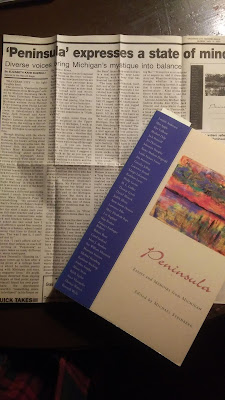
Pope did a reading at Dog Ears Books years ago from her collection of short stories, Divining Venus, and a memoir essay, “Downshifting, included in Peninsula: Essays and Memoirs from Michigan, edited by Michael Steinberg, tells of her summer job at Barb’s Bakery in Northport, so perhaps you met her at the bakery or the bookstore or both. Whether or not you did then, you will not want to miss The Gods of Green County. Really!

Friends past and present gathered together


So even in “escape,” you see, I have not been wasting my time. I’ve been getting out in the sunshine and under cloudy skies, too, as much as possible, enjoying the beautiful Michigan autumn and the companionship of a dog who doesn’t love the whole world (as did Sarah) but who does, at least, demonstrably love the Artist and me. And I am doing the best I can to deserve the love of them both.

That clueless heartbreaker!


Wednesday, October 6, 2021

Local Color and Stubborn Onions


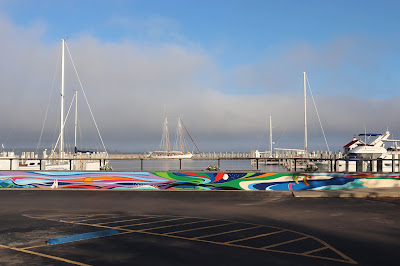
Northport Harbor is so beautiful! 

If anyone ever asks me….


Someone did ask me, a few years ago, to what I attributed my success in a world of bookselling dominated by the online behemoth, and my answer was to tell him I am very stubborn. Too stubborn to give up, that is. So last night as I was sauteing onions and musing on how often I am slicing or dicing or sauteing onions, it occurred to me that if I live to be 100 (my mother was just shy of 96 when she died) and am asked the secret of my longevity, I can say, “I’m very stubborn and I've always eaten lots of onions.” 


Onions were not part of my bookstore’s success, but Dog Ears Books had its 28th birthday this past July, putting us now into our 29th year. Longevity! In a challenging world!


Onions are not good for dogs, we are told – toxic, in fact -- but not giving up is essential when working with a challenging rescue dog. More on this in a minute….


Since the end of September, 


I have read these books to add to my 2021 list: 


134. Thomas, Dylan. Portrait of the Artist as a Young Dog (fiction). Largely autobiographical fiction, that is, and for some reason I never really entered into it deeply enough to lose myself in the stories. “How was it?” the Artist asked. “Okay.” “Only okay.” Shrug. “Okay.”


135. McKenzie, C.B. Burn What Will Burn (fiction). This crime novel set in backwoods Arkansas opens with a body in Piney Creek and gathers complications from then on. The characters and dialogue are vivid, along with touches of local realism (for instance, “snake pit” is not metaphor but simple fact), and yet the story faded from my mind quickly after I finished reading the book. It was, I’d say, very plot-driven, with not a lot of the kind of description that makes a place I don’t know come alive for me. The contrast I’d make is with Damnation Creek, by Ash Davidson. But then, McKenzie’s is more of genre fiction, Davidson’s more literary, as I read them.


136. Bragg, Rick. The Speckled Beauty: A Dog and His People(nonfiction). This story of a “bad” dog who finds a family unwilling to give up on him had me laughing with tears in my eyes. Will he bite? Under certain circumstances, he’ll even bite Rick. But he’s a handsome dog. Rick says, “Looks ain’t his problem.” Oh, my gosh! These are not only real people – they come across the page as real people, and the place as a real place. I could see it all as if I were there.


137. Cogan, Priscilla. Winona’s Web (fiction). Most chapters in this “novel of discovery” (as it’s called on the cover) recount sessions the protagonist, a psychotherapist, has with an elderly Native American woman who expects to die soon, although she is not ill and is not planning suicide. The client quickly becomes the therapist, and the therapist of record allows it to happen, for her own sake and the sake of the old woman. Despite the obvious setup, the story is never boring, and I quite enjoyed it, both for the cross-cultural learning and the opening up of the main character’s heart. I suppose, however, that I must add that this is very much a white woman's book, and that cross-cultural learning could also be seen as cultural appropriation -- which is why it has taken me so many years to get around to reading Winona's Web in the first place.


138. Cormier, Robert. The Chocolate War (fiction). Somehow this book had slipped under my radar completely since it was first published in 1974, although now I find it created quite a stir. The protagonist, an only child and a freshman in a Catholic boys’ high school, has recently lost his mother and does not seem to have a close relationship with his father, although there is no real friction between them, either. My take on this novel is that it’s Lord of the Flies without the isolation of an island or the absence of putative adults: human greed and cruelty and desire for power and status infect some of the teachers as well as the boys in school, which allows a small group of boys to terrify the rest into submission – until Jerry takes it in his head not to go along … and pays the price.


139. Zadoorian, Michael. The Narcissism of Small Differences(fiction). Reading this novel for the second or third time, I entered more fully into the lives of a just-turned-40 couple still trying to find themselves before they age out of being cool and “weird.” I need to think more about the title, which comes from an idea of Sigmund Freud’s, that “the minor differences in people who are otherwise alike that form the basis of feelings of hostility between them.” Some of the scenes in Zadoorian’s short story collection, Lost Tiki Palaces of Detroit, come into this longer work with more detail, and there is plenty of ambivalence to go around, both toward the abandoned inner city and toward capitalism in general, but the characters take center stage.


And now, about Peasy –


-- Because I know that’s really why many of you tune in to Books in Northport in the first place. Recently I posted on Facebook that Peasy is my comfort and my challenge, companion and burden, solution (to some of life’s problems) and problem (on his own, in many ways). All in all, it’s fair to say he is in some ways my salvation and in other ways my nemesis! How can one dog be so many things? Rick Bragg (see book list above) would understand, I know.


The first time I saw Peasy in the Graham County, AZ, pound (thinking he was a she, but that’s another story), it was clear that this dog was very skittish. That was the mild way of putting it. He was afraid of people, to put it more bluntly. And once I had him home, it was clear that he knew no commands, had no manners, and had almost zero impulse control. So he has come a very long way in ten months, to become an affectionate, devoted, fun-loving companion to the Artist and me. The trouble comes when other people come onto “our” territory, which he seems to feel responsible for guarding.


Will Peasy ever be able to have a normal social life? And will we, given that he is such a part of our life? Such challenges! I yo-yo back and forth between hope and despair. But we are not giving up on this little guy – and I say “we” because the Artist is now squarely on Peasy’s side, the two of them quite bonded at last – and my stubbornly hopeful (or hopefully stubborn) nature got a big shot in the arm reading about clicker training for to curb reactivity by getting the dog to stop and think.


Among the reasons I look forward to my annual seasonal retirement in southeast Arizona, this year being able to concentrate on Peasy and work intensively on his social skills is high on the list. It will be good to rejoin the neighborhood pack (my friend Therese and her dogs), which was the groundwork of Peasy’s social life last winter and will be our starting point again in 2021-22. Thank heaven he didn’t exhibit dog-dog aggression! Molly is more than a match for him, anyway! No, it’s people he needs to stop fearing, but I have, once again, hope. So stay tuned, because I fully expect to have happy news to share. I am determined to have happy news to share.


Our beautiful boy!


P.S. The beautiful art adorning the marina in Northport, Michigan, was created by Kat Dakota


Saturday, February 27, 2021

How I’m Coping Without My Bookstore


My old girl, Sarah, in her younger days

“It’s only temporary!” Loretta (played by Cher) yells at her father when he asks to see her engagement ring and she shows him (as he points out) what is obviously a pinkie ring. 


Everything is temporary”! he yells back.


“Moonstruck” is one of my favorite movies, one of those rare films with nary a clinker. Every scene and line is perfect. I think of it as I write this post today because, as you know, my bookstore in northern Michigan is closed while I take my annual seasonal (winter) retirement.


The daily “Shelf Awareness” newsletter has had a regularly occurring feature since sometime in 2020, inspired by the COVID-19 pandemic, called “How Bookstores Are Coping.” The feature tells stories from all over the United States about how supportive customers have been, online orders being received on store websites, tales of curbside delivery; etc. And every day when I read those stories, I feel like a deserter from the front lines, although Dog Ears Books is not closed for the winter because of the pandemic, but only so this aged bookseller can have a respite before taking a deep breath and plunging into another busy season as one of the “working aged” (as another of my still-working friends informs me we are identified). 


Resting on her laurels in old age


Open for business only four months last year when stay-at-home restrictions were eased, I was full of trepidation beforehand, but after another still-working friend helped me out with a professional deep cleaning and I got all my pandemic precautions in place, things went fine. In four months, only two people complained about. having to wear masks (one of them told how to wear it correctly, up over his nose, made a fast exit, and that was okay, too -- his choice). Everyone else was cheerful, and more than one person thanked me for requiring masks and hand sanitizing at the door. 


Sarah with me for her last bookstore season


Bookstore people! They are the best!


Out here in Arizona in the early winter of 2019-2020, I was happy to arrange a couple of very parttime volunteer gigs for myself. On Monday mornings, at the Friendly Bookstore in Willcox, a venture of the Friends of the Elsie S. Hogan Community Library, and on Wednesday mornings in a program that paired older volunteers with at-risk children in early grades at the local public school, reading with them and having them write stories. I loved that git – the first volunteer job of my life! The children were darling, and naturally I felt right at home in a bookstore. 


Then came the stay-at-home order, and everything came to a sliding stop – which is much faster than it sounds. No more reading with little kids at school. No more selling books and honey. No socializing with neighbors, either. 


Well, you all know. We were “all in it together,” we were told over and over. Now, almost a year later, we hope the end is in sight, but life is still not back to normal, and the stories of “coping” continue.


The first winter the Artist and I came out West, there were three independent bookstores in Benson, just 30-odd miles down the pike from Willcox. The one we frequented most often and always found stacks of books to buy closed when the bookseller decided 25 years in business was long enough. The second, which we belatedly discovered on a back street, was gone without explanation last year. And the owner of the third, way out in the country, on a ranch with donkeys (and yes, a little dog, too), died in late 2020 at the age of 90, after 46 years as a bookseller. 


From three indies to none in five years. 


So now, unless we want to drive down to Bisbee or all the way to Tucson (where I had discovered the wonderful Book Stop not long before shelter-in-place order hit), neither of which we’ve done so far this season, we’re thrown back on the pot luck of thrift shops and FOL bookstores, which are better than nothing -- and some very nice and friendly and COVID-aware -- but nothing like the curated collection of an indie. And the FOL place in Benson has been closed since the first of the year. 


I miss the indies and supporting my fellow indie booksellers, my colleagues. Who knows? Maybe before we leave for Michigan this spring we’ll make it back over to the Book Stop neighborhood in Tucson or down to Meridian Books in Bisbee. I hope so. Because I have not yet abandoned the front lines myself, and it’s important to me to support with my purchases – support that really counts -- others who are out there in this always-risky, always changing business called bookselling. 


We indie booksellers all need to make money to stay in business, but we didn’t go into this particular business to get rich. You know why we do it! You wouldn’t be reading “Books in Northport” if you didn’t love books!


Not there now, but I shall return!


Postscript Update, 3/13/2021: The Friends of the Library bookstore in Benson, closed January and February, re-opened March 3, and we made our first visit of the year on March 12. I was delighted to find the volunteer in charge none other than Lenore, retired from the the former Benson bookstore we visited so many times. She was able to tell us that Mary Ann, another of Benson’s booksellers, moved her shop to Apache Junction to be nearer her son. (Mary Ann's and Lenore's former Benson bookshops appear in this old post.) Also, that the heirs of the late Win Bundy, bookseller at Singing Winds bookstore (the one with the donkeys), are trying to figure out how they might re-open. That would be fantastic, as Win's inventory of books on the Southwest was nothing short of mind-boggling.


Saturday, May 9, 2020

The World of Then, The World of Now

Original digital photograph

Then: I was younger and tried hard to make my bookstore a year-round business. I even bowed to pressure from locals to serve coffee every morning one winter when Barb’s Bakery was closed, hoping to disprove a former landlord’s advice, gleaned from personal experience: “The key to a seasonal business is to keep it seasonal.” 

Now: I’m older, still working and still dependent on my business income, but I’ve given myself permission for several years now to take “seasonal retirement” during the off-season.

Then: When I took the photograph at the top of this post, Woodruff Palmer owned the building, and I managed sales for his Painted Horse Gallery, along with running my bookstore. 

Now: With Clare Gengarelly as the building’s current owner, a wall separates her space from mine, and Dog Ears Books has its own entrance. Very slightly farther down the building than this photograph shows, next to my door, is the door of David’s Grath’s studio and gallery. 


Then: We undertook our occasional travels with light hearts and a sense of excitement. An annual September getaway to the Upper Peninsula took us back to familiar scenes that pleased year after year.

Now: In the time of coronavirus, as spring progresses across the land, we continue to shelter in place in our winter rental cabin, leery of taking the road home and with hearts heavy over the many divisions in our country.


Then: My photograph of the snowy scene on Waukazoo Street appeared only in digital form on my blog. 

Now: One of David’s cousins has had it reproduced for us on canvas, even after the printer made the cousin sign a form saying he would accept the results regardless of resolution. The printer didn't think the image was good enough to reproduce. Really! Who expects a clear image in a blizzard? This is perfect! And not as dark as it appears below -- sorry about that!

Photograph reproduced on canvas

Then: Our reality was a daily commute from home to village on icy, snowy, slippery roads. Spring came gradually, backsliding frequently but eventually settling into days of sun or rain. We could count on spring wildflowers in the woods, and we hoped no late frost killed cherry blossoms.

Trillium
Cherry blossom
Altered orchard!

Mesquite blooms
Now: Our present reality is mountain scenery, birds at the feeder, quail coming for a morning drink at the water bar, mesquite forming almost solid green across the high desert floor. We follow the weather and other news from Northport and expect to be there again eventually but are unsure when that will be or what we can expect when we get there. 

Then: We looked forward to a summer of hard work, with a few weeks’ window of financial reward to get us through the next winter.

Now: It’s anyone’s guess what the future will bring. We do, however, draw on a rich store of memories.

Thank you, Jim!


Wednesday, April 24, 2019

Sometimes (even in seasonal retirement) Nature Says, “Slow Down!”


There’s an old joke about death, to the effect that it’s Nature’s way of telling you to slow down. Our days are hardly hectic during seasonal retirement, but they do begin early for me, and they can often be tiring. I felt empathy for the mule deer on Sunday afternoon when they were taking shelter from sun and wind in the shade of the dry wash behind the cabin, gathering their strength for the summer’s work ahead of them. The challenges of winter lie behind us, the challenges of summer lie ahead!

Here in the high desert, I’m generally up at “first light” or before, and the cactus wren doesn’t begin singing (if you can call it that) until the sun is up. Like chickadees in northern Michigan, the cactus wren is a faithful companion through snow, rain, and sunshine. a year-round resident here in Dos Cabezas and the state bird of Arizona, a charming, cheerful neighbor even if his so-called singing “suggests someone cranking the motor on an older car, trying to get it started.” That description comes from Richard Cachor Taylor in his book, Birds of Southeastern Arizona, the same book in which he describes the canyon towhee, another little desert pal of mine, as “the most confiding towhee, often under cars, picnic tables, and farm machinery in rural areas.”


Last Saturday morning I finally took the plunge (at the eleventh hour, it's true) into local community service. A group of volunteers for the Willcox Historic Theatre and Arts group assembled at the Historic Palace Saloon, just a few doors down from the Historic Willcox Theatre, along what the Artist and I call “Old Town” Willcox, to clean up the old saloon in preparation for painting and renovation. Future Studio 128 events (we attended two lectures and a concert this year) will be held in the larger space when renovation is complete. I’d mentally committed myself to two hours, and that turned out to be about all I could handle: climbing up and down a ladder, standing on a ladder, scrubbing walls by reaching up over my head — all good cardiac exercise, right? Right!


We were back in Old Town that evening to see “The Mustang,” a film by actor-screenwriter-director Laure de Clermont-Tonnerre, who is now a member of my personal pantheon of heroes. I won’t say “The Mustang” is a perfect film. It is not flawless. But it attempts so much and achieves so much and does it so very, very powerfully that the Artist and I were nearly stunned when it finished. I'm not even going to begin to try to describe this movie. Just go see it!


And then, driving back out into the mountains on Hwy 186, suddenly a colossal light appeared on the horizon! What unthinkably huge vehicle — or UFO? — must be approaching from the distant east to cast such binding light into the sky? Then it broke over the mountain — and it was the moon, just past full but looking more enormous than any rising moon either of us could remembering seeing, and I’m sorry I couldn’t capture the experience with my camera but have only this very ordinary image to share, because the vision was overwhelming at the time.

What a day! Physical work, great movie, unforgettable moonrise! What next?

Well, our neighbor and my walking/hiking partner Therese and I had a plan for Easter Sunday. Neighbor Dan was bringing his family from Tucson, and his son and daughter always climbed the big hill (or small mountain, if you will) across the road to the cross planted on top years ago (or so the story goes) by an itinerant monk. Therese wasn’t sure where to find the beginning of the path up, so we wanted to join the young people. After our Echo Canyon Loop hike, I had serious doubts about my being able to reach the summit and said only that I would “see how far I can get.” Saturday had also been a very warm day, so I’d been thinking that 5:45 a.m. would be a good time to begin the ascent. But by 8 a.m. there was still no sign of Dan and his family. 

“I’m relieved!” the Artist said frankly. “I worried about it all night. You’re in pretty good shape for your age, but what if you fell and broke your hip? What would we do?” 

We agreed that shotgun and backhoe would be in order, should that catastrophe occur. Ha-ha. Therese and I were, I think, half-disappointed and half-relieved. 

Then the neighbor family arrived, and the athletic 30-year-old, by himself, sprinted up the mountain! He made the climb in 22 minutes! Look to the right and see the height of the climb relative to the houses below.

In the photo below, you can see the young man just to the left of the cross. Twenty-two minutes -- I could never have made it!


“He’s a running fool,” his dad said proudly later in the day, when he brought plates of Mexican fried chicken, potato salad, and beans over for for us for “a little snack to have later.” This was after we had brushed and clipped and bathed Sarah, always an exhausting project — which is why it’s not done more often.


Alas for an evening of bird-watching! Nature’s message to me was not as blunt as death, I’m happy to say, but came in the milder form of migraine. (Good thing I didn't attempt that hill climb, eh?) I ate a little chicken and beans and staggered off to bed, pulling the blankets over my head but leaving the rest of me out to catch the breeze through the window. When the Artist told me there were mule deer in the wash, I had to get up to see them, but I didn’t stay up long, and I backed out of a Monday morning walk plan, too. 

The sun is lovely, and light is life, but there are times when listening to Nature’s message and one’s own body is just common sense. We only have one week left here, and there’s no sense crashing and burning now. It’s going to be a busy summer back in Michigan….