Search This Blog

Thursday, November 14, 2013

Who’s Ready to Hit the Road Again?


Sometimes flipping a coin isn’t necessary. Which would my readers rather see in a new blog post, philosophy or travel? Post-structuralism or American roads? No contest, is it? Add to those considerations that any new book from William Least Heat-Moon is worth attention -- which would doubtless even be true if he were to write about philosophy, but you can relax on that score.

Heat-Moon’s new book is Here, There, Elsewhere: Stories From the Road, and it’s a collection of short journalistic travel pieces the author wrote over the years. (“One advantage books have over a newspaper or magazine is that it’s harder to wrap yesterday’s fish with them.”) In it he travels to Japan, his assignment to investigate the postwar economy, his personal mission to purge himself of World War II hatred of the Japanese. He scours the U.S. for authentic, traditional beer and ale, back before microbreweries had popped up everywhere. He pilgrimages to Mississippi in search of William Faulkner when that famous author was still alive (but alas, teaching in another state at the time). And that is only the beginning.


These stories are a famous American writer’s early work. His love of travel, he tells us, goes back to boyhood and his realization that the highway outside the drugstore soda bar window stretched all the way to New Orleans and that U.S. 40 through Kansas City, Missouri, connected the Atlantic and Pacific coasts of America. “To me,” he writes, “a road map is the printed lyrics to a siren’s song....”  Heat-Moon also sees American roadways as the web holding Americans together:
It’s a commonplace to say that no one can interpret America without understanding our use of automobiles, but I think what we really mean is that one doesn’t comprehend the United States without taking into account our mobility, and preeminently that means roadways, perhaps the most American of symbols, one even more functionally representative than the Statue of Liberty or Mount Rushmore. We are a widely dispersed and numerous people bound together by three million miles of painted stripes atop concrete and asphalt.
He cites Albert Gallatin’s report to Congress in 1808 recommending more good roads through the country, “to strengthen and perpetuate the Union which secures independence, domestic peace, and internal liberty.” I find that idea worth pausing over. As Americans, we are free to travel anywhere in our own country. Some areas have higher crime rates than others, but nowhere do we find a region in the hands of armed insurgents. Should our system of highways get some of the credit for this happy state of affairs? William Least Heat-Moon thinks so.


Answering and amplifying the author’s love of maps, love of travel, and appreciation for the union of diverse regions and peoples, this new collection adds a special interest for writers.
Despite assertions to the contrary, exceptional is the magazine editor who truly trusts in the intelligence and creativity of his readership. How many times from an editorial desk have I heard, “Our audience won’t understand this.” “This” being an idea, a word, sentence construction, sentence length, literary allusion, historical reference, or a brief digression underpinning an idea. Too few editors grant American readers much capacity or willingness to think critically, just as they believe their audience will not tolerate a vocabulary beyond the basic five or six thousand words in common usage. If I formerly thought editors were wrong on those questions, now I believe my argument is weaker. Evidence of America getting “dumbed down” in self-fulfilling ways grows apace.
Heat-Moon had to suffer the editorial blue pencil when he originally turned in his assignments, but putting together this new collection gave him a chance “to restore elements one editor or another deemed too challenging for the audience he perceived.” He also gave himself license to rework or expand ideas where inspired to do so.
To my surprise, I’ve liked doing the restitution of the pieces here as I’ve liked returning details and sentence structures I dared not even try with an editorial practitioner of the hack-and-hew school....
What writer can fail to be sympathetic to these feelings? In light, then, of the time that has passed and the changes made to the originally published articles, as well as changes made by the author for the sake of the present collection, each piece is preceded by a brief explanatory note, with Heat-Moon telling us why that particular trip was important to him when he made it and why he thinks we will enjoy revisiting the old ground, perhaps reworked, with him today.

Aficionados of travel writing will open this book eagerly. Fans of William Least Heat-Moon will be grateful for it. Anyone who writes for a living – or simply from love – will be fascinated by this writer’s look at his own pages past.

And happily, Here, There, Elsewhere is already available in paper, and I have ordered it and will have it next week at Dog Ears Books! To my customer this morning who said her husband has Heat-Moon’s Blue Highways on his bookshelf but she hasn’t read it yet, I say, “Open that book today! You have denied yourself the pleasure far too long already!”


We have no travels planned for this winter, but we are happy to have plenty of travel books at hand.

Monday, November 11, 2013

Want to Visit South Manitou Island Today?


Writing a letter to my sister the other day with pen and paper, I thought I'd transcribe the long pages about my current reading here to the blog, so that's today's topic.

We got outdoors this morning to snow on the ground in Leelanau County. We're on the cusp of winter, David says. Still bits of color in the orchards, while along the roadsides and in the woods predominant color is now brown, the toasty brown of oaks and beeches.


November 10, 2013
Northport, Michigan

Dear sister –

I’ve been reading a little book about life on South Manitou, back when there were still people farming on the island. There were 13 families in residence in 1870, and during 1917-18 there were 30 students enrolled in the school. Besides farm families, some of the Coast Guard men brought their families with them to live on the island. There were also two sawmills in operation in 1913. Timber had been the first reason for white men to stop on the island, as they needed wood to produce steam power for the lake boats.

Life on South Manitou Island around the time of World War I, according to descriptions in Isle of View: A History of South Manitou Island, by Charles M. Anderson, was in many ways very similar to life in remote Siberia today, as shown in that documentary about the trappers I was telling you about, “Happy People” [I had the title wrong before] -- for instance, skis made by hand, in the same manner, both on the island 100 years ago and in Siberia today. The book is really a memoir, not a history, but since the author came to the island with his family from Wisconsin when he was only five years old (1913) and lived there for 13 years, working on the family farm, going to school, exploring the island with his brothers, and finally going out on Lake Michigan with his father, there is a lot of detail about how the islanders lived. The author’s youngest brother was the last child born on South Manitou, in the year 1921. His oldest brother, age 21, died the same year, of diabetes.

Farming was all done with horses. Anderson writes that he could plow only 2 to 2-1/2 acres a day, using three horses, and after the field was plowed it had to be dragged and marked out for planting, which was done by “two people pulling a pole about 24 feet wide with 7 chains attached to the pole 30 inches apart.” The author adds, “The field had to be marked two ways, 30 inches apart, and then it was ready to plant. Pulling or pushing that marker, I believe, was one of the hardest jobs on the farm for a child of twelve years old, as I was at the time.” David liked the bits about the bull with the ring through his nose, led by a long stick attached to the ring. Also attached to the ring was a heavy chain that dragged on the ground. The idea was that if the bull wanted to run someone down, he would step on his own chain and stop himself, but the bull was smart and learned to straddle the chain so he wouldn’t trip on it.

The Anderson family planted corn, rye, and oats, mostly for their livestock, and for themselves they also raised potatoes, carrots, beets, onions, cabbages and apples. Popular orchard varieties on the island were Greening, Northern Spy, and Wagoner apples. Many families made their own maple syrup (as they did on the mainland, as well), but you may be surprised to know that they also made a great quantity of hard cider from those apples. This was during Prohibition, but on the island no one cared about that, except to hide the evidence whenever there was a rumor that the Feds might be coming to look around. (No one ever did.) It sounds like the cider was for local social consumption, not for sale.

Another surprise crop (to me) was ginseng, which also grew wild on the island. When we drive to St. Paul, we see fields of ginseng in Wisconsin, under netting to protect it from the sun, and a lot of South Manitou islanders came from Wisconsin, so maybe that’s part of the explanation. Or maybe there was just a good ginseng market in those days. One farm wife left the farm, divorced her husband but stayed on the island, and opened up a little shop near the Coast Guard station. She sold chewing gum, candy, and wild ginseng, which she hunted herself. A couple times a week she took homemade bread to her former husband, and in return he supplied her with firewood. He had, by the way, a lot of cats, “about ten,” and that might have been all it took to drive his wife away from home. I think five cats would drive me away.

So marriage wasn’t always “forever” in that place and time, and that may be another surprise to some people reading the story today. One of the mail carrier’s sons was married and divorced five times! Another man, 65 years old, came to the island with his third wife to help the author’s father make cement blocks for the foundation of a new barn. When he arrived on the island, he had already fathered 25 children, and his twenty-sixth was born while he and his wife were on the job there. Yes, his wife was helping make the cement blocks, and perhaps the first and second wives had died after so much childbearing and work. The author doesn’t say. The twenty-sixth baby died shortly after birth.

Some islanders never married at all. One man farmed with his brother and died single at the age of 78. When he visited the author’s family in the evening, “he always sat in the same chair. Dad would ask him to sit in a chair near him, but he never would.” Can’t you just see it? Such a little detail makes the old bachelor farmer more than just another name.

Here’s another detail of island life that might not occur to us: they had no toothbrushes! The Anderson family did not even have their own well but had to haul all their water, for all purposes, from either Lake Florence (their source of ice, cut in winter and stored in sawdust to use during the summer) or from a neighbor’s well. If a tooth had to be pulled from man or beast, there was a man on the island to do it, but the author was 21 years old before he had his first toothbrush. I can imagine living without electricity and even without running water, but without a toothbrush?

The Andersons left the island to move to Frankfort when Charles was 18. By then he had already been sailing with his father for two years, carrying various cargos from one Lake Michigan port to another. Loading grapes from Benton Harbor to carry to Sheboygan and Milwaukee, Wisconsin, they learned of the House of David community near Benton Harbor. Charles Anderson says the whole family was glad to move to the mainland, but he went back to visit the island year after year and clearly loved it very much. At the close of his book, he laments the overgrowth of old paths and trails since the Park Service purchased the island. My impression is that the neglect he perceived has been remedied in years since.

It seems ridiculous that I lived for years in Leland and never managed to take the ferry over on a day trip and still live close enough to the ferry dock that it would seem a simple voyage to undertake. I always think I’ll do it in the fall. (Don’t want to face mosquitoes in spring or crowds in summer.) But the ferry season is over for another year now, and it’s another year I haven’t made the trip.

Maybe I should make that a priority for fall of 2014?

Anyone interested in reading about South Manitou Island online can find information here


Thursday, November 7, 2013

Seeing the World or Only the Insides of Our Own Heads?


Vase of purple asters
My six-week beginning drawing class is over, but I’m going to keep drawing. Drawing for me is diary and meditation and vacation and conversation, all rolled into one slow, low-key, low-tech activity. Paper and pencil. Or paper and pen. Enough light to see. That’s all it takes.

The drawing I did of my son during his visit I posted on Facebook as well as here on my blog. Reaction from many people (including my son) is often, “I can’t draw at all” or “I can’t even draw a straight line.” Honestly? I have trouble with straight lines myself, but that’s what rulers are for. The contours of most of the things I want to draw, it turns out, do not have straight edges.

What about you? Do you think you can’t draw?

Our instructor remarked the first evening of class that no one would expect to sit down at a piano and rip off a Beethoven sonata without advance study and practice, but people think they should be able to pick up a pencil and right away dash off a good drawing the first time around. Anyone can learn to draw, Elizabeth Abeel, our instructor, told us, but it is something to be learned, and it does take practice.

Classic book!
Abeel uses a lot of techniques from Betty Smith’s classic Drawing on the Right Side of the Brain: A Course in Enhancing Creativity and Artistic Confidence, the book that convinced me long, long ago that I (or “even I,” as I thought then) could learn to draw with a teacher using these methods. Whether you take “left brain/right brain” terminology to be strict physiological description of brain anatomy or a metaphorical distinction between two different ways of interpreting the world, the big lesson in drawing is this:
"DRAW WHAT YOU SEE, NOT WHAT YOU KNOW."
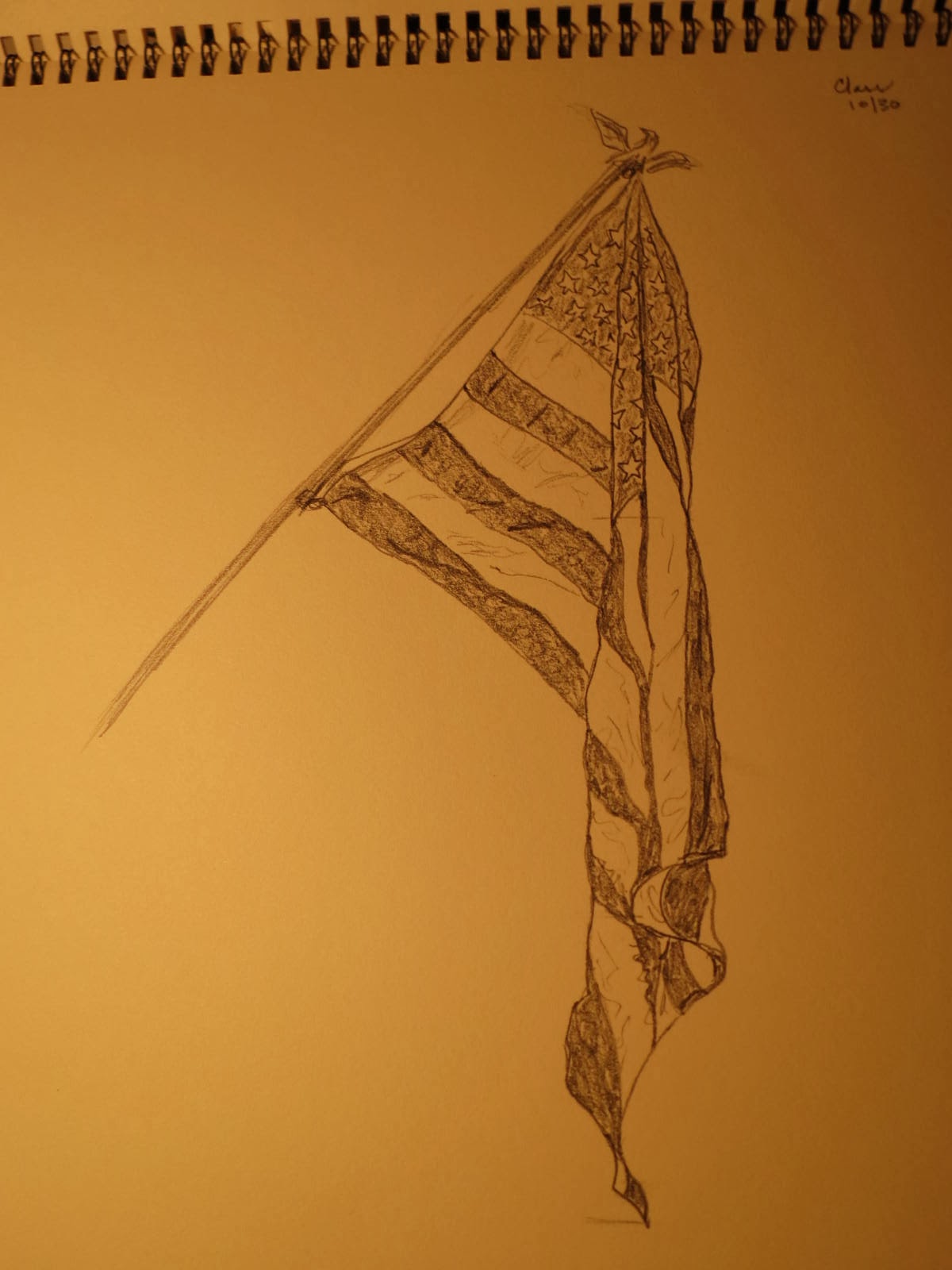
Betsy said this to us over and over, and here’s an example of what it means: If someone is told, “Draw a flag,” most beginners will have recourse to their mental symbol set. That first flag drawing, therefore, will begin as a rectangle, with stripes, stars and whatever subsequently filled in. The drawings will look pretty much like this section of a page from an atlas, only without color and without the slight wave in the lines of these flags:

Flat flag symbols 
But how often do we see a flag stretched out flat? The lesson is to resist pulling out a mental symbol and, instead, to look at a real flag, hanging on a pole. Here are a couple of my efforts to draw a flag in front of me. The first is a hurried first-night sketch (I had read the book long ago and had spent time one winter and all last year drawing, so my first sketch wasn't quite as flat as is the usual with beginning students), the second our “final exam” on the last night of class.

Quick sketch, first night of class
Slow, careful study of artfully draped flag
Getting from the flat symbol to the complex rendering of reality is not instant. One of the first exercises we did was to draw “vase faces,” as our instructor and Betty Edwards call them. (This is in Chapter 4 of the Edwards book, the chapter titled “Crossing Over: Experiencing the Shift from Left to Right.”) First we drew a simple contour of a face seen from the side – forehead, indent for the eye, nose, open mouth, chin, neck. Then we drew lines extending out from the top and bottom of that curved line. Finally, we began the curved line again on the opposite side. The result is either two faces looking at each other or a single vase, depending on how you look it, but the point of the exercise is that one’s “left brain” (verbal, symbol-using, fact-obsessed) will be frustrated and give up, allowing the “right brain” (visual, intuitive, loving complexity) to take over. The “left brain” hates complexity, and the “right brain” loves complexity. You can see why it’s necessary to make that shift if you want to draw what you see and not what you know.

Another exercise was drawing upside-down, copying a drawing which we were also looking at upside-down. Again, the aim was to frustrate the left brain so that it would give up and get out of the way. Instead of the left brain being able to look at a hand and say, “I know what a hand looks like” and pull a clumsy, flat, iconic mitten out of its symbol set, the right brain was given time to concentrate on lines and relationships, without putting nametags on any of the parts. 

(Drawing, the mind bypasses names and symbols and reasons and arguments and causal chains and settles down in the moment. That’s what makes drawing such a meditative experience.) 

Another exercise was doing "pure contour" drawings. In my mind, I call them "blind" rather than "pure," because what you're doing in this kind of work is drawing an object -- say, your own hand -- while looking only at the object and never at your paper. Also, you put the pencil to the paper and don't lift it until you've finished the drawing. The idea is not to reproduce the object perfectly but to give your eye time to follow all the complicated ins and outs of the object's contour and have your hand translate its movement directly from that of your eye.

You can see all these exercises in the Betty Smith book, and in it you'll also find many examples of student work showing exciting and vast improvement in the course of a very few weeks.

A question I have – a hope I have – is whether/that what can be done for seeing can also be done for hearing. What would it take to quiet the chattering, knowing-everything voices in our heads and truly hear what other people are saying? For them to quiet their minds enough to hear us in return? For all of us to slow down and talk to, not past, each other?

Can we translate the lessons of meditation into everyday life?

Tuesday, November 5, 2013

Didn't I Tell You We're a Family of Readers?

My mother and one of my sisters and my son have all been visiting these last few days. My mother and sister are staying at Sunrise Landing over on the Grand Traverse Bay side of the Leelanau peninsula. I've sent a lot of people to Sunrise Landing over the years (based on my parents' strong recommendation) but had never been there myself. What a great place! My mother says the rooms have all been updated and upgraded since she and my dad stayed there years ago, but it still has a pleasant, local, real Up North, not-chain-motel-at-all look and ambience. And of course, it's right on the water.

On Monday, my son and sister and mother and I drove to Traverse City so my family could see "The Art of Sleeping Bear Dunes" show at the Dennos Museum Center. They were properly impressed by the unbeatable placement of David's painting, right by the gallery entrance.

Family by David Grath painting
But we all looked at the entire exhibit before taking in the Inuit art and interactive room -- and making several purchases from the gift shop, let me not neglect to mention.

Mother of artist Doug Racich is one of my mother's old friends.


Later in the day, we all assembled back at the old farmhouse for a second family evening and meal. 

Perusing books while visiting -- these are my people!


My son stayed with David and Sarah and me at the farmhouse during his visit and spent lots of time with me at the bookstore, too, and while he gave Sarah lots of attention and talked with all of us, he also spent a lot of time reading, because -- well, that's just what my family does. Here is my sketch of him at the bookstore, engrossed in a book:

Man in glasses, reading
And now? My son is headed toward home, and David will fend for himself this evening while my mother and sister and I attend tonight's National Writers Series event, an evening with Sara Paretsky. You may recall that my sister has already met Paretsky. Ah, but this time I'll be there, too, and our mother will be with us! Now, if only the third sister hadn't had a scheduling conflict....

My sister with Sara Paretsky earlier this year
We're all Paretsky fans, as well as readers and book-lovers. It's the perfect evening's entertainment for my family!

Saturday, November 2, 2013

Are We the People to Blame for the Breakdown of the Legislative Process?


[This is a continuation of a recent post. Look here for the beginning of my discussion of this book.]

Congress no longer works. This is not a news flash. The question is, Why? Fishing through the tangled skeins clogging the federal legislative pipes requires careful, detailed and objective analysis of sociological data, looking at correlations between trends unlikely at first glance. It also takes a long look into American history. And so the explanation given in The Big Sort: Why the Clustering of Like-Minded America Is Tearing Us Apart, by Bill Bishop, is not easily reducible to one short phrase. Bishop’s answer is NOT shameless gerrymandering or any kind of [conscious]“conspiracy.” Instead, he says, the Big Sort is the increasing ability of Americans to choose to associate primarily if not exclusively with people like themselves.

What's wrong with wanting to hang out with people like us? How can that account for the failure of Congress to do its job?

There have always been competing political parties in the U.S., and there have always been certain voter “blocks” and interests in competition. As Smith traces the history of partisanship, however, increasing divisions emerge in the late 1960s and into the 1970s, and gaps dividing Americans have been steadily increasing since that time. Okay, so why? The argument is complex, the data surveyed diverse and impressive, but I’ll try to compress the argument into a somewhat lumpy nutshell.

1)    Prosperity and economic security enabled more Americans to choose where they would live.
2)   Choice enabled people to congregate in communities with like-minded individuals, those with the same values and lifestyles.
3)   People in conversation primarily (or only) with like-minded individuals reinforced and strengthened each other’s commitments. When necessary, individuals adjusted their beliefs to conform to those of the group.
4)   Marketers, churches, and political parties increasingly began to target groups-- “tribes”--rather than appeal to a “mass market” or the country as a whole.
5)   To win the allegiance of “tribes,” political parties and churches (following market research) set out to attract groups rather than individuals, and to do this they could not challenge beliefs already strongly held.
6)   Consensus within groups became more extreme than prior individual beliefs had been.
7)   The middle view, those who could see both sides or agreed partially with one side and partially with the other, those who believed in compromise, etc. dropped out of the picture.
8)   Campaigns on both sides of the political divide demanded party purity, and moderate candidates were purged/
9)   “Without a sizable group of moderates, Congress has a harder time passing major legislation. The parties engage in the horseplay Americans see daily in Congress . . . while significant issues are sidelined.”
10)                 Legislative bodies “’either go lurching from one side to another, which means we have no continuity; or they are immobilized.’”

[Caveat: My ten steps could probably be reduced to five or enlarged to 20 and could certainly be formulated differently but are my quick and dirty synopsis of what the author took an entire book to explain.]

The political form of the “Question of the One and the Many” used to be, “How do the many – the diverse, those with different beliefs and backgrounds and values and interests – come together to live as one nation?” That question has been superseded in the last 30-4o years, as political marketers seek to ask instead how segments of voters can be isolated and converted. Demonizing the “other side” is part of the [marketing/identity] process.

“Us vs. Them” studies are a lot scarier than you might imagine.
People enhance their social identities by viewing their own groups positively and seeing other groups negatively. ... The price of identity is that despite what the human relations movement had hoped, differences aren’t diminished when groups come together. Instead, as social psychologists found out, differences are exacerbated.
And it’s even worse than that.
Researches found that there didn’t have to be any discernible dissimilarity [my emphasis added] between groups for “us” versus “them” conflict to arise. People adopted group identifications with only the flimsiest of pretexts.
In study after study, it turned out, incredibly --
The simple fact of assigning people groups led to discrimination....
The good news (were you hoping there would be some? I know I was) is that knowledge of different Others can reduce prejudice and increase tolerance, but it takes more than putting opposing groups in the same room. Psychologist Gordon Allport found that a number of necessary conditions besides proximity must also be met:

Ø    Groups must see themselves as equals.
Ø    Meetings between groups “should take place as a regular pursuit of an ordinary and shared goal.”
Ø    Meetings should “avoid artificiality.”

Without these conditions, disagreement between members of different groups will typically result in avoidance and silence rather than discussion.

Political scientist Diana Mutz, from the University of Pennsylvania, found that Americans are very reluctant to talk politics with those who might disagree with them.
In a comparison of citizens from twelve countries, Americans are the least likely to discuss politics with someone holding a different view. ... [T]hey avoid political confrontations personally – more so than people in any other country in this study.
Is it not paradoxical and horribly ironic that in the land of free expression, conformity and fear keep us from expressing ourselves except with those who already think the same way we do?

Do your friends share your political and religious beliefs and values? Are you able to talk to – and listen to -- those with different beliefs? How do you see the legislative future of American government? Divided by geography, by income, by education, by religion, and by political party, is there any hope that "one nation" will be able to move forward?

It would be so cool to get bipartisan groups together to read and discuss this book!

*  *  *  *  *

This is a complete change of subject and has nothing to do with the rest of today's post, but I wanted to note that for some reason (I'm sure there is a reason, but for the life of me I cannot identify it) new titles I'm adding to my "Books Read 2013" list are now appearing at the bottom rather than the top of the list. It's messing me up, so if anyone has a solution, please clue me in. Thanks!


*  *  *  *  *

Coming back a day later to take another stab at this. Here's my synopsis in only four steps:

1) Since the early 1970s, Americans have chosen, increasingly, to live and associate as much as possible with those "like" themselves, in terms of income, education, lifestyle, and religious and political affiliation. 

2) Churches and political parties, following market research, have learned to target these belief and value groups to "sell" their "products."

3) Groups with different beliefs have moved further away from each other, become more extreme as they move apart, with the result that like-minded communities have become geographical, and so political districts have become increasingly polarized.

4) In polarized districts, moderate political candidates at the regional level cannot find party support, and so the middle drops out -- leaving in Congress two extremes with no ability or motivation to work together.

The author believes [on what grounds?] that only a younger generation can (and will?) reverse this trend, and yes, given enough time a pendulum does reverse direction, but where, in its swing from one extreme to the other, is the Early American ideal of a diverse citizenry overcoming differences to work together? Will our grandchildren achieve what we have lost?

COMPLETE COINCIDENCE??? The current New Yorker magazine opens with a piece by Steve Coll, called "Party Crashers," in which he follows one politician, through a brief number of years, adjusting his utterances and his votes in Congress again and again to satisfy the extreme of his party's line but ultimately failing to be "pure" enough.
Political purges have no logical end point; each newly drawn inner circle leaves a former respected acolyte suddenly on the outside.
Are we waking up yet?

Wednesday, October 30, 2013

Drawing, Reading, Thinking, Recommending

Milkweed pods in late October
Am spending early mornings drawing and reading rather than jumping directly online, and it's a nice change. Feels more productive and also calmer, although sometimes I do get pretty worked up by what I'm reading.

This morning, for instance, I raced through the the first three chapters (Part I) of The Big Sort: Why the Clustering of Like-Minded America Is Tearing Us Apart (Mariner Books, 2009), by Bill Bishop. Are Americans more deeply divided than in past decades? Bishop's data and analysis of it say yes. He does not, however, blame either political party (or both) or conspiracy or gerrymandering but has traced the phenomenon to a "migration of self-selection," whereby Americans able and willing to relocate tend to join people like themselves in a new kind of segregation, economic and "value"-driven. The author looks at sociological studies on how people form and hold beliefs and opinions, and the finding is that, whatever the group under scrutiny, "Mixed company moderates; like-minded company polarizes." This is because (1) in a homogeneous group people are likely to hear only arguments supporting the group's dominant position; and (2) in order to fit in, group members are constantly comparing their own beliefs and positions to those of the group.
"It's an image maintenance kind of thing," explained social psychologist Robert Baron. Everyone wants to be a member in good standing with the dominant group position. It's counterintuitive, but people grow more extreme within homogeneous groups as a way to conform.
Bishop's look back at the Founding Fathers was fascinating and instructive. While a couple of anonymous critics of federalism, Cato and Brutus, believed that only very small communities could effectively self-govern, Madison and Hamilton saw in the heterogeneity of a vast and varied geographical expanse a source of strength. The very mixture of opinions and interest, they believed, would work against the growth of factions.
The men who wrote the U.S. Constitution and Bill of Rights rejected the "right to instruct" and adopted instead a government of deliberation and compromise within a heterogeneous legislation.
Where do today's lobbyists fit into this picture? What about those groups not allowed to lobby who instead invite legislators to "educational" events?

I'm only on page 81 of this 303-page book but am completely engrossed. Which town or neighborhood we live in, the newspapers we read, our Facebook friends, which nonprofit groups we support with donations and/or volunteerism, etc. may all be pushing us farther away from those we see as our opponents, making us unable even to hear what they are saying.

Food for thought? Good thing I have drawing class tonight (my last!) to give my brain a rest!

As far as new books arrived in my Northport shop, there is a wide range, from brain-breaking deep subjects to literature of all kinds to poetry and painting to sweep the unsettled dust away. I have to make a special plug for Farmacology, which is featured up in the right-hand corner and which I've written about before, though not a full-fledged review. If anyone I know were to read only one new nonfiction book this year (or next), this would be my recommendation. It is, necessarily, about a lot more than health and farming -- because how can issues in agriculture and medicine be separated from life choices and political agendas?

Others for your consideration today are:

 The Luminaries, by young New Zealander Eleanor Catton, is this year's winner of the Man Booker Prize.
Rabbit's Snow Dance is the retelling for little ones of a classic Native American story, with irresistible illustrations.
 Legends, Icons & Rebels: Music That Changed the World (another good holiday gift choice) comes with two CDs.
 Leaving popular culture for deeper philosophical questions are Martha Nussbaum's Political Emotions: Why Love Matters for Justice, and Ronald Dworkin's Religion Without God.
 Malcolm Gladwell straddles the gap between deep philosophy and cultural observation. How do "underdogs" and "misfits" battle "giants"? Find out in Gladwell's latest book, David and Goliath.
Now the promised relief, in two beautiful new books, Art of the Sleeping Bear Dunes and, from New Issues Press, Poetry in Michigan. Even if I were not biased in favor of these two titles by the inclusion of beautiful David Grath images, I would recognize and recommend them as important contributions to new Michigan classics.


I probably don't need to remind anyone that there are always plenty of beautiful and thought-provoking used books at Dog Ears Books, too -- and when it comes to those treasures, every day is a potluck, and no one is a loser!

Later postscript: See here for continuation of discussion of THE BIG SORT.

Thursday, October 24, 2013

Always, For Me, Jane Austen


Our “intrepid Ulysses group,” having tackled James Joyce, Dante, Beckett, Shakespeare, Tolstoy, Faulkner and so on, decided most recently to read Pride and Prejudice together, the first time for about half the group. As for me, I’ve read this delightful novel countless times – really, cannot begin to count my readings, since Austen was my tired-brain-bedtime reading through my first two years of graduate school. Lined up at the head of my futon on the floor were Pride and Prejudice; Sense and Sensibility; Emma; Northanger Abbey; and Persuasion, and every evening when my brain could not absorb one more word of philosophy, I would crawl under the blankets and pull out whichever Austen novel I had closed the night before, opening where my bookmark had been left. Night after night. Finishing one, I would move on to the next, and at the end of the row I would begin again at the beginning. So yes, I know these novels pretty well.

But being asked to lead a group discussion made my reading different this time around. For the first time, I noticed Austen’s incredible economy of language. How much information is packed into the first sentence! We know that we have begun reading a comedy, that the cast of characters comes from a certain class of society, that the story will end in marriage, and that the author looks at her world with eyebrows raised and an amused smile on her lips.
It is a truth universally acknowledged, that a single man in possession of a good fortune, must be in want of a wife.
There it is. This “truth universally acknowledged” is of course not “universal” at all but part of the fabric of a certain class of English society at the time of the novel. The “good fortune” tells us more about which class of English men and women we will meet in the novel’s pages. “Single man” and “wife” aims us toward the marriage market, and the author’s sly wording tells us that she finds much humor in this business of families looking to marry daughters into money. All this in twenty-three words!

I also noticed for the first time how short many of the chapters are and how most of them consist of a single scene. Onstage in the first chapter are Mr. and Mrs. Bennett. Basically, we are given two sentences of introduction, then a spirited dialogue between husband and wife, ending with a paragraph summing up their marriage in general. Austen’s ability to convey character through dialogue is well known, and it’s no wonder her novels have been so often adapted for dramatic presentation, but has anyone considered how the English theatre might have been changed had she been introduced into a literary/theatrical milieu in London? What a playwright she might have been!

Of the 61 chapters of Pride and Prejudice (the final chapter being a summary exposition of the future of its characters, without dialogue), three stand out from the rest -- for me, at least -- in their startling dramatic impact: Chapter 19, the extraordinarily ridiculous proposal of marriage from Mr. Collins and Elizabeth’s spirited refusal of same; Chapter 34, another proposal of marriage, this time issuing reluctantly and haughtily from Mr. Darcy, and Elizabeth’s even stronger refusal; and finally the marvelous, irresistible scene between Elizabeth and Lady Catherine de Bourgh in Chapter 56. Surely Lady Catherine could hold her own onstage beside Oscar Wilde’s Lady Bracknell! Which one do you think would come out on top?

And oh, that Eliza Bennett! Who can help loving her? She is well read but no showoff bluestocking, musical without the heaviness of genius, not a ravishing beauty but slim and attractive, with bright, lively eyes, dark and beautifully expressive. Her sense of humor is irrepressible. She loves long country walks. She will not marry without love, even if it means remaining an old maid, and she is determined to be recognized as a “rational creature.” 

Not for Elizabeth the wit of the staircase, l’esprit de l’escalier, thinking too late of the retort she should have made. No, Eliza is never at a loss for words (except when spoken to by her sister, Mary, who has none of Elizabeth’s quickness or sense of the ridiculous). Our heroine’s regrets are of a very different order, regret for what she said rather than what she did not say, regret that she let herself be prejudiced against Mr. Darcy and in favor of Mr. Wickham for no other reason than the former’s initial coldness and the latter’s easy charm, the one offending and the other fueling her own pride. The conclusions of all reasoning rest on the soundness of first premises, and this charming "rational creature" had some hard lessons to learn before reaching her happy ending.


I put forward to the group the following hypothesis: Mrs. Hurst, Bingley’s married sister, is crucial to the story by giving Miss Bingley an audience for her cruelest observations on the Bennett family. Without Mrs. Hurst, Miss Bingley’s character would not be so readily revealed. Mr. Hurst, who does nothing but eat and sleep, is useful in taking his wife out of the marriage market so that Bingley does not have two sisters competing for Mr. Darcy.

One question our group has not yet resolved is Mary, the pedantic Bennett sister. What is her function in the story (or drama, as I now think of it)? Does she have one? Any thoughts?


Not generally a great reader of secondary sources, I did venture into a couple other writers’ researches and views of Austen. I picked up some interesting facts but also found a couple of opinions that had me spluttering. How in the world can Francine Prose, in Reading Like a Writer: A Guide for People Who Love Books and Those Who Want to Write Them, say that Mr. and Mrs. Bennett had a happy marriage?! Did she read the last paragraph of the first chapter or the first paragraph of the forty-second chapter? “Close reading,” the method Prose recommends to writers, certainly fell down on the job here! And Nigel Nicolson, in his book, The World of Jane Austen – how can he say that Austen looked at houses only as evidence of characters’ wealth, not of their taste? Here is a description of Pemberley and Elizabeth’s response to it:
It was a large, handsome, stone building, standing well on rising ground, and backed by a ridge of high woody hills – and in front, a stream of some natural importance was swelled into greater, but without any artificial appearance. Its banks were neither formal, nor falsely adorned. Elizabeth was delighted. She had never seen a place for which nature had done more, or where natural beauty had been so little counteracted by an awkward taste.
Does that sound as if only wealth had been on display or noted by the heroine or author? Nicolson advances “evidence” for his claim that Austen did not care for a certain contemporary architect by quoting lines of dialogue from another of her novels – but the character who advises throwing out the architect’s plans is a shallow fop! Who on earth would take Robert Ferrars as a mouthpiece for the author?

But there were nuggets of information in the little secondary reading I did. For example, I learned that the four novels published during the author’s lifetime were published anonymously ... that her brother acted as her agent ... that her posthumous reputation was very great when her brother revealed her identity ... and, most heart-piercing nugget of all to my mind, that Jane Austen never in her life met another writer. It is one thing to live in a small village or in the countryside and to have a limited circle of acquaintance but never in her life to have met another writer? How I wish I could invite her to my bookstore to meet my writer friends! Imagine the exchange of views, the “spirited critique” of society and literary fashion!