Search This Blog

Showing posts with label Great Lakes. Show all posts

Thursday, April 9, 2026

Changing Moods of Northern Michigan


One rainy morning on Waukazoo Street


The season is dragging its feet, but the rocket took off.

Spring break? I didn’t take one. A lingering cough and less-than-optimal driving weather put the kibosh on travel plans. There were a few highlights in the week, however, including birthday dinner at a friend’s house, where we watched the launch of Artemis II together. 

Moon launch! Following the crew of Artemis II these past few days has been good medicine for me, a cheery antidote to the insanity of you-know-who and you-know-what.

As a devoted earthling who has never had the slightest desire to travel in outer space, I’ve never been a big fan of the space program, but Wednesday evening’s launch warmed my heart. Here’s what I loved most about it: Everyone involved was calm, competent, skilled, intelligent, knowledgeable, dedicated, modest, and grateful to be part of a team effort years in the making. What a breath of fresh air in today’s world! And one of the four astronauts, 47-year-old Christina Koch, is from Michigan! 

Thanks to the Artemis II mission, we have already learned to call the side of the moon facing away from earth the “far" side, rather than the “dark” side. Makes me think of Gary Larson’s cartoons. Here are some Larson takes on space travel.


Much, much closer to home than 250,000 miles, spring plants whose flowering was set back by two feet of March snow are preparing once again for their postponed season opening. Winter aconites, snowdrops, and hellebore seem as eager to blossom as I am to see the blossoms. Even buds of small branches torn from big trees—little detached limbs!—want to participate.

Reminders of my friend Chris, who gave me the first ones

Need to plant more of these in the fall

Still crumpled from their sleep under the snow

Life force!


Participating in democracy is heartwarming.

The March 28 “No Kings” gatherings across the country were once again peaceful and full of joy. Recovering from one of my life’s worst colds, I didn’t think I could handle a big Traverse City crowd but made a sign and went to join demonstrators in Suttons Bay. The thought I had that morning was that I was not only demonstrating for those whose views I share but for all Americans, not only for my own future and that of my children and grandchildren but for the children and grandchildren and great-grandchildren of all Americans to the seventh generation—at least! 


It was good to see demonstrators carrying American flags. We were out there on a chilly morning because we love our country!

I wanted a larger, clearer sign on March 28 than the one I’d held earlier in Northport when I joined “the stalwarts” (as I call them) for a couple Thursdays on the corner south of my bookstore. My solution was to take a large trifold pasteboard I’d put together for the Artist’s memorial gathering in Leland and tape it closed, using what had been the back of the trifold for the front of my sign. No one else knew, but I liked knowing that the Artist and my family and friends were with me inside that sign.


My reading is random, as usual.


“On behalf of those who are suffering now I make this protest against the deception which is being practiced on them; also, I believe that I may help to destroy the callous complacence with which the majority of those at home regard the continuance of agonies which they do not share, and which they have not sufficient imagination to realize."

- Pat Barker, Regeneration (1991)

Barker’s historical novel, Regeneration, takes place during World War I and opens with poet Siegfried Sassoon's letter protesting the war’s continuance. Taken to be suffering from shell shock, he is sent to a hospital for treatment rather than being court-martialed, and in the hospital he, the historical character, and we, the readers, meet other soldiers sent home from the front and gradually learn their stories. One of the others is young Wilfred Owen, another English poet, killed when he returned to action, age 25, a week before the war's end. (Sassoon lived through the war and died at the age of 80.) The character whose thoughts we follow most intimately is the doctor in charge of Sassoon’s case. 

But it was that letter on the first page of the novel that grabbed my attention like a fire engine siren, with the phrases “callous complacence,” “agonies which they do not share,” and “have not sufficient imagination to realize.” Isn’t that the case with the present war begun by our own country? Except that the sufferers today are, for the most part, not our country's military but civilians (including children) of the country our president wants to bomb “back to the Stone Age.”

***

Shifting gears here--On an Inland Sea: Writing the Great Lakes, edited by Michael Welch, is a  collection of nonfiction and poetry by 33 different writers living in the U.S. and Canada on one or another of the Great Lakes. The publishing house, Belt Publishing, is new to me, and none of the writers in the book had names I recognized. An interview on Interlochen Public Radio with one of the writers (Sara Maurer, “What Are Yoopers Without Winter?”) brought the volume to my attention and led me to order it, and I am so grateful to IPR for the connection! I’ve been skipping around in the volume, opening at random and reading wherever the book opens, and everything I’ve read has been excellent. Not just good but excellent, and I am eager to get this book into my bookstore customers’ hands.


Slowly, the season to come is taking shape.


Dog Ears Books will celebrate Indie Bookstore Day on Saturday, April 25, with a poetry reading by Fleda Brown at noon. This will be Fleda's fourth appearance in Northport, so it's safe to say there is mutual affection. Mark your calendar now!


May will be a quiet month, without any special events, as I have several special events in my personal life that month. 

On Thursday, June 11, at 4 p.m., our bookstore guest will be Robert Downes, doing a slide show presentation on the arrival of Europeans in North America and what that meant for indigenous cultures, along with a signing of his new book, Sun Dog: A Novel of Native America. 


***


Tuesday, December 30, 2025

Nineteen Years Ago

What is written down and kept brings the past back to life.


I read a lot of books (over 150 in this year that is soon coming to an end), but now and again I look back and read my own words. For instance, on and off in my life I have carried around little dimestore notebooks filled with random jottings. This red-covered one from 2006 that surfaced recently begins with names of people met for the first time in my bookshop and in social settings. Nancy P., Michael H., Angela W. and Dennis S., Trudy C., all of them lasting friends, I first met that year. 


A few pages in, however, the jottings change character, because when the Artist and I traveled, I always kept notes, so I see that we left Leland on September 10th that year, with the odometer reading 176,729. The day was sunny, clear, and cool, morning wet with heavy dew. East and north of Traverse City, it seemed to me that we entered a different world.


None of the elements is foreign to our own peninsula, but here they occur in unfamiliar configurations—not the hills, trees, fields we know but strange hills, strange pines, strange oaks, orchards, barns, subdivisions and business development.
 

That would be Antrim, Charlevoix, and Emmet counties going north. The September sunlight, I had written, was 


…soft and glaring at the same time, bringing every color forward—asters and goldenrod, the subtle lavender and plum and purple underlying green….


When we crossed the Mackinac Bridge, I spotted the firewood drop-off site and vowed to drop off “my worries and frets” at that point in our travels and leave them there. What was worrying me in 2006? Luckily, I don’t recall.


Crossing from the lower to the upper peninsula is always significant, but that September we were going farther, crossing into Canada at the Soo (Sault Ste. Marie). We stopped for gas on the U.S. side (12 gallons), and noticed a group of couples on motorcycles going in the same direction we were headed, searching for their passports to have them ready to hand, “so we won’t have to get off the bike,” as one of them put it.


In Ontario we stopped at the Visitors’ Centre to change money, then at a gas station to buy bottled water, and already I was “elated, giddy.” Everything was different! We were in a foreign country! I overheard a man at a pay phone speaking in a dialect of French so far from the French I had learned in school that I could hardly pick out a single word. Down the road at Bobber’s Restaurant (Bruce Mines, Ont.) was a trio of Germans conversing in their home language. A foreign country, a different Great Lake—not Michigan or Superior, our home lakes, but north Lake Huron, with pre-Cambrian shores and wild verges of tansy.


Next day: 


17-East is a road from heaven this morning. Traffic light. Fall color coming on. The bones of the Canadian Shield thrust up through a thin skin of soil. Old wooden fences surround pioneer fields, [and there are] small stone cairns on rock shoulders, glimpses of cool lakes and rivers, signs for trailer camping parks.


Sometimes all I write is a list of place names: Spruce Grove Cemetery, Iron Bridge (pop. 900), Iron Bridge Motel, Three Aces Restaurant, Elly’s Diner—“Mom & Pops,” I write. Then—“Mississagi River, big and beautiful, shining on its way.”


Finally, this list:


      patch of loosestrife

      iron bridge

      old board-and-wooden shingle house


with a note to self appended: “Picture these. Souvenez-les.” Remember them.


There were people congregated across the river at a rapids, many of them fishing, not many catching. Mississagi First Nation issues permits. And next came Blind River, pop. 3600. A float plane! Helicopter! Mixed yellows of tansy, butter-&-eggs, goldenrod, hawkweed, and coltsfoot.


Rocky points jut out, horizon filled with islands, sky with clouds, water with whitecaps and glints of reflected sunlight.


Next to the library (I remember the street and picture it today in my mind) was a real estate board listing 1000’ of shoreline, with 10 acres and year-round access, for $49,500. We were only in the market for lunch, though, and happy to find a Chinese restaurant and meet the proprietor, Ivy Chen, 16 years in Canada, over a year in Blind River, Ivy’s family including a husband and two children, 9-year-old boy and 10-year-old girl who sat with us while doing their homework. The soup was turkey broth with pork and pork wontons “and no MSG,” Mrs. Chen assured us. It was beautiful and delicious. I bought four books at the library for $1.25, and we were on our way again. Much later, when we were back in Leelanau County, I sent a couple books they had requested to the Chen children, who would be all grown up now. Looks like Blind River has grown, too, since we were there.


Serpent River … First Nation Trading Post … what I called “a sea of nothing but cattails in the sun, their seasons short-lived.” Above an outcropping, leaves were red and orange, “echoing the iron-stained color of the ancient rock surface.” Then I noted parenthetically, casting my mind back to the day before,


(Yesterday, somewhere, golden ferns and seedlings of red sumac on the ground looked as if the color had dripped down from the branches above.)


In Massy, Ontario (pop. 1,000), where we had stopped on a previous trip to photograph outdoor metal sculptures by Laval Bouchard, we decided to stay overnight at the Mohawk Motel, stopping while it was still afternoon. While the Artist rested from the drive, I sat outdoors with book and notebook, looking forward to exploring nearby Chutes Park and then, the next day, reaching Manitoulin Island, where I had arranged to rent a little cabin on a lake on the island for four nights. We decided we would come back to Massey on Saturday, after our time on Manitoulin, for a big street painting event. 


The Mohawk Motel was German-run and had a long list of written rules—quite a long list!—but the room was large and had “everything,” and the Artist loved it. Our cabin on Manitoulin would have no TV, so he was happy to have a movie channel for one night in Massey. Later we walked (1 kilometer) to Chutes Provincial Park and found our way through the campground to the waterfall before a light supper and well-earned sleep. Morning was coffee in our room, a dog walk, TV, then more coffee in the lobby, with toast, fresh muffin, and conversation with the owners, who were looking forward to the second year of their street painting festival. The wife had organized the event, and artists would be coming from Germany, the U.S., and other parts of Canada. Previous year’s attendance had been 10,000. Government funding had helped with a publicity campaign. I wonder if that festival is still going on…. 


And that is only a few pages in the beginning of a little notebook that goes on to recount our time on Manitoulin, the return visit to Massey for the festival, and finally a stretch of days in dear, familiar Grand Marais. It was one of our longer September getaways and one I love revisiting now, seeing those scenes once more as I flip the little pages.


Do you keep written notes on your travels? Sketchier or more fulsome than mine? Do your notes or diaries help you recall those earlier times?


Happy new year, if I don't write again until NEXT YEAR!


Wednesday, May 13, 2020

Lake Dunes in the Desert

View across playa toward Dragoon Mountains from Hwy 186

Playa is Spanish for beach and also the term geologists use for dry lakes, such as the Willcox Playa, called Lake Cochise when referred to in its Pleistocene incarnation.  But the playa in Cochise County is not always dry. In fact, owing to a wet summer and fall, this past winter the so-called “dry lake” held more water than we ever saw in it before — bearing in mind, of course, that our personal memories here are only five years long. Right from the start, though, even bone dry, the playa exerted a fascination for us, as vast empty spaces tend to do. 

Our first year, on every trip to town, we would gaze out over that apparent void and speculate on its prehistory, straining our eyes to determine if we were seeing water or a mirage over on the far shore. The playa seemed so near and yet very far away -- and, always, utterly mysterious. 

Public access off Kansas Settlement Road
Now we learn that the section of the Sulphur Springs Valley in Cochise County (the northern end of the valley is in Graham County, its southern reaches in Mexico) has two drainage basins, Willcox in the north and Whitewater in the south, and that the heart of the Willcox drainage is the playa. Furthermore, the Willcox is a closed system, an endorheic basin, which means that water draining from the mountains down to the playa does not join ever-larger streams and rivers and make its way the ocean. Water may (and often does) evaporate or soak into the ground before ever reaching the playa, but it isn’t going anywhere else, and this kind of “unintegrated interior drainage” (Gilluly, Waters & Woodford, 1959) is typical of deserts.


View from 191 overpass, looking across corner of playa toward Willcox

Just as today’s Lake Michigan was once the much larger Lake Nipissing, what is now a playa was also once much more. An Arizona Heritage Waters website, hosted by Northern Arizona University, puts it like this: 

About 15,000 years ago in Willcox Playa, Lake Cochise reached a maximum depth of 46 feet and covered 140 square miles, maintained by the relatively cool, moist Pleistocene climate. Currently, with a mean annual rainfall of 18.5 inches per year and a mean annual temperature of 90℉, the modern playa can support only shallow, ephemeral ponds that form after heavy rains or snows. The most recent high lake level occurred about 9,000 years ago.
For more, see here. 

“It’s temporary!” Cher’s character screams at her father, when he objects that the “engagement” ring she shows him is a pinky ring. “Everything is temporary!” he memorably retorts. Ah, yes. Even mountains fail to pass the test of eternity. Ephemerality, as concept and reality, is an essential component of time, without which the world would be frozen and static.


We will not always be here. We are barely insects caught and stopped all too soon by the windshield of time, but my mantra is “We’re here now!” and so, while here, I am endlessly (note the contradiction) fascinated by what my Michigan eyes see as dunes on the Dos Cabezas Mountains side of Highway 186, miles from the extant playa in the opposite direction. 


This area reminds me of Lake Michigan sand dunes. Even the vegetation along the road looks somewhat similar — with alkalai sacaton here in place of Michigan’s marram grass — but mountainward, or “inland,” as I can’t help thinking of the land even farther from the playa, the look of the land and its vegetation is nothing like the Great Lakes region of the northern Midwest.


Farther inland and into what appear as dunes, mesquite dominates, as it does on the rangeland around Dos Cabezas. In both places occasional mesquite trees reach impressive size and stand out from their shrubbier fellows. The commonest cactus in Cochise County, cholla, is ubiquitous here, too, with foot-high cholla common and taller individuals commanding recognition. 


So it really has very little in common with the Great Lakes; however, these “duney bits,” as I can’t help calling them, continue to fascinate my mind, pulling me to them like some prehistoric, displaced mirage.


Sarah likes it, too. Of course, she likes to be wherever we are.


Friday, August 24, 2018

Haunted By Moose


The area encompassed by Leelanau Township is 227.6 square miles. Isle Royale in Lake Superior has an area of 206.7 square miles. On Isle Royale there are 1500 moose. 

Can those of you who live in or know Leelanau Township imagine it with a moose population of 1500? Where would they all sleep? Okay, that’s just being silly, but the overpopulation problem is real, as the wolf population on the island is now reduced to two, and those two — mother and son are also sister and brother — cannot reproduce. Elderly besides, they are unable, without help from other wolves (presently unavailable), to take down moose and survive instead on a diet of small mammals and the occasional moose that dies of natural causes. 

My TEA guest this week (that's Thursday Evening Authors, the literary series celebrating my bookstore's 25th anniversary), author Loreen Niewenhuis, told us that one devastating cause of wolf die-off was canine parvovirus. A domestic dog infected with the virus was brought to the island, and the infection spread through the two then-resident wolf packs, killing large numbers of animals. Another problem was inbreeding. In colder years, and with fewer humans living on the Lake Superior shore, wolves could cross back and forth from the island to the mainland. Illness, inbreeding, climate change -- all have contributed to killing off wolves on Isle Royale.

Poor wolves, you may be thinking, but the moose have problems of their own. Think of overcrowded human cities and endemic poverty. Also, moose cows commonly produce twins. Without predation by a healthy wolf pack, the moose population is on the rise. (If you missed Loreen Dog Ears Books’ TEA this week, you can read a bit about the problem here.) Moose love balsam fir. The trees don’t get very tall, as the moose browse their tops. What would happen if too many moose “deforested” the island?

Since I’ve been reading Collapse: How Societies Decide To Fail or Succeed, by Jared Diamond (and I wonder if the title was chosen or guided by the publisher, because it hardly seems the Easter Islanders made a conscious decision to starve) and can’t help seeing parallels between human populations and societies and those of our animal relatives. With those thoughts in mind, this morning I was not only haunted by problems of human civilization but also haunted by moose. Maybe I am just haunted in general by the challenges of life on this beautiful, tough, fragile, dearly beloved green and blue planet of ours.

Loreen Niewenhuis has spent the month of May on Isle Royale for four years and will go again in 2019 as part of a 61-year study, the “longest continuous study of any predator-prey system in the world.” The current plan is to introduce new wolves onto the island, in hopes of bringing the wolf-moose system back into some kind of “balance,” although Loreen says that one thing the Isle Royale study shows very clearly is that the idea of “balance” in nature is more fiction than fact. 

I don't know how to wrap up or conclude this post, either. I'm sure the haunting will continue for a long time, maybe for the rest of my life, though I will probably haunt the moose and wolves only in the pages of books and leave the big adventures to people like Loreen.


Monday, April 4, 2016

Worlds Come Crashing Down


Probably because a week ago Sunday we got the sad and shocking news that Jim Harrison had died the day before, I failed to read the week's e-mailed “Shelf Awareness” newsletters carefully, and so I missed another piece of sad and shocking news: Partners Book Distributing – going out of business. April 1 their last day. Not an April Fool’s joke.

Book buyers not in the business themselves cannot possibly realize what a huge hole this punches in the Great Lakes bookselling world. It isn’t personal, you say? Oh, yes, it is. It’s very personal. 

One a person and dear friend, the other a business, but, although never on an intimate basis, the people at that business were friends, too. Partners was the regional distributor of new books for the Great Lakes. They supported small presses and regional authors. Calling on the phone to put in an order at Partners was a pleasure. There were, literally, partners with authors and regional publishers and booksellers. And now they are gone? Just like that?

One writer friend who saw the news on Monday was still reeling when I called him, trying to take in my first knowledge of the closing. Another friend, a bookseller, hadn’t understood a message on her desk until I called to confer with her. I just can’t believe this. I guess that’s why I was calling other people – in hopes someone would tell me it isn’t true, after all.


“I don’t know what I’m going to do,” said one Partners employee to me over the phone. “I love books. All I ever wanted to do was sell books.”

The times, they are a-changin’ – constantly. Over and over, the rug gets pulled out from under our feet.

It’s another death in the family.

Monday, May 4, 2015

Back to the Blue


A good friend here in Leelanau County commented that she didn’t care much for the Arizona high desert, all that “brown landscape.” It’s true, there is not a lot of color in the prismatic sense. I found, however, a lot of local color, to use the term in something other than its literal sense, and I loved being immersed in a culture so different from what I’ve known for most of my life. But it’s good to be home, too.

Home. Michigan. Coming home to Michigan from Arizona feels much more different from years-ago homecomings from Florida, the Southwest itself much more different, mostly in the absence of greenery and blue water (both of which are abundant in Florida), so that what strikes me most this spring on re-entry is seeing Lake Michigan again, Grand Traverse Bay, Lake Leelanau, even the little creeks running everywhere through the county. We were driving a few days ago on a road down by Cedar, and I remarked to David, commenting on a ditch running with fresh, clear water, “In Arizona, that would be considered a river.” More than that, in the Southwest I oriented myself by mountain ranges, whereas now, back home, I have returned to orienting by bodies of water.

Another friend reminded me, when I was rhapsodizing online about Arizona horses, that we have horses here, too. Indeed we do, and also cows, and I have been seeking them out in the landscape. To make sure I see horses every day is one of my personal "goals" for 2015. Cows are good, too. Horses: exciting. Cows: calming.


For yet another friend, who mentioned that I hadn’t posted any photos of the outside of our winter getaway cabin, here's one for Joanne, though it has nothing to do with anything else in this post.


Returning to the land of blue water has also brought me back to new books by Michigan authors, another refreshing source of joy. I have come home to In Pursuit of Birds, by Ladislav Hanka of Kalamazoo, and Testimony of the Senses, by Cory Oldweiler of Leland, to mention only two outstanding examples. There are many more, and I’ll be writing about some of them soon in this space.

My hours for May are Wednesday through Saturday, 11 a.m. to 5 p.m., except for Memorial Day weekend, when we will be --unthinkably! -- closed to attend a family wedding. Stop by soon when we're open to put your name on the reservations list for the Hanka book, which I will have in stock later this month.


Books are alive and well in Northport, I am happy to report. The first day of the Dog Ears Books season, Saturday, May 2, was filled with friends and customers, hugs and sales. It is a rich life here in the Upper Midwest, on our peninsula on a peninsula in the Great Lakes.


Monday, November 11, 2013

Want to Visit South Manitou Island Today?


Writing a letter to my sister the other day with pen and paper, I thought I'd transcribe the long pages about my current reading here to the blog, so that's today's topic.

We got outdoors this morning to snow on the ground in Leelanau County. We're on the cusp of winter, David says. Still bits of color in the orchards, while along the roadsides and in the woods predominant color is now brown, the toasty brown of oaks and beeches.


November 10, 2013
Northport, Michigan

Dear sister –

I’ve been reading a little book about life on South Manitou, back when there were still people farming on the island. There were 13 families in residence in 1870, and during 1917-18 there were 30 students enrolled in the school. Besides farm families, some of the Coast Guard men brought their families with them to live on the island. There were also two sawmills in operation in 1913. Timber had been the first reason for white men to stop on the island, as they needed wood to produce steam power for the lake boats.

Life on South Manitou Island around the time of World War I, according to descriptions in Isle of View: A History of South Manitou Island, by Charles M. Anderson, was in many ways very similar to life in remote Siberia today, as shown in that documentary about the trappers I was telling you about, “Happy People” [I had the title wrong before] -- for instance, skis made by hand, in the same manner, both on the island 100 years ago and in Siberia today. The book is really a memoir, not a history, but since the author came to the island with his family from Wisconsin when he was only five years old (1913) and lived there for 13 years, working on the family farm, going to school, exploring the island with his brothers, and finally going out on Lake Michigan with his father, there is a lot of detail about how the islanders lived. The author’s youngest brother was the last child born on South Manitou, in the year 1921. His oldest brother, age 21, died the same year, of diabetes.

Farming was all done with horses. Anderson writes that he could plow only 2 to 2-1/2 acres a day, using three horses, and after the field was plowed it had to be dragged and marked out for planting, which was done by “two people pulling a pole about 24 feet wide with 7 chains attached to the pole 30 inches apart.” The author adds, “The field had to be marked two ways, 30 inches apart, and then it was ready to plant. Pulling or pushing that marker, I believe, was one of the hardest jobs on the farm for a child of twelve years old, as I was at the time.” David liked the bits about the bull with the ring through his nose, led by a long stick attached to the ring. Also attached to the ring was a heavy chain that dragged on the ground. The idea was that if the bull wanted to run someone down, he would step on his own chain and stop himself, but the bull was smart and learned to straddle the chain so he wouldn’t trip on it.

The Anderson family planted corn, rye, and oats, mostly for their livestock, and for themselves they also raised potatoes, carrots, beets, onions, cabbages and apples. Popular orchard varieties on the island were Greening, Northern Spy, and Wagoner apples. Many families made their own maple syrup (as they did on the mainland, as well), but you may be surprised to know that they also made a great quantity of hard cider from those apples. This was during Prohibition, but on the island no one cared about that, except to hide the evidence whenever there was a rumor that the Feds might be coming to look around. (No one ever did.) It sounds like the cider was for local social consumption, not for sale.

Another surprise crop (to me) was ginseng, which also grew wild on the island. When we drive to St. Paul, we see fields of ginseng in Wisconsin, under netting to protect it from the sun, and a lot of South Manitou islanders came from Wisconsin, so maybe that’s part of the explanation. Or maybe there was just a good ginseng market in those days. One farm wife left the farm, divorced her husband but stayed on the island, and opened up a little shop near the Coast Guard station. She sold chewing gum, candy, and wild ginseng, which she hunted herself. A couple times a week she took homemade bread to her former husband, and in return he supplied her with firewood. He had, by the way, a lot of cats, “about ten,” and that might have been all it took to drive his wife away from home. I think five cats would drive me away.

So marriage wasn’t always “forever” in that place and time, and that may be another surprise to some people reading the story today. One of the mail carrier’s sons was married and divorced five times! Another man, 65 years old, came to the island with his third wife to help the author’s father make cement blocks for the foundation of a new barn. When he arrived on the island, he had already fathered 25 children, and his twenty-sixth was born while he and his wife were on the job there. Yes, his wife was helping make the cement blocks, and perhaps the first and second wives had died after so much childbearing and work. The author doesn’t say. The twenty-sixth baby died shortly after birth.

Some islanders never married at all. One man farmed with his brother and died single at the age of 78. When he visited the author’s family in the evening, “he always sat in the same chair. Dad would ask him to sit in a chair near him, but he never would.” Can’t you just see it? Such a little detail makes the old bachelor farmer more than just another name.

Here’s another detail of island life that might not occur to us: they had no toothbrushes! The Anderson family did not even have their own well but had to haul all their water, for all purposes, from either Lake Florence (their source of ice, cut in winter and stored in sawdust to use during the summer) or from a neighbor’s well. If a tooth had to be pulled from man or beast, there was a man on the island to do it, but the author was 21 years old before he had his first toothbrush. I can imagine living without electricity and even without running water, but without a toothbrush?

The Andersons left the island to move to Frankfort when Charles was 18. By then he had already been sailing with his father for two years, carrying various cargos from one Lake Michigan port to another. Loading grapes from Benton Harbor to carry to Sheboygan and Milwaukee, Wisconsin, they learned of the House of David community near Benton Harbor. Charles Anderson says the whole family was glad to move to the mainland, but he went back to visit the island year after year and clearly loved it very much. At the close of his book, he laments the overgrowth of old paths and trails since the Park Service purchased the island. My impression is that the neglect he perceived has been remedied in years since.

It seems ridiculous that I lived for years in Leland and never managed to take the ferry over on a day trip and still live close enough to the ferry dock that it would seem a simple voyage to undertake. I always think I’ll do it in the fall. (Don’t want to face mosquitoes in spring or crowds in summer.) But the ferry season is over for another year now, and it’s another year I haven’t made the trip.

Maybe I should make that a priority for fall of 2014?

Anyone interested in reading about South Manitou Island online can find information here. 


Friday, April 19, 2013

Answers to Time-Honored Journalistic Questions

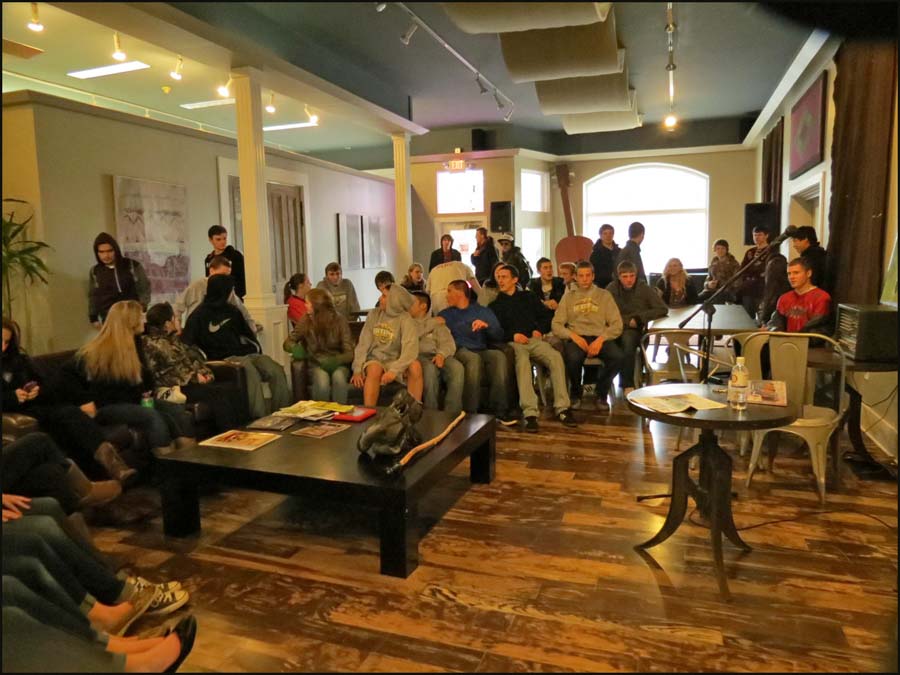
This was the notice on the bookstore door, reminding people that our kick-off 20th anniversary year event was being held at Brew North coffee house. So that answers the Who? and Where? questions, I hope. The When? was yesterday, Thursday afternoon, April 18.

It was great! The whole high school came!


How? Loreen Niewenhuis is a terrific presenter -- personable, engaging, down-to-earth, and often funny. The students and others in the audience clearly appreciated both her sense of adventure and the scientific research she does before and during her long lakeshore walks. Loreen alternated reading from her book (she has a lovely reading voice, soft yet perfectly audible and well articulated) and taking questions from the audience. The variety gave a comfortable informality to a very professional presentation.


I've said Loreen is engaging. The students were engaged. They were attentive. They asked excellent questions. I was so happy to connect local students -- at last -- with one of the many top-notch visiting authors who have come to Dog Ears Books over the years. I hope this will be only the first of many such engagements. Why? Does anyone need to ask why? I hope not!


Following the presentation came the usual milling around, more informal chat with the author, a bit of bookselling, and gift Dog Ears Books pens for all in attendance -- except that we ran out of pens, so a couple students will have to pick theirs up at the bookstore. "No problem," they assured me. 

Loreen hung out at the bookstore afterwards until close to 5 o'clock, when we went next door for a bite at the Garage Bar & Grill, where David joined us, all of us well satisfied with our day. 

Many, many, many thanks to English teacher Jenny Walter for helping to put this event together, and many, many, many thanks to Erik and Deirdre Owen for volunteering their space at Brew North, as well as to Dominic Iseli-Smith for helping set up ahead of time. This was a true community effort and success. 

And now it's time for me to turn my attention and energy to painting my new bookstore wall.