Search This Blog

Showing posts with label practice. Show all posts

Saturday, January 6, 2024

What will I practice this year?

"What's up, Momma?"


 Whatever you practice

grows stronger.


Those five words stopped me in my mental tracks. They’re from a little book called Radical Compassion, by Tara Brach. A practice is intentional, whereas a habit is often unconscious, but in either case repetition creates a groove.


(1)       Only yesterday I was looking at the pages of my very first sketchbook, given to me by the Artist Christmas of 2004. It came in a wooden box (with carrying handle) that also contained pencils of all kinds, watercolors, brushes, and pastels. Trying out the pencils that first morning took courage on my part, but even in this first book, before any classes, there are a few drawings made as time went by that I see now as “not awful.” (Many, admittedly, are pretty lame.) Much more importantly, for each one I see, I recall the place, the day, the circumstances, such that together they constitute a kind of visual diary stretching from 2005 to 2010, many entries from winter months in Florida. More than does a photo album – because a drawing takes so much longer to produce – they bring the past back to me and give me pleasure. And so I inch slowly, in thought and preparation, back into my once-daily practice of drawing, a way of recording the ordinary stuff of my everyday life.


2006

2009


Big jump here. 


us


(2)       Giving and loving, in thought and action, is a practice for which my marriage was a school, and now that the Artist is no longer with me, I have been consciously and intentionally expanding outward that small,  personal world. How far can my loving intentions reach?This thought will connect to others (perhaps) in what follows.


(3)       In general, over my lifetime, humor has not usually been my first response to anything (and I can be obtusely literal at times), but lately I’m finding it a better response than my habitual reactions to a lot of situations. Instead of leaping to argue or withdrawing to brood, my slower response (because I am not a fast thinker) is gentle and often leads me to laugh at myself. Because whether or not another person intends to say or do something cruel or dismissive or presumptuous – and often they don’t intend that! – if I don’t feel I deserve it, why would I want to take it on and feel bad and launch an angry exchange? Or silently hold a grudge? If the other is speaking or acting from such a negative space, isn’t that just sad? Don’t they need, maybe, reassurance? At least a smile! – I don’t know. I’m just today beginning to work through these thoughts. (Note: Snippy or smart-ass humor would only be anger in disguise. Not what I’m talking about.)


Back to the drawing board

Drawing, giving and loving, laughing are all practices I’ve chosen to focus on in this new year. The last one on my list, (4) forgiveness, is the biggest challenge of all for me, but I am hoping that the others will help me get there. BLTN. Better Late Than Never. Mieux tard que jamais.


My bookstore Christmas tree dropped almost all its needles at once, making procrastination not an option for taking the tree down and putting away the ornaments, and that in turn cleared space in the front window to showcase other green plants, living plants, which received a much-needed beauty treatment, ridding them of dead leaves and cutting back where needed. Having live things indoors with me helps on these gloomy-skied January days.


Window greens

Because yes, the sky is grey, and the days are dreary and cold. “Do you miss Arizona?” someone asked. Mornings in the mountains of the Southwest aren’t much warmer than northern Michigan mornings, but I do miss the almost daily appearance of the Arizona sun and the way it brought the temperature up considerably by afternoon. So, the sun. And the mountains. I miss the mountains.


“When you were in Arizona, did you miss Michigan?” No, I said, because I knew I would be coming back to Leelanau in May. I didn’t have to miss Arizona in summers past, either, when I could count on returning to the mountains in winter. Life is different now. But it’s okay. I am not unhappy about where I am. This is my beautiful home, and when we finally get more snow, it will be even more beautiful. Update: It's Saturday, and it's snowing!


Only the beginning -'

There are exciting aspects to 2024 Michigan winter bookstore life, too. For one thing, the long-awaited release date for Bonnie Jo Campbell’s new novel, The Waters, draws near! As the buzz builds, my impatience grows! Meanwhile, in addition to the Tara Brach book quoted at the top of this post, I am rereading one of my favorite Walter Mosley novels, Always Outnumbered, Always Outgunned (a book I find absolutely perfect) and have read William L. Andrews, the editor’s, introduction to a paperback edition of The Autobiography of an Ex-Coloured Man, a novel (yes) by James Weldon Johnson that I will jump into as soon as I reach the last page of Mosley. Finally, from the Grath collection of river books, I most recently chose to read (or re-read? I don’t remember) a book titled Little Rivers: A Book of Essays in Profitable Idleness, by Henry van Dyke. Obviously, a book with such a title is not one to race through, so I read the preface and first chapter and then slid it back in its place, to pull out again perhaps on Sunday afternoon. 


Many more thoughts percolating about enchantment and right and left brain stuff, but I will keep those for another day. 

To be continued....


Monday, January 3, 2022

The Practice of Grief


Humans and Dogs


The very next morning after we said goodbye to our beloved little Peasy, a much-beloved human friend of ours took leave of this earthly life. We knew it was going to happen and had spent as much time as possible with her during the beautiful Michigan autumn of 2021, laughing, reminiscing, and also seriously plumbing life’s deepest mysteries – in short, having the kind of conversations one has with a close friend of many years. She had been through a decade of cancer treatments and had outlived her physicians’ expectations for her threefold, but now she was ready to go, and we had to continue to be understanding and supportive and strong for her. She had been through enough. It was a cruel twist of fate that had taken her own little dog from her only two months earlier.


Melanie called our weekly meetings in the fall “our special Sundays,” and we had five of them altogether. The Artist was with us for two of them, as he and Melanie had a special friendship dating back to the year her mother was dying (and died) of cancer, and David helped listen and talk her through that hard time. Melanie and I, on the other hand, when by ourselves, talked of family and friendship matters but also spent a lot of our time together talking about dogs.


“I think it’s harder when a dog dies than when a human does,” Melanie said to me one Sunday, “but you can get over losing a dog faster.” It broke her heart to lose Lulu, but even with Stage IV cancer and two broken legs, our dear Mel was seriously considering bringing another little dog into her life. And that was pure Melanie – always looking past present pain to future joy.


The only thing that got me over losing Sarah was adopting Peasy, so I think I know what Melanie was saying. Over time, the dogs we love tend to blend together in memory to a large extent, and taking a new dog into your heart crowds out the pain of having lost the one before, whereas one never really 100% “gets over” losing a family member or close friend, and the personalities of those individuals do not blur together over time. When I think of Annie or Linda or my grandmother, it is that person I want here at my kitchen table, sitting across from me, smiling and laughing and sharing stories. Melanie!


But there she was, only weeks away from the end, telling me that she thought it was “harder when a dog dies”! If she were here with me now, Melanie would not chide me for the grief I feel over Peasy but would understand it completely. A dog, after all, is an around-the-clock, constant companion. When you share your world with a dog, you are the sun and the moon to that animal. You never have to worry that the dog might have other plans for the day. He or she is there, rain or shine, whatever your mood.


Grief Practice


It is a new year.

The year 2021 brought countless deep losses for many people, not only us, and, as the Artist notes, at our time of life it is in the nature of things that friends will die. Another friend, blessedly (!) still alive in her 90s, made the suggestion the other day that perhaps grief is a practice. The way I heard her suggestion was understanding grief as a kind of meditation, with its own rituals, something we go to daily, like prayer.


Julia made her suggestion about grief as a practice after I had posted on Facebook a pencil sketch I’d done of Peasy. He was a beautiful, extremely photogenic dog, and I have a lot of photographs of him to use as models for sketches. Another friend (maybe the same day) shared the idea that grief is love that has nowhere to go, and that made sense to me, too. When the ones we love are alive, our love has their physical presence as its object. Now, with my little guy’s absence confronting me everywhere I look in the physical space around me, it is some comfort not only to look at photos of him but also to try to capture as many details as possible on paper with my pencils. The visual and tactile aspects of drawing give my love “somewhere to go” so that it doesn’t paralyze me. It is grief work. Soul work. 


Talk is a big part of the practice of grief, too. The Artist and I spend countless hours remembering friends no longer with us and also recalling the dear and beautiful and humorous aspects of our departed dogs. (“What do you miss about him most?” “The snuggling.” “Yeah, that was the best part.” “And his little ears, too.” The way his little rear end would wiggle with joy, since he had no tail to wag. The way he would run so proudly from one end of the house to the other with his squeaky lion.) We tell and retell stories of times spent with friends, as a way of keeping them with us. I also go back mentally, over and over, the meal menus of the “special Sundays” with Melanie: homemade muffins from my farmhouse kitchen; Polish sausage and sauerkraut from Bunting’s Market in Cedar, Indian food from NJ’s in Lake Leelanau, that fabulous “Figgy Piggy” sandwich from the New Bohemian CafĂ©; and Indian food again. Planning each Sunday meal helped to make those afternoons celebratory. And the Artist and I go over the conversations….


Talking often leads to crying, and crying is part of the value of the talk. There is no shortcut through grief, only the painful way through it, and the talk and the tears allow the feelings to be consciously and fully felt. Does that sound paradoxical? That a person could have “feelings” without feeling them? Think denying, repressing. Not a solution.


Talking and drawing invite grief to sit down next to me. I need to let myself feel the losses fully. On the social side, however, I am also forcing myself out to spend time in the world of other people rather than immersing myself in grief fulltime. Dropping out is no solution, tempting though it can be. -- In fact, quite honestly, it tempts me again and again, and I have to overcome it over and over….


Ambiguity and Dilemmas


I’m going to try to telescope and condense as much as possible other topics I wanted to cover in this post -- ambiguous loss, moral dilemmas, and negativity bias – so as not to exhaust readers’ patience or my own mental and emotional energy. 


Moral dilemmas,” the idea of them, is a large area of exploration and thought in the academic study of ethics in departments of philosophy. Some philosophers think moral dilemmas do not exist: there are only right and wrong choices, and if you don’t know what to do, you’re either not thinking clearly or trying to put one over on yourself. What world do these people live in? In my world, whether there are only two choices or half a dozen, sometimes there is no choice that comes without something to regret. 


“You had no choice,” people like to say, and yes, sometimes life decides for us, but other times we do indeed have to choose. “You did the right thing. You have nothing to regret.” Oh, yeah?


“Choosing under uncertainty” is also an area of study, not only in philosophy but also in economics. Well, aren’t we always? We repeatedly ask “What if?” questions. What if this or that consequence were to come about? Horrible! Need to avoid it! But what if it never would have? We cannot know.


A friend sent me an article on negativity bias (here is one article on negativity bias, though not the one my friend had copied and pasted into an e-mail to me) after I’d sent her one on ambiguous loss, and I’ll be reflecting on these ideas for quite a while. But putting them together, I wonder: can there also be ambiguous gains? I understand the idea that some losses are obvious and clear-cut, others hard to point to or recognize, but I’m wondering now if the same might not be true of gains and if it is negativity bias that gets in the way of our seeing ambiguous gains.


Deciding to end our young, happy, loving dog’s life out of concern for the safety of our human friends and family was a hard, hard call, and I would be lying if I were to say I am completely comfortable in thinking that I did “the right thing,” i.e., made the only ethical choice possible. It isn’t only that I miss Peasy dreadfully. It’s knowing how much he loved his life with us! His future was uncertain! Well, we “played it safe,” and he won’t injure anyone else in future (now that he has no future), but I can’t help the agony of second thoughts, the bleak, dark hours of wishing I had tried longer and harder and more wisely to rehabilitate him fully. Is that negativity? For me, I see it as trying to understand and to learn. 


Losing him was not an ambiguous loss. Damned obvious! What, though, about gains?


Pointing to the obvious gains of his presence in our life is easy (something about this, at least, is easy-Peasy!): the love we gave him and the love he gave us, all of it growing stronger and deeper all the time; the joy he took in being alive and in having a family and the joy we took in seeing him happy; satisfaction in being able to give shelter and security and a good life to the dear little creature. More ambiguous gains, perhaps, were the lessons we two human beings learned in being calm and patient and nonjudgmental. There were incidents of unacceptable behavior, but we never blamed our dog for what he couldn’t help. Can we carry this learning back into the world of other human beings? Should we try?


Now that he’s gone (and there is no getting him back again!), I don’t want to hear about all the horrible things that could have happened with him. None of those horrible things will happen now. It’s over. He’s gone. All I want to think about (if only I could control what comes into my mind! Because what keeps coming in are the second thoughts, the regrets!) is everything about my little dog-boy that was lovely, beautiful, cute, funny, sweet, joyful. His wonderful qualities were unambiguous.


So where am I now? Still alive, awash in ambiguity and uncertainty, gratitude and regret.


Books Read Since Last Listed


Here are the books I read in the last days of 2021:


174. Frank, Anne. The Diary of a Young Girl (nonfiction)

175. BenĂ­tez, Sandra. Bitter Grounds (fiction)

176. Charging Eagle, Tom & Ron Zeilinger. Black Hills, Sacred Hills (nonfiction)

177. Dillard, Annie. Pilgrim at Tinker Creek (nonfiction)

178. Diffenbaugh, Vanessa. The Language of Flowers (fiction)


(In case you’re wondering, 174, 177, and 178 were all re-reads for me.)


The first things I’ve read in this new year have been:


1. Into the Savage Country, by Shannon Burke (fiction); and

2. Le Coeur Simple, by Gustave Flaubert (fiction)

3. Fidelity, by Grace Paley (poetry)


I had read none of these three books before. New year, new (to me) books. Onward and upward --


P.S. I hope at least some of this makes sense. I am not at the top of my game these days.

Tuesday, October 18, 2016

Is Riding a Bicycle Like Riding a Bicycle?


Are there things you just don’t forget how to do, if once you’ve learned them? David thinks playing the violin is “like riding a bicycle,” in that anyone who ever played the violin can pick it right up again after years of not practicing. Oh, no! I told him that playing the violin is not like that at all! Even singing isn’t like that. The voice is an instrument, too, and not practicing has consequences. Really.

For most of my life, I only dreamed of being able to draw, but then I read Drawing On the Right Side of the Brain, by Betty Edwards, and became convinced that even I could learn to draw with a teacher using these methods. At last Elizabeth Abeel offered a drawing class in Traverse City in the evening, when I could get there to take it, and so, three years ago, my lessons and practice began.

Three years ago. I kept at it through July 2014 but subsequently lost my discipline, only picking up a pencil or pen a few times during our following Arizona winter.

I’ve missed those sessions with paper and pen or pencil. Photography, another blessedly wordless activity, offers moments of relief from mental chatter, but drawing is more like yoga than it is like (amateur) photography in that regard, centering one’s focus and slowing subjective time. Really, taking time out of consciousness altogether.

It will take time, however, for me to work back into the wonderful discipline of losing myself in drawing. That’s okay. I fully intend to get back to doing it again on a regular basis – and making that decision, simply anticipating drawing, brought joy to my heart. Waking up Saturday morning, before opening my eyes, I was already seeing lines on paper – branches, leaves, facial features – simple lines growing organically into living forms. What a simply luscious way to wake up! A little later, then, driving along familiar country roads, I began seeing again as I had when morning drawing meditation was a regular part of my life. Seeing more, seeing with joy!

My hand is rusty, though. My mind still wants to jump around, and so do my eyes. What I need to do is go back to those first lessons with Betsy, drawing vase-faces and copying drawings upside-down. The purpose of those exercises is to turn off the part of the brain that has names for objects and wants to take a short-cut by producing a prototype. Oh, no you don't! We want that naming brain to shut up and let the eye and hand follow contours wordlessly.

This is going to be good medicine. I feel it already. Don't you feel the need for a break from talk-talk-talk this season, too?

...I venture to say that learning to draw always seems to help and never to harm. My students’ most frequent comment after learning to draw is “Life seems much richer now that I am seeing more.” That may be reason enough to learn to draw.
 - Betty Edwards, Drawing On the Right Side of the Brain: A Course in Enhancing Creativity and Artistic Confidence


Thursday, April 21, 2016

Looking for That Thin Line

Showing you my daffodils


The intrepid Ulysses Reading Circle met last night to discuss Sherwood Anderson’s Winesburg, Ohio. I don’t intend to give a full report on our discussion (some of what is said in Reading Circle stays in Reading Circle), but the book got me thinking again about something I raised in our conversation, addressing myself primarily to the two fiction writers in the group. It’s this business of “Show, don’t tell” that writers hear all the time these days. (They are told. Is that ironic?) Sherwood Anderson, I noted, did quite a lot of telling. His characters were often silent types, either unable or unwilling to express themselves to others in their little town, even to their own spouses. (Marriage in Winesburg was more inevitable than desired.) The writers agreed, and I guess we chalked it up to the time, this novel or group of stories – whatever one decides to call it – being now almost 100 years old.

This morning I remarked to David that “Show, don’t tell” these days has almost the force of law in writing advice. Certainly it is an article of belief, a dogma of fiction instruction. Does this mean fiction before our time somehow fell short? Was it in an earlier, lesser stage of literary evolution? Or is today’s dogma simply current fashion, possibly “tomorrow’s outworn myth”?

David made an interesting point. If we see fiction as coming out of story-telling, he said, why would we denigrate it for telling? A story-tellers tells a story, he said, adding, “It’s not a movie!”

I’ve pondered this question before. Like so many of life’s fascinating questions, though, it has a way of coming around to nag me again and again.

Here’s one of the first sites (following a Wikipedia entry) that turned up in my search today. It’s a copyrighted site, and I’m reluctant to quote from it, partly because of the copyright and partly because I’m not crazy about the “evocative description” he uses as a substitute for flat telling. For me, the description is full of trite adjectives. And anyway, isn’t the writer telling the reader what the woman looks like, rather than, as in the rejected sentence, just telling the reader she’s old -- so that the former, more descriptive telling is not called telling, but showing?

Another site offering the same lesson and advice on avoiding the pitfall urges the addition of detail. So is showing just telling more? Caution is urged, relevance of detail stressed....

I keep scratching, and the itch doesn’t go away.

Then I come upon a site where a writer calls “Show, don’t tell” “the Great Lie of Writing Workshops,” and I can’t wait to read it! Joshua Henkin makes the same point David made, i.e., that stories are not movies and can do things movies cannot --
most important, novels can describe internal psychological states, whereas movies can only suggest them through dialogue and gesture (and through the almost always contrived-seeming voiceover, which is itself a borrowing from fiction). To put it more succinctly, fiction can give us thought: It can tell. And where would Proust be if he couldn’t tell? Or Woolf, or Fitzgerald? Or William Trevor or Alice Munro or George Saunders or Lorrie Moore?
Henkin blames lazy instructors’ and lazy students’ reliance on the “Show, don’t tell” dictum for a lot of bad fiction writing, the kind full of pointless description that does nothing to reveal character or advance plot. I really, really recommend going to the Writer’s Digest site (so I’m giving the link here a second time) to read what Henkin has to say. And then you might want to go back and read again the supposedly improved versions on other sites advocating what they call “showing.”

Read like a writer. Write like a reader. That’s my very vague and unspecific advice.

How do you see the telling/showing question?

Showing chionodoxa


Thursday, November 7, 2013

Seeing the World or Only the Insides of Our Own Heads?


Vase of purple asters
My six-week beginning drawing class is over, but I’m going to keep drawing. Drawing for me is diary and meditation and vacation and conversation, all rolled into one slow, low-key, low-tech activity. Paper and pencil. Or paper and pen. Enough light to see. That’s all it takes.

The drawing I did of my son during his visit I posted on Facebook as well as here on my blog. Reaction from many people (including my son) is often, “I can’t draw at all” or “I can’t even draw a straight line.” Honestly? I have trouble with straight lines myself, but that’s what rulers are for. The contours of most of the things I want to draw, it turns out, do not have straight edges.

What about you? Do you think you can’t draw?

Our instructor remarked the first evening of class that no one would expect to sit down at a piano and rip off a Beethoven sonata without advance study and practice, but people think they should be able to pick up a pencil and right away dash off a good drawing the first time around. Anyone can learn to draw, Elizabeth Abeel, our instructor, told us, but it is something to be learned, and it does take practice.

Classic book!
Abeel uses a lot of techniques from Betty Smith’s classic Drawing on the Right Side of the Brain: A Course in Enhancing Creativity and Artistic Confidence, the book that convinced me long, long ago that I (or “even I,” as I thought then) could learn to draw with a teacher using these methods. Whether you take “left brain/right brain” terminology to be strict physiological description of brain anatomy or a metaphorical distinction between two different ways of interpreting the world, the big lesson in drawing is this:
"DRAW WHAT YOU SEE, NOT WHAT YOU KNOW."
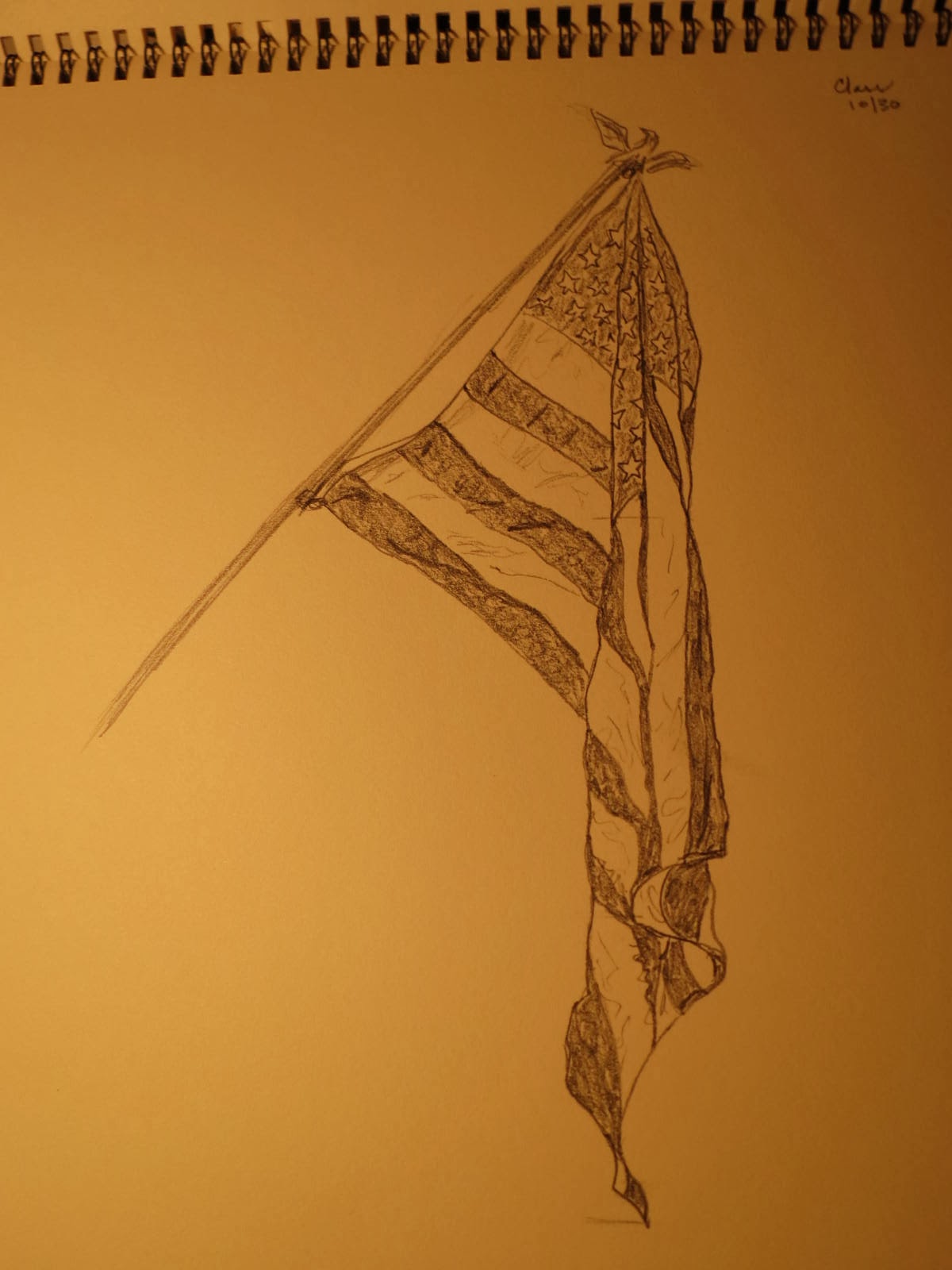
Betsy said this to us over and over, and here’s an example of what it means: If someone is told, “Draw a flag,” most beginners will have recourse to their mental symbol set. That first flag drawing, therefore, will begin as a rectangle, with stripes, stars and whatever subsequently filled in. The drawings will look pretty much like this section of a page from an atlas, only without color and without the slight wave in the lines of these flags:

Flat flag symbols 
But how often do we see a flag stretched out flat? The lesson is to resist pulling out a mental symbol and, instead, to look at a real flag, hanging on a pole. Here are a couple of my efforts to draw a flag in front of me. The first is a hurried first-night sketch (I had read the book long ago and had spent time one winter and all last year drawing, so my first sketch wasn't quite as flat as is the usual with beginning students), the second our “final exam” on the last night of class.

Quick sketch, first night of class
Slow, careful study of artfully draped flag
Getting from the flat symbol to the complex rendering of reality is not instant. One of the first exercises we did was to draw “vase faces,” as our instructor and Betty Edwards call them. (This is in Chapter 4 of the Edwards book, the chapter titled “Crossing Over: Experiencing the Shift from Left to Right.”) First we drew a simple contour of a face seen from the side – forehead, indent for the eye, nose, open mouth, chin, neck. Then we drew lines extending out from the top and bottom of that curved line. Finally, we began the curved line again on the opposite side. The result is either two faces looking at each other or a single vase, depending on how you look it, but the point of the exercise is that one’s “left brain” (verbal, symbol-using, fact-obsessed) will be frustrated and give up, allowing the “right brain” (visual, intuitive, loving complexity) to take over. The “left brain” hates complexity, and the “right brain” loves complexity. You can see why it’s necessary to make that shift if you want to draw what you see and not what you know.

Another exercise was drawing upside-down, copying a drawing which we were also looking at upside-down. Again, the aim was to frustrate the left brain so that it would give up and get out of the way. Instead of the left brain being able to look at a hand and say, “I know what a hand looks like” and pull a clumsy, flat, iconic mitten out of its symbol set, the right brain was given time to concentrate on lines and relationships, without putting nametags on any of the parts. 

(Drawing, the mind bypasses names and symbols and reasons and arguments and causal chains and settles down in the moment. That’s what makes drawing such a meditative experience.) 

Another exercise was doing "pure contour" drawings. In my mind, I call them "blind" rather than "pure," because what you're doing in this kind of work is drawing an object -- say, your own hand -- while looking only at the object and never at your paper. Also, you put the pencil to the paper and don't lift it until you've finished the drawing. The idea is not to reproduce the object perfectly but to give your eye time to follow all the complicated ins and outs of the object's contour and have your hand translate its movement directly from that of your eye.

You can see all these exercises in the Betty Smith book, and in it you'll also find many examples of student work showing exciting and vast improvement in the course of a very few weeks.

A question I have – a hope I have – is whether/that what can be done for seeing can also be done for hearing. What would it take to quiet the chattering, knowing-everything voices in our heads and truly hear what other people are saying? For them to quiet their minds enough to hear us in return? For all of us to slow down and talk to, not past, each other?

Can we translate the lessons of meditation into everyday life?

Thursday, May 23, 2013

Writing of Home – and One Southern Black Man’s Home Ground


Writing for me is discovery. If I knew everything when I began a novel, I’m afraid it would be boring to write. I do not know everything that’s going to happen in the book. I don’t want to know everything. I want to discover, as you, the reader, want to discover, what it’s all about. Those little unknown things that happen on the train between San Francisco and New York keep me writing and you, the reader, turning the pages. Oprah Winfrey asked what I try to reach for in my writing. And I said something to this effect: I try to create characters with character to help develop my own character and maybe the character of the reader who might read me.
 - Ernest J. Gaines, “Writing A Lesson Before Dying,” in Mozart and Leadbelly: Stories and Essays
There is always time for reading in a bookseller’s life -- or in a writer’s life or, definitely and by definition, in a reader’s life. In fact, most gardeners I know are readers, too. So yes, even in the midst of downsizing and moving, de-acquisitioning and remodeling and painting and planning and planting and gearing up for what we call “The Season,” I carve out little pieces of reading time here and there.

Home – what it means, what we mean by the word -- is much on my mind these days. Recurring throughout my life has also been the question of how much any writer can know about his or her characters before writing their stories. The two questions would not necessarily be related in every mind, but because I have been thinking about home and reading Gaines – and because home and writing are both central to my life -- they do occur together in my thoughts.

Again and again Gaines emphasizes that much of his writing career has focused on trying to reconstruct the porch conversations of the old black people in his part of Louisiana. Writing of himself in the third person in “A Very Big Order: Reconstructing Identity,” he recalls the day he left home to go away to school.
[He] realized that to find the tree from which the leaf had been broken was to go back to those who sat out on the porch the day he left. What were they talking about that day while he was inside packing? What did they talk about the day before, the year before, the years and years and years before?
Louisiana (but not New Orleans) is the place Gaines knows best, the place he grew up, but to carve out a literary place for that rural Louisiana required thinking about it, reflecting on it, researching its past, and writing, writing, writing. Because that is what he wanted to do: to write about “the people at home,” the people who had not yet been given a place in the American literature he read in college, to create that literary place for them, to give them life on paper, to introduce them to the world.
I wanted to smell that Louisiana earth, feel that Louisiana sun, sit under the shade of one of those Louisiana oaks, search for pecans in that Louisiana grass in one of those Louisiana yards next to one of those Louisiana bayous, not far from a Louisiana river. I wanted to see on paper those Louisiana black children walking to school on cold days while yellow Louisiana buses passed them by. I wanted to see on paper those black parents going to work before the sun came up and coming back home to look after their children after the sun went down. I wanted to see on paper the true reason why those black fathers left home – not because they were trifling or shiftless, but because they were tired of putting up with certain conditions. I wanted to see on paper the small country churches (schools during the week), and I wanted to hear those simple religious songs, those simple prayers – that true devotion.
Gaines, Southern and black, is unmistakably American, his stories rooted, like those of Wendell Berry’s Kentucky farmers, in a very specific American landscape whose people readers from elsewhere in the country and in different situations would not know but for his work. The place and people existed and are in some true way the source of the stories, but they had to be -- brought forth? That cannot be the right way to say it.

A famous sculptor spoke of subtracting from the stone everything that was not his subject, the subject being “always already” there (“toujours dĂ©jĂ ,” comme disent les français), but can stories pre-exist their writing? And does the sculpture, really? It sounds good, but is it true? I for one don’t believe it.

A different sculptor would, I’m sure, have found a different subject in the stone. Another writer would have found his own very different characters in this “same” terroir. It cannot be the limits of geographical region and actual and historical inhabitants alone that determine stories of any particular place, because there is also the unique voice of the particular author who wrote the stories, and that voice did not simply pour out when tapped, like a vein of oil or an underground spring of water, but had to be developed over time, through work, through the continued and dedicated practice of writing. The writer had to show up for work, sit down to work, and keep at his work. He had to write and edit and rewrite and discard and start all over again. And he had to be open to discovery, to letting characters emerge in their own truth. The characters of Gaines’s work are true to those people he knew when he was young, to people he has known all his life, but no character is simply translated from life to the page. His characters are new beings in the world.

Read that long quoted passage again, the one in which the name “Louisiana” sounds over and over like a bell. Can you feel the sun? Can you smell the earth and the grass and see the children? That is the setting, very different from my northern Michigan home. Next, to enter the lives of Gaines’s specific characters, you must read his stories and novels.

Every successful writer of fiction creates a new world for us. If we give ourselves a chance and let ourselves trust a writer, we can slip out of our own lives for a while and into a place other people call home, and in this way, we can broaden our own sense of being at home on this earth.

Feeling or not feeling at home. Wanting a home, finding a home, losing a home. Homelessness, alienation. Being at home in one's skin and in one's language. The feeling for home is universal, but every instance of it can only be specific.