Search This Blog

Showing posts with label literature. Show all posts

Thursday, October 17, 2024

Look Behind You!


I turned around, and, with the sunrise is behind me, I loved this view.


Sunny Juliet is always ready for outdoor fun, but our style will be somewhat cramped for a while, because after spotting a very large porcupine in the yard (luckily, Sunny was in the house at the time), borrowing a live trap, and watching a couple videos online, I decided I did not have the necessary confidence for Stage 2, i.e., the release of the porky into the wild (far from my home) all on my own. And so, while Trapper Ron is on the job for the next two weeks, Sunny and I will be coming and going from the house with a stout leash between us. 


A friend suggested “maybe he’d leave you alone if you put out a salt block. They like salt." I thought, How about a welcome mat, too? Really, they are so cute, so droll! But they did a lot of expensive damage to a neighbor’s house and ate many tires off cars in my husband’s woodland past, and, if a dog tangles with a porky, consequences can be potentially life-threatening. It isn’t simply an inconvenient, no-fun headache, like a dog-skunk encounter.


So that’s a little news from the outdoor home front, where we also had our second morning of hard frost at our place. The two frosty mornings were not consecutive, however, and now Leelanau is in for a nice little stretch of sunny days, with highs of 60 degrees and above – perfect for enjoying the beautiful fall color, which is what inspired several of today’s photos.


Sunrise, still from behind me, has reached across the field to trees.

Looking at sunrise-lit trees glimpsed under cherries still in shadow.


As for the bookish home front, I have been doing everything possible to postpone coming to the last page of Precious Bane, by Mary Webb. Since bane is something poisonous, toxic, while what is precious is dear and beloved, the title (which comes from an oft-repeated phrase of the narrator) presents us with an oxymoron. Or should we see it (as Susan Cain might) as paradoxical but all the truer to life by reason of acknowledging paradox? Do you think a paradox is a contradiction?


Rather than provide a link to a standard source for Mary Webb's novel, I’m sending those of you who can’t wait to hear more about it to a blog post I found online, because I think the “literary gypsy” loves Precious Bane as much as I do, and I love it so much that I ordered a couple of new paperback copies for my shop, in hopes of sharing the book with others. It is a story in which we look behind us to a very different time, and the dialect is archaic and regional, but a reader falls right into its magic. At least, this reader did.


But here is the rising sun, which I can't deny you.


The porcupine’s appearance and a couple other minor challenges, on top everyone’s current major obsession (campaign season, dontcha know), had me in a rather downbeat mood for a day or two, and I feared that if I came to the end of Mary Webb’s novel during that time, it might just be the straw that broke the camel’s back, so I set Prue’s story aside for two nights and read a couple cozy mysteries back to back, and by Wednesday evening, with Trapper John’s promise of action on the porcupine front and a beautiful sunset, my courage returned. Below is the brilliant sky following the setting of the sun on Wednesday -- but for a more unusual and even more enthralling sight (in my opinion), take a look over on my photo blog, A Shot in the Light, to see what I saw when I turned around. At sunset as well as sunrise, it often pays to turn around and look in another direction. 


Tuesday, August 29, 2023

No one will care, but here is Part II at last.

Cardinal flowers earn their name with bright splashes of scarlet.

I recently read a novel by the philosopher Iris Murdoch, The Sandcastle. It was brilliantly achieved, characters all quiveringly true to life, outcomes in suspense until the very end. A compelling fiction. Following my reading, I sought out the late Murdoch online and found a long interview she did with Bryan Magee, on the topic literature and philosophy. At the beginning, I noted that in mentioning philosophers in our “modern times” who were good writers, he named Bertrand Russell but omitted Henri Bergson, who also received the Nobel Prize for Literature. In naming earlier philosophers who were great writers, he included Nietzsche, my nemesis. 


Here are links to the interview. I followed Part I with interest and got a little way into Part II, but did not watch all five parts because, having only a couple of weeks ago read another book (nonfiction) that brought back my quarrel with Nietzsche, I wanted to write through my thoughts on philosophy as a personal quest rather than an abstract search, because (another because) in the opening part of their conversation, Murdoch and Magee agree that philosophy is impersonal and, unlike literature, does not involve the personality of the writer. 


I strongly disagree. 


Each weaves according to her nature.

I would say, on the contrary, that philosophy makes a pretense of being impersonal and that the writers of philosophy have all, until very recently, attempted to hide themselves behind language that strives to be objective and “universal.” Looking deeply at the problems on which different philosophers have focused, however, and their very different takes on those problems — not just writing style but the substance of their writing — shows obsessions and prejudices and hopes and fears bleeding through, and for me Nietzsche is a striking example.


As my subject heading to this post indicates, I doubt very many, if any, people will mind that it was way back in 2011 that I posted what I called Part I of my own Nietzsche story. If you want the background, here it is, yes, a full dozen years ago. 


For those not inclined to follow links, I'll summarize by saying that I was writing a chapter on Nietzsche in my dissertation on theories of metaphor and, bending over backwards to give him the benefit of the doubt (following philosophy's "principle of charity," a principle more honored in the breach than in the observance), I was “bracketing” – setting to one side – all his troubling remarks on Jews, women, blacks, and others said to possess a “slave mentality” to focus exclusively on what he had to say about language. How much more generous could I be? 


When working on any long piece of writing (and writing a dissertation in philosophy typically stretches over a couple years or more), there is a frequent need to get up out of a chair and move around. Go for a walk. Take a shower. Hit the bars. Whatever it takes to jar the brain enough to get thoughts flowing again. In my case, one fateful day I was pacing back and forth in front of a friend’s bookshelves and pulled a book out almost at random, hardly thinking it would bear on my subject. The title intrigued me: Women and Pornography. The author was Susan Griffin. I opened somewhere in the middle, again at random, and began reading -- idly, at first.


Take a deep breath and plunge forward --

Susan Griffin never once cites Nietzsche in her book. His name does not appear. And yet I kept seeing that name on page after page as I read and as a knot of dread formed in my gut. 


In a chapter entitled “The Sacrificial Lamb” (I borrowed the book from interlibrary loan last month and copied the relevant pages), Griffin describes what she calls “the chauvinist mind.” writing 


…we discover that just as the racist is obsessed with a pornographic drama, the pornographer is obsessed with racism.


She cites the work of Lucy Dawidowicz who concluded, after studying a rock group that proclaimed itself the “master race” and after listing items found in a Hell’s Angel apartment, “Pornography and propaganda have reinforced each other over the decades.” The psychoanalytic term for what the chauvinist’s mind does is projection. What is feared and hated in the self is projected onto another. Here is Griffin again:


Over and over again the chauvinist draws a portrait of the other which reminds us of that part of his own mind he would deny and which he has made dark to himself. The other has appetite and instinct. The other has a body. The other has an emotional life, which is uncontrolled. And in the wake of this denied self, the chauvinist constructs a false self with which he himself identifies. 


Wherever we find the racist idea of another being as evil and inferior, we also discover a racial ideal of the self as superior, good, and righteous. 


Griffin, next page (162):


…The chauvinist cannot face the truth that the other he despises is himself. 


…The chauvinist insists upon an ultimate and defining difference between himself and the other. 


What is it that is feared in the self? Appetite, instinct, emotion, the body and its needs and urges. In short, the power of nature. Thus the “other” is to the chauvinist an “animal,” while he is not – or would have himself not be, but as that is impossible (he is, after all, “all too human”), “his mind is filled with contradiction.”


…He both longs for and fears the knowledge of the body. Nature is a part of him. He cannot divide what cannot be divided. His mind is in his body. His body thinks; his mind feels. From his body, nature renders meaning. He is trapped inside what he fears. 


Anyone who is still with me this far, if anyone is, might wonder what this has to do with language and metaphor. And didn’t I say I was going to set aside all that other stuff? The thing is, everything I set aside is still right there in the writings on language. That’s what filled me with such horror that I fell into a state of shock. 


Do you need refreshing, cool water? I do. Okay....

How so? The task Nietzsche set himself was to “recover” meanings he felt had been “lost,” and this largely involved discarding later meanings, which he regarded as “decadent.” To simplify, imagine a word as a playing card. It has two sides, two different meanings which may even stand in opposition to each other: one side, the “pure” side, “lost”; the other “decadent,” one he would overcome. (This is an oversimplification, obviously, because meanings are more often multiple than merely dual, but if you want a more complicated image, make one up yourself.) In recovering the lost meaning, Nietzsche would have stripped off the decadent meaning. -- But note the problem: the playing card still has two sides! There is no way to get down to a single side, no matter how many layers are stripped away. The task of recovering an imagined original purity of meaning is doomed. 


And yet nature goes on, unconcerned with our angst!

An obsession with purity is essential to racism, just as it is in countries where women must cover their faces and are forbidden to attend school or drive or even to appear in public. It is not the women who are obsessed with their purity but the men who make the laws, who see their own purity at risk if women are too free. 


Policing language is nothing new, either, and you can find examples all over the world. Historically, conquered peoples’ languages have been outlawed by conquerors; various countries strive to keep “foreign” words out of public discourse; and older generations object to new meanings the young attach to older words and phrases. But as I wrote in my dissertation, words are like horses and can be stolen and ridden by those other than self-acclaimed owners, and no one, not even Nietzsche, can ever have the “last word” on any particular meaning. Languages and cultures and meanings evolve, much as do living organisms.


Nietzsche’s Zarathustra raved about clouds staining the “purity” of the sky. I ended my dissertation chapter on Nietzsche with the Gerard Manley poem "Pied Beauty." 

Glory be to God for dappled things—

   For skies of couple-colour as a brinded cow;

       For rose-moles all in stipple upon trout that swim;

Fresh-firecoal chestnut-falls; finches' wings;

   Landscape plotted and pieced—fold, fallow, and plough;

       And all trades, their gear and tackle and trim.


All things counter, original, spare, strange;

   Whatever is fickle, freckled (who knows how?)

       With swift, slow; sweet, sour; adazzle, dim;

He fathers-forth whose beauty is past change:

                                     Praise Him.


Coming back now to my disagreement with Iris Murdoch, I offer for your consideration: Plato's rejection of the natural world as nothing but "appearance," reality being entirely and only eternal, ideal and unknowable (the life lessons the narrator draws from Plato are good ones, but do they need the metaphysics?); Schopenhauer's pessimism; Russell's frustration that philosophy could not be reduced to mathematics (this is my own view of him, so read him yourself to see what you think); Bergson's optimism and obsession with time; my own passionate love of natural ephemera and my Bergsonian-Heideggerian obsession with time. I confess I have not read Murdoch's philosophy, but I have no doubt her personality would reside in it, even if cloaked in mystifying universal terms. 


The images in today's post are from my personal life and surroundings, places and things I love, and my hope is that they will encourage philosophobes to come all the way with me, whether or not they slow down to muse or hurry to this final line.


Clouds add so much to the beauty of the sky.


Wednesday, August 23, 2023

Home and Heroes

I live in northwest lower Michigan, but for me that is not a single place. My official homestead residence is in Leelanau Township, the northernmost of our county’s township divisions. Tell that to my new phone, though! It keeps identifying my photographs near home as having been shot in Leland Township. Wrong! Trust my camera and me instead: the camera doesn’t try to be smarter than I am.


I live in an old farmhouse with a dog, but I also live outdoors (with the dog), working in the yard, going for long walks, noting the passing seasons in signs like the ripening of chokecherries and the way Queen Anne’s lace blossoms curl up into little brown birds’ nests come late summer.


During my working days, I live in my place of business, of course, the bookstore that was 30 years old in July. It wasn’t always in the same location (I’ve been in four different buildings in Northport), but whenever it’s moved I have kept the basic arrangement of books more or less the same, so there is a familiar continuity from one place to the next, and my current location has been home to Dog Ears Books since – can it really be since December 2006? Seventeen of my 30 years???


On a long drive across several states, a vehicle becomes a “mobile home,” even if it’s only a two-door sedan. A van, of course, holds even more, and on a good trip one comes to live in it (or two or more live together in it) with the feeling of being at home even when not stationary (though some days are more comfortably homey than others). Over our years in Leelanau County, the Artist and I enjoyed many a “county cruise,” as he liked to call our Sunday expeditions or slow summer evening drives down to Maple City for pizza or Cedar for ice cream. We could have found pizza and ice cream in Northport, but after being in situ all day we enjoyed the leisurely changing scenery of favorite back roads, and we sought out horse farms for the pleasure of seeing beautiful animals. 


But (my point is that) wherever the Artist and I were together felt like home to me. There was one unhappy night during our otherwise joyous time in France when we wished ourselves elsewhere, but that was due to a flat tire in the rain on a narrow road and a strangely (uniquely) unsatisfactory meal. By the time we ditched the offending rental car in Fontainebleau the next day and were on the train back to Paris, everything was fine, and once back in Paris, we were “home” again. Here is an old post I found with thoughts on travel and home. 


During winters in Cochise County, Arizona, the Artist surprised himself one evening when we returned to the cabin and he remarked, “It’s good to be home.” It was only a rental, but over time it filled with our own things – art on the walls, bookcases filled with books, kitchen items and linens and cowboy boots and hats picked up here and there – so that it did, indeed, come to feel like home to us. We had routines there, we had pleasant neighbors….


All earthly homes, after all, are temporary, are they not?


Anyway, as you know if you’ve read this blog before, (and as you might guess, anyway, knowing that I have a bookstore), I also live in books. Recently reading Horse, by Geraldine Brooks, I lived multiple lives stretching from 1850 to 2020, and now, nearing the last pages of Confederates in the Attic, by Tony Horwitz, late husband of Geraldine Brooks, I am traveling through the South and meeting people I never would have met in my own “real” life. Both these books have my highest recommendation. I’m not sure everyone would respond to them exactly as I did, however. 


Would other readers tremble as they turned the pages of Horse, and would their eyes fill with tears, not only over certain passages when a human or equine character is in danger or difficulty but nearly all the way through the book? And was my reaction influenced by the knowledge that Brooks had begun the novel before her husband’s sudden, unexpected death and finally returned to it as she worked through her grief at his loss? Ah, but I loved the story, and not only for its horsiness, though that was certainly part of the appeal. 


At least one reviewer felt that the author had made the characters of Jarrett and Theo, both young black men, too good. As a white female writer (Australian to boot), Brooks knew some people would fault her for trying at all to portray the inner life – thoughts and feelings – of black men, particularly the 19th-century life of enslaved Jarrett but also that of modern mixed-race Theo. But if writers only wrote characters like themselves, literature would be a rather barren field, wouldn’t it? And isn’t it strange that fictional characters might be seen as too good? 


I can’t help feeling that the “too good” judgment says more of our times than of the author’s choices. There are many kinds of heroes in literature, after all, and not all have to be tragic heroes, brought down by a tragic flaw. They certainly don’t all have to be anti-heroes, either, I hope! Read through this list and see – if you’ve read Horse, and if you haven’t yet, then get on it right away! – what kind of hero you might call Jarrett or Theo. Or not heroes at all? Then, why not? Another question here: Does the 21st century accept everyman or classic heroes only in fantasy fiction? That seems sad.


In Confederates in the Attic, Tony Horwitz tours historic Civil War sites in ten states and learns just how alive the Civil War still is for many Southern groups and individuals, their cast of heroes and villains very different from that of Americans in other parts of the country. That is, while I don’t recall being taught in my Illinois education that any of historical persons of the 1860s (other than anonymous slave-holders) were exactly “villains,” Illinois as the “Land of Lincoln” certainly saw Abe as a hero and martyr. Yet I always had my doubts about Sherman’s march to the sea, which appeared to me somewhat like America’s dropping atom bombs on Hiroshima and Nagasaki, the argument in both cases being that the wars came to a close sooner, thus saving soldiers’ lives. Killing civilians, including children, to save men in uniform, though, never sat right with me. And who knows when or how the Civil War and World War II might have ended without those civilian atrocities? 


Joseph Campbell, in Hero With a Thousand Faces, identified a universal hero myth, in which the protagonist leaves home, has transformative adventures, and eventually returns, changed and triumphant. I wonder about this. I’ll go along with the adventures – challenges to be met, adversities to be overcome – but is life really that much like baseball, with return to home plate the only possible good outcome? I see that homecoming can be a good way to bring a life to wholeness, but I question whether or not it is the only way. Some of us whose families have not been established in the same place for generations are fortunate, as I have been and as John Denver was, to “come home” to a new landscape and to create memories there in whatever time we have.


One man Tony Horwitz spent time with, in a little Southern crossroads called Sutherland Station, lived in the same building where he had been born. It had been a general store when his parents were alive.


We sat on the porch, spitting watermelon seeds and watching traffic pass on the busy new highway bypassing town. I told Olgers about my journey and asked why Southerners like himself revered the past. “Child, that’s an easy question,” he said. “A Southerner—true Southerner, of which there aren’t many left—is more related to the land, to the home place. Northerners just don’t have that much attachment. Maybe that means they don’t have as much depth.” He paused, then added, “I feel sorry for folks from the North, or anyone who hasn’t had that bond with the land. You can’t miss something you never had and if you never had it, you don’t know what it’s all about.”  


Someone who has never traveled 100 miles from home, I guess, can be forgiven for imagining that people in other parts of the country are not attached to their home ground. Certainly Wendell Berry has a bond with the land of his Kentucky farm, but I know people here in Leelanau County, farmers or not, with similar feelings. “I’ve come home,” one young woman told me just the other day. She had lived away for a few years but has returned now to the house her grandparents lived in when they farmed the land. And the now-vanished log cabin site I visited only the other day housed an early generation of a family many of whose members (though not all) lived and died not far from those beginnings.


My personal story is that of more restless Americans: father born in Ohio and mother in California, they married in Chicago, and I was born in South Dakota, later to grow up in Illinois where my younger sisters were born. Our family started camping in Michigan when I was 12 years old, though, and when I was 18 it became my home and has been ever since, despite my love for France and a more recent romance with the mountains of Cochise County, Arizona. “I can’t imagine not living in Michigan,” I told our grandson when he asked if I might someday want to move permanently to Arizona. 


The catalpa trees that have appeared on their own and grown since the Artist and I began living in the old farmhouse, apple trees I planted that now bear fruit every year, old maples and basswood planted by the original owners, as well as smaller discoveries, some of them new in the past couple of years, like young hawthorns and exciting wild ginger – all of this, along with every road in the county, spells home to me and is redolent of priceless memories.


I look forward to reading very soon Pamela Perro’s The Long Field: Wales and the Presence of Absence, a Memoir. That phrase “presence of absence” certainly speaks to me. My more specific expectations of this book I will save for another time, however, when I have read it and can report on what I found in its pages.


Thank you for being with me today, on  whatever “today" you are reading these words. 


Wednesday, February 8, 2023

Omigod! Another BOOK???

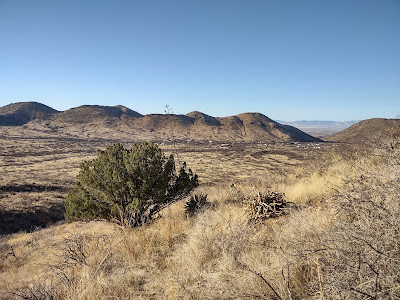
View from the first juniper --


My previous post told of a climbing adventure Sunny Juliet and I had on Saturday morning after I admitted that, before our adventure, I had “gotten up on the wrong side of the bed,” as my parents used to express morning crabbiness. Returning to the cabin post-adventure, then, with no possibility of a coffee house visit in town, would I also return to crabbiness? That was the big question! I had no social plans for the day, and no plans for further adventures, so the danger was real. I busied myself by starting to cook a pot of lentils to stave off bad temper, but the success of this plan would depend on the success of the lentils….


Ah-ha! Suddenly I remembered that the day was Saturday, not Sunday, and that meant there might be something in my mailbox down the road! Purposely stretching out the period of anticipation, however, I chopped onion and carrot to add to the lentils, adding also dissolved tamarind paste, Better than Bouillon (chicken flavor), and plenty of curry powder. Swept the floor. Picked up a book. 
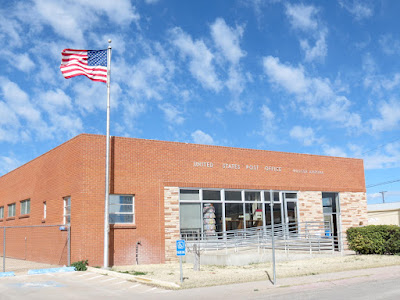

I love USPS, and they do an excellent job here!


Because, you see, if the mailbox is empty on Saturday, all hope must be deferred until Monday; but until my key unlocks the box, hope can imagine a happy outcome. Is Schrodinger’s cat dead or alive? Is my mailbox empty, or does it hold a surprise to gladden my heart? Possibilities exist, if only in the mind, until a box is opened, so why hurry, since one possibility is always disappointment? 


(Please note I do not say the mailbox was both empty and containing a surprise, any more than I say the cat in Schrodinger’s closed was both alive and dead until the box was opened. This frequent interpretive error of a famous argument in physics is made by those who do not recognize the argument as a reductio ad absurdum. Thank you very much!)


Cut to the chase. Waiting for me on Saturday was not emptiness but a book I had ordered from Midtown Scholar Bookstore in Harrisburg, Pennsylvania. (Note: When I order online, I always try to order from real bookstores.) Carry the package back to the cabin. Remove brown cardboard. Next, open the book! Again, a range of possibilities presents. Will I be made happy? Disappointed? Left indifferent?


Flashback. One or two friends had posted links on Facebook to the personal home library of the late Dr. Richard Macksey, humanities professor at Johns Hopkins University. Seductive images of the library made me want to know more about Richard Macksey, and after I’d read about his life and work, naturally I wanted a book he’d written, which is how this particular volume came to be in my mailbox on Saturday. 
 

Not one you would have chosen?

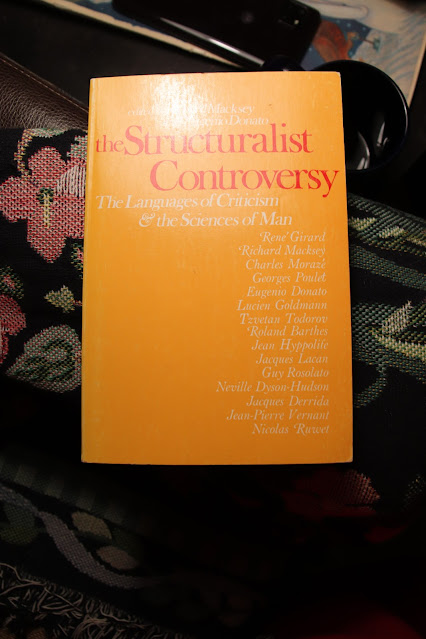
The book. What I found at Midtown Scholar was a paperback edition of the proceedings of an international symposium on structuralism convened at Johns Hopkins in 1966 – not only papers presented but discussion following each presentation – with, thanks to Richard Macksey, an all-star multidisciplinary cast: René Girard, Richard Macksey, Charles Morazé, Georges Poulet, Eugenio Donato, Lucien Goldmann, Tzvetan Todorov, Roland Barthes, Jean Hippolite, Jacques Lacan, Guy Rosolato, Neville Dyson-Hudson, Jacques Derrida, Jean-Pierre Vernant, and Nicolas Ruwet, to give the names in the order in which they appear on the book’s cover. The book itself is The Structuralist Controversy: The Languages of Criticism & the Sciences of Man.


Reminder and disclaimer. I was never an English major, please recall. Reading literary and art criticism can put me off, and writing it (I learned early on, when given such an assignment, not to choose work I loved!) I found downright painful. One graduate class in Philosophy of Literature and a semester as a teaching assistant in Philosophy of Film, with another in Philosophy of Art – that is the extent of my formal background in criticism. Graduate classes in philosophy in the late 1980s, however, introduced me to Foucault and Derrida, structuralism and deconstruction. But that’s all, and it was not a road I traveled very far.


Back to the book. Richard Macksey’s opening remarks to the assembled group bore the title “Lions and Squares.” It was – I suppose predictably and appropriately – academic, historic, and jargon-studded. It was fine. It did the job. My heart was not set on fire, but neither did I regret having ordered the volume. I read on….


I should probably re-read, “Tiresias and the Critic,” presented by René Girard, and before doing that should re-read Oedipus Rex, but as there was no discussion following that short piece, I moved on to Charles Morazé on “Literary Invention,” in which he proposed to question “the relationship of literary invention to invention in general.” Both the paper and the discussion following leaned on a distinction between invention and discovery, and I found myself smiling at the discussion, so familiar from my graduate school years. I was reading happily, crabbiness banished.


Jackpot!

Then came “Criticism and Interiority.” At first the paper’s title gave me a sinking feeling, a feeling that could be named the “Anticipation of No Fun at All.” How wrong that prediction was, and how glad I was to have been wrong! Why was I never introduced before to Georges Poulet? Here is how he begins:


At the beginning of Mallarmé’s unfinished story Igitur there is the description of an empty room, in the middle of which, on a table, there is an open book. This seems to me the situation of every book, until someone comes and begins to read it. Books are objects. On a table, on shelves, in store windows, they wait for someone to come and deliver them from their materiality, from their immobility. When I see them on display, I look at them as I would at animals for sale, kept in little cages…. They wait. Are they aware that an act of man might suddenly transform their existence? Read me, they seem to say. I find it hard to resist their appeal. No, books are not just objects among others. 


This man is speaking my language! And while his position becomes increasingly complicated as he proceeds, I was with him all the way. He speaks of how, when we read, the mind of the author enters our own. We think the writer’s thoughts – or they think us – but we are not thereby invaded. No, in the intimacy of reading, “I begin to share the use of my consciousness…” as the author and I “…start having a common consciousness.” From his personal experience, Poulet says,


Thus I often have the impression, while reading, of simply witnessing an action which at the same time concerns and yet does not concern me. This provokes a certain feeling of surprise within me. I am a consciousness astonished by an existence which is not mine, but which I experience as though it were mine. 


Haven’t you felt this, too, at times? “Lost in a book,” now and then you remember that you are reading, that you are not the character with whom you identify or the author of the characters, that you are holding in your hands a physical object, a book, and that the words on the page are creating visions in your mind. Really, it is astonishing, is it not?


I will not attempt a complete exposition of the ideas in Poulet’s paper, as I’ve probably lost 95% of my readers by now, anyway, and you few stalwarts hungry for more can treat yourselves to reading his works firsthand. But first, just a little more, because I find this so delicious. Poulet draws a contrast between two kinds of critics, one who loses their [you see? I can use current pronouns, though it still goes against the grain!] own consciousness in that of the writer, the other who refuses such identification altogether. The first kind of critical thought (I might say ‘reception) he calls ‘sensuous,’ the second ‘clear.’


…In either case, the act of reading has delivered me from egocentricity. Another’s thought inhabits me or haunts me, but in the first case I lose myself into that alien world, and in the other I keep my distance and refuse to identify. Extreme closeness and extreme detachment have then the same regrettable effect of making me fall short of the total critical act: that is to say, the exploration of that mysterious interrelationship [my emphasis added] which, through the mediation of reading and of language, is established to our mutual satisfaction between the work read and myself. 


He then suggests – perfect, I say! – combining the two methods “through a kind of reciprocation and alternation,” and I am delighted! Well, there is much more about subjects and objects, subjectivity and objectivity, but I leave it to you who are interested to follow up with primary sources. 


The first question asked of Georges Poulet in the discussion that followed his presentation was how, if at all, reading was to be differentiated from understanding another’s speech, and while acknowledging the fundamental similarity in the two cases, Poulet pointed out that in conversation, two or more participants are not only listening but also themselves speaking,


…and when we speak, we don’t listen. Thus very often, conversation, instead of becoming an inquiry in which someone who listens (or who reads) strives to identify himself with the thought of someone who speaks (or writes), becomes instead, quite to the contrary, a sort of battle….


Here, now, re-reading, I pause. [Pause. What do you think?] Because when I read history or opinion of any kind, I read not to lose myself (as in reading a novel or a poem) but as if I am a participant in a conversation, agreeing and disagreeing, questioning, objecting – in short, definitely keeping my distance. As when I read this very paper! But this is not a major disagreement….


Only one more bit that I can’t stop before including: In response to a philosophical question from James Edie, Poulet addresses an implied side issue: 


Am I “for” or am I “against” structuralism? I simply do not know; it is not for me to say; it is for the structuralists themselves. For my own part, sometimes I feel rather alien to the abstract and to the voluntarily objective way in which these structuralists express their own discoveries, and sometimes I am even shocked by that position. Sometimes I am shocked especially by their air of objectivity (I think particularly of one of them whom I consider a friend). I am particularly shocked when he claims to arrive thereby at scientific attitudes. I must confess that, to my own mind, very clearly, very definitely, criticism has the character of knowledge, but it is not a kind of scientific knowledge, and I have to decline very strongly the name of Scientist. I am not a scientist and I do not think that any true critic when he is making an act of criticism can be a scientist. [Again, the emphasis added is my own.] 


Well, my love only deepens with the statement quoted above. Not all knowledge should be called science, and science does not exhaust all the possibilities of knowledge. Thank you, Monsieur Poulet, for knowing so clearly where you stand and for allowing me, in reading your words, to stand with you!


And, once again, I echo fervently the words of the fictional Roger Mifflin, “Thank God I am a bookseller!” Magic and mystery are on every page of every book!


Postscript on Wednesday: 


State of the Union address: I listened and was very, very proud of President Biden, both for what he said and how he said it. At the same time, I couldn’t help remembering that last year David and I listened together, and that brought tears to my eyes. Several times the president made a joke, and I thought of how important a sense of humor was to David, in his friends and in anyone who intersected with his life. I also noted times when we both would have said, “Yes!” to the president’s statements. (Unlike me, my husband always listened quietly to political speeches, saving his comments for afterward, so with him I tried to do the same.) I remembered how David’s opinion of the president (make no mistake: we both voted for him!) rose considerably after the State of the Nation address. This year again, the president showed dignity, strength, and resolve. He did not avoid controversial subjects, either. The office of the president is strong and honorable under this president.


Throughout the year, President Biden is not always in our faces from one day to the next and acting like the “great and powerful Oz." No, he is a team player -- but he is also a strong leader, and when he does speak out, he speaks out strongly. 


David, I miss you! I wish we could have listened together again this year! Hope for my country, hope for our grandchildren and great-grandchildren — that’s what I got out of President Biden’s State of the Union address, and I know I am not alone. 


Keep calm. Carry on.


Wednesday, June 9, 2021

Thoughts on Death – Literary, Botanical, and In Summer

Leelanau Township cemetery


In Books


I was writing something completely different the other morning when out of the blue came this thought: I believe there are many more murders and suicides per capita in literature than in life. Doubtless part of what gave rise to this was having finished reading Edna O’Brien’s Country Girls trilogy. Women as well as men, O’Brien makes clear, can lead lives of quiet desperation. 


The per capita notion always puts me in mind of a graduate school friend from Winnipeg, who told me of a friend of hers, a fellow Canadian, who always insisted on putting Canadian statistics in per capita figures so his country could come out near the top. It does make sense, though. Ten of anything in a population of a million isn’t much, but ten in a population of twenty-five is significant. 


What makes soap operas seem unreal, I realized back in my teen years, was the small population involved. Affairs, unplanned pregnancies, marriages, divorces, murders, and incidents of injury causing amnesia (a popular soap tragedy) all happen in real life but spread out much more thinly among the population of a community. In the soap world, the cast of characters is limited, and so every dramatic event possible will eventually befall a character who is on the show for many years. (Numbers by themselves are only numbers.) In a work of fiction, though, while the number of characters is limited, we usually have a sense of those characters as placed in a world as large as our own, usually in fact having a great semblance to the world we know, and so what happens to the characters in their lives seems more realistic than what happens to characters in a television soap.


Yet for every Anna Karenina or Caithleen Brady, for every Tom Buchanan or John Proctor, how many men and women go on with their lives despite unhappy love affairs or marriages (either with their spouses or their lovers), and how many divorced parents remain involved in the lives of children by former spouses, often with the blessings and cooperation of those same former spouses? I’m not really asking for numbers, only pointing out that heartbreak leads to a tragic end much less often in real life than it does in books, which makes me wonder what writers and readers are looking for in literature. Something more (or at least other) than simple reality, clearly. More structure, more logic, more of a moral lesson? Clear consequences?


I told the Artist that I would not have wanted either of the country girls in Edna O’Brien’s books for a close friend. To me the emptiness of their lives was worse than anything they did or anything that happened to them, and I hope those I have loved went to their eternal rest with a greater sense of peace and satisfaction in the lives they lived.


Black locust flowers


In the Garden


Years ago I was telling a fellow gardener about dead-heading flowers in my garden, and he advised me that it were well to leave room for death among the flowers. “My garden isn’t big enough,” I objected. Flowers do bloom and fade and fall, of course, as leaves bud and grow and die in their turn, and all that is part of the natural year. But a perennial shrub is not meant to die during the long days of June! Its flowers are meant to fade and drop petals, not turn brown, and the leaves should stay green and moist, not shrivel up and fall off! I am stricken to the heart by this development. 


Sad, dying viburnum!

Sad closeup


Talk about heartbreak! This viburnum was my garden pride and joy, the most beautiful plant I had -- flowering in spring, leafy green all summer, with brilliant fall color. Then this past week its lovely flowers began to shrivel into ugly brown frozen-looking chunks, and the leaves began to wilt and fold up and dry out and die, and I’m pretty sure – believe me, I make the diagnosis reluctantly, not looking for drama – that the culprit is verticillium wilt, a horrible soil-borne fungus that strikes all manner of plants. And once it strikes, it is incurable. So the viburnum may not be the only plant to die for me this summer, and that makes me grateful, in a sighing, could-be-worse kind of way, that I didn’t buy more perennials, tempted as I always am by the idea of beauties that “come back” every spring and don’t need to be replanted.  


Northport corner


In Summer


It is June already! The longest day is coming fast upon us (June 20), after which date the hours of daylight decrease toward December. Oh, no, no, no! Do not turn around so quickly, summer!


Of all the seasons of every passing year, for me summer holds the most and thickest layers of memories with old friends. So many little things remind me of those who are gone – but I cannot begin naming those absent ones, as the list is longer and longer each year. I can accept death in the abstract: it is normal, it is part of the natural cycle (like those fading blossoms). When it comes to individuals, however, it seems unfair. 


“I’m tired of _____ being dead!” I complained impatiently to the Artist one day. “She’s been dead long enough, and I want her back here!” 


In fact, I would settle for having her somewhere on earth again, among the living, and taking comfort in that, even if we never talked on the phone again and she never wrote me another letter. But no, that time will never return. I know we were fortunate to have had the friendship for the years we were both alive. Still….


So strange, how infinitesimal tiny human lives are against the great sweep of history, let alone against the unfathomable backdrop of geologic time. How insignificant, all of us in that perspective. And yet how vivid, how intense, life is for each of us in our brief, immediate days. The brilliancy of buttercups in a patch of sunlight, sudden cry of redwing blackbird, soft kiss of evening breeze, taste of juicy strawberry. Heartache and joy. Oh, the joy of my little dog, rolling on his back in the grass like a horse in the desert dust, scratching an itch with sybaritic abandon. As my friend in New South Wales says, I wouldn’t be dead for quids. -- Except that one day, of course, I will be, so all the more reason to take in as much of life and love and beauty as possible in the here and now.


Calm morning on the bay