Search This Blog

Showing posts with label seeing. Show all posts

Monday, July 7, 2025

Meeting Dogs vs. Being Married, Searching for God, and Building Community

The dogs are excited enough.

First, the dogs --


Whether you are meeting a dog for the first time or coming home to your own dog … whether the dog is reactive or simply exuberant or whatever … the rules of engagement as formulated by Cesar Milan are simple: No talk, no touch, no eye contact. Or as I tell friends coming to my house, “Ignore the dog.” What you’re doing is keeping your own energy calm. You don’t ignore the dog indefinitely, of course, but what you want to reward is calm behavior, not excitement, on the part of the dog. 


Calm is rewarded with play.

I am completely on board with Cesar’s advice and only wish more people would practice it. Even when directly instructed, too many find it difficult not to approach a dog head-on (an aggressive approach in the dog world) with big smiles (showing teeth) and/or cooing voices (inviting dominant behavior from the dog). Then when jumped on, many of those people assure the owner, “It’s all right.” No, it is not all right! You are working against the owner and not in the dog’s best interest! 


But that’s all I’m going to say today about dogs...


Then, marriage --


...because what I want to focus on today is a book by David Brooks, and I want to begin by saying that the way to approach a dog is not the way to make a good, strong, satisfying and lasting marriage. 


On Sunday morning I was writing to a friend, telling her about The Second Mountain, and admitting that I did not fully engage with the book until I came to the section on marriage. And then, as I was writing that to my friend, it occurred to me that what I miss most since my husband died is exactly what we should not do when meeting or reuniting with a dog! 


I miss the talk: the shorthand of “trivial” daily sharing (never trivial to the sharers of it) and the deeper conversations extending over hours or even years. 


I miss the touch: holding hands while walking, sitting side by side in a restaurant instead of across the table from one another, being in direct physical contact as much as possible. 


I miss the eye contact: seeing and being seen, not as two strangers glancing at one another on a sidewalk but as intimates, seeing each other’s hearts and minds and souls. “He saw you,” that same friend wrote to me once. 


"The first time ever" -- I saw him.

Here is the sentence from the section called “The Stages of Intimacy” that changed my casual, desultory reading of Brooks to total engagement:


When you choose to marry someone, you had better choose someone you’ll enjoy talking with for the rest of your life. 


That sentence stopped me in my tracks. Brooks continues:


It doesn’t work unless two people can fall into a state of fluid conversational flow. The phone calls can last hours. They can spend a fourteen-hour day together and the words don’t stop. Everything can eventually be said, and every topic can be discussed. This is what Martin Buber called ‘pure relation,’ when I-It becomes I-Thou. This is what it feels like to be known.


We saw each other.

I really appreciate how David Brooks does not set aside passion to focus on common interests and common values. Friendship is not enough to make the kind of “maximum marriage” he describes and most of us (those who wanted marriage) always wanted to find. A relationship can “make sense” without touching the depths of the soul. Couples who enjoy each other’s company and admire each other 


…may tell each other that they love each other, they may feel real love for each other, but somehow it’s not the kind of love that makes it painful to be away from the person, the kind of love that stirs up turmoils of fear that the other person might go away, the kind of love that produces enchantment and deep happiness when the two of you are just next to each other doing nothing, the kind of love that calls forth the everyday service and constant solicitude that marriage requires.


I can almost see some of my readers recoiling in disgust at this description of what they would call “codependence,” but my money is on the quite well-known woman whose name escapes me at present who said in one of her comedy routines (or in a book she wrote?) that what other people call codependence she simply calls the human condition. Well, but maybe not everyone wants enchantment. Someone once accused me of romanticizing my life, something the Artist and I certainly did, but if we didn’t, who would, and why would we want to stop? 


The Second Mountain is not a book about marriage alone but about commitment and transformation. (Or should I say transformation and commitment?) Brooks calls the first mountain the one on which we strive to measure up as adults.


On the first mountain, we all have to perform certain life tasks: establish an identity, separate from our parents, cultivate our talents, build a secure ego, and try to make a mark on the world….


The goals on that first mountain are the normal goals that our culture endorces….


Then something happens.


What happens varies from one person to another, but the result is the sense that there is another mountain to be climbed. There may be but is not necessarily a change in careers or marriages, but it is transformation that characterizes the second mountain, a move from acquisition to contribution. Topics such as intellectual commitments, spiritual seeking and/or conversion, and community building—these are reasons why I think everyone, not just romantics, should read this book. I loved the idea of community building focusing on possibilities rather than problems, especially the story of the Spartanburg (SC) Academic Movement. 


Basically, the story is about the joy of commitment, which reminds me of the answer Richard Leakey gave when asked if he was really willing to give his life to Kenyan politics. His response was, “What else does any of us have to give?” Where we give our attention and care and time is where we give our life. Something to ponder….


Friday, September 18, 2015

In the Sands, the Dust, the Snows, and the Mud of Time


[A] track is a temporary thing. Unless the mud goes suddenly hard and turns gradually to stone, tracks do not last. They fade, and as they dry, the wind sweeps them relentlessly level to ease its way across the ground. Tracks exist at the interface where the sky drags along the surface of the earth. They exist for a relatively brief time in a narrow level near the surface of the ground where the wind and weather move across, changing the temperature and building information into the track. Nature conspires to steal even the traces of passage. Most tracks made in the world go under unseen. I try to follow every one I can.
- The Tracker: The true story of Tom Brown, Jr., as told to William Jon Watkins.
One of the many glories of an unpaved road is the way it holds tracks. On our morning walks, Sarah sniffs the grass and weeds at the side of the road: that’s her morning newspaper, her nose telling her who’s been where and what's gone on. While she uses her nose, I depend on my eyes to note the patterns made by a tractor, trails of another, earlier walker, the narrow, winding path of a snail, tiny bird footprints, a place where a deer leaped or stepped daintily across the road or where a coyote trotted or strolled, or the surprise evidence that sandhill cranes have been in the neighborhood. 


Until the rains come, that is, washing the slate clean until the next round of news is printed.


Noting tracks, following trails gives me an anticipation for winter and reminds me of the year I spent an hour a week just sitting outdoors, being in one place.
The more we learned to let our attention wander and come to rest on the thing at hand just often enough to catch the disturbances, the better we became as trackers and as observers of the woods.
I was reading those words one morning out on the front porch, before sunrise, with many different messages coming to me through the window – tapping of a woodpecker, crow’s call, screech of jay, rustle of linden leaves, my attention wandering easily and seamlessly from the words on the page to the outdoor sounds and back again.

Our intrepid Ulysses reading group will be getting together next week to discuss Hemingway’s Nick Adams Stories and to propose our next reading adventure. Now that summer is over, we will probably return to “challenging” books, books for which we feel the need of “a support group,” as one member called it when we first came together to read James Joyce. But first we’ll be talking about Hemingway, and I’m still sorting through my responses on that score. Never mind separating the man from the myth – it’s separating the writer from the myth that concerns me.

A recent New York Times “Bookends” piece asked, “Do We Mistake Inaccessibility for Brilliance?” In other words, if a book is very, very long and difficult to read, do we think it must be a work of genius? Hemingway does not force us to that question, especially with his short stories. His style can hardly be called convoluted.
Out through the front of the tent he watched the glow of the fire when the night wind blew on it. It was a quiet night. The swamp was perfectly quiet. Nick stretched under the blanket comfortably. A mosquito hummed close to his ear. Nick sat up and lit a match. The mosquito was on the canvas, over his head. Nick moved the match quickly up to it. The mosquito made a satisfactory hiss in the flame. The match went out. Nick lay down again under the blankets. He turned on his side and shut his eyes. He was sleepy. He felt sleep coming. He curled up under the blanket and went to sleep.”
― Ernest Hemingway, The Nick Adams Stories
Does the simplicity of Hemingway’s style mark it as as a work of genius? Did he, as has often been said, as he himself seems to have claimed, give us a new way to see the world?

In a way, it seems, every writer with a voice of his or her own cannot help giving a new way to see the world, for despite our commonalities and connections and dependencies, despite the cultural grids through which we perceive, each of us must perceive the world for ourselves. I cannot see through your eyes or hear through your ears: what world do I have to offer except the one my own eyes and ears, my own hands and feet and nose and mouth and skin and muscles give me?

So that can’t be the question. The question has to be, instead: Do I see the world differently for having read Hemingway? Do you? Or can any of us only read his work through the myth of Hemingway the writer? 

I’ll leave the questions there for today, but please feel welcome to leave your two cents' worth. It's a quiet, rainy Friday. Sarah and I are at the bookstore. What are you doing with this only September 18, 2015, of your life?


Thursday, November 7, 2013

Seeing the World or Only the Insides of Our Own Heads?


Vase of purple asters
My six-week beginning drawing class is over, but I’m going to keep drawing. Drawing for me is diary and meditation and vacation and conversation, all rolled into one slow, low-key, low-tech activity. Paper and pencil. Or paper and pen. Enough light to see. That’s all it takes.

The drawing I did of my son during his visit I posted on Facebook as well as here on my blog. Reaction from many people (including my son) is often, “I can’t draw at all” or “I can’t even draw a straight line.” Honestly? I have trouble with straight lines myself, but that’s what rulers are for. The contours of most of the things I want to draw, it turns out, do not have straight edges.

What about you? Do you think you can’t draw?

Our instructor remarked the first evening of class that no one would expect to sit down at a piano and rip off a Beethoven sonata without advance study and practice, but people think they should be able to pick up a pencil and right away dash off a good drawing the first time around. Anyone can learn to draw, Elizabeth Abeel, our instructor, told us, but it is something to be learned, and it does take practice.

Classic book!
Abeel uses a lot of techniques from Betty Smith’s classic Drawing on the Right Side of the Brain: A Course in Enhancing Creativity and Artistic Confidence, the book that convinced me long, long ago that I (or “even I,” as I thought then) could learn to draw with a teacher using these methods. Whether you take “left brain/right brain” terminology to be strict physiological description of brain anatomy or a metaphorical distinction between two different ways of interpreting the world, the big lesson in drawing is this:
"DRAW WHAT YOU SEE, NOT WHAT YOU KNOW."
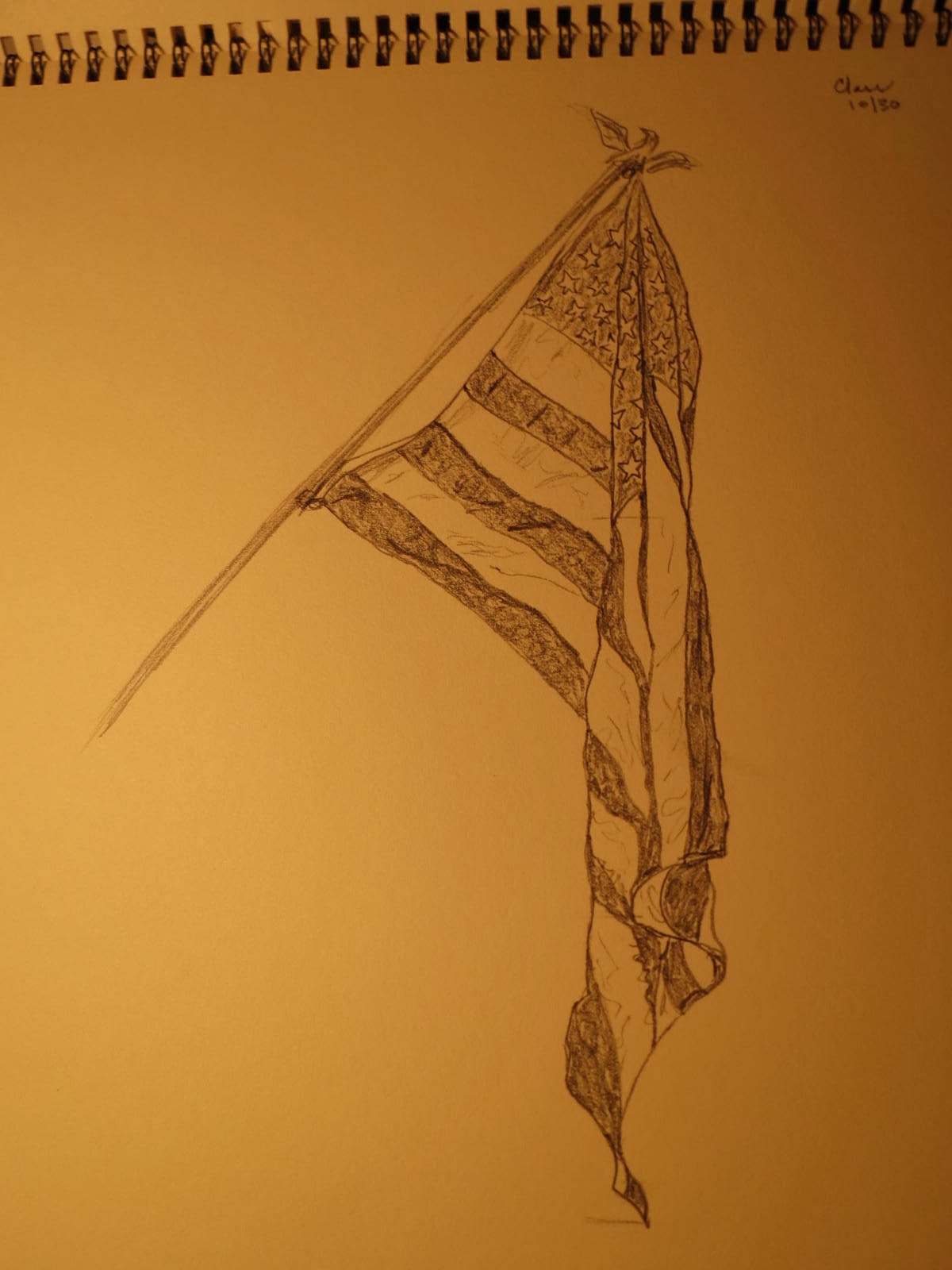
Betsy said this to us over and over, and here’s an example of what it means: If someone is told, “Draw a flag,” most beginners will have recourse to their mental symbol set. That first flag drawing, therefore, will begin as a rectangle, with stripes, stars and whatever subsequently filled in. The drawings will look pretty much like this section of a page from an atlas, only without color and without the slight wave in the lines of these flags:

Flat flag symbols 
But how often do we see a flag stretched out flat? The lesson is to resist pulling out a mental symbol and, instead, to look at a real flag, hanging on a pole. Here are a couple of my efforts to draw a flag in front of me. The first is a hurried first-night sketch (I had read the book long ago and had spent time one winter and all last year drawing, so my first sketch wasn't quite as flat as is the usual with beginning students), the second our “final exam” on the last night of class.

Quick sketch, first night of class
Slow, careful study of artfully draped flag
Getting from the flat symbol to the complex rendering of reality is not instant. One of the first exercises we did was to draw “vase faces,” as our instructor and Betty Edwards call them. (This is in Chapter 4 of the Edwards book, the chapter titled “Crossing Over: Experiencing the Shift from Left to Right.”) First we drew a simple contour of a face seen from the side – forehead, indent for the eye, nose, open mouth, chin, neck. Then we drew lines extending out from the top and bottom of that curved line. Finally, we began the curved line again on the opposite side. The result is either two faces looking at each other or a single vase, depending on how you look it, but the point of the exercise is that one’s “left brain” (verbal, symbol-using, fact-obsessed) will be frustrated and give up, allowing the “right brain” (visual, intuitive, loving complexity) to take over. The “left brain” hates complexity, and the “right brain” loves complexity. You can see why it’s necessary to make that shift if you want to draw what you see and not what you know.

Another exercise was drawing upside-down, copying a drawing which we were also looking at upside-down. Again, the aim was to frustrate the left brain so that it would give up and get out of the way. Instead of the left brain being able to look at a hand and say, “I know what a hand looks like” and pull a clumsy, flat, iconic mitten out of its symbol set, the right brain was given time to concentrate on lines and relationships, without putting nametags on any of the parts. 

(Drawing, the mind bypasses names and symbols and reasons and arguments and causal chains and settles down in the moment. That’s what makes drawing such a meditative experience.) 

Another exercise was doing "pure contour" drawings. In my mind, I call them "blind" rather than "pure," because what you're doing in this kind of work is drawing an object -- say, your own hand -- while looking only at the object and never at your paper. Also, you put the pencil to the paper and don't lift it until you've finished the drawing. The idea is not to reproduce the object perfectly but to give your eye time to follow all the complicated ins and outs of the object's contour and have your hand translate its movement directly from that of your eye.

You can see all these exercises in the Betty Smith book, and in it you'll also find many examples of student work showing exciting and vast improvement in the course of a very few weeks.

A question I have – a hope I have – is whether/that what can be done for seeing can also be done for hearing. What would it take to quiet the chattering, knowing-everything voices in our heads and truly hear what other people are saying? For them to quiet their minds enough to hear us in return? For all of us to slow down and talk to, not past, each other?

Can we translate the lessons of meditation into everyday life?

Monday, October 7, 2013

My Brain is on FIRE!


On last Wednesday morning's walk

Up early in the dark on Sunday morning, habit too strong to let me “sleep in,” I read through the last few chapters of the first half of Pride and Prejudice, making notes for the discussion I am to lead on Tuesday night, and then picked up a book I haven’t had time to open in the last two busy weeks, Farmacology: What Innovative Family Farming Can Teach Us About Health and Healing (NY: William Morrow, 2013), by Daphne Miller, M.D. A review in Acres USA brought this book to my attention, and it sounded like a must-have for my bookstore’s section of new titles in agriculture and gardening, so I ordered two copies a few weeks back. Now I feel the same way I did the first few weeks of my freshman year in college, learning huge amounts at a tremendous speed and seeing connections everywhere. But let me begin at the beginning of Sunday morning.

Wow! I had trusted the book would be interesting but hadn’t expected to meet my old friend (no, we’ve never met; I only know his work) Wendell Berry on the very first page. Only a few pages further in – by page 8, to be precise -- my head was humming like a basswood tree full of honeybees, when the author, through a chance encounter with a little book called The Soul of Soil, recounts how she began wondering if principles for rejuvenating soil could be applied to human health. When a presenting medical problem is simple, she writes, the focus of the physician can be narrow and simple, as well. “But most of the time our health needs are more complex and dynamic” --. I stop in my tracks mid-sentence, my own mind italicizing the words “complex and dynamic.” Associations to into high gear, branching out in surprising directions, and I have to put the book down to give myself time to catch up and slow down again.

This fall I’m taking a non-credit class in beginning drawing, the first art class I’ve ever taken in my life, and in our second session the instructor gave us exercises to do to move us from our left to right brains: “The left brain does not like complexity,” she told us, so when we embark on a complex drawing without recognizable, nameable parts, by attempting to copy a line drawing while looking at it only upside-down, the left brain “will give up and get out of the way.” When the left brain “gets out of the way,” we can no longer rely on pulling stored symbols out of memory but must concentrate on shapes, lines, and relationships, actually seeing rather than thinking about what’s in front of us. (And yes, the instructor, Elizabeth Abeel, does draw heavily from the Betty Edwards book, Drawing on the Right Side of the Brain.)

You see the connection? Miller writes that most of our health needs are “complex and dynamic,” and I hear my drawing instructor saying, “The left brain does not like complexity,” and I see monoculture and pesticides, along with restricted diets, antibacterial cleaners, prescription drugs and supplements as left-brain “solutions,” spawning in their wake myriad new problems because they fail to address the real-world complexity. Miller’s mention on the same page of “reductionist medical training,” the conceptual division of the body into parts for focused study and diagnosis, brought to my mind Bergson’s intellect/intuition distinction, the intellect being our problem-solving, “engineer’s” brain, conceptually breaking reality into parts and often gaining a practical advantage by doing so but making a mistake by believing the analysis has uncovered a deeper reality. The tools created by analysis (i.e., reductionist thinking), Bergson insisted, must always misrepresent reality in order to make its manipulation possible.

Miller contrasts reductionist with holistic, Abeel and Edwards draw the line between left and right brain, and Bergson distinguishes intellect from intuition. I'm only on page 8 of Miller's book, and my head is already reeling, as Wendell Berry and Henri Bergson and drawing and seeing and soil and farming show themselves as always-already aspects of one great whole.

I need to pause here and make it clear that neither Bergson nor Miller would have us do away with intellect or analysis. We need intellect and its work. We must always remember, however, that “the map is not the territory," and that there will always be more to reality than the most minutely painstaking analysis can show.

Back to the rest of Miller’s show-stopper sentence, but let me begin again at its beginning:
But most of the time our health needs are more complex and dynamic, just like the soil, and most of what ails us today – depression, anxiety, diabetes, heart disease, fatigue – is multifactorial, chronic, and not well served by a static and highly focused approach.
“Static” is what analysis gives us. Snapshots. But life is never static, as Bergson insisted over 100 years ago. We are not machines. We are not laboratory creations but living beings – as Wendell Berry reminds us over and over, creatures of the soil.

I want everyone I know to read this book – farmers, medical workers, office workers, parents of young children and older, retired people. “Can’t afford” fresh local produce? I saw a great bumper sticker not long ago: “You can either pay the farmer or pay the doctor.”

This is what happens when one lives surrounded by books. What did Christopher Morley’s old bookseller character say about books being more explosive than dynamite, by virtue of the ideas in them?

Meanwhile, the list of recent topics I have yet to cover here in “Books in Northport” grows ever longer: “Leelanau UnCaged,” visiting poets (Fleda Brown, Arturo Mantecón, and Mark Statman), and soil erosion are the three on the top of the list, unless, that is -- exciting as those topics are -- they get bumped down the line by yet another glorious streaking comet of written excitement that I can’t wait to share. Would it be possible to combine topics and do a post on “Poetry and Soil Erosion”? Possible, surely, but the result would probably too long to hold readers to the end....

Field corn drawings from 2012 stillness project
Well, what is happening in the countryside these days? Farmers who got in their field corn before the last few several days of drenching rain are undoubtedly happy. It’s bow season for deer; how is that working out in the rain? Visitors come Up North for fall color have surely been gratified by its beginning, despite the wet weather, and weather remains warm, so even annual flowers are still bright and lively. 

Ever in motion, ever complex, ever fascinating, the world brings us every day new joys and challenges, painful shocks and delightful surprises. Drawing and writing, we create a record of time that will never, in today’s specificity, return.


Monday, January 25, 2010

Surrounded by Words


I learned so much reading Temple Grandin’s Animals in Translation that I only hope I can remember some of it. I’ll easily remember the parts that were already familiar to me, such as the idea that humans and dogs co-evolved or Grandin’s contention (something I’ve suspected myself) that pain and suffering are two different experiences. What I’d like to remember are the things she says that I’ve never suspected or read or thought or been taught before. I found it fascinating, for example, that researchers now look differently at animal experiments in which the subjects self-stimulated a particular region of their brains. Remember those studies? Remember the so-called “pleasure center” of the brain? Like Grandin, “I thought the ESB animals must be experiencing something like a permanent orgasm.” Well, evidence now says what the rats were stimulating circuits in the brains having to do with curiosity, interest and anticipation, not satisfaction per se.
That’s not as surprising as it sounds when you think about it. At the most basic level, animals and humans are wired to enjoy hunting for food. That’s why hunters like to hunt even if they’re not going to eat what they kill: they like the hunting part in and of itself. Depending on their personalities and interests, humans enjoy any kind of hunt: they like hunting through flea markets for hidden finds; they like hunting for answers to medical problems on the Internet; they like hunting for the ultimate meaning of life in church or in a philosophy seminar. All of those activities come out of the same [“seeking”] system in the brain.


Has someone been watching David and me on a hidden camera? No, we are just typical animals, rejoicing in the thrill of the hunt at bookstores, libraries, thrift shops, flea markets and roadside produce stands.

A more alarming section of Grandin’s book is a section titled “Words Get in the Way,” dealing with a phenomenon called “verbal overshadowing.” Let’s say you witness an event, subsequently engage in an unrelated activity, and then you are asked to write down what you remember of the event. “For example, in one study people watched a short videotape of a bank robbery...,.” Their viewing was followed by 20 minutes of unrelated activity, and after the 20 minutes the viewers were divided into two groups, one asked to write down what they remembered about the robber’s face in the video, the other assigned an “unrelated task.” Finally, both groups were tested to see if they could recognize the robber’s face.
Two thirds of the people who wrote nothing down and did unrelated tasks could identify a photograph of the robber, while only one third of the people who wrote verbal descriptions could pick him out. This is a well-established effect; many studies have found exactly the same thing, and some studies have extended the effect to auditory memory as well. People who write down a description of a voice are less able to pick it out from other voices than people who didn’t describe the voice in words.

How counter-intuitive and shocking is this? “Write it down so you’ll remember it,” we typically say, but now it turns out we might remember better if we didn’t write it down! Are witnesses to real crimes, asked to repeat their testimony over and over, less likely to get the story right or be able to identify suspects correctly? Is describing what you saw in speech different from describing it in writing, or is describing in speech subject to the memory problems? And what about writers who keep journals? Are they chipping away at their memories rather than anchoring experiences in place? And is it only identification of faces and voices that is more difficult after writing a description, or are all kinds of recall adversely affected? There is some comfort to be had in the finding that visual memories are not erased, only suppressed, by written descriptions, but what it takes to recall the nonverbal memories is not necessarily what a court witness or memoir writer would automatically do, so the questions, for me, remain.

Well then, next, having read Grandin’s book, I picked up again Andrei Codrescu’s The Disappearance of Outside with (or through) a whole new frame (or grid) of reference. This book is an example of the very “professor” sort of literature the author rails against in chapter after chapter. a long, long, long series of polemical statements, one after another. The author never has questions, he never wonders, he never doubts or thinks maybe there’s another way to look at matters or says “It seems to me” or “perhaps.” No, the text reads like this: “This, I say, is true. This, I say, is true. This, I say is true.” It’s mentally exhausting, like being punched in the head over and over and over and over. To make matters worse, almost every one of his pontifical declarative sentences is abstract in nature. It’s never “The sun was shining” but always some abstract Take-my-word-for-it truth claim--and often metaphorical, to boot. Not that I have any general problem with figurative language (we would not have poetry without it), but if it’s possible to abuse metaphor, this author has done it.

My suspicions were already considerably aroused before I reached the end of Part Four, entitled “Living with Amnesia,” and found myself (having been thinking a lot lately about words and images) reading the last sentences of that section over and over again:
Unlike words, images do not overthrow each other: they join up. To get beyond them we need to know how to disrupt their joining. We become flatter as they become more multidimensional: each trick of perspective that we dispose of, they take up. Eventually we may become mere images, trapped like shadows in some collective hell, the United Fascist States of Utopia. In another generation, people raised by images will not be able to imagine escape. The walls of Plato’s prison-cave will be animated.

Strange notion, isn’t it, that images will kill imagination? Here’s my one-sentence summary of the passage above: Images are ganging up on us and will take our place, if we’re not vigilant. (When my university students complained that John Locke was too difficult to understand, I had them reduce each paragraph in the Second Treatise on Government to a single sentence. It wasn’t easy, but they could do it, and it’s a good way to figure out what a difficult writer is saying.) Well, if I’d grown up under Stalinism I might find this kind of hyperbole convincing, but as it happens I attended graduate school in philosophy before post-structuralism had been laid to rest (I’m told it that only pockets of it survive today), and so I am as skeptical about scholarly obfuscation as Codrescu is about political propaganda. Also, having spent years picking apart arguments I don’t adopt conclusions too easily, whether my own or someone else’s. So after reading the excerpt above several times over, I went back to the beginning of the long paragraph of which these sentences are the end, and here’s how it begins: “All images want to become one image, the Sacred Image, the Icon.” And I asked myself, “Do I believe that?” And I answered in the negative. I don’t believe it. I don’t believe images want anything, and I don’t even believe that there is a tendency for images to collapse into one another, reducing to a singularity. Quite, I would say, the opposite. The immediacy of the visual world is such that we cannot, unless in some state of psychic shock, avoid a succession of perceptions, or images, and opening our eyes to them, really looking, trying to see, can be an antidote to the often misleading abstractions of words. At least, I find it so.

Is it easier to break an image’s spell with words than it is to break a verbal spell with an image? I don’t think so. Words can be used to overthrow each other, but they can also be used to reinforce, to confuse, to silence, and they have often been so used.

I wrote the other day that David usually sees much more than I do and has a much better visual memory and can describe people better than I can. We left a shop recently, and I asked David if he had noticed the clerk’s tattoo. He hadn’t. It was on her forearm, I told him, indicating its size on my own arm and describing it to him. He was as delighted as I was that my eyes had been open to what was in front of me.

Seeing! What a delight! Shall I shut up now?