Search This Blog

Friday, September 18, 2015

In the Sands, the Dust, the Snows, and the Mud of Time


[A] track is a temporary thing. Unless the mud goes suddenly hard and turns gradually to stone, tracks do not last. They fade, and as they dry, the wind sweeps them relentlessly level to ease its way across the ground. Tracks exist at the interface where the sky drags along the surface of the earth. They exist for a relatively brief time in a narrow level near the surface of the ground where the wind and weather move across, changing the temperature and building information into the track. Nature conspires to steal even the traces of passage. Most tracks made in the world go under unseen. I try to follow every one I can.
- The Tracker: The true story of Tom Brown, Jr., as told to William Jon Watkins.
One of the many glories of an unpaved road is the way it holds tracks. On our morning walks, Sarah sniffs the grass and weeds at the side of the road: that’s her morning newspaper, her nose telling her who’s been where and what's gone on. While she uses her nose, I depend on my eyes to note the patterns made by a tractor, trails of another, earlier walker, the narrow, winding path of a snail, tiny bird footprints, a place where a deer leaped or stepped daintily across the road or where a coyote trotted or strolled, or the surprise evidence that sandhill cranes have been in the neighborhood. 


Until the rains come, that is, washing the slate clean until the next round of news is printed.


Noting tracks, following trails gives me an anticipation for winter and reminds me of the year I spent an hour a week just sitting outdoors, being in one place.
The more we learned to let our attention wander and come to rest on the thing at hand just often enough to catch the disturbances, the better we became as trackers and as observers of the woods.
I was reading those words one morning out on the front porch, before sunrise, with many different messages coming to me through the window – tapping of a woodpecker, crow’s call, screech of jay, rustle of linden leaves, my attention wandering easily and seamlessly from the words on the page to the outdoor sounds and back again.

Our intrepid Ulysses reading group will be getting together next week to discuss Hemingway’s Nick Adams Stories and to propose our next reading adventure. Now that summer is over, we will probably return to “challenging” books, books for which we feel the need of “a support group,” as one member called it when we first came together to read James Joyce. But first we’ll be talking about Hemingway, and I’m still sorting through my responses on that score. Never mind separating the man from the myth – it’s separating the writer from the myth that concerns me.

A recent New York Times “Bookends” piece asked, “Do We Mistake Inaccessibility for Brilliance?” In other words, if a book is very, very long and difficult to read, do we think it must be a work of genius? Hemingway does not force us to that question, especially with his short stories. His style can hardly be called convoluted.
Out through the front of the tent he watched the glow of the fire when the night wind blew on it. It was a quiet night. The swamp was perfectly quiet. Nick stretched under the blanket comfortably. A mosquito hummed close to his ear. Nick sat up and lit a match. The mosquito was on the canvas, over his head. Nick moved the match quickly up to it. The mosquito made a satisfactory hiss in the flame. The match went out. Nick lay down again under the blankets. He turned on his side and shut his eyes. He was sleepy. He felt sleep coming. He curled up under the blanket and went to sleep.”
― Ernest Hemingway, The Nick Adams Stories
Does the simplicity of Hemingway’s style mark it as as a work of genius? Did he, as has often been said, as he himself seems to have claimed, give us a new way to see the world?

In a way, it seems, every writer with a voice of his or her own cannot help giving a new way to see the world, for despite our commonalities and connections and dependencies, despite the cultural grids through which we perceive, each of us must perceive the world for ourselves. I cannot see through your eyes or hear through your ears: what world do I have to offer except the one my own eyes and ears, my own hands and feet and nose and mouth and skin and muscles give me?

So that can’t be the question. The question has to be, instead: Do I see the world differently for having read Hemingway? Do you? Or can any of us only read his work through the myth of Hemingway the writer? 

I’ll leave the questions there for today, but please feel welcome to leave your two cents' worth. It's a quiet, rainy Friday. Sarah and I are at the bookstore. What are you doing with this only September 18, 2015, of your life?


Monday, September 14, 2015

Magic Words, Magic Day


Bee at work on goldenrod

“Sunday off” is a magic phrase. Like “weekend,” it isn’t part of my summer vocabulary, but once September rolls around, I’ve earned a little time off, and when a Sunday in September begins so rich in promise, the open road beckons, speaking much more loudly than yard chores and certainly more compellingly than housework. I came to the end of a delicious book as the sun came up over the woods, and that was enough reading for the day.


Morning reading spot (one of them)


Backyard birdland


Off down the road we went! South! Opposite the direction I go most mornings!

Following breakfast at Art’s Tavern, we ventured down an unpaved side road to a little inland lake south of Glen Arbor. Other dogs were frolicking in the water, and we broke our Sarah’s heart by not letting her join in the fun! Cruel, cruel dog parents!


Lucky dogs!

Our expedition had barely begun. We hadn’t brought a towel. Sarah would acknowledge no merit in our excuses. So, “Time to move along,” we told her. Before envy completely spoiled her day....


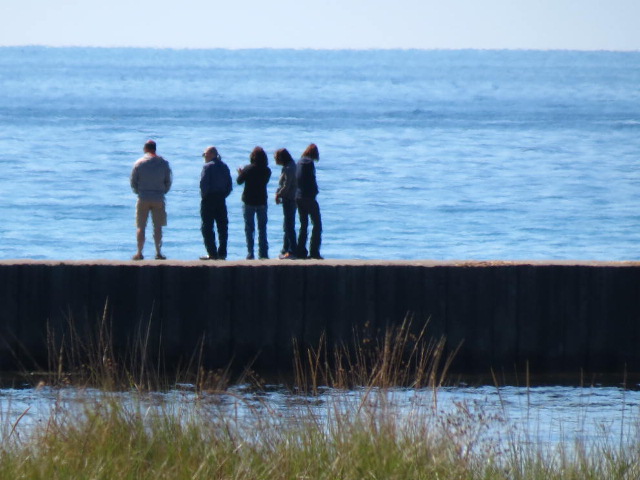
Strollers and fisherman shared the breakwater at Frankfort, a scene we took in from across the Platte River outlet, sharing a cup of coffee before a visit to the Oliver Center for the Arts, where a very colorful show was in progress. You must take my word that it was colorful, or go see it for yourself, though, because I kept the lens cap on as we made our way through the galleries (in which an etching by L. C. Lim, an artist I do not know, kept pulling me back again and again). When we got to the pottery studio, though, I could not help seeing still life compositions everywhere I looked, and while David visited with the potter, I let myself frame a few shots.


South of Frankfort, in southernmost Benzie County and into Manistee County, landscape and scenery looked more and more like the U.P. to me. Towns there are simpler, country houses more modest, and the perils and tribulations of modern civilization comfortably seem far-off. Elberta exhibited a bit of change but not too, too much. Between Elberta and Arcadia we ventured off two-lane blacktop onto a dirt road that narrowed quickly to two-track and then threatened to disappear altogether, crowded on both sides by impenetrable wetland growth. There was nowhere to turn around, and so we had to go on, not daring to stop in loose, soft sandy places or muddy stretches with deep holes. But isn't this just what we had gone seeking? Adventure! A road completely new to us! Coming onto higher ground, with a cornfield on one side, we stopped to stretch our legs and let Sarah stretch hers. At the edge of the cornfield was a pile of fresh scat, with lots of cherry pits and corn kernels showing. I walked down the road a way and found raccoon tracks. Back in the car we continued on our way and eventually came out onto pavement again, none the worse for our exciting detour. Rather the better, I like to think. But I took no pictures on that little road. Private adventure, secret road.

Beyond is Lake Michigan

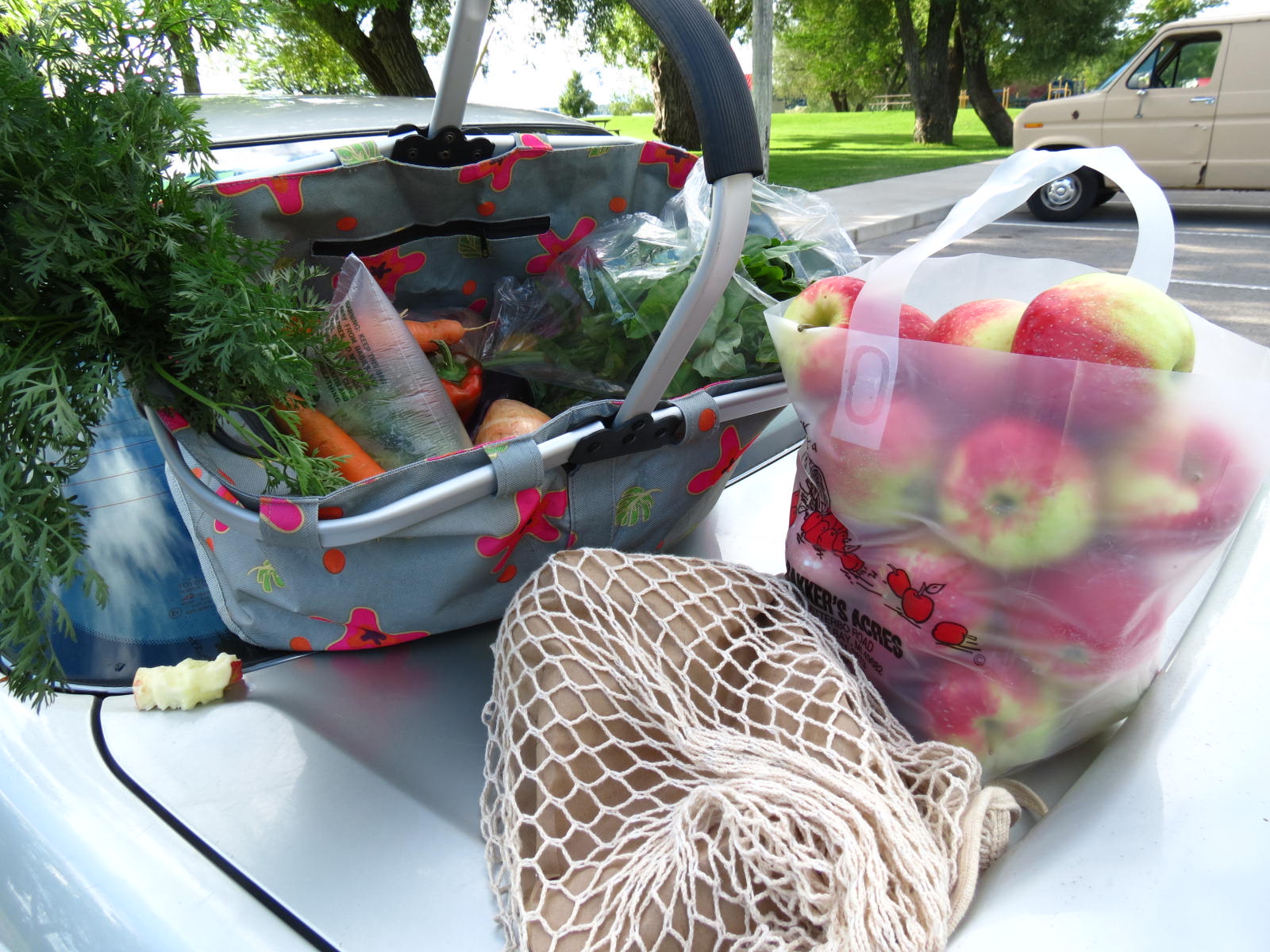
In Arcadia we found a public bench on a dock on the edge of Arcadia’s long, lake-like harbor and soaked up peace and sunshine for a while, sharing a fresh, crisp apple and a bottle of cold water from home: heaven enow. Across the water and behind the sand dune was Lake Michigan.

Too late
Exploring old boatyards exercises the dream muscles (although ours are never inactive for long), and here was no exception. Neither of us is or ever will be a sailor, but we both appreciate nice lines. 

Too big


Then David finds a boat that could use improvement and expounds on its shortcomings and needs, and I discover a flowering plant I associate with Lake Huron rather than Lake Michigan and attempt to impress him with my find – and his interest in botany equals mine in remodeling boats, but never mind! We are patient -- and familiar -- with each other’s pet obsessions after so many years together.

Square windows on a boat!

Tansy!

Circling back through Honor, we stopped for cheeseburgers at the Lumberjack Bar & Grill. As we looked over the menu, two couples in the booth behind me were packing up their leftovers, and I heard one of the men say, “No, the dog won’t eat pickles.” Suddenly I felt a happy kinship with strangers whose faces I could not even see. Without leftovers at the end of my own meal, I saved the last bite of cheeseburger to wrap in a napkin and take out to patient Sarah, waiting for us in the car.

All day long the light seemed golden, with none of that flat, white, washed-out look so usual in the middle of a day. Was it the time of year or because we were so near water that the low fall sunlight was bounced back up and all around us? “Like the light in Italy,” David affirmed when I cautiously ventured my hypothesis. (Neither of us has ever been to Italy.) Perhaps we have seen days just as beautiful but not more beautiful, surely!

There were many photographs I did not take, but back at home, as evening pulled the sun down behind the neighbors’ hill, it seemed I would be able to see this day forever and that along with images of trees and water and fields and golden light pouring down, soaking through, animating everything, I would remember as well our desultory conversation, shared memories evoked by well-known scenes and impossible but entertaining dreams sparked by less familiar horizons.

Home again, where we belong


Saturday, September 12, 2015

Green, Green Grass Still Growing, Growing


With all the dry weather we’ve had, we’d almost convinced ourselves that mowing was over for the season. Then rain came. Encouraged and revitalized, grass reached for the sky. We mowed all evening on Wednesday. That night and Thursday morning it was raining again.


Northport is quieter – as, I’m sure, are many summer tourist towns, in Michigan and elsewhere. School is back in session, visiting families have gone home, their vacations over, and a general early autumn lull has set in. A certain number of older couples take advantage of the quiet time to do some leisurely traveling. Lake Michigan is still warm enough for swimming – more comfortable for swimming now than it was in June, when summer kicked off.

Friday morning was the last official farmers market day in Northport. A few vendors had dropped out, but it was the absence of all the summer people and tourists that was most evident on Friday. 


Our intrepid Ulysses group gave ourselves an easy assignment for September: Hemingway’s Nick Adams stories. When we meet next week for discussion, we’ll propose more arduous works for the months ahead. I undertook on a somewhat arduous solo reading task recently, The Master and Margarita, by Mikhail Bulgakov, translated by Diana Burgin and Katherine Tiernan O’Connor, advised by a summer customer who grew up in Russia that it was a book worth reading although I could not expect to catch all the contemporary political references in the work. The general feeling of the time, however, one does pick up in the English translation. But what a strange, genre-defying novel! Fantasy, allegory, magic realism? And at the same time, the unmistakable traditional Russian flavor, with philosophy and religion and morality and folklore all woven through the dreamlike story, along with ordinary descriptive passages that might have come from almost any era. 

Was the author at all religious, or was it simply the moral aspects of religion that he found missing in Stalinist Russia, and how does the symbolism of the Crucifixion story connect to the devil’s visit to Moscow? Well, very challenging reading, indeed, and I’m glad I read it, but I would probably need to study The Master and Margarita in a classroom to get much more out of it than the basic story, a general sense of the political mise-en-scène, and many vivid scenes, from droll to hair-raising.

September is here. Rain has returned. My thoughts turn to Johnny and Rosanne Cash and their haunting duet, “September When It Comes.” It’s a good time of year to read Nick Adams, too.


Tuesday, September 8, 2015

“How was your summer?” “Literary!”


Poet Jennifer Clark & bookseller Pamela Grath

Here is the Dog Ears Books Summer 2015 season in review, a season that featured fourteen very special bookstore guests. My thanks once again to all of these writers and artists, as well as to those who found time to attend readings, signings, and workshops.

June 17: Ellen Airgood, THE EDUCATION OF IVY BLAKE (YA fiction), 7 p.m.

June 25: Holly Wren Spaulding, PILGRIM (poetry), 4 p.m.

June 30: Anne-Marie Oomen, LOVE, SEX, & 4-H (memoir), 3-5 p.m.

July 8: Jennifer Clark, NECESSARY CLEARINGS (poetry), 3 p.m.

July 25: David Greenwald, THE WICHITA MOUNTAIN MANHUNT (fiction), 3-5 p.m.

July 28: Loreen Niewenhuis, A 1,000-MILE GREAT LAKES ISLAND ADVENTURE (nonfiction), 3-5 p.m.

August 5: Barbara Stark-Nemon, EVEN IN DARKNESS (historical fiction), 7 p.m.

August 8: Ken Scott, THE BACK PAGES (photography), noon - 1 p.m.

August 9: Jerry Dennis & Glenn Wolff, A WALK IN THE ANIMAL KINGDOM (nonfiction), 1-3 p.m.

August 16: Ross Biddiscombe, RYDER CUP REVEALED, 12:30-2:20 p.m.

August 27: Luisa Lang Owen, CASUALTY OF WAR: A CHILDHOOD REMEMBERED (WWII memoir), 7 p.m.

September 3: Susan Gilbreath Lane & Steve Gilbreath, DIGNITY OF DUTY: JOURNALS OF ERASMUS CORWIN GILBREATH, 1861-1898 (nonfiction - Civil War through Spanish-American War), 7 p.m.

STILL TO COME --

Wednesday, October 14, at NOON: Bonnie Jo Campbell, MOTHERS, TELL YOUR DAUGHTERS (fiction)

In short, I kept very busy! How was your summer?


Saturday, September 5, 2015

What Happened Before Labor Day?


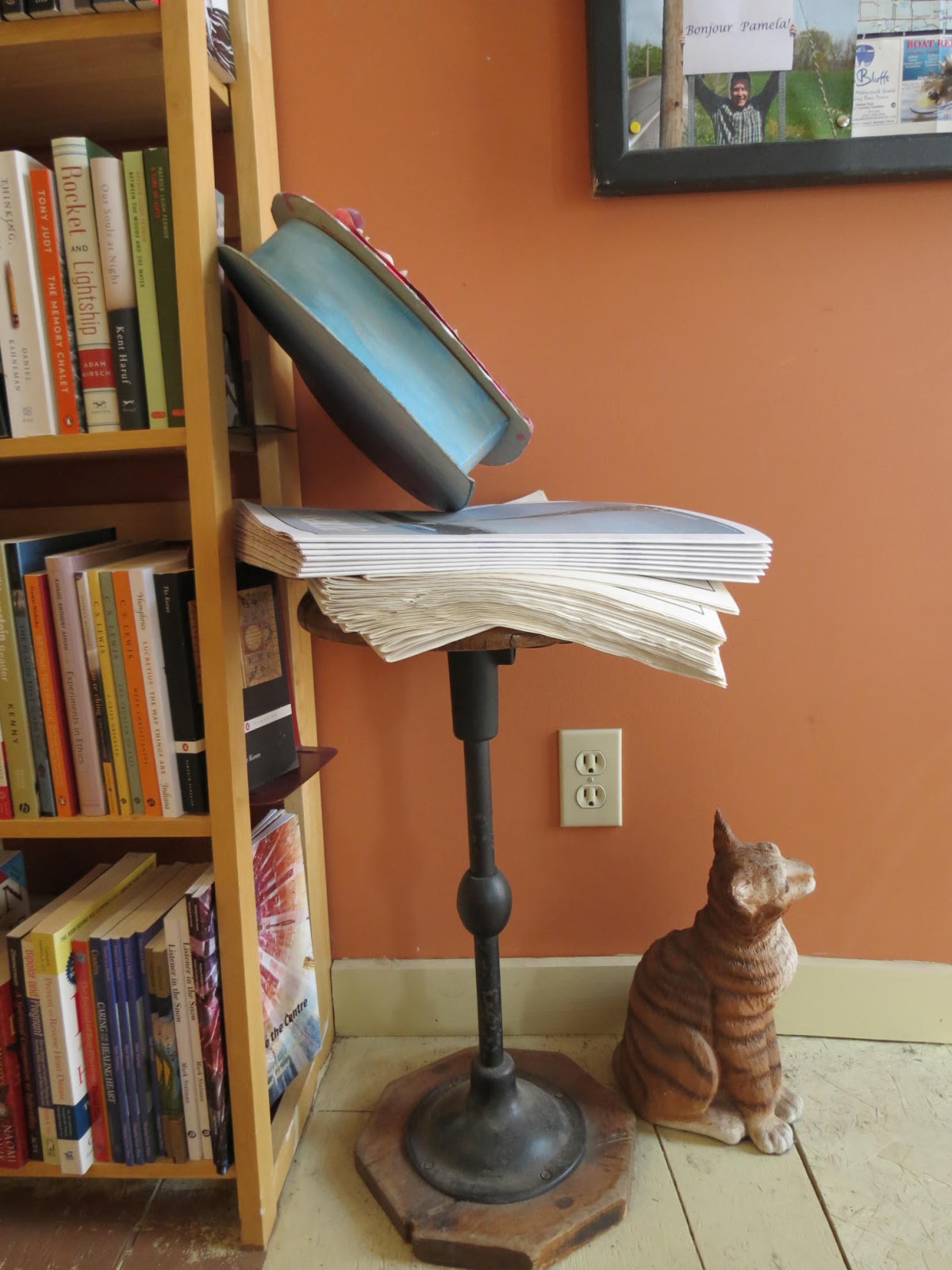
For one thing, the bookstore cat acquired a name. I’ve had the cat for twenty years, a gift from one of my younger sisters, but no one had ever asked its name before. Now a little girl asked, and I had to admit I had never named the cat. I asked her if she would like to name it and what she thought would be a good name. Right away she said, “Kangaroo!” So now Kitty Kangaroo is second-in command store mascot – second, of course, to Sarah the dog, or, as one friend calls her (remembering when we first brought the puppy home and tried out different names), Sarah-Forever.


On Friday afternoon, September 4, the banner announcing Leelanau UnCaged went up across Waukazoo Street.


But the big last hurrah for the bookstore summer season was the September 3 evening event with Susan Gilbreath Lane and one of her three brothers, Steve Gilbreath of Northport. It is their great-grandfather’s journals, telling of his military experiences from 1861 (beginning in the Civil War) to 1898 that were recently published by the Pritzker Military Museum and Library in Chicago, as part of Pritzker’s “Citizen Soldier” series, as Dignity of Duty: Journals of Erasmus Corwin Gilbreath, 1861-1898. The family did not even know of the existence of these journals until Susan found them, by chance, as she was doing genealogical research among her grandfather’s papers donated to the Detroit Public Library. One audience member summed up what Susan called her “dumb luck” in a memorable nutshell expression: “You hit the genealogical jackpot!”

And that’s not all. Not only did the family now have a record of thirty-seven years of their ancestor’s life, but Erasmus Corwin Gilbreath, to the good fortune of all involved, was an educated and very lively writer, so that his eyewitness accounts of many famous battles and of life on the American frontier have a vivid immediacy for any reader. Here is a striking passage from early in the book, to give a flavor of Gilbreath’s writing style:
Night came upon the scene with a pale moon. Its silvery light seemed paler in light of the burning Congress. She burned slowly, and for hours the flames seemed to be playing with the huge vessel whose hull stood forth so massive and black. 
Now a tongue of flame would spring from her portholes and spin up the long ropes to the furled sails. A spar would fall or a sail unfurled by the fire would fall over the side on fire. Again a great tongue of flame would spring aloft as the deck burned through, or a burning mast would fall. And during all this mournful conflagration, as all the guns were shotted, the fire would ignite the charge and some gun would fire sending a ball up or down the river. So slowly and almost regularly did these explosions occur that they seemed like signals of distress or that the noble vessel was firing her own death knell.

Susan told the story of finding the journals and how they came to be published by Pritzker, and then she and Steve took turns reading short passages. There were questions from the audience before we adjourned to give Susan, who edited her great-grandfather’s journals, a chance to sign books for purchasers.


Steve and Lauran Gilbreath have been Northport residents for 22 years. The morning following the bookstore event, Susan Lane and her husband closed on a house of their own in Leelanau Township. What a wonderful way to wrap up an event-filled bookstore summer! Dog Ears Books truly is Leelanau Township’s local bookstore!

What a summer! Thank you to all our loyal bookstore customers for making our events successful!


Thursday, September 3, 2015

Sometimes Reading Makes Me Dizzy


It happens when I’m reading three or more books at the same time – not during the same moments, but going from one to another for several days or weeks, as I’ve been doing since reading Uncle Tom’s Cabin and Harriet Beecher Stowe: A Life.

I’d heard of Between the World and Me, by Ta-Nehisi Coates before someone at our reading group mentioned it, so that was my first post-Stowe book. Very heavy going but speaking from deep in the heart, this black American father’s “letter” to his teenage son is called “required reading” by Toni Morrison. Coates pulls no punches, sugar-coats nothing. Yes, it should be required reading, but I’m afraid it is the kind of required reading too many white Americans will either avoid or set aside quickly. The truth hurts.

Next I picked up Three Minutes in Poland: Discovering a Lost World in a 1938 Family Film and was immediately transfixed. Discovering anything that documents one’s family’s past, whether letters, photographs, or home movies, cannot help astonishing the finder, all the more when the existence of what is found had not been suspected beforehand. In this case, Glenn Kurtz found his great-grandfather’s travel films from 1938 and 1939, including three minutes of footage shot in a Polish village immediately prior to the beginning of the Holocaust. The book is the author’s story of trying to piece together the life of that village, to put names to the living human beings in the film whose lives were soon to end.
Three Minutes in Poland is unlike any other book I have ever read. Aside from the compelling particulars, I took two general messages from it. The first has to do with the ephemeral nature of physical memory storage, the second (not a new realization) with the dismaying human propensity, when the chips are down, to categorize some human beings as Other.

Between the World and Me and Three Minutes in Poland were such intense reading experiences that I needed something else right before sleep each night. For a while, the lighter reading at bedtime was Laurie Lee’s The Edge of Day: A Boyhood in the West of England, originally published in England as Cider with Rosie, but even lyrical memories of boyhood in rural England contain dark episodes. Another “escape” book was The Girl at the Lion d’Or, by Sebastian Faulks, a book that held my interest but left me confused at the end. Was that the end, or were pages missing?

And all along, alongside those four books, I was slowly making my way, a couple pages at a time, through Northern Border, a festschrift volume of research on the Upper Peninsula (and one paper set in Detroit’s factories). Although Coates and Kurtz had the most painful truths to tell, in the book of U.P. history, there was much poverty and violence, and characters in the Faulks novel were haunted by World War I, as was true of people in Laurie Lee’s memoir, too. Last night my dreams were strange.

This morning, awake in the wee, dark hours, I turned to an old stand-by, The Haunted Bookshop. Yes, World War I is in the background there, too. Yes, there are German spies. Yes, violence lurks in the shadows. But the story is a familiar one that I have been re-reading for decades. Interesting how one’s perspective on a book shifts over the years – but that’s another story.

Tonight is the last big bookstore event before the Labor Day weekend, summer’s unofficial end. Northport’s own Steve Gilbreath and his sister, Susan, will be presenting Dignity of Duty, a book of their great-grandfather’s military memoirs, edited by Susan. Another family, another war, the family now connected to yet another village: Northport. As is true of people, sometimes all books seem connected.

I hope that many of you will be able to join us tonight at 7 o’clock.