Search This Blog

Showing posts with label September. Show all posts

Thursday, October 3, 2024

“It’s just books in there.”

Outside these days, it's "just" (beautiful) wild asters.

When I heard a woman out on the sidewalk in front of Dog Ears Books utter those words to her companion, I had to smile. Yep, it’s a bookstore, bookshop, a place full of pretty much -- “just books.” And that’s what today’s post is, too, my “Books Read” list for September, but if you missed the story and pictures from my pre-UnCaged morning and from Sunny Juliet’s teeter work at our last agility session, you can find that stuff here. Today, though? Just books.


Books Read in September 2024 


129.        MacHarg, William & Edwin Balmer. The Indian Drum: A Romance of the Great Lakes (fiction, 1917). This novel is a Michigan classic, and I had never read it before. Expecting a story of Native Americans, then, I was surprised to find the action centered on Lake Michigan shipping (over a century ago) from Chicago to the Straits of Mackinac. A young man who has been raised in Kansas is summoned to Chicago by a man he comes to believe must be his father. When the older man disappears, his secrets untold, the younger begins working lake boats in search of answers. While mystery drives the plot, it is the character of Lake Michigan and the men of its lakes that sustain a reader’s interest. A modern author “retold” the story, under a different title but with the same character names, to the distress and disappointment of readers of this, the original version.

130.        Stanwell-Fletcher, Theodora C. Driftwood Valley (nonfiction, 1947). See September 12 post for my very brief synopsis of this book, with a couple’s adventures beginning in 1937.

131.        Grinnell, George. A Death on the Barrens (nonfiction, 2004). At the age of 70, the author finally published his story of an expedition begun in July of 1955 by six young men who set out in three canoes to be the first to cross the empty, treeless, and largely unexplored area of northern Saskatchewan known as the Barrens. What some members of the team, Grinnell included, hoped would be an adventure became a brutal test of endurance that only five survived. This book is Grinnell’s tale of physical challenge, spiritual transformation, and a life forever changed. 

132.        Hawkins, Karen. The Book Charmer (fiction, 2023). I expected light chick lit, and that’s what I was in the mood for and basically what I got – but I also had tears in my eyes a couple of times, laughed a couple of times, and didn’t feel that my day off spent reading outdoors in the shade was wasted at all. And even though I could see the romantic happy ending coming right from the start, there were a couple of serious issues dealt with in a helpful, positive manner. Hawkins is a good writer.

133.        Boyd, James. Drums (fiction, 1925). Drums is a novel set during the period leading up to and through the American Revolution period of history, but there are only two major battle scenes, and both (one at sea, one on land) occur late in the story. This book is not analyzing the reasons for war or viewing its conduct on the battlefield but seeing how people of the time thought of the situation, chiefly through the eyes of a young man who is no more than a boy at the beginning of the story. Johnny’s Scottish father doesn’t believe war will come or, if it does, that anyone can beat the English. Johnny himself becomes more and more pro-English during the time he studies with a gentle English cleric on the East Coast and associates with English gentry living there. (I always want to put “gentry” in scare quotes. Really!) It takes the experience of living and working in England, where he was happy to flee the possibility of combat, for Johnny to become disillusioned with the British value put on titles and wealth. This is a difficult book to read by reason of its casual racist language and stereotypes. Despite the author’s negative and frankly appalling description of a “slaver,” when the ship carrying its dying cargo anchors offshore, he seems to accept the general establishment of slavery without a twinge, and as for Native Americans, the only speaking Cherokee character is shown defeated by alcohol, as well as by white westward encroachment on traditional hunting lands. Johnny himself, the protagonist, highly impressionable and with vacillating principles, is often hard to find sympathetic. It is his spiritual and intellectual journey to manhood, however, that makes the story, along with a wide variety of characters and the very different ways they meet their tumultuous times. My main takeaway from this novel is that ours is a country that was born splintered and divided. See a previous blog post for more.

134.        Henry, Emily. Happy Place (fiction, 2023). Not sure how I feel about this book. Henry’s novels are very popular, with love themes and happy endings, so I kind of knew what I was getting into and wanted a change of pace after Drums. I had not expected the high level of unresolved sexual tension throughout most of the book, however, and part of Emily’s two- or three-part decision at the end (I’m not doing a spoiler here) disappointed me, though regular readers of romance novels will probably not share my view.

135.        Murray, Albert. Train Whistle Guitar (fiction, 1974).* 

136.        Murray, Albert. The Spyglass Tree (fiction, 1991).* 

*See paragraph below. 


As you can see, my September list is short, only eight books long, owing to my frequent “locals’ summer” vacationing while the sun shone on Leelanau. This morning I reached the third and final section of Albert Murray’s The Seven League Boots, but that book will be on October’s list, because I haven’t yet reached the end. And there’s a fourth after that one, too, and then poems and nonfiction by Murray, so I’ll postpone further discussion of his writing for now, except for referring you to what's in my previous post, the one from UnCaged. 


Tuesday, October 1, 2024

My Lovely (Lucky!) End-of-September in Leelanau

Northport celebrates! 

Although a little slower in general, the month of September brings its own highlights and excitement, not the least of which is Northport’s fabulous street fair, Leelanau UnCaged. “Get out of whatever cage you’re in,” a sign urged in a previous year, and the John Cage-inspired event brings music and dancing, art and crafts, food and drinks out onto Waukazoo, Nagonaba, and Mill streets. 


Sign on Mill Street

As a business proprietor, I spend the day indoors, 10 hours straight this year. (You might not think people at a street fair would come into a store and buy books, but they do, bless their hearts!) Before opening, however, I walk around with my camera to photograph our town making preparations. 


Setting up the dance stage

Cheerful volunteer Ty Wessell on Mill Street

Vendors on Nagonaba Street

My friend Sally getting ready


Waukazoo Street vendors setting up early

New Bo warning: only BREAKFAST sandwiches today!

Added string of beautiful birds this year

With this year’s absolutely perfect weather, I had my shop door wide open all day and could enjoy jazz coming from just up the street. Lovely!


After all that excitement, my Sunday at home was pretty much a day of rest. Only minimal mowing and raking. The gardens needed watering, of course, because after a single night of precipitation we are still waiting for more rain. Sunny and I worked on the hurdles and weave poles, and we got in a little Frisbee practice, too. Sunny, nunca te rindas! You’re getting better and better! 


I haven’t given up on my morning glory vine, either, and look! When these unfurl -- !!!


Early morning and late evening these days, as September turns to October, I have been spending a lot of mental time in Alabama and am now traveling all over the country with a band. Other than cowgirl, singer with a band was my other dream life for years, but it’s the magic of reading that takes me on these journeys, and my author-guide and companion is a writer I should have met long before now – but so should other avid readers, and so far no one I’ve asked has been familiar with his name. Does that make me feel better or worse? I was not alone in my previous ignorance, but such a writer deserves to be far better known in his own country.


Albert Murray, novelist and poet, music critic, essayist, and biographer, was born in Nokomis, Alabama, in 1916. Britannica says of him that his writings “assert the vitality and the powerful influence of black people in forming American traditions,” in particular, that jazz and blues styles developed “as affirmative responses to misery.” Among many awards he received in his lifetime, from a variety of groups, Murray won the very first Harper Lee Award in 1987.


My Library of America volume contains all four of Murray’s semi-autobiographical novels, beginning with Train Whistle Guitar (title alone gave me an appetite for that one), and I’m now well into Seven League Boots, a hero’s journey in music. It didn’t take many pages of Train Whistle Guitar, however, before I began looking forward to future readings in years to come. I want to read other books of his, too, especially The Omni-Americans and South to a Very Old Place.


Monday, believe it or not, I had an appointment to have snow tires mounted, because yes, winter will come (last year it snowed on Halloween), but first Sunny and I went for an agility session for Coach Mike, and we had a great session. We concentrated on my giving hand signals to Sunny without vocal commands (except for “Tunnel!”) and giving more commands to her from a distance so that I am not trying to run the course as fast as she can run it. For the sake of documentation, we slowed the action to a few successive stops for the following photos, with Sunny on the “teeter,” Coach Mike on my phone, and me with Sunny. When we are actually running the course, there are no more treats at the end of the teeter -- we just race to the next station! 


Teeter: uphill,

Downhill,

Target area and reward.


The sun is coming up later these days in northern Michigan and setting earlier, but while it shines it is bright, bright, bright, and has given us a beautiful “locals’ summer” September. I am counting my blessings and thinking about which organization to donate to for hurricane and flood relief in the South, where the sun was not shining recently, many died, and millions are without power. Unimaginable devastation -- time for Americans to come together....


Tuesday, September 5, 2023

We Turned the Corner, Walking


The north wind blew for a couple of days, and Leelanau residents and visitors closed their windows against the chill night air. When the wind shifted around and came back from the south, it wasn’t any longer a summer breeze but pleasantly balmy again, as September winds and breezes can be (even with rainclouds above), and so the windows were opened again. Now along county roadsides, pinkish lavender of spotted knapweed and cornflower blue of chicory share the stage with the whites of Queen Anne’s lace umbels and white sweet clover racemes, and there are peaches and nectarines in the markets and on roadside stands.


Is September an exciting beginning to a new year for you, or does it signal a bittersweet, melancholy season? Opinions are divided, but I’m wondering if it can’t be both. So few things in life are cut and dried, black or white, don’t you find? The very idea of bittersweetness captures the absence of a clear-cut distinction, and I’m all for the William James’s non-static view of life: 


It is, the reader will see, the reinstatement of the vague and inarticulate to its proper place in our mental life which I am so anxious to press on the attention. (Principles of Psychology, 254) 


We don’t pass from one “state of mind” block to the next, with a sharp dividing line between them. Thoughts and feelings can be hazy, fringed at the horizon, spreading into one another. Certainly that sounds like the bittersweet feeling Susan Cain describes in her book, Bittersweet: How Sorrow and Longing Make Us Whole, about which I wrote a bit last winter.


September 2000 took us to Paris, France.


Whether you find September exciting or melancholy or maybe a bit of both or something else altogether (What else? Pray share!), summer’s end is a good time for poetry. Not that there is a bad time, but September’s apple-scented air seems to call for poetry in a special way, and I’ve been reading High Water Mark: Prose Poems, by David Shumate, rationing the pages so as not to run through the slim volume too fast – and then Fleda Brown’s Flying Through a Hole in the Storm, with its marvelous poem, “Milkweed,” in which these lines appear: 


            The stalks remain upright

in spite of their hollowness. Everything is hollow

      in a good way. Everything has finished its job

            and has moved on to the next thing.


Brown writes of milkweed’s “bliss of shedding.” Can we learn to do that? To shed blissfully? I need to think about whether or not I want to shed and if so, what....


After reaching the end of a very unsatisfying murder mystery on Saturday, I was ready for a dose of good nonfiction and turned to Rebecca Solnit, who never disappoints me. Her book Wanderlust: A History of Walking had a title that called my name. Solnit writes of pilgrimages and labyrinths and has this to say of the latter:


In such spaces as the labyrinth, we cross over; we are really traveling, even if the destination is only symbolic, and this is in an entirely different register than is thinking about traveling or looking at a picture of a place we might wish to travel to. For the real is in this context nothing more or less than what we inhabit bodily. A labyrinth is a symbolic journey or a map of the route to salvation, but it is a map we can really walk on, blurring the difference between map and world. If the body is the register of the real, then reading with one’s feet is real [travel] in a way that reading with one’s eyes alone is not. (p. 70)


A friend of mine who is a labyrinth facilitator (guide?) would probably appreciate this book, although I suspect she would be impatient with the way the author uses ‘labyrinth’ and ‘maze’ interchangeably, but Solnit did acknowledge on the following page that “many” people distinguish mazes from labyrinths (as does my friend), the former intending to confuse, the latter having only one possible route.


On Sunday morning, the day before Labor Day, I drove down to Cedar. There are many possible routes to take from my house to Cedar and back, and the Artist and I seldom returned north on the same roads we took south. I did not on Sunday morning, either. But, as always, I missed his presence acutely on all the familiar county roads, and so these words of Solnit’s struck a chord with me:


…Just as writing allows one to read the words of someone who is absent, so roads make it possible to trace the route of the absent. Roads are a record of those who have gone before, and to follow them is to follow people who are no longer there…. (p. 72)


Solnit had in mind “shepherds, hunters, engineers,” etc., but I had in mind my own past and a shared life. We did a lot of “riding around” and “county cruising.” Far from home, too, we sought out back roads, those less traveled, where we might explore at a slower pace than people anxious to get “from Point A to Point B” (as another friend of mine likes to travel). Most of my long walks, on the other hand, not only now that he’s gone but also in the last years of my life with the Artist, were taken with a dog or a friend or friends and dogs (example: in Arizona). He and I didn’t do a lot of walking together, I was thinking, so it’s no wonder my associations are stronger on county roads.


But as the book slipped out of my hands and I began to doze (there on the porch, a sweet breeze through the open windows and the dog lying quietly on the floor nearby), memories surged back. Walking home from downtown Kalamazoo, uphill, holding hands, past old historic houses, noticing architectural details. Long-ago nighttime walks through sleepy, dark, summer Leland. On Lake Michigan beaches and along the Lake Superior shore. Wading in the Crystal River (and picking off leeches afterward). A Christmas Day walk through deep snow in Houdek Dunes, having it all to ourselves, our footsteps the first. Strolling in Paris, in Avignon, and oh-so-memorably in Blesle, that sweet medieval village! And, of course, our last long walk through the dear meadow bordering Shell Lake.


In the Yoop


Avignon


Aux Crozes-Hauts -- and still alive!


An unexpected dream come true --

We had many, many memorable walks together over the years, I realize, and seeing them again in my mind, eyes closed, I re-read those happy days, my hand in his, the world sparkling around us.


In the meadow, two years ago --


September is a good month for walking, as well as for reading. 


And so, now that the season has turned the corner, I’ll be shortening up my open hours to take advantage of “locals’ summer,” adding Tuesday to Monday’s “by chance or appointment” on the schedule line: 


Dog Ears Books

FALL HOURS

September-October 2023


Monday-Tuesday: by chance or appointment

Wednesday – Saturday: 11 a.m. – 5 p.m.

Sunday: Closed


Time for "Locals' Summer"


Thursday, August 31, 2023

Again, September

Once, we were there....
 

Not at all like a thief in the night but perceptibly, on Monday evening, August 21st, a good week and a half before the calendar announced ‘September’ to us, the season turned the corner. Already there had been blackberries fermenting on the stem, wafting their sickly, drunken perfume abroad, and goldenrod putting forth its brilliant pyrotechnical displays, but that Monday evening, as friends and I were finishing up the pizza they’d brought for dinner, which we’d been enjoying outdoors in the shade of black walnut and basswood trees, all at once the temperature dropped and we agreed to have dessert on the porch. The calendar didn't say so yet, but September had come. 


U.P. "home away from home" in the old days


Bessie and Heidi


Superior Hotel, Grand Marais


September used to be the time the Artist and I would take a break after our summer in the public eye – my bookstore, his gallery -- and drive up to the U.P. for a few days on Lake Superior or, the last couple of years, over to Lake Huron, where his grandfather had farmed long ago. All traces of the old farm are gone, but we hunted out his grandparents’ graves in a little country cemetery and one time ran into one of his shirttail cousins having breakfast at a lakeside diner...


... and we ventured down to the tiny crossroads of Glennie and little Vaughn Lake, where his parents had rented a cottage for a few years and for a while owned a lot that David fondly imagined, as he, a boy, cleared away popple trees with his little axe, would be his someday. When a neighbor on the lake became more than a little nutty, however, his father sold the lot. 


“Tell me a story about when you were a little boy in Detroit,” I would say when nighttime found us both sleepless. “Or the time you buried the chartreuse bop cap [his most regretted fashion faux pas] at Vaughn Lake.” Sometimes he would protest, “Oh, you know all my stories,” but I could prime the pump and weasel him into a storytelling mood every time. He was, as all friends and family will attest, a wonderful storyteller. I only wish I had recorded some of those sessions, because he was never interested in writing them down. He sometimes made brief notes for stories but never went further. Maybe, though, record his storytelling would have put a crimp in his style, and I need to be content with the memory of our intimacy and not yearn for wordy details….


I’ve been reading a very dreamy book, Pamela Petro’s The Long Field: Wales and the Presence of Absence, a Memoir. I live daily with "presence of absence” since the Artist died, but the idea she describes of having more than one sense of “home” is familiar, too, and has been since David and I went out West and I encountered and fell unexpectedly in love with mountains. Oh, and then there was Paris – and the Auvergne! I recommend the Petro book to all dreamers, but for now I ask you at least to follow this link for an introduction to the Welsh concepts of hiraeth and hwyl.


I did not grow up in the place where I was born, and the place where I grew up is one I longed to leave all through my childhood and youth. I love France, and I truly love Cochise County, Arizona. But Midwest, mountainless, English-speaking, Great Lakes-surrounded Michigan is my home, mon chez moi, and I cannot imagine giving it up. My own life stories are here.


Here, where every mile holds memories


A third echo my own life finds in The Long Field is the author’s love of stones, of rock. She writes not only of mountains but also of megaliths, rocks made to stand upright by ancient humans for reasons lost to time. The mystery of them.


We know we can’t live forever, but stones can, almost. Right up to the threshold of immortality. So we prop them up and carve them. We make cairns and temples and snuff bottles. Sometimes we shape them to look like us. 


I wonder if she has ever read David Leveson (whose name I see I spelled wrong in this old blog post). Stones, rocks, mountains – their “innocence” (as Leveson sees them) and their vast age (Petro’s focus) as compared to our own brief lives combine to make them endlessly fascinating – to those of us fascinated by them, I suppose. Perhaps others are left unmoved. Probably. Chacun à son gout, said the old lady as she kissed the pig.


Hiking Arizona rocks with a neighbor

September, though – ah, September! No more going back to school for me, either as student or teacher, and no more rambles with my love in our familiar home-away-from home, Grand Marais, with its hollyhock-lined, grass-carpeted alleys. (Here was our getaway in 2015, and another the following year.) The haunting music of the song “September When It Comes,” by Johnny and Rosanne Cash, fills me with hiraeth and the bittersweet, unquenchable longing evoked by the presence of absence.


On a lighter note, if you’re in Ohio and you visit these people, tell them Dog Ears Books sent you. They came to Northport and visited Dog Ears Books on August 29, 2023. 


Tuesday, August 10, 2021

What’s in a Book?


Better (at least more interesting) Than Money


“Do you ever find money in old books?” I’m often asked. In 28 years of bookselling, I haven’t found so much as a single dollar bill, and it seems unfair, too, considering my own long-ago habit of hiding 5s and 20s in volumes on my shelves at home. It’s been a long time since I did that, but somewhere in the world there may be paper currency inside the pages of a book that once belonged to me. 


But dollars are interchangeable. One is worth as much as another. What I found recently in an old book, on the other hand, was something unique. Since it’s a little hard to read soft pencil, especially in a photograph, here is my transcription:


Empire Mich Dec 13, 1897.

Mr. W. Benjamin

Leland Mich

Dear Sir: It is snow

ing fast today.

Our school has just 

had examination

and did fairly will.

Hoping you will

come soon I remain

Very Respectfully

Neddy Drow


Did young Ned ever send this letter to Mr. Benjamin? What were their respective ages? Their relationship? Can you believe this little epistle in pencil is almost 125 years old? Doesn’t that have much more interest (and intrinsic value) than a dollar bill?


 Books I finished reading since my last post:


I should explain that I am often reading several books in the course of a day, which means that the reading of one is often interrupted by reading others more quickly finished. Anyway, additions to this year's list since my last post --


102. McAnulty, Dara. Diary of a Young Naturalist (nonfiction

103. Washington, Mary Helen. The Other Blacklist: The African American Literary and Cultural Left of the 1950s (nonfiction)

104. Hicks, Joyce. One More Foxtrot (fiction)

105. Roberts, Tanya. A Little Italian: A Journey, A Family, and St. Francis (nonfiction)

106. Levi, Primo. If This Is a Man (nonfiction)

107. Smiley, Jane. Perestroika in Paris (fiction)


Despite the many ways in which these books differ (and they differ very widely!) from each other, I found all full of life and passion and humanity. And on the subject of life, passion, and humanity in books, I must note that my first shipment of Ellen Airgood’s new novel, Tin Camp Road, is here now, with another case arriving later this week.


Better Late Than…


My sad, dwindling selection of postcards should be beefed up with colorful images this week, too, since I finally located my “postcard lady,” who hasn’t visited the shop for three years but does have an online presence. Stay tuned also for a new line of notecards I hope to have before summer is over!


Because summer is racing by pretty quickly, fields filling with blossoming coneflowers and Queen Anne’s lace and spotted knapweed -- yes, that last an invasive alien, but it’s hard not to appreciate the lavender color it lends the hills – as September keeps appearing here and there while August is still here. Don’t you smell September in the rain? Feel it in the wind?


Peasy doesn’t take much note of wildflowers, and while this is his first round of spring-summer-fall in northern Michigan, he seems to be enjoying it. We love his joy, too. A dog’s happiness: irresistible!


Monday, September 16, 2019

Wandering Strangers, Part II

Old railroad depot, Harrisville
I’m still sorting through impressions and memories of our brief four-day September getaway, and it’s good that I have photographs and maps and other sources of information, because I’m finding it all too easy to forget which day we were where and what town offered what delights. Also, now that a friend has asked me for tips about places to visit and stay on the back roads of the Lake Huron shore, I realize all over again (once more consulting those maps and photos) that much of the joy for me of the northeast corner of the state is that there are no expressways. I-75 runs up the middle of the lower peninsula to Mackinac City, but east and west of that monster, high-speed highway cruising is more intimate. In the northeast corner, only occasional passing lanes widen the highways from their usual narrow, winding ribbon. 

We did wander off US-23 several times. For instance, between Tawas and Alpena we left the highway to tour Harrisville, and north of Harrisville we took Lakeshore Drive as far north as Black River, and north of Alpena we ducked inland to search out Posen and Metz. There was our real back roads expedition to Lincoln and of course the twists and turns, while mildly lost, that took us unexpectedly through Curtisville and Hale. But in thinking how to answer my friend’s question, I realize that she doesn’t really need to search out back roads — and wouldn’t find much lodging out there if she did — because most of the Lake Huron shore, at least between Tawas and Cheboygan, is reminiscent of Traverse City 50 years ago. It is log cabins, tourist cottages that look like little Monopoly houses, and one-story mom-and-pop strip motels for miles and miles. That’s what gives the area its charm, as far as I’m concerned. 

But there are a few towns large enough to be considered cities, too, namely Alpena, Rogers City, and Cheboygan.


Twenty years ago the Artist and I hit on the idea of escaping early spring cabin fever with a drive over to Alpena. At the time there was a fabulous old used bookstore there (last time I checked, it was up in the Keewenaw, in Calumet — yep, still there) that served as our destination for an overnight trip. We also sought out the John A. Lau Saloon, named for a ship-owning great-uncle of the Artist’s. Two decades ago, Alpena was a pretty sad place — but then, so was Northport as recently as 15 years ago. On more recent visits we have noticed new energy in Alpena (as many return visitors have noted in Northport), and last week we discovered for ourselves the Great Lakes Maritime Heritage Center, an informative, entertaining, and definitely worthwhile stop back along the river. After all, the very name Thunder Bay is thrilling, is it not?


It’s obvious that a group or several groups of people in Alpena have been working hard at making a name for their town as “Sanctuary of the Great Lakes.” The obviously complementary themes of shipwrecks and diving are incorporated into every aspect of their publicity, and the art theme has been braided in, too, as you can see in the photos below. 


"Dive into reading!"
One of the most unusual and amazing places we visited in Alpena, however, had nothing to do with water or ships or diving or art. It’s a shop with the mysterious and intriguing name 'Traveling Ladders,' housed in an old pharmacy, where most of the old shelving and drawers and many of the old bottles and boxes — some of them still holding contents from a century ago — are still in place, along with unrelated antiques and some tasteful modern reproductions. The view from the (slightly scary) mezzanine took my breath away. And I loved the old painted floor. So much to see! My purchases were in the line called ‘ephemera,’ not books but charming little printed paper antiquities. 


I highly recommend a leisurely stop at Traveling Ladders. I guarantee it's like no place you've ever been before. Afterward you have your choice of several good places to get coffee or lunch or dinner nearby, which will give you a chance to recollect your wits and let your head stop spinning.

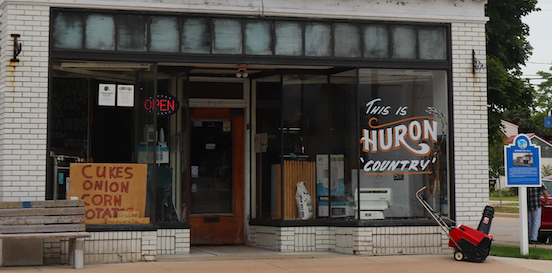
Storefront in Rogers City that caught my eye
We did not linger (in the rain) in Rogers City but pushed on west to Cheboygan, another town that seems to be undergoing a renaissance similar to that of Alpena. If we hadn’t decided to make for home by nightfall, we would have explored Cheboygan much more thoroughly. As it is, we saw enough to whet our appetite for another, longer stay in the area. 

But I’ll save my Cheboygan photos for another day and one more travel post that will bring us right back to where I am today, here in Northport.

TO BE CONTINUED —