Search This Blog

Showing posts with label bookstore events. Show all posts

Thursday, April 9, 2026

Changing Moods of Northern Michigan


One rainy morning on Waukazoo Street


The season is dragging its feet, but the rocket took off.

Spring break? I didn’t take one. A lingering cough and less-than-optimal driving weather put the kibosh on travel plans. There were a few highlights in the week, however, including birthday dinner at a friend’s house, where we watched the launch of Artemis II together. 

Moon launch! Following the crew of Artemis II these past few days has been good medicine for me, a cheery antidote to the insanity of you-know-who and you-know-what.

As a devoted earthling who has never had the slightest desire to travel in outer space, I’ve never been a big fan of the space program, but Wednesday evening’s launch warmed my heart. Here’s what I loved most about it: Everyone involved was calm, competent, skilled, intelligent, knowledgeable, dedicated, modest, and grateful to be part of a team effort years in the making. What a breath of fresh air in today’s world! And one of the four astronauts, 47-year-old Christina Koch, is from Michigan! 

Thanks to the Artemis II mission, we have already learned to call the side of the moon facing away from earth the “far" side, rather than the “dark” side. Makes me think of Gary Larson’s cartoons. Here are some Larson takes on space travel.


Much, much closer to home than 250,000 miles, spring plants whose flowering was set back by two feet of March snow are preparing once again for their postponed season opening. Winter aconites, snowdrops, and hellebore seem as eager to blossom as I am to see the blossoms. Even buds of small branches torn from big trees—little detached limbs!—want to participate.

Reminders of my friend Chris, who gave me the first ones

Need to plant more of these in the fall

Still crumpled from their sleep under the snow

Life force!


Participating in democracy is heartwarming.

The March 28 “No Kings” gatherings across the country were once again peaceful and full of joy. Recovering from one of my life’s worst colds, I didn’t think I could handle a big Traverse City crowd but made a sign and went to join demonstrators in Suttons Bay. The thought I had that morning was that I was not only demonstrating for those whose views I share but for all Americans, not only for my own future and that of my children and grandchildren but for the children and grandchildren and great-grandchildren of all Americans to the seventh generationat least! 


It was good to see demonstrators carrying American flags. We were out there on a chilly morning because we love our country!

I wanted a larger, clearer sign on March 28 than the one I’d held earlier in Northport when I joined “the stalwarts” (as I call them) for a couple Thursdays on the corner south of my bookstore. My solution was to take a large trifold pasteboard I’d put together for the Artist’s memorial gathering in Leland and tape it closed, using what had been the back of the trifold for the front of my sign. No one else knew, but I liked knowing that the Artist and my family and friends were with me inside that sign.


My reading is random, as usual.


“On behalf of those who are suffering now I make this protest against the deception which is being practiced on them; also, I believe that I may help to destroy the callous complacence with which the majority of those at home regard the continuance of agonies which they do not share, and which they have not sufficient imagination to realize."

- Pat Barker, Regeneration (1991)

Barker’s historical novel, Regeneration, takes place during World War I and opens with poet Siegfried Sassoon's letter protesting the war’s continuance. Taken to be suffering from shell shock, he is sent to a hospital for treatment rather than being court-martialed, and in the hospital he, the historical character, and we, the readers, meet other soldiers sent home from the front and gradually learn their stories. One of the others is young Wilfred Owen, another English poet, killed when he returned to action, age 25, a week before the war's end. (Sassoon lived through the war and died at the age of 80.) The character whose thoughts we follow most intimately is the doctor in charge of Sassoon’s case. 

But it was that letter on the first page of the novel that grabbed my attention like a fire engine siren, with the phrases “callous complacence,” “agonies which they do not share,” and “have not sufficient imagination to realize.” Isn’t that the case with the present war begun by our own country? Except that the sufferers today are, for the most part, not our country's military but civilians (including children) of the country our president wants to bomb “back to the Stone Age.

***

Shifting gears here--On an Inland Sea: Writing the Great Lakes, edited by Michael Welch, is a  collection of nonfiction and poetry by 33 different writers living in the U.S. and Canada on one or another of the Great Lakes. The publishing house, Belt Publishing, is new to me, and none of the writers in the book had names I recognized. An interview on Interlochen Public Radio with one of the writers (Sara Maurer, “What Are Yoopers Without Winter?”) brought the volume to my attention and led me to order it, and I am so grateful to IPR for the connection! I’ve been skipping around in the volume, opening at random and reading wherever the book opens, and everything I’ve read has been excellent. Not just good but excellent, and I am eager to get this book into my bookstore customers’ hands.


Slowly, the season to come is taking shape.


Dog Ears Books will celebrate Indie Bookstore Day on Saturday, April 25, with a poetry reading by Fleda Brown at noon. This will be Fleda's fourth appearance in Northport, so it's safe to say there is mutual affection. Mark your calendar now!


May will be a quiet month, without any special events, as I have several special events in my personal life that month. 

On Thursday, June 11, at 4 p.m., our bookstore guest will be Robert Downes, doing a slide show presentation on the arrival of Europeans in North America and what that meant for indigenous cultures, along with a signing of his new book, Sun Dog: A Novel of Native America


***


Friday, August 1, 2025

The season is moving right along

Days begin and end in smoky haze.

Smoke from Canadian fires makes for dramatic sunrises and sunsets, in addition to reduced air quality. I was going to say “daytime” air quality, but quality must be compromised at night, too, though we don't see the haze. 


In my neighborhood, cherry harvest is over for another year. The month of July is over everywhere! Admittedly, the season we anticipate all winter long, summer, always passes too quickly, but I can’t believe how this one is flying by—a blur, as I always tell people when they ask how my summer is going or, later, how my summer was.


Daisies at their peak bloom. This now is in the past.

For now we still have black-eyed Susans, and the raspberries aren’t quite finished, but already daisies are going to seed, Joe Pye-weed is blooming, and the first goldenrod is showing its bright color. Too soon! Too soon! 

Goldenrod already!


What Has Happened

The Friends of Leelanau Township Library wrapped up their summer author series with guest author Aaron Stander, who read from the 12th book in the very popular Sheriff Ray Elkins series, Smoke and Mirrors, set right here in what he calls “Cedar” County. Aaron shared with the audience some background on how he started writing murder mysteries (Elmore Leonard inspired him) and told stories of having an agent (briefly), looking for a publisher (one was interested until she learned the author's age), and—this was the happiest story—having a loyal, trustworthy editor.

"Did I overdress?" he asked me facetiously.


On the home front, Sunny and I had a visit from a couple old friends of mine and the new little dog of one of those friends. How apprehensive I was beforehand! Would my Naughty Barker terrorize the little rescue pup, who had been cagebound for most of his life until he came to live with Sandra? 

Little Milton, visiting dog

They were fine! They were better than fine! Milton was friendly and relaxed, and so was Sunny. My girl barked briefly at introductions, but soon the two dogs seemed to have been best dog buddies all their lives, and their easy-going happiness added to the humans’ enjoyment of the visit. Relieved? I was overjoyed! It was almost as if Sunny Juliet were channeling Sarah….

Getting acquainted...

Accepting...

Posing...

Resting, hanging out after play -- ah!


What’s Still to Come

Please disregard the erroneous headline in the Enterprise story on my upcoming bookstore event. Our township librarian was even more startled than I was to see the words “library event” (she thought she had forgotten something major!) above the story about Tim Mulherin’s August 13th appearance at Dog Ears Books. 


We’ll begin at 7 p.m. that Wednesday, but you might want to come a little earlier to be sure of a chair, because I’m thinking Tim’s topic is one that could draw a pretty big audience.

Even before that, Northport will have on Saturday, August 2, the annual Fly-In and pancake breakfast, and on Saturday, August 9, the annual and always highly anticipated dog parade. The theme this year is Bone Appétit (please note that final 't' is silent), and, please note, I am registering dog parade entries at Dog Ears Books.

AND my sisters are coming for a visit!!!


My Current Reading

I am still reading the book about Aristotle mentioned in my previous post, along with the other book I wrote about there, In the Merrimack Valley, but was sidetracked yesterday by a very small paperback that I haven't finished yet, an account written in prison—of what turned out to be his last days on earth—by Andrei Ivanovich Shingarev. He was arrested and thrown into prison, without trial, on November 27, 1917, and murdered in January 1918 after being transferred to a hospital. What is available online about Shingarev's life is sparse and conflicting. I have to say, however, that when he writes from prison that members of his political party, the Constitutional Democrats, were declared “enemies of the people” by the antidemocratic Bolsheviks, I thought of similar name-calling from our own White House in our own time. He also writes of lies and hypocrisy but is steadfast in his hope that the Russian people will eventually wake up and throw off those who betrayed their revolution. An empty hope, as it turned out, for that country. Will Americans be different?

Words he wrote from prison --

Which leads me to....


My Thoughts on Forgiveness (because it’s something I think about)

If someone hurts me but exhibits remorse and asks for forgiveness, I can forgive that person. If there is no remorse, no “Sorry!”—let alone a mending of the ways—I feel no compulsion to forgive. I can “move on” without it. Because you can’t make people care.


As I see it, though, forgiving wrongs done to others is an entirely different matter. That is not a matter of forgiveness for me. It is not up to any unharmed and uninvolved person but up to the person or persons harmed to offer forgiveness—if they are still alive and can find it in their hearts to forgive.

In this light, when I look at what is being done in the name of my country in today’s world, at members of our own government who are inflicting harm in our name within our borders and around the world, I not only hold them responsible but also those who put them in office and continue to support them. Can I ever forgive these people? I doubt I will ever be asked, but if I were, my answer would be no. I could forgive ignorance if the truth were inaccessible, but it is not. I could forgive honest mistakes if they were admitted and ways mended, but this is not happening. And even then, I myself cannot forgive violations of the rights and liberties and lives of other people, the ones wronged. 

People who support these violations and call themselves Christian (or Muslim or Jewish or Buddhist or Hindu or whatever!) can ask their God for forgiveness. Rudolf Vrba wrote a book about the Holocaust and the concentration camps and titled it I Cannot Forgive. As I see things (and I realize not everyone will agree), he was right not to.

And as the unforgivable continues to take place day after day, so does rallying around the golden calf. Where is Moses when we need him?


Never malicious —

That’s one of the things I love about the world of plants and sky and rock. Any of these can hurt you, but they never do so intentionally. Even poisonous plants bear us no malice. They are—and I appreciate this from the bottom of my heart—indifferent to human life. Storms may rage, winds may howl, and trees may crash to the ground, but they would do the same if we weren’t in their way, and if we are—well, that’s our bad luck. 

Nothing living lives forever.


Only one of our fellow living beings can push us off a mountain ledge. We may be alone and slip on loose rock, but the mountain is not responsible. There is no one to blame and nothing to forgive. I find that infinitely comforting.

I love their indifference.

Tuesday, July 15, 2025

What are you missing? What do you love?

Taking a break from the hurdles--with her beloved tennis ball!

“You haven’t been posting as much about Sunny on your blog lately,” one bookstore browser observed recently.  In the old days of Dog Ears Books and Books in Northport, the Artist and our dog Sarah were the stars. 


Sarah in the bookstore

Now (though not in the bookstore) it’s Sunny who is my blog star, so here she is opening the show today before I go on to my usual bookish meanderings. Sunny Juliet is still a Naughty Barker, nowhere near the almost-perfect bookstore dog that her predecessor, Sarah, was for 13 years, but she and I are pretty bonded, her recall improves steadily, and she is the stronger member of our one-person, one-dog agility team, no question about it.


Gli Etruschi e io


La campagna


“The Etruscans and me”? Not really. Not me, personally. It’s D.H. Lawrence and the Etruscans I encountered in the author’s posthumously published book, Etruscan Places. But the title captured my attention, because whether a book is fiction or nonfiction, place-based literature, stories and experiences anchored in a village or a region, is what I find most compelling. 


Il lago


Etruscan Places, in addition to being very much anchored in place, is also very personal to the author. Unlike his fiction, this book’s style is more like letters written to a friend, with emotional responses accompanying Lawrence’s observations. He doesn’t only write about the Etruscan tombs, either, but includes by name all the wildflowers along the way, which (naturally!) I found charming. Judgments on history and the present day also begin on the very first page:


The Etruscans, as everyone knows, were the people who occupied the middle of Italy in early Roman days, and whom the Romans, in their usual neighbourly fashion, wiped out entirely in order to make room for Rome with a very big R. They couldn’t have wiped them all out, there were too many of them. But they did wipe out the Etruscan existence as a nation and a people. However, this seems to be the inevitable result of expansion with a big E, which is the sole raison d’être of people like the Romans.


Lawrence was not a fan of the Romans. He saw the Etruscans as a people living attuned to Nature (and was instantly drawn to them when he first saw some of their artifacts in a museum),  the Romans as a foe of that sweet life, wanting only to crush and dominate it. Whether he is comparing paintings or architecture, he sees everywhere the same contrast. The “impious pagan duality,” a phrase he uses only in order to reject it, “did not,” he claims, “contain the later pious duality of good and evil.” He sees the Etruscans as a more natural people, more accepting of death—which they saw as a continuation of life on earth, rather than existence in an entirely different kind of realm—and at the same time much more playful than the Romans who came later. 


Besides his observations on the tombs and the art in the tombs and his personal judgments on the art and how it compares to Greek and Roman and modern art, Lawrence notes wildflowers he sees along the way, what he and his companion saw in the villages and the countryside, and the different mood called forth by each place.


It is very pleasant to go down from the hill on which the present Tarquinia stands, down into the valley and up to the opposite hill, on which the Etruscan Tarquinii surely stood. There are many flowers, the blue grape-hyacinth and the white, the mauve tassel anemone with the red, sore centre—the big-petalled sort. It is curious how the anemone varies. Only in this one place in Tarquinia have I found the whity-pink kind, with the dark, sore-red center. But probably that is just chance. 


The town ends really with the wall. At the foot of the wall is wild hillside, and down the slope is only one little farm, with another little house made of straw. The country is clear of houses. The peasants live in the city.


Probably in Etruscan days it was much the same….


Bellissimi fiori


What Lawrence never states explicitly but what readers in 1932 understood is that the Italy of Lawrence’s investigative travels into history was also the Italy of Benito Mussolini, who had transformed the country into a one-party dictatorship, first by outlawing labor strikes and soon with the use of secret police, eventually allying his Fascist authoritarian state with Hitler’s Germany and Imperial Japan. So when he writes about the “all-conquering Romans,” he is also heaping scorn on the Fascists, for the latter “consider themselves in all things Roman,” and he despises Romans and Fascists alike. 


Myself, I like to think of the little wooden temples of the early Greeks and of the Etruscans: small, dainty, fragile, and evanescent as flowers. We have reached the stage when we are weary of huge stone erections, and we begin to realize that it is better to keep life fluid and changing than to try to hold it fast down in heavy monuments.


Only a little while later he asks,


Why has mankind had such a craving to be imposed upon? Why this lust after imposing creeds, imposing deeds, imposing buidings, imposing language, imposing works of art? The thing becomes an imposition and a weariness at last. Give us things that are alive and flexible, which won’t last too long and become an obstruction and a weariness. Even Michelangelo becomes at last a lump and a bore. It is so hard to see past him.
 

We may well object here. How can anyone reject Michelangelo? But life in the shade of Fascism, along with the tuberculosis that was soon to bring about the author’s death, may have made him impatient. He did love the Italian countryside:


Such a pure, uprising, unsullied country, in the greenness of wheat on an April morning!—and the queer complication of hills! There seems nothing of the modern world here—no houses, no contrivances, only a sort of fair wonder and stillness, an openness which has not been violated. 


One morning I gave myself a complete vacation from news headlines and enjoyed, before my bookish day, immersion in my own “pure, uprising, unsullied” countryside. Deer in the orchard, ducks and loons on Lake Leelanau, Canada geese overhead, and everywhere the deep, rich, varied greens of summer! 


Una bella mattina! E vivo in campagna! Che fortuna!


But how long are we going to let ourselves be imposed upon, and how far will we let the impostors impose on us? Where and when is it going to stop?


Why we (I and others of my ilk) keep harping on current events


The question was asked, Why do Democrats care so much about ICE raids and deportation of immigrants? Why don’t they worry and demonstrate instead about other unsolved problems in our country, such as the plight of the mentally ill or the homeless or people suffering from natural disasters? Years ago, one of my uncles took me to task for donating to the ACLU, arguing that they had done nothing for disaster relief that week. I forget what the specific disaster was, but I explained to my uncle that the mission of the ACLU was not disaster relief and that I had donated to Lutheran World Relief and indicated that my donation was to go to that week’s specific disaster, for which LWR had promised to provide 100% of donations so targeted. 


Supporting one cause does not mean ignoring others.


There are always ongoing issues we care about and contribute to and work for year after year. Most of us contribute regularly to various nonprofit organizations, each one with a different and important goal. I have a sponsored child through “Save the Children,” donate annually to the Michael J. Fox Foundation (for Parkinson’s Disease), and generally give to disaster relief funds through Save the Children or Lutheran World Relief, besides making annual donations to the ACLU and Southern Poverty Law Center. Memorial donations are an opportunity to give to specific hospitals or churches or libraries (wherever they may be) or local organizations.


The reason to pay so much attention to "this stuff” right now—to pardons for insurrectionists; firings of judges for being impartial rather than partisan; arrests, detainments, and deportations without due process—and to demonstrate and to continue to spread the word about what’s happening is that our country, the country we love, is at a critical crossroads. Democracy is in crisis. Understandably but tragically, many Americans, including the young, have stopped following the news, and this is how authoritarianism takes hold. 


As Eric Holder, the 82nd U.S. Attorney General , wrote recently: 


Right now, core pillars of our democracy are under attack – including a free press and educational institutions that teach independent and critical thinking. This isn’t isolated or random — this is an intentional effort by the far right to weaken the very systems we have in place to ensure the health of our democracy. They are dragging us toward authoritarianism. What’s happening now is NOT normal. 


If law enforcement and the judicial system are replaced by authoritarian goon squads of revenge, no one will be safe, and all those people Democrats are accused of ignoring will be among the victims, simply because they are so vulnerable. The fight for American ideals is not choosing to care only about, for instance, immigrants. It is about assuring a future in which everyone in this country is accorded dignity, in which everyone’s humanity is recognized and respected.


Back to the Books


On Wednesday evening, August 13, Dog Ears Books will host Timothy Mulherin, author of This Magnetic North: Candid Conversations on a Changing Northern Michigan. These conversations with northern Michigan residents from all walks of life (he interviewed over 75 people for the book), explore the topic of “relocation,” how it may be (some think yes, some think no) changing the face and character of northern Michigan, and what different people think of the changes and hope to see in the future. 


Do you see our area changing? If so, how do you feel about it? What do you want us to hold onto, and what could be improved upon? Are there things you miss about the Old Days?


Kinda "old days" in Northport

Older days in Leland

We were all young once.

August 13 promises a lively discussion with this author, who splits his life between Indiana and Leelanau County, so mark your calendar and don’t forget! I’ll issue reminders, never fear.


Thursday, June 19, 2025

Not Yet the Solstice, But—the Race Is On!


Reminder First, Right Up Front


Next Tuesday, June 24, at 4 p.m., Dog Ears Books in Northport will host a poetry reading featuring Jennifer Clark from Kalamazoo. Jennifer will read from her new book, Intercede: Saints for Concerning Occasions, and visit with audience members following her reading. She is the author of three previous poetry collections, author of a children’s book, and co-editor of the anthology, Immigration & Justice for Our Neighbors. She is so much fun that this is her third appearance at Dog Ears Books, so do yourself a favor and don't miss her!


Poet Jennifer Clark

Racing Season


Not a season of races, that is, but a season racing by, as summer always does. (Yes, even before it officially arrives!) Overnight, it seems, the rivers of gold that were the blooming cowslips (marsh marigolds) turn to wet-footed, narrow meadows of lacquer-yellow buttercups; sweeping white hills of woodland trillium fade and disappear; the tree canopy grows dense; and yellow-eyed white daisies (the happy days’ eyes) dance along roadsides in sun or in rain. Forget-me-nots have gone to seed for another year, and so has the first round of dandelion blossoms, but cheery little English daisies enliven otherwise monochrome green lawns, and now—coreopsis already!!!


Coreopsis here before the longest day!

Gardening


My fall bulb catalogs arrived in May, and I am determined to order early this year, because if I wait too long I will forget again … or decide not to bother … even knowing what pure delight those flowers that bloom in the spring (“tra-la!”) will give.


Meanwhile, there is always “just one more” trip to a garden center or nursery, “just one more” plant that my garden must have! Oh, yes, borage! 


Magical borage --


Books


Did you ever read this one?

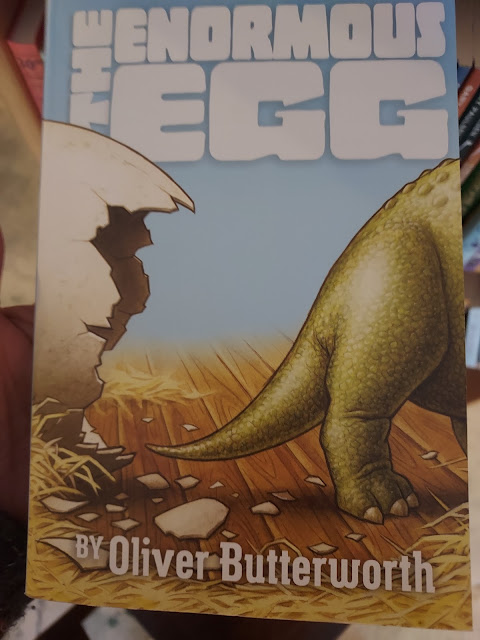
Do you remember some of your favorite books from grade school? One of mine was Oliver Butterworth’s The Enormous Egg. I was reminded of that favorite story when a little boy visited my bookshop wearing a striped t-shirt with a line of Triceratops dinosaurs marching along every other stripe. In the book, young Nate Twitchell is almost as faithful as the family hen in taking care of the unusually large, leathery egg in hopes it will hatch—and it does! But the little dinosaur does not stay little for long. 


I didn’t remember the ending, so I had to order and reread the whole book. Thus I traveled with Nate and Dr. Ziemer and Uncle Beazley (the triceratops) from New Hampshire to Washington, D.C., and then right into the halls of Congress, where a United States senator proposed legislation that would outlaw Uncle B. and have him killed and stuffed! Given the expense of housing a dinosaur over the course of its lifetime, there is support in the Senate for the bill. Uh-oh! What hope does young Nate have of saving his rapidly growing pal? Wonderful story!


A much older book that went home with me for bedtime reading was a falling-apart copy of Rudyard Kipling’s Second Jungle Book, in which we meet again Mowgli and his animal friends. 


There are also other stories in the book, including one that takes place in the high Arctic, but Mowgli and friends are the center. As captivating as the stories, once I stopped to look at them more closely, are illustrations by the author’s father, John Lockwood Kipling, the smallest seeming at first glance only decorative. But no! Each one clearly depicts something in that particular story.


John Lockwood Kipling deserves a new paragraph. Although his career was overshadowed by that of his famous son, Lockwood was an astonishingly accomplished polymathic artist in his own right, producing drawings, furniture, sculpture, pottery, and more. During his 25 years in India, as teacher and later museum curator in Lahore, he was also active in a revival of traditional Indian arts and crafts.


And let me say right here that wonderful as much of Walt Disney’s work was (and his "Jungle Book" film was the last for Walt), Disney’s Mowgli is not Kipling’s Mowgli, and people need to read the books to learn the Law of the Jungle as the man-cub learned it. 


Alongside these deep and deeper dives into the past, I read also a novel published only two years ago, inspired because the author came to Northport. Mary Kay Zuravleff gave a reading and presentation following the business portion of the annual meeting of the Friends of Leelanau Township Library (FOLTL) on Saturday, June 14. When she and local author Karen Mulvahill stopped by the bookstore ahead of her FOLTL appearance, they took a couple extra books from my stock, in case they ran short. And they would have! Note: I am ordering more and will be restocked by this Friday.


The title of Zuravleff’s novek, American Ending, comes from the fictional narrator’s mother, a Russian immigrant. When telling her children bedtime stories, she would ask, “Russian ending or American ending?” In the Russian ending of a fairy tale, the wolf eats the bride who wanted a ride on his back to her wedding, while the American ending has the groom slicing open the wolf’s belly and the bride leaping out unharmed.  But even as a child Yeleni doesn’t fully trust American endings, suspecting that good luck isn’t necessarily permanent and that life can take sorrowful turns. 


The setting is a coal-mining town in Pennsylvania, and the story opens in 1908. It is a complicated family saga, with a large cast of characters, but American-born Yeleni’s voice, steadily throughout the book, keeps us oriented. This is a world where girls are married as early as 13 years old to grooms chosen by their parents, young boys taken from school and sentenced to dangerous lives underground, and adults too often seek solace from poverty’s troubles in alcohol. Yet, for all that, it is also a life of tradition and memory and feasting and celebration. When Yeleni’s mother invites the schoolteacher to Thanksgiving dinner, the whole neighborhood contributes.


It was a miracle the way people pitched in when they weren’t even invited, and not with a shriveled turnip or the stringy end of a roast either. Here came a sturgeon turnover to fatten up the schoolteacher, poppyseed bubliks for the single men, cherries in a jar if Lethia wanted to bake pie. Lethia collected candle stubs at church and polished the table with beeswax and beef tallow, another miracle. Robert and Pa captured two wild turkeys. Really, Kostia did. The birds were always in the meadow nipping at him, and Kostia led them into a trap….


-      Mary Kay Zuravleff, American Ending


Despite being a story set in the America of over a century ago, the novel is also very much a story of today. Late in the novel, when Yeleni urges her husband to apply for U.S. citizenship, he answers, 


“I’ll need a witness willing to swear I’m not a phut.”


“English, please,” I said, “or they’ll send you back on the next boat, crook or not.” 


It was one of my fears, though Erie Russians scoffed at the idea of anyone being sent back. Who would make the town’s streetcars, engines, or boilers; their boots and buttons; their paint, paper, or pickles? Who would slaughter the meat or tan the leather if Russians were sent back?


Sound familiar? Since summer is my heaviest work season, both at home and in my bookshop, reading time is at a premium, but I still manage to squeeze it in. (Not having TV helps!) American Ending is Mary Kay Zuravleff’s fourth novel and the first of her work I have read, but it certainly will not be the last.


And then one night I turn to an old favorite, Harlan Hubbard’s Payne Hollow: Life on the Fringe of Society, a sequel to Shantyboat, the story of Harlan and Anna’s river adventure years. 


I love Harlan's sketches in the book


Returning at last to the Ohio River as to an old friend, the Hubbards settled down and built a house on the river bank (shades of Rat and Mole), put in a garden, raised goats, and continued their evening practice of reading aloud to each other and playing duets. Their “bijou riverside residence” (as the Mole called Rat’s hole in the bank) was larger than their old shantyboat but, like it, lit by fireplace and oil lamps and complete with cunning cupboards for the storage of food and a bed that slid away out of sight when morning came. Harlan and Anna kept to old, simple ways. 


…So many times have the advantages of a garden tractor or tiller been pointed ot to me that I half believe the argument myself…. My strength returns when I am alone in the garden, working with some beloved tool, the birds whistling overhead. Even on a sultry July morning, when not a breath of air stirs, when the sun’s heat is magnified by the encircling trees, and weeds are sprouting everywhere, not even then could I welcome one of those nondescript, unlovable gadgets, brightly painted and streamlined, which make an intolerable noise and smell bad. They get the work done, you say? I say they are expensive and insidiously destructive. I will get the work done in my own way. Save time? The best use of time is to enjoy it, as I do when working in peaceful silence. 


-      Harlan Hubbard, Payne Hollow


Oh, that is exactly how I feel about working outdoors! No string trimmers or leaf blowers for me, please!


How economically he captures chickadee and woodpecker!


Agility work


Sunny Juliet and I had our first session of the year with Coach Mike, who is very enthusiastic and encouraging and genuinely loves the sport and all his doggie pupils. He is an excellent teacher!


Agility work is as challenging—maybe even more so—for the human member of the team as it is for the dog. The sport was inspired by equestrian show jumpingand more and more I realize the strong parallels between work with horses (which I must admit, sadly, I know about almost exclusively from reading) and work with dogs. We humans are a talky species, and we are usually so busy talking and listening to each other and thinking about what we want to say next that we lack awareness of what our bodies are telling us and telling others. 


Anyone knows that riders “tell horses what to do” by applying reins and knee pressure, but horses also respond to much more subtle signals, whether or not the rider intends the signaling. How one sits and every little shift of the seat is information to the horse. A well-trained dog responds to voice commands, but any dog is also, and much more continually, paying attention to physical cues. 


In our agility work Sunny is aware of every little move or gesture I make, intentional or inadvertent, although I am not physically in contact with her. If I shift my shoulders slightly or vary the height of my hand from the ground or speed up or slow down or merely glance off to the side—all that is telling her something, which means that I too have to be aware of my body in order to give her the proper signals. 


And have you ever thought about the difference in peripheral vision between humans and canines? (Don’t feel bad. I never had.) We see about 180 degrees, or half of the circle of which we are the center, but dogs’ eyes are spaced more widely apart than ours, so their peripheral vision is much wider, 250 to 270 degrees (depending, I guess, on the shape of a particular dog’s head, which would vary from one breed to another), which means Sunny is still seeing me after she runs past, so if I stop and turn around, she thinks she needs to do that, too! 


It’s a lot to think about. It’s also impossible, as you can imagine, for me to get video or even still footage in the middle of our demanding work!


But now—oh, dear! Sunny has developed a limp that seems to come and go, as if maybe she pulled a muscle or something (it started with that porcupine chase), so for now my girl needs to rest from strenuous activity. She’s to be on-leash for a week, with aspirin or Tylenol twice a day, the vet says. Poor Sunshine! She thinks “taking it easy” is a great big bore!


Tenting Tonight


My birth family went on our first camping trip when I was 12 years old, five of us sleeping in a borrowed tent, a heavy canvas umbrella tent. It rained all week. And we all wanted to do it again! 


Jack and his crew

Now grandson Jack from St. Paul, Minnesota, a newly graduated art student from Kalamazoo College, is here this week, rain and/or shine, with his ten senior-year classmate/housemates, the whole crew camping in the yard and eagerly exploring Leelanau. (I know the kids would love to play Frisbee with Sunny, and ordinarily I’d have been all for it, but not right now, as she needs to rest her jumping muscles. If only she would rest her barking muscles, too!) What a happy scene the tents and hammocks and everything else make in our usually empty yard! At last it felt as if there had been a point to all that grass mowing! 


Fog rolled in, but the campers are happy.

While all of the young people are delightful, naturally grandson Jack is very special to me. When I look at a closeup of Jackson examining a camera I found for him, I see his grandfather, alive and young again.