Search This Blog

Showing posts with label beauty. Show all posts

Tuesday, July 15, 2025

What are you missing? What do you love?

Taking a break from the hurdles--with her beloved tennis ball!

“You haven’t been posting as much about Sunny on your blog lately,” one bookstore browser observed recently.  In the old days of Dog Ears Books and Books in Northport, the Artist and our dog Sarah were the stars. 


Sarah in the bookstore

Now (though not in the bookstore) it’s Sunny who is my blog star, so here she is opening the show today before I go on to my usual bookish meanderings. Sunny Juliet is still a Naughty Barker, nowhere near the almost-perfect bookstore dog that her predecessor, Sarah, was for 13 years, but she and I are pretty bonded, her recall improves steadily, and she is the stronger member of our one-person, one-dog agility team, no question about it.


Gli Etruschi e io


La campagna


“The Etruscans and me”? Not really. Not me, personally. It’s D.H. Lawrence and the Etruscans I encountered in the author’s posthumously published book, Etruscan Places. But the title captured my attention, because whether a book is fiction or nonfiction, place-based literature, stories and experiences anchored in a village or a region, is what I find most compelling. 


Il lago


Etruscan Places, in addition to being very much anchored in place, is also very personal to the author. Unlike his fiction, this book’s style is more like letters written to a friend, with emotional responses accompanying Lawrence’s observations. He doesn’t only write about the Etruscan tombs, either, but includes by name all the wildflowers along the way, which (naturally!) I found charming. Judgments on history and the present day also begin on the very first page:


The Etruscans, as everyone knows, were the people who occupied the middle of Italy in early Roman days, and whom the Romans, in their usual neighbourly fashion, wiped out entirely in order to make room for Rome with a very big R. They couldn’t have wiped them all out, there were too many of them. But they did wipe out the Etruscan existence as a nation and a people. However, this seems to be the inevitable result of expansion with a big E, which is the sole raison d’ĂȘtre of people like the Romans.


Lawrence was not a fan of the Romans. He saw the Etruscans as a people living attuned to Nature (and was instantly drawn to them when he first saw some of their artifacts in a museum),  the Romans as a foe of that sweet life, wanting only to crush and dominate it. Whether he is comparing paintings or architecture, he sees everywhere the same contrast. The “impious pagan duality,” a phrase he uses only in order to reject it, “did not,” he claims, “contain the later pious duality of good and evil.” He sees the Etruscans as a more natural people, more accepting of death—which they saw as a continuation of life on earth, rather than existence in an entirely different kind of realm—and at the same time much more playful than the Romans who came later. 


Besides his observations on the tombs and the art in the tombs and his personal judgments on the art and how it compares to Greek and Roman and modern art, Lawrence notes wildflowers he sees along the way, what he and his companion saw in the villages and the countryside, and the different mood called forth by each place.


It is very pleasant to go down from the hill on which the present Tarquinia stands, down into the valley and up to the opposite hill, on which the Etruscan Tarquinii surely stood. There are many flowers, the blue grape-hyacinth and the white, the mauve tassel anemone with the red, sore centre—the big-petalled sort. It is curious how the anemone varies. Only in this one place in Tarquinia have I found the whity-pink kind, with the dark, sore-red center. But probably that is just chance. 


The town ends really with the wall. At the foot of the wall is wild hillside, and down the slope is only one little farm, with another little house made of straw. The country is clear of houses. The peasants live in the city.


Probably in Etruscan days it was much the same….


Bellissimi fiori


What Lawrence never states explicitly but what readers in 1932 understood is that the Italy of Lawrence’s investigative travels into history was also the Italy of Benito Mussolini, who had transformed the country into a one-party dictatorship, first by outlawing labor strikes and soon with the use of secret police, eventually allying his Fascist authoritarian state with Hitler’s Germany and Imperial Japan. So when he writes about the “all-conquering Romans,” he is also heaping scorn on the Fascists, for the latter “consider themselves in all things Roman,” and he despises Romans and Fascists alike. 


Myself, I like to think of the little wooden temples of the early Greeks and of the Etruscans: small, dainty, fragile, and evanescent as flowers. We have reached the stage when we are weary of huge stone erections, and we begin to realize that it is better to keep life fluid and changing than to try to hold it fast down in heavy monuments.


Only a little while later he asks,


Why has mankind had such a craving to be imposed upon? Why this lust after imposing creeds, imposing deeds, imposing buidings, imposing language, imposing works of art? The thing becomes an imposition and a weariness at last. Give us things that are alive and flexible, which won’t last too long and become an obstruction and a weariness. Even Michelangelo becomes at last a lump and a bore. It is so hard to see past him.
 

We may well object here. How can anyone reject Michelangelo? But life in the shade of Fascism, along with the tuberculosis that was soon to bring about the author’s death, may have made him impatient. He did love the Italian countryside:


Such a pure, uprising, unsullied country, in the greenness of wheat on an April morning!—and the queer complication of hills! There seems nothing of the modern world here—no houses, no contrivances, only a sort of fair wonder and stillness, an openness which has not been violated. 


One morning I gave myself a complete vacation from news headlines and enjoyed, before my bookish day, immersion in my own “pure, uprising, unsullied” countryside. Deer in the orchard, ducks and loons on Lake Leelanau, Canada geese overhead, and everywhere the deep, rich, varied greens of summer! 


Una bella mattina! E vivo in campagna! Che fortuna!


But how long are we going to let ourselves be imposed upon, and how far will we let the impostors impose on us? Where and when is it going to stop?


Why we (I and others of my ilk) keep harping on current events


The question was asked, Why do Democrats care so much about ICE raids and deportation of immigrants? Why don’t they worry and demonstrate instead about other unsolved problems in our country, such as the plight of the mentally ill or the homeless or people suffering from natural disasters? Years ago, one of my uncles took me to task for donating to the ACLU, arguing that they had done nothing for disaster relief that week. I forget what the specific disaster was, but I explained to my uncle that the mission of the ACLU was not disaster relief and that I had donated to Lutheran World Relief and indicated that my donation was to go to that week’s specific disaster, for which LWR had promised to provide 100% of donations so targeted. 


Supporting one cause does not mean ignoring others.


There are always ongoing issues we care about and contribute to and work for year after year. Most of us contribute regularly to various nonprofit organizations, each one with a different and important goal. I have a sponsored child through “Save the Children,” donate annually to the Michael J. Fox Foundation (for Parkinson’s Disease), and generally give to disaster relief funds through Save the Children or Lutheran World Relief, besides making annual donations to the ACLU and Southern Poverty Law Center. Memorial donations are an opportunity to give to specific hospitals or churches or libraries (wherever they may be) or local organizations.


The reason to pay so much attention to "this stuff” right now—to pardons for insurrectionists; firings of judges for being impartial rather than partisan; arrests, detainments, and deportations without due process—and to demonstrate and to continue to spread the word about what’s happening is that our country, the country we love, is at a critical crossroads. Democracy is in crisis. Understandably but tragically, many Americans, including the young, have stopped following the news, and this is how authoritarianism takes hold. 


As Eric Holder, the 82nd U.S. Attorney General , wrote recently: 


Right now, core pillars of our democracy are under attack – including a free press and educational institutions that teach independent and critical thinking. This isn’t isolated or random — this is an intentional effort by the far right to weaken the very systems we have in place to ensure the health of our democracy. They are dragging us toward authoritarianism. What’s happening now is NOT normal. 


If law enforcement and the judicial system are replaced by authoritarian goon squads of revenge, no one will be safe, and all those people Democrats are accused of ignoring will be among the victims, simply because they are so vulnerable. The fight for American ideals is not choosing to care only about, for instance, immigrants. It is about assuring a future in which everyone in this country is accorded dignity, in which everyone’s humanity is recognized and respected.


Back to the Books


On Wednesday evening, August 13, Dog Ears Books will host Timothy Mulherin, author of This Magnetic North: Candid Conversations on a Changing Northern Michigan. These conversations with northern Michigan residents from all walks of life (he interviewed over 75 people for the book), explore the topic of “relocation,” how it may be (some think yes, some think no) changing the face and character of northern Michigan, and what different people think of the changes and hope to see in the future. 


Do you see our area changing? If so, how do you feel about it? What do you want us to hold onto, and what could be improved upon? Are there things you miss about the Old Days?


Kinda "old days" in Northport

Older days in Leland

We were all young once.

August 13 promises a lively discussion with this author, who splits his life between Indiana and Leelanau County, so mark your calendar and don’t forget! I’ll issue reminders, never fear.


Tuesday, January 28, 2025

Do I read too much?

What does SHE think?


That question is instantly joined by another: Why do I read? Then there is, of course, What else could or should I be doing? And right away we can discount Sunny Juliet’s opinion, since hers is a distinctly self-serving perspective. In her point of view (I cannot imagine I’m misreading her on this), all the hours I’m focused on objects held in my hands is robbing her of my attention, and there’s no amusement for her in watching me, either, as what I am “doing” seems so little like doing anything.


Oh, my dear, impatient, so patient companion!


Even with a beef bone, she hopes for play with momma.

What do I seek in all this reading? That’s the “why” question. One answer is understanding. I want to understand as much as I can of the knottiest, most insoluble human predicaments, problems to which I will never have a full answer as long as I live. That answer surely elicits another “Why?” What is the good of understanding that leads no further?


Oh, tree in the garden! What knowledge did its fruit offer? 


I see different kinds of hungers for knowledge and understanding in different human beings. The pragmatically scientific want to take things apart, see how they work, and then do things that have not been done before. They are eager to change the world. Why? Sometimes for the betterment of mankind, sometimes just “Because we can.” Around those seekers, always, are hangers-on and parasites with no intrinsic hunger of their own for the knowledge and inventions, who do, however, care very much for the wealth that can be generated, wealth multiplying itself into the future, if only one makes a reservation early enough on the investment bandwagon. Theirs is hunger for accumulation, which is qualitatively different from hunger for knowledge. 


And yet, honestly, don't most of us have a certain hunger for accumulation? I look around my life and see art on walls, books on shelves, stacks of photograph albums, dishes of stones and fossils, and physical representations of beautiful living things.


Beauty and memories, memories and beauty. Objects that invite my eyes and my hands, pages that carry me over oceans to inhabit other lives and other times and also let me relive my own past years. Associations carried by these material objects are my real accumulated wealth, the objects themselves only carriers.


Does the quest for understanding life look more to the past than to the future? “Life can only be understood backwards, but it must be lived forwards,” wrote Kierkegaard. We do seek hope in the possibility of applying our understanding to the future. For example, restricting the question of “how we came to be where we are” to immediate family and acquaintance rather than society as a whole, I can see errors I have made and try to avoid repeating them in what remains of my time on earth. Sadly, human societies, with longer spans than individuals but always peopled by those shorter-lived humans, have difficulty learning from previous generations. Somewhere in his book, Surely You’re Joking, Mr. Feynman, the insatiably curious physicist wrote that we live our lives, see where we’ve gone wrong, and then die. For some reason, the simple truth of that statement, the flat-footed way he phrased it, amuses me no end. That's us, all right! And is that how it will be with our species as a whole? I wonder. They came into existence, succeeded magnificently for a while, then messed it up and went extinct. Maybe. Understanding too late--.


Besides understanding, however, there’s no denying the strong element of escape in much of my reading, and often these hungers pull in decidedly opposite directions. When the world is too much with me and I want to drown out the clamor of politicians who have once again invaded my thoughts with one outrageous act or speech after another, my hunger for escape pulls away from my hunger for understanding, and I can only feed them in turn, first one and then the other, these jealous rivals, setting aside Jimmy Carter’s Keeping Faith for The Moffats, by Eleanor Estes.


Looking for understanding,

the search continues.

Caveat emptor: I’ll stop here for a moment to remind myself and my readers that naming desires, like naming emotions, distorts our inner reality. They are not things and do not occur singly, and my attempts to tease out separate strands from an inchoate stream can be only a partial and misleading picture. All analysis distorts. Keep that in mind, please, and what I write here will not seem, perhaps, quite so absurd!


The open road! Escape!


And now I’m thinking that understanding and escape are very earthbound dimensions of reading hunger, very, very human, and that there is something else, woven tightly into these hungers and yet also very different, and that is our longing to live beyond the limits of our individual life spans, not only longer but also larger. You see instantly how the desire to expand beyond cannot be separated from hunger for understanding or for escape—and yet, do you also see that it cannot be completely expressed by those two hungers? We want something eternal, deathless. No theologian, however, I'll just leave that teasing suggestion right there.


I have more to say about the comfort of remembering, which also lets us slip time's constraints. 


Through the Looking Glass brings back, for me, the excitement I felt when I ran into the kitchen to tell my mother, “It’s a chessboard!” Lewis Carroll had not stated it so baldly, and my parents had not explained the story to me that way, but all of a sudden, reading it to myself, I had seen the chessboard when the Knight told Alice he could go no farther because he had reached the end of his move, and I had to run and tell my mother, who responded, “You didn’t know that?” No, I didn’t, but the excitement of my discovery was not dampened by her amusement, because I discovered it for myself, as I still remember with pleasure. 


If I were to pick up right now, today, Milan Kundera’s The Unbearable Lightness of Being, it would carry me back to the Parc Monceau in Paris (as merely thinking of the book carries me back), especially if I had the French paperback. One summer, day after day I went to the Parc Monceau with that book in hand, L’insoutenable lĂ©gĂšretĂ© de l’ ĂȘtre, lost in an Eastern European world inside the landscaped French world around me in my dream city far from home. 


And Wind in the Willows! I read that book to my son, giving the different animal characters different voices, and we had a wonderful time, which he still remembers. Then when the Artist and I had a layover in the Detroit airport on our way home from France, we read to each other (from a battered paperback copy that is here in my house somewhere, but where?) the chapter “Dolce Domum,” tears streaming down our faces, while all around us business people busily consulted their Blackberries and the contents of their briefcases. 


Are you still with me? Are you as tired as Sunny Juliet of my egghead ruminations? “Momma, get real!”


Real is snow in thick flurries and wind that drifts it across roads!

Well, here’s what was real for me on Monday evening as the blizzard swirled and on Tuesday morning when darkness had not as yet retreated: I was reading, for the first time in years, Jim Harrison’s novel, Dalva. First published in 1988, Dalva is written in the first person, the first and third sections in a woman’s voice, and what inspired me to revisit this book in 2025 was the new collection of Jim’s work in French translation that concentrates on his women characters, both in first-person stories and in third-person works with central female characters.


I have to admit that when Dalva first came out, it was hard for me to “hear” the female narrator’s voice, what with Jim’s own gravelly, very masculine speaking voice so familiar to my ear. Reading the book now is a very different experience. For one thing, Jim’s speaking voice has been gone for nine years, and he had been gone from Michigan longer than that, gone to live in Montana and Arizona. But also I am 37 years older than when I first read this novel. Thirty-seven years of varied life experience, shall we say, gives me a much richer perspective, and now Dalva’s voice comes through strong and clear to me, and I am loving this book, truly loving it, and have a much deeper appreciation for what the author accomplished, not only in writing from a woman’s point of view but in speaking so many truths.


It is somewhat a mystery to me how the rich can feel so utterly fatigued and victimized.

... 


Now there’s a specific banality to rage as a reaction, an unearned sense of cleansing virtue.

... 


The tomatoes looked as if they were suffocating in the glass jars, livid red and suffering.

... 


…I had told him that I was without a specific talent, other than that of curiosity, and he saw that as a large item. It is terrible to assume life is one thing, only to discover it is another. A highly mobile curiosity gives you the option of looking into alternatives. 


There is also, I must admit (Another admission? Is this post becoming overly confessional?) my love for southeast Arizona (a love that took me by surprise), and the way the mountains and high desert haunt my northern Michigan winter finds solace in Harrison’s descriptions of places not far from my former winter stomping grounds in Cochise County. He was just a couple of mountain ranges west and south. Hackberry trees along dry streambeds, mesquite on overgrazed acreage, eroded gulches, alligator juniper at higher elevations—all that. I came to know such country intimately.


How much poorer my present life would be had I not come back to re-read this novel! How many hungers it satisfies!


I would defend my answer to my own original question by noting that I spend no time whatsoever watching television and none drinking in bars, although as a word-addicted, dream-addled, introverted widow I do not hold my priorities up as superior to anyone else’s. All I’m saying is that reading is a priority in my life, and this is where I look for comfort and strength and beauty and understanding.


Also, never fear, Sunny and I manage a lot of dog-and-mom time, indoors and out!


Thursday, October 6, 2022

Reading For Pleasure


Do you read for pleasure? For work? For information? 


Information, of course, as we all realize, is of many sorts and sought for many reasons. (Egad! Don’t I just sound like that boring sister, Mary, in Jane Austen’s Pride and Prejudice? Forgive me, please!) For example, friend and I were puzzling over the research findings of the newest Nobel Prize winners in quantum physics, that of “entangled quantum states, where two particles behave like a single unit even when they are separated," but a sentence my friend read to me from the New York Times over the breakfast table (she is visiting from Ann Arbor for a couple of days) only increased our bafflement: 


Measuring one of a widely separated pair of particles could instantaneously change the results of measuring the other particle, even if it was light-years away. 


"So," I asked, "are the changes in the particles or only in the measurements?" We quickly leapt to the uncertainty principle, which I have always liked because it points to limits of human knowledge, and I like the principle for its reminders that human understanding of the universe, however much it expands, will always remain partial, but my question remained unanswered. I can phrase it another way: Are we learning more about particles or more about measurement? 


If you follow the link above, you’ll see further links to what we might call (awkwardly, I admit) sub-subjects, and the one that caught my eye asked, “Does colour exist when no one is watching?” Unfortunately, the diagrams that might have answered that question (did they?) were accompanied by text in Swedish. I was reminded, though, of conversations with my beloved husband, the Artist affirming to me more than once that color exists only in the presence of light – as what philosophers call a “secondary quality,” something partly in the object and partly in our own perception. I always asked, though I knew the answer, if I couldn't turn the lights on very fast! and catch color waking up.


I will never be a quantum physicist.


Physicists and physicians, engineers and programmers need information for their work, but an author writing historical fiction also reads for information related to her work, though the work is very different in kind. She is recreating a whole world, not exploring the world of today. And writers of speculative fiction (science fiction, fantasy, dystopic narratives, etc.) create imaginary worlds, but they also need to be grounded in whatever natural, physical, and social sciences give plausibility to their imagined worlds. Presumably, those scientists and novelists are doing work they live and so find pleasure in the reading they do for information. 


Others of us are just plain curious. I read history and economics not professionally but because I crave understanding. Why are things the way they are? How did they get to be the way they are? My larger point – one of them, at least – is that reading for pleasure does not have to be only easy reading, and by no means does reading pleasure have to be limited to fiction. 


Here, for example, is part of a preface to a book on geology:


This work attempts to hold a position between textbooks and books of light reading. The formal textbook would not suit the class of readers addressed. The style of light reading would have been unworthy of the theme, and would not have supplied the substantial information here intended….


The method of treatment is simple. The reader begins with the familiar objects at his very door. His observations are extended to the field, the lake, the torrent, the valley, and the mountain. They widen over the continent until all the striking phenomena of the surface have been surveyed. Occasionally, trains of reasoning suggested by the facts are followed out until the outlines of geological theories emerge. The course of observation and reasoning then penetrates beneath the surface … striking fossils … nebular theory … retrospect and reflection … a relish may be stimulated ….


-      Alexander Winchell, Walks and Talks in the Geological Field (1886)


Only a few days before this book came into my hands, a geology student from Grand Rapids had visited my bookstore and found a few useful textbooks on her subject. What I wished I’d had for her, though, were some of the books on geology that, for me, stimulate relish and speak directly to the fascination so many of us find in rocks and landforms:


Bass, Rick. Oil Notes (1995)

Leveson, David. A Sense of the Earth (1971)

Pettijohn, F. J. Memoirs of an Unrepentant Field Geologist (1987)


I’ll add to that –


Lopez, Barry. Home Ground: A Guide to the American Landscape (2006)


All these books deal with material all too often presented in dry textbook style for people originally drawn to the subject, drawn outdoors, and drawn to pick up rocks and climb mountains by beauty and mystery, while these books are definitely to be read for and with pleasure.


David Grath in Texas Canyon

Note: This post could be taken as an extension of the previous post on reading subjectively. So, not a critic and not a quantum physicist!

Sunday, October 2, 2022

Enthusiasm


Enthusiasm in My Household Pack


The Artist liked to say, crediting Jim Harrison with originating the phrase, that “advancing age brings a diminishing portfolio of enthusiasms.” Recently a friend on Facebook credited Tom McGuane with those words, and then a long interview with McGuane had McGuane himself giving the credit to F. Scott Fitzgerald. Credit whom you will, many people have apparently found the idea true to their lives. 


Or did they only like the apparent truth of a witty phrase? I wonder.


Obviously, I never lived with F. Scott Fitzgerald, nor with Tom McGuane or Jim Harrison. David Grath’s enthusiasm, however, is something that enriched our life together on a daily basis, whether on cross-country road trips or mere jaunts to thrift shops and drives down to Cedar for ice cream. Some of our enthusiasms changed over the years (some falling away but new ones coming along), and our energy in later decades was not what it had been in our 20s, 30s, and 40s. (We didn’t go out to bars and stay until closing time any more, certainly!) But did the number of our respective and shared enthusiasms diminish? That would be harder to say, as what naturally enthusiastic person would have the patience to sit down and make a numbered list of their heart-quickening activities and experiences?


Horses introduce this post because, while I was always the horse-crazy girl and never left that enthusiasm behind, the Artist had loved horses as a boy and always loved seeing them, especially with me. Of course, we never drove by them without at least remarking and often stopping to visit. “Which one is yours?” we would ask each other.


But the Artist also waxed enthusiastic over Peterbilt trucks, big boat-like American cars, and stylish motorcycles, depending on me to notice tiny things such as the little lichens called “British soldiers.” In general, when it came to landscape, I called his attention to ephemera at our feet, and he called mine to look up and to the horizon. “Big picture! Big picture!” he would say.


In Kalamazoo, when we lived there, we were forever noticing architectural details on older homes and downtown buildings. On foggy evenings, we would drive out to the country to catch the “Japanese landscape” effects. Out west, the grandeur of mountains, skies, and long sweeps of desert and grassland called forth our admiration. (We were both “big picture” viewers out there.) And it was a rare drive here in Leelanau County when the Artist didn’t say aloud, in tones of grateful reverence, “We live in a beautiful place.” So now I say that to Sunny Juliet when we’re in the car and crest a hill that gives us a view of Lake Michigan: “We live in a beautiful place.” Then I tell her, “That’s what your daddy always said.”


Lake Michigan, winter view


You may recall that the Artist did not fall in love with Peasy right away, the dog we were only able to have for a year. Eventually, though, they bonded. “Do you love him a little bit?” I asked. His response: “How could I not? It would be churlish not to love him.” Well, yes, as the dog came to worship David so absolutely! (Me he adored, David he worshipped.) He also said, “He’s so full of life! I miss that in myself, and I love it in him.”

No really good pictures of the two of them together -- sigh!

I never saw the Artist as anything but “full of life.” Even on those last winter mornings in the ghost town, when I came home from rambles over desert and foothills with neighbor and dogs to find him still in bed, watching television, he was enthusiastic in his urgings for me to watch with him a show about dogs … or hurricanes … or history. “I’m learning a lot,” he often said, and he never tired of learning. Or of seeing beauty, telling me that his helicopter flight from the little hospital in Willcox to a larger one in the Phoenix area had been “transcendent!”


Sometimes Sunny Juliet needs to curb her wild enthusiasm, but I appreciate her joyfulness. It makes me smile and even laugh at times. When I feel distant even from the natural beauty surrounding me, she brings me back to the immediate present.


An Enthusiastic Author


It is always a joy to host Newbery-winning author Lynne Rae Perkins in my bookstore. On Saturday she brought her own mice! I’d put three little mice on the table ahead of time, but she had made hers, and their markings were those of Violet and Jobie, the mice in her eponymous children’s book (too good for adults to pass by, is my verdict) who did not seek adventure but had adventure thrust upon them. 


Those of you who missed Lynne in the store can stop by for a signed copy of her book while my bookstore is open -- for the last month of the 2022 season, because come the end of October, I’ll be going on seasonal retirement until May, and I’ll just say right here that July 2023 will be the 30th anniversary of Dog Ears Books, so there is that ahead of me, too.


Books Read Since Last Listed


93. Bythell, Shaun. Confessions of a Bookseller (nonfiction)

94. Balzac, Honoré de. Le Curé de Tours (fiction)

95. Woodward, Bob & Robert Costa. Peril (nonfiction)

96. Shafak, Elif. The Island of Missing Trees (fiction)

97. Perkins, Lynne Rae. Violet & Jobie in the Wild (fiction – juv.)

98. Harrison, Jim. The Raw and the Cooked (nonfiction)

99. Oomen, Anne-Marie. As Long As I Know You: The Mom Book (nonfiction)

100. Brann, Esther. Five Puppies For Sale (fiction – juv. – 1948)

101. Harrington, C.C. Wildoak (fiction – YA – ARC)

102. Colwin, Laurie. Happy All the Time (fiction)

103. Jamison, Kay Redfield. Nothing Was the Same (nonfiction)

104. Proust, Marcel. The Past Recaptured (fiction)


Apple Enthusiasm


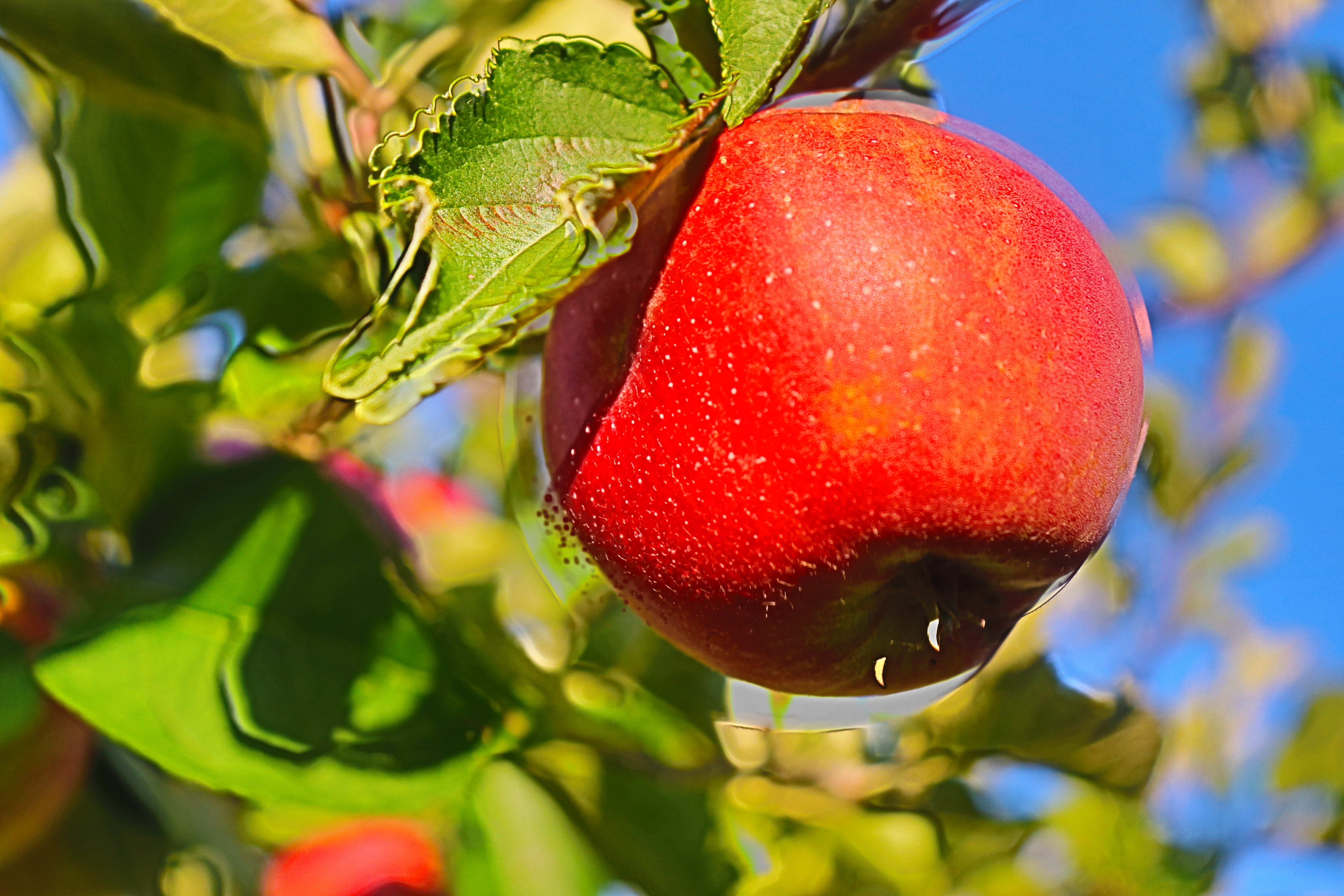
I’ll need all the enthusiasm I can muster to keep at the apple projects this month. My trees are bearing more heavily than ever before, and the apples are big and beautiful. How many apples will it take to fill the dryer with slices? Not many, I’m afraid, which means there will be lots of applesauce, as well, and maybe a pie or two.


Happy October, everyone!


Saturday, March 28, 2020

Can This Be Real?

Spring comes to southeast Arizona
I had a sudden insight upon awakening this morning, because, you see, we went for a drive yesterday, our first pleasure trip since we started hunkering down. Sky, clouds, grasses, cattle, wildflowers, mountains! They are all still there! In fifty miles we encountered only a single other vehicle, when the Artist had stopped so I could jump out with my camera, and the driver of a pickup truck loaded with hay bales stopped to see if we needed help. 


“Everything okay?” “Yes,” I told him, “it’s just so beautiful!” 

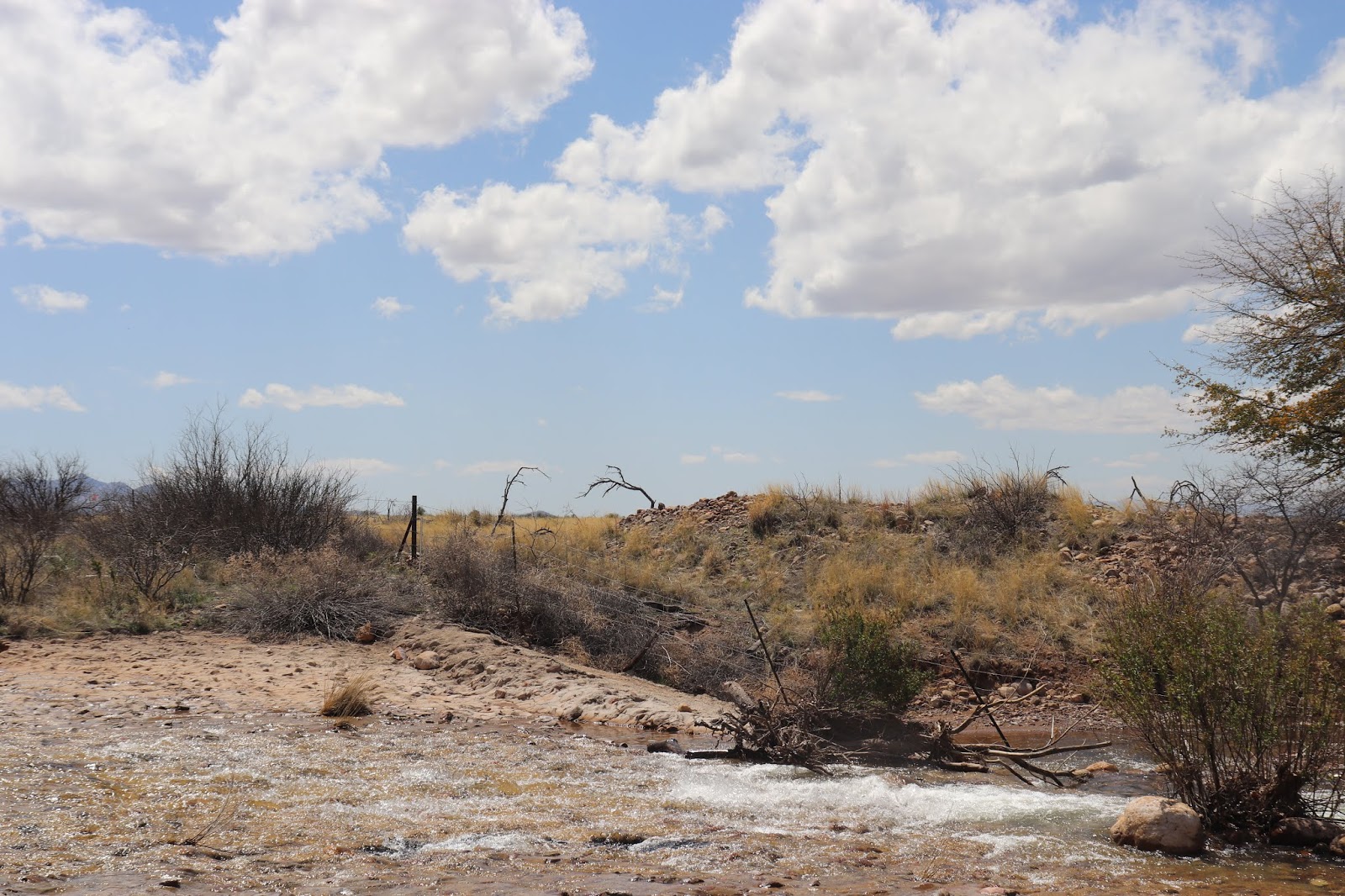
We went on, past the road to the Chiricahua National Monument, continuing south. Prickly poppies all along the road will be blooming by next week. We always appreciate places where water flows across the road. The day was golden, and we stopped again and again.

Turkey Creek


I walked a while along Turkey Creek Road, in  surroundings so heartbreakingly lovely I was holding back tears when I returned to the car and could not speak for several minutes. Finally I said softly, “It doesn’t seem possible, does it?” And the Artist answered, also in a low, reverent tone, without losing a beat, “No, it really doesn’t.”

These days we all, especially people our age, consider the possibility of dying. Even without coronavirus, the future grows shorter the longer we live. 

“We might never have seen this,” I begin haltingly.

“What do you mean?”

“Well, for instance, it’s unlikely I’ll ever see Ireland.” 

My mother and father made that trip before they died, and both my sisters have visited the land of our maternal grandfather. One of my old boyfriends, who lives in Ireland with his wife, invited us to visit! But travel by plane to a foreign country may not be on our agenda any longer. 

“Why not?”

“Well, we can’t drive there, and if we were there we couldn’t rent a car.” 

Friends told of the cut-off age for car rentals, and the Artist had been appalled. 

“But,” I go on, getting to my real point, “we’re here. We’ve seen this. I’ve seen this.” 

We continued along the way, leaving private land for national forest, climbing into an entirely different life zone and following the beautiful creek that rushed along beside and below us, loving every inch of our road.


The Coronado National Forest isn’t the Grand Canyon, and I don’t mind a bit. It’s enough for me. More than enough. The various pieces of the Forest in the Chiricahua, Dragoon, and Pinaleño Mountains fill my heart with joy, lift it with silent song. I can hardly believe I have been so fortunate as to be here, sometimes can hardly believe this land exists at all.

So my insight was about Americans who still think the coronavirus danger is a “hoax,” “fake news,” even while their Great Leader has changed his tune and admitted it’s real and is acting to mitigate the danger in various ways. It’s so peaceful here, so normal, and we don’t know anyone who has the virus. It doesn’t seem real at all from here. 

And yet the virus is real. The danger is real. But unbelievable beauty is real, too. Love is real. The danger of the virus, the beauty of the mountains and high desert, the gifts of love — at times all these realities seem equally hard for the human mind to encompass. This world of ours is amazingly complex, and both what we love and what we fear can be overwhelming at times.

So I do all I can to protect myself and others from the virus and take every opportunity to drink in and feel gratitude for beauty and love, and I hope you are doing the same. Today is the day we have. We're here now.

Spring comes even in dark times.