Search This Blog

Showing posts with label remembering. Show all posts

Tuesday, September 23, 2025

Does Anybody Really Know?

A last bright stretch

Nature’s greens are no longer bright. Where they can still be called green, leaves look tired and dull.  Brightness now belongs to scattered patches of fall’s early turning colors since, except for a few stretches that continue to shine, most of the goldenrod has lost its luster, Joe Pye-weed has gone from rosy lavender to dusty brown, and bracken will soon be crunchy underfoot. 


Typical dull September colors

Over the lakes, moods of sky and water are not confined to seasons, and one September morning’s sunshine and haze can look like a morning of almost any month of the year, though admittedly the lake itself may have a solid rather than a liquid surface in late winter. 


Grand Traverse Bay, always magical --

Even as summer does its usual reprise in September, it's time to put away summer serving dishes. Casserole season will soon be upon us.


Summer dishes, to be put away for winter --


Hurrahs Yet to Come

When someone asked me on Saturday if the season is winding down now in Northport, I mentioned next Saturday’s Leelanau UnCaged, our village’s annual all-day street fair, with three stages of dance and music, lots of food vendors, and arts and crafts booths filling the streets. It is a happy day for all and has been, from the first year, a kind of homecoming day for Northport. Colored lanterns hanging over Mill Street are but one of the first signs of the festival to come, along with medieval-looking pennant flags and posters in windows. This coming Saturday!!!


And even UnCaged will not be the last hurrah, for in October Leelanau County will have fall color and Northport will have Halloween, followed a month later by the customary beautiful tree lighting on the Saturday evening following Thanksgiving, with Santa in the village. Streets will be quieter beginning in January but not fully dormant even then. Dog Ears Books—to take one not-quite-random example—will be open four days a week, Wednesday through Saturday, from 11 a.m. to 3 p.m. during the cold winter months.


My Own Treasure Island

In the past couple of weeks, I have had a lot of first-time customers exclaiming over the exciting selection of books they found in my shop. It’s true: I have been able to create an island of literary treasures in the 32 years I’ve been in business. Have you ever heard of a restaurant that served onion soup from a cauldron that was never allowed to go empty and never off the fire, the soup becoming richer with every passing year? Apocryphal or not, concerning the soup, it’s the way I see my bookshop.

Marbled boards announce treasure within.

The current New York Review of Books has an article on Charlotte Brontë that I read avidly. I would have been interested, anyway, but was especially so as I currently have in my shop an early copy of one of Brontë’s novels, so early that the title page attributes the work to Currer Bell, Charlotte and two of her sisters having taken on the pen names Currer Bell, Acton Bell, and Ellis Bell, in part mocking their minister father’s strait-laced curate, Arthur Bell Nichols. 


Following the deaths of the last of her siblings (their mother having died much earlier), Charlotte at last accepted a proposal of marriage from Nichols, her fourth suitor and more than likely, as she told her father, to be her last. Nichols proposed in December 1852, and after 16 months her father finally gave his consent to the marriage, which took place June 29, 1854. When Charlotte died on March 31, 1855, after less than a year of wedlock that included a difficult pregnancy, her vicar father and curate widower lived on, together, until the vicar died, at which point Arthur returned to Ireland and married one of his cousins. The revised 1871 edition of Shirley, then, appeared only after no member of the famous Brontë family remained alive. Control of his late wife’s literary estate having gone to the widower, was the author name on the title page in 1871 his choice?

A Britannica article on Charlotte Brontë gives much more information on the family, and the NYRB review of The Invention of Charlotte Brontë: A New Life, by Graham Watson, tells some of the story behind the story of Elizabeth Gaskell’s The Life of Charlotte Brontë, first published in 1857, commissioned by Charlotte’s father, Patrick. Frances Wilson, the reviewer, tells us that Elizabeth Gaskell and Charlotte “lost touch” after the latter’s wedding “because Nicholls forbade his wife to write to her.” (The sin that made Gaskell an inappropriate correspondent for the Anglican curate's wife was Unitarianism.) The new husband also told his wife that she had “no time for writing [her fiction] now” and must instead tend to her “duties as a clergyman’s wife.” 

Since Charlotte died of hyperemesis gravidarum, extreme morning sickness, only nine months after their wedding, how much time or energy would she have had for those duties? And was there an emotional component to the extreme morning sickness that could also be described (Frances Wilson uses this term) as severe anorexia? Would a husband more attuned and sympathetic to her essentially creative and sensitive nature have been able to see her through the pregnancy alive, perhaps with a living child? I don’t know if Elizabeth Gaskell or Graham Watson asked these questions—Frances Wilson does not—but to me they are natural questions and beg to be asked, though we will never know the answers with certainty. No one living knows or ever can.

Charlotte Brontë has been dead for 170 years, and there is no asking her now if she entered blindly and desperately into what I speculate was a life-destroying marriage, but her writings live on, and while reading what others have to say about her is endlessly fascinating, none of it substitutes for reading Charlotte’s works themselves. 

So yes, the books are the main attraction of my business, and yet it’s important to me also that my treasure island is a physical location that can be visited in person. I have shared joys and sorrows with many families and individuals for over three decades now, have watched children grow up, and have had long-time customers become dear friends. Other businesses sell books only online, some through their own websites, others through gargantuan, impersonal, multi-dealer sites, while booksellers who have both physical and online presences cover all the bases in a way that doesn’t work for me in my one-woman shop. It's all right. I am content with my way of bookselling. It works for me. And judging from all the kind and complimentary words I’ve had from visitors this past year, it works for my customer-friends, too.

Reunion! Another generation is coming up!

For another literary chapter in my life, see this post on one of my other blogs. Also, I'll ask you now to circle a date on your calendar: Wednesday, November 12, 4 p.m. There will be a very special guest with a new book speaking then at 106 Waukazoo Street! I'll tell you more soon.... 

Meanwhile, I ask you, where will we all be five years from now? You, me, our country? No one knows! The future is even more opaque than the past! But we are here now, we have today, and how we treat each other matters. 

Friends! Priceless!

So now, speaking of friends, let's salute the memory of Leelanau County's own Dr. Kenneth Wylie, writer and teacher, lifelong student and learner and loyal friend. For years, he and the Artist were like brothers, and so I often thought of Ken as my brother-in-law. How many holiday dinners we shared! The last one was just Ken and me, at his house, in December 2024, shortly before he moved to Traverse City. Ken died this month, and he will never be replaced. (The Old Guard is passing.) I will come back to add a link to Ken's obituary when it becomes available.

Charlotte Brontë, Langston Hughes (see link a few paragraphs above), and Kenneth Wylie, two writers I never met in person and one who was a close family friend—these are the lives I choose to remember and celebrate today, in part because I believe that the lives we remember and celebrate contribute to the lives of our own souls, and so we must make those choices thoughtfully and carefully.

Kenneth C. Wylie, 1938-2025

Tuesday, January 28, 2025

Do I read too much?

What does SHE think?


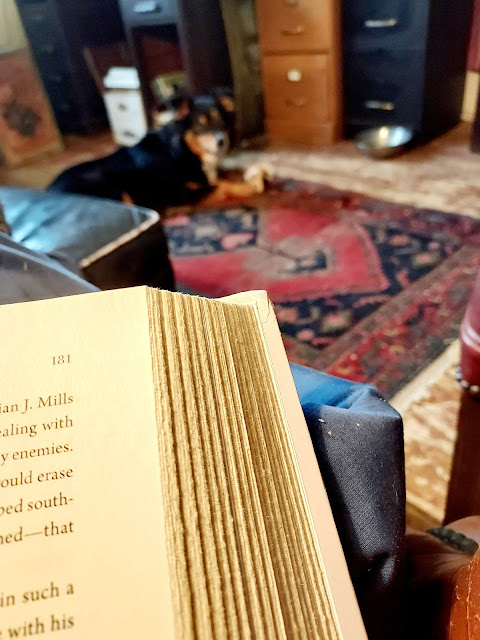
That question is instantly joined by another: Why do I read? Then there is, of course, What else could or should I be doing? And right away we can discount Sunny Juliet’s opinion, since hers is a distinctly self-serving perspective. In her point of view (I cannot imagine I’m misreading her on this), all the hours I’m focused on objects held in my hands is robbing her of my attention, and there’s no amusement for her in watching me, either, as what I am “doing” seems so little like doing anything.


Oh, my dear, impatient, so patient companion!
 

Even with a beef bone, she hopes for play with momma.

What do I seek in all this reading? That’s the “why” question. One answer is understanding. I want to understand as much as I can of the knottiest, most insoluble human predicaments, problems to which I will never have a full answer as long as I live. That answer surely elicits another “Why?” What is the good of understanding that leads no further?


Oh, tree in the garden! What knowledge did its fruit offer? 


I see different kinds of hungers for knowledge and understanding in different human beings. The pragmatically scientific want to take things apart, see how they work, and then do things that have not been done before. They are eager to change the world. Why? Sometimes for the betterment of mankind, sometimes just “Because we can.” Around those seekers, always, are hangers-on and parasites with no intrinsic hunger of their own for the knowledge and inventions, who do, however, care very much for the wealth that can be generated, wealth multiplying itself into the future, if only one makes a reservation early enough on the investment bandwagon. Theirs is hunger for accumulation, which is qualitatively different from hunger for knowledge. 


And yet, honestly, don't most of us have a certain hunger for accumulation? I look around my life and see art on walls, books on shelves, stacks of photograph albums, dishes of stones and fossils, and physical representations of beautiful living things.


Beauty and memories, memories and beauty. Objects that invite my eyes and my hands, pages that carry me over oceans to inhabit other lives and other times and also let me relive my own past years. Associations carried by these material objects are my real accumulated wealth, the objects themselves only carriers.


Does the quest for understanding life look more to the past than to the future? “Life can only be understood backwards, but it must be lived forwards,” wrote Kierkegaard. We do seek hope in the possibility of applying our understanding to the future. For example, restricting the question of “how we came to be where we are” to immediate family and acquaintance rather than society as a whole, I can see errors I have made and try to avoid repeating them in what remains of my time on earth. Sadly, human societies, with longer spans than individuals but always peopled by those shorter-lived humans, have difficulty learning from previous generations. Somewhere in his book, Surely You’re Joking, Mr. Feynman, the insatiably curious physicist wrote that we live our lives, see where we’ve gone wrong, and then die. For some reason, the simple truth of that statement, the flat-footed way he phrased it, amuses me no end. That's us, all right! And is that how it will be with our species as a whole? I wonder. They came into existence, succeeded magnificently for a while, then messed it up and went extinct. Maybe. Understanding too late--.


Besides understanding, however, there’s no denying the strong element of escape in much of my reading, and often these hungers pull in decidedly opposite directions. When the world is too much with me and I want to drown out the clamor of politicians who have once again invaded my thoughts with one outrageous act or speech after another, my hunger for escape pulls away from my hunger for understanding, and I can only feed them in turn, first one and then the other, these jealous rivals, setting aside Jimmy Carter’s Keeping Faith for The Moffats, by Eleanor Estes.


Looking for understanding,

the search continues.

Caveat emptor: I’ll stop here for a moment to remind myself and my readers that naming desires, like naming emotions, distorts our inner reality. They are not things and do not occur singly, and my attempts to tease out separate strands from an inchoate stream can be only a partial and misleading picture. All analysis distorts. Keep that in mind, please, and what I write here will not seem, perhaps, quite so absurd!


The open road! Escape!


And now I’m thinking that understanding and escape are very earthbound dimensions of reading hunger, very, very human, and that there is something else, woven tightly into these hungers and yet also very different, and that is our longing to live beyond the limits of our individual life spans, not only longer but also larger. You see instantly how the desire to expand beyond cannot be separated from hunger for understanding or for escape—and yet, do you also see that it cannot be completely expressed by those two hungers? We want something eternal, deathless. No theologian, however, I'll just leave that teasing suggestion right there.


I have more to say about the comfort of remembering, which also lets us slip time's constraints. 


Through the Looking Glass brings back, for me, the excitement I felt when I ran into the kitchen to tell my mother, “It’s a chessboard!” Lewis Carroll had not stated it so baldly, and my parents had not explained the story to me that way, but all of a sudden, reading it to myself, I had seen the chessboard when the Knight told Alice he could go no farther because he had reached the end of his move, and I had to run and tell my mother, who responded, “You didn’t know that?” No, I didn’t, but the excitement of my discovery was not dampened by her amusement, because I discovered it for myself, as I still remember with pleasure. 


If I were to pick up right now, today, Milan Kundera’s The Unbearable Lightness of Being, it would carry me back to the Parc Monceau in Paris (as merely thinking of the book carries me back), especially if I had the French paperback. One summer, day after day I went to the Parc Monceau with that book in hand, L’insoutenable légèreté de l’ être, lost in an Eastern European world inside the landscaped French world around me in my dream city far from home. 


And Wind in the Willows! I read that book to my son, giving the different animal characters different voices, and we had a wonderful time, which he still remembers. Then when the Artist and I had a layover in the Detroit airport on our way home from France, we read to each other (from a battered paperback copy that is here in my house somewhere, but where?) the chapter “Dolce Domum,” tears streaming down our faces, while all around us business people busily consulted their Blackberries and the contents of their briefcases. 


Are you still with me? Are you as tired as Sunny Juliet of my egghead ruminations? “Momma, get real!”


Real is snow in thick flurries and wind that drifts it across roads!

Well, here’s what was real for me on Monday evening as the blizzard swirled and on Tuesday morning when darkness had not as yet retreated: I was reading, for the first time in years, Jim Harrison’s novel, Dalva. First published in 1988, Dalva is written in the first person, the first and third sections in a woman’s voice, and what inspired me to revisit this book in 2025 was the new collection of Jim’s work in French translation that concentrates on his women characters, both in first-person stories and in third-person works with central female characters.


I have to admit that when Dalva first came out, it was hard for me to “hear” the female narrator’s voice, what with Jim’s own gravelly, very masculine speaking voice so familiar to my ear. Reading the book now is a very different experience. For one thing, Jim’s speaking voice has been gone for nine years, and he had been gone from Michigan longer than that, gone to live in Montana and Arizona. But also I am 37 years older than when I first read this novel. Thirty-seven years of varied life experience, shall we say, gives me a much richer perspective, and now Dalva’s voice comes through strong and clear to me, and I am loving this book, truly loving it, and have a much deeper appreciation for what the author accomplished, not only in writing from a woman’s point of view but in speaking so many truths.


It is somewhat a mystery to me how the rich can feel so utterly fatigued and victimized.

... 


Now there’s a specific banality to rage as a reaction, an unearned sense of cleansing virtue.

... 


The tomatoes looked as if they were suffocating in the glass jars, livid red and suffering.

... 


…I had told him that I was without a specific talent, other than that of curiosity, and he saw that as a large item. It is terrible to assume life is one thing, only to discover it is another. A highly mobile curiosity gives you the option of looking into alternatives. 


There is also, I must admit (Another admission? Is this post becoming overly confessional?) my love for southeast Arizona (a love that took me by surprise), and the way the mountains and high desert haunt my northern Michigan winter finds solace in Harrison’s descriptions of places not far from my former winter stomping grounds in Cochise County. He was just a couple of mountain ranges west and south. Hackberry trees along dry streambeds, mesquite on overgrazed acreage, eroded gulches, alligator juniper at higher elevations—all that. I came to know such country intimately.


How much poorer my present life would be had I not come back to re-read this novel! How many hungers it satisfies!


I would defend my answer to my own original question by noting that I spend no time whatsoever watching television and none drinking in bars, although as a word-addicted, dream-addled, introverted widow I do not hold my priorities up as superior to anyone else’s. All I’m saying is that reading is a priority in my life, and this is where I look for comfort and strength and beauty and understanding.


Also, never fear, Sunny and I manage a lot of dog-and-mom time, indoors and out!


Tuesday, June 13, 2023

Timing? Time? Something Else?


This past week the timing has been right for black locust perfume in the air

Sometimes timing is everything. Other times, as the Artist said so often, it’s lighting that makes all the difference. Then of course (for restaurants and retail stores) there is “Location, location, location!” and (with rare books, especially), “Condition, condition, condition!” This past weekend, fortuitously, my timing was perfect for planting on Saturday evening perennials purchased that morning at the Northport Women’s Club’s first perennial sale, which I hope will become an annual event. 


Beautiful aliens, I can't help loving them.
 

Earlier in the week we were promised three straight days of rain – Sunday, Monday, Tuesday – with the 10-day forecast showing rain for every daylight hour those three days. By Saturday, however, the chances had thinned out, and only one measly hour was showing rain for Sunday morning. We need rain so badly! But I had gotten my three new iris (white), three lady’s mantle, and three pots of Shasta daisy plants (more than three plants in those pots) into the ground on Saturday evening, although it meant moving a few other things first and preparing soil in one new place to accomplish the task. They don’t look like much yet but will, I’m confident, be splendid additions to my outdoor surroundings. For now, iris and annuals provide lively color.


And then, Sunday morning – beautifully overcast, with a very gentle rain falling like a Sabbath benediction. Everything green seemed to be taking deep, happy breaths of cool, moist air. A perfect day for me to stay inside, vacuum floors, clear away clutter, make a pot of chili, and take reading breaks as needed. – Oh, yes, and breaks to throw tennis balls for Sunny Juliet, of course.


Busy in Northport bookstore and gallery and outdoors at home with dog and yard, I’ve been in drifting mode lately with my reading. My dinner companion on the porch most evenings is one of Jim Harrison’s novels in a French translation (strange to read the northern Michigan town and road names in such a different-feeling context!), and my Audubon Society wildflower guide is next to that novel on the table, as I have reason to consult it on a fairly regularly basis at this time of year as I consider what else to include in a planned wildflower area between barn and chicken coop. 


Next to my bed are Tom Springer’s The Star in the Sycamore: Discovering Nature’s Hidden Virtues in the Wild Nearby (doesn’t that sound like a book I would love? I do!); Jon McGregor’s If Nobody Speaks of Remarkable Things; and Paul Harding’s Tinkers. Recent bedtime reading included a Saul Bellow novella, The Theft, and Michele Harper’s memoir, The Beauty in Breaking. Since drafting this post, I have slipped into the long ago of One Hundred Saturdays: Stella Levi and the Search for a Lost World, by Michael Frank, a time when Jews, Greeks, Turks, and Italians lived peacefully together on the island of Rhodes. At least, that’s how and where the book begins. I’m afraid it may go somewhere darker before it ends, but I will go with Stella wherever she goes….


On a lighter note, this coming week at Dog Ears Books should see delivery of neighbor Robert Underhill’s new murder mystery, One Cold Coffee. Customers have been clamoring for a new Underhill novel for the last couple of years, so the first two copies he brought me went out the door before I could even open one myself. “I hope you’ll read it, too,” Bob said. Well, of course! 


[Update: 6/13, 12:45 p.m. It's here now!]


Does all this drifting from book to book make me sound like a shallow consumer of the printed word? I was heartened recently to read of a study showing that reading anything in a series of short sessions, rather than all at once, actually helps us remember better what we have read. We remember longer what we don’t read all at once. Immediately I thought of meeting in a small group for eight consecutive sessions to discuss James Joyce’s Ulysses. Despite everything we have read and discussed in years since, the Ulysses experience for me was our never-equalled benchmark in terms of meaningful reading, because we took so much time with it. I think of this kind of involvement with a book as not just reading but living with and in the book day after day.


One June I was immersed in Vikram Seth’s A Suitable Boy for the entire month. Another time it was The Flowering of New England, 1815-1865, by Van Wyck Brooks, a history of American literature during those years of the 19th century. I recommend the Brooks literary histories as “slow books.” He doesn’t rush his story, and a reader cannot rush through, either. One settles down to a 19th-century pace.


Now as the summer solstice is fast approaching, it can seem as if we are careening toward that longest day, a day that comes all too soon, after which there will be increasingly less daylight to fill with summer activities through July and August. To slow time down now, even if you can only do so in quarter-hours here and there, make it a point to read slowly, wander aimlessly, to putter, saunter, loll, etc. Think of the best words you know to describe the voluptuous sense of wrapping yourself in slow moments....


Maybe, like the short reading sessions, twenty minutes of any kind of undirected leisure here and an hour there is what we will remember best and longest when winter returns – for instance, that lovely, surprising morning coffee moment when the house wren landed on the windowsill! Ah, yes! I hope so!


Grief Notes:


When it comes to grief, though, time is almost nonexistent. One can count weeks and months following loss, but there is no measuring its depth. One does not “get through” or “get over” it. You are involuntarily exiled from the beloved and familiar and transported overnight to a strange new place. You will never return. You will never forget. You simply go on, because there’s nothing else to do, because you are alive, because the one you loved “would want you to,” and so on and so forth. 


The sun shines, clouds form, rain falls. Birds sing and nest, flowers and trees blossom and grow. Young couples fall in love, and babies are born. The earth continues its revolutions, and night and day alternate, as they always have. Sometimes you smile or laugh. Everything is the same as it’s always been, and -- nothing will ever be the same again. 


It is love that is everything, and you had love, its joy and its pain. Now you have memories, a volume of images and remembered conversations that come throughout the day and in dreams at night. To live without this grief would be “never to have loved,” and how could anyone wish for that?


I hold it true, whate'er befall;
   I feel it, when I sorrow most;
   'Tis better to have loved and lost
Than never to have loved at all.