Search This Blog

Showing posts with label escape. Show all posts

Thursday, March 5, 2026

A few books, a few words


"What's with all this reading, anyway?"

Earth may be blown to smithereens (one of my mother’s oddball words) any day now, but until that happens I continue to go to my bookshop, continue to communicate with friends with phone calls, texts, emails, letters, and in-person conversations, go for walks with my dog, and yes, I am still reading. Here is the list of the books I’ve read since the beginning of the year. There are not as many as usual for over two months into 2026’s twelve, but here they are:


1. Binet, Laurent. Perspective(s) (fiction, 2023)
2. Raskin, Jamie. Unthinkable: Trauma, Truth, and the Trials of American Democracy (nonfiction, 2022)
3. Letts, Elizabeth. The Perfect Horse: The Daring U.S. Mission to Rescue the Priceless Stallions Kidnapped by the Nazis (nonfiction, 2016)
4. Giffels, David. Barnstorming Ohio to Understand America (nonfiction, 2020)
5. Field, Isobel. This Life I’ve Loved (nonfiction, 1937)
6. Stevenson, Robert Louis. An Inland Voyage (nonfiction, 1878)
7. Stevenson, Robert Louis. Crossing the Plains (nonfiction)
8. Sixsmith, Martin. The Lost Child of Philomena Lee (nonfiction, 2009)
9. Morris, Heather. The Tattooist of Auschwitz (fiction, 2018)
10. Hill, Justin. The Drink and Dream Teahouse (fiction, 2002)
11. Paton, Alan. Cry, the Beloved Country (fiction, 1948)
12. Buchan, Elizabeth. Revenge of the Middle-Aged Woman (fiction, 2002)
13. Power-Greene, Ousmane K. The Confessions of Matthew Strong (fiction, 2022)
14. Galbraith, John Kenneth. The Scotch (nonfiction, 1964)
15. Paul, Elliot. Linden on the Saugus Branch (nonfiction, 1947)
16. MacDonald, Ross. Sleeping Beauty (fiction, 1973)
17. MacDonald, Ross. The Name is Archer (fiction, 1946-1983)

Make what you will of my Books Read 2026 list so far. Ask questions if you have them. I can tell you that I am currently reading Thomas Hardy’s Under the Greenwood Tree at bedtime; with dinner, a book about trees written for artists (forget title and author name; the book is at home, and I am not); began The Man Who Planted Trees, by Jim Robbins, sitting in my car by the side of an icebound inland lake; and have a George Elliot novel, The Mill on the Floss in the wings, ready to follow Thomas Hardy.

Sometimes I find it hard to justify (to myself) the hours I spend reading books while the country and the world fall apart; however, giving up the hope of making certain others care about what breaks my heart, I am now spending less time online, having realized at long last that sharing and forwarding stories to people who either deleted my messages without reading them or maybe even blocked me and never saw the messages at all was a lost cause. As long as they continue circling their golden calf and cheering him as their savior (incomprehensible!), they will be unable to take in messages that conflict with their "true belief.” (Here's another.) Time to re-read Eric Hoffer?

I won’t deny, either, that much of my reading is escape (just look at the dates of some of those novels and memoirs and travel books), but who wouldn’t want to escape from a present in which one’s own beloved country bombs a children’s elementary school in another country, kills over a hundred schoolgirls, and our “leaders” express not a single word of regret? Everything else—all the threats to voting rights, violations of the Constitution, outright lies left and right, incompetence and corruption—all of it pales for me in the light of those dead schoolgirls. Will Iran be better off now that the Ayatollah is gone? Those little girls, dead, are not better off. You think opposing abortion regardless of circumstances means you reverence life, and yet you say nothing in opposition to these murders? And because I am an American, these murders were done in my name, also! For shame, America! For shame!

Beautiful earth! Beautiful trees and mountains, lakes and rivers, hills and prairies alive with life! Potentially beautiful human animals with your lacerated hearts and stumblings and gettings-up-again and attempts to love one another! Open your eyes!

Beautiful Michigan!

Tuesday, January 28, 2025

Do I read too much?

What does SHE think?


That question is instantly joined by another: Why do I read? Then there is, of course, What else could or should I be doing? And right away we can discount Sunny Juliet’s opinion, since hers is a distinctly self-serving perspective. In her point of view (I cannot imagine I’m misreading her on this), all the hours I’m focused on objects held in my hands is robbing her of my attention, and there’s no amusement for her in watching me, either, as what I am “doing” seems so little like doing anything.


Oh, my dear, impatient, so patient companion!
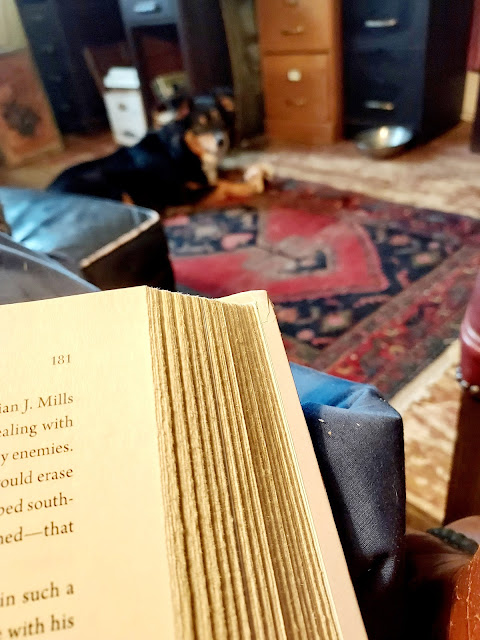
 

Even with a beef bone, she hopes for play with momma.

What do I seek in all this reading? That’s the “why” question. One answer is understanding. I want to understand as much as I can of the knottiest, most insoluble human predicaments, problems to which I will never have a full answer as long as I live. That answer surely elicits another “Why?” What is the good of understanding that leads no further?


Oh, tree in the garden! What knowledge did its fruit offer? 


I see different kinds of hungers for knowledge and understanding in different human beings. The pragmatically scientific want to take things apart, see how they work, and then do things that have not been done before. They are eager to change the world. Why? Sometimes for the betterment of mankind, sometimes just “Because we can.” Around those seekers, always, are hangers-on and parasites with no intrinsic hunger of their own for the knowledge and inventions, who do, however, care very much for the wealth that can be generated, wealth multiplying itself into the future, if only one makes a reservation early enough on the investment bandwagon. Theirs is hunger for accumulation, which is qualitatively different from hunger for knowledge. 


And yet, honestly, don't most of us have a certain hunger for accumulation? I look around my life and see art on walls, books on shelves, stacks of photograph albums, dishes of stones and fossils, and physical representations of beautiful living things.


Beauty and memories, memories and beauty. Objects that invite my eyes and my hands, pages that carry me over oceans to inhabit other lives and other times and also let me relive my own past years. Associations carried by these material objects are my real accumulated wealth, the objects themselves only carriers.


Does the quest for understanding life look more to the past than to the future? “Life can only be understood backwards, but it must be lived forwards,” wrote Kierkegaard. We do seek hope in the possibility of applying our understanding to the future. For example, restricting the question of “how we came to be where we are” to immediate family and acquaintance rather than society as a whole, I can see errors I have made and try to avoid repeating them in what remains of my time on earth. Sadly, human societies, with longer spans than individuals but always peopled by those shorter-lived humans, have difficulty learning from previous generations. Somewhere in his book, Surely You’re Joking, Mr. Feynman, the insatiably curious physicist wrote that we live our lives, see where we’ve gone wrong, and then die. For some reason, the simple truth of that statement, the flat-footed way he phrased it, amuses me no end. That's us, all right! And is that how it will be with our species as a whole? I wonder. They came into existence, succeeded magnificently for a while, then messed it up and went extinct. Maybe. Understanding too late--.


Besides understanding, however, there’s no denying the strong element of escape in much of my reading, and often these hungers pull in decidedly opposite directions. When the world is too much with me and I want to drown out the clamor of politicians who have once again invaded my thoughts with one outrageous act or speech after another, my hunger for escape pulls away from my hunger for understanding, and I can only feed them in turn, first one and then the other, these jealous rivals, setting aside Jimmy Carter’s Keeping Faith for The Moffats, by Eleanor Estes.


Looking for understanding,

the search continues.

Caveat emptor: I’ll stop here for a moment to remind myself and my readers that naming desires, like naming emotions, distorts our inner reality. They are not things and do not occur singly, and my attempts to tease out separate strands from an inchoate stream can be only a partial and misleading picture. All analysis distorts. Keep that in mind, please, and what I write here will not seem, perhaps, quite so absurd!


The open road! Escape!


And now I’m thinking that understanding and escape are very earthbound dimensions of reading hunger, very, very human, and that there is something else, woven tightly into these hungers and yet also very different, and that is our longing to live beyond the limits of our individual life spans, not only longer but also larger. You see instantly how the desire to expand beyond cannot be separated from hunger for understanding or for escape—and yet, do you also see that it cannot be completely expressed by those two hungers? We want something eternal, deathless. No theologian, however, I'll just leave that teasing suggestion right there.


I have more to say about the comfort of remembering, which also lets us slip time's constraints. 


Through the Looking Glass brings back, for me, the excitement I felt when I ran into the kitchen to tell my mother, “It’s a chessboard!” Lewis Carroll had not stated it so baldly, and my parents had not explained the story to me that way, but all of a sudden, reading it to myself, I had seen the chessboard when the Knight told Alice he could go no farther because he had reached the end of his move, and I had to run and tell my mother, who responded, “You didn’t know that?” No, I didn’t, but the excitement of my discovery was not dampened by her amusement, because I discovered it for myself, as I still remember with pleasure. 


If I were to pick up right now, today, Milan Kundera’s The Unbearable Lightness of Being, it would carry me back to the Parc Monceau in Paris (as merely thinking of the book carries me back), especially if I had the French paperback. One summer, day after day I went to the Parc Monceau with that book in hand, L’insoutenable légèreté de l’ être, lost in an Eastern European world inside the landscaped French world around me in my dream city far from home. 


And Wind in the Willows! I read that book to my son, giving the different animal characters different voices, and we had a wonderful time, which he still remembers. Then when the Artist and I had a layover in the Detroit airport on our way home from France, we read to each other (from a battered paperback copy that is here in my house somewhere, but where?) the chapter “Dolce Domum,” tears streaming down our faces, while all around us business people busily consulted their Blackberries and the contents of their briefcases. 


Are you still with me? Are you as tired as Sunny Juliet of my egghead ruminations? “Momma, get real!”


Real is snow in thick flurries and wind that drifts it across roads!

Well, here’s what was real for me on Monday evening as the blizzard swirled and on Tuesday morning when darkness had not as yet retreated: I was reading, for the first time in years, Jim Harrison’s novel, Dalva. First published in 1988, Dalva is written in the first person, the first and third sections in a woman’s voice, and what inspired me to revisit this book in 2025 was the new collection of Jim’s work in French translation that concentrates on his women characters, both in first-person stories and in third-person works with central female characters.


I have to admit that when Dalva first came out, it was hard for me to “hear” the female narrator’s voice, what with Jim’s own gravelly, very masculine speaking voice so familiar to my ear. Reading the book now is a very different experience. For one thing, Jim’s speaking voice has been gone for nine years, and he had been gone from Michigan longer than that, gone to live in Montana and Arizona. But also I am 37 years older than when I first read this novel. Thirty-seven years of varied life experience, shall we say, gives me a much richer perspective, and now Dalva’s voice comes through strong and clear to me, and I am loving this book, truly loving it, and have a much deeper appreciation for what the author accomplished, not only in writing from a woman’s point of view but in speaking so many truths.


It is somewhat a mystery to me how the rich can feel so utterly fatigued and victimized.

... 


Now there’s a specific banality to rage as a reaction, an unearned sense of cleansing virtue.

... 


The tomatoes looked as if they were suffocating in the glass jars, livid red and suffering.

... 


…I had told him that I was without a specific talent, other than that of curiosity, and he saw that as a large item. It is terrible to assume life is one thing, only to discover it is another. A highly mobile curiosity gives you the option of looking into alternatives. 


There is also, I must admit (Another admission? Is this post becoming overly confessional?) my love for southeast Arizona (a love that took me by surprise), and the way the mountains and high desert haunt my northern Michigan winter finds solace in Harrison’s descriptions of places not far from my former winter stomping grounds in Cochise County. He was just a couple of mountain ranges west and south. Hackberry trees along dry streambeds, mesquite on overgrazed acreage, eroded gulches, alligator juniper at higher elevations—all that. I came to know such country intimately.


How much poorer my present life would be had I not come back to re-read this novel! How many hungers it satisfies!


I would defend my answer to my own original question by noting that I spend no time whatsoever watching television and none drinking in bars, although as a word-addicted, dream-addled, introverted widow I do not hold my priorities up as superior to anyone else’s. All I’m saying is that reading is a priority in my life, and this is where I look for comfort and strength and beauty and understanding.


Also, never fear, Sunny and I manage a lot of dog-and-mom time, indoors and out!


Thursday, April 15, 2021

Incomplete But Nonetheless True Confessions

Spring is here.

I have not yet (ever) read The Handmaid’s Tale.


For any serious reader but especially for a bookseller (female, yet!), this is a pretty serious confession, and two years ago I vowed I would read Margaret Atwood’s modern feminist classic over the winter. I didn’t, though. And I haven’t yet. 


I’m not intentionally avoiding the story, but sometimes when any book has already captured the attention of so many other people I don’t feel a huge amount of personal responsibility for hurrying to get to it myself. Bestsellers are already bestsellers, after all, and classics are not going to stop being classics overnight. I’ll get to The Handmaid’s Tale in my own good time, as I’ve gotten around at last to many other long-neglected and worthy works of literature.


My book corner: you've seen it before.


I am usually reading multiple books at any given time. 


One of the books I’m currently reading is a different Margaret Atwood novel, Life Before Man, set in 1970s Toronto, a book that came to me serendipitously, as so many of my books do. I couldn’t have sought it out, because I don’t recall hearing the title before. Written in the third person throughout, the story presents multiple points of view, one point of view contained in each short chapter. I find it difficult to stop at the end of a chapter, feeling almost compelled to begin the next.


My car book these days is Crazy Weather, by Charles L. McNichols, first published in 1944. Lewis Gannett, reviewing Crazy Weather in Books and Things, wrote of it:


Crazy Weather is the story of a white boy who, through four days of torrid weather and cloudbursts, goes glory-hunting with an Indian comrade [Mojave] and returns to discover that he is, and prefers to be, white after all.


South Boy’s ambivalence is clear from the very beginning of the story, and no wonder, given the opposition of character presented by his father and mother. Hal Bortland wrote of the story:


This is the story of a boy who became a man in four days. Into it Charles McNichols has packed an amazing amount of action, adventure, Indian lore, and satisfying psychology…. 


Sterling North loved it, too. I wonder what reputation (if any) the book holds in our own day, particularly among Native American readers.


After our nightly pack time and movie, before going to sleep, I picked up another J. A. Jance mystery featuring fictional Sheriff Joanna Brady of Cochise County, Arizona. Part of this particular novel’s action took place on the old Charleston Road between Tombstone and Sierra Vista, and I read the description of the road aloud to the Artist, who instantly recognized the road we had taken to see water in the San Pedro River and been surprised by the locks on the footbridge.


I have been known to go on a genre fiction binges.


Yes, it’s true. While I called myself “a serious reader” at the top of this post, I do go on these binges from time to time. Presently it’s J. A. Jance. At other times it’s been Lee Child or Alexander McCall Smith or Sara Paretsky or James Lee Burke. Don’t get me wrong, though. This is a confession, not an apology.


Current binge books --


Mystery series books, books that develop a main character through time and through multiple crimes solved, I make little to no attempt to read in chronological order (whether reading for the first time or re-reading the series).


As a bookseller, I am very familiar with readers who feel they must begin a series at the beginning. A few won’t even start reading until they have the entire series lined up. I, on the other hand, would be hard pressed to name a series I started with the first book. What usually happens is more like this: I realize that such-and-such a writer is immensely popular and that it would behoove me to have some slight acquaintance of her or his work, so I pick up a book from the series and try it out. If I like it, I reach for another. Eventually I worked my way through the entire Ladies No. 1 Detective Agency series in that haphazard, nonchronological manner and still feel comfortable picking up any book in the series whenever the mood strikes. I dove into Jance’s Joanna Brady series the same way and continue as I find more books in the series.


Arizona dry wash


Escape is probably one of the reasons I read so many books. 


There are so many reasons for reading books, and like many readers I can’t say a single reason explains what some might term an addiction. I read for information, for understanding, for pleasure – and, I will not deny it, for escape. But my life is wonderful! Why do I need escape?


I am a worrier. 


I wrote once in this blog that I have come to believe needless worry, the kind of fretting that we do completely apart from taking action, is a form of superstition. Here’s some of what I wrote on the subject a while back:


As I try to tease apart this mystery, it seems to me that we hold a vague, unconscious, and unreflective belief that by worrying we feel we are making time payments to ward off future disaster. Pay now, play later! The focus of a worry, remember, is an undesirable outcome (or, all too often, multiple undesirable outcomes on a variety of fronts); thus worrying is suffering in advance that we feel should be subtracted from the outcome. If my hypothesis is correct, this same unconscious belief explains our worry over loved ones, as well. If, for example, I worry myself sick over my son’s late return home, I am paying the price that might otherwise have to be paid by a terrible accident befalling him. Or so says my superstitious belief.


Anyone who may want to read the entire post can find it here.


What I thought and said and wrote then and still believe today is that such worrying is irrational. And yet I continue to do it! I don’t worry that much about myself (What is this rough patch of skin? Should I have it looked it? Okay, when we’re back in Michigan) as I do about others. 


Since my former husband died a year ago, I’ve talked to my son nearly every day by phone. He is doing fine. But once a mom, always a mom! When I don’t hear from friends, I worry that something might be amiss with them. Situations of those I love facing surgery or recovering (I hope!) from same: another source of worry. 


I worry about drought in the Southwest, race relations across the nation, family, friends, the future of the country, the fate of the earth -- and especially, these days, what is going to become of my rescue dog, the “dog with issues,” little Peasy. I wake up in the middle of the night worrying about Peasy’s future and have to turn on the light and read myself back to sleep ... because ...  


Along the Kansas Settlement Road


I have fallen in love with Peasy. 


It wasn’t “love at first sight” when I first laid eyes little Pea. (It was hard to get much more than a glimpse of him, the way he hid from anyone who came near!) He was cute, though, and needed a home, and I needed a dog and figured I could work him through some of his issues. Together we have made great strides! And naturally, gradually day by day, I have come to love him more and more. The way he looks at me! How can I help it?


Good boy!


David and I were absolutely smitten with our Sarah. Besotted! The thing is, though, anyone would have loved Sarah, and quite honestly I think she could have been just as happy in another home, with another family. Not only beautiful, Sarah was also supremely confident and easy-going and able to adjust herself to any situation. (She barely had a startle reflex at all.) When people asked if we had “rescued” her, I used to say we were just lucky enough to find her before anyone else did, and that was the truth. That little puppy spent only a single night in the shelter before we scooped her up took her home, and she was about as easy to train and live with as a puppy could possibly be.


Peasy, now -- quite a different kettle of fish! Not easy-peasy! Picked up as a stray, he was held in the pound for over three months because no one wanted him! What a challenge that boy was his first week with us! 


Now people who see him tell me what a beautiful dog he is, and I see him as beautiful, too, where at first he was only a funny, kinda cute, goofy little scaredy-dog, way too skinny and with a coat full of mats. He is still afraid of strangers, though, and just about everyone is a stranger. And so --


I could and would give him up, out of love for him, if I found someone who could give him a better, fuller life here in Arizona than I can hope to give him in Michigan. At least I think I could....


Because he is so happy here! He behaves and minds me very well. He has an absolutely joyous time when we go out with our neighbor and her two dogs. If the Artist and I leave him alone for a couple of hours, he greets us with happy wiggles when we return. And he blisses out when he joins us for 15 minutes to half an hour of nightly pack time up on our bed. He is, as I say, a happy dog. But still a dog with issues. And back in Michigan I won’t have the freedom of my “seasonal retirement” to devote myself to his training and exercise. I cannot see Peasy leading a rich, fulfilling life alone all day and/or in a cage (call it a “crate,” if you like, but it’s a cage all the same), and he has a very long way to go when it comes to acquiring social skills. 


Clockwise from left: Buddy, Peasy, Molly


I still think adopting him was not only good but the best thing for him. He could have languished in that sterile cell forever! Instead, he has had love and lessons and increasing freedom, and he begins and ends every day a happy, happy dog. (I know I am repeating myself. He is lying contentedly at my feet as I type these lines. How can I help myself?) And that’s what I want to continue: a happy, rich, fulfilling life, with as much outdoor work and play as possible. 


My Peasarino is a good, sweet, loving little dog. Given the right situation for him, for the dog he is, and given a kind, attentive, patient, owner who will love him as much as I do, I think he has potential to be a great dog. It's just that (I can't help thinking) someone else might be better able to bring out his full potential.


And yet I’ve done almost nothing to find another Arizona home for him. 


It’s so hard even to think of giving him up that I don’t look much more than a week ahead, if that, telling myself there’s no need to rush, that I still have time to work with him. But as hard as it is for me to think about his long-term future, it’s equally hard to banish those thoughts or worries from my mind, because there’s no way I’m going to “surrender” him, even to Aussie Rescue or the well-run shelter in Willcox, without knowing where he might end up. I am the one who adopted this dog, and that makes me the one responsible for his life.


And so continues the unfolding saga of Peasy, dog of the desert.

Thursday, October 8, 2020

Read What You Need


Note: I wrote this post over the course of a few days, so as to give mini-reports along the way to make my book-hopping lack of pattern more obvious. And then this morning I took long, leisurely outdoor time to walk with Sarah and photograph today’s beautiful Thursday world around me.


Tuesday afternoon


Already I have to resort to paraphrase, because I don’t know what I did with the original quote, but it came from another bookseller in another state, who said, as far as recommending or advising people on what books to read these days, that the thing to do right now is to read whatever it is you need. If you need information, read books of information. If it’s escape you need, read escape. I’d amplify that to say specifically that whether you need poetry or history or religious meditations or humorous essays, science fiction or Victorian gardening texts, whatever books you need are the ones you should be reaching for right now.


For me, once again, it’s sometimes one and sometimes another, and I go from one kind of reading to another, skipping between often totally unrelated books with no apology whatsoever. Crazy Horse, by Mari Sandoz, is both informative and beautifully written, as was Isabel Wilkerson’s The Warmth of Other Suns. Wilkerson’s migrants did not find a perfect society in the North, but for the most part they were glad they had made the move, and I devoured that book to the last page quickly, eager to see how their lives turned out. It’s different with Crazy Horse. Since I know there will be no “happy ending” – and there are plenty of tragedies before the end, also – I keep setting that painful saga aside, taking breaks with something easier on the spirit.


Steve Hamilton’s A Cold Day in Paradise, the first of his Alex McKnight mysteries, was a re-reading experience, a little self-indulgence I frequently give myself in the best of times (which these are not). Even when I remember more of a story than I recalled from my first, long-ago reading of A Cold Day in Paradise (first memorably read in a motel in St. Ignace, cover to cover in one night), there is always a lot that I’ve forgotten and that seems fresh and new, whatever the book. 


The Boy, the Mole, the Fox and the Horse is a children’s book and generously (and beautifully) illustrated, so reading that story took me only very briefly away from the world of challenging reality and challenging reading. Native Tongue, the first volume of Susanne Haden Elgin’s feminist speculative fiction trilogy, interested me without completely fully absorbing my attention. I would call it a novel of ideas rather than a character- or plot-driven work. But it did offer escape from political campaigns and COVID-19 concerns.


Sometimes the way a book falls into my hands is complete serendipity. Such was the case with Jimmy Carter’s Why Not the Best? But I wrote about Why Not the Best? in my last post and won’t repeat myself here.


The Uncalled, by Paul Laurence Dunbar, published over a century ago, was something chosen more deliberately. Familiar with Dunbar’s name because of his poetry (Maya Angelou took her title I Know Why the Caged Bird Sings from a Dunbar poems), I hadn’t realized he also wrote novels. Interestingly, though Dunbar was perhaps the first well-known black American poet, there is nothing of race in the story of The Uncalled – at least, so far. I’m only halfway through this little book.


And now already I’ve found something else that seems worth reading. My Brilliant Career, by Miles Franklin, made a big splash when its teen-aged author published her novel in Australia in 1901, but then it was out of print until 1966. Despite the book’s initial success, Franklin felt there was no place for her in the new, very male, nationalistic Australian literary world; she was also unhappy with some of the interpretations laid upon her work.


Australia – now that’s an escape from my everyday world!


Our brave little reading circle, the one that convened years ago to study James Joyce’s Ulysses together, is now committed to reading and discussing for November William Faulkner’s Absalom, Absalom! Faulkner will be a stretch for me, as I am in general not a fan, but the book covers the same period as Margaret Walker’s Jubilee, so it will be interesting from that standpoint, and I need to challenge myself, anyway, which was this group’s original mission – to read together books we might not have read on our own. 


Some (but not all) of us took on Proust one fall, and I’ve been reading him again recently, in French, a few pages at a time. I’m not sure whether to classify Proust “difficult” or a familiar and comforting refuge. He is probably the latter for me. Not an “easy” read, but his writing is luxurious – especially the opening scenes of childhood, both at the grandparents’ house in Combray and in the parks and streets of Paris. These long-ago, faraway scenes carry me away from the present, away from worry and strife -- and isn’t that how we define escape reading?


Wednesday morning


I finished The Uncalled last night and fell asleep over early pages of My Brilliant Career. Of the former, I can say it is very much a Victorian novel, with only a couple of places that one might, if informed of the author’s life, see something of his own experience as a black man in [that long-ago] turn-of-the-century America. Paul Laurence Dunbar’s parents, I read, were born in slavery, so he and his siblings were the first generation of the family born free, but as the orphan protagonist of The Uncalled, however, realizes so strongly, there is more to freedom than not being held in bondage. The fictional character longs to break away from his guardian’s very strict religious household (where baseball is considered as great a sin as dancing) and her plans to make him a preacher. Like Dunbar himself, young Brent longs for the freedom of the writing life. When a friend in the seminary warns him of that life’s agonies, Frederick Brent listens with no change of heart.


“This is your story,” said Brent; “but men differ and conditions differ. I will accept all the misery, all the pain and defeat you have suffered, to be free to choose my own course.”


Besides several volumes of poetry, for which he is chiefly known, Dunbar’s only other published book was Tales from Dixie, a collection of short stories featuring African-Americans before and after emancipation. This may be his least sentimental, most realistic work, and I would like to read it sometime. Sadly, the writer died young, only 33 years old, but he earned success while he lived, which is more than many poets, black or white, can say.


Not having more Dunbar on hand last night, I curled up in bed with My Brilliant Career but laid it aside to watch “Dark Waters” with the Artist, taking it up again after the movie and falling asleep before getting very far into the story. And earlier this morning, over the first cup of coffee, somehow I became embroiled in old e-mails, clearing out as many as could be deleted, filing others, re-reading and re-living days COVID and pre-COVID.


Here at the bookstore now, I’m pleased to have restocked many of Jim Harrison’s fiction titles; Katey Schultz’s brilliant Still Come Home (which every American should read); and to have some charming new children’s books now in stock. October will be the last full month of the 2020 year for Dog Ears Books (let’s be clear: we do plan to be back in the spring!), but it isn’t too early to get some of that holiday shopping out of the way, and I’ll be glad to help with that. 


Wednesday afternoon


Continuing with My Brilliant Career, I am intrigued by the fact that the adolescent author, while complaining of her own fate when times grew hard for the family, managed to recognize her parents’ difficulties, as well, and even to see their life in the greater national context.


…Household drudgery, woodcutting, milking, and gardening soon roughen the hands and dim the outside polish. When the body is wearied with much toil the desire to cultivate the mind, or the cultivation it has already received, is gradually wiped out. Thus it was with my parents. They had dropped from swelldom to peasantism. They were among and of the peasantry. None of their former acquaintances came within their circle now, for the iron ungodly hand of class distinction has settled surely down upon Australian society – Australia’s democracy is only a tradition of the past. 


I wonder, is My Brilliant Career considered an Australian classic by now – does it still fall short of the Australian male nationalist literary tradition?


Thursday morning


The world forced itself upon me last night. The event was the vice-presidential “debate,” and I steeled myself to listen, confident that it could not sink to the level of the presidential candidates’ horror show circus. Fortunately, I am blessed with generally low blood pressure.


Everyone listening (or watching, as more probably did) will have a different impression of the performances. My impression of Pence – a cipher in my mind beforehand – was that he is a very slippery, sneaky little man. He pretended great politeness and respect at the beginning of each two minutes allotted him (“Thank you, Susan”) but then talked on past his limit again and again, while the moderator tried to stop him with “Thank you, Mr. Vice-President” over and over. He also interrupted Senator Harris more than once. In short, he was as determined as the president not to be hemmed in by the rules but maintained a surface demeanor of civility and normality.


How many questions asked by the moderator were actually answered by either candidate? Once Pence asked that the record show that Harris had not answered a question – this after he, Pence, had evaded countless previous questions! I wish Harris had challenged him on that hypocritical remark, as well as on his repeated admonition to her, “You are entitled to your own opinion, but you are not entitled to your own facts.” This was a fiendish ploy, as the very phrase “alternative facts” was invented in the White House to excuse lies told by the president! The vice-president took the administration’s own guilt and painted the senator with it, and Harris let him get away with it!


I still have no clear answer on the Democratic position on fracking. I believe fracking should be banned, for strong scientific reasons, but now it seems both parties have decided that fracking is something holy -- if anything, more sacred than a fertilized human egg. Will people be talking about fracking today? Will that issue get any attention at all? For me, it was the most worrisome take-away, other than the revelation of the vice-president’s character.


And so this morning, waking once again to the political take-over of my brain, I fled to Australia with Miles Franklin, and during the day I will no doubt read a few more poems by Jane Kenyon (because Lord knows I need poetry right now and will probably need it more and more in the less than four weeks ahead!), but before the bookstore I spent time in the beautiful outdoors with my dear old dog.


I am not, you see, doing a complete ostrich act and avoiding reality or succumbing to an escape addiction, but neither am I willing to let every waking moment be taken over by those aspects of reality that do nothing but heighten anxiety and/or plunge me into depression. I'm no good to anyone like that. Regular reading of other times and places is part of my life, anyway. The difference now is that I do it for sanity’s sake. 


Measured doses – reality, escape – I seek some kind of mental balance. A beautiful, sunny fall morning doesn’t hurt, either.