Search This Blog

Wednesday, February 13, 2013

What Does “Nonfiction” Mean to You?

Marina parking lot, full of snow

In my literary lexicon, there is poetry, drama, fiction, and nonfiction, so I’m always a little confused when a newcomer to my bookstore asks, “Do you have a nonfiction section?” Nonfiction, in fact, takes up most of the shelf space in my bookstore.

One wall and a small part of another is basically fiction—and then there’s history and travel (which I combined, for the sake of convenience, when I made the move back to Waukazoo Street), biography and memoir, philosophy, religion, self-help, health, sports, law, economics, true crime, foreign language, natural history, physics, astronomy, do-it-yourself, cookbooks, military. There’s even a category for “islands” and another for “adventure.” So the answer to the question is not “Yes, I have a nonfiction section,” but “I have many nonfiction sections.” Still, I couldn’t help wondering, so when I ran into a fellow bookseller the other day, I asked him if I was missing something.

I mean, back in the old days (by which I mean 15+ years ago) we did not say, “Back in the day.” Really! We said, “Back in the old days.” The first time I saw the newer reference to earlier times, it was in print, and my inner editor was highly offended. What the hell did the writer mean by that? But then I started listening for the phrase and hearing it everywhere. I may never hear it without an initial shudder or twinge, but I realize now that it’s a phrase in common usage, clearly (I note with interest) accepted across the generations, and one that has replaced my old way of speaking. (Sigh!)

Life itself has been newly divided into five kingdoms (there were two when I was in school), so who knew what new divisions might have been inaugurated in the world of books? Do you see the source of my unease? Was there, I wondered, a younger, hipper definition, some narrower definition than the one in my mind, for “nonfiction”?

The fellow bookseller I asked, who as it happens is exactly my son’s age, reassured me. No, he said, there is no new boundary for the term, and the people who ask need to be more precise about what they want. What a relief!

But I’m exaggerating my anxiety. What constitutes “nonfiction” for any particular bookstore browser has never been a problem, because I don’t mind asking questions in return to get closer to what a customer wants, I don’t expect everyone who comes into my bookshop to use my vocabulary and intuit my way of categorizing books, and it’s a nice opening for conversation. It’s certainly preferable to “Is there any organization at all to how these books are arranged?” Can you believe someone actually asked me that once? No, I just put those identifying tags on the shelves to encourage false hope!

About half the books I read every year are nonfiction. Quiet: The Power of Introverts in a World That Can’t Stop Talking was the first one of this year, and I wrote about it at length in January. Meditations on Hunting was a gift from a dear friend and as much philosophy as sport. Many of my friends would find it morally repugnant, I know, but I was fascinated by the argument Ortega y Gasset makes for hunting (and fishing, he allows, but then does not explore this aspect) as the only true way human beings (and he says “men,” but I see no reason to restrict the argument in that way) can reconnect with the precivilized life we had in common with other, still wild animals. The author makes particularly scathing remarks about “hunting” with a camera but says nothing, I couldn’t help noticing, of drawing or sketching or even tracking without killing, and isn’t “to hunt” to seek, to search for, to follow? In the end, I’m not sure I bought his whole argument, but it was fascinating to follow the trail of his reflective thought through woods and field....

Deadly Spin I've also written about already so won’t say more here, and next in my 2013 nonfiction reading was The Jefferson Bible, something I’d heard about for years but never before read. Jefferson’s purpose was to separate the message of Jesus from other material in the Gospels. Jefferson didn’t care about miracles but about the teachings of Jesus, and I’d say that his idea was that to be a Christian meant to follow the teachings, rather than to get too hung up on belief in miracles.

Solzhenitsyn’s speeches, despite repetitions within them, were fascinating. What would he say today, I wonder, about cordial American business relations with the government of China?

Finally I treated myself to Adam Gopnik’s book of essays on winter. Gopnik never disappoints me. Although this one has been more of an indoor winter for me, as opposed to last year’s outdoor winter, it was satisfying to reflect with the author on Western views of winter born in the modern era and how they have changed over the course of 200 years.

David has been reading nonfiction, too, most recently the Frances Mayes book called Bella Tuscany, which he tells me I’ll love, as she writes quite a lot about gardening. Is he escaping from winter in reading about life in Italy? Nothing wrong with that, is there? He balanced the Italy escape last night with a book about the recent global financial collapse and told me a lot about Iceland and how its economy fell. 

Are we recovering? The president thinks so. Do you? Can afford to indulge yourself with a good new book? I'll have an order arriving in the next couple of days.

Lights on and wear seatbelts, please!

Monday, February 11, 2013

Where Is Benjamin Busch These Days?


It's been three years since Ben appeared on my radar. First came discovery. Then eager anticipation. Finally, reality. For the sake of accuracy, perhaps I should note that Ben preceded his book, when I invited him up before it was even finished to have a conversation in the bookstore with essayist Anne-Marie Oomen in front of a fascinated public. That was when he still had his ponytail. But I digress. 

It's hard to keep track of such an active, creative person as Benjamin Busch. If he isn't making a movie or taking it around to film festivals or exhibiting photographs, he's on a book tour, so I guess my subject heading today was kind of misleading, because I don't know exactly where he is this month. I do know that Dust to Dust was named one of the Top 5 memoirs of 2012 by Library Journal, has been named a Michigan Notable Book for 2013, and received the 2013 GLCA Award for Nonfiction. If you have yet to make the acquaintance of this very memorable, beautifully written memoir, please visit Dog Ears Books and let me introduce you soon. You won’t be sorry.

Take a close look at that Michigan Notable Book list, and you'll also see Michigan authors,  Jeff Vande Zande and  Laurie Sommers, visiting authors at Dog Ears Books now receiving state-wide recognition. Northport is almost at the end of the road, but we don't take a literary back seat. 


Saturday, February 9, 2013

Georgia Road Trip, January 2003


Yes, you read that subject heading correctly: it was a full decade ago, almost five years before I started this blog, that David and I drove south with our old dog, stopping in many little towns along the way. A couple old photo CDs from that trip surfaced recently, and in response to one of my readers, Bob and Carol’s daughter (who may not even know that her mother told me she, the daughter, missed my road trip posts from other winters), I’ve decided to take one day a week for a while to revisit vacation scenes of years ago. Ready? Let’s go! The year is 2003, and we are making the first of several pilgrimages to Plains, Georgia, home of President Jimmy Carter. Plains is a pretty small town, but for part of the year it is serviced by a short line train from nearby Americus. Here is downtown Plains:

Plains, Georgia
Whenever we go to Plains (most recently in January of 2010), we plan to arrive about midday on Sunday, just in time for a big Sunday Southern dinner at Mom’s Kitchen, a no-frills, cafeteria-style restaurant with some of the best home cooking in the South. Whatever you do, do not miss the sweet potato pie!!! But then, anything you have to eat there will be good. You'll leave clean plates behind....


Mom's Kitchen, Plains, Georgia
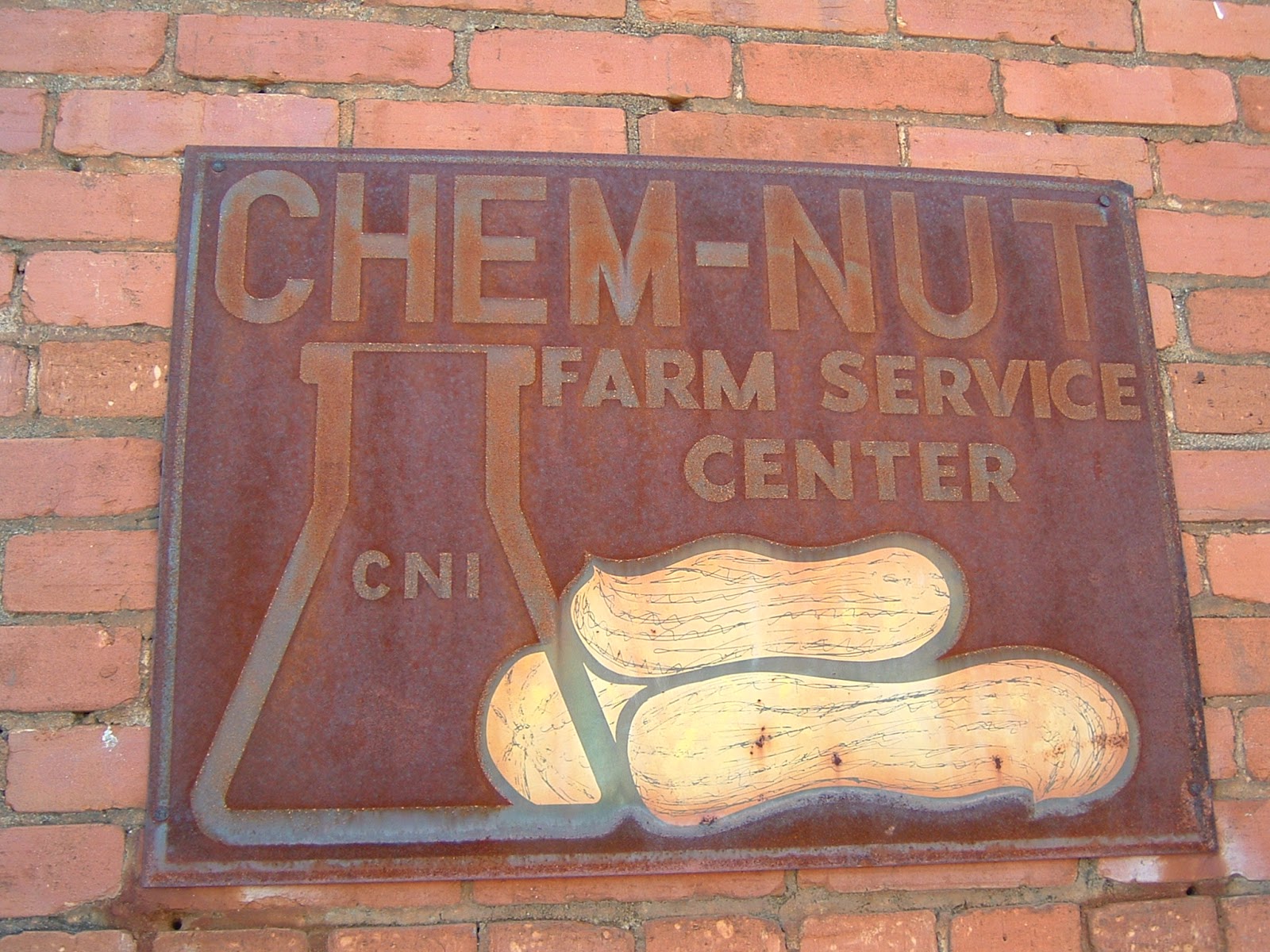
Then we visit the Plains Trading Post and walk around the old peanut warehouses. Red clay soil and red bricks—it all makes sense.

Arcade, downtown Plains

Slightly scary old warehouse sign
Nikki had a little trouble on this first trip, and we were terribly worried that she might not even make it out of Plains. What if she died and we had to bury her there? We took pictures of each other with her, and an obliging policewoman took a picture of all three of us. She was an old dog, but she recovered and lasted another four years, bless her heart!

The old pack pauses on the road
President Carter went to high school in this handsome building, now a museum. I would have loved to watch the first Obama inauguration here!

President Jimmy Carter went to high school here

Old Plains High School Auditorium
A short drive through the countryside from Plains takes us to Archery, the little community that was Jimmy Carter’s boyhood home. Here is the house, which is in my favorite Georgia architectural style.

Old Carter home, Archery
And nearby is the store that Carter’s father ran, the store young Jimmy worked in as a boy.

Old country store at Archery

Inside country store
We’re staying home again this winter, but that’s no reason not to do a little armchair traveling. And for follow-up reading, my book recommendation to go with today’s trip is Carter’s engaging memoir, An Hour Before Daylight. It’s a lovely book to read aloud to someone you love on a snowy, cold, Michigan winter night.

[This is the twelve-hundredth post on Books in Northport.]

Thursday, February 7, 2013

Books That Shaped Our Nation


The intrepid group of reader-friends first formed to read James Joyce’s Ulysses together, the bunch that last year tackled Dante’s entire Divine Comedy, is taking a winter break this year. We are not weary of reading, simply reluctant to take on a new challenge while one of our members is away for four months. Book groups can be like that: each member is integral to discussion, no one expendable. And we are only seven, forged into historical unity through the fire of some difficult books over the three years of our existence.

Four months is a long time, however, so rather than do without each other altogether for the winter, our fearless leader suggested we gather to discuss a list put together by some folks at the Library of Congress. Unlike Modern Library’s top 100 books of the 20th century, books on this list were not necessarily chosen for literary quality but for the impact they had on Americans in their time. Some of the great works read by our Ulysses group (and another group some of us had formed for another, temporary purpose) are on it, such as Moby-Dick and Whitman’s Leaves of Grass. There are also nonfiction works widely read and influential in their time—McGuffey’s Reader, The Kinsey Report on Male Sexuality, Rachel Carson’s Silent Spring, etc. I was very happy that A Tree Grows in Brooklyn is listed. To Kill a Mockingbird is there, as well. You can click here to read more about the exhibit and/or simply scroll through my bare bones presentation of authors and titles below to the rest of my rambling thoughts (following list).


With a list like this two questions naturally spring to mind: (1) Is there anything on the list that you would not have included? (2) What do you think should be here that isn’t?

(Did you find yourself nodding as your eye moved down the screen? Harrumphing as you looked back to confirm, indignantly, the absence of one of your favorites?)

An odd note on the (even) number of works: 88. Why 88? Why not 75 or 99 or 100? It turns out that the books were chosen for a specific exhibit space, so when the space was filled, the list was deemed complete—therefore, is not presented as definitive. Oh! And there’s only one book on it from the new century, which seems fair, as who would want to debate newly published work that may or may not, at some future time, be judged to have shaped the time in which we are now living? But did the Sixties get a fair shake? The Forties? The last years of the 20th century?

Each of us felt the neglect of a different, particular area, depending on our individual interests, and so one member wanted social gospel authors (“Where’s Dorothy Day?”), another more on education (“Where’s John Dewey?”) and politics (The Pentagon Papers). Only one philosophy title had made the list, and while I was happy to see William James there, I’d have thought his Varieties of Religious Experience more widely read and influential than his Pragmatism. (And I definitely agree that the omission of anything by Dewey is shocking and indefensible!)

Here are a few titles and authors we would have added:

Fun With Dick and Jane.
Tom Swift series.
Wilder. Little House on the Prairie.
Updike. Rabbit, Run.
Schumacher. Small is Beautiful.
The Last Whole Earth Catalog.
The Joy of Sex.
Edgar Allan Poe; J. I. Rodale; John Dewey; Dorothy Day; Saul Bellow; Norman Mailer. (We did not choose specific titles for these writers.)
Keller. The Story of My Life.
Halberstam. The Best and the Brightest.
Howard Zinn (various work proposed; my choice was People’s History of the United States).
In the drama category were proposed: “Long Day’s Journey Into Night,” “The Glass Menagerie,” “A Raisin in the Sun,” and “Death of a Salesman.”

What about you? How many on the list have you read? Do you have a candidate from the 19th century that should be on the list? A book to represent the Vietnam era? Like Modern Library’s list for the millenium, this Library of Congress gathering is a good conversation starter. It can also be an inspiration for further reading, which is always good. Other ideas or suggestions?

Tuesday, February 5, 2013

The “Cabin” Is My Refuge


Let's address a major Up North winter issue: cabin fever.
I live in an old farmhouse, not a cabin, but cabin fever is no respecter of architecture. Like the flu, it can invade mansion or hovel or anything in between. Up North people know what I’m talking about.

A couple of lifetimes ago, in Kalamazoo, I went through a winter of impassioned Arctic reading. Couldn’t get enough of that polar stuff. Especially liked books by women in the Arctic. A Woman in the Polar Night (now reprinted) is one title I recall, in which the author lived through the dark winter days with her husband and another man (husband’s coworker or something) in a tiny, tiny cabin. She took seriously the advice that it was important to get outdoors every day but also that she must not fail, under any circumstances, to keep one hand on the cabin wall at all times so as not to lose her sense of direction, get lost, and freeze to death a foot from safety. And so she would leave the shelter of the cabin interior, dressed in her warmest clothes, and make a circuit outdoors, in darkness and stinging wind and snow, clinging to the safety of the walls, every day of the Arctic winter. That was her outdoor exercise and her cabin fever preventative.

The tropical equivalent to cabin fever is island fever. Simple and beautiful and idyllic as life can be in the islands, a non-native visitor can suddenly be overpowered by a desperate need for immediate escape. Lemme outta here! After all, an island is isolated land, and isolation deprives us of sensory and social variety. Iso- is sameness. So not any particular deprivation, such as cold, for example, but deprivation itself is the essence of cabin fever. Feeling trapped.

A friend asked me if I missed Florida this year. (The last time our pack went south for the winter was in 2010.) Not really. I always love being on the road, and our time in Aripeka was creative, but being home this year feels just fine. Not going outdoors with my sketchbook, as I did last year, I still get out with Sarah for little dog-and-mom adventures, very necessary and healthy for both of us. The bookstore is still open four days a week, and on other days we sometimes range as far afield as Traverse City, so no, I don’t feel housebound or trapped.

In fact, what I’m feeling deeply this winter is love and gratitude for my home, for my very specific old farmhouse, for the cold, windswept land surrounding it, the rooms we close off and don’t heat (for the sake of economy), our sheltered central room (no exterior walls) with dining table and fireplace and my yellow leather chair, my tiny Paris kitchen, our tiny bathroom with the beautiful new floor tile I admire daily, the “mouse nest” of a living room with its overflowing bookshelves, comfy pillows, and cozy throws, and the bedroom, where Sarah (who can be a real “bed hog”) joins us at night on a double bed piled high with blankets and pillows. Sometimes, as I did Monday, I stay home all day, and it feels like such a luxury! No one who has never held jobs outside the home could possibly understand! 

More often, David and Sarah and I travel together to Northport to do our errands and tend to our work (studio/gallery and bookstore) and our social lives—and then we come home again, and it feels so good to walk in the door and shed our coats and put the kettle on! “Isn’t it great to be home?” we say to each other every day.

Immune to cabin fever? Like flu, one should never feel too cocky about not coming down with it. Sometimes the fever doesn’t pounce until March, and I’m not saying it can’t happen to me, only that it hasn’t struck yet, and I’m feeling no symptoms. Love my crockpot! Love my rice cooker! Love that big cast iron Dutch oven! Last night’s beef barley soup and biscuits were heaven on the table!

Time to read!!!

Cabin fever? Hardly! Well, not at the moment....

Saturday, February 2, 2013

Bookseller Imagines Groundhog-Asteroid Collision


Groundhog Day, 2013, M-22 

Sometime early in the dark, David looked at his watch and announced, “It’s Groundhog Day,” disturbing my dreams and nudging my sleepy brain in an entirely new direction. A little confused? Judge for yourself--

“Groundhog Day” is one of my favorite movies. I always remember the first time I saw it, and how a few repetitions into the radio alarm scene that wakes Bill Murray up in the morning, over and over, I thought, Okay, okay, enough. But then it went on, the day repeating again and again but never quite the same way, because the visiting TV weatherman remembers the previous Groundhog Days, learns from his experiences, and finally—well, either you’ve seen it or you haven’t. If you haven’t, what are you waiting for? Since that first viewing, every time I’ve seen it again--so many times I’ve lost count: back when we had television and David would be channel-surfing and come upon it, he’d try to hurry past before I could exclaim, “Oh, it’s ‘Groundhog Day!’”--there have been parts I’ve remembered and anticipated and other parts that surprised me all over again. “Oh, I’d forgotten that!” I never get tired of it. In my book, “Groundhog Day” rates 5 stars.

A few evenings ago we watched a very different kind of movie, “Seeking a Friend for the End of the World.” I’d seen the preview (sorry, can’t call it a “trailer,” no matter how ubiquitous that term becomes) and thought it looked interesting. Indeed it was. A quiet, middle-aged insurance agent goes to his office as usual, but nothing else is as usual: traffic is a worse mess than ever before, many people have not shown up for work, and the challenge of selling insurance has never been greater, because—in three weeks an asteroid is due to collide with the earth, bringing about “the end of the world”! He goes home and finds that his wife has left him. Also, a neighbor has gotten his mail by mistake for weeks and not bothered to get it to him until now. In that old mail is a letter from an old girlfriend that closes with, “You were the love of my life.” What else has he to do in the three remaining weeks other than try to reconnect with that old girlfriend? The neighbor, a young Englishwoman, distraught at having missed the last flights out of the country, wants nothing more than to be back home with her family in England. Random, senseless rioting and violence break out at night, friends and strangers engage in orgies, and in one sweet homage scene to “On the Beach,” another end-of-the-world film, families relax by the seaside. It is summer, after all, even if the world is about to end.

In my sleepy, only half-awake state I couldn’t help wondering what kind of movie would result if “Groundhog Day” were combined with “Seeking a Friend for the End of the World.” First I thought that the last day of the world should be Groundhog Day, repeated over and over: because earth’s inhabitants had no hope of another spring, let alone Thanksgiving or Christmas, they would have to celebrate Groundhog Day, even knowing that there would not be six more weeks of anything. And then, of course, they must re-live the last day of the world over and over again. What do you think?

Or else, instead of Groundhog Day being the last day or even a day three weeks from the end, it could be six weeks from the end, six weeks before the asteroid will collide with earth. Would it matter if the six remaining weeks were winter or if there were hope of an early spring? Neither “On the Beach” nor “Seeking a Friend for the End of the World” has the world ending on a snowy winter day, but the last scene of “Seeking a Friend” is one that fits easily into a cold-weather scenario. See it for yourself.

Can you imagine how you would want to spend not only your own last days but the last days of the world? Is it ever too late to learn how to live?


Friday, February 1, 2013

Two Poets of the Earth


David wondered aloud if Jim Harrison and Wendell Berry knew each other, and my initial response was that they would have little in common. Harrison, former long-time Leelanau County resident, has always been given to excessive eating and drinking and to recounting wildness and excess in his novels, whereas Berry’s novels, with their noble and dignified rural characters, seem to come to us from another age. Harrison has lived in several different parts of the United States (Michigan, New York, Arizona, Montana), while Berry is rooted in Kentucky farmland and his small local community. But both men write poetry that tugs at readers’ hearts because it so clearly comes directly out of the poets’ deepest feelings.

Here is a poem from the new Wendell Berry collection:
“A Standing Ground”   
      Flew fro the prees, and dwelle with sothfastnesse; 
     Suffyce unto thy thyng, though hit be smal . . .* 

However just and anxious I have been, 
I will stop and step back 
from the crowd of those who may agree 
with what I say, and be apart. 
There is no earthly promise of life or peace 
but where the roots branch and weave 
their patient silent passages in the dark; 
uprooted, I have been furious without an aim. 
I am not bound for any public place, 
but for ground of my own 
where I have planted vines and orchard trees, 
and in the heat of the day climbed up 
Into the healing shadow of the woods. 
Better than any argument is to rise at dawn 
and pick dew-wet red berries in a cup.
And here, from Harrison’s Songs of Unreason (2011), is one of his:
“Our Anniversary”  

I want to go back to that wretched old farm 
on a cold November morning eating herring 
on the oil tablecloth at daylight, the hard butter 
in slivers and chunks on rye bread, gold-colored 
homemade butter. Fill the woodbox, Jimmy. 
Clots of cream in the coffee, hiss and crackle 
of woodstove. Outside it’s been the hardest freeze 
yet but the heels still break through into the earth. 
A winter farm is dead and you want to head for the woods. 
In the barn the smell of manure and still-green hay 
hit the nose with the milk in the metal pails. 
Grandpa is on the last of seven cows, 
tugging their dicklike udders, a squirt in the mouth 
for the barn cat. My girlfriend loves another 
and at twelve it’s as if all the trees have died. 
Sixty years later seven hummingbirds at the feeder, 
miniature cows in their stanchions sipping liquid sugar, 
we are fifty years together. There are still trees.
Berry, a farmer who comes from farmers, and Harrison, his whole life shaped by camping, fishing, and hunting, both have knowledge and love of nature that only comes from years outdoors. Living in the country, close to the earth, they have first-hand experience with hard physical labor and its satisfactions. Each continues in a long marriage to his first, original, and only wife. Nature, labor, and marriage, then, provide solid ground, fertile soil from which to bring forth poems.

*From Chaucer’s “The Flower and the Leaf”